Showing posts with label Harper. Show all posts

Monday, September 18, 2023

The Harpers, the Other Harpers, and the Other Other Harpers

I thought I would just quickly research Calvin and Mary (Underwood) Harper of the brick house beside the Deep River, and figure out what (if any) relation they had to Ainsworth's other Harpers (Benjamin; Middleton; Robert; and Robert's aunt, Ellen, who married Cyrus E. Smith). I did research them, but it wasn't quick.

So first let me just get the basic facts about Calvin and Mary Harper, who built the brick house.

Calvin was born in Ohio on September 24, 1819, to William and Deborah (Thompson) Harper. William was a native of New York, Deborah of Vermont, but they had moved to Ohio by the time of their marriage in 1818.

Calvin married Mary Underwood in September of 1843, in Ashtabula County, Ohio. Mary had been born in 1822[1] to Harmon and Mary (Mather) Underwood, in New York. The family must have moved to Ohio by the 1840s, although I can't find them in the census. By 1850 Harmon, Mary, and several of their children had gone to Lake County, Illinois.

But their daughter Mary, now a Harper, did not go with them. Here we see her and Calvin, with their only child, Mayvorite, in Ashtabula County, Ohio, in the 1850 Census:

2023-09-18. 1850 Census - Harper, Calvin and Mary
(Click on image to enlarge)
Image from Ancestry.com.


You will note that their neighbors include Harpers and Thompsons, any of whom may have been relatives. The family of Benjamin and Ruth Harper is particularly interesting. Ruth was Mary's sister, who married Benjamin Harper in 1842 (in Ashtabula County). But what was Benjamin to Calvin? — per a family tree I've found on Ancestry.com, Benjamin was Calvin's uncle, but that tree doesn't cite any definitive sources.

In my earlier post about the land now occupied by Southlake Mall, I noted its purchase in October 1852 by Daniel Underwood. He must have been some a relation to Mary (Underwood) Harper — brother, probably, or uncle. According to Early Land Sales, Lake County, in that same month and year, her father, Harmon Underwood, bought at least 160 acres in Ross Township.

Calvin and Mary Harper came to Ross Township in 1850, according to her 1916 obituary;[2] if so, that must have happened after July 1850 when the census was taken. The land they eventually owned was purchased by James Halsted in June 1852. The 1860 Census records Calvin and Mary in Ross Township. While (as we know) early censuses don't give addresses, the Harpers appear as neighbors (on the census, at least) to Carter and Charlotte Castle, who owned land adjacent to James Halsted's 1852 purchase. This suggests that the Harpers were already on their farm on what is now Grand Boulevard, living in a predecessor to the brick house.

In 1868, Mayvorite Harper married Admiral[3] Rodney Castle. He was the son of Lysander and Maria Castle, born in Ohio in 1841 (Indiana Death Certificates). Lysander had died in 1851[4], and his widow married Samuel Lathrop. The 1860 census and the 1874 Plat Map show the Lathrop-Castle blended family as neighbors of the Harpers.

As for Benjamin and Ruth Harper, they were still in Ohio in 1860, but within the decade they also came to Ross Township, where the 1870 Census found them. According to the 1874 Plat Map, they owned a good chunk of land at the tiny village of Hickory Top (later Ainsworth). They probably lived in, and may have built, the house at 6305 Ainsworth Road, built in 1869 per the county records.

The children of Benjamin and Ruth were Mary, Ellen, and Frank.

Ellen married Cyrus Smith in 1861 in Erie County, Pennsylvania;[5] in 1863[6] they moved to the farm in Ross Township where they would settle permanently.

Ellen's brother, Frank Harper, married Ella Hopkins in 1878, here in Lake County, and they had two children: Cassie and Robert. Thus, Robert was Ellen Smith's nephew.


When it comes to Middleton Harper, things get murky. From his obituary and his grave marker, we know he was born in Montgomery County, Indiana, on December 10, 1850. Per his death certificate, his father was John Harper, born in Tippecanoe County, Indiana, and his mother was Sarah Frazier, born in "East Tenn." or maybe "East Penn."

Middleton first appears as a nine-year-old boy in the 1860 Census of Tippecanoe County. The household consists of his grandfather (I'm guessing), Middleton, born circa 1795 in Maryland, and his 27-year-old mother, who is described as widowed. (She has several children besides Middleton, and there is a 21-year-old William who may be her brother-in-law.)

The next glimpse I catch of Middleton Harper is not the 1870 Census — I can't find him in it — but the Indiana Marriage Collection, which shows him in Lake County, Indiana, marrying Anna Goodrich in 1872. You'd expect to find them in the 1880 Census, but you'd be disappointed.

We do find Anna Harper in the 1900 Census. By then she was widowed. We also find her in 1910 and 1920, living with her married daughters.

But that doesn't help us figure out if Middleton Harper was any relation to all these other Harpers. I just don't know.

♦    ♦    ♦

All of this was put together with online sources. If I ever get the time to go through microfilm and other offline sources, I may find out more.


_______________
[1] Indiana Death Certificates.
[2] "Descendant of Cotton Mather Dies at Miller," Porter County Vidette (Valparaiso, Ind.), 19 Apr. 1916.
[3] Yes, that was his given first name.
[4] He is buried on the south bank of the Deep River west of State Road 51; according to legend (as noted in the NWIGS's Ross Township Cemeteries), at the time of his funeral and even after two days' wait, the river was too swollen to carry his coffin across to the cemetery up the road in Hobart Township.
[5] This is according to his obituary ("Death of a Ross Township Citizen," Hobart Gazette, 8 Oct. 1915); I can't find a record of their marriage on Ancestry.com. I do wonder if this means that Ellen's family spent some time in Pennsylvania, between the time they left Ohio and the time they came to Indiana.
[6] Also from Cyrus' obituary.

Thursday, September 7, 2023

The Harper-Carlson-Grabowski-Pike House

I came across this article, in the Hobart Herald of September 9, 1954, summarizing the history of the house at 6430 Grand Boulevard.

2023-09-07. 1954-09-09 Hobart Herald, Old Hobart Houses (Pike house) 01
(Click on images to enlarge)

2023-09-07. 1954-09-09 Hobart Herald, Old Hobart Houses (Pike house) 02

According to the county records (which tend to be imprecise when you get back into the 19th century), the house was built in 1879: a date not inconsistent with this article. I am so curious to know what the author was told that led her to say that the house was built "sometime after 1863" — not that I doubt it; I'm just curious. I'm guessing she talked with old-timers to get this information.

The article doesn't mention William Blumenthal's brief ownership, but of course he was a mere passer-by, wasn't he?

Considering that the Grabowskis' addition to the house was begun in 1923, it's possible the old timers' memories were not serving them well if they thought it hadn't been completed yet by 1930.

The "Verne Manteuff" whose identification of a shoe is said to have been so important after the accident that killed the Grabowskis was LaVerne Manteuffel.

I want to get into more detail about some of the people mentioned in this article, and I will do that in future posts.


By the way, the photo at the top of my second image above doesn't relate to the house, but to a monument I posted about 'way back in 2010, which (according to the program John Dorman had printed up) was erected in 1931.

Wednesday, June 27, 2018

Burning Crosses

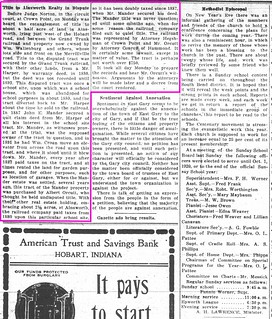
Several nights in early May 1923 were lit up with burning crosses in Ainsworth, Hobart, and East Gary (Lake Station).

2018-6-27. Burning Crosses
(Click on image to enlarge)
"Local and Personal," Hobart News, May 10, 1923.


Since the Klan parade three months earlier had featured a burning cross, the writer probably understood the association. But we don't know if any of these displays were aimed at anyone in particular. (Henry Paulus, many years later, recalled a cross being burned on his lawn in 1924.)

♦    ♦    ♦

Above that item we find a description of a pretty nasty wreck that fortunately did not injure Ainsworth's Robert Harper.

Sunday, February 12, 2017

A Chopping Bee

In December 1922, the men of the South of Deepriver neighborhood got together and held a "chopping bee" to supply Jim Jeffrey with stove wood for the winter — as Jim was in no condition to chop wood for himself, with a twice-broken leg.

2017-2-12. South of Deepriver
(Click on image to enlarge)
Hobart News 21 Dec. 1922.


I've paid so little attention to the Prescott family that I had to go look them up to remind myself that Mrs. John Prescott was born Carrie Sturtevant.


Over in the left-hand column, the Central Drug Store in downtown Hobart was selling popular recordings. I've never heard of either "Indiana Lullaby" or "Three O'Clock in the Morning" before. I guess I need to get out more.

Monday, August 17, 2015

South of Deep River

First of all, I think that the reference to "Mrs. Carl Harper" as the secretary of the League of Women Voters' Ainsworth chapter was the newspaper's mistake for Pearl Harper, aka Mrs. Robert Harper. In the April 6, 1922 issue of the Hobart News, we find her placing a "Notice to Women Voters of Ainsworth" to announce a meeting at Lena Hunter's house, and signing herself as Secretary. Mystery solved.

Now, on to the social news from the countryside south of Deep River:

2015-8-17. South of Deepriver
(Click on image to enlarge)
Hobart News 6 Apr. 1922.


I suppose M.J. Guernsey was Melvin Guernsey, son of D.L. (David) and Stella Guernsey.

I'm having a little trouble identifying this newcomer, John Arnson. I suspect that the un-Americanized version of his name was Anders Johan Aronson, and the land he bought was in Union Township, Porter County, near Huffman's mill.

2015-8-17. Aronson 1928
(Click on image to enlarge)
Union Township plat map, 1928, from http://www.inportercounty.org/Data/Maps/1928Plats/Union-1928.jpg, courtesy of Steven R. Shook.


If I've identified him correctly, he was born in Sweden circa 1868, came to the U.S. circa 1886, and married Cora Burge on August 17, 1910. I suppose she was related to the Burges, a large family that went back to the 1830s locally, but I can't identify her precisely. As far as I can tell, John and Cora had no children. She died in 1939, he in 1944.


Additional Sources:
♦ 1920 Census.
♦ "Hold Rites for Mrs. Aronson." Vidette-Messenger (Valparaiso), 26 May 1939.
♦ Indiana Marriage Collection.
♦ "Johan Aronson, Age 74, Dies Sunday Night." Vidette-Messenger (Valparaiso), 21 Aug. 1944.

Thursday, July 30, 2015

Frederick Doepping

Frederick Doepping was an "aged Ainsworth citizen" when he died in March 1922.

2015-7-30. Obit of Frederick Doepping
(Click on image to enlarge)
Hobart News 23 March 1922.


Per my own imaginative reading of the 1920 Census, I'm guessing Frederick and Mary occupied one of those little houses on the west side of Grand Blvd./S.R. 51 just north of the Canadian National tracks, either of which is old enough to accommodate them. But that's just a guess.

I am a bit confused about the Doepping family. According to the obituary, Frederick had no daughters (if a daughter had died before him, you'd still expect her to be mentioned). And yet the 1900 Census shows Frederick and Mary sheltering under their roof a schoolboy of 13 named Henry Kastner, described as their grandson. With only two sons, how did they get a grandson with a different surname? Or is that just a mistake by the census enumerator?

You may have noticed some mention in this blog of a Reinhart Doepping, most notably in connection with tree-related crime. I'm beginning to suspect that "Reinhart" was the newspaper's mistake for "Rheinholdt." It appears that the enumerator of the 1900 Census made the same mistake, while the 1910, 1920, 1930 and 1940 Census got the name more or less right.

Rheinholdt/Reinhart had a son named Richard Doepping (and I've encountered more than one reference in the newspapers to "R. Doepping," which isn't illuminating). In January 1919, Richard Doepping bought a farm belonging to Chester Guernsey — exact location unknown, but my guess is that it was somewhere close to the Ross-Winfield Township line and the Lake-Porter County line. ("South of Deepriver," Hobart News 23 Jan. 1919.)

The other son, Emil, is elusive. He may be the Emil Doepping born Dec. 24, 1880, who married a woman named Bertha between 1910 and 1920 (though I can't find the record of their marriage). But in that case, the official records would seem to place him in Chicago, not south of Ainsworth.

This is where I stop trying to figure out the Doeppings.

♦    ♦    ♦

Moving on to the items in the "Local and Personal" column, Mrs. Mike Foreman was married to a man who liked to confuse historians by going by Michael, Mike, or Helmuth, as his fancy took him. She had been born Mary Mau (Indiana Marriage Collection).

James Jeffrey had indeed bought some Guernsey land, but I wouldn't describe it as being near the old Deepriver schoolhouse.

Elizabeth Fredrick was my favorite census enumerator; Sadie Baker helped her husband, William, run their general store in Deep River. I have no idea who Mrs. Carl Harper was. Mrs. Lulu Crisman was married to Thomas, who was a son of John and Elizabeth (Small) Crisman of Porter County … which would, I think, make him a brother of John Crisman of Deep River.

And, of course, we all know the Raschkas and the Shearers.

Saturday, July 25, 2015

The Vote of the Ladies Is Respectfully Solicited

Several acquaintances were running in the primary election in the spring of 1922, and every candidate was asking for the vote of the recently enfranchised women. Earnest Walter was the father of the Walter Bros. Robert Harper lived near Ainsworth and, last I heard (1917), served as its marshal. John Harms lived on Cleveland Avenue and was part of the large Harms family that populates this blog.

2015-7-25. Harper et al. running in primary
(Click on image to enlarge)
Hobart News 23 March 1922.


The "Local and Personal" column is crammed with people we know. The John Crisman, Jr. with rheumatism may be Dorothea's father … or perhaps her 16-year-old brother. Earl Blachly and his second wife, née Annie Witt, had recently shed all their farming-related possessions. Mrs. William Killigrew and Mrs. Dwight Mackey had grown up east of Ainsworth as Etta and Ruth Bullock. And apparently Otto and Lesta (Raschka) Maicke have moved back to Ainsworth, after living in Hobart for some time.

Saturday, March 7, 2015

Ross Township Trustee's Report, 1921

2015-3-7. Ross Twp. Trustee's Report for 1921
(Click on image to enlarge)
Hobart Gazette 13 Jan. 1922.


So many of our acquaintances here, I can't index them all. Gus Lindborg was still the go-to man for bus repairs, among other things. Bus drivers included C.S. Guernsey, Paul Fredrick, William Springman, John Miller, and Thomas Sullivan. Schoolteachers included Elsie Gruel, Olive Wood, and Evelyn Fredrick (Paul's daughter). Charles Goldman sold unspecified merchandise to the township. Robert Harper provided "advisory service." And under "Road Fund Disbursements," many familiar names.

Tuesday, February 3, 2015

Entertainments at the Ainsworth School

2015-2-3. Entertainments at W.G. Haan school
(Click on image to enlarge)
Hobart News 1 Dec. 1921.


I don't know the reason for this Thanksgiving-evening banquet in the W.G. Haan School, nor do I know the topics of those "talks." The first talker I can only tentatively identify as George B. Argo, whom I haven't mentioned yet in this blog. Born in Iowa circa 1884, George shows up in my notes as early as 1912, when apparently he was the Grand Trunk agent at the Ainsworth depot. He pops up now and then through June 1913, after which he disappears; that may have been when he was transferred to the Grand Trunk station at Capac, Michigan, where the official records place him in 1918 and 1920. But now he's back in the area — where, exactly, I don't know; perhaps he's in Hobart, where the 1930 census will record him. Anyway, if George had anything to do with the February 1921 community entertainments and the "Argo orchestra," he must have been something of a live wire.

The other two talkers at the November 1921 banquet were, I'm guessing, Robert Harper (a local dairy farmer and one-time marshal of Ainsworth), and Albion Paine (another local dairy farmer, and father of Alice ).

After the talking, there was dancing.

♦    ♦    ♦

I have not been able to find a script for that 2.5-hour play, The Country Minister, which may be a mercy. But the performance was intended to raise money for a good cause — the purchase of equipment for the school — and in fact it was well attended, and judged "a big success."


Additional Sources:
♦ 1920 Census.
♦ 1930 Census.
♦ "Additional Local News." Hobart Gazette 2 Dec. 1921.
♦ "Ainsworth Notes." Hobart News 26 June 1913.
♦ "Local and Personal." Hobart News 15 Dec. 1921.
♦ "Local Drifts." Hobart Gazette 2 Dec. 1921.
♦ "Ross Township Notes." Hobart Gazette 21 June 1912.
♦ WWI Draft Cards.

Monday, January 20, 2014

Ellen's 78th Birthday

It's a collection of Ainsworth old-timers, as two Chester sisters — Carrie Raschka and Lovisa Nelson — visit Mrs. C.E. Smith, née Ellen Harper. Carrie and Lovisa must have known Ellen from their childhood, as she and her husband Cyrus were already their neighbors when they came into the world.

Mrs. C.E. Smith; John Harms move
(Click on image to enlarge)
From the Hobart News of 3 Mar. 1921.


Also, it's the farm-moving season, and John and Sophia Harms, with their two children, at last are occupying the land they bought in August 1919.

Saturday, July 20, 2013

Marriages and Other Transitions

Two young people with Ainsworth connections; two marriages.

After the coal-gas incident in 1917, William Gernenz was lucky to have a life to pledge to his bride in September 1920.

And Mildred Blachly had grown up on a farm near Ainsworth, a descendant of local farming families. Her grandparents were (the late) Morgan and Amelia Blachly, her parents Walter and Eva (Harper) Blachly.

Gernenz-Wesley; Kostbade-Blachly
(Click on image to enlarge)

In spite of Anna Wesley's family being "well known people residing south of Ainsworth," I have not seen fit to mention them yet in the blog. I don't even have much on them in my notes. Let us hope this is because they lived quietly happy lives, not because I missed something juicy. It does appear that Anna's father, John, had lost his first wife (name unknown). In 1898 he married the 20-year-old Ida Sonntag, who became stepmother to John's three boys, the oldest of whom was about 13. Ida went on to bear him two daughters, Anna and Theresia. The Wesley land lay mostly at the intersection of (present-day) E. 83rd Ave. and Randolph Street — 40 acres on the northwest corner and 30 acres on the southeast corner, with another 20-acre parcel further south on Randolph. (Anna's oldest half-brother, Edward, had married Martha Sonntag's sister, Selma, in 1906.)

And so the newlywed Gernenzes settled down to farming near Ainsworth, and the young Kostbades took up residence in Valparaiso, washing their hands of both farming and Ainsworth.

♦    ♦    ♦

Another kind of transition — from life to death, or from death to life, by Frances Springman Schavey, without whom there would have been no Schavey envelope.

Frances Schavey obit

This obituary from the Gazette is a little confused — it was six sons and two daughters who survived her. [7/26/2013 update: more than a little confused, as it got her parents wrong too. Correction here.]

♦    ♦    ♦

Lastly, a mundane sort of transition: Amelia and May Blachly moved, yet again.

Amelia and May Blachly move again
(Click on image to enlarge)

The Gazette described Amelia's new house as "opposite the Hobart Lumber Co." (which was on the west side of Main, where the "lumber" part of Hobart Lumber is now). Two weeks early, Amelia had sold her home on Fourth Street, described as the former A.C. Thompson house, to one John Walsh.

Also note the item that mentions a couple of Dr. Clara Faulkner's relations by marriage. But Dr. Clara wasn't married anymore — not if I'm reading the 1920 census correctly. Sometime after the 1910 census, her husband, Samuel, vanished. I can't find him anywhere. I was hoping to see something in the local newspapers about the divorce (or death, if not divorce), but I haven't; either I missed it, or the incident was treated with unusual discretion.


Sources:
♦ 1891 Plat Book.
♦ 1908 Plat Map.
♦ 1910 Census.
♦ 1920 Census.
♦ "Gernenz-Wesley." Hobart News 30 Sept. 1920.
♦ "Hobart Boy Marries." Hobart Gazette 1 Oct. 1920.
♦ Indiana Marriage Collection.
♦ "Kostbade-Blachly." Hobart News 30 Sept. 1920.
♦ "Local and Personal." Hobart News 16 Sept. 1920; 30 Sept. 1920.
♦ "Local Drifts." Hobart Gazette 26 Oct. 1906; 8 Oct. 1920.
♦ "Mrs. Schavey Dies in Chicago." Hobart Gazette 1 Oct. 1920.

Friday, March 1, 2013

Ross Township Graduates

There are several familiar names among the Ross Township graduates — and this was graduation from the eighth grade, not high school; none of these schools (save Merrillville, mentioned at the end of the article) had high-school classes, and a brief check on some of these children shows them in the age range of 12 to 14 years.

This article predicted that the new Ainsworth school would be ready for the next school year, which I suppose means the autumn of 1920.

Ross Township graduates
(Click on image to enlarge)

You will also notice Charles Goldman's ad, at right.

Here's another ad, in case you were wondering who the local sellers of United States Tires were:

U.S. Tires ad


Sources:
♦ 1920 Census.
♦ Advertisement. Hobart Gazette 21 May 1920.
♦ "Ross Township Schools." Hobart Gazette 21 May 1920.

Monday, February 18, 2013

Twenty Years to the Day

Twenty years to the day after her husband died, Anna Harper went to join him. She had been a resident of Ross Township for at least half a century, yet her passing prompted only this brief mention in one of the Hobart papers.

Anna Harper death notice
(Click on image to enlarge)

Anna had been born a Goodrich, so the two brothers were Levi and Charles; she married Middleton Harper in 1872. The home "near Merrillville" where she died was, I believe, the farm of her daughter Eva and son-in-law Walter, on the south side of 73rd Avenue west of Ainsworth — part of the old Morgan Blachly land. The land that had once been known as the "Mid Harper farm" was now the Sizelove farm.

Harper, Mid and Annie
(Click on image to enlarge)

I had to go back and look at the 1900 microfilm to find out what kind of a write-up Middleton Harper got upon his death. It was more than Anna had:
Middleton Harper, a farmer near the Adam's school house in Ross township, died Sunday evening, May 6th, 1900, aged 49 years 4 months and 25 days. The deceased was born in Montgomery Co, Ind., but for the last thirty years had been a resident of Lake county. During recent years he had become very fleshy, so much so that he weighed over three hundred pounds, and as a result he became afflicted with fatty degeneration of the heart. The funeral service conducted by Rev. J.L. Greenway took place at the church in Merrillville on Tuesday, a large number of friends being present. The deceased was a good neighbor and was respected by all who knew him. He leaves a mother, wife and three daughters, also two brothers and one sister.

There is no Death! What seems so is transition;
This life of mortal breath
Is but a suburb of the life elysian,
Whose portal we call Death.

And though at times impetuous with emotion
And anguish long suppressed,
The swelling heart heaves moaning like the ocean,
That cannot be at rest,—

We will be patient, and assuage the feeling
We may not wholly stay;
By silence sanctifying, not concealing,
The grief that must have way.
The poetry is an excerpt from Henry Wadsworth Longfellow's "Resignation." I shall have to wait until I retire from blogging and have some free time so I can go and check the Crown Point newspapers of 1920, before I make any remarks about Anna's family not being able to find any poetry for her.


Sources:
♦ 1870 Census.
♦ 1920 Census.
♦ Indiana Marriage Collection.
♦ Indiana WPA Death Records Index.
♦ "Local and Personal." Hobart News 6 May 1920.
♦ "Obituary." Hobart Gazette 11 May 1900.

Monday, October 29, 2012

Big Fight Over a Little Land

It was only a half acre, but someone thought it was worth fighting over.

Land dispute
(Click on image to enlarge)
From the Hobart Gazette of Jan. 2, 1920.


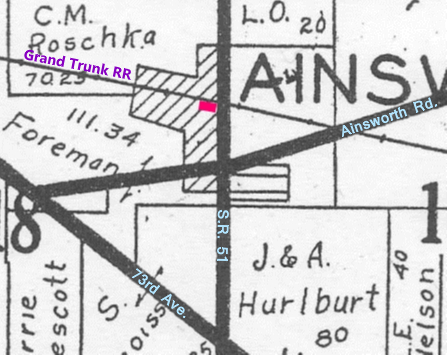
This excerpt from the 1926 Plat Book shows approximately where the little parcel was located (the red rectangle):

Disputed land

Well, that's right in the heart of the Ainsworth business district! Location, location, location!

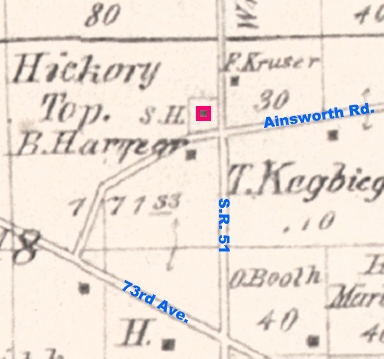
The one bit of information I found surprising in this article is that there was once a schoolhouse on that land, and that it was abandoned, not moved. Actually, this is not inconsistent with the 1874 Plat Map (schoolhouse marked in red):

Schoolhouse 1874

But the little frame building generally considered Ainsworth's first school stood further west along Ainsworth Road.

Sunday, August 26, 2012

Another Long-Timer Gone

William Smith had lived 54 of his 72 years in Ross Township, and aside from a couple years' residence in Hobart, had left only for brief visits to family and friends. In October 1919 he left forever.

William Smith obituary
(Click on image to enlarge)

William had been quieter than his older brother, it seems; his name rarely appeared in the newspapers except in connection with visits and bereavements. His only daughter, Mabel, and her husband Frank owned a farm well south of Ainsworth. William's four surviving grandchildren were Lynne, Helen, Glen and Ruth, the oldest being about 14 and the youngest an infant.

William was buried in Crown Hill Cemetery with both his wives.

Smith, William

Smith, Carlie

Smith, Cassie

The first wife, Cassie, had originally (in 1877) been buried somewhere else — I don't know where. About two months after the second Mrs. Smith died (November 1908) and was buried in Crown Hill Cemetery, the first Mrs. Smith was removed from her first grave and reburied in the cemetery where lay her successor … and also her grandson; but whether that made any difference to her, I cannot say.


Sources:
♦ 1920 Census.
♦ "Death of a Ross Township Citizen." Hobart Gazette 10 Oct. 1919.
♦ "Local Drifts." Hobart Gazette 6 Nov. 1908; 22 Jan. 1909.
♦ "South of Deepriver." Hobart News 9 Oct. 1919.

Sunday, July 29, 2012

Ainsworth Items

Back in July 1919 the News ran one Ross Township column — now it's August and we have one actual Ainsworth column!

Ainsworth Items
(Click on image to enlarge)
From the Hobart News of August 28, 1919.


The excerpt from the 1926 Plat Book below shows (my best guesses at) a few of the locations mentioned in the column. At left, the Raschka land rented by Charles Henrichs; at center, Lovisa Nelson's 40 acres bought by Jacob Hurlburt (don't ask me why the 1926 Plat Book shows them still in Lovisa's name); at right, the James Chester land rented by William Shults, and just to the left of that land, the green dot shows approximately where Herman Harms was building his new silo.

Ainsworth column land (Aug. 1919)
(Click on image to enlarge)

Wednesday, July 25, 2012

Yet More Land Changing Hands

When Swan Peter Carlson died in 1919, he had been a Hobart resident for five years but still owned a farm in Ross Township.

As we learned from his obituary, Swan had settled on the "Harper homestead" when he moved to Indiana from Chicago in 1890. The 1874 plat map shows us 80 acres in Ross Township belonging to a C. Harper (possibly Calvin), and the 1908 plat map shows those same 80 acres owned by "S.P. & H. Carlson" — Swan Peter and (I believe) his wife, Hedvig (or "Hadwick," per the 1910 census).

Harper-Carlson 1908
(Click on image to enlarge)

Late in August 1919, their daughter, Augusta Koehler, "traded her home and twenty acres on the Ainsworth road for a residence in Chicago," according to the News ("the Ainsworth road" being known now as Grand Boulevard, or State Road 51). It is not clear to me whether those 20 acres were all that was left of the old homestead, or whether that was only Augusta's share, the remainder being divided among her brothers. The buyer of the 20 acres was one "Wm. Blumenthal of Chicago."

I gather that Mr. Blumenthal was an acquaintance of John Dorman and intended to be an absentee landlord, as we find John Dorman, in the September 5 Gazette, offering for rent "the Carlson 20-acre farm 1½ miles south of Hobart."


Sources:
♦ 1870 Census.
♦ 1874 Plat Map.
♦ 1880 Census.
♦ 1891 Plat Book.
♦ 1908 Plat Map.
♦ 1910 Census.
♦ 1920 Census.
♦ "All Kinds of Wants." Hobart Gazette 5 Sept. 1919.
♦ "Local and Personal." Hobart News 4 Sept. 1919.
♦ "Local Drifts." Hobart Gazette 29 Aug. 1919.

Tuesday, May 1, 2012

In Milk We Trust

The dairy farmers surrounding Chicago had scarcely begun marketing their own products through the Milk Producers' Co-operating Marketing Co. when the federal government began investigating them. The Gazette reported in mid-April:
A thousand or more dealers, farmers and brokers will be summoned before a federal grand jury. It is alleged that the "milk trust" has complete control of milk and butter in the dairy district surrounding Chicago, in violation of the Sherman anti-trust law. Federal officers have had this matter under investigation for some time, and some farmers from this locality have been quizzed.
Secretaries of local branches of the Milk Producers' Association were ordered to bring their books and records to Chicago and turn them over to the grand jury. Locally, those summoned included George Lutz of Hobart, Robert Harper of Ainsworth, Walter Demmon of Merrillville, and L.F. Bay of Gary.

The details of the investigation were not reported in the Hobart papers, but evidently it resulted in the indictment of eight officials of the Milk Producers' Association. Although the case was ready to be heard in June 1919, it was postponed, apparently on the grounds that "keeping a jury locked up for the summer months" during what promised to be a "long drawn out" trial would be inhumane.

♦    ♦    ♦

In somewhat-related news,* the Lake County Commissioners announced in April that they had selected and purchased a site for the county's planned tuberculosis sanatorium — a spread of nearly 80 acres known as the J. Frank Meeker farm, in southern Ross Township about two miles north of Crown Point, and conveniently near a trolley line running to that town. The commissioners had $100,000 to work with, consisting of funds from the sale of bonds. The land cost about $13,000. The remainder would be used for buildings and fixtures.

Tuberculosis Sanatorium site
(Click on image to enlarge)
This excerpt from the 1926 Plat Book shows what I believe to be the land purchased in 1919 by the Board of Commissioner's for Lake County's tuberculosis sanatorium. This land is now the site of the Lake County Government Center.


_____________________
*As we know, there is a link between dairy cows and tuberculosis in humans.


Sources:
♦ "County Commissioners Purchase Sanitarium Site." Hobart News 24 Apr. 1919.
♦ "Government to Probe Milk Trust." Hobart Gazette 18 Apr. 1919.
♦ "Indiana Milk Shippers Summoned Before Federal Authorities." Hobart News 24 Apr. 1919.
♦ "Local Drifts." Hobart Gazette 20 June 1919.

Tuesday, April 19, 2011

Now That His Cows Are Safe…

We've seen Rollie Sizelove sell off all his cows to keep them from being killed by the trains passing across the farm he rented. Now that his cows are all safe with Charles Chester, he goes and buys a farm that is untouched by railroads.

(I just had to go back to that cow post and fix his name. I thought it was "Raleigh" because that's how census-taker in 1910 spelled it, and I haven't been able to find any other census record of him. The newspapers refer to him as "R.D.," or sometimes "Rollie." Now I finally track down his World War I draft registration card, and find out that "R.D." stood for "Roland Dolphus" — no wonder he used his initials.)

I don't know much about the Sizeloves. Rollie came from some unknown location (possibly Grant County, Indiana) to marry Hattie Maybaum in April 1907. In December of that year Hattie bore a daughter, name unknown. No children are listed in the 1910 census, so I suppose their little daughter did not live long.

That loss aside, their life seems to have been peaceful and pleasant. They were a fairly sociable couple, with a large extended family to visit. Twice during the winter of 1910, Rollie won a prize for the handsomest costume at a masquerade ball, one in Ainsworth, one in Deep River. In 1911, about 30 friends threw a surprise party for them at their own home, and spent several hours playing cards and dining. That home of theirs was well south of Ainsworth, as for some years they rented all or part of the Sela A. Smith farm.

In mid-February of 1918, the Sizeloves finally purchased their own land: a 60-acre parcel known as the Mid Harper farm. It had been owned by Middleton Harper at least since 1891. Since early 1901 Walter Blachly had rented it. Walter may have eventually bought it, but the report of the sale to the Sizeloves doesn't name the seller. Whoever it was, he or she got $7,000 from Rollie and Hattie.

They expected to stay in their rented home on the Smith farm until the first of March, but Rollie immediately set about building a new barn on their very own farm.

SizelovelandSmithfarm
(Click on image to enlarge)
This image from the 1926 Plat Book shows the Sizeloves' new farm outlined in green, and the Sela Smith farm, which they had been renting, outlined in red.


Sources:
♦ 1891 Plat Book.
♦ 1900 Census.
♦ 1910 Census.
♦ 1926 Plat Book.
♦ "Ainsworth." Hobart News 9 Nov. 1911; 26 June 1913.
♦ "Deepriver Items." Hobart Gazette 11 June 1909.
♦ "General News Items." Hobart Gazette 7 Dec. 1900; 20 Dec. 1907.
♦ "General News." Hobart Gazette 15 Feb. 1918.
♦ Indiana Marriage Collection.
♦ "Local Drifts." Hobart Gazette 14 Jan. 1910; 4 Feb. 1910; 3 Mar. 1911; 25 May 1917.
♦ "Ross Township." Hobart News 2 Jan. 1913.
♦ WWI Draft Cards.

Friday, January 14, 2011

Marshal Robert Harper

And suddenly, out of blue, I find out that Ainsworth had a marshal! It would have been nice if someone had bothered to report on his election.

The only reason I know about this at all is because the Hobart News mentioned that "Marshal Robert Harper of Ainsworth" caught a couple of car thieves the night of May 29, 1917. Four men had stolen a "large Hudson car"; they ran it into a ditch west of Ainsworth; someone notified Robert; he came out and caught two of the men, and hauled them off to jail in Crown Point. (A third man was captured in Merrillville. The fourth got away.)

1917HudsonSuperSix
A 1917 Hudson automobile, which may or may not have been the model stolen by the thieves. (Click on image to enlarge)
Image credit: IMCDB.org.


Robert was then about 34, Pearl 38, and they had four children. (The oldest was 14 and so could not have been born of their 1911 marriage. I don't know what her story was.) With the help of one hired man, the Harpers operated a dairy farm on rented land.


Sources:
♦ 1920 Census.
♦ Untitled social column. Hobart News 31 May 1917.