Showing posts with label Stommel. Show all posts

Tuesday, November 15, 2022

"No Athletes, No Musicians!"

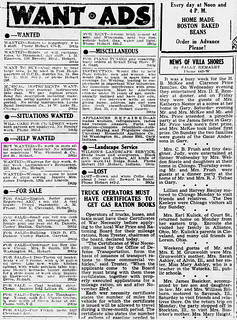
This Help Wanted ad appeared in the Hobart Gazette of November 11, 1942.

2022-11-15. 1942-11-12 Gazette, Want Ads
(Click on image to enlarge)

Is that the voice of Carl Krausse I hear, echoing down the years?


Further down the same column, we find an ad placed by Claude Groom of Ainsworth (or thereabouts). A few years ago someone mentioned him to me and I had to admit I did not know the first thing about him. Well, now I know the first thing about him: he sold milk-fed turkeys.

At the top of the middle column, we learn that in Hobart in 1942 you could still rent a house with an outdoor toilet, if you wanted to. On that note, do historians of Hobart (like historians of Munster, where I grew up) know the location of the last outdoor toilet in town?

Friday, January 18, 2019

Hot Weather

The last two weeks of June 1923 were so hot that the strawberry crop withered and the M.E. church held its services in the basement. The Gem Theatre in Hobart enticed its patrons with "12 big fans" to cool them off. (The movies had not yet become the talkies so there was no spoken dialogue to be drowned out by those fans.) When sundown brought a little relief, you could go dancing at the pavilion just north of the old Liverpool schoolhouse, on the northeast corner of the Old Ridge Road-Liverpool Road intersection. The brave young people playing tennis on Stommel's lot did so early in the morning or late in the afternoon, I hope.

Nothing much was planned in Hobart for Independence Day, but on its eve Camp 133 promised a big fireworks display. If you didn't care for fireworks, you could go dance at the old Deepriver schoolhouse to music "with real pep" played by Perry's Big Six (I have no idea).

2019-01-18. Lee, Gazette, 6-29-1923
(Click on image to enlarge)
Hobart Gazette, June 29, 1923.


Still, work had to go on. Planning for the future Roosevelt Gym building was going forward, and our favorite plumbers, Lee & Rhodes, as the only bidders for the plumbing work, were awarded the contract.

Some unpleasant business involving tuberculosis-testing of cattle occurred on "the big farm of Roper Bros." (and even more unpleasant business later at a Chicago slaughterhouse). I don't know where that farm was. I can't find any land owned by a Roper in Union Township on the Lincoln Highway in the 1921 or 1928 plat maps.

Wednesday, December 17, 2014

The Unpleasantness with the Prohibition Officer

On an October afternoon in 1921, two prominent Hobart citizens mistakenly got into a car chase with a federal Prohibition officer.

2014-12-17. Prohibition officer
(Click on image to enlarge)Hobart Gazette 12 Oct. 1921.*

The story suggests that the officer's car had no markings that would have made it identifiable as such. From what I've read about the early federal Prohibition enforcement effort, I gather it was grossly understaffed, with the officers poorly paid, often untrained and ill equipped.

Above that story, we have the news of the death of William Krausse (father of Carl), who had a more interesting life than I suspected.

♦    ♦    ♦

The "Local and Personal" column of the Hobart News of October 13, 1921, included this item:
O. Amlong and family have moved to the Chester Cooper residence on Lake street and Mr. and Mrs. Otto Maicke of Ainsworth have moved to the Humes flat vacated by Mr. and Mrs. Amlong.
… which leaves me knowing very little except that Ainsworth had lost its Maickes.

___________________________
*This issue of the Gazette is erroneously dated "Friday, Oct. 12, 1921." Friday was the usual day for the Gazette to come out, but that week's Friday fell on the 14th.

Friday, June 20, 2014

The Camp Ground in McAfee's Woods

Since January 1921 the Hobart Commercial Club had been working with Paul Newman, trailsman, to develop a camping ground near Hobart for tourists on the Yellowstone Trail. At a Commercial Club meeting in March, the camping-ground committee reported on its progress: it had entered negotiations with William McAfee to rent four acres of his "7-acre wood lot east of town"; it had planned what improvements would be built and roughly how much those improvements would cost (about $250, to be raised by subscription); it had already received donations of over $100.

I do not know exactly where these four acres were. William McAfee had owned land along the south side of Cleveland Avenue, east of town, for many years (indeed, his parents had owned land there at least since the 1870s), but it's in different places per the 1908 Plat Map …

2014-6-20. W. McAfee 1908
(Click on images to enlarge)

…and the 1926 Plat Book.

2014-6-20. W. McAfee 1926

Nor can I see anything recognizable as a camping ground in the 1939 aerial photos, though we do see what looks like a wooded tract on the southeast corner of Cleveland and S.R. 51. But it's a long time between 1921 and 1939, and the camping ground may not have been in existence by then, even if it could be identified from the air.


Anyway, work went forward during the spring of 1921, and by the end of April, the camping ground was nearly completed.

2014-6-20. Camping ground

The Commercial Club had exceeded its own goal in raising money. So many local individuals and businesses had contributed that I can't index them all. The Kulage Brick Works even donated bricks.

2014-6-20. Report


Sources:
♦ "Commercial Club Holds Good Meeting." Hobart Gazette 11 Mar. 1921.
♦ "Report on Tourists' Camp Ground." Hobart News 19 May 1921.
♦ "Tourists' Camp Ground About Ready." Hobart Gazette 29 Apr. 1921.

Friday, December 14, 2012

Embarrassment at the Bank

Hobart Bank ad
This ad appeared in Hobart High School's Aurora yearbook for 1919.
Image courtesy of the Hobart Historical Society.


It was an ordinary business morning — Wednesday, January 25, 1920 — and in the Hobart Bank, cashier William Killigrew and assistant cashier Deering Melin were going about their ordinary business when an official from the state banking department walked in and told them to close their doors and suspend all business. The bank was under investigation.

The news came as a shock to the two men, as they had no reason to think anything was wrong. The state official explained that the Farmers' State Bank of Valparaiso had likewise just been closed, and there lay the problem: the two banks shared a principal owner, one William H. Gardner of Valparaiso — so it was a case of suspicion by association.

State officials' examination of the Valparaiso bank's books, begun earlier in the week, had turned up a shortfall of $200,000. Examiners believed that bank funds were being used in stock speculation. The Farmers' State Bank cashier, Henry Winneguth, openly confessed to the shortfall; as for President Gardner, he had nothing to say — he was nowhere to be found.

The news, and the shock, spread locally. William Killigrew published a notice in the News asking for Hobart Bank patrons' "patience and good will until matters [were] straightened out." The Gazette had this to say:
Wm. J. Killigrew, the cashier, has been connected with the Hobart bank for some ten years, and D.D. Melin, the assistant cashier, for the past eight years. They have always retained the confidence of the general public, and through this confidence the bank has grown nicely, much to the credit of these two young men and the town. The Hobart bank was established here as a private bank in 1884 by the present owner's father, and was counted as solid as any institution.
By Friday, Mr. Gardner had turned up and surrendered all his property — hundreds of shares of stock, including all his stock in the Hobart Bank, his "magnificent home and all its luxurious fixtures" and "half a dozen other pieces of property"; Cashier Winneguth had also surrendered his home and personal property. Between the value of those assets and "financial soundness of [the bank's] backers," by the end of the week the Farmers' State Bank failure was apparently headed for a happy ending.

Meanwhile, the Hobart Bank, with a shortage of $46,000, faced either a winding up of its affairs with a possible loss of 30 percent to depositors, or a reorganization that would allow it to continue business with no loss to depositors. On Sunday morning a number of depositors, determined to reorganize, gathered at the bank and worked out the details with the help of state banking examiners. Quickly ("in ten minutes," according to one report) depositors bought $50,000 worth of stock, more than making up the shortage. By Tuesday morning, the Hobart Bank was open for business again.

♦    ♦    ♦

Many of those involved in the reorganization are acquaintances of ours. The bank's new officers were William Stommel (president); John J. Wood (vice-president); William Killigrew (cashier); and Deering Melin (assistant cashier). Its directors were Calvin Shearer, Emil Scharbach, Sherman Henderson, John Stocker and John Hillman. All officers (except Deering Melin) and directors were shareholders; additional shareholders were Andrew Melin, Armin Mackeldey, Paul Emery, Fred Rose, Lawrence Traeger, Alex Boyd, John Killigrew, Philip Thompson, Harry Parker, Siegfried Baumer, Robert Scholler, and Simeon Bullock.


Sources:
♦ "Bank Shortage to Be Made Good by the Backers." Kokomo Daily Tribune 27 Feb. 1920. http://www.newspaperarchive.com (accessed 12/7/12).
♦ "Doors of Hobart Bank Closed Wednesday Morning." Hobart News 26 Feb. 1920.
♦ "Hobart Bank Closed Wednesday by State Officials." Hobart Gazette 27 Feb. 1920.
♦ "Hobart Bank Involved in Crash, Will Reopen." Elkhart Review 1 Mar. 1920. http://www.newspaperarchive.com (accessed 12/7/12).
♦ "Hobart Bank Opened Tuesday." Hobart Gazette 5 Mar. 1920.
♦ "Hobart Bank Opens Under Reorganization." Hobart News 4 Mar. 1920.
♦ "State Auditor Closes Up Two Indiana Banks." Kokomo Daily Tribune 26 Feb. 1920. http://www.newspaperarchive.com (accessed 12/7/12).
♦ "Two Indiana Banks Closed By Auditor Shortage $200,000." Logansport Daily Tribune 26 Feb. 1920. http://www.newspaperarchive.com (accessed 12/7/12).

Tuesday, August 21, 2012

Hobart Then and Now: Union Block/MainSource Bank

Circa 1911, and 2012.

Union Block (Stommel's)
Third and Center SW corner 2012
(Click on images to enlarge)

Here we have the southwest corner of Third and Center Streets in downtown Hobart, Indiana. The first image comes from a postcard postmarked 1911. At the east (left) end is the Wm. Stommel & Co. Spot Cash Store; to the west of that is Charles Borger's harness shop; and at the west end, if I'm reading the lettering on the window correctly, is Charles Gruel's store — probably a meat market, since he so describes his business in the 1910 Census. And the next building down the street would be The Hub, John Hillman's saloon.

I feel lucky to have got this postcard, as I don't believe I've seen this particular view of the Union Block before. The details are wonderful, so I scanned the living daylights out of this thing; while the image above links to a reduced version, you can view the "Original" size on Flickr to see details — but I warn you, it's a very large file.

Here are a couple details I especially liked. First, two women(?) watching the photographer from the second-story bay window to the right of the Spot Cash Store sign.

Watching the Photographer

On the door below the Spot Cash Store sign, we can see the names Mackey and Faulkner. I expect the two doctors had offices on the second story.

Mackey and Faulkner

And the fancy lettering on Charles Borger's windows!

C.A. Borger

The left windows reads: "C.A. Borger/Whips." On the right window, we can partially see what I think is "Harness," and below that, smaller, "Blankets." Which latter would account for those blankets festooning the entrance.

Saturday, March 26, 2011

George Sauter Sells Out

His business was successful, but it was killing him. So George Sauter believed, and so the newspapers repeated. Day after day, week after week for the past four years, he'd worked long hours behind the counters of the store, cooped up in its narrow space, sweltering in the summer, alternately freezing and roasting in the winter. Now his health was breaking down.

The hands-on running of the business had fallen mainly to him; the contribution of Armin Mackeldey, the senior partner, apparently ran more to advice and capital than daily presence in the store. But that suited George — he was a worker. He'd begun his working life at about 13 years of age, employed first by E.H. Guyer and then by Stommel & Co., where he learned the grocery trade. From there, in partnership with Armin, he'd become an entrepreneur, like his father before him.

I do wonder if some of George's drive came from the memory of the financial disaster that had overtaken his father's Ainsworth venture. George was about 14 when his family went bankrupt — old enough, certainly, to understand what was happening and to feel the disgrace of it.

Perhaps a determination not to let the same thing happen to him drove George to devote so much time and energy to his own store. In all the four years he'd been running it, he'd never taken a day off. And the store made good money.

But George himself wasn't doing well. Though it isn't clear exactly what ailed him, his doctors told him that if he didn't ease up on the work, he'd soon be beyond their help.

He took their advice. In early November 1917, George sold his share of the partnership to Armin. That brought in enough money to tide him over while he took a rest and tried to get his health back. He could go where he liked, as he had no wife or children to be considered. First, he said, he was heading up to the woods of Michigan for a vacation. Then maybe he'd spend the winter in Florida. He had no plans yet for future employment, although he'd been offered a job as a traveling salesman by some unnamed firm.

If George ever got to Florida, he didn't stay there long. His rest lasted scarcely two months. By January 1918 George was working again, now as an assistant manager in the meat and grocery department of the Lowenstine store in Valparaiso.

Lowenstine Dept. Store
(Click on image to enlarge)
The J. Lowenstine & Sons Dept. Store in Valparaiso, 1911. From the collection of S. Shook, courtesy of the Northwest Indiana Genealogical Society.


Sources:
♦ "Armond Mackeldey Takes Over the Sauter & Mackeldey Grocery." Hobart News 8 Nov. 1917.
♦ "Grocery Store Changes Hands." Hobart Gazette 9 Nov. 1917.
♦ "Local and Personal." Hobart News 17 Jan. 1918.