Showing posts with label Sullivan. Show all posts

Thursday, January 27, 2022

Schoolteachers, Fall Term, 1886

While searching for something else, I came across this mildly interesting list of schoolteachers in Lake County for the fall term of 1886.

2022-01-27. LAKE CO. TEACHERS - Crown-Point-Register-Nov-25-1886-p-2
(Click on image to enlarge)
Crown Point Register, 25 Nov. 1886.


"Names and addresses," it says at the top, so perhaps the towns are where they lived but not necessarily where they were teaching, although where they lived would seem to be less important.

Many of these names are familiar.

Among the teachers in Ainsworth, if Alice Palmer was living there she must have been teaching there as well; otherwise she would have stayed at her father's home in Merrillville.

I wonder if A.H. Swain was related to our 1904 Grand Trunk station agent, P.H. Swain? I can't find out anything about either of them.

The only Charles Jones I can find in the 1880 Census would have been about 19 years old in 1886 — old enough to teach school. His father was a farmer named James. His mother, in the 1870 Census, is named Eliza, but in 1880 she's Jennie. Stepmother, or just using her middle name? Eliza J. Jones shows up in the 1890 Plat Book owning 142 acres in Section 19. Much of that land, I believe, was later purchased by Michael Weiler. Beyond that, I can't find out anything about Charles or his family.[1]

Kate Marble was the daughter of Horace and Mary Ellen (Booth). In June 1887 she married John Wesley Ott.


I don't have the time or energy today to look into all the names listed under Merrillville and Hobart, many of which are familiar. I will just say that among the Hobart teachers, Mary Sullivan was known to all Ainsworthites, and the Gadsbys were a teaching family, as well as being active in the Union Sunday School: here George is listed with two daughters, Annie and Nettie.

Just for search-engine purposes, I will list all the Hobart, Ainsworth, and Merrillville surnames list that I haven't discussed: Booth, Collins, Cook, Davis, Flick, Frazier, Halfman, Kern, Nash, Parks, Pattee, Smith, Spencer, Spray, Zuvers.


_______________
[1] The 1860 Census shows a 25-year-old Jacob Jones working as a stagecoach driver and living with Lewis Merrill, stagecoach proprietor. The age is right for this to be our James, and of course James is the Anglicized form of Jacob.

Friday, December 6, 2019

Threshing Circa 1919

2019-12-06. EvaT015
(Click on images to enlarge)
Images courtesy of Eldon Harms.


There is no date on this photograph. I'm guessing at roughly 1919 based two things: first, the tractor is an International Harvester Titan 10-20, a model produced between 1915 and 1921 according to online information.

Secondly, the men in the photo are named on the back …

2019-12-06. EvaT016

… and the three I've been able to identify lived in the vicinity of the Sela Smith farm in Ross Township, where Eva Thompson (who gave the photo to Eldon Harms, who let me scan it) moved with her family in 1918.

Spade was the Americanized spelling of the German name Spaeth. Richard was born in 1874 to Edward and Alvina Spaeth (1900 Census). In 1897 he married Minnie Keiser (Indiana Marriage Collection). The Spaeth family lived and farmed on the west side of Clay Street at 83rd Avenue.

Albert Wilier, I'm willing to bet, was actually Albert Weiler.

Gust Kaiser is a mystery to me at this point. It seems possible that he was related to Mrs. Richard Spade, née Minnie Keiser, whom I think I've found in Hanover Township, Lake County, in the 1880 Census, but I can't find a brother or other relative of hers named Gust (August).

We've met Harry Sullivan before; he was Arthur's brother.

Friday, December 1, 2017

Ainsworth Basketball Team, 1941-42

Ainsworth Basketball Team, 1941-42
(Click on image to enlarge)
Image courtesy of the Hobart Historical Society.


This photo comes to us with the following IDs:

Back row, L to R: Young Johnson, Pat Sullivan, unknown, unknown, Donald Tonagel, Ron (last name unknown), Jack Dick, Don Carpenter.

Front row, L to R: Dick Julian, unknown, unknown, Jerry Kuntz, Wayne Johnson, Jack Woodland, Principal George Garland. Little boy in front may be Frankie Foreman.

To the extent I've been able to find these boys in the 1940 Census, they are all around 11-13 years of age, and, I suppose, students at the W.G. Haan School in Ainsworth. Here are my notes on each:

Young Johnson — don't know if "Young" is a first name or an adjective. If it's a first name, I can't find him; but see Wayne Johnson below.

Pat Sullivan — have no evidence that he's related to the Ross Twp. Sullivans; can't really find who is he is related to.

Donald Tonagel — As we learned a long time ago, he was the elder of the two children of Cecil and Ruby Tonagel.

Ron (last name unknown) — can't find any Ron in Ross Twp. who would be the right age.

Jack Dick — his family farmed in southeastern Ross Township. His parents were Sherman and Anna.

Don Carpenter — maybe son of Lawrence and LaRiatha, born 1930 in Ross Township; by 1940 lived in Gary.

Dick Julian — possibly the son of Ralph and Rachael Julian of Hobart Township. Ralph is a described as a "laborer" in a "W.P.A. project."

Jerry Kuntz — Paul Gerald "Jerry" Kuntz, son of William and Iva, who in 1940 were living in Ross Township, somewhere (to judge by their neighbors) along the old Lincoln Highway near S.R. 51. Jerry Kuntz went on to serve in the Korean War and to work with Eldon Harms at NIPSCO.

Wayne Johnson — may be the son of Clarence and Bernice Johnson of Hobart. The 1940 Census confusingly describes him as their daughter; however, the 1930 Census shows him as their one-year-old son. If "Young" Johnson (above) is a description, then that boy might be Wayne's younger brother, Richard.

Jack Woodland — can't find in Ross Township 1940 census. Eldon Harms told me that Jack was a resident of the Cozy Camp (successor to Chester's Camp, situated on the north side of the Old Lincoln Highway just east of DeKalb Street), his family having come down from Kenosha, Wisconsin.

Principal Garland is George Bronson Garland.

The little boy in front holding the basketball is probably Frankie Foreman, youngest son of Otto and Louise Foreman. Between Frankie and his next oldest brother, there were about 10 years. Frankie was a surprise baby, who came at a time when his parents had stopped expecting any more children.

Sunday, June 12, 2016

Mahala Burge Frame

Since this blog is full of Burges and Frames, I thought I should go back to 1912 and post this obituary, skipped over the first time …

2016-6-12. Mahala Burge Frame et al.
(Click on image to enlarge)
Hobart Gazette 1 Mar. 1912.


… not that it's particularly helpful, since it fails to name her parents or her children. But with a little research, we can try to remedy that.

Looking at the 1850 Census, we find J. and Julia Burge farming in Chautauqua County, New York. While the census does not include what relationship each member of the household has to its head, this household includes a 17-year-old Mahala Weaver, a 13-year-old Byron, and a nine-year-old Henry. This suggests that the obituary gave the date of Mahala's first marriage incorrectly. In the 1860 Census, still in Chautauqua County, we find a 27-year-old Mahala Weaver living with a 31-year-old carpenter, Oren Weaver, and a three-year-old Ida.

Sometime after 1860, the family came west. Orrin died in Porter County on June 9, 1866.** In 1867 Mahala married Levi Frame in Porter County (Indiana Marriage Collection). While I can't find them in the 1870 Census, another source* seems to place Levi Frame in Christian County, Illinois, by 1870; and that is where we find Mahala in the 1880 Census, by which time she was widowed. A child of her first marriage, the 17-year-old Arthur Weaver, was living with her, as well as a 10-year-old girl named Effie Brown, who was described as an adopted daughter. The children of the second marriage were: John (11 years old), Burton (10), Frank*** (6), and Jesse (4).

So that gives us the five sons mentioned in the obituary. I suppose the one surviving daughter was from the first marriage.****

Sometime during the next 20 years, Mahala left Illinois for Indiana. In the 1900 Census, she was living in Hobart with her youngest son, Jesse.

Well. That was a lot of research for a little bit of information.

♦    ♦    ♦

Elsewhere on that page from the Gazette, we find obituaries of people we've mentioned before — Patrick Sullivan and Ericka Pearson.

Marion Wilson was a member of the Wilson family of Union Township, which I've only recently noticed. The obituary says he was buried in the Boiling Springs cemetery, which may be the Leonard Family cemetery on Boiling Springs Road listed on the NWIGS site. If the obituary is correct, it seems he was later moved, as today he rests in Blachly Cemetery. His wife was a daughter of Harriet Towl Ragen.


________________________
*Ancestry.com. Selected U.S. Federal Census Non-Population Schedules, 1850-1880 [database on-line]. Provo, UT, USA: Ancestry.com Operations, Inc., 2010.
**According to his grave marker in Mosier Cemetery; the obituary states 1865.
***I swear the enumerator wrote "Freak," but that can't be right.
****Based on information at findagrave.com, I believe her name was Blanch.

Wednesday, June 17, 2015

Mud, Mud, Mud

This photograph of mud includes Arthur Sullivan and a horse-drawn school bus.

See EvaT018 for verso.
(Click on images to enlarge)
Images courtesy of Eldon Harms.


Arthur Sullivan, born circa 1904, was the son of Thomas and Augusta Sullivan, and the grandson of Patrick and Sarah. This photo has no date. It's difficult to judge Arthur's age here — I would guess about 20, give or take a few years. In my newspaper reading, I have not yet noticed him receiving pay from the township for driving a bus, although his father had in 1919 and 1921 (and likely other years that I can't lay my hands on at the moment). Ross Township may have had at least one motorized school bus by about 1920, but horse-drawn buses were still in use through the 1920s. Inside the bus (according to this photo's present owner, who rode a horse-drawn bus throughout his first year of school), there were two benches, one along each side wall, so the riders sat facing each other.

Notes on the back of the photo suggest that this bus carried Vincent school students.

Verso of EvaT017.

Wednesday, June 10, 2015

Students at the Vincent School

I have mentioned that in the spring of 1918 Evie Thompson's family moved to the vicinity of the Vincent school, and Evie became a student there. We have a photo of her with her classmates.

2015-6-10. EvaT012
(Click on images to enlarge)
Images courtesy of Eldon Harms.


On the back, someone has hinted at the identities of the children …

2015-6-10. EvaT013

… failing to include a full surname, or to indicate which name belongs with which child. The only one we can recognize is Eva Thompson herself, the tall girl with glasses, second from the left in the back row.

Looking through the 1920 Census, I have come up with possible surnames for these children, based on the matching first letter and the apparent proximity of their families to the Vincent school:
Elmer Reithel, Harry Sullivan, Clarence Reithel, Theodore Henning, Delmer Henning, Donald Weiler, Eva Thompson, Mathilde Prochno, and Mabel Burkley
These are only guesses on my part, and I still don't know which name goes with which child.

The former Vincent schoolhouse still stands on the southwest corner of the intersection of Clay St. and 83rd Ave., and you can still see that pattern in the brick on its side wall.

Incidentally, I suspect that when the Gazette, in June 1912, mentioned that Gust Lindborg had "bought the old Sullivan schoolhouse" and moved it to Ainsworth to serve as his residence, the building referred to was the old frame Vincent schoolhouse. At that writing, per the 1891 Plat Book, the Sullivans had owned for some twenty years what was originally the Vincent land (per the 1874 Plat Map), and the schoolhouse had always been catercorner to that land, so I can understand why either name might be applied to the schoolhouse.

Also, this obituary of Mercy Vincent suggests that the Vincents had owned the land from circa 1844 until circa 1890, which really has nothing to do with anything, but I didn't post this before so I might as well do it now.

2015-6-10. Mercy Vincent obituary
(Click on image to enlarge)
Hobart Gazette 12 Jan. 1906.

Saturday, March 7, 2015

Ross Township Trustee's Report, 1921

2015-3-7. Ross Twp. Trustee's Report for 1921
(Click on image to enlarge)
Hobart Gazette 13 Jan. 1922.


So many of our acquaintances here, I can't index them all. Gus Lindborg was still the go-to man for bus repairs, among other things. Bus drivers included C.S. Guernsey, Paul Fredrick, William Springman, John Miller, and Thomas Sullivan. Schoolteachers included Elsie Gruel, Olive Wood, and Evelyn Fredrick (Paul's daughter). Charles Goldman sold unspecified merchandise to the township. Robert Harper provided "advisory service." And under "Road Fund Disbursements," many familiar names.

Tuesday, June 24, 2014

Ross Township School Commencement

The new W.G. Haan school's first academic year was nearing its end. The auditorium — in the school's basement, I believe — would be the venue for Ross Township's eighth-grade commencement ceremonies in May 1921.

2014-6-24. Ross Twp. Commencement
(Click on image to enlarge)
From the Hobart Gazette, 20 May 1921.


We know the District 2 teacher, Elsie Gruel. I suppose District 2 was the W.G. Haan school, considering the number of graduating students in that district and the distribution of their homes around Ainsworth — for example, Vincent Chester came from the northeast, John Mankey from the southeast, Grace Sullivan from the southwest.

Mabel Henrichs, or Henricks, was Laura's sister.


… Also, a progress report on the Lincoln Highway improvements.

Sunday, November 25, 2012

Ross Township Trustee's Report for 1919

Many familiar names in this report!

Pearl Ols, Elsie Gruel, Olive Wood and Wilma Cullman teaching school … wagon repairs by Gust Lindborg … coal from Shearer & Emery, supplies from Charles Goldman, merchandise from William H. Wood … draying by James Chester and Lee Hunter, teams and labor from Mike Foreman and John Miller. Sam Campbell cut brush. Thomas Sullivan, William Springman, James Frame drove buses. Just to name a few.

Ross Twp Trustee Rpt 1919
(Click on images to enlarge)
From the Hobart Gazette of Jan. 30, 1920.


Ross Twp Trustee Rpt 1919

Thursday, February 24, 2011

A Quiet Life, A Quiet Death

Boldtfarm
(Click on image to enlarge)
On this image from the 1926 Plat Book, the farm of William and Mary Boldt is outlined in red.


She lived a quietly useful life, and died younger than she should have. She was Mary Sullivan Boldt, daughter of Patrick and Sarah Sullivan.

She had been born November 11, 1857, at Kendallville, Indiana, but as she was only six years old when her parents settled in this area, she probably remembered little of any other home. She grew up south of Ainsworth. In her twenties, she spent several years teaching in the Hobart public schools. In 1888, at the age of 30, she married William Boldt, a German immigrant turned Hobartite and a bricklayer by trade. For the next two decades they lived on the 80-acre farm shown above. They had five children: Carl, John, Theresa, Margaret and Helen.

Around 1909 William and Mary left their farm and moved to Hobart. William continued to do some masonry work. Mary was active in St. Bridget's Church as well as the Woman's Sodality. Their nieces and nephews (children of her brother Thomas and his wife Augusta) came up from Ainsworth now and then to visit.

Although Mary had not been in the best of health for a few years, her death came as a surprise; she was suddenly taken ill one evening after dinner, lost consciousness by the next morning, and quietly passed away within three days. She was just short of 60 years old.

William survived her. By this time only two of their children, Margaret and Helen, remained at home — John had joined the U.S. Army and was stationed at Borden, England (and by December would be in France); Carl was somewhere in the south (I believe he had joined the army as well, or soon would); and Theresa had married Fred Collins of Crown Point.

Mary is buried in Crown Hill Cemetery. Her grave marker is slowly being covered by the earth and a tree.

MarySullivanBoldt
(Click on image to enlarge)


Sources:
♦ "Additional Local News." Hobart Gazette 4 Aug. 1916.
♦ "Ainsworth Pick-Ups." Hobart Gazette 1 Aug. 1910; 26 Aug. 1910.
♦ "Funeral of Mrs. Wm. Boldt Held Wednesday Morning." Hobart News 11 Oct. 1917.
♦ "Local U.S. Service Items." Hobart Gazette 14 Dec. 1917.
♦ "Mrs. Wm. Boldt Dies Suddenly." Hobart Gazette 12 Oct. 1917.

Wednesday, December 29, 2010

Musical Houses

In this blog, it's but a day from the epoch-making to the trivial.

Since they left Ainsworth in 1915, William and Carrie Raschka had been renting a house on Sixth Street belonging to William Boldt (husband of Mary Sullivan — you couldn't swing a cat in Hobart without hitting a former Ainsworthite). In March 1917 they bought a home of their own: William Hollister's "eight-room modern brick residence on Lake Street." They would move in the following month.

Meanwhile, our old friend Howard Shearer, who had left Ainsworth in 1915 for the Green flat on Center Street, decided to buy his own home, too, and he chose William Boldt's house, soon to be vacated by the Raschkas.

Too bad I don't know exactly where either of these houses was.

…OK, this whole episode is even more trivial than I thought when I started writing, but these coincidences amuse me. (I'm easily amused.)


Source: Untitled social column. Hobart News 15 Mar. 1917; 12 Apr. 1917.

Saturday, August 7, 2010

Sarah and Patrick Sullivan

To conclude the sad inventory of Ainsworth's 1913 deaths, I should mention Sarah Sullivan.

Her husband, Patrick, had died on February 26, 1912. Sarah outlived him by a little more than one year.

Both had been born in Ireland; they came separately to the United States, and met and married in Allen County, Indiana. Their marriage lasted almost 56 years.

Of those 56 years, they had been farming in Lake County for all but four — or a little more, if you count the time that Patrick spent in the Union Army during the Civil War. When they first came here in 1860, they farmed west of Hobart; later they moved southwest of Ainsworth, where, by 1891, they owned 100 acres. A 1906 purchase expanded the family farm by 40 acres.

Their eldest child, Mary, married a Hobart bricklayer, William Boldt. According to the 1880 census, they had another daughter, Margret, but I don't know what became of her — she is not mentioned as surviving them. Their only son, Thomas, married Augusta Bergmann in 1894. He continued farming the family acres, and his parents lived with him. By 1910 Thomas and Augusta had six children, ranging in age from 14 years to one, so if Sarah and Patrick enjoyed the company of their grandchildren, it must have been a delightful home. At the time of Sarah's death, she had 13 grandchildren and two great-grandchildren.

Patrick would later be honored as one of Hobart and Ross Township's pioneers. Sarah had always been at his side, sharing with him all the work of making a home in the thinly settled land.

They are still together, in Crown Hill Cemetery.

PatrickandSarahSullivan


Sources:
♦ 1880 Census.
♦ 1891 Plat Book.
♦ 1900 Census.
♦ 1910 Census.
♦ "Death of Mrs. Sullivan." Hobart Gazette 14 Mar. 1913.
♦ "Death of Patrick Sullivan." Hobart Gazette 1 Mar. 1912.
♦ "Funeral of Mrs. Sarah Sullivan Held Wednesday." Hobart News 20 Mar. 1913.
♦ "General News Items." Hobart Gazette 28 Sept. 1908.
♦ Indiana Marriage Records.
♦ "Married Fifty Years." Hobart Gazette 7 Dec. 1906.

Friday, July 16, 2010

Indian Ridge and Pioneers

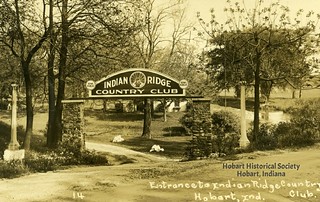
That Indian Ridge Golf Club postcard from earlier motivated me to check in the Indian Ridge file at the Hobart Historical Society Museum. Here are a couple things I found there.

The entrance, from a postcard postmarked 1934:

Indian Ridge entrance
(Click on images to enlarge)
All images in this post courtesy of the Hobart Historical Society.


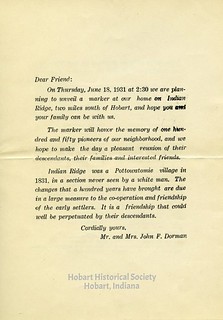
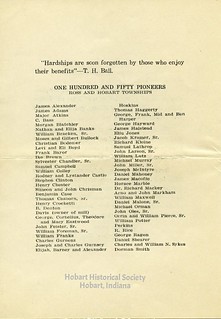
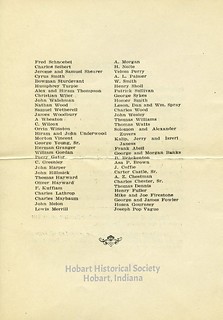
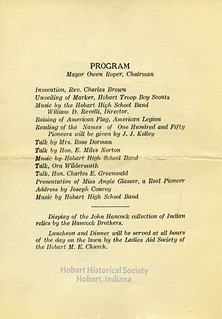
In 1931 the Dormans hosted a ceremony dedicating a monument to 150 pioneers of Hobart and Ross Townships. The program for the ceremony listed the pioneers they had in mind.

Program page 1

Program page 2

Program page 3

Program page 4

*sigh* Most of these men had wives. But there were no women pioneers.

Leaving aside that little injustice, I notice some familiar names on this list. I've already written about, or at least mentioned, Morgan Blachly; Henry Chester and his father, Charles; Charles Gernenz; Horace Marble; William Potter; Cyrus Smith; Henry Nolte (there were two who could qualify as pioneers); and Patrick Sullivan.

Monday, June 7, 2010

Saturday Nights and Studebakers

For a few months in the spring of 1908, after "Sauter's hall" became "Lindborg's hall" — or simply "the hall at Ainsworth" — dances were given there under the management of Charles Hamilton, a Hobart mail-carrier. Then Charles faded from view and Gust Lindborg took over that part of Ainsworth's Saturday-night entertainment.

Henceforward you could count on finding, about once every month (sometimes twice or thrice) the same item in the Ainsworth news column: "A public dance will be given this week Saturday in the hall at Ainsworth. Good music will be furnished. The dancing public is invited."

Sometimes the dance would be a masquerade ball, with tickets at 75 cents per couples and prizes awarded for the handsomest costume and for the most comical. Once it was a "married people's" dance.

In October 1911, Gust started running separate dance advertisements in the Hobart News:

Lindborgdance
(Click on image to enlarge)

These ads appeared only in the News, as if Gust believed that paper to be the favorite of the partying types. After a few weeks, he discontinued the ads. They probably were not necessary to attract people; the brief mentions in the social columns were enough. And now and then the papers carried reports of good attendance at a dance that Gust had not even bothered to advertise. So popular were the Ainsworth dances that Hobartites often took the mile-long jaunt south to attend them.

Gust's promise, in the ad above, to maintain "good order" was probably inspired by previous incidents. In February 1909, for example, a fight broke out at one of those Saturday-night dances between two locals, Ed Maybaum and Louis Weiler. (They settled the matter in court the next week, with Ed, who started the fight, assessed about $20 in fines and costs.) An August 1910 item in the Ainsworth new column hinted at further trouble: "What was the fight about Saturday evening?"

I have the impression that Ainsworth could sometimes be a bit rough on weekends, and that's just from the dust-ups that got reported; I expect there were others that didn't. The incidents might be treated with wry humor — some sort of fracas in January 1905 was reported thus: "Ainsworth ranks first in the line of pugilists as it went to show Saturday evening. Anyone can get particulars by asking Ed. Mankey"; a December 1907 incident came out as: "A little shooting affair is reported to have taken place Sunday morning at Ainsworth but no one was hurt." In October 1906, as we've mentioned already, a brutal Saturday-night fight between George Young and Duffy DeFrance had the latter facing a charge of murder. My guess is that fights, when they occurred, tended to start either at the dance hall or just around the corner at the saloon.

And Gust Lindborg, while fundamentally kind-hearted, was a serious man, sometimes to the point of sternness, and definitely not the type to be amused by such antics. So I think it suited his inclination as well as his business sense to maintain order at his dances.

However, his good intentions and best efforts could not always prevail against liquored-up rowdiness, as in July 1912, when, according to the Gazette:
A disgraceful fight occurred last Saturday evening in the dance hall at Ainsworth and one of the drunken whelps struck a Hobart girl and felled her to the floor, according to a report. Boy's [sic] who can't behave themselves in public should not be permitted to attend a dance and should be made to suffer for any wrong done. A young man, whether drunk or sober, who strikes a girl with his fist should be made to pay dearly for the act.
How the "drunken whelp" in question was made to pay for his act was not reported. I can only imagine what Gust had to say about it all.

The dance hall was only a side business, of course, and Gust's main business, the blacksmith shop, was humming along. Starting in 1911, he began running a weekly advertisement in the Gazette (and only in the Gazette — apparently he thought the serious, businesslike people preferred that paper to the News):

Lindborgad
(Click on image to enlarge)

This ad ran on the same page with those of Hobart's doctors, lawyers and architects, Main Street livery stables, and a competing blacksmith, August Mueller.

The quality of Gust's blacksmithing and machinery-repair skills was such that by 1910 Trustee Calvin Shearer entrusted to him repair work on Ross Township's school buses.

In July 1911 the two men made a trip to the Studebaker Company in South Bend, where Calvin purchased a new bus for the township, with Gust handling the sale. The newspaper report does not specify whether this bus was horse-drawn or motorized. The Studebaker Company had begun manufacturing gasoline-powered vehicles in 1904, and by 1912 it was producing handsome automotive school buses like this:

1912StudBus
(Click on image to enlarge
Image credit: Wikimedia Commons.


But whether the rural Ross Township school system could afford such a high-end machine is another question.

That same month Gust sold a horse-drawn wagon to a neighbor, William Foreman.

By now Gust and Anna had two young children: Mildred, born 1906, and Franklin, born 1909. The young family still found time to visit with relatives and friends in Chicago. Anna had family in south Chicago, possibly including Andrew and Agnes Palm, who show up there in the 1910 census;* the Lindborgs also visited the family of William Kimball, whose wife, Elma, was a recent immigrant from Sweden. Gust had a relative in Chicago named Emil Lindborg, who visited Ainsworth at least once. On occasion the Lindborgs drove out to Miller to visit friends there.

In August of 1911 Anna suffered serious health problems. She entered a hospital in Chicago, where on August 22 she underwent an operation for what the newspaper described as "liver trouble." She remained hospitalized until mid-September, and shortly after returning home she became so ill that a doctor had to be called. She recovered, apparently, since by early December the Lindborgs were out and about again, visiting friends. No more was heard of Anna's being sick until March 1912, and then she seems to have suffered only a brief illness.

I said in my previous entry about the Lindborgs that I wasn't sure where they lived when they first came here — and now I'm even less sure, for I now know that the little house at 6310 Ainsworth did not arrive until June of 1912, when the Gazette reported:
Gust Lindborg who bought the old Sullivan schoolhouse has moved it to the side of his dance hall and carpenters are remodeling it for a cottage.
The name of the school may indicate that it had been built on land belonging to Patrick and Sarah Sullivan; they had lived in Lake County since 1860, and by 1891 owned 100 acres southwest of Ainsworth and bordering on present-day Route 30. Evidently the old schoolhouse was no longer sufficient, for a new Sullivan school was being built — brick, two-roomed, with a basement. So the little frame schoolhouse was picked up and moved to the heart of Ainsworth, where it started its new life as the Lindborg home.

[To be continued]
____________________________
*[8/2/10 amendment] It was more likely Anna's brother, Peter Palm, and his wife, Hulda. They are harder to find in the 1910 census because the style of the census-taker's handwriting makes their name look like "Palen," which is how the Ancestry.com search engine interprets it.


Sources:
1891 Plat Book.
♦ 1910 Census.
♦ "Ainsworth Pick-Ups." Hobart Gazette 27 Jan. 1905; 5 Aug. 1910; 19 Aug. 1910.
♦ "Ainsworth." Hobart News 20 July 1911; 17 Aug. 1911; 24 Aug. 1911; 31 Aug. 1911; 7 Sept. 1911; 21 Sept. 1911; 2 Nov. 1911; 7 Dec. 1911; 14 Dec. 1911; 21 Dec. 1911; 28 Dec. 1911; 14 Mar. 1912.
♦ "Dance at Ainsworth." Hobart News 25 Oct. 1911.
♦ "General News Items." Hobart Gazette 20 Dec. 1907; 6 Mar. 1908; 8 May 1908; 26 June 1908; 7 Aug. 1908;
♦ Lindborg, Gust. Advertisement. Hobart Gazette 21 July 1911.
♦ "Local Drifts." Hobart Gazette 26 Feb. 1909; 22 Dec. 1911; 16 Feb. 1912; 21 June 1912; 12 July 1912.
♦ Penrice, John. "Studebaker History Timeline." Studebaker History. http://www.studebakerhistory.com/dnn/Timeline/tabid/65/Default.aspx (accessed 1 June 2010).
♦ Personal interview with a Lindborg descendant, May 2010.
♦ "Personal Mention." Hobart News 30 May 1912.
♦ "Ross Township Notes." Hobart Gazette 25 Aug. 1911; 1 Sept. 1911; 22 Sept. 1911.