Showing posts with label Carlson. Show all posts

Thursday, October 15, 2026

The Ainsworth School Loses Its Principal

2026-10-15. William Shaver
(Click on image to enlarge)
Image originally posted to Ancestry.com by user mksrnbsn.


William Shaver was the principal of the W.G. Haan School when he died in 1924 at only 38 years of age.

2026-10-15. 1924-02-21 News, Funeral of William E. Schaver, principal of Ainsworth School
(Click on image to enlarge)
Hobart News, 21 Feb. 1924.


I am not sure the obituary gets the timeline exactly correct. The 1910 Census shows William as a boarder in the home of Edward and Anna Notter near Deepriver, giving his occupation as teacher in a public school. He was only on his second month of marriage, and living apart from his wife. This may have been a matter of convenience for his job, but apparently the marriage ultimately did not succeed, as his death certificate lists his marital status as divorced.

However, William and Grace spent enough time together to have two children: a son, Leslie, born in Valparaiso in 1911, and a daughter, Winnifred, born in Ainsworth in 1913.

The divorce probably happened "some time" previously, about the "some time" when his son and daughter went to live with his mother in Cairo.

I believe that the two men who accompanied William's body to Cairo — Oscar Carlson and John Thiel — were not relatives but fellow members of one of the fraternal organizations to which William had belonged.

Friday, December 6, 2024

Unidentified Scenic Beauty, 1911, East Gary

I bought these postcards (postmarked 1911) on Ebay because, at first glance, they seemed to show the view from the hill where I think the Bijou resort was located (now Riverview Park). Once I received them and had a chance to look more carefully at them, I started doubting my first impression. But if not there — where?

2024-12-06. 1911 East Gary Crose-Ashton Deep River scene 002-a
(Click on images to enlarge)

2024-12-06. 1911 East Gary Crose-Ashton Deep River scene 003-a

"Bend of Deep River" — the Deep River has lots of bends, but one of the most significant is near Riverview Park, where there would also be a bridge carrying a road (now S.R. 51) over the river. But wouldn't you expect to see some evidence of "downtown" East Gary, if the photographer were on the Riverview Park hill pointing the camera more or less north?

He might not have been on a hill. He might have climbed somebody's windmill to get that aerial view.

I scanned these at 1200 dpi to bring out the details. The trees along the road have been planted at such regular intervals that, viewed from a distance against the road, they give the illusion of a line of railroad cars. In the second image (where you can see some farm outbuildings), there's a man working in the field near the right edge. I think the cattle are the same in both pictures — they just moved a bit while the photographer was adjusting the camera's position.

Here's what I get when I put the two images together through Hugin (free panorama software):

2024-12-06. 1911 East Gary Crose-Ashton Deep River scene - panorama of 002-a and 003-a


The location of the third postcard is even more of a mystery:

2024-12-06. 1911 East Gary Crose-Ashton Deep River scene 001-a

This one shows two bridges over the Deep River. I can't tell if the far one is a road or a railroad.

Although there's a spot where Central Avenue crosses a river near a railroad bridge, I can think of at least two problems in the way of identifying this image as showing those two bridges: one, the river by that point is the Little Calumet — the Deep River has already flowed into it and lost its own identity. (On the other hand, the photographer and the person who commissioned the photos might not have known or cared about exactly which river they were looking at.) Two, I'm not sure Central Avenue extended that far in 1911, or had such a nice bridge. Oh, and third, since even today this location is outside the Lake Station city limits, I'm not sure anyone in 1911 would have attached "East Gary" to the description. (On the other hand, it wasn't inside any other city, so why not attribute that scenic beauty to East Gary?)

♦    ♦    ♦

Thanks to Steve Shook's research, we already have information about the Crose Photo Co. But what about the person who commissioned the photos, W.E. Ashton?

I believe he was William E. Ashton, shown here in the 1910 Census:

2024-12-06. 1910 Census - Ashton
(Click on image to enlarge)
Image from Ancestry.com.


As the proprietor of a general store, he might have wanted his own exclusive line of postcards.

William was born in Illinois and grew up in DuPage County, I gather. We find him in the 1870 Census in Downers Grove, his father describing himself as a day laborer, and in Hinsdale in the 1880 Census, by which time his father was working as a butcher.

The 1900 Census showed William out on his own, farming in Liberty Township, Porter County. His household included no family, but three boarders — all female; two widowed, one single. The single one was Mabel Lester,[1] whom William married in 1901 (Cook County, Illinois, Marriages Index). A 1905 directory out of Valparaiso shows them still living along a rural route, and the 1906 plat map of Liberty Township shows their 30-acre farm (I hope I labeled the roads correctly):

2024-12-06. Ashton - Liberty Twp. -1906
(Click on image to enlarge)
Image from https://www.inportercounty.org/Data/Maps/1906Plats/Liberty-1906.jpg.


It appears that the move to East Gary happened sometime between 1906 and 1910. Thus, the Ashtons' stay in East Gary probably was no more than 14 years, at most. The 1920 Census records them in Gary. William worked as a laborer then, employed by a "Bridge Works."

Assuming I've found the right people, by the 1930 Census William and Mabel had moved to Mississippi! There William described himself as a carpenter. Then they came to their senses and moved back to Indiana — to Hobart, in fact, where the 1940 Census recorded them living on West Third Street. William and Mabel described themselves as a retired owner/manager and clerk, respectively, of a grocery store. Later, they moved to Crawfordsville, Indiana (1950 Census).

William died in 1951, Mabel in 1973, and they both were laid to rest in Hobart.

♦    ♦    ♦

The three postcards were all sent by the same person. Here they are in the same order as above.

2024-12-06. 1911 East Gary Crose-Ashton Deep River scene 002-b verso
(Click on images to enlarge)

2024-12-06. 1911 East Gary Crose-Ashton Deep River scene 003-b verso

2024-12-06. 1911 East Gary Crose-Ashton Deep River scene 001-b verso

Ellen (last name/maiden name probably Carlson) first sent postcards to her mother, Mrs. J.A. Carlson, and her father (or stepfather), J.A. Carlson. Two days later she sent a third to her sister/maiden aunt/cousin/whatever, Miss Anna Carlson. I have found households with most of those names or initials, but none with all of them, so the Carlsons remain unidentified for now.


_______________
[1] One of the widowed boarders was Mabel's mother, Linna ("Linnie").

Thursday, September 7, 2023

The Harper-Carlson-Grabowski-Pike House

I came across this article, in the Hobart Herald of September 9, 1954, summarizing the history of the house at 6430 Grand Boulevard.

2023-09-07. 1954-09-09 Hobart Herald, Old Hobart Houses (Pike house) 01
(Click on images to enlarge)

2023-09-07. 1954-09-09 Hobart Herald, Old Hobart Houses (Pike house) 02

According to the county records (which tend to be imprecise when you get back into the 19th century), the house was built in 1879: a date not inconsistent with this article. I am so curious to know what the author was told that led her to say that the house was built "sometime after 1863" — not that I doubt it; I'm just curious. I'm guessing she talked with old-timers to get this information.

The article doesn't mention William Blumenthal's brief ownership, but of course he was a mere passer-by, wasn't he?

Considering that the Grabowskis' addition to the house was begun in 1923, it's possible the old timers' memories were not serving them well if they thought it hadn't been completed yet by 1930.

The "Verne Manteuff" whose identification of a shoe is said to have been so important after the accident that killed the Grabowskis was LaVerne Manteuffel.

I want to get into more detail about some of the people mentioned in this article, and I will do that in future posts.


By the way, the photo at the top of my second image above doesn't relate to the house, but to a monument I posted about 'way back in 2010, which (according to the program John Dorman had printed up) was erected in 1931.

Sunday, August 11, 2019

Having a Gas, in Ainsworth and Elsewhere

This page from the August 23, 1923 issue of the Hobart News is dominated by Carlson news. First off, Charles Carlson, gassing up his automobile in Ainsworth, luckily avoided a conflagration.

2019-08-11. Carlson, News, 8-23-1923
(Click on image to enlarge)
"Local and Personal," Hobart News, Aug. 23, 1923.


The automatic shut-off mechanism for gas pumps hadn't been invented yet.

I suppose this gas-pumping Charles Carlson and the corn-selling Charles Carlson in the item above are the same person. The other "Carlson brother" would be Richard, whom we've heard of before. The 1920 Census shows Charles, age 42, living in the vicinity of what is now the Indian Ridge golf course (to judge by his neighbors) with his 79-year-old mother, Hedvig (widow of Swan Peter). But the old Carlson house and the land surrounding it was now owned by Teofil and Wanda Grabowski.

Which leads me to wonder about the location of the "Carlson grove … on the banks of Deep river" where the family reunion (mentioned in the middle column) was to take place. The Carlsons' land (shown here on the 1939 plat map) no longer bordered on the river. Perhaps the Grabowskis let the Carlsons use a grove on their land for the reunion.

Looking at those planning to attend the reunion, I recognize only a couple of names. Russell Koehler was the Carlson brothers' nephew, son of their sister Augusta. Tekla Ceander used to be Tekla Anderson … but I don't know how she was related to the Carlsons.

♦    ♦    ♦

Now, who might have been selling gasoline in Ainsworth? Here is Henry Paulus, owner of the Ainsworth department store, listed among the sellers of Red Crown gasoline:

2019-08-11. Red Crown, News, 8-30-1923
(Click on image to enlarge)
Hobart News, Aug. 30, 1923.


♦    ♦    ♦

To end this post, we have news of that elegant young couple, George and Pearl (Severance) Yager, who eight years earlier had fled Ainsworth and never looked back.

2019-08-11. Yager, Gazette, 8-24-1923
(Click on image to enlarge)
Hobart Gazette, Aug. 24, 1923.

Friday, December 22, 2017

South of Deepriver, March 22, 1923

2017-12-22. South of Deepriver 3-22-1923
(Click on image to enlarge)
Hobart News 23 March 1923.


Among all the other social news, we find Maybelle Guernsey marrying Lloyd Moreland of Sedley, who thus far has figured in this blog only as a visitor in other "South of Deepriver" columns. But looking into his background a little, I find that his family goes back to the 1870s in Union Township, Porter County. His grandparents were Joshua and Margaret Anna. I believe that Joshua, born in Ohio in 1834 (Indiana Death Certificates), shows up in Union Township in the 1870 Census with his name spelled Moorland. The following year he went back to Ohio to marry his sweetheart, Margaret Anna McConkey.[1]

The young couple probably returned to Indiana soon after their marriage. The 1876 plat map for Union Township shows a J. Moreland owning a nice big parcel of land not far southeast of where Sedley would be after the Grand Trunk Railroad came through.

Around 1874, Joshua and Margaret had a son named Harrison (1880 Census). In 1896, Harrison married Jessie Wilson (Indiana Marriage Collection). Their son Lloyd was born in 1898 (Indiana Death Certificates).

Per the Union Township plat map of 1921, Harrison Moreland owned nearly 200 acres around Sedley.

2017-12-22. Moreland 1921
(Click on image to enlarge)
Image from http://www.inportercounty.org/Data/Maps/1921Plats/Union-1921.jpg.


The 1930 Census shows Lloyd and Maybelle farming rented land in roughly the same vicinity (to judge by their neighbors); it may have been his father's land. By then they had three children.


To the left of the "South of Deepriver" column is an open letter from William O. Sievert. He may or may not be somehow related to the Ainsworth-area Sieverts — I don't know. I believe he was a Hobart resident; the 1920 Census shows a 25-year-old steel-mill employee by that name in Hobart with his widowed mother, Anna. The Charles Carlson (who was allegedly to blame for the accident) was a son of Swan Peter and Hedwig Carlson, and per the 1920 Census lived in Ross Township, farming on part of the old Carlson place on S.R. 51, roughly across S.R. 51 from the present-day Indian Ridge Golf Course.

____________________

[1] Ancestry.com. Ohio, County Marriages, 1774-1993 [database on-line]. Lehi, UT, USA: Ancestry.com Operations, Inc., 2016. Original data: Marriage Records. Ohio Marriages. FamilySearch, Salt Lake City, UT.

Sunday, October 2, 2016

Turk's Melody Boys

"Music by Turk's Melody Boys," says the advertisement for a dance at Niksch's dance hall, providing no further detail, as if everybody knew who Turk's Melody Boys were … or as if they were so obscure that there was nothing to say about them.

2016-10-2. Melody Boys
(Click on image to enlarge)
Hobart Gazette, 29 Sept. 1922.


Googling "Turk's Melody Boys" turns up only a few references to a band called Johnny Turk's Melody Boys, which got some air time on West Coast radio broadcasts circa 1926; for example:

2016-10-2. Johnny Turk and his Melody Boys
(Click on image to enlarge)
Eugene Guard (Eugene, Ore.) 27 July 1926 (via newspapers.com).


I wonder if Johnny Turk's Melody Boys got their start in such humble places as the old Deep River schoolhouse? But theirs wasn't a story of a rise from small beginnings to great fame: after a few radio broadcasts they seem to have disappeared, and have not resurfaced in any modern-day account of American musical history that I can find.

The woman whose obituary takes up most of the left-hand column of the Gazette page above was Christina (Blank) Hazelgreen's sister.

♦    ♦    ♦

Here's a summary of local auto accidents in the space of a week:

2016-101-2. Accidents
(Click on image to enlarge)
Hobart Gazette 22 Sept. 1922.


Dr. Phillip Forsberg was a veterinarian, and I suppose his wife, Mary, was the "Mrs. Forsberg" whose identity eluded me when she sang in Ainsworth. They both rest in Hobart Cemetery, beneath a literary epitaph. Their "house by the side of the road" was at 56th and Broadway (WWII Draft Cards), which was in Ross Township (1940 Census). Phillip was a friend to man's best friend, anyway. And Mary, who gave her occupation in 1940 as assistant school principal, was a friend to children, we can hope.

The Carlson fruit farm and its melons were on the west side of S.R. 51, somewhere near what is now Indian Ridge Golf Course.

Wednesday, April 20, 2016

South of Deepriver

Random bits from the countryside south of Deepriver, late July-early August 1922.

2016-4-20. South of Deep River
(Click on images to enlarge)
Hobart News 3 Aug. 1922


I don't know exactly what a separator canvas is, but the wording of that item suggests that the farmers of southeastern Ross Township had chipped in to buy themselves a communal farm machine — a sensible thing to do — and it was getting a workout in that summer's wheat threshing.

… Here's a little article about a threshing machine that has a separator and a canvas, somehow or another.

2016-4-20. Separator
(Click on image to enlarge)
From the Chilton Tractor Journal, Vol VIII, No. 4 (April 1, 1922). Retrieved from https://books.google.com/books?id=xsZMAQAAMAAJ&lpg=RA3-PA14&ots=pSADxxAJwL&pg=RA3-PA14&ci=80%2C816%2C899%2C500&source=bookclip#v=onepage&q&f=false.


♦    ♦    ♦

Elsewhere in the August 3, 1922 issue of the News, we find out that the strikebreaker has still not recovered …

2016-4-20. Ida Heck Carlson et al.

… and among the familiar names in the second column, we also find Miss Jeanette Peterson, daughter of Lena and George. The Hugo Zobjeck at Camp Knox in Kentucky was Hugo Jr., now about 17 years old.

In the third column are a couple of obituaries. The first concerns the untimely death of Ida (Heck) Carlson, who probably grew up on the old Heck place. The second brings me to consider the Wilson family of Union Township, Porter County, whom I have considered very little up to now. Mrs. Jane Harwood would have been Aunt Jane to "Miss Leola Wilson of Blachly's corners," and also, I believe, to Ralph Wilson, who in his youth took music lessons from Ainsworth's own Hugh Dotzer ("Ainsworth Pick-Ups," Hobart Gazette 6 Jan. 1905). In my notes and in the blog, I find several references to Wilsons, and some day when I retire and have time on my hands, perhaps I shall investigate which of them belonged to the Wilson family of Union Township.

Here is the farm of Jane's parents, Amos and Hannah Wilson, as it appeared on the 1876 plat map:

2016-4-20. Wilson 1876
From http://www.inportercounty.org/Data/Maps/1876Plats/Union-1876.jpg, courtesy of Steven R. Shook.

Monday, November 16, 2015

Elmer Bullock, Crown Point Class of 1922

Elmer Bullock's proud grandmother, along with Mary Kipp and her sisters, went to Crown Point on May 19, 1922, to see him graduate from high school.

2015-11-16. Elmer Bullock graduation
(Click on image to enlarge)
Hobart News 25 May 1922.


Just above that item we hear from the Carlson brothers, Charles and Richard, whom I thought I wrote about earlier … but if I did, I can't find the story now.

Their fruit farm was on the west side of Grand Blvd./S.R. 51, just a part of the 80-acre farm that had belonged to their parents, Swan Peter and Hedvig Carlson. The 1926 Plat Book does not show ownership for the small parcels in that area. We have to go to the 1939 Plat Book to find a parcel with the name Carlson, which seems to be in roughly the right place, but whether it was exactly the location of the 1922 Carlson farm is something I can't tell you.

2015-11-16. Carlson 1939

In the 1920 Census we find the 42-year-old Charles living in that area with his widowed mother, operating a "market garden." Richard, some ten years younger, was then living in Hobart with his wife, but the wording of the news item suggests they had moved to, or near, the farm by 1922.

♦    ♦    ♦

In the right-hand column we read of the loss of another local Civil War veteran, Conrad Bender.


Additional Source: "Death of Conrad Bender." Hobart Gazette 26 May 1922.

Monday, August 3, 2015

He Let a Sleeping Dog Lie …

I like how the newspaper takes pains to point out that it was a "foreigner" who allowed a dog to nap atop the fruit he was selling.

2015-8-3. Fruit as doggy bed
(Click on image to enlarge)
Hobart News 30 March 1922.


The "Mr. DeKalb" who bought 15 acres was Charles DeKalb of Gary, not Chesterton (1920 Census; "Local Drifts," Hobart Gazette 7 Apr. 1922). Charles was in his early 30s and worked as a foreman in a tin mill. He had a wife, Esther, and an eight-year-old daughter, Mildred. The 1926 Plat Book does not give names for the small parcels along S.R. 51, but here is the DeKalb 15 in the 1939 Plat Book:

2015-8-3. DeKalb 1939
(Click on image to enlarge)

As for Guy Crisman, his accident shows that while the village of Deep River may have been tiny, it wasn't sleepy, sitting there on the Lincoln Highway. The newspaper describes Guy as the eldest son of Mr. and Mrs. John Crisman; per the census records, I thought their eldest son was named John, but I suppose "Guy" could have been a nickname.


Not on the print-out above but elsewhere in the same issue, we learn that Alice Paine was home from the Blaker college, aka Teachers College — on spring break, it appears, and intending to go back to college on April 2.


Additional Source: "Health Department Wins Approval." Hobart Gazette 31 March 1922.

Tuesday, November 25, 2014

A Six-Room Bungalow

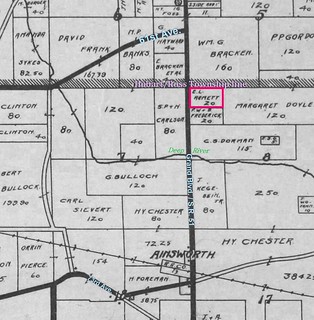
The first I ever heard of the "E.L. Arment 20 acres" was in March 1918, when Charles Sapper and his son, John, rented that land for some unnamed purpose, probably agricultural. The land lay on the east side of present-day Grand Boulevard, south of the Bracken land that is now Barrington Ridge, north of the Dorman land that is now the Indian Ridge golf course. The 1908 Plat Map ascribes it to "E.L. Armett":

2014-11-25. Arment 1908
(Click on image to enlarge)

I do not know when E.L. Arment purchased these 20 acres. The 1891 Plat Book has Annie Ford written in as the owner, over a crossed-out "A.R. Castle." If we go back to the 1874 Plat Map, we find another Castle owning the land.

Anyway, now — at September 1921 — comes the announcement that E.L. Arment intends to construct a six-room bungalow on his 20 acres, and has given Frank MacPherson the contract to build it.

I am having some trouble positively identifying Mr. Arment. I suspect he may have been Elmer Livingstone Arment, who in November 1900 had married Maud Rifenburg of Hobart. Elmer had worked as a guard at the Indiana State Prison at Michigan City from 1900 (or earlier) on through the first World War, but by 1920 he had gone to work at a steel mill in Gary. It appears he managed to get himself counted twice in the census — once at home in Michigan City, where Maud naturally enough gave his name to the census enumerator as the head of the household; and on the same day in Gary, where he was listed as a lodger in a steelworker's home.

The six-room bungalow may have been intended as a new home for his family, but I have yet to confirm that they ever lived in it. Or even that it was ever actually built, much less still standing.

♦    ♦    ♦

One report on the Arment land described it as "opposite the Richard Carlson fruit farm." As you can see from the image above, opposite the Arment place is the 80-acre farm that once belonged to Swan Peter and Hedvig Carlson. We know that 20 acres of that parcel were sold in 1919 by a daughter of the Carlsons, at which time I wasn't sure what had become of the other 60 acres. Per the 1910 census, among the Carlson children was a son named Richard, who would have been about 35 years old in 1921; perhaps he owned another parcel carved out from the original 80 acres, and used that land to raise fruit (although no census describes him as a farmer). If that's the case, it suggests the old homestead was divided up among the survivors after S.P.'s death. (The 1926 Plat Book shows that land in several small parcels — too small to show the owners' names — while one of the small parcels was owned by a Carlson per the 1939 Plat Book.)


Sources:
♦ 1900 Census.
♦ 1910 Census.
♦ 1920 Census.
♦ 1930 Census.
♦ Indiana Marriage Collection.
♦ "Local and Personal." Hobart News 8 Sept. 1921.
♦ "Local Drifts." Hobart Gazette 29 Mar. 1918; 9 Sept. 1921; 16 Sept. 1921.
♦ WWI Draft Cards.

Friday, November 14, 2014

Oscar Carlson v. Linda Street, Episode III

Oscar W. Carlson's quarrel with the town of Hobart over Linda Street first came to my attention in 1915, and Episode II happened in 1919. Two years later and Oscar is still at it, and now he has recruited Sam Tree (among others) to join the fight.

Linda St. dispute
(Click on image to enlarge)
Hobart Gazette 26 Aug. 1921.


Fetterer's New Home Sub
(Click on image to enlarge)
This 1960 map shows Fetterer's New Home Subdivision.
Image courtesy of the Hobart Historical Society.


Oscar and his allies lost this battle too: the remonstrances against the opening of Linda Street were unanimously voted down at a Board meeting on September 27 ("Town Board Doings," Hobart Gazette 30 Sept. 1921).

Wednesday, May 7, 2014

The Old Carlson Place Again

William Blumenthal of Chicago, having tired of being an absentee farmer, sold the old Carlson place. The buyer was Teofil Heronim Grabowski, a 32-year-old Gary lawyer who also served as president of the American State Bank at 17th and Broadway in Gary. Teofil had immigrated from Poland in 1905. He eventually married Wanda Cieszynski (about nine years his junior), and in 1920 they lived in Gary with Wanda's 18-year-old brother, Valerian, a student.

Teofil was evidently a person of great energy: soon after buying the old Carlson place, he set about remodeling the farmhouse, building chicken coops, and making other unspecified improvements. The Gazette explained: "We understand [Mr. Grabowski] expects to engage extensively in the chicken raising business. That is he expects to raise 'broilers' for an eastern market." The Grabowskis intended to live on the Hobart farm, while Teofil commuted to his Gary law office and bank presidency. And indeed they did so at least through 1923; we shall have to wait to see what happens after that.


Sources:
♦ 1920 Census.
♦ Gary (Indiana) City Directory 1923 (R.L. Polk & Co.), from Ancestry.com. U.S. City Directories, 1821-1989. Provo, UT, USA: Ancestry.com Operations, Inc., 2011.
♦ "Improving the Old Carlson Place." Hobart Gazette 22 Apr. 1921.
♦ WWI Draft Cards.

Friday, September 6, 2013

Diphtheria

The early autumn of 1920 saw an outbreak of diphtheria in Hobart. At that time, treatment relied mainly on an antitoxin, developed in the 1890s, to neutralize the effects of the toxin secreted by the diphtheria bacteria; but with effective and widespread vaccination still a few years in the future, and no antibiotics to treat the main infection, the only way to fight the spread of the disease was quarantine. Among the first houses to be quarantined was the Springman home on Lake Street, where the widowed Hattie lived with three sons between 12 and 20 years of age.

Diphtheria was particularly dangerous for young children. The mortality rate for patients under five years of age was about 20%, and for those five years or older, 5-10%.* The first fatality in this outbreak seems to have been Leslie Carlson, the five-year-old son of Albert and Hannah Carlson of Michigan Avenue, who died October 23.

By early November the disease was in Joryville. Eugene Hill, 50 years old, was infected and his house quarantined, as was the home of James and Hulda Shearer, whose only child, the 10-year-old Clara, was sick. Nearby in the Frank and Christina Popp home, an (unnamed) young daughter had caught the same disease. By the time the this report came out, Eugene was already on the mend; Clara would pull through, as would the Popp girl. But on Fleming Street, diphtheria took the life of three-year-old Theresia Peas.

On November 18, the News declared: "The diphtheria epidemic is well under control. All suspicious symptoms are treated with rigid care. … No new cases are reported." As you might expect, the next week brought another reported quarantine — the home of Melvin and Marian Parker, though it isn't clear how many were sick in that household, which included four children under 11, and Melvin's 70-year-old father.

After that, however, diphtheria faded from the news for what remained of 1920.

♦    ♦    ♦

On a related note, for a good read I recommend The Cruelest Miles by Gay Salisbury and Laney Salisbury (2003). It centers on a diphtheria epidemic that broke out in Nome, Alaska, in the winter of 1925. The city was unreachable by boat or airplane; the only way to transport fresh antitoxin from Seward, 1000 miles away, was by dogsled. The Cruelest Miles tells the story of that life-and-death dogsled race.


________________________
*The mortality rate for adults over 40 was 20%, but more of the adult population could be expected to have the immunity that usually resulted from surviving a childhood infection.


Sources:
♦ "Diphtheria." History of Vaccines. College of Physicians of Philadelphia, n.d. http://www.historyofvaccines.org/content/articles/diphtheria. Accessed 28 Aug. 2013.
♦ 1920 Census.
♦ "Local and Personal." Hobart News 11 Nov. 1920; 18 Nov. 1920.
♦ "Local Drifts." Hobart Gazette 15 Oct. 1920; 29 Oct. 1920; 12 Nov. 1920; 26 Nov. 1920.
♦ Steven, Doerr, MD. "Medical Dictionary." EMedicineHealth. WebMD, Inc., n.d. http://www.emedicinehealth.com/diphtheria/article_em.htm. Accessed 28 Aug. 2013.

Friday, February 22, 2013

The Mover Moves On

When last we saw William Croan, it was a summer morning in 1915 and he was moving a whole house to Linda Street.

Now we meet him again on a spring morning in 1920, and it will be the last time we meet him.

Once again he had joined forces with Oscar Carlson. About 8:45 a.m. on May 13, William and Oscar were already hard at work on the Claude Bullock farm, north of Ainsworth on the banks of the Deep River.

The men were dismantling a barn, I gather, so that it could be moved. They were about to remove a large portion of the roof by sliding it down an incline. William was standing on the ground to one side of the incline when a large, heavy beam — six by six inches — suddenly slid sideways and caught William on the side of the head. He fell to the ground senseless.

When the witnesses (Claude and Mary Ann Bullock as well as Oscar) could not revive him, they sent for Dr. Dwight Mackey. The doctor arrived only to find himself useless. He judged that William had died instantly, or nearly so. Nothing was left to do but notify the family, and take the dead man to Alwin Wild's funeral parlor.

Neither Hobart newspaper, in reporting on the tragedy, was able to give William's exact age, nor did they later print any more extensive obituary; according to his grave marker, he was born in 1864. He had survived a wife, and was survived by another; one daughter from his first marriage (now Mrs. Oscar Meyers of Chicago), and three more daughters still at home, as well as two step-daughters (one of whom was Edna Schiel of Toledo, Ohio).*

The funeral was held the afternoon of Sunday, May 16, under the direction of the Independent Order of Odd Fellows, and William was laid to rest in Hobart Cemetery, never to move again.

Calvin C. Shearer was appointed administrator of his estate, and a month later offered William's house-moving business, as well as some personal property, for sale to the public.

William Croan
(Click on images to enlarge)
William Croan's grave marker in Hobart Cemetery.


Phoebe Croan
The grave marker of Phoebe, a wife who preceded him in death.

Croan children
These stones are now illegible, but earlier readers (per the Northwest Indiana Genealogical Society's compilation of Hobart Township Cemeteries) were able to decipher inscriptions (on the central obelisk, I assume) for a baby boy, Walter D. Croan, who died May 18, 18?? [last two digits illegible] at the age of 8 months and 6 days, and a little girl, Lilly M. Croan, who died October 25, 1888, aged 6 years, 11 months and 11 days, as well as the initials "W.D.C." and "L.M.C." — probably on the two little stones flanking the obelisk.

____________________________
*This information comes from combining the accounts of the two Hobart newspapers. Other sources raise some questions. The 1900 Census shows William, as of June 1900, married to May for four years, although the grave marker of the wife who died in September 1900 bears the name Phoebe; May claims to be the mother of one child only, living or dead; William claims an 11-year-old daughter, Mamie, and a 9-year-old stepdaughter, Edna Hanes. The Indiana Marriage Collection shows him marrying, in Lake County, Phoebe (last name illegible) in 1896, and Ellen Johnson in 1902, but also shows a William Croan marrying (in Marion County) an Amanda Adams, in 1888, which could account for the 11-year-old daughter — except that the Marion County William and Amanda seem to be still alive and married in 1900. Little Lilly's grave being in this group suggests she was William's daughter or step-daughter, but she was born in 1881 or '82. I leave it up to genealogists to figure this all out.


Sources:
♦ "Funeral of William Croan Held Last Sunday Afternoon." Hobart News 20 May 1920.
♦ "Local and Personal." Hobart News 24 June 1920.
♦ "Notice of Administration." Hobart News 20 May 1920.
♦ "William Croan Killed Instantly This Morning." Hobart News 13 May 1920.
♦ "Wm. Croan Killed." Hobart Gazette 14 May 1920.

Sunday, September 23, 2012

Armistice Day Anniversary

The first anniversary of Armistice Day brought thousands of people to downtown Hobart to celebrate the end of the war and the return of their soldiers — about 5,000, from Hobart itself, from neighboring farms and from nearby towns. The weather cooperated, with clear skies and mild temperatures.

In the afternoon, even before the main festivities, the town had a rare treat. A couple of pilots had been in the area taking "high-altitude" photographs for the government, and Harry Coons, president of Hobart's Commercial Club, had persuaded them to put on a little air show. Astonished schoolchildren were among those watching as the aircraft flew over the town and performed aerial stunts.

At 6:00 p.m., many businesses in Hobart shut down so that their owners and employees could join the fun — only the ice-cream parlors stayed open; and in the Watson building, the ladies in charge of feeding the crowds reported handing out some 4,000 plates between 6:00 and 8:00 p.m. (And the food was free to the diners — paid for by subscriptions, or donated.)

After an hour and a half of eating, about 100 local men who had served in the late conflict began assembling in front of Odd Fellows Hall (Fourth and Main). They were in civilian dress, but each had been provided with a white ribbon, printed with the words: "Hobart Veteran, Armistice Day, 1919" in gold letters. These men, led by a Hobart musical band and four Civil War veterans carrying the American flag, marched the two blocks north to Community Hall (the former Hobart House).

There they halted, and they and the crowd pressing around them listened to an address by the Rev. A.H. Lawrence — only ten minutes of solemn speech, and then everything dissolved into merry-making. A Chicago vaudevillian provided comic relief; a quartet sang; the Hobart band played and young folks transformed the newly paved Main Street into an open-air dance hall. Later the dancing went indoors, to the polished floors in Community Hall and Odd Fellows Hall.

It was "a splendid demonstration of community pride and patriotism," said the Gazette, "not unlike the old Fourth of July celebrations held back in the 90's."

♦    ♦    ♦

The same issue of the Gazette brought us some news about our old friend, John Killigrew:
While workmen were digging for a sewer lead to the new house which John Killigrew is having built on Michigan avenue, on land purchased from Oscar Carlson, two large and handsome Indian tomahawks were unearthed. Mr. Killigrew feels proud of the recovery of the old relics.
(It also reported that the "Jolly Four," whose identity I hope to discover, planned to host a masquerade ball at Ainsworth on November 19.)

According to the following week's News, the new Killigrew bungalow was being built by Walter Boal and Willard Stevens, and was to have seven rooms. I don't know where it was, or is.


Sources:
♦ "Hobart Celebrates for Returned Soldiers." Hobart News 13 Nov. 1919.
♦ "Hobart Has Big Celebration." Hobart Gazette 14 Nov. 1919.
♦ "Local and Personal." Hobart News 20 Nov. 1919.
♦ "Local Drifts." Hobart Gazette 14 Nov. 1919.

Wednesday, July 25, 2012

Yet More Land Changing Hands

When Swan Peter Carlson died in 1919, he had been a Hobart resident for five years but still owned a farm in Ross Township.

As we learned from his obituary, Swan had settled on the "Harper homestead" when he moved to Indiana from Chicago in 1890. The 1874 plat map shows us 80 acres in Ross Township belonging to a C. Harper (possibly Calvin), and the 1908 plat map shows those same 80 acres owned by "S.P. & H. Carlson" — Swan Peter and (I believe) his wife, Hedvig (or "Hadwick," per the 1910 census).

Harper-Carlson 1908
(Click on image to enlarge)

Late in August 1919, their daughter, Augusta Koehler, "traded her home and twenty acres on the Ainsworth road for a residence in Chicago," according to the News ("the Ainsworth road" being known now as Grand Boulevard, or State Road 51). It is not clear to me whether those 20 acres were all that was left of the old homestead, or whether that was only Augusta's share, the remainder being divided among her brothers. The buyer of the 20 acres was one "Wm. Blumenthal of Chicago."

I gather that Mr. Blumenthal was an acquaintance of John Dorman and intended to be an absentee landlord, as we find John Dorman, in the September 5 Gazette, offering for rent "the Carlson 20-acre farm 1½ miles south of Hobart."


Sources:
♦ 1870 Census.
♦ 1874 Plat Map.
♦ 1880 Census.
♦ 1891 Plat Book.
♦ 1908 Plat Map.
♦ 1910 Census.
♦ 1920 Census.
♦ "All Kinds of Wants." Hobart Gazette 5 Sept. 1919.
♦ "Local and Personal." Hobart News 4 Sept. 1919.
♦ "Local Drifts." Hobart Gazette 29 Aug. 1919.

Friday, April 27, 2012

Oscar Still At It

Nearly four years after his first "scrap" with the town over Linda Street, Oscar Carlson still hadn't given up the fight.

Town Board Doings
(Click on image to enlarge)
From the Hobart Gazette of April 18, 1919.


Thanks to those glass-plate images, I feel as if I know Oscar better than when I came across the 1915 incident. I was still unclear on who was who among all the Carlsons in Hobart, but then in May 1919, Swan Peter Carlson died, and his obituary helped to explain the relations.

SP Carlson obituary
(Click on image to enlarge)
From the Hobart News of May 1, 1919.


The Hobart museum has a large binder devoted to Carlson genealogy, for anyone who is serious about it.

♦    ♦    ♦

In non-Carlson news, a somewhat vague report seems to have John Dorman leading the effort to get firefighting equipment for Ross Township, and to store such equipment at Ainsworth … the heart of Ross Township.

Township Firefighting Equipment
(Click on image to enlarge)
From the Hobart News of April 17, 1919.

Monday, February 20, 2012

Harry Carlson (Random Old Photos)

It's hard to keep track of all my material. Long after I got through speculating on whether an unidentified photo might be Harry Carlson, I noticed that months ago I scanned a couple of identified photos of Harry onto one of my flash drives.

So here they are, for comparison.

Harry Carlson
(Click on images to enlarge)
Images courtesy of the Hobart Historical Society.


Harry Carlson 1898-1969

Very strong resemblance to that earlier, unidentified photo, but on the other hand I don't know what his brother Paul looked like as an adult.

Friday, February 10, 2012

Maybe a Carlson (Random Old Photo)

Maybe a Carlson
(Click on image to enlarge)
Image courtesy of the Hobart Historical Society.


This little developed portrait was in the cigar box with the small glass-plate negatives. The subject is not identified. Notes on the back read: "2 1/4     W&W Preters[?]     65836."

If you ask me, this young man has some family resemblance to Eric Carlson, but I don't think it's Eric himself — maybe one of his younger brothers, Paul or Harry, a few years after the glass-plate images.

Saturday, January 14, 2012

I'm Cold (Unidentified Glass-Plate Image)

I'm Cold
(Click on image to enlarge)
Image courtesy of the Hobart Historical Society.


Completely unidentified. The photo was poorly focused in the first place, and then the glass plate appears to have suffered some rough handling. I think this young fellow looks a bit like Eric Carlson. I wish I could see what he's holding in his hand — a book? a pouch of something?