Showing posts with label Chester. Show all posts

Thursday, November 5, 2026

A Grain of Truth in a Pearl of Gossip

Oral history usually starts with something that actually happened, and from there the human memory might create an amalgam of various real events, or the human imagination build up something more exciting than the bare facts. An interesting aspect of working with oral history is finding that grain of truth under the pearly layers of imagination or creative memory[1] — which is not to say I don't appreciate the pearly layers: they are art; they are a uniquely human activity.

What also fascinates me is that people who tell embroidered or confused history are not conscious of embroidery or confusion. For example, in my post about the Stoltz tragedies, the person who reported Mary Stoltz's thoughts in the minutes before her death — something impossible to know — believed what he or she was saying.

It is time now to return to the juicy story related by Minnie Rossow Harms that I discussed some 13 years ago. If you don't want to click on that link to read the original post, I will boil it down: the story told in the Ainsworth neighborhood (and written down years later by Minnie) was that Charles Chester's first marriage was to Ida Harms and went very badly; Ida developed a "weakened mind"; Charles brought another woman into the home; and finally Ida disappeared and locals suspected that Charles had murdered her and buried her body in the woods.

As I noted then, it's a great story that I could not find a shred of evidence to support.

Thanks in part to some amazing history-detective work by Emily Iland, we now know more of the truth about Charles' two marriages, and the surprising reason why the Harms name ever came up.

♦    ♦    ♦

On August 15, 1893, Charles Chester, 23 years old, married Dora Foreman,[2] a 20-year-old Illinois native. In May 1894, they had a son, Arthur, followed by a daughter, Theresa, in July 1895.

According to Charles' later testimony, the marriage went bad around that time. Dora was unfaithful to him (again, Charles' testimony) and by early 1896 had left their home in Ross Township[3] and gone to live on her own. In November 1898, Charles filed for divorce, saying that he had been completely abandoned by his wife for some two years.

There is one fact that is inconvenient for Charles' version of the story: that same month, Dora gave birth to another son, Willie,[4] who had been fathered by Charles, as established by modern DNA technology. Dora could thus not have completely abandoned Charles after 1896. However, the child was born in Iowa, so they were living apart at the time.

Charles was up to his own activities in the months before Willie was born. This item is from the Hobart News of October 14, 1898:
In speaking of the work of the recent grand jury the correspondent from Crown Point to the Hammond News uses the following: "One of the most surprising of the charges was that brought against Chas. Chester of Ross Township. … He is now charged with adultery and fornication and was arrested and stalled in the county jail last Friday on that indictment. According to reports Chester has a wife living in Iowa by whom he has had children, and one in Ross Township. If these reports are true Chester will find it hard work to clear his skirts."
The "wife" in Ross Township was Constance McClain Booty. She lived in his home, but she and Charles were not married.

Charles started the divorce action on November 12, 1898. Oddly enough for one whom the local papers viewed as a Ross Township resident, he filed in Cook County, Illinois, telling the court that he had been living in Chicago for the past three years. He said initially that Dora's last known address was in Hobart, Indiana, and that is where the court clerk mailed to her a copy of the notice of the pending divorce suit. The notice was also published in the National Corporation Reporter, a Chicago newspaper. At the divorce trial in December, Charles said Dora was living in Chicago. It is likely that Dora, the whole time, had been in Iowa, where she gave birth to Willie on November 14.

On November 25, in Lake County, Charles was cleared of the adultery charge.
The adultery case against Chas. Chester tried in the Lake circuit court the 25th of last month resulted in a vindication of the defendant. The report that the woman who is keeping house for him is his wife could not be proven and Mr. Chester and the woman swore they are not married, she being only his housekeeper working for weekly wages. Mr. Chester does not deny that he has a wife living in Chicago. We understand the defendant has begun a $10,000 damage suit against a number of Ainsworth farmers who were instrumental in his prosecution, for defamation of character.[5]
I never heard any more about that defamation suit, and I expect Charles quietly let it drop. While it's true he was not a bigamist, lawsuit proceedings might have elicited testimony making it difficult for him and Constance to maintain that there was absolutely nothing personal going on between them.

Charles' suit for divorce was heard in the Cook County court on December 21, 1898. Dora may not have attended the hearing — there is no record of testimony from her, although Charles and Constance testified. Charles was awarded his divorce and custody of the two children, Arthur and Theresa. There was a third child, as we know, but the court did not address that child. Charles may not have known about him.

Once a free man, Charles hastened to bind himself again.
On Tuesday of this week, Dec. 27th, 'Squire Mathews at his home spoke the words that united Chas. E. Chester and Constance Booty, of Ainsworth, as man and wife. Miss Booty for some time has been keeping house for Mr. Chester. We presume Mr. Chester has been successful in securing a divorce from his former wife, action for which was begun in Chicago some little time ago.
Thus began a long and apparently happy marriage between Charles and Constance.

♦    ♦    ♦

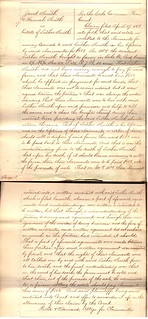
And now we get to the reason why the Harms name worked its way into the story when Minnie Rossow Harms wrote it down, over half a century after it happened: one of Dora Foreman Chester's alleged adulterous lovers was (according to Charles) none other than John Harms.

2026-11-05. John Harms accusation - Cook Co Court records Chester vs Chester divorce Nov-Dec 1898-1
(Click on image to enlarge)
I have not identified Edward Naughton.


How does "John Harms was Dora's lover" translate to "Ida Harms was Charles' wife"? That would be one of the creative miracles of human memory!

Although the divorce suit was tried in Cook County, I think it very likely that some knowledge of Charles' accusation reached John Harms' relatives in Ainsworth. (Whether there was any truth to the accusation, we'll never know. There was never a hint of any such goings-on in the local newspapers, which could sometimes be surprisingly frank about naming adulterers.) That knowledge injected the Harms name into the scandal. By the time Minnie Rossow Harms, born in 1897, was old enough to be told of such things (probably by her mother-in-law) memory may have already worked its magic; or maybe the magic happened between Minnie's hearing of the scandal and her writing it down — which I think was about 1952, and maybe later.

So in a sense, Minnie did not make up Ida Harms out of whole cloth. There really was some involvement of a Harms figure in Charles Chester's first marriage.

But what of the more serious allegation in the gossip: namely, that Ida-Dora disappeared and Charles was suspected of murdering her?

It may be that as far as Ainsworth people were concerned, Dora did disappear. She left her husband's Ross Township home. People probably heard she might be in various places — Chicago, Iowa, Hobart — but likely no one in the neighborhood ever saw her again. As for Charles' murdering her — if that can be explained by anything other than a wild flight of fancy, it might have arisen from the general feeling that Dora Foreman had been treated badly by Charles. He did have another woman living with him while he was still married to Dora. We see him emerging from the divorce proceedings with everything he wanted: his freedom, sole custody of his and Dora's two oldest children, and the love of a woman who would be his partner until her death. Meanwhile, Dora and Willie, her youngest child, had difficult and short lives.

Dora left Willie to be raised by her father and stepmother, while she went to work. The 1900 Census shows her boarding in a home in Lyons Township southwest of Chicago, giving her occupation as "servant," while her little boy lived in the city with Christ and Susan Foreman. Christ, at 57 years of age, worked as a day laborer, so likely the family was not well off.

A 1905 directory for East St. Louis, Illinois, apparently shows Dora and her father living there; but Dora may have already been an inmate of the St. Clair County Farm.

On January 4, 1908, the Belleville News-Democrat published her death notice:

2026-11-05. 1908-01-04 Dora Chester, The Belleville News Democrat, p. 8
(Click on image to enlarge)

The St. Clair County Farm housed indigent people. But I ask myself if perhaps, when this news trickled back to Ainsworth, the poorhouse became an institution … an asylum … an insane asylum — hence the "weakened mind" of "Ida Harms" in the original story. However, there were other possible origins of the "weakened mind," as we shall see.

Willie was not yet ten years old when his mother died. He went on living with his grandparents in East St. Louis (1910 Census).

We have to piece together some of Willie's subsequent history from family stories (as confirmed by DNA): later in that decade, he got a young woman pregnant. He did not marry her, it seems. She gave birth to a baby boy who was adopted by Willie's married cousin, Frances Bonanno, and her husband. Willie's draft card from 1918 shows him apparently living with the Bonannos, working as a coal miner. (Since he listed Frances as his nearest relative, his grandfather may have died sometime after 1910.) The 1920 Census likewise shows Willie with the Bonannos and their "adopted son" in Collinsville, Illinois. Willie worked in a brickyard.

In 1926 Willie became an inmate of the Peoria State Hospital — an insane asylum. This information, if it reached Ainsworth, might be another inspiration for the "weakened mind" of "Ida Harms." But there was one more possible source: when Arthur Chester (son of Dora Foreman and Charles Chester) died in 1930 at the Logansport State Hospital, the death certificate listed his cause of death as epilepsy, with a contributory cause of epileptic psychosis. This news most likely did reach Ainsworth, since Arthur had been a local most of his life, and he was brought back to Hobart for burial. A little confusion in human minds, after a decade or two, could transform Arthur's psychosis into his mother's "weakened mind."

Willie was still an inmate of the Peoria State Hospital when the 1930 Census came around. On August 29, 1931, he died there.

Considering the fate of her two sons, and her own untimely death, there is a sense of tragedy about Dora and her family. That tragic atmosphere might have eventually fermented into the story of Charles' murdering her. Yes, it would be an amazing transformation. This piece of neighborhood gossip, as reported by Minnie, is a tribute to the creativity of human memory.

♦    ♦    ♦

We know Charles was innocent of the worst allegation in the scandal. Yet he does not come out of this story looking very good. He lived under the same roof with Constance while still married to Dora (and we have to wonder — did he hire a housekeeper because Dora had left him, or did Dora leave him because he "hired" a "housekeeper"?). He filed for divorce in Cook County, not Lake County where he lived; and Charles and Constance both seem to have lied to the court about being residents of Chicago. I suspect they also lied, to both the Cook County and the Lake County courts, about being no more to each other than employer and employee. We know from the DNA results that Charles lied about being completely abandoned by Dora. And if he did not have more evidence than we know of for his accusations of adultery against Dora, he blackened her name unjustly.

But isn't there something in this that rises above the sordid? Perhaps my mind is shaded because just lately I've been re-reading the Kristin Lavransdatter trilogy and watching a similar story play out in great literature: two people in the throes of love abandoning all principles to be united, for better or for worse, until death. Charles and Constance became each other's lifelong companions, apparently happy together. If we believe that suffering can compensate for sin, we might look at what Charles and Constance went through in their marriage: the heartbreak of losing a son and a daughter, as well as dealing with a life-altering injury to one child (whom they both ultimately outlived) and the illegitimate pregnancy of another.

Those two latter, of course, were Dora Foreman Chester's children. I would have liked to see at least one of her children go through life without suffering a major misfortune.


It is a sad story all around. I almost feel guilty for having enjoyed finding out the truth behind what seemed to be a wildly fanciful piece of gossip; or at least, getting some insight into the possible route human brains might have travelled from Dora Foreman and a divorce, to Ida Harms and a murder.

I would never have found out the real story if Emily Iland had not tracked down the records from the divorce proceedings and shared them with me. To view those records, you may click here.


_______________
[1] I know it's a myth that pearls form around grains of sand. They form around pieces of the oyster's own mantle tissue, or in the case of cultured pearls an introduced bead, or even a parasite that drills through the oyster's shell. But was I supposed to title this post "The Piece of Mantle Tissue of Truth…"?
[2] Indiana Marriage Collection; "Chester-Foreman Nuptual," Hobart Gazette, 18 Aug. 1893. If Dora had any relation to the Ainsworth or Hobart Foremans, we have not uncovered it.
[3] I am not sure where Charles and Dora lived locally during their marriage. My guess is that they rented a farm somewhere in Ross Township.
[4] Ancestry.com. Iowa, U.S., Births and Christenings Index, 1800-1999 [database on-line]. Provo, UT, USA: Ancestry.com Operations, Inc., 2011. Original data: "Iowa Births and Christenings, 1830–1950." Index. FamilySearch, Salt Lake City, Utah, 2009, 2010. Index entries derived from digital copies of original and compiled records.

The 1900 Census seems to agree with the 1898 birth year for Willie, although in later records he himself gave 1897 as his year of birth.
[5] "Additional Locals," Hobart Gazette, 2 Dec. 1898.

Monday, June 1, 2026

Sale on the Howard Smith Farm

For some reason I thought this notice about a sale on Howard Smith's farm in February 1924 was interesting enough to retrieve from the microfilm. Maybe because Howard Smith was dead, and dead people are my favorite people. Anyway, I'm going to slap this up here, because I'm still too busy to do any kind of post that requires research.

2026-06-01. 1924-01-31 News, Administrator's Sale - Howard Smith
(Click on image to enlarge)
Hobart News, 31 Jan. 1924.


The last time we saw Melvin Guernsey, it was 1920 and he was planning to leave for Florida. If he did go, he was obviously back, and farming again. Melvin was not planning on quitting farming (unlike Barney Rhoda in the notice below his): he was just moving to the "Wm. Bixenman farm three miles east of Crown Point."[1]

The notice names "M. Hurlburt" as the administrator of Howard Smith's estate. That would be Milan Hurlburt, who was Howard's uncle.

♦    ♦    ♦

I did not realize when I was getting this page from the microfilm that the story in the left-hand column quotes Charles Chester of Ainsworth. If only I had! — I would have gotten the whole story, so we could have found out what Charles Chester of Ainsworth said about Calumet Electric company's proposal. Now we'll never know. But at least we now know that in 1924, the Chester farm was getting electricity from its own generating system.

_______________
[1] "Local and Personal," Hobart News, 31 Jan. 1924.

Monday, December 5, 2022

Drug Money in Ainsworth

Today I want to look at the northeastern part of Ross Township as shown on the 1939 Plat Map.

2022-12-05. Schmitt - 1939 Plat Book
(Click on image to enlarge)

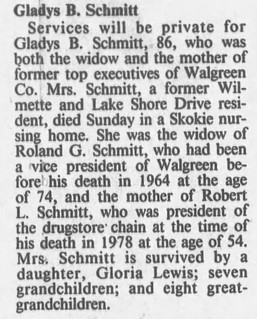
Sometime during the 1930s, Roland G. and Gladys B. Schmitt quietly bought up farmland that had belonged to two of Ainsworth's long-time residents, Charles Chester and Henry Nolte.[1] If I'm reading the plat map correctly, by 1939 the Schmitts owned some 400 acres. Where, during the Great Depression, would the money for that kind of purchase come from? The answer is: drugs. Roland Godfrey Schmitt was an executive with the expanding drugstore chain, Walgreens.

Born in Warsaw, Illinois, in 1890, he had started with Walgreens when he was just 20 years old and the chain itself not quite 10.
Roland G. Schmitt’s path to and through Walgreens would become a well-worn one, and it is still traveled today. The very day he enrolled in the Illinois School of Pharmacy in 1910, he noticed a “help wanted” announcement on a bulletin board at the school for a part-time apprentice at Walgreen’s first store at the corner of Cottage Grove and Bowen avenues. In the same youthful spirit that Walgreen demonstrated when he hopped on a train from Dixon to Chicago 17 years earlier, Schmitt stepped on a streetcar that afternoon, introduced himself to Arthur Thorsen — who was impressed by the young man’s wit and warmth — and accepted Thorsen’s offer of $8 a week (just $3 more than Walgreen earned after he got off the train almost two decades before).

Schmitt worked at the store every morning for an hour and a half, took the same streetcar back to school for a day of classes, then returned to the store to work from 6 P.M. to midnight — then got up and did it again after a few hours of sleep. After graduation, Schmitt became a full-time employee, a store manager, and finally the vice president of store operations — an unusually well-liked man with an easy smile. He retired in 1960, after putting in a very productive half century with Walgreens.[2]
In 1912, Roland married Amanda Schilling. By the 1920 Census — at which time there were 23 stores in the Walgreens Chain[3] — Roland and Amanda were living on Chicago's south side with their one-year-old son, Roland Jr. In September of 1922, Amanda died. Five months later, Roland Sr. married Gladys Forsaith. Together they would have two more children, Robert and Gloria.

The Schmitt family remained Chicago residents, per the 1930 and 1940 censuses. For them and their relatives and friends, I expect the farm was something of a vacation home. It was still a working farm, though. Roland Schmitt turned it into a big chicken-raising operation, producing eggs to sell in Walgreens stored. He hired local people to operate it. Among them, for a few years, was my late friend Eldon Harms. These are my notes from a conversation with Eldon in 2010:
The chicken houses were near the main house,[4] north and west of it on the same side of Ainsworth Road. They had some 2,000 chickens. Eldon worked on weekends, earning enough money to pay for his own textbooks (he was in high school at the time) and one suit of school clothes, and then his parents bought him another so he had a change.

The hens were all in nests along the walls. You had to go collect the eggs a couple times a day; if you left them there they'd be broken when the hens got to fighting over the nests. Eldon also had to clear out the old straw and lay down fresh, and if you want to hear some singing, you should have been there when the hens got the fresh straw. They just loved it.

The eggs had to be carried down into the storeroom in the basement of the house. They had one of those outside entrances, too. Twice a month a big green semi-trailer would come out from Chicago to collect the eggs.

He didn't earn a lot of money, but it was better than nothing.
I'm guessing the Schmitts built the guest house of which the chimney still stands in the woods north of Big Maple Lake. The main house was certainly large enough to accommodate guests, but a rustic cabin out in the forest (with indoor plumbing and gas piped in) would have been a more vacation-like getaway.

In December 1943 the Schmitts sold off their Ainsworth farm. I will get to that episode soon.

♦    ♦    ♦

Here is Roland's obituary from the Dixon Evening Telegraph of December 29, 1964.

2022-12-05. Roland Schmitt obituary. Dixon Evening Telegraph, 29 Dec. 1964
(Click on images to enlarge)

And Gladys', from the Chicago Tribune of August 13, 1987.

2022-12-05. Gladys Schmitt obituary, Chicago Tribune, 13 Aug. 1987


_______________
[1] As we know, Henry Nolte had been murdered in 1934, leaving no immediate family. Charles Chester was still living, but I am told by descendants of his that financial problems compelled him to sell, sometime in the 1930s, the farm that had been in his family for nearly a century.
[2] John U. Bacon. America's Corner Store: Walgreens' Prescription for Success. Hoboken, N.J.: John Wiley & Sons, Inc., 2004.
[3] "Walgreen Drug Stores," Chicagology (https://chicagology.com/walgreens/).
[4] The former Chester house, which stood on the west side of Big Maple Lake and was demolished in 2021.

Thursday, November 25, 2021

Chester's Grove

This Thanksgiving, I am grateful for trees.

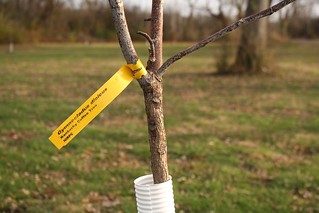
The Lake County Parks people have been very busy lately around Big Maple Lake, and now the old Chester place has a grove of saplings in what used to be the back and side yard.

2021-11-25. Chester's grove
(Click on images to enlarge)

There is an interesting variety of trees: Kentucky Coffee Tree (I don't know much about trees, I just read the labels):

2021-11-25. Kentucky Coffee Tree

This one is Black Cherry:

2021-11-25. Black Cherry

And this is Ohio Buckeye:

2021-11-25. Ohio Buckeye

And Pin Oak:

2021-11-25. Pin Oak

In another ten or twenty years, I expect, Chester's Grove will be lovely.

Along the gravel road that leads back of the lake, they have planted some Cucumber Trees. I am looking forward to seeing how those turn out.


In other tree news, I discovered a little volunteer oak sapling in my field. From the looks of it, I had run over it with my brush mower last spring (maybe the spring before, too), not even realizing it was there. But now I have marked it so I will never run over it again.

Tuesday, November 9, 2021

The Maples on the Old Chester Place

I stopped by the old Chester place late yesterday afternoon to photograph the lovely foliage of the maples there.

This shot would have been impossible a year ago, when the house was still standing:

2021-11-09. Maples through house
(Click on images to enlarge)


Looking east along Ainsworth Road:

2021-11-09. Maples along Ainsworth


The side yard, and the setting sun shining through the leaves:

2021-11-09. Maples in the sun


The back yard, looking toward Big Maple Lake:

2021-11-09. Out back


Maybe someone who actually knows something about trees can tell me if any of those are old enough to have been planted by a Chester. Maybe they are the Wasy trees, I don't know.

Thursday, October 7, 2021

Tressy's Secret

Theresia Chester
(Click on image to enlarge)
Image courtesy of the Hobart Historical Society.


When a stranger named Mandy Haggerty contacted me out of the blue to tell me that her grandfather was Theresia Chester's illegitimate child, I was astonished. Tressy? Who would ever have thought…?

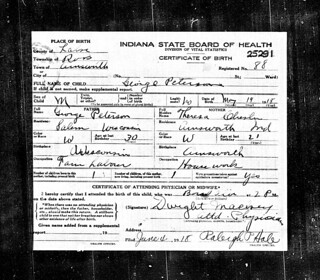
But the birth certificate is easy enough to find, if only I had known to go look for it. I wonder that I did not stumble across it before in all these years of research.

2021-10-07. George Peterson Jr. Birth Certificate 1918-05-14
(Click on image to enlarge)
Image from Ancestry.com.


The father, George Peterson, was born December 24, 1888, somewhere in Wisconsin (sources vary). His parents, Danish immigrants, were farmers (1900 Census, and I am relying on Mandy's research for his background, since a guy with a name like George Peterson — well, you have to have a special interest in him to do the work of separating him from all the other George Petersons). At about 20 years of age George married for the first time and had a child; the 1910 Census shows him living in Chicago with his in-laws. I do not know what became of that marriage. George somehow found his way down to Ross Township. When the Great War broke out and he had to complete his draft card on June 5, 1917, he described himself as single (WWI Draft Cards). He was working as a hired hand on the farm of Nicholas Fleck, Jr.

Living in Ross Township, he not surprisingly came to know Tressy Chester. She was about ten years his junior.

What is surprising about this episode is that throughout the late autumn of 1917, and the winter and spring of 1918, none of the local papers mentioned a word about Charles Chester's taking any legal action against his daughter's seducer — or even illegal action, as might be the first impulse of the hot-headed Charles.

To his credit, Charles apparently did not do anything against his pregnant daughter, either. It was probably under his roof, on May 14, 1918, that George Jr. was born. As noted on the birth certificate, George Sr. was then residing back in his home state, Wisconsin.

We have no way of knowing how Tressy felt about giving her child up for adoption. The fact that birth certificate recorded a name rather than just "baby boy" would suggest emotional attachment — but I ought not to subject Tressy to my amateur psychologizing.

At that time and place, of course, her keeping the child as a single mother would have come at a very heavy social cost. As to letting her parents raise the child as their own — as the Ols family had done with little Lela — well, Charles and Constance were both about 46 years old at that time; I suppose they could have brazened it out if they'd really wanted to. But that didn't happen.

The child having been adopted out, Tressy's life resumed all appearance of normality. As we know, in September 1919 she married Robert Shaw. The ceremony took place in Holy Name Cathedral in Chicago. The bride wore white crepe de chine and was attended by her sister, Jennie.[1]

Our knowing what we know now makes it all the more poignant that the first child of that marriage, a little boy names James, died shortly after birth (Cook County, Illinois, Deaths Index). Robert and Tressy went on to have two more sons whom they raised to adulthood.

I wonder if Robert knew about Tressy's first child?

The Chesters kept quiet about it all even within the family, it seems. In contrast to the Ols descendants, to whom the story of Jennie and Lela was just a part of family history, none of the Chester descendants I'm in touch with knew anything about Tressy's secret. The story was equally unknown among the descendants of Tressy's baby. Mandy Haggerty needed an Ancestry.com DNA test, with its suggestions of possible relatives, as well as the help of a "search angel," to figure out that the grandfather she knew as Donald Robert Haggerty had come into the world as George Peterson, Jr.

I will talk about him and his adopted family in a future post.

_______________
[1] "Hobart," The Times (Hammond, Ind.), 5 Sept. 1919.

Thursday, September 23, 2021

Frederick and Fredericke

2021-09-23. Suhr, Fredericke and Frederick
(Click on image to enlarge)
Fredericke and Frederick Suhr. Images from findagrave.com.


Returning to the Harms 73rd Avenue farm, we left off in 1873 when Mary Chester bought the lower forty of the 80-acre parcel.

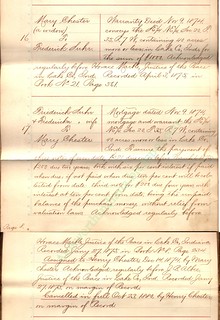
In September 1874, Mary lost her husband, Charles. In November, she sold her 40 acres to a German immigrant family by the name of Suhr, lending them $921 of the $1,000 purchase price.

2021-09-23. 1874 Chester to Suhr - Harms Abstract of Title
(Click on image to enlarge)
Image courtesy of the Eldon Harms family.


I did not recognize that name at first, but I should have: from the early days of this blog, when I was researching the Chester Cemetery, as that is the final resting place of the couple who bought these 40 acres. Back then, I was able to find very little information on them: just the 1880 Census showing Frederick and Fredericke, along with their 27-year-old son, Henry, farming somewhere in Ross Township.

Since 2009, I have discovered findagrave.com, which, through the collective effort of many people, has become a remarkable resource. From information there, I can now fill in some of the missing background, as well as post photos of the Suhrs (above) from the same source.

Frederick and Fredericke (Lichtwarle) Suhr had been married in Germany, their native land, where Frederick worked as a miller. (It was Fredericke's second marriage; her first had produced one son, Charles Schmidt, named for his father.[1]) They came to the U.S. in 1870, evidently just missing the census, and brought with them their three children: Fredrika, Henry, and Emma.[2] They lived in South Chicago at first, but, as we see from our documents above, by 1874 the family moved to Indiana.

Their children all married — most importantly, Emma, in 1887, to Conrad Bender, a man prominent enough in Porter County to rate a biographical sketch in a regional history book, whence I have gleaned some of this information.[3] The other children, Fredrika and Henry, appear to have spent much of their married lives in Illinois.

The Suhrs evidently did well enough on their farm to pay off their mortgage by 1880.

In 1882, at only 65 years of age, Fredericke Suhr died. She was buried in the Chester Cemetery, west of their farm. Frederick then sold the farm and left Indiana to spend the next 15 years in Illinois, probably with one or both of his married children there. He died in 1897, and they brought his body back to Ainsworth, to rest beside Fredericke.

Through their daughter, Emma Bender, their descendants were spread around northwest Indiana. Emma, who died in 1918, was survived by seven children: "Edward F. Bender, of Gary; Mrs. Martha Lute, of Hobart; Mrs. Ida Schenelter of Crown Point; Mrs. Bertha Malone, who lived with her mother in Hobart; Albert C. Bender and Frank J. Bender, who live on and operate the Bender farm in Portage township and Walter F. Bender, of Chesterton."[4]

♦    ♦    ♦

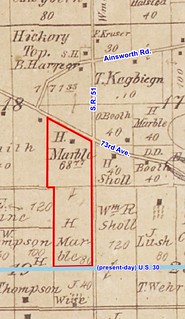
The real estate transaction we're looking at brought up two other names I recognize from past posts. The mortgage of the land in October 1874 was acknowledged before Justice of the Peace Horace Marble, whose 140-acre parcel just south of Ainsworth included the cemetery. (He was listed there, as a farmer, in the 1870 Census, but by 1880 had moved to Hobart and become a "commission merchant.")

2021-09-23. Marble, H., 1874
(Click on image to enlarge)
The Horace Marble farm as it appeared on the 1874 Plat Map. Hickory Top had not yet been renamed "Ainsworth."


The assignment of the mortgage, in December 1874, by Mary Chester to her son, Henry, involved J.P. Jesse B. Albee.

_______________
[1] Pictorial and Biographical Record of La Porte, Porter, Lake and Starke Counties, Indiana. Chicago: Goodspeed Brothers, 1894.
[2] "Long Illness Proves Fatal to Mrs. E. Bender," Vidette-Messenger (Valparaiso), Oct. 20, 1933 (transcribed at findagrave.com).
[3] Goodspeed (1894).
[4] "Long Illness Proves Fatal," 1933.

Sunday, August 22, 2021

Heartbreak, Nebraska

In our tracing of the history of the Harms farm on 73rd Avenue, we left off in May of 1869, when Jacob and Hannah Smith had just bought back the 80-acre parcel from the estate of their deceased son, Luther.

In October 1869, Jacob and Hannah sold those 80 acres to their only surviving son, Charles L., for $1400.

2021-08-22. Smith, Charles, 1869-10-27
(Click on images to enlarge)
Images courtesy of the Eldon Harms family.


Charles, in turn, immediately gave his parents a lifetime lease on the northern half of that parcel, along with a pledge of support in the amount of $800, if needed.

2021-08-22. Smith, Charles, 1869-10-27 lease

Possibly Charles was farming the southern half for himself.

Not quite a year later, Charles gives up all ownership of the 40 acres his parents were farming.

2021-08-22. Smith, Charles, 1870-10-11

From this transaction we learn that Charles, now about 33 years old, was a single man.

In 1873, Charles — who is now in Clay County, Iowa — sells the southern 40 acres back to Mary Chester (who, with her husband, had sold the land to Charles' parents in 1857).

2021-08-22. Smith, Charles, 1873-03-24

Thus we learn that in the two and a half years between October 1870 and March 1873, Charles had found and then lost a wife. I have no idea who the wife was. I can't identify any record during these years of Charles' marriage. Of course, my galloping imagination races to the conclusion that he left Indiana to get away from the heartrending memories after his wife died. But he may have married her in Nebraska. I just don't know.

A year later we find Charles in Hamilton County, Nebraska, as he recruits James Sanders to collect his mortgage money from Mary Chester.

2021-08-22. Smith, Charles, 1874-12-08

In 1876 Charles married Mary Jones,[1] who apparently had had an earlier marriage with at least one child (1880 Census). But previously Charles had entered yet another marriage, according to the 1910 Census, which notes that Charles was on his third marriage and Mary her second. So between 1873 and 1876 Charles may have suffered heartbreak yet again.

♦    ♦    ♦

Albert Van Doozer, who bought the northern 40 acres, is a bit of a mystery. We encountered him for the first time in my earlier post about the Smith family, when (for quiet-title purposes, I believe) he wrote letters saying that he had been "well acquainted" with the late Jacob and Hannah Smith and their late daughter-in-law, Sarah.

I don't know how he became acquainted with this family of farmers, or what he wanted with farmland: he doesn't seem to have been the farming type himself. Born in New York in 1838, he shows up in the 1850 Census as a city boy, living in Buffalo, New York. His father was a joiner. Then I lose track of him until 1866, when he marries Emma Bevans — but the marriage is recorded in both Lake County, Indiana and Cook County, Illinois.

Not coincidentally, I'm sure, this was the same Emma Bevans, or Bevins, who had appeared in the 1850 Census living in the household of Jacob and Hannah Smith. She was a native of Canada. How and why did she get to Ross Township, Indiana, and into this particular household? I have no clue.

In the 1880 Census, Albert and Emma were living in Chicago and he worked as a shoemaker. By 1900, they were living in Wheatfield, Jasper County, Indiana; Albert described himself as a watchmaker. Ten years later, in the same town, he owned a jewelry shop. In 1920, at the age of 81, he was still a jeweler, still making watches, but Emma had died. Albert lived only three more years and was probably making watches to the end.


_______________
[1] Ancestry.com. Nebraska, U.S., Select County Marriage Records, 1855-1908 [database on-line]. Lehi, UT, USA: Ancestry.com Operations, Inc., 2017.

Saturday, July 10, 2021

Death and Dollars

When we left off with the Harms 73rd Avenue farm, Charles Chester had just bought those 80 acres.

That was August 1856. Some seven months later, in March 1857, Charles and his wife, Mary, sold the land to Luther and Sarah Smith for $900. The purchase was financed with six promissory notes coming due at intervals over the next six years, their payment secured by a mortgage.

2021-07-10. 1857 Harms Abstract of Title 003 a - Chester sale to L. Smith, mortgage
(Click on image to enlarge)
Image courtesy of the Eldon Harms family.


The Smith family and the Chester family had been neighbors for a few years before this sale. If we look at Early Land Sales, Lake County, we find that in May of 1850, Charles and Mary Chester bought the northwest quarter of Section 17. The following year, Jacob and Hannah Smith (Luther's parents) bought the adjacent northwest quarter of the northeast quarter — that is, the land where someday Henry Chester would build his brick farmhouse.

Chester 1850, Smith 1851 on 1874 map
(Click on image to enlarge)
This image is from the 1874 Plat Map.


The Smiths had been in Ross Township early enough to be counted in the 1850 Census: Jacob, 49, a native of Connecticut; his wife, Hannah, also 51, born in New York; and their children, Luther and Charles L. (16 and 13, respectively, and both born in Ohio), plus a 19-year-old woman named Emma Bevins, of Canadian birth. They were recorded with only one intervening entry between them and the Chester family, so perhaps the Smiths were renting farmland nearby.

In 1854, Luther Smith married Sarah Maxwell (Indiana Marriage Collection), who was only about 15 years old.[1]

Then in 1857 comes this sale to Luther and Sarah of the Chester 80 acres along Randolph Street. And that is where the 1860 Census finds them, with their children, Emma (5), Albert (2), and Sarah (10 months). Also in the home were Luther's parents, Jacob and Hannah.[2]

The mortgage on the land was cancelled in 1861, a year before the final promissory note was due. It may have been paid off early with money raised through what happened in 1859: Luther gave his parents a life-long lease on the land, for which they paid him $600.

2021-07-10. 1859 lease
(Click on images to enlarge)
This image and the images below courtesy of the Eldon Harms family.


In January 1865, Luther enlisted in the Union Army. By August of that year he was at home (not discharged yet, so perhaps on leave, possibly due to poor health). On August 10, he died.

He had made no will, and it seems that for a few years, his survivors went on farming that land together peaceably, not even seeking to have Luther's estate probated. But in 1868, something began to stir, and that's when the county court finally appointed an estate administrator.

2021-07-10. 1868 estate administrator
(Click on image to enlarge)
Image courtesy of the Eldon Harms family.


And in 1869 Jacob and Hannah sued the estate for the return of the $600 they had paid Luther ten years earlier.

2021-07-10. 1869 suit

The 1859 transaction between them and their son, they said, wasn't just a lease for $600. It was a promise of a home: "these claimants were to live with said Luther Smith upon said premises and help to till the same and to share the benefits thereof throughout their natural lives," and if ever Luther sold the farm out from under them, Jacob and Hannah would get their $600 back. But that provision was not included in the lease "through a misunderstanding of the Justice [of the Peace] drawing said agreement, and through their own ignorance of the modes of doing business and the force of written contracts."

Reading between the lines of the last paragraph, it sounds as if, in August of 1865, Luther did not expect to recover from his sickness — he and his parents "talked over" these arrangements, "and the final understanding was that in the event of his death the farm must be sold." He did die, as we know, but the farm wasn't sold, and his parents went on without their $600 for several years.

I wonder if Sarah — still a young woman — was getting restless around 1868, wanting to sell the farm, take her share of the money, and move on with her life somewhere else.

A sympathetic court decided that the lease of the farm should be cancelled, and the $600 returned to Jacob and Hannah.

2021-07-10. 1869 ruling

The estate administrator then petitioned the court to be allowed to sell the farm, and summarized the estate:

2021-07-10. 1869 summary

After the required publications to advise potential buyers, the sale went forward. And Jacob and Hannah bought the farm.

2021-07-10. 1869 report of sale

Luther's widow and four minor children received a total of $506.22 from the estate (about $10,000 in today's money).

2021-07-10. 1869 summary

The estate administrator duly conveyed the land to the elder Smiths.

2021-07-10. 1869 transfer of title

Sarah may have moved on with her life, but unfortunately she did not have much life left. According to the penciled note in the bottom margin of page 6 of the abstract, above, "Sarah P. Smith died Aug 9th 71." Perhaps that was written circa 1896, when Henry and Johanna Harms were buying the land. But a statement from 1878 says approximately the same thing:

2021-07-10. 1878 statement re Sarah Smith

By 1877, Jacob and Hannah had died too.

2021-07-10. 1877 statement re Jacob and Hannah Smith

Concerning the four minor heirs of Luther's estate, someone jotted notes on the abstract, again probably circa 1896: Emma, Elbert, and Ambrose were dead; Adna was living in Denver (where he is now buried). The little Sarah from the 1860 census is unaccounted for; she may have died in infancy. The rest of Luther's survivors named in the abstract are a mystery to me — their lives, their deaths, their final resting places.

Luther Smith himself is buried in the Woodvale Cemetery, but he is not alone. His and Sarah's son rests there too — a two-month-old infant, named Jacob for his grandfather.

_______________
[1] I don't know much about Sarah's family of origin. Her marriage is the earliest record I can find of her locally.
[2] The other son, Charles L., was not in the household and in fact I can't find him in 1860, but we will hear from him again.

Tuesday, May 18, 2021

Episodes in the History of the Harms' 73rd Avenue Farm

Thanks to the Harms family, I have a copy of an abstract of title to the second farm owned by Henry and Johanna (Anna) Harms. It comprised 80 acres on the west side of Randolph Street, straddling 73rd Avenue. They bought it while still living on the old Harms place.

The abstract starts with the 40 acres that lie on the northwest corner of the intersection of Randolph Street and U.S. 30, marked here on Google satellite view (and I hope I got the upper boundary right):

2021-05-18. Satellite view of SE 1-4 NE 1-4 sec 20 twp 35 n range 7 west
(Click on image to enlarge)

The first page tells us that those 40 acres (plus the 40 acres lying immediately north) were bought by Zachariah Elliott from the U.S. government (at the Winamac land office on January 10, 1852.

That would seem to indicate that Zachariah was the first private owner since the Potawatomi ceded the land to the federal government. Occasionally you find abstracts of title that actually give the name of the Native American who signed the treaty whereby the land was transferred. Unfortunately, this isn't one of them.

After holding the land for nearly two years, Zachariah sold it to John D. Willson (or Wilson).

2021-05-18. Elliott, Zachariah 1852 to John Willson 1853
(Click on image to enlarge)
Image courtesy of the Eldon Harms family.


I cannot positively identify either of these men in census or any other records besides land-sales records. I don't know where they came from, why they bought land in Lake County, or where they went afterward.

I love the name of the justice of the peace involved in the second sale — Socrates Griswold. Him I can find in the 1850 Census, a Vermonter born in 1807, living and farming in eastern Ross Township. Early Land Sales, Lake County shows him buying up some 230 acres in the same general area throughout the course of 1853. But he didn't stick around: by the 1860 Census, he had moved to Valparaiso and become a drayman.[1]

The next sale, in 1856, brings up a name we know.

2021-05-18. Willson, John to Chester, Charles 1856

This Charles Chester is not, of course, Truculent Chuck, but his grandfather. We don't know much about this Charles. From the biographical sketch of his son, Henry, we learn just a little about this Charles and his father:
His [father], John Chester, was a native of England, whence he came at an early day to Pennsylvania, and for seven years fought in the ranks of the patriots in the Revolutionary war, becoming an officer in the Continental army. He saw and talked with General Washington and was a prominent man. His son Charles, father of Henry, was born in Pennsylvania, and came out to Lake county, Indiana, as a pioneer in 1847, living here until his death in 1874. He married Mary E. Price, a native of Pennsylvania and of German descent, and they were the parents of two daughters and one son that reached maturity.
From the stones in the Chester Cemetery, we learn that Charles lived from 1798 to 1874, and Mary Price Chester from 1811 to 1878.[2]

Here is the first appearance of the Charles Chester family in Ross Township, in the 1850 Census:

2021-05-18. Chester, Charles, 1850 Census
Image from Ancestry.com.

There are three children: Rebecca, Henry, and Roxanna.[3] In December 1850, Rebecca married George Miller in Lake County, Indiana. They lived in Hobart Township (1860), then moved to Ross Township (1870), where they and their children lived on a farm somewhere southwest of Merrillville (to judge by their neighbors). By 1880 it appears they had moved to Black Hawk County, Iowa; there Rebecca died in 1881.

In July 1856 Henry Chester married Harriet Perry, daughter of Ezekiel and Olive Perry of Porter County. The Perrys are recorded in the 1850 Census farming in Center Township; by 1860 the parents had moved to Union Township. We need say no more about Henry: so much of this blog has been devoted to him.

Not quite two months later, in August 1856, Roxanna married her brother-in-law, Allen Perry (some 14 years her senior). They remained in Ross Township through the 1860 Census, but then moved to Black Hawk County, Iowa. (I wonder if things got awkward after Henry and Harriet divorced.)


To be continued.

_______________
[1] In 1856 he married Mary Frasier in Porter County (Indiana Marriage Collection). They remained in Valparaiso through the 1870 Census; the 1880 Census records them in Wisconsin, apparently visiting a niece; but they may have settled there, because both Socrates and Mary died there in December 1893, within a few days of each other. And I wonder if there is a story behind that.
[2] Someone has posted a photo of a Mary Chester on the findagrave.com entry, but unfortunately the photo is not of Mary Price, Charles' wife, but Mary Baird, the third wife of Charles' son, Henry.
[3] The wording of the biographical sketch quoted above suggests that Charles and Mary had at least one other child that did not live to maturity, but I can't find any information about any such child.

Sunday, April 4, 2021

Happy Easter

2021-04-04. Crocus at Henry Chester house
(Click on image to enlarge)

Wednesday, March 24, 2021

The End of the Road for Henry Chester's House

After 140 years, Henry Chester's fine brick house is slowly but surely coming down.

2021-03-24. Henry Chester house demolition
(Click on image to enlarge)

Sunday, November 1, 2020

Jim's Bad Day on the Dunes Highway

James Chester's first time ever driving on the newly opened Dunes Highway did not go well.

2020-11-01. Jim Chester, News, 11-29-1923
(Click on image to enlarge)
"Local and Personal," Hobart News, Nov. 29, 1923.


An item in the same column tells us that an infant daughter of Leo and Augusta (Buchfuehrer) Fifield was seriously ill. Clara Mae Field had been born August 14, 1923 (delivered by Dr. Clara Faulkner). Fortunately, Clara survived her illness and shows up alive and well in the 1930 Census and beyond.

2020-11-01. Fifield, Clara, 1941 senior photo
(Click on image to enlarge)
Image from Ancestry.com.

Saturday, May 23, 2020

Road Trip #Whatever, I've Lost Count

Those enthusiastic road-trippers, Charles and Constance Chester, hit the road again in the autumn of 1923.

2020-05-23. Road trip, News, 11-15-1923
(Click on image to enlarge)
"Local and Personal," Hobart News, Nov. 15, 1923


Sela Chester was one of Charles and Constance's children; he was about 24 years old.

Raymond and Maud McClain, Constance's brother and sister-in-law nephew and his wife, had traveled with the Chesters on a 1,000-mile road trip in 1919.

Mamie Hull was the teenaged sister of Charles and Constance's son-in-law, Homer.

Tuesday, January 28, 2020

Cantankerous Hank and Truculent Chuck

While searching for something else, I came across information about another bad day for Henry and Charles Chester, among unnamed others. This one happened sometime around late August of 1898.

2020-01-28. Chester, CPRegister, 9-2-1898
(Click on image to enlarge)
Crown Point Register, Sept. 2, 1898.


I will try to fill in the details: Homer L. Iddings, as "Superintendent" of something (I don't know what; he was also Ross Township trustee at that time), had ordered that a drainage ditch be built along the Chicago & Grand Trunk Railroad,[1] which crossed Henry Chester's land. Henry Chester had some objection to that. When the men building the ditch came onto his land to do their work, he and his sons, including Charles,[2] attacked them.

Or his sons did, anyway; it seems Henry himself was found not guilty:

2020-01-28. Chester, CPRegister, 9-16-1898
(Click on image to enlarge)
Crown Point Register, Sept. 16, 1898.


In the next column over, the Merrillville correspondent is sorry to see the end of this exciting case … and further down, we see that the ditch-diggers are continuing about their business.

The last I heard of this case was this item in the "Hobart News" column of the October 21, 1898 Crown Point Register: "H. Merril has commenced suit against Hank Chester for permanently disabling him on the occasion of the late ditch melee. Merril asks $3,000 damage." Whether he got any part of $3,000, I don't know. This is the first evidence I have that anyone ever called Henry Chester "Hank." I have no evidence that anyone ever called Charles Chester "Chuck."

♦    ♦    ♦

I tried but failed to positively identify the two ditch-diggers.

The H.G. Merrill might possibly have been H.C. Merrill — Henry Cass Merrill, one of the Merrill brothers, born (1852) and raised in Ross Township; but by 1880, it appears he had left the area and was never again counted in a Ross Township census. The 1900 Census shows him living in Chicago and working as a bank clerk.

As for the other man, who is variously referred to as "Hartner," "Hartnip," and "Hartman," he might have been Edgar Hartnup of Hobart, who was described in the 1900 Census as a 46-year-old day laborer. If not, I'm out of ideas.


_______________
[1] "H.G. Merrill has the C. & G.T.R. ditch completed and will now commence on the Hayward-Goodrich ditch." "Merrillville," Crown Point Register, Oct. 21, 1898.
[2] An item in the "Additional Locals" column of the Hobart Gazette of October 14, 1898, mentions that Charles Chester of Ross Township had recently been through a criminal trial.


Sunday, September 29, 2019

The Hay Press and George Bodamer

Hay press runs over George Bodamer, ruptures an artery in his leg. If it was the femoral artery, he could easily have bled to death. He gets first aid, then — goes to the hospital? Not George!

2019-09-29. Bodamer, Gazette, 9-7-1923
(Click on image to enlarge)
"Local Drifts," Hobart Gazette, Sept. 7, 1923.


I think this is the George Bodamer who first separated my 3.5 acres from the Chester land. I hope it is, since I'm now going to spend some of my precious time researching him.

He, like Benjamin, was one of the children of Christopher (aka Christian) and Elizabeth (Lortz) Bodamer. (For a little background information on those two, visit Christopher's entry on findagrave.com.)

George was born in Indiana on October 12, 1853 (Indiana Death Certificates) — about the time the family came to Lake County from New York. The 1860 Census records the family farming in Ross Township. I can't find them in the 1870 Census, but the 1876 plat map of Union Township, Porter County, shows them owning 80 acres:

2019-09-29. Bodamer Union-1876
(Click on image to enlarge)
Image from https://www.inportercounty.org/Data/Maps/1876Plats/Union-1876.jpg.


And that is where the 1880 Census places them.

On June 3, 1885,[1] in Porter County, George Bodamer married Christina Frederika (Gross) Stoeckert, widow of George Stoeckert. The next record we have of them is the 1900 Census, which shows George and Frederika (or Freeda) owning a farm in Ross Township. To judge by their neighbors, it is in the vicinity of these Bodamer parcels that appear on the 1908 Plat Map:

2019-09-29. Bodamer Ross-1908

All of this land (and more) had been owned by C.F. Bodamer in 1891, per the 1891 Plat Book.

The 1900 census shows George and Freeda with three children: Elizabeth (14), Christopher (12), and Henry (9).

In April 1901, Christine Frederika Gross Stoeckert Bodamer died.

2019-09-29. Bodamer, C.F., Gazette, 4-5-1901
(Click on image to enlarge)
Hobart Gazette, Apr. 5, 1901.


I can't account for the six children mentioned in the obituary vis-à-vis the three in the 1900 census; the others were probably from her previous marriage.

On March 19, 1904,[2] George's daughter Elizabeth married Earl Blachly. (The marriage did not last.)

I cannot find George Bodamer at all in the 1910 Census. One son, Christopher, was farming on the old Bodamer place in Union Township, Porter County, living with his grandmother; the other son, Henry, lived in Wheeler in the home of a Walsh family and worked in a mill.

The "Local Drifts" in the Hobart Gazette of April 3, 1914, included this item: "James Chester has sold four acres off the old Flaherty farm to Geo. Rodamer for $525." If "Rodamer" is a misprint for "Bodamer," that could be our George. Looking on the 1908 plat map image above, we see below the Bodamer parcels two parcels belonging to Hy. Chester and T.&E. Flaherty. Henry Chester apparently bought those ten acres from a D. Flaherty around 1891 (1891 Plat Book). After Henry's death in 1910, his son James may have owned that land at the south end of S. Hobart Road.

Later that year, George's older son, Christopher, shows up in Michigan marrying a Lavina Hilliker.[3] It appears that Christopher and Lavina settled and lived out their lives in Michigan.

In October 1915, George's younger son, Henry, married Minnie Baessler. By the 1920 Census, the two of them were living in Gary, so Henry must be the son in Gary to whom George went with his ruptured artery in 1923.

I cannot find George in the 1920 census, and (spoiler alert!) he died in 1929 (Indiana Death Certificates).

_______________
[1] Indiana Marriage Collection; other sources say June 4.
[2] Indiana Marriage Collection; March 23, 1904, per "General News Items," Hobart Gazette, Apr. 1, 1904.
[3] Ancestry.com. Michigan, Marriage Records, 1867-1952 [database on-line]. Provo, UT, USA: Ancestry.com Operations, Inc., 2015. Original data: Michigan, Marriage Records, 1867–1952. Michigan Department of Community Health, Division for Vital Records and Health Statistics.