Showing posts with label Scharbach. Show all posts

Friday, June 12, 2020

The Dunes Highway Opens

Construction on the Dunes Highway had started in 1922. By mid-November 1923, the Highway was ready to be opened to public use. The dedication ceremony would be attended by some prominent Hobart citizens.

2020-06-12. Dunes Hwy, Gazette, 11-9-1923
(Click on image to enlarge)
Hobart Gazette, Nov. 9, 1923.


The following week's Gazette reported that the ceremony included an odd incident that was resolved with "a bottle" …

2020-06-12. Dunes Hwy, Gazette, 11-16-1923
(Click on image to enlarge)
Hobart Gazette, Nov. 16, 1923.


… which I'm inclined to interpret as a flouting of Prohibition, which (as we know) was not uncommon — but this case would be uncommonly open and public.

The "Local Drifts" of the same issue mentioned that "Paul Bruebach of this city was a member of Perry's Municipal Band that furnished music last Friday afternoon at the dedication of the Dunes Highway."

Incidentally, in spite of the November 9 issue's giving November 14 as the planned date of the ceremony, and the inclusion in the Route 12 Wikipedia entry of a picture of a historic marker also giving November 14 as the date of the highway's opening, the two November 16 items name "Friday," that is, November 16, as the date of the ceremony. So does this article from the Hobart News of November 22, 1923:

2020-06-12. Dunes Hwy, News, 11-22-1923
(Click on image to enlarge)
Hobart News, Nov. 22, 1923.


The "Local and Personal" column of the same issue mentioned a few more locals who attended the ceremony: "Paul Emery, W.J. Killigrew, Evan Roper, Leslie Walters, A.J. Smith, O.L. Pattee; and John Dorman and Alex Boyd of Ross Township."

In the November 22 issue above, an article in the second column to the right mentions a "Bootjack extension" that was planned to connect the Dunes Highway and the Lincoln Highway. An online article about the Lincoln Highway in Indiana includes a map from 1924 showing the "Boot Jack Corner" near Rolling Prairie, and even today in that vicinity there is an "East Bootjack Road." Add this to the collection of random facts I have learned accidentally since I started the blog.

♦    ♦    ♦

Also in the November 22 issue, we see an announcement of a law-and-real-estate partnership between F.E. Demmon and C.L. Fleming. We've already met Calvin L. Fleming, former cigar-maker and billiard-room operator, now concentrating on real estate. The lawyer would be, I suppose, Floyd E. Demmon, whom the 1920 Census records as a 28-year-old lawyer for an unnamed railroad, living on Cleveland Avenue with his mother-in-law, Harriett Mundell. Floyd had married Alice Mundell in 1918 (Cook County, Illinois, Marriages Index).

Monday, October 14, 2019

The Scharbach-Kramer Wedding Party

Long ago, I posted a photo of Louis Kramer on the morning of his wedding to Myrtle Scharbach, getting a haircut from Hazard Halsted. Later I posted a newspaper account of the wedding.

Now, thanks to a modern-day Scharbach, the Hobart Historical Society has a photo of the whole wedding party.

2019-10-14. Scharbach004
(Click on image to enlarge)
Image courtesy of the Hobart Historical Society.


Mr. Scharbach knew only the identities of the bride and groom. To identify the rest of the wedding party, who were all named in the newspaper story, we have to use other means. So, I believe we have, standing, from left to right: Florence Ewigleben (by process of elimination), Elmer Scharbach (cousin of the bride and looks a bit like her), George Kramer (brother and spitting image of the groom), Erna Piornack (confirmed by living relatives), and Mary Grace Barnard.

Florence Ewigleben was related to the bride: Myrtle Scharbach's mother, Caroline, had been an Ewigleben. Florence was born in 1906 to Fred and Tillie (Blanchard) Ewigleben. In 1927 she would marry Erna Piornack's brother, George (Indiana Marriage Collection).

Elmer Scharbach, born 1906, was the son of Emil and Emma (Busse) Scharbach.

George and Louis Kramer were sons of Conrad and Louise (née Wischman).

I do not know if Erna Piornack was actually related to the bride or anyone else in the party, or just a good friend. As I mentioned above, she was Florence Ewigleben's future sister-in-law.

As for little Mary Grace Barnard of Mishawaka, her mother was born Gertrude Scharbach. Gertrude's father was Frank — the bride's uncle — and her grandfather William Sr. of the lumber yard.

Saturday, August 12, 2017

Lumber and Groceries of Yore

The news of Allie Mason's death in February 1923 including some new information (new to me!) about Hobart's past.

2017-8-12. Alfaretta Dickerson Mason obit
(Click on image to enlarge)
Hobart Gazette 23 Feb. 1923.


From the Illinois Deaths and Stillbirths Index, we learn that Allie's given name was Alfaretta. Her father was David Dickerson; her mother's maiden name was Tilitha McClosky.

Going by the 1895 Sanborn map, I guess the Dickerson lumber yard/grocery was about where the American Legion post is now — 208 S. Linda Street.

In one of the Hobart Township Trustee's account ledgers that I've indexed, we find D.H. Dickerson supplying a broom for a school in 1874 …

2017-8-12. Dickerson HTTA1859-075-18740212
(Click on image to enlarge)
Image courtesy of the Hobart Historical Society.


… and in 1875, lumber for a bridge over Duck Creek.

2017-8-12. Dickerson HTTA1859-083-18750319
(Click on image to enlarge)
Image courtesy of the Hobart Historical Society.


And in the Indiana Marriage Collection, we find Alferetta Dickerson marrying George D. Mason on March 6, 1877.

If the Dickersons did indeed move to Hobart in the 1860s and were still around in the mid-1870s, you would expect to find them in Hobart in the 1870 Census … but instead we find them in Allen County, Ohio: David H. and Talitha, with daughters Marietta and Alfaretta, and sons Franklin and Wellington. In the 1880 Census, Talitha, now widowed, is living in Putnam County, Ohio. Marietta, unmarried, is still with her; so are the married Alfaretta and her two-year-old daughter, Grace (where's George?), as well as two male boarders.

I can't find the Dickerson family at all in the 1860 Census.

My theory is that the Dickersons moved to Hobart only for a few years between 1870 and 1880. More than forty years later, someone's memory misplaced the Dickersons in the 1860s.

Monday, December 7, 2015

Oklahoma!

Just out of high school, Leona Raschka dashed off to spend June 1922 in Oklahoma, of all places. According to a brief genealogy at findagrave.com, Grace Short was the daughter of Leona's father's sister, but I have no clue who the "relatives and friends" in Oklahoma were.

2015-12-7. Leona Raschka goes to Oklahoma
(Click on image to enlarge)
Hobart News 8 June 1922.


I wonder whence the strawberries would come for the social in the Ainsworth school — from Jake Yager, perhaps, or the Carlson brothers?

The item about little Elmer Palm's christening is interesting to me because this could well be the celebration memorialized in the photo in Mildred Lindborg's album.

♦    ♦    ♦

On the morning of June 7, 1922, Hazard Halsted performed an immortalized haircut, and that afternoon Louis Kramer and Myrtle Scharbach were married.

2015-12-7. Kramer-Scharbach wedding
(Click on image to enlarge)
Hobart Gazette 9 June 1922.


The front page of that issue mentioned Lee & Rhodes' "fine new delivery car" with no further details, alas, and yet another dance at the old Deep River schoolhouse, but it also had some interesting stories about nobody we know, such as a false report of a mass drowning, and a pastor ejected from a church for assault and battery:

2015-12-7. Lee and Rhodes new delivery vehicle
(Click on image to enlarge)
Hobart Gazette 9 June 1922.

Saturday, November 7, 2015

A Triangle, Two Rectangles, and a Little Sunshine

Albert Verplank ventured into the business world of Hobart in May 1922, when he purchased the "triangle" bounded by Main, Center, and Front Streets. The seller's name was given as William Foreman; I assume he was the Hobart William Foreman, not the Ainsworth one. (See "Albert Verplank Buys Triangle of Wm. Foreman For Sum of $2,000," Hobart News 25 May 1922.)


Elsewhere, we find the Scharbach lumber people building large rectangular signs for the McAfee woods campground, one of which will be placed along the Lincoln Highway south of Ainsworth — which makes sense; with that highway being closed for construction, why not send the detoured traffic to the Yellowstone Highway?

2015-11-7. Signs
(Click on image to enlarge)
"Local Drifts," Hobart Gazette 26 May 1922.


Two weeks after being stolen, John Killigrew's car is still missing.

I believe the Ed Sauter leaving Gary for South Bend and its Studebakers is Edward Sauter, Jr., now almost 30 years old. I haven't been able to find him in the 1920 Census, but we know he was living and working in Gary when the U.S. entered World War I (WWI Draft Cards).

George and Pearl (Severance) Yager were celebrating the christening of their little "Sunshine," born January 25, 1922.

Thursday, May 7, 2015

Superior Farms and Certified Milk

Jumping around in time as I do with the blog, I've long associated the Gruel farm with the name Superior Farms, but apparently it did not get that name until early in 1922:

2015-5-7. Gruel dairy
(Click on image to enlarge)
Hobart Gazette 27 Jan. 1922.


(And apparently Fred Scharbach objected to his mention in the previous week's letter from Canada.)


2015-5-7. Gruel dairy
(Click on image to enlarge)
Hobart News 9 Feb. 1922.


2015-5-7. What is Certified Milk?
(Click on image to enlarge)
Hobart Gazette 24 Mar. 1922.

Thursday, December 18, 2014

Emil Scharbach and Emma Busse

Yesterday we read about an unpleasant experience that involved Emil Scharbach, so today let's look at one of his more pleasant experiences.

2014-12-18. st010
(Click on image to enlarge)
Image courtesy of Eldon Harms.


Emma Busse (sister of Adeline) married Emil Scharbach on June 27, 1903, when she was about 18 and he 20.

August Haase photographed the happy couple.

The Hobart Gazette of July 3, 1903, described the wedding ("Scharbach-Busse Nuptial"):
The German Lutheran church was packed last Saturday evening, June 27th, 1903, to witness the marriage of Mr. Emil Scharbach, son of Mr. and Mrs. Wm. Scharbach, and Miss Emma Busse, daughter of Marshal and Mrs. Gust Busse, both of Hobart. The ceremony was performed by the Rev. Peter Claussen, pastor of the German Lutheran church at Valparaiso, at the hour of eight. The bride was handsomely attired in crepe de chine and carried a large bouquet of roses. The young couple were attended by Miss Martha Busse as Maid of Honor and bridesmaids — Miss Wanda Busse, Miss Lizzie Lentz and Miss Ida Stoltz, and groomsmen — Bernard Scharbach, John Kruse, Henry Bewersdorf and Art Newman.

After the conclusion of the services at the church, the young couple and a large number of relatives and friends assembled at the bridge's home on Main street to celebrate the event. An abundance of everything good to eat and drink was provided for the guests and the occasion was most enjoyable for all.

The bridge received many beautiful and costly presents. The young couple have already begun housekeeping in the Swedish Lutheran parsonage. We join their many friends in extending best wishes and congratulations.

The relatives present from abroad to attend the wedding were: From Chicago — Mr. and Mrs. Henry Sachtbeben, Mrs. Hannah Schroeder, Louis Scharbach and daughter and Mr. and Mrs. Henry Schroeder; From Wanatah — Mr. and Mrs. Herman Busse, Mr. and Mrs. Wm. Stoltz, Mr. and Mrs. Wm. Rozenbaum, Mr. and Mrs. Louis Pratt, Mrs. Wm. Hermann and Emil Lawrence; From Evanston — Miss Ida Busse.

Wednesday, December 17, 2014

The Unpleasantness with the Prohibition Officer

On an October afternoon in 1921, two prominent Hobart citizens mistakenly got into a car chase with a federal Prohibition officer.

2014-12-17. Prohibition officer
(Click on image to enlarge)Hobart Gazette 12 Oct. 1921.*

The story suggests that the officer's car had no markings that would have made it identifiable as such. From what I've read about the early federal Prohibition enforcement effort, I gather it was grossly understaffed, with the officers poorly paid, often untrained and ill equipped.

Above that story, we have the news of the death of William Krausse (father of Carl), who had a more interesting life than I suspected.

♦    ♦    ♦

The "Local and Personal" column of the Hobart News of October 13, 1921, included this item:
O. Amlong and family have moved to the Chester Cooper residence on Lake street and Mr. and Mrs. Otto Maicke of Ainsworth have moved to the Humes flat vacated by Mr. and Mrs. Amlong.
… which leaves me knowing very little except that Ainsworth had lost its Maickes.

___________________________
*This issue of the Gazette is erroneously dated "Friday, Oct. 12, 1921." Friday was the usual day for the Gazette to come out, but that week's Friday fell on the 14th.

Monday, November 17, 2014

Rose and Fritz

I recently came across an article about their wedding (while looking for something else), so I may as well post this lovely wedding photo of Rose Kietzman and Fred (aka Fritz) Scharbach taken by August Haase:

2014-11-17. img946
(Click on image to enlarge)
Image courtesy of the Hobart Historical Society and Fred Ols.


From the Hobart Gazette of 24 June 1910, an article entitled, "Hobart People Marry":
Fred Scharbach, youngest son of Mr. and Mrs. Wm. Scharbach, and Miss Rose Kietzman, eldest daughter of Mr. and Mrs. Chas. Kietzman, were united in marriage on Wednesday of this week, June 22d. The ceremony was performed at 2 o'clock at the bride's home on Kelly street in the north part of town by Rev. E.R. Schuelke and in the presence only of members of the two families.

The bride was attended by the groom's cousin, Miss Helen Scharbach of South Chicago and the groom by the bride's brother Charles.

The happy young couple left that evening for Chicago but returned on the late train to take up their residence on Devonshire street where their new home has been furnished for their occupancy.

Both have been raised in Hobart and possess a large circle of friends who wish them a happy wedded life. The Gazette extends hearty congratulations.
Rose was then just 17 years old, and Fred 21. According to the 1910 Census, in spite of Fred's father owning a lumber yard, Fred himself worked for a railroad as a section "boss."

Thursday, August 14, 2014

"Camp Grounds in Much Favor"

The Cleveland Avenue campground's first summer was proving its value to travelers.

2014-8-14. Campground
(Click on images to enlarge)
From the Hobart Gazette 10 June 1921.


How I wish I had the picture taken May 10, 1921:

2014-8-14. Campground photo
From the Hobart Gazette 17 June 1921.

(Also: Wood-Rose genealogy revealed in the "Local Drifts"!)


Here a Gary newspaper mentions a Chicago newspaper's praise of the Hobart campground:

2014-8-14. Credit for campground
From the Hobart News 23 June 1921.

(Also, the obituary of William Scharbach, Sr.)


Local people found the campground a convenient and pleasant spot for outings, too, and Augustana Lutheran Church held its annual picnic there on June 30, 1921.

2014-8-14. Picnic at campground
From the Hobart Gazette 8 July 1921.

The "Local Drifts" column of the same issue noted the entrepreneurial spirit of the McAfees' 15-year-old son, Warren:
Warren McAfee has established a refreshment stand near the park entrance, and is meeting with very good success supplying tourists with refreshments. His stand is also well patronized by campers.

Friday, June 20, 2014

The Camp Ground in McAfee's Woods

Since January 1921 the Hobart Commercial Club had been working with Paul Newman, trailsman, to develop a camping ground near Hobart for tourists on the Yellowstone Trail. At a Commercial Club meeting in March, the camping-ground committee reported on its progress: it had entered negotiations with William McAfee to rent four acres of his "7-acre wood lot east of town"; it had planned what improvements would be built and roughly how much those improvements would cost (about $250, to be raised by subscription); it had already received donations of over $100.

I do not know exactly where these four acres were. William McAfee had owned land along the south side of Cleveland Avenue, east of town, for many years (indeed, his parents had owned land there at least since the 1870s), but it's in different places per the 1908 Plat Map …

2014-6-20. W. McAfee 1908
(Click on images to enlarge)

…and the 1926 Plat Book.

2014-6-20. W. McAfee 1926

Nor can I see anything recognizable as a camping ground in the 1939 aerial photos, though we do see what looks like a wooded tract on the southeast corner of Cleveland and S.R. 51. But it's a long time between 1921 and 1939, and the camping ground may not have been in existence by then, even if it could be identified from the air.


Anyway, work went forward during the spring of 1921, and by the end of April, the camping ground was nearly completed.

2014-6-20. Camping ground

The Commercial Club had exceeded its own goal in raising money. So many local individuals and businesses had contributed that I can't index them all. The Kulage Brick Works even donated bricks.

2014-6-20. Report


Sources:
♦ "Commercial Club Holds Good Meeting." Hobart Gazette 11 Mar. 1921.
♦ "Report on Tourists' Camp Ground." Hobart News 19 May 1921.
♦ "Tourists' Camp Ground About Ready." Hobart Gazette 29 Apr. 1921.

Thursday, June 12, 2014

The Death of Fred Hillman

Fred Hillman and his wife, Bessie, had just moved into the flat over the soft-drink parlor when a car accident took his life in May 1921.

6-12-2014 Fred Hillman accident
(Click on images to enlarge)

Fred's funeral was in keeping with his status as a prominent, life-long citizen of Hobart, a member of the Elks Lodge, and an army veteran of the World's War.

6-12-2014 Fred Hillman Funeral


William J. Killigrew was appointed administrator of Fred's estate. Ed Scheidt and Emil Scharbach carried out the appraisal of its value.

♦    ♦    ♦

Fred's grave marker in Hobart Cemetery.

6-12-2014 Fred Hillman grave marker

He lies beside his mother, Mary — John's first wife …

6-12-2014 Mary Hillman grave marker

… and a brother, Wallace, who was born in August 1892 and died in October 1892.

6-12-2014 Wallace Hillman grave marker


Sources:
♦ "Fred Hillman Killed This (Thursday) Morning When Car Turns Over." Hobart News 12 May 1921.
♦ "Fred Hillman Killed." Hobart Gazette 13 May 1921.
♦ "Fred Hillman Laid at Rest." Hobart Gazette 20 May 1921.
♦ "Local and Personal." Hobart News 19 May 1921.
♦ "Local Drifts." Hobart Gazette 20 May 1921.

Sunday, January 5, 2014

Shearer & Son

Shearer & Emery ad for coal
(Click on images to enlarge)
Who knew there were so many kinds of coal? (Ad from Hobart Gazette 14 Jan. 1921.)


Shearer & Son announcement
From the Hobart News 24 Feb. 1921.

Paul Emery, as you may remember, married Bliss Shearer in 1915, so the firm had been, in effect, Shearer & Son-in-Law. It was just losing the "in-law."

Scharbach ad for coal
The competition.
(Ad from the Hobart Gazette 4 Feb. 1921.)


♦    ♦    ♦

Speaking of things that are almost indistinguishable, the Gem Theater would be hosting an ambitious demonstration — live music v. recording.

Is it live or is it Edison? demo
From the Hobart News 24 Feb. 1921.

Could an audience of 1921 really not hear any difference between a live performance and an Edison Chippendale phonograph?

(The "Mr. Tilford" who was kind enough to lend his phonograph for the occasion was probably Thomas Tilford, described in the 1920 Census as a 56-year-old railroad lineman.)

Friday, December 14, 2012

Embarrassment at the Bank

Hobart Bank ad
This ad appeared in Hobart High School's Aurora yearbook for 1919.
Image courtesy of the Hobart Historical Society.


It was an ordinary business morning — Wednesday, January 25, 1920 — and in the Hobart Bank, cashier William Killigrew and assistant cashier Deering Melin were going about their ordinary business when an official from the state banking department walked in and told them to close their doors and suspend all business. The bank was under investigation.

The news came as a shock to the two men, as they had no reason to think anything was wrong. The state official explained that the Farmers' State Bank of Valparaiso had likewise just been closed, and there lay the problem: the two banks shared a principal owner, one William H. Gardner of Valparaiso — so it was a case of suspicion by association.

State officials' examination of the Valparaiso bank's books, begun earlier in the week, had turned up a shortfall of $200,000. Examiners believed that bank funds were being used in stock speculation. The Farmers' State Bank cashier, Henry Winneguth, openly confessed to the shortfall; as for President Gardner, he had nothing to say — he was nowhere to be found.

The news, and the shock, spread locally. William Killigrew published a notice in the News asking for Hobart Bank patrons' "patience and good will until matters [were] straightened out." The Gazette had this to say:
Wm. J. Killigrew, the cashier, has been connected with the Hobart bank for some ten years, and D.D. Melin, the assistant cashier, for the past eight years. They have always retained the confidence of the general public, and through this confidence the bank has grown nicely, much to the credit of these two young men and the town. The Hobart bank was established here as a private bank in 1884 by the present owner's father, and was counted as solid as any institution.
By Friday, Mr. Gardner had turned up and surrendered all his property — hundreds of shares of stock, including all his stock in the Hobart Bank, his "magnificent home and all its luxurious fixtures" and "half a dozen other pieces of property"; Cashier Winneguth had also surrendered his home and personal property. Between the value of those assets and "financial soundness of [the bank's] backers," by the end of the week the Farmers' State Bank failure was apparently headed for a happy ending.

Meanwhile, the Hobart Bank, with a shortage of $46,000, faced either a winding up of its affairs with a possible loss of 30 percent to depositors, or a reorganization that would allow it to continue business with no loss to depositors. On Sunday morning a number of depositors, determined to reorganize, gathered at the bank and worked out the details with the help of state banking examiners. Quickly ("in ten minutes," according to one report) depositors bought $50,000 worth of stock, more than making up the shortage. By Tuesday morning, the Hobart Bank was open for business again.

♦    ♦    ♦

Many of those involved in the reorganization are acquaintances of ours. The bank's new officers were William Stommel (president); John J. Wood (vice-president); William Killigrew (cashier); and Deering Melin (assistant cashier). Its directors were Calvin Shearer, Emil Scharbach, Sherman Henderson, John Stocker and John Hillman. All officers (except Deering Melin) and directors were shareholders; additional shareholders were Andrew Melin, Armin Mackeldey, Paul Emery, Fred Rose, Lawrence Traeger, Alex Boyd, John Killigrew, Philip Thompson, Harry Parker, Siegfried Baumer, Robert Scholler, and Simeon Bullock.


Sources:
♦ "Bank Shortage to Be Made Good by the Backers." Kokomo Daily Tribune 27 Feb. 1920. http://www.newspaperarchive.com (accessed 12/7/12).
♦ "Doors of Hobart Bank Closed Wednesday Morning." Hobart News 26 Feb. 1920.
♦ "Hobart Bank Closed Wednesday by State Officials." Hobart Gazette 27 Feb. 1920.
♦ "Hobart Bank Involved in Crash, Will Reopen." Elkhart Review 1 Mar. 1920. http://www.newspaperarchive.com (accessed 12/7/12).
♦ "Hobart Bank Opened Tuesday." Hobart Gazette 5 Mar. 1920.
♦ "Hobart Bank Opens Under Reorganization." Hobart News 4 Mar. 1920.
♦ "State Auditor Closes Up Two Indiana Banks." Kokomo Daily Tribune 26 Feb. 1920. http://www.newspaperarchive.com (accessed 12/7/12).
♦ "Two Indiana Banks Closed By Auditor Shortage $200,000." Logansport Daily Tribune 26 Feb. 1920. http://www.newspaperarchive.com (accessed 12/7/12).

Tuesday, February 7, 2012

"Oh, You're Not Bootleggers!"
"And You're Not Chicago Bandits!"

On the evening of January 27, 1919, a cozy little auto party drove out of Hobart. Emil Scharbach, his wife, Emma, and his father, William, were accompanied by their friend, Hobart attorney Roscoe Peddicord. They headed west: Emil and Roscoe to attend a meeting and banquet at the Hammond Country Club — just over the Illinois state line — William and Emma to visit the family of Frank Scharbach (another of William's sons), who now lived in Hammond.

When all the banqueting and visiting were done, it was well after 10 p.m., and the Scharbach-Peddicord party headed back toward Hobart, probably along the Ridge road. As they neared the town of Highland, a large, fast car passed them in the darkness. When they came to Highland's main intersection, they found the same large car stopped crossways in the road, blocking their passage, and several men signaling them to stop. Emil, at the wheel, obeyed the signal, although his heart beat fast, for his first thought was that they were being held up by Chicago bandits.

The men approached the car, and fear gave way to surprise and relief as the Hobart party recognized their old friend, Sheriff Lewis Barnes, with several deputies.

Sheriff Barnes was equally surprised: he had thought he was catching bootleggers! On the lookout for a red car from South Bend, supposedly carrying booze in from Illinois, the sheriff had seen this closed car making a suspicious night journey east from the state line — in the darkness he could not recognize the Scharbach car or its occupants — and so he gave chase.

The intended arrest dissolved into a happy reunion. The Hobart party carried no liquor — so the Gazette said; Sheriff Barnes did not insult his old friends by searching their car. After greetings and explanations and laughter, the Hobart party headed for home again, and the sheriff and his men went back to patrolling for the South Bend bootleggers in the red car.

"Sheriff Barnes is to be congratulated for his vigilance," concluded the Gazette. The News added that despite the efforts of law enforcement, "booze is brought into the state in large quantities. South Bend parties, it is said, are large offenders who have been making trips through Lake county."

♦    ♦    ♦

For a few weeks there had been talk around Hobart of a "mysterious woman in black" lurking about the town's side streets, glimpsed by various people at various hours of the night. Similar reports came from other towns, such as Whiting. Children lived in fear that the woman in black would come in the night and get them. No one knew the identity of this person or what business brought her out in the streets, if, indeed, she was not the figment of overactive imaginations, but the News added that the latest theory was "that 'he' or 'she' or 'it' is a walking 'blind pig' dispensing vile booze to the thirsty."


Sources:
♦ 1920 Census.
♦ "Hobart Citizens Held Up at Highland Monday Night." Hobart News 30 Jan. 1919.
♦ Lake County Encyclopedia.
♦ "Sheriff Does Effective Policing." Hobart Gazette 31 Jan. 1919.
♦ "The 'Mysterious Woman in Black' Visits Hobart." Hobart News 6 Feb. 1919.

Friday, July 22, 2011

Hazard Halsted (or Halstead)

Hazard Halsted Barber Shop in Lightner building, undated
(Click on images to enlarge)
All photos in this post courtesy of the Hobart Historical Society.


Today's random old photos are not as random as usual, because Hazard Halsted* once lived near Ainsworth. The 1900 Census finds 13-year-old Hazard on a Ross Township farm with his parents, Wallace and Jessie, and his 21-year-old sister, Alta, who was then a schoolteacher. Their farm was in the vicinity of Gilbert and Estella Bullock's.

Furthermore, his grandparents, James and Mary Halstead, were described as "pioneers of Ross Township" by Sam B. Woods in his article on "The Passing of the Pioneers" in Lake County History, Vol. 10 (published by the Lake County Historical Association in 1929).

By the 1910 Census, the Halsteds had moved to Hobart. The 1920 Census shows Hazard married to Dora (maiden name unknown) and working in a steel mill, but when the 1930 Census came around, Hazard called himself a barber.

Actually, he was barbering before 1920, as shown by this notice printed in the Hobart Gazette of August 23, 1918:

7-22-2011 Halsted barber notice 8-23-1918

He was also barbering not long after 1920, as we can infer from this photo:

Hazard Halsted cutting Louis Kramer's hair, undated (but it's Louis Kramer's wedding day)

Here's the caption on the back:

HalstedLouisreverse

I've found in Hobart (per the 1930 Census) a Louis Kramer who married a Myrtle (maiden name unknown)** in 1923 or 1924 — a date not inconsistent with anything I see in that photo. [10/14/2019 update: We have a photo of the wedding party here.]

Notes on the first photo (the exterior shot) say that the barbershop was in the Lightner building. I seem to recall reading somewhere that the Lightner building was (is) the building on the northwest corner of Main and Fourth. But I can't remember where I supposedly read that, so I can't check and make sure I wasn't just dreaming it. And this building doesn't look as if it's on a corner. So … I don't know.


__________________________
*How I wish these people would decide on one spelling for their names — I'm going with "Halsted" because that's how I first encountered it and began indexing it.

**[7/27/11 update] Mystery of Myrtle solved! See Comment below.

Monday, June 6, 2011

Buy More Liberty Bonds!

yourfarmshelled
(Click on image to enlarge)
This scary ad was part of Hobart's third Liberty Loan drive.


Late in March 1918 word came down from Washington that the third Liberty Loan issue would be in the amount of $3,000,000,000. Lake County's allocation was $3,000,000 in Liberty Bonds, with Hobart's quota being $80,000.

The people of Hobart were determined to meet their quota.

The townspeople gathered in the High School Auditorium on March 26 to get the ball rolling. They elected town board president James Carpenter as permanent chairman of the Liberty Loan committee. Several prominent citizens volunteered their services to help organize and direct the selling of bonds. An executive committee consisting of H.W. Paxton, John Gruel and William J. Killigrew devised a pseudo-military sales organization: Hobart and Ross Townships were divided up into "districts"; each district was managed by a "captain," who then appointed "lieutenants," who would go out and solicit Liberty Loan subscriptions, reporting back to the captain on their results.

By the following week, the 11 captaincies had been filled by John Dorman, Sam Woods, William Lennertz, Silvester Gross, John Lutz, John Larson, Jr., William Earle, Carl Olander, Hugo Zobjeck, John J. Wood and Emil Scharbach.

The drive began on Monday, April 8, with 100 men and women making a house-to-house canvass for subscriptions. By the evening they had sold about $30,000 in Liberty Bonds. Tuesday's work added another $10,000 in subscriptions. By the end of the week, District No. 1, captained by John Dorman, was far in the lead, with $15,000 in sales (lieutenant W.H. Wood alone having sold $7,600 worth); its next closest competitor was Emil Scharbach's District No. 11, with $3,500. The Gazette mixed reportage with exhortation: "Every citizen is now expected not only to do his 'bit,' but his 'most.' Open your purse strings and give till it hurts."

On the evening of Monday, April 15, Hobart's streets were packed with marchers and spectators as the Liberty Loan parade, directed by Calvin C. Shearer and Marshal Fred Rose, moved in a slow circle around the heart of the town. In the lead were four aging Civil War veterans (N.P. Banks, Conrad Bender, Matt Franzen and Charles Niksch). They marched to music played by Hobart's militia company. Following behind them were representatives of "every society and organization in Hobart," including the Boy Scouts, the Campfire Girls, and fraternal organizations such as the Masons, Royal Neighbors, Eastern Stars and North American Union. Hundreds of children and young adults, ranging in age from four years to the late teens, joined in the march.

The procession moved from the high school onto Main Street, then north through downtown to Second Street, then to Center Street and back to the high school, where the whole crowd squeezed into the auditorium. Dr. E.M. Linton of Indiana University took to the stage; after giving some rough treatment to an effigy of the Kaiser, he lectured on the war and its causes. Next, attorney Roscoe R. Peddicord announced that Hobart had already subscribed for $50,000 of its $80,000 allotment, and that the aim of this meeting was to make up the deficit. Canvassers spread out among the audience to collect subscriptions. Acting as secretary, attorney Alta Halstead spent an hour scribbling down names and amounts — which, by the evening's end, added up to another $10,000.

On April 18, the News reported that Hobart was still $15,000 short of its quota, and added a veiled threat: "The committee and captains will hold another meeting next Tuesday evening at the town hall, after which a list of every individual subscriber in this territory will be compiled. IF YOU HAVE NOT ALREADY SUBSCRIBED FOR A LIBERTY BOND, DO SO AT ONCE."

♦    ♦    ♦

From La Porte, Indiana, came a report that a non-naturalized German resident had been thrown in jail "for disloyalty." The allegations against him were that he had said he wanted Germany to win the war, and that he refused to buy a Liberty Bond.


Sources:
♦ "Everything Ready for Liberty Loan Drive." Hobart Gazette 5 Apr. 1918.
♦ "Hobart Has Big Patriotic Meeting." Hobart Gazette 19 Apr. 1918.
♦ "Hobart Has Subscribed $65,000 of Liberty Loan Quota." Hobart News 18 Apr. 1918.
♦ "Hobart's Liberty Loan Parade Proves a Big Success." Hobart News 18 Apr. 1918.
♦ "Jailed for Disloyalty." Hobart Gazette 26 Apr. 1918.
♦ "The Drive Is On." Hobart Gazette 12 Apr. 1918.
♦ "Third Liberty Loan Drive, For $3,000,000,000, on Next Week." Hobart News 28 Mar. 1918.

Monday, May 30, 2011

Scharbach Lumber Company, 1892

Scharbachlumberyard
(Click on image to enlarge)
Image courtesy of the Hobart Historical Society.


I'm clueless. Anybody know where this was?

♦    ♦    ♦

[6/1/11 update]
Bonnie has provided some information about members of the Scharbach family. First, a 1904 biography of the lumber company's owner, William Scharbach, Sr. (published in the Lake County Encyclopedia):
Numbered among the leading business men of Hobart is William Scharbach, a dealer in lumber and building materials. He is a native son of Germany, and in his career has manifested many of the strong and sterling traits of the people of the fatherland. His birth occurred in Sophienhoff bei Demmin, Stettin, October 15, 1843, his parents being William and Mary (Stoll) Scharbach, both of whom are now deceased. His father came to the United States in 1867, locating in Chicago.

In taking up the personal history of William Scharbach we present to our readers the life record of one who is widely and favorably known in Hobart and Lake county. His education was acquired in Germany, and he remained there until after he had attained his majority. He was but twenty-four years of age, when in 1867 he bade adieu to friends and native land and sailed for the United States, hoping that he might find better business opportunities in the new world. He did not tarry long on the Atlantic coast, but made his way at once into the interior of the country, locating in Chicago, where he was engaged in the lumber business. He came to Hobart in 1893 and established the lumber yard which he is now conducting. He deals in all kinds of lumber and building materials, and has developed an enterprise which has reached extensive and profitable proportions. Ernestly desiring to please his patrons, he has through his obliging manner, honorable dealing and reasonable prices won a large share of the public trade. He also conducts a planing mill in connection with the lumber trade.

In 1868 Mr. Scharbach was united in marriage to Miss Minnie Hagen, who was born in Germany and came to America in 1867. They have five children: Frank, William, Emil, Bernhard and Frederick.

Mr. Scharbach is recognized as a stalwart Republican and has been town trustee for one term, but his time and attention are chiefly devoted to his business interests, in which he has met with signal success.

Frank C. Scharbach, the eldest son of William Scharbach, was born in Chicago, January 31, 1873, and was largely reared in that city, attending German schools. He was also a student in Concordia College at Milwaukee,. Wisconsin, for three years, during which time he made a special study of languages. After completing his education he joined his father in the lumber business. He was twenty years of age when he came to Hobart, and he is now a well known factor in commercial circles. He, too, is a stanch Republican and is very active in the work of his party, serving as chairman of the township central committee. He is now precinct committeeman of the second precinct of Hobart township. On the 29th of September, 1895, he wedded Miss Mary Schumacher, a daughter of John Jeremiah Schumacher, and they have one daughter, Gertrude. Both Mr. Scharbach and his son are well known, and the business enterprise and laudable ambition of the young man, supplementing the sound judgment of the senior partner, render this firm a very strong one in Hobart.
Secondly, from the Kokomo Tribune of March 25, 1930 (via the Monon Railroad Historical-Technical Society, at http://monon.org/MononNews/MononNews1930.pdf):

Killed at Crossing

Munster, Indiana March 25 — Edwin Scharbach, 20, of Hobart, Ind., and an unidentified girl were instantly killed last night when their automobile crashed into the side of a Monon railroad engine at the Ridge road crossing. Scharbach's father is a wealthy lumber contractor.
Edwin was the second son of Emil and Emma Scharbach, thus William Sr. and Marie's grandson (1920 Census).

[I grew up in Munster not far from that crossing, but I had no idea it was the scene of such a tragedy. I suppose I'll encounter more information about this when my research gets to 1930 … eventually.]

Tuesday, May 11, 2010

Hobart Then and Now: Main and Second, Southeast Corner

Circa 1907-8 and 2010

SecondandMain
MainandSecond2010
(Click on images to enlarge)
Top image courtesy of the Hobart Historical Society.


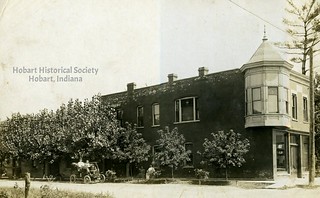
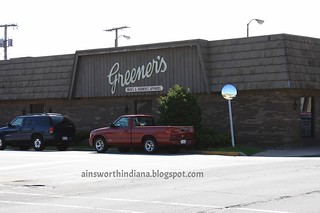
The older image comes from a postcard in the Hobart Historical Museum files. On the back some anonymous person noted the location and the names of the people in the picture: sitting in the car are George Pederson [or Pedersen?] and Gertrude Scharbach, and on the sidewalk are Lizzie and Mary. Lizzie and Mary who, the anonymous writer didn't mention. George's wife's name was Lizzie, but I don't have a clue about Mary.

It's hard for me to believe that this is actually Main and Second. There was such a lovely building there, and they knocked it down?