Showing posts with label Chandler. Show all posts

Sunday, April 30, 2023

Yet Another Car Crash at the Black Cat

This one has a twist.

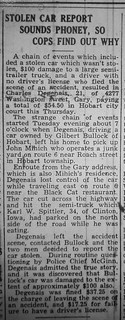
2023-04-03. 1952-04-03 Gazette, Crash at Black Cat
(Click on image to enlarge)
Hobart Gazette, 3 Apr. 1952.


The mention of Gilbert Bullock reminds me that this is supposed to be the Ainsworth blog, not the Crash-at-the-Black-Cat blog. This particular Gilbert was the son of Claude Bullock and his second wife, Mary Ann Chandler. The 1950 Census shows him living at Peter Bates' hotel, 314 Main Street.

♦    ♦    ♦

Also from yesterday's microfilm-reading and phone-photographing session:

2023-04-03. 1952-01-04 Gazette, New Hobart Bowling Lanes
(Click on image to enlarge)
Hobart Gazette, 4 Jan. 1952.


The Gazette actually published bowling league scores weekly in this time frame, or at least in the late 1940s.

Friday, January 20, 2017

Martha Wood

Martha Beatty Wood has been so quiet all this time that I don't believe I've yet mentioned her name in this blog — though her husband, William (and indirectly her son, Raymond, who helped to run the Wood garage), and her daughter, Olive, have made several appearances.

Now it's November 1922, and Martha has quietly slipped away.

2017-1-20. Martha Wood obit
(Click on image to enlarge)
Hobart Gazette 24 Nov. 1922.


In the left-hand column, we learn of the death of Lydia Clifford — another person I've never mentioned, but I have posted about three of her sisters: Mrs. Matilda Demmon, known as Tillie, had married Walter Demmon, who built the store in Merrillville; Carrie Chandler, with her husband Eugene, lived on a farm on Liverpool Road; and Emily had married Fred Shults (whose brother just recently quit farming).

Going by the 1920 Census and judging by their neighbors, I gather that Frank and Lydia Clifford owned a farm northwest of Ainsworth, but I haven't been able to find it on any plat map.

Wednesday, July 13, 2016

The Old Folks at Home Drove Her 'Round the Bend

On August 25, 1922, at their farm on Liverpool Road, Eugene and Carrie Chandler had a birthday party for their daughter, Mildred. A few days later, John and Ella Dorman hosted a Sunday school picnic on their lovely farm overlooking the Deep River, now the Indian Ridge Golf Course.

And the Kemerley family took a long motor trip that included a visit to Mrs. Kemerley, whose first name I still do not know, and whose hard work at the restaurant and boarding house in Hobart had shattered her nerves.

2016-7-13. Chandler et al.
(Click on image to enlarge)

Remember that undated photo of Hazard Halsted in the car sales and service business? The item in the right-hand column gives us a starting date for that venture.

Just above that … well, I know young people weren't angels even before the 1960s, but I am surprised at the number of extramarital births locally. (An article in the Gazette on the same topic explained that the area in question was Hobart and East Gary, and the time covered was the past six months; see "Shocking Birth Conditions," Hobart Gazette 1 Sept. 1922.)

Monday, July 13, 2015

The Lye Accident, and an Update

I was nosing around in old issues of the Hobart Gazette, looking for any mention of Daisy Chester's marriage to E.D. Scroggins that I might have missed the first time around, when I came across this item in the January 4, 1907 issue that I definitely missed the first time around:
A week ago last Sunday the 2-year-old son of Mr. and Mrs. Chas. Chester who live on the Dick Sykes farm pulled from a table a can of concentrated lye which flew upon the little fellow's face and severely burnt him. The right eye seemed to be the worst for the accident and for several days it was feared he would lose its sight but it is now thought the eye will be all right in time.
Based on the 1910 Census, I conclude that the unnamed two-year-old was Robert Chester.

I do not know where the Dick Sykes farm was. Per the 1891 Plat Book, there had been farms belonging to Sykeses in Ross, Hobart and Winfield Townships — not to mention any that may have been in Porter County — but which was known as the "Dick Sykes farm," I do not know.

[7/20/2015 update] Suzi Emig has solved the mystery of the Dick Sykes farm! She writes:
Climb into the time machine ... we are going back to April of 1912. I have attached the newspaper account of my dad's parent's wedding. It was extremely yellowed and fragile when I got it years ago from my aunt. Fortunately she laminated it, so it survives. You will see many familiar names in the list of wedding guests. There is one error. The bride's mother, Mrs. Susan Casey, was a sister to Constance Chester, not to Mr. as stated. If you refer to the 1908 plat map (which you so conveniently provide!) the SE corner of 61st and Colorado is owned by a William Sykes ... maybe Dick was a nickname or he was incorrectly named in the lye incident article. William is shown in the 1880 census to be living on this property as a 21 year old with his mother and siblings, 3 brothers and a sister. Their neighbors are the John Schnabels. Their main house was on the SW corner of the intersection. It appears that William and his family were living here per the 1900 census, as the Fred Schnabels are listed as neighbors. Evidently William decided to give up farming and leased his home and land ... he is in Mississippi, working as a public road contractor in 1910, then in 1920 is back up north residing in Gary as a city clerk, and a garage owner there in 1930. He died in 1940 in CA. My dad always referred to that SE property as "the old Sykes farm", so I guess to the old timers that name stuck. The Charles Chesters were living in Stark Co., IN per the 1900 census. In 1910 they were somewhere in Ross Twp., and evidently relocated by 1912 to the Sykes property. By 1920 they were in the old house that Henry built.
2015-7-20. Schnabel Casey
(Click on image to enlarge)
I believe this clipping is from the Hobart Gazette of April 19, 1912.


Here is the William "Dick" Sykes farm on the 1908 Plat Map:

2015-7-20. Sykes 1908
(Click on image to enlarge)

Here's a clipping from the "General News Items" of the Hobart Gazette of July 5, 1907 (I didn't miss it the first time around; I just didn't post it) in which "Dick" is enclosed in quotes, as if to mark that it is a nickname.

2015-7-20. Chester-Sykes, Gaz, 7-5-1907

Here ends this update. If I find out how William got his nickname, I will update again.

♦    ♦    ♦

Thanks to our identifying-est commenter ever, we now have IDs on the people in the Chester-house-then-and-now pictures. (I have also added Chuck's IDs to each picture's description on Flickr, for ease of reference.)

Monday, March 2, 2015

South of Deepriver

Random news from the countryside south of Deep River, and elsewhere.

2015-3-2. South of Deepriver
(Click on image to enlarge)
Hobart News 5 Jan. 1922.


Melvin and Verna Guernsey are moving back into my bailiwick, so maybe I will start paying attention to them again. But if they are moving to the Howard H. Smith farm, where is Howard H. Smith going?

Sunday, February 15, 2015

Three Spring Shoats

2015-2-15. Thos. Chandler notice
(Click on images to enlarge)
Hobart Gazette 16 Dec. 1921.


If I hadn't already shot off my mouth about where I thought the Ella Roper farm was, I could have pretended that I knew all along it was northwest of Hobart, as Thomas Chandler says in his notice. The only problem is that I can't identify an Ella Roper farm northwest of Hobart … unless maybe it's the "E.S. Roper" land shown in this image from the 1926 Plat Book:

2015-2-15. ESRoper 1926

Anyway, this means that Fred and Olga Rossow are not going to become Ross Township residents when they move onto the Ella Roper farm.

Tuesday, December 30, 2014

Bungalow or No?

After the trouble I went to finding out who Elmer Livingston Arment was, I'm annoyed that suddenly in October 1921 he has to move half a state away and has no further need for a bungalow on Grand Boulevard … which means I've probably been wasting my time trying to figure out which of the houses in that area was his.

2014-12-30. Exit Arment
(Click on image to enlarge)
"Local Drifts." Hobart Gazette 21 Oct. 1921.


But wait! — up jumps the builder, Frank MacPherson, with an announcement:

2014-12-30. Bungalow will be built!
(Click on image to enlarge)
"Local Drifts." Hobart Gazette 4 Nov. 1921.


Next door to that item, another interesting announcement about some people we know. I haven't blogged much about the Thomas Chandler family, although they show up here and there in my notes, in happy events of births or ordinary sociability. (I was just checking my notes from way back and found this little item from 1910: "A daughter was born Apr. 13th to Mr. and Mrs. Chas. Mosher who live at present with Mr. and Mrs. Thomas Chandler near Deepriver." The first time I read that, I had no clue who the Moshers were.)

Now that these Chandlers are leaving my bailiwick, I suppose I should finally talk about them! Thomas, born in 1878 and named for his grandfather, was one of seven children of Sylvester and Margaret Chandler — an older brother to Eugene Chandler, whom we've heard so much about.

In February 1900 Thomas married Maud Whittmer. Early on in their married life, it appears they lived in western Ross Township, and Thomas worked as a railroad section hand. In 1907 they were living near the village of Deep River — perhaps farming, as the 1910 census shows them farming rented land in the same area. In 1913, the family reportedly bought "the 52-acre farm of Charles E. and Maggie E. Barney at Palmer," and yet in 1919 they were "occupying the Cunningham farm of 116 acres six miles southeast from Ainsworth, for the third year" — and the last year, it seems, as their landlord was reportedly selling the farm out from under them. In 1920, they were farming rented land in Winfield Township. (By this time, Thomas and Maud had three children: Emery, Josephine, and Janet.) And now, in November 1921, the Chandlers were departing from the Ella Roper farm, which I believe lay on the west side of Clay Street, its southern border at present-day U.S. 30 (see 1908 Plat Map).

As so off go the Chandlers, and onto the Ella Roper farm come Fred and Olga Rossow.


Additional Sources:
♦ 1880 Census.
♦ 1900 Census.
♦ 1910 Census.
♦ 1920 Census.
♦ "Additional Local News," Hobart Gazette 29 Aug. 1919.
♦ "General News Items." Hobart Gazette 30 Aug. 1907.
♦ Indiana Marriage Collection.
♦ "Local Drifts." Hobart Gazette 22 Apr. 1910.
♦ "Personal and Local Mention." Hobart News 10 Apr. 1913.

Wednesday, December 4, 2013

Clara Chandler Banks, 1850 – 1921

She grew up in the village of Deep River; her parents are buried in Chester Cemetery; and she raised her own family on a farm straddling the Ross-Hobart Township line; so I ought to take notice of her passing.

Obituary of Clara Chandler Banks
(Click on image to enlarge)
From the Hobart Gazette, 14 Jan. 1921.

Saturday, September 28, 2013

Party at Chandlers', Play at W.G. Haan

Eugene and Carrie Chandler's house on South Liverpool Road was packed with guests celebrating his 34th birthday on November 15, 1920.

The audience at the Willing Workers' play in the W.G. Haan school auditorium may have enjoyed it while sitting in new chairs.

Chandler; South of Deepriver social column
(Click on image to enlarge)
From the Hobart News of Nov. 18, 1920.


I do not know whether, or how, Paul Newman may have been related to the Leopold Gruel who bought the Ford sedan. Per the 1920 Census, Leopold was a 53-year-old Hobart resident, born in Germany, who came to the U.S. in 1888.

Saturday, October 13, 2012

The Race Car Driver Settles Down

Last we heard of Clifford Blachly, he was speeding around a track in Valpo, winning an auto race. Now, at the tender age of 20, he is settling down.

Clifford Blachly/Mary Heiney
(Click on image to enlarge)
From the Hobart News of 11 Dec. 1919.


The 1920 Census would show him living in Gary with his wife — who would that year give birth to their first child — and his parents, and working as a foreman in a steel mill. Sounds very responsible. I don't know if we'll hear any more of his racing cars, but in by the 1930 Census he had found a way to combine his love of cars with responsible wage-earning: he was a steel-mill chauffeur.

… Also, Eugene and Carrie Chandler are so excited about moving to their very own farm that they can't wait for all those fine buildings to be finished.

♦    ♦    ♦

As we continue following the unusual career of Ellsworth Humes, we find this in the "Local and Personal" column of the Hobart News of December 18, 1919: "Ellsworth Humes left last week to become advance advertising man for Harvey's Greater Minstrels. The show is now eastward bound, and will later go to the Pacific coast."

It's difficult to find any information about Harvey's Greater Minstrels. Here is a brief summary.

A minstrel show was something of an anachronism in 1919, as such entertainments had, since the turn of the century, been giving way to vaudeville and stage musicals, and now the movies were taking over the entertainment world.

Thursday, September 27, 2012

Meanwhile, At the Weilers' …

There were a whole lot of Weilers farming around Ainsworth, and I haven't yet figured out their relations to each other, if any.

One of them, Mrs. Mary Weiler, announced in the autumn of 1919 her intention to quit farming:

Weiler public sale
(Click on image to enlarge)

This Weiler, I believe, was the widow of the Christian (Christ) Weiler who bought some Blachly land in 1912. Christ died May 28, 1916.

C. Weiler obit

I am mystified by "Mrs. Louise Weiler of Chicago" — she sounds like the widow of a deceased son, but the only children recorded in the census are the four boys named in this obituary. If they had an older brother, he must have left home early, before the 1900 census. And he must have died before 1912, since Louis, when he married Martha Klemm in that year, was described as the eldest Weiler son. The youngest, Will, may have been the soldier lately returned from overseas.

On the 1908 plat map, I find more than one parcel labeled "C. Weiler," plus there was the 1912 purchase.

C. Weiler land 1908
(Click on image to enlarge)

From the directions in the sale notice, I think the sale happened at the southernmost parcel. The Vincent schoolhouse was well south of present-day U.S. 30.

Once the sale was over, Mary would lease the farm to her son George, who would carry on with farming, while Mary would "make her home with her children," in the cryptic words of the News.

♦    ♦    ♦

Next to Mary's public sale notice, above, ran a similar notice placed by Eugene Chandler. His sale, as we know, was in preparation for the move to his new farm.

Construction was still underway on the new farm. The News listed the buildings going up: "a modern brick house, barn, granary and chicken house." Eugene had even hired Lee & Rhodes to install a "Standard" electric lighting plant, to give his farm electricity at about half the cost of town power.

The new brick house, built by James Carpenter, Walter Boal and Willard Stevens, was now ready for the plasterers. The Halsted brothers were building the barn. Who had the honor of building the granary and chicken house is not recorded.

E. Chandler 1926
(Click on image to enlarge)
I believe this is the Chandler farm as it appeared in 1926. I wonder if the lovely old brick house at 5501 S. Liverpool Road is the "modern brick house" that the Chandler family moved into?


Sources:
♦ 1900 Census.
♦ 1908 Plat Map.
♦ 1910 Census.
♦ 1926 Plat Book.
♦ "Local and Personal." Hobart News 13 Nov. 1919; 20 Nov. 1919.
♦ "Local Drifts." Hobart Gazette 14 Nov. 1919.
♦ "Public Sale." Hobart News 13 Nov. 1919.

Tuesday, September 25, 2012

Overrun with Hunters and Dogs

Notice to Hunters
(Click on image to enlarge)

This inhospitable notice, published on the front page of both local papers, was provoked by the area's growing population, as the News explained:
Farmers in this locality have become tired and disgusted with having their farms overrun with hunting parties with dogs, and have decided to put a stop to the practice. As the Calumet region grows, the hunters naturally increase until they have become a nuisance. A number of names appear in this issue of The News warning hunters to keep off their farms. It may be well for hunters to heed this notice or someone will pay a heavy fine.
♦    ♦    ♦

The "Births" column below the warning to hunters reports good news for some old friends, Charles and Amelia Gernenz — a new addition to the family. It's reported as a son, but later censuses seem to indicate it was in fact a daughter, Bertha.


Sources:
♦ 1920 Census.
♦ 1930 Census.
♦ "Births." Hobart Gazette 14 Nov. 1919.
♦ "Local and Personal." Hobart News 13 Nov. 1919.
♦ "Notice." Hobart News 13 Nov. 1919.
♦ "Warning to Hunters." Hobart Gazette 14 Nov. 1919.

Sunday, June 17, 2012

Portable Housing

I've mentioned Eugene Chandler here and there, only, it seems, in connection with his misfortunes, such as the time he broke his collar bone in the Ainsworth barbershop disaster, or when his young family fell ill with the Spanish influenza.

Eugene's father, Sylvester, was the only son of Thomas Peach Chandler, who settled in Lake County in 1854 on an 80-acre farm about a mile west of the village of Deep River. Eugene, born in 1886, grew up in the Deep River area. He was a farm boy, and after his marriage to Carrie Schnabel early in 1910, he continued to farm, but on other people's land. For example, the birth of his first child in 1910 finds him on the farm of his uncle, Nathaniel P. Banks, south of Hobart; soon thereafter he moved to the W.B. Owen farm (the location of which I don't know), and then in 1911 to the Kruse farm southeast of Ainsworth. In 1915 he moved from there to "the Gordon farm," somewhere south of Hobart.

That's a lot of moving. But the Gordon farm was the last stop before Eugene finally got a farm of his own. In July 1919 he bought the Anna Franz farm, an 88-acre spread about three miles west of Hobart. That farm had no house, no barn, no improvements of any kind, so the little Chandler family remained on the Gordon farm, to harvest their season's work and await the completion of their new home.

Now we have to mention another of Eugene's misfortunes. About 6:30 on the morning of July 29, someone passing by the Gordon farm noticed smoke coming from the top of the farmhouse, and alerted the Chandler family. Eugene and Carrie got their children safe, and by quick work managed to save most of their furniture and personal effects. But in spite of the best efforts of the Hobart fire department, the house was destroyed. The News added:
Mr. Chandler's loss is fully covered by insurance, but even so, that does not replace eighty gallons of pure cider vinegar, some fifteen gallons of lard and forty or fifty quarts of canned fruit.
If those items were of home manufacture, they represented a tremendous amount of work.

And there was the Chandler family, with their old house in ruins and their new house not yet even begun. So they turned to the 1919 version of a mobile home — bought a small house in the village of Wheeler and simply had it picked up and moved to the Gordon farm.

By mid-August Eugene had broken ground for a brick house on his new farm. James H. Carpenter was to build it.


Sources:
♦ 1874 Plat Map.
♦ 1891 Plat Book.
♦ 1900 Census.
♦ "Additional Local News." Hobart Gazette 15 Aug. 1919.
♦ "Death of an Old Citizen." Hobart Gazette 4 Nov. 1904.
♦ "Fire Destroys Residence of Gordon Farm South of Hobart." Hobart News 7 Aug. 1919.
♦ "House on Gordon Farm Burns." Hobart Gazette 8 Aug. 1919.
♦ Indiana Marriage Collection.
♦ "Local and Personal." Hobart News 10 July 1919.
♦ "Local Drifts." Hobart Gazette 2 Sept. 1910; 17 Nov. 1911;
♦ WWI Draft Cards.

Thursday, March 11, 2010

A Great Fall

SautersPlace
(Click on image to enlarge)
Image courtesy of the Hobart Historical Society.


I think there was a barbershop on the second floor of the brick part of Ed Sauter's blacksmith shop, reached by means of that external wooden staircase you see in the picture. The reason I think so is because the stairs leading to "the barbershop upstairs in the Sauter building" once collapsed, and if I had to choose which part of these structures looked most likely to collapse, I'd definitely say that outdoor staircase.

The accident happened in May 1904, after Ed had sold his saloon to Claus Ziegler.

On the evening of Saturday, May 21, several young men were standing on the staircase outside the barbershop when the structure gave way beneath them and they all fell to the ground below. Some of them were badly injured, including 18-year-old Eugene Chandler, whose collar bone was broken. Apparently none of the injuries were fatal, however.

♦    ♦    ♦

The barber, or one of the barbers, of Ainsworth was named Lee Hunter. A few months after this incident he moved to California, and wrote back in December 1904 to say that he was not impressed with that part of the country. And that's the kind of random, useless information you can get from reading old newspapers.

Oh, and Eugene Chandler was the nephew of N.P. Banks, a Hobart farmer apparently so well known that the Gazette simply gave his name with no further identifying information.


Sources:
♦ 1900 Census.
♦ "Ainsworth Pick-Ups." Hobart Gazette 16 Dec. 1904.
♦ "General News Items." Hobart Gazette 27 May 1904.


[3/16/10 update: D'oh! Maybe N.P. Banks was well known because he was an officer and director of the First State Bank and a school trustee as well as a farmer.]