Showing posts with label Humes. Show all posts

Monday, December 11, 2017

Nickel-Plate Nostalgia

On March 19, 1923, Thomas Maloney turned 71 — who, you ask? Good question. I never heard of him before, but he takes us back to old times, to the coming of the Nickel Plate through Hobart in 1881 (so the article says and I don't have time to research that). While constructing the railroad, Thomas boarded at the Morton building, eating the home cooking of one of those spirited Shearer sisters: Nora (aka Elizabeth) Shearer Ensign.

2017-12-11. Ensign, Maloney
(Click on image to enlarge)
Hobart News 22 March 1923.


Since first looking into Nora's history, I have learned that she was divorced from Fred Kappelman in 1903.1 The marriage had been a mistake from the start, apparently, since it happened in 1899 and by the 1900 Census they were living apart. I still haven't been able to find out when her first husband, William Ensign, died.

Elsewhere on the page above, we learn that Hobart was hit with a late-winter blizzard in March 1923. A natural curiosity about the low temperature, and the kids' leaving their toys on the porch, cost Mrs. Charles Koeppen a broken knee. She was the former Tena Rohwedder — daughter of Hans and Margaret (Thune),2 sister of Edward. The Charles Koeppen farm lay just at the eastern outskirts of Wheeler:

2017-12-11. Koeppen 1921
(Click on image to enlarge)
Image from http://www.inportercounty.org/Data/Maps/1921Plats/Union-1921.jpg.


Finally, 'way out in New York, Ellsworth Humes hears of all those liquor-related arrests in Lake County.

________________________
[1] "Court Doings," Hobart Gazette 6 March 1903.
[2] Indiana Death Certificates.

Friday, July 21, 2017

Kenneth Humes Puts a Ring on His Finger

After winning $100 in damages for his lost finger, Kenneth Humes could afford to buy a nice set of wedding rings, I suppose.

2017-7-21. Kenneth Humes marriage
(Click on images to enlarge)
Hobart News 15 Feb. 1923.


I still don't know exactly where the Humes residence was, or is, if it's still standing. Nor do I know where the Bradley garage was — but it might have had something to do with Charles Bradley.

An item in the "Local and Personal" column of the same issue reports that a sister of Kenneth who married a William Hill came to town for the happy occasion. As far as I know, Edwin and Carrie Humes' only daughter was Gladys … but Gladys shows up in the 1930 Census, married, with the surname Stevens (living with her parents; husband not recorded in the household), and with a child old enough to have been very young in 1923, surname also Stevens. Hm!

2017-7-21. Grace Nelson

I hope Grace Nelson got well in time to attend the program at the W.H. Haan School.

Wednesday, April 12, 2017

Gone But Not Forgotten

Back in September 1916, Kenneth Humes had lost a finger to farm machinery on a Blachly farm. More than six years later, his suit for damages was finally being heard.

2017-4-12. Amputation litigation
(Click on image to enlarge)
Hobart News 11 Jan. 1923.


After several hours' deliberation, the jury would award Kenneth $100 and his costs ("Local and Personal," Hobart News 18 Jan. 1923).


Elsewhere on the page above we find Herman Harms, Jr., aka "Bud" — about four years old — sick with pneumonia at his maternal grandparents' house. His own parents, having been ill so recently, might have found it difficult to care for him.

Among the deaths reported in the right-hand column was that of the infant son of John and Goldie Ensign who had probably been named for his Uncle Walter. According to his death certificate, little Walter was buried in Crown Hill Cemetery, but it seems that his grave is unmarked.

Sunday, October 23, 2016

Breaking Camp

Mrs. George Thompson was Lee's (and Eva's) mother. Her maiden name was Swartz and per the 1900 Census she had married George Thompson in 1899, but I've not yet been able to find the record of their marriage.

2016-10-23. Nancy Thompson
(Click on image to enlarge)
Hobart News, 19 Oct. 1922.


The little Amlong family started camping out near the village of Deep River in June. They must have spent a few chilly nights in their tent before finally moving into a house for the winter. The "Humes residence south of the city" was likely on what's now State Road 51, though I still don't know exactly where.

Wednesday, May 25, 2016

Jawbreaker

This is not the first barn dance I've heard of at the Houck farm, which I believe was in Winfield Township, but it's the first jaw-breaking I've heard of there. The alleged jawbreaker was one of the Hahn boys who had lived on the McAuliffe farm, but by 1922 I expect he was out on his own. Kenneth Humes had long ago left a finger in Ainsworth.

2016-5-25. Jaws
(Click on image to enlarge)
"Local Drifts." Hobart Gazette 11 Aug. 1922.


Elsewhere, news of other acquaintances … Mrs. A.G. Ingram had been born Anne Fleck.

If I've got the right Triebesses, these are Julius and Sophia Triebess, who were living in Chicago while renting their Ainsworth-area farm. I leave it to people with more time than I have to figure out exactly how Sophia was Mrs. Christ Passow's niece, if they are interested.

I believe the farm Harve Carey was moving back to consisted of 160 acres in southeast Portage Township, Porter County.

The Epps family was recently bereaved.

And on his small farm in Union Township, Jacob Yager was breaking his back again picking strawberries.

Wednesday, November 12, 2014

Weekend Wreckage Report

2014-11-12. Car wrecks
(Click on image to enlarge)
Hobart News 25 Aug. 1921.


The first accident occurred at the intersection of present-day E. 73rd Ave. and Grand Blvd./S.R. 51. That spot may have been particularly dangerous, with Lincoln Highway tourists adding to the traffic, and heaven knows if there was even a stop sign at the intersection.

William Fisher (husband of Jennie Hurlburt) was innocently getting the honey from Joe's bees when an anonymous driver struck his car on Old Ridge Road.

The column to the left of the "Week-End Accidents" relates the adventures of the local young men in the National Guard. I believe the John Fisher mentioned in that story was William's nephew.

♦    ♦    ♦

In other auto-related news, I now learn of yet another named highway that (like the Yellowstone Trail) I'd never heard of before; but the "Liberty Highway" is so obscure that I have not been able yet to determine whether it, too, was a cross-country route, or ran only between Kokomo and Chicago.

2014-11-12. Liberty Highway
(Click on image to enlarge)
Hobart Gazette 26 Aug. 1921.


In addition to a reminder of the hard times the nation was experiencing, the "Local Drifts" column notes the purchase by Joseph Wegesin of the Thomas Roper farm "south of Deepriver." The only farm I can find matching that description shows up in the 1891 Plat Book in the northeast corner of Winfield Township:

2014-11-12. Roper land in Winfield Twp.
(Click on image to enlarge)
Image from the 1939 Plat Book.


Blog-wise, I've ignored the Wegesin family up until now. In my newspaper notes, I've recorded only two mentions.* One was in 1911, when Mrs. Conrad Wegesin (Joseph's mother) came down from Chicago to the home of Mr. and Mrs. Henry Fasel, Sr. for Mrs. Fasel's 54th birthday party. The second was in May 1920, when Joseph's oldest daughter, Gladys, attended a birthday party for Lillie Fasel, who was the daughter of Mr. and Mrs. Henry Fasel, Sr. (I wonder if the Wegesins had a family connection to the Fasels?)

From a brief look at the official records, I gather that sometime after Joseph's birth in Ohio in 1881, his parents, Conrad and Mary, moved the family to Chicago, where 1900 census found them. About a year later, Joseph married Martha Semmer, who also went by the name Magdalen in some censuses. By 1910 Joseph and Martha-Magdalen had moved to Hobart. Ten years later, they had seven children of their own, plus a niece and a nephew living with them.

I'm not sure I'm going to have to pay much more attention to this family, as it appears that by 1930 they had moved to Muncie, Indiana.

___________________
*There may have been more, but I did not record them.


Additional Sources:
♦ 1900 Census.
♦ 1910 Census.
♦ 1920 Census.
♦ 1930 Census.
♦ Cook County, Illinois, Marriages Index.
♦ "Local Drifts." Hobart Gazette 3 Feb. 1911.
♦ "Young Lady Surprised." Hobart Gazette 28 May 1920.

Friday, August 8, 2014

On the Ainsworth Stone Road

We know it as Grand Boulevard or State Road 51, but to the 1920 census enumerator it was the "South Hobart Road to Ainsworth," and to editor of the Hobart News, writing in 1921, it was the "Ainsworth stone road." Edwin and Carry Humes had been living in a rented house along that road, with their four children, when the 1920 Census recorded them. In June 1921 they bought that house — the "Hettie Ryan residence," which was in Hobart Township, but since the plat maps don't show parcels of three acres, I don't know exactly where.

Further south on the same road, in Ross Township, the Grabowskis continued their improvements to the old Carlson place. My current theory is that the red brick house on the west side of S.R. 51, on the north bank of the Deep River, is the old Carlson place, but that's just my current theory.

Also, the Yellowstone Trail got re-routed through the heart of Hobart …

2014-8-8. Humes house purchase
(Click on image to enlarge)
"Local and Personal," Hobart News 16 June 1921.


… and a Buick report.

Wednesday, October 2, 2013

How the Dormans Partied

On November 19, 1920, they partied with 35 people from Gary and goodness knows how many other neighbors and friends.

Dorman party; Ellsworth Humes
(Click on images to enlarge)
From the Hobart News of Nov. 25, 1920.


(Also an update on the show-biz career of Ellsworth Humes.)

On November 22, 1920, they partied with ten carloads and one truckload of church people.

Dorman party; South of Deepriver
From the Hobart News of Nov. 25, 1920.

(And from the "South of Deepriver" we learn the interesting news that Nora Campbell is about to be married.)

The 1920 Census gives John Dorman's age as 59, Ella's as 56.

Saturday, October 13, 2012

The Race Car Driver Settles Down

Last we heard of Clifford Blachly, he was speeding around a track in Valpo, winning an auto race. Now, at the tender age of 20, he is settling down.

Clifford Blachly/Mary Heiney
(Click on image to enlarge)
From the Hobart News of 11 Dec. 1919.


The 1920 Census would show him living in Gary with his wife — who would that year give birth to their first child — and his parents, and working as a foreman in a steel mill. Sounds very responsible. I don't know if we'll hear any more of his racing cars, but in by the 1930 Census he had found a way to combine his love of cars with responsible wage-earning: he was a steel-mill chauffeur.

… Also, Eugene and Carrie Chandler are so excited about moving to their very own farm that they can't wait for all those fine buildings to be finished.

♦    ♦    ♦

As we continue following the unusual career of Ellsworth Humes, we find this in the "Local and Personal" column of the Hobart News of December 18, 1919: "Ellsworth Humes left last week to become advance advertising man for Harvey's Greater Minstrels. The show is now eastward bound, and will later go to the Pacific coast."

It's difficult to find any information about Harvey's Greater Minstrels. Here is a brief summary.

A minstrel show was something of an anachronism in 1919, as such entertainments had, since the turn of the century, been giving way to vaudeville and stage musicals, and now the movies were taking over the entertainment world.

Saturday, February 25, 2012

A Mustache and a Circus; Also, Bums

Just catching up with a couple of old friends …
Chas. Borger made his appearance last week minus his mustache, which he had worn for about thirty-five years. This was surely a case of parting with an old friend. Those who have noticed the change have remarked that it has caused him to look ten years younger.
This comment from the News in January 1919 suggests that Charles Borger had already lost his beard. Alas, we have no photos of him clean-shaven. We do know he eventually let the mustache grow back.

Recent price increases had led to a boom in one aspect of Charles' business: oiling and repairing harnesses. Within a the last few years, according to the Hobart News, the cost of new harnesses had just about doubled, going from $45 or $50 to $80 or $100. Charles was now so busy during the winter months keeping farmers' old harnesses in working condition that he had hired an assistant.

In February we get news of our friend with the circus.
Ellsworth Humes, who for the past few seasons has traveled with the advertising cars of the Hagenbeck-Wallace shows, has been offered a similar position with the Sells-Floto circus for the coming season.
No mention here of his having worked for Thurston the magician.

As he waited for the circus-advertising season to begin, Ellsworth occupied himself with lettering windows and signs for businesses around town.

♦    ♦    ♦

Meanwhile, the Hobart area was beginning to notice effects of the post-World War I recession, but laid-off workers were getting little sympathy from the News:
Since the slackening up of the industries, letting out large numbers of men, tramps and bums are beginning to make their appearance. All we have to say is, the ordinarily healthy individual out of work and no money is entitled to very little consideration. For two years everyone who wanted work in this locality, or almost any other for that matter, could have all the work he wanted at high wages, and if he did not save a small portion of it he should go to South America and live under the cocoanut tree.


Sources:
♦ "Local and Personal." Hobart News 30 Jan. 1919; 13 Feb. 1919; 27 Mar. 1919.
♦ "Oiling and Repairing Harness Has Now Become a Regular Occupation." Hobart News 27 Feb. 1919.

Monday, February 13, 2012

The End of Company K

The bad news came to Captain Charles Reeve late in January 1919: Co. K was doomed. The adjutant general of Indiana had ordered more than a dozen state militia companies mustered out of service, and Hobart's was one of them. (Valparaiso's was another.)

Co. K had over a hundred men in its ranks, with uniforms and rifles; several hundred dollars in its treasury; a silk flag, and a great deal of pride.

Captain Reeve set about preparing for the end, whenever it might officially come. He had to prepare discharge papers for all his men, compile muster rolls, and collect, list and pack up any company property that had to be returned to the state, such as uniforms. Early in February he notified the Indiana attorney general that by the 11th his work would be done and his company ready to be mustered out at the state's pleasure.

A week or so later, Captain Reeve heard back from the state. February 27 was set as the day.

But the captain's preparations were not quite complete. A young Michigan City man named Pedroski (first name not given) had at one point joined Company K and received a uniform; he still had that uniform and failed, or outright refused, to return it. After tracking Pvt. Pedroski down in South Bend, Captain Reeve sent Sgt. Kenneth Humes and Pvt. Milton Ballantyne after him. They returned the evening of Sunday, February 16, with their prisoner, and put him in the Hobart jail. On Tuesday night, facing a court martial, Pvt. Pedroski told a "hard luck tale," presumably to the effect that he was hanging onto his uniform because he had no other clothes to wear and no money to buy them. The court's response was to give him a suit of civilian clothes, make him promise to pay back $20 in costs, and — once he had changed his uniform for the civvies — let him go.

(Incidentally, beside this story in the News ran a short article reporting that the subject of the previous summer's manhunt had been caught, and tried and convicted of the assault on Mrs. Davenport: one John Sims of Gary, a former serviceman who appeared in court in uniform. The article did not say how he had been found.)

February 27 arrived at last, and brought with it Colonel Charles A. Garrard of the Indiana militia. That evening he completed the mustering-out of all of Co. K's members, excepting the captain and two lieutenants. Some $700 in the company's treasury was distributed among its members in proportion to their attendance at drills. The silk flag was given into the custody of the members who were Odd Fellows; they intended to display it, and a membership roster, in a glass case at the Hobart public library.

Afterwards, the former militiamen and their families held a dance in celebration of the adventure and companionship of Co. K, and the little company marched into history.

♦    ♦    ♦

The following Co. K membership list comes from a list on display at the Hobart Historical Society. It may be the membership roster mentioned above, but I don't know for certain. I promise it's the last Co. K membership list I'm going to post!

Militia Roster 1917-1919


Sources:
♦ "Co. K Militia Boy Given Summary Courtmartial." Hobart News 20 Feb. 1919.
♦ "Co. K Mustered Out." Hobart Gazette 28 Feb. 1919.
♦ "Co. K Ready to Be Mustered Out." Hobart Gazette 7 Feb. 1919.
♦ "Hobart Militia Co. One of Fourteen to Be Mustered Out." Hobart News 30 Jan. 1919.
♦ "Hobart Militia Co. to Disband." Hobart Gazette 31 Jan. 1919.
♦ "The Negro Assaulter of Mrs. Davenport Convicted and Sentenced." Hobart News 20 Feb. 1919.
♦ "Will Muster Out Co. K February 27." Hobart Gazette 14 Feb. 1919.

Saturday, October 1, 2011

What Next for Ellsworth?

Part of the reason I've been following Ellsworth Humes is his employment by the Hagenbeck-Wallace Circus — I was wondering whether he would be involved in the deadly train wreck on June 22, 1918.

But the local papers reported on the disaster without mentioning Ellsworth. I suppose that as a publicity agent he would travel ahead of the circus itself. Whether he had friends aboard that train is another question.

I don't even care anymore about the finger that his brother Kenneth left behind on a farm in Ainsworth; now I'm just following his career for its own sake. From the "Local and Personal" column of the Hobart News of September 26, 1918, comes news of a change of employer:
Ellsworth Humes, who has been with one of the advertising cars of the Hagenbeck-Wallace shows the past season, arrived home Saturday, the season having closed. He expects to leave soon for Boston, Mass., to begin work as advance advertising man for Thurston, the magician, playing in the larger cities.
I never heard of Howard Thurston the magician before, but then I'm not into magic. Yet according to his Wikipedia entry, he was bigger than Harry Houdini, in his day.

Thurston poster
Image credit: Library of Congress.

Saturday, August 20, 2011

When An Amateur Historian Has a Bad Day (Part 2)

At the museum this morning I was looking for more images for Downtown Hobart 1979 and came across this one:

Kenneth Humes et al
(Click on image to enlarge)
Image courtesy of the Hobart Historical Society.


According to the caption, that smiling guy at center is Kenneth "Kip" Humes. So that must be the Kip who once had a gas station at 55 Center Street, right?

But wait — I thought his brother's nickname was "Kippy"!? From the Hobart Gazette of April 18, 1918:
Ellsworth Humes will leave today for Cincinnati, Ohio, where he will join advertising car No. 2 of the Hagenback-Wallace shows. This show will tour the New England states this summer. During his spare time, while taking a vacation the past couple of weeks, he has lettered several of the windows of the business houses about town. "Kippy" is pretty handy with the brush.
Maybe the editor of the Gazette was confused, too. It makes more sense to get "Kip" out of "Kenneth" than out of "Ellsworth."

Monday, June 27, 2011

Back to the Circus

Ellsworth "Kippy" Humes* left Louisville and its Gaiety in March 1918 to come to Hobart for a visit with the folks. He had already signed up for the upcoming season of the Hagenbeck-Wallace Circus. He would be traveling with the advance advertising cars due to leave West Baden, Indiana around mid-April.

It appears his number came up in the draft; on the 22nd he presented himself for examination, but due to poor health ("rheumatism and heart trouble" as well as a slight build) he was exempted from service.

That left him with a couple of weeks' vacation to spend in Hobart. Being skilled at hand-lettering with a brush, he spent some time decorating the windows of several of Hobart's businesses — we don't know which ones.

On April 18, he left for Cincinnati, Ohio, where he was to join the Hagenbeck-Wallace's advertising car No. 2.


___________________
*Whose brother, Kenneth, lost a couple fingers on the Walter Blachly farm near AINSWORTH — so there!


Sources: "Local and Personal." Hobart News 14 Mar. 1918; 28 Mar. 1918; 18 Apr. 1918.

Sunday, April 3, 2011

It's Not That Much Fun to Stay at the YWCA

CampLewis
(Click on image to enlarge)
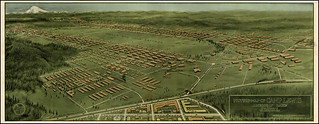
Camp Lewis in Washington, circa 1918.
Image credit: Barry Lawrence Ruderman Antique Maps Inc.


The Hobart News reported on a wartime story making the rounds in Seattle which proved that West Coast gossips were as inventive as those of Chicago.

During the summer of 1917 a vast new cantonment, then known as Camp Lewis, was hastily erected near Seattle. Covering some 70,000 acres, it was built to house about 60,000. Recruits began arriving there in September 1917. By December it was teeming with men.

According to a story of mysterious origin, the Seattle Y.W.C.A. enlisted about 3,000 young women and moved them into a special camp near the gates of Camp Lewis. Their mission: to serve as dancing partners for the men housed there — to boost morale, one supposes. The women earned a salary of $15 per week, plus a commission for every dance. Supposedly there was nothing improper going on, since the young women were under the pastoral supervision of the Seattle Ministerial Federation as well as the Y's own, but still — even for the sake of the war effort, wasn't the whole arrangement just a bit shocking?

What was shocking, the Y.W.C.A. replied, was that anybody would repeat such a blatant falsehood. There was no special camp, there were no dancing girls — at least, none recruited by the Y.W.C.A. The story was a fabrication from start to finish.

Like the Red Cross spokesman who denied the sweater story, the Seattle Y.W.C.A. spokeswoman attributed the gossip to a propaganda campaign by some unnamed pacifist organization.

♦    ♦    ♦

A young ex-Hobart man named Ellsworth Humes brought a strange but true story home from Louisville, Kentucky.

Ellsworth had thus far had a pretty interesting career. He'd spent a couple of seasons working for the Hagenbeck-Wallace Circus and had risen to the position of press agent. When the circus ended its 1917 season, Ellsworth went to Cuba with Jess Willard's Buffalo Bill's Wild West Show. In mid-November he moved on to Louisville, Kentucky, where he landed a job as assistant advertising manager for the Gaiety Theatre.

The Gaiety management let him have a few days off in December so he could come back to Hobart and spend Christmas with his parents, Edwin and Carrie Humes. While here, he mentioned the effect produced on the theater by its proximity to Camp Zachary Taylor. The Gaiety had been a burlesque house, but lately it had been obliged to run only musical comedies — "a taboo [had] been placed upon the burlesquers." While Ellsworth did not name (or the News did not repeat) the source of the "taboo," it seems unlikely that the theatre management volunteered to change the character of its shows lest they inspire impure thoughts in the minds of any soldiers who might be in the audience. I suspect that the anti-burlesque edict came down from high in the camp's command, as part of the military's policy of suppressing "the social evil."

As social evils go, burlesque shows are pretty mild, but then one can never guard too carefully the tender innocence of a soldier, can one?


Sources:
♦ Denfeld, Duane Colt. " Fort Lewis, Part 1, 1917-1927." 16 Jan. 2008. From HistoryLink.org http://www.historylink.org/index.cfm?DisplayPage=output.cfm&file_id=8455 (accessed 26 Dec. 2010).
♦ "Local and Personal." Hobart News 1 Nov. 1917; 27 Dec. 1917.
♦ "One of the Many False Stories Going the Rounds." Hobart News 20 Dec. 1917.
♦ Untitled social column. Hobart News 12 Apr. 1917.

Thursday, November 18, 2010

More Trouble for a Corn-Husker Victim

A month after he lost his older brother John to tuberculosis, William Witt found himself with a medical problem of his own.

We first met William when he lost an arm to a corn husker in November 1901. Fifteen years later, we find him, in spite of his loss, able to earn a living as a teamster, managing a team of horses and a wagon. But in August 1916, he began suffering such severe pain in the amputated arm that Dr. L.M. Friedrich of Hobart decided to take him to Chicago to be seen by a specialist.

LMFriedrich1955
(Click on image to enlarge)
Dr. L.M. Friedrich circa 1955. He is standing on Main Street opposite the office of the Hobart Gazette. Image courtesy of the Hobart Historical Society.


The Gazette did not report the results of that visit. But it may be significant that a month later William began placing ads to sell his team and wagon "Team of bays," one of his ads said; "weight about 2,800, good pullers, good wind, gentle, drive single or double, also harness in good condition, and Birdsell wagon and 2-yard Studebaker dump box. Price right."

Early in November he sold the whole outfit to William Raschka.

♦    ♦    ♦

Meanwhile, farm machines continued their bloody harvest. For example, on September 30, 18-year-old Kenneth Humes was working a corn shredder on the Walter Blachly farm west of Ainsworth when he got his fingers too near the machine's blades. That mistake that cost him part of his right index finger and all of his left middle finger. His left index finger was severely cut up, but his doctor hoped it could be saved.


Sources:
♦ "Gets Fingers in Shredder." Hobart Gazette 6 Oct. 1916.
♦ "Local Drifts." Hobart Gazette 29 Sept. 1916; 20 Oct. 1916; 10 Nov. 1916.
♦ "Personal and Local Mention." Hobart News 26 Oct. 1916.
♦ "To Consult Specialist." Hobart Gazette 18 Aug. 1916.