Showing posts with label Boyd. Show all posts

Friday, August 14, 2026

[Formerly] Unidentified People with Food ca. 1962

[8/19/2026 update: the people in the photo have been identified, at least tentatively. Left to right: Ralph Kennedy, Dick Boyd(?), Dwight Mathis, Chief of Police William McGinn, and Officer Dick Raiza. My thanks to Suzi Schnabel Emig and Barbara Phillips Rowley.]


All the good people who have been sharing food in the wake of the August 11 derecho/tornadoes made me think of this photo.

2026-08-14. Unidentified people with food
(Click on image to enlarge)

There are no notes on the back to tell us who these people are or what sort of event this was. But this photo was one of three that I recently bought as a package, and the other two pertain to the Hobart Police Department and date to the early 1960s, so this one likely does too. Not to mention the uniformed officer at right, and the fashions.

No reason to believe it involved a disaster, though.

♦    ♦    ♦

[further update] While searching for Chief McGinn's first name, I came across this article from the Hammond Times of June 26, 1963, which teaches us that if we're going to try to start a bookie operation, we should not order five telephones all at once.

2026-08-14. 1963-06-26 Hobart Bookie Nabbed, Hammond Times, p. 20
(Click on image to enlarge)

Saturday, August 24, 2019

Warning Signs at the Death Crossing

After the recent fatal accident at the Lincoln Highway intersection south of Ainsworth, a private organization put up warning signs, and other steps were taken to improve visibility.

2019-08-24. Warning Signs, Gazette, 8-31-1923
(Click on image to enlarge)
Hobart Gazette, Aug. 31, 1923.


Two columns over, a couple other stories caught my eye.

I've mentioned Charles Boyd before but never took the time to figure out exactly where his farm was. Here is his land as it appeared in the 1926 Plat Book:

2019-08-24. Boyd, C.E. 1926
(Click on image to enlarge)

I don't know exactly where the house and burning barn were.

Below that, we find H.W. Traeger — probably the same man who gave that awful Traeger crossing its name — warning people to stay off not only his land, but "the land known as the Garden City, controlled by" him. Does that mean the former site of the Garden City brickyard, on the east side of the intersection of County Line Road and S.R. 130? It seems likely, with that land being so close to H.W. Traeger's own land. I find it interesting that the Garden City name stuck, although the brickyard had stopped operating long ago.

♦    ♦    ♦

Here's the social news from south of Deep River for the last week of August 1923:

2019-08-24. SoDR, News, 8-30-1923
(Click on image to enlarge)
Hobart News, Aug. 30, 1923.

Monday, March 27, 2017

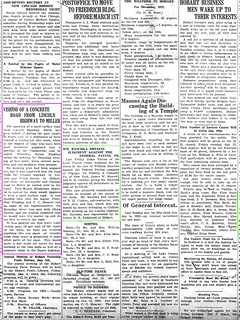
Visions of Concrete

The new year, 1923, brought dreams of pavement:

2017-3-27. Concrete plans
(Click on image to enlarge)
Hobart News 4 Jan. 1923.


From the Lincoln Highway to Lincoln and Tenth would be the route of today's State Road 51. From the brickyards and the Chicago road to Miller would be Lake Park Avenue.

Speaking of pavement — the next column we find William Raschka winning a lawsuit against the Federal Paving Co. — the same company that had recently lost a court battle with some Ross Township farmers.

The story in the right-hand column about the lecture course interested me mainly because of who was selling tickets — among Hobart's high society, we find Lovisa Chester Nelson in her little house in the village of Ainsworth.

Tuesday, December 20, 2016

Blessed Are the Cheesemakers

The news that Ernest Walters (or Walter) was re-elected yet again in November 1922 as Ross Township assessor leads me to pay a little more attention to him. Thus far I've mentioned him only as the father of the garage partners. As the article explains, however, he had long been Merrillville's cheesemaker.

2016-12-20. Walters
(Click on image to enlarge)
Hobart Gazette 11 Nov. 1922.


He had been born in Sheboygan, Wisconsin, in 1853.[1] Having arrived in this area after 1880, he missed that census. In Lake County in 1888, he married Louisa Niksch.[2] The 1900 Census shows the two of them with their cheese factory and their three sons in Merrillville.

A Pictorial History of Merrillville has this to say about Ernest and his cheese:
Initially Ernest had a factory on Walter's Avenue but later relocated to the southwest side of the C. & O. Railroad on Madison Street in closer proximity to the Township's busy square. … Ernest traveled as far as Hammond, Indiana, in his horse and buggy to peddle his hefty rolls of cheese for $3.00 apiece.

Known far and wide by his nickname, "Cheese Henry," Ernest was much appreciated by the local farmers as they found in his business as market for their slightly sourced milk that was not suitable for shipping to Chicago on the "dummy" train.
If "later relocated" means about 1900, then the second cheese factory (south of the former C&O tracks) may still be standing.

♦    ♦    ♦

In the left-hand column of the page above, we find that Roy Hack, fresh off his victory over the paving company, has won the election for Ross Township trustee. He would succeed Alex Boyd, who after eight years had evidently had enough of trusteeship, as he did not seek re-election.

In the middle column, we find our friend Annie Peterson selling off household goods — preparing to downsize her living quarters, perhaps?

Below that, with respect to the fire starting from the Charles Lee property, if "Nagel subdivision" in the news item = "Nagle's Addition" on the map, then the corner of Cleveland and Ohio was a good distance for a fire to travel, or an odd stopping place for the fire department — I'm not sure which from the wording. Perhaps someone flagged them down there and told them all the excitement was over, but you'd think they would go check it out for themselves.


_______________________
[1] Indiana Death Certificates.
[2] Indiana Marriage Collection; Indiana Death Certificates. Louisa may have been from the Merrillville Niksch family which, as far as I know, was not related to the Hobart/Ainsworth Niksch family.

Sunday, November 20, 2016

The Farmers Win One

It's an old story, you see. Little guy criticizes something big guy did, big guy sues little guy for defamation to shut little guy up. Sometimes little guy shuts up, since fighting a lawsuit is expensive and big guy's pockets are deep. Sometimes little guy fights it out.

2016-11-20. Farmers
(Click on image to enlarge)
Hobart News 26 Oct. 1922.


All right, I admit that Sam Woods, Alex Boyd, and Roy Hack were not exactly little guys in Ross Township, but when they went up against the Federal Paving Co. "backed by practically all of the large contracting companies of the United States," I suppose you could say it was a David-versus-Goliath situation.


Over in the left-hand column is a little notice for a community Halloween masquerade to be held in the basement of the W.G. Haan School.

♦    ♦    ♦

At the top of the left-hand column is a fragment of a story out of Hammond that, even though it nothing to do with Ainsworth, I was considering writing about just because it was so bizarre. However, a little Googling into the Hazel McNally "twin-doll murder case" revealed that other bloggers have saved me the trouble, and if you are interested, you can read about the case in various places, like this one.

Saturday, April 16, 2016

The Death of Harold Boyd

After the heartbreak of her early widowhood, Lizzie Sauter Boyd Epps' life had gone more happily, as she raised her two sons and eventually found love again. But the summer of 1922 brought her fresh and indelible grief.

2016-4-16. Harold Boyd
(Click on image to enlarge)
Hobart News 3 Aug. 1922.


Additional Source: "Harold Boyd Drowns in Michigan." Hobart Gazette 4 Aug. 1922.

Friday, March 25, 2016

Walter Bros. Garage circa 1919

We've seen the Walter Bros. Garage before, but here's a slightly different view:

2016-3-25. Walter Bros 1919 a
(Click on images to enlarge)

So that would be the Lincoln Highway passing in front of the garage. It does not appear to be paved. I believe this photo dates to 1919 or earlier, based on the verso evidence:

2016-3-25. Walter Bros 1919 b

We do see "1919" in what appears to be a postmark. But also, the message was written by someone named Paul who is linked somehow to a Lina or Lena, and a little Elmer; and in the 1920 Census, taken in February of that year, we find a nine-month-old boy named Elmer, the son of Paul Bourquin and his wife, Lena, who were farming rented land in Ross Township. (They also have a two-year-old son, Paul.) Paul Sr. and Lena were both natives of Switzerland whose mother tongue was French.

The message is written in German. Now, what little I know of that language, I learned against my will in grade school, so it's not surprising that I would have trouble reading the postcard message. But I think in this case the difficulty is not just my own ignorance — this doesn't seem to be the proper German we learn in school. I have no idea whether Paul is being playful by writing incorrectly, as people sometimes do, or whether this is a regional dialect of German, or whether it's just the sort of German you might expect from a native French speaker.

Anyway, I've attempted a loose translation:
Hello there! (We) have received on Good Friday morning a healthy splendid little boy (Buebchen). Here it is Good Friday morning and we're as sound as turnips. All are doing well, all 4 are healthy and jolly. When you get married we will all quickly come across, so don't keep us waiting. When you get married, get over here right away so we won't be left suffering any longer. Lena wants to get little Elmer baptized. I hope you and all the rest are healthy, and my hearty greetings to all. Paul.
Perhaps some German-speaker will stumble across this post and help me out. [Update: the corrected sentences are from Jon Casbon's comments to this post.]

I can't positively identify Paul in any official records other than the 1920 census. Nor can I find any mention of him in my newspaper notes … until August 1922:

2016-3-25. Bourquin public sale
(Click on image to enlarge)
Hobart News 17 Aug. 1922.


To find a Goodrich farm meeting that description, we have to go all the way back to the 1891 Plat Book, where we find this parcel of land, shown on the 1908 Plat Map as belonging to Eli and Levi Boyd, owned by a Thomas Goodrich.

2016-3-25. Goodrich farm 1891
(Click on image to enlarge)
This image from the 1908 Plat Map shows the Thomas Goodrich farm as shown in the 1891 Plat Book.


Now I have to stop and ask myself who Thomas Goodrich was. Born 1826, died 1891, he was the father of Charles Goodrich, whose family has been mentioned several times already in this blog. I can't find him in Ross Township any earlier than the 1870 Census, where he and his wife, Sarah, with their three children (Anna, Levi P.,* and Charles), are farming in what seems to be roughly the vicinity of the "old Goodrich farm."


But to return to the Bourquins — that 1922 farm sale sounds as if they are getting ready to move, doesn't it? If so, I don't know where they went, any more than I know where they came from.

__________________
*Levi seems to have preferred his middle name, Perry, as evidenced by the census records and various newspaper items. I think Perry may have continued farming the old Goodrich land for some years after his father's death.

Tuesday, January 5, 2016

South of Deepriver

Random events in the countryside south of Deep River … and west of Deep River, Alice Paine is on summer vacation from Teachers College.

2016-1-5. South of Deepriver
(Click on image to enlarge)
Hobart News 22 June 1922.

Thursday, October 22, 2015

South of Deepriver

Social news from the countryside early in May 1922:

2015-10-22. South of Deepriver social column
(Click on image to enlarge)
Hobart News 11 May 1922.


The Guernsey family was planning another reunion.

I don't know who Albert Starr was, but he lived in Valparaiso (1920 Census).


Over in the left-hand column, we hear of an auto accident "south of Ainsworth," but we don't get enough details to figure out exactly where it happened.

Tuesday, August 25, 2015

A Rare Treat

Since the Ainsworth-area community had been holdings meetings and entertainments in the W.G. Haan school from the time it opened, I would guess that the entertainment of April 7, 1922 took place there as well, although the article gives no location.

2015-8-25. Entertainment in Ainsworth
(Click on image to enlarge)
Hobart Gazette 14 Apr. 1922


Perhaps someone can tell me if "Lola" was Eleanor (Schuelke) Pflughoeft, Herman's wife; if so, she was then about 27 years old. I can't identify "Mrs. Forsberg." Thelma Fetterer was the daughter of Franklin (Sr.) and Harriet, about 24 years old. "Little Margaret Strong" was very little indeed — only about four years old, if I've identified her correctly (which isn't at all certain, since I can find her only in 1930, living with her grandparents in Winfield Township). Ellen Boyd was only a year older, the daughter of George and Addie (Guernsey) Boyd, who farmed near Merrillville.

I'm afraid "the Sunny South Girls," whoever they were, blackened their faces and spoke or sang in exaggerated dialect. Such treats as that were not as rare as we might like to think.


As for the meeting about the paving of what's now S.R. 51, I don't know where it took place. I can only imagine how "interesting and enthusiastic" it must have been, since just the previous month S.R. 51 had been described as "nearly impassable" around 61st Ave.


Additional Sources:
♦ 1920 Census.
♦ 1930 Census.

Friday, January 23, 2015

Schools for Sale

With the new W.G. Haan school in its second year of operation, Ross Township had no further use for the two old wooden schoolhouses that had formerly served the Ainsworth and Deep River areas. In November 1921, they were offered for sale.

2015-1-23. School buildings for sale
(Click on image to enlarge)
Hobart Gazette 18 Nov. 1921.


Back in October, the Ainsworth school had been appraised by Charles Chester, John Gruel and William Shults at $40.00* in value, its woodshed at $3.00 and its outdoor toilet at $2.00.

2015-1-23. Ainsworth school appraisal
(Click on image to enlarge)
Image courtesy of the Merrillville/Ross Township Historical Society.


I already know what happened to the Ainsworth school: someone from the Foreman family bought it. I think a Niksch bought the Deep River school, but we shall see.

_______________________
*The figure looks like $40.00 to me, but I might be wrong.

Tuesday, January 13, 2015

South of Deepriver

It was probably a postcard or telegram with words to the effect of "If you want to see your brother alive, come home," that brought William Guernsey back from West Virginia to visit Harold, whose condition was deteriorating.

2015-1-13. South of Deepriver social column
(Click on image to enlarge)
Hobart News 3 Nov. 1921.


The rest of the "South of Deepriver" column was happier.

The "Local and Personal" columns included a visit from "Mr. and Mrs. Clinton Hile" — she being the former Louise Halladay. Amelia Blachly is home from a visit to her son, who, I believe, was living on the Lincoln Highway between Ainsworth and Merrillville. And the "Hobart band" — the high-school band, I suppose? — is performing to raise money for the W.G. Haan school in Ainsworth.

Friday, December 14, 2012

Embarrassment at the Bank

Hobart Bank ad
This ad appeared in Hobart High School's Aurora yearbook for 1919.
Image courtesy of the Hobart Historical Society.


It was an ordinary business morning — Wednesday, January 25, 1920 — and in the Hobart Bank, cashier William Killigrew and assistant cashier Deering Melin were going about their ordinary business when an official from the state banking department walked in and told them to close their doors and suspend all business. The bank was under investigation.

The news came as a shock to the two men, as they had no reason to think anything was wrong. The state official explained that the Farmers' State Bank of Valparaiso had likewise just been closed, and there lay the problem: the two banks shared a principal owner, one William H. Gardner of Valparaiso — so it was a case of suspicion by association.

State officials' examination of the Valparaiso bank's books, begun earlier in the week, had turned up a shortfall of $200,000. Examiners believed that bank funds were being used in stock speculation. The Farmers' State Bank cashier, Henry Winneguth, openly confessed to the shortfall; as for President Gardner, he had nothing to say — he was nowhere to be found.

The news, and the shock, spread locally. William Killigrew published a notice in the News asking for Hobart Bank patrons' "patience and good will until matters [were] straightened out." The Gazette had this to say:
Wm. J. Killigrew, the cashier, has been connected with the Hobart bank for some ten years, and D.D. Melin, the assistant cashier, for the past eight years. They have always retained the confidence of the general public, and through this confidence the bank has grown nicely, much to the credit of these two young men and the town. The Hobart bank was established here as a private bank in 1884 by the present owner's father, and was counted as solid as any institution.
By Friday, Mr. Gardner had turned up and surrendered all his property — hundreds of shares of stock, including all his stock in the Hobart Bank, his "magnificent home and all its luxurious fixtures" and "half a dozen other pieces of property"; Cashier Winneguth had also surrendered his home and personal property. Between the value of those assets and "financial soundness of [the bank's] backers," by the end of the week the Farmers' State Bank failure was apparently headed for a happy ending.

Meanwhile, the Hobart Bank, with a shortage of $46,000, faced either a winding up of its affairs with a possible loss of 30 percent to depositors, or a reorganization that would allow it to continue business with no loss to depositors. On Sunday morning a number of depositors, determined to reorganize, gathered at the bank and worked out the details with the help of state banking examiners. Quickly ("in ten minutes," according to one report) depositors bought $50,000 worth of stock, more than making up the shortage. By Tuesday morning, the Hobart Bank was open for business again.

♦    ♦    ♦

Many of those involved in the reorganization are acquaintances of ours. The bank's new officers were William Stommel (president); John J. Wood (vice-president); William Killigrew (cashier); and Deering Melin (assistant cashier). Its directors were Calvin Shearer, Emil Scharbach, Sherman Henderson, John Stocker and John Hillman. All officers (except Deering Melin) and directors were shareholders; additional shareholders were Andrew Melin, Armin Mackeldey, Paul Emery, Fred Rose, Lawrence Traeger, Alex Boyd, John Killigrew, Philip Thompson, Harry Parker, Siegfried Baumer, Robert Scholler, and Simeon Bullock.


Sources:
♦ "Bank Shortage to Be Made Good by the Backers." Kokomo Daily Tribune 27 Feb. 1920. http://www.newspaperarchive.com (accessed 12/7/12).
♦ "Doors of Hobart Bank Closed Wednesday Morning." Hobart News 26 Feb. 1920.
♦ "Hobart Bank Closed Wednesday by State Officials." Hobart Gazette 27 Feb. 1920.
♦ "Hobart Bank Involved in Crash, Will Reopen." Elkhart Review 1 Mar. 1920. http://www.newspaperarchive.com (accessed 12/7/12).
♦ "Hobart Bank Opened Tuesday." Hobart Gazette 5 Mar. 1920.
♦ "Hobart Bank Opens Under Reorganization." Hobart News 4 Mar. 1920.
♦ "State Auditor Closes Up Two Indiana Banks." Kokomo Daily Tribune 26 Feb. 1920. http://www.newspaperarchive.com (accessed 12/7/12).
♦ "Two Indiana Banks Closed By Auditor Shortage $200,000." Logansport Daily Tribune 26 Feb. 1920. http://www.newspaperarchive.com (accessed 12/7/12).

Thursday, November 8, 2012

A Gentle Bull and a Couple of Babies

Charles Boyd was (if I'm not mistaken) the son of Eli Boyd; Eli and his brother Levi were the "E. & L. Boyd" whose Holsteins were the ancestors of the cattle Charles was now selling, including the gentle bull. Charles probably intended to get out of farming — at any rate, he had done so by 1930.

Boyd sale; Fleck and Rhodes babies
(Click on image to enlarge)

And you will notice some familiar names in the "Births" column. Roberta Leona's mom was the former Daisy Raschka; this was her second child and first daughter. Mrs. George Rhodes had been Helen Mackey (and I hope she had found that lost velvet rabbit). This baby, Jane, was their second daughter. They would bring her home to a full household, as the Rhodeses lived with Helen's widowed mother, Ruth, who also provided a home for her other daughter, Martha, and Martha's husband of three months, Don Gilger — but if they occupied that sprawling house on Center Street, no doubt there was plenty of room for them all.


Sources:
♦ 1900 Census.
♦ 1920 Census.
♦ 1930 Census.
♦ "Births." Hobart Gazette 16 Jan. 1920.
♦ "Births." Hobart News 15 Jan. 1920.
♦ "Public Sale." Hobart Gazette 16 Jan. 1920.

Saturday, July 21, 2012

Farm Buildings and Buyings

The Price family set about improving the farm they had recently bought. By early August 1919, they had hired numerous local contractors to do work for them:
F.B. Price of Ross township has given the contract to Wall & Fleming for the building of a new house and barn, including half a dozen outbuildings on his farm which he recently purchased from W.O. Halsted. The cement contract goes to Vincent Boyd and the electrical wiring to Henry Kegebein. He will install a private electric generating outfit, making his farm one of the most up-to-date in the vicinity.
I'm not sure if any of that glorious work has survived. I've gone out there and tried to spot anything that suggested 1919, but then I have trouble applying those boundaries, so clear in the plat maps, to the real land outside the window of my car.

♦    ♦    ♦

A little distance northeast of the Price farm lay some 200 acres that had been known as the Clinton farm for decades — as early as 1874 we find most of that land under Eli Clinton's name, and by 1919 it all belonged to Steve Clinton. Now it passed into the hands of David and Agnes Frank. Those 200 acres touched on the 167 acres that the Franks had farmed since at least 1908 (I can't find any earlier records of them).

Clinton-Frank farm
(Click on image to enlarge)
From the 1908 Plat Map: outlined in red, the Frank farm in Hobart Township; outlined in green, the Clinton 200 acres in Ross Township.


David Frank intended to continue farming all his land, with the help of his 20-year-old son, John. His other son, Robert, was 17 years old and probably still in school.

♦    ♦    ♦

If we look again at that 1908 map, we will notice the Bullock land due north of Ainsworth, 160 acres bordering State Road 51 and divided by the Deep River.

Claude Bullock farm

In 1919 this land changed ownership on paper only. Since 1912, Claude and Mary Ann (Chandler) Bullock had lived and farmed there. Now they bought out the shares in that land belonging to Claude's brother, Hubert, and sister, Ruth Mackey.

Claude was then about 39 years old, Mary Ann 34. They had two sons: three-year-old Kenneth, and little Gilbert, just past his first birthday.


Sources:
♦ 1908 Plat Map.
♦ "Local and Personal." Hobart News 7 Aug. 1919; 14 Aug. 1919.
♦ "Local Drifts." Hobart Gazette 8 Aug. 1919.

Saturday, April 7, 2012

Fifth Liberty Loan Drive!

The war was over, but the paying for it wasn't. Late in March 1919 the Gazette announced the leadership organization for Lake County's part in the fifth Liberty Loan drive. John C. Cavender was chairman for Hobart Township. In Ross Township, the general chairman was Sam Wood, with Alex Boyd heading the effort in Merrillville, and William Wood in Deep River.

We shall see what parades, etc., may follow to whip up the bond-buying sentiment. For my own part and on behalf of these people, I'm tired of being harangued to buy Liberty Bonds — but I may be wasting my sympathy. Although many returning veterans said they were sick of war, I do not know that civilians felt the same way. It was still a time of fervent declarations of patriotism and a warlike hatred of all things German.

Such attitudes would be strengthened in anyone who caught one of the "special" shows at the Gem Theatre on April 5.
Gem ad
(Click on image to enlarge)
"The Heart of Humanity" was war propaganda released in February 1919 — too late for the war itself, but in good time for the fifth Liberty Loan drive.

Go here to see a short clip from the film … now, don't you feel like buying some Liberty Bonds, just to show that evil Hun?


Sources:
♦ 1920 Census.
♦ Advertisement. Hobart Gazette 4 Apr. 1919.
♦ "The Fifth Liberty Loan." Hobart Gazette 21 Mar. 1919.

Tuesday, February 21, 2012

What Alex Boyd Was Selling

Alex Boyd public sale
(Click on image to enlarge)

In February 1919, Alex Boyd was going to sell a lot of things on the Boyd farm. Did he intend to quit farming? — I have no idea.

Even more interesting was what he was going to sell off the Boyd farm:

Bonds for school
(Click on image to enlarge)

At the end of the month, Trustee Boyd set March 22 as the date when he would take bids for the construction and furnishing of the new school.

Apparently we have here the inception of the brick school building still standing on State Road 51. I did not expect it to be built quite so early — but perhaps these plans will be delayed.


Sources:
♦ "Local Drifts." Hobart Gazette 28 Feb. 1919.
♦ "New Schoolhouse for Ainsworth." Hobart Gazette 7 Feb. 1919.
♦ "Public Sale." Hobart Gazette 7 Feb. 1919.
♦ "Public Sale." Hobart News 6 Feb. 1919.

Saturday, February 11, 2012

We've Got Ourselves a Farm Bureau
(No Thanks to You Slackers)

Chas. Chester left Monday for Indianapolis to take a hand in the framing of laws in which the farmers are interested or not interested. He will probably be there all week.
With that "interested or not interested" comment, the Valentine's Day issue of the Gazette took a swipe at the farmers of Hobart Township, who had proven themselves slackers when it came to organizing the new Farm Bureau.

At a meeting in Crown Point on February 1, 1919, several hundred farmers had come together to dissolve the Lake County Farmers' Association and in its place to formally organize the new Lake County Farm Bureau. They elected officers (Alex Boyd of Ross Township being Second Vice President) and directors, and each township reported on its membership figures. The Bureau now boasted a total of some 800 members, but a mere nine of those were in Hobart Township. It was the second-lowest membership in Lake County, beat out only by Calumet Township's six. Other nearby farming areas had done much better; for example, Ross Township had 120 members, West Creek 135, Winfield 65.

The next week's Gazette carried a short article by Hobart Township drive chairman John Larson, Jr., titled, "What's The Matter With Hobart?" — a question he claimed was asked over and over at the organizational meeting, especially since only one of Hobart Township's nine members (presumably John himself) showed up at that meeting. John was given the task of corralling enough of Hobart Township's slackers to elect a township director, hence his Gazette article. He chiding his fellow farmers and urged them to redeem themselves at a meeting in the Hobart library on the evening of February 7.

"A rather small number of farmers" came to that meeting, but they managed to elect themselves a director: William Bach. By the time Charles Chester left for Indianapolis, the Lake County Farm Bureau's total membership had risen to 1,000, Hobart Township's to 15.

I do not know exactly what Charles intended to lobbying for or against. He may have been helping the three Farm Bureau officers who reportedly planned to go to the capitol to "protest against the establishment of a criminal court in Lake county and … against the tuberculosis bill." No, I don't know why the farmers would be against a criminal court, unless it was a matter of higher taxes, nor do I know what the "tuberculosis bill" was — I can only guess that it involved stricter requirements for tuberculin testing of cattle.

♦    ♦    ♦

Out of Washington, D.C. came some good news for the farmers — the House agricultural committee was making plans to guarantee the price of wheat for 1919 at $2.26.* If the market price fell below that, the consumer would pay the lower price and the federal government would pay the farmer the difference.

Lake County agricultural agent Virgil Place was making himself useful. He offered advice about the planting of spring wheat, and pointed out that Farm Bureau members could get limestone fertilizer at a reduced price. He also began to urge methodical steps toward improving the dairy cattle of Lake County; with their advantageous location — in the heart of good agricultural land, but also near Chicago's large and thirsty population and its transportation facilities — Lake County's dairy farmers need only organize themselves to improve the breeding, testing and management of their cows "to become noted nationally as a county where exceptionally good, pure bred Holstein cattle are produced."

_______________________
*Per bushel, I presume. A newspaper addressing a farming community does not need to specify such things.


Sources:
♦ "Hobart Farmers Elect Directors." Hobart Gazette 14 Feb. 1919.
♦ "Lake County Farm Bureau Organized at Crown Pt. Saturday." Hobart News 6 Feb. 1919.
♦ "Local Drifts." Hobart Gazette 14 Feb. 1919.
♦ "News from the County Agent." Hobart News 20 Feb. 1919; 27 Feb. 1919.
♦ "Spring Wheat." Hobart Gazette 7 Mar. 1919.
♦ "What's The Matter With Hobart?" Hobart Gazette 7 Feb. 1919.
♦ "Wheat Price to Stand — Gov't to Pay Difference." Hobart News 13 Feb. 1919.

Saturday, November 12, 2011

Another Pioneer Gone

I was mistaken about the degree to which Benjamin Case distinguished himself among the pioneers of Ross Township by his unmarried and childless condition. Just about a month after Benjamin's death, another bachelor pioneer followed him — Levi Boyd.

Levi and his twin brother, Eli, had settled in the Lake County area in 1848, according to the Rev. T.H. Ball's biographical sketch (although the 1850 census found them in Michigan). They lived and farmed together always, even after Eli married and started a family — they were "inseparable through life" and held their property jointly. And that property had grown to be considerable over the years; by 1918 Levi owned some "965 acres of Lake county's finest land." He had lost his twin brother in 1911, and was living with a nephew, Alex, the Ross Township Trustee.*

Levi died on October 29, 1918, a week after suffering a paralyzing stroke. He was 82 years old, well known in the area and, according to his obituary, well beloved — "a generous and liberal man who numbered his friends by the score, and it is said of him that he had not an enemy in the world."

And so, another pioneer gone; another veteran of the Civil War as well, for he had fought with the 99th Indiana Infantry and been wounded in July 1864; another "staunch republican" who had cast his first vote for Abraham Lincoln.

__________________________
*Another nephew, Warren, had been Lizzie Sauter's first husband.

Sources:
♦ 1850 Census.
♦ "Additional Local News." Hobart Gazette 25 Oct. 1918.
♦ "Eli Boyd Dies." Hobart Gazette 24 Mar. 1911.
♦ Lake County Encyclopedia.
♦ "Levi A. Boyd, Lake County Pioneer Passes Away Last Tuesday." Hobart News 31 Oct. 1918.
♦ "Local Drifts." Hobart Gazette 1 Nov. 1918.

Friday, September 17, 2010

New Love for What's-Her-Name

Late in July of 1915, Lizzie Sauter Boyd remarried.

9-17-2010 Epps-Boyd 1915
(Click on image to enlarge)

I'm glad she found love again after her tragic first marriage. Still, I couldn't help but be amused by that announcement: it doesn't give the slightest hint that either the bride or her mother ever had any connection to the name Sauter. Was Ed such a bad guy that he had to be erased? … Maybe they just didn't want to remind people about the divorce. As if anybody in that small town needed reminding.

Ed had gone to live somewhere in southern Illinois, or so he said when he came back to Hobart for a brief visit early in June 1915. Apparently he did not attend his daughter's wedding: the day it took place, July 24, Ed was in Chicago watching rescue operations on the capsized Eastland. (The Gazette mentioned a story Ed related about an infant taken alive from the hull of the ship eight hours after it capsized; the child had been suspended above the water inside by a nail on which its clothing caught.*)

________________________
*The Gazette report gives the date only as "Sunday," but the Eastland disaster occurred on Saturday, July 24.


Sources:
♦ "Epps-Boyd." Hobart News 29 July 1915.
♦ "Local Drifts." Hobart Gazette 11 June 1915; 30 July 1915.