Showing posts with label accident on GTRR. Show all posts

Wednesday, February 18, 2026

Love and Death at the Ainsworth Crossing

For Fred Ahrens, the 1920s started out with grief upon grief. In February 1920, he lost his mother to complications of influenza. In February 1921, his 38-year-old wife, Mollie, died of tuberculosis. Fred was left with a young daughter and son to raise. He moved into his widowed father's house, where his sister, Mary, could help with the children. His former home became a rental property.

In May of 1923, the house got a new tenant, a former Chicago resident named Catherine McManus. She had something in common with Fred: she too had lost a spouse and was raising a daughter and son on her own. Her husband, Matthew, had died in 1918. For a few years after her loss, Catherine had remained in Chicago, working as a waitress and taking in boarders to make ends meet.

Catherine probably was familiar with Hobart long before she moved there. Her married sister was a Hobart resident for some ten years before moving to Gary. Their mother, Carolina (Lena), had been one of the local Springmans by birth. Lena's first husband (Catherine's father) was Nicholas Semmer, whose parents had farmed in Ross Township in the mid-19th century before relocating to Chicago. Her second husband was Fred Maybaum. So Catherine had many local relations, and surely friends and acquaintances too. Fred Ahrens may have been among the latter.

He soon became something more. These two bereaved hearts found solace in each other. Catherine and Fred fell in love, decided to marry, and quietly told their family and friends of their decision.

Since the two of them were an item, it was natural for them to travel together to the surprise birthday party planned for Rollie Sizelove, an Ainsworth-area farmer, on the evening of January 9, 1924. They would drive south from Hobart on present-day State Road 51, cross the Grand Trunk tracks at Ainsworth, turn right onto Ainsworth Road to reach the Lincoln Highway, then west to Colorado and north to the Sizelove farm.

But their journey ended at the Ainsworth crossing.

2026-02-18. 1924-01-10 News, Fred Ahrens and Mrs. Catherine McManus Killed at Ainsworth
(Click on image to enlarge)
Hobart News, 10 Jan. 1924.


2026-02-18. 1924-01-11 Gazette, Two Hobart Citizens Killed
(Click on image to enlarge)
Hobart Gazette, 11 Jan. 1924.


There was no indication that Fred might have been trying to beat the train, as in the case of an earlier accident at this railroad crossing. It seems that he simply didn't notice it in time to react.

2026-02-18. 1924-01-17 News, Accidental Death Coroner's Verdict Ainsworth Tragedy
(Click on image to enlarge)
Hobart News, 17 Jan. 1924.


2026-02-18. 1924-01-18 Gazette, General News, inquest testimony about Ainsworth accident
(Click on image to enlarge)
"General News," Hobart Gazette, 18 Jan. 1924.


A double funeral for Fred and Catherine, held at the Evangelical Lutheran Church, was widely attended.[1] They were laid to rest in the Hobart Cemetery.[2]

The surviving family members thanked their friends and neighbors as one:

2026-02-18. 1924-01-17 News, Card of Thanks
(Click on image to enlarge)
Hobart News, 17 Jan. 1924.


The orphaned children all had relatives willing to give them a home:

2026-02-18. 1924-01-17 News, Local and Personal
(Click on image to enlarge)
"Local and Personal," Hobart News, 17 Jan. 1924.


_______________
[1] "Local Drifts," Hobart Gazette, 18 Jan. 1924.
[2] Catherine's grave is listed on findagrave.com and in the NWIGS's Hobart Township Cemeteries. Fred's grave does not appear in either source; nor does his wife's (Mollie).

Wednesday, May 14, 2025

The Great Mayonnaise Derailment of '83

(Also: Junk in the Woods)

I have been hoping to find this story[1] ever since Eldon Harms told me about a derailment on the Grand Trunk, where local residents who came to gawk at the wreckage walked away with all the mayonnaise they could carry. And why not? It would only go to waste otherwise, wouldn't it?

The story is told in the Hobart Gazette of July 6, 1983, as part of a larger story about massive rainfall and flooding.

2025-05-14. 1983-07-06 - 001
(Click on images to enlarge)

2025-05-14. 1983-07-06 - 002

2025-05-14. 1983-07-06 - 003

♦    ♦    ♦


Junk in the Woods: A Photo Essay

On a possibly related note, here are some pictures I took last fall of the junk in the woods of Deep River County Park, on the south side the train tracks, between the river and County Line Road. This junk may or may not be left over from the Great Mayonnaise Derailment of '83.

Some of these pictures include a 22-pound dog for scale.

2025-05-14. Junk in the Woods 001
(Click on images to enlarge)

2025-05-14. Junk in the Woods 002

2025-05-14. Junk in the Woods 003

2025-05-14. Junk in the Woods 004

2025-05-14. Junk in the Woods 005

2025-05-14. Junk in the Woods 006

2025-05-14. Junk in the Woods 007

2025-05-14. Junk in the Woods 008

2025-05-14. Junk in the Woods 009

2025-05-14. Junk in the Woods 010

2025-05-14. Junk in the Woods 011

2025-05-14. Junk in the Woods 012

2025-05-14. Junk in the Woods 013

2025-05-14. Junk in the Woods 014

2025-05-14. Junk in the Woods 015

2025-05-14. Junk in the Woods 016

2025-05-14. Junk in the Woods 017

On the north side of the tracks in the same area, there is a rusty hunk of metal that looks like a car engine, but it's way up high on the steep embankment and I wasn't going to climb up there (much less walk out there on the tracks) to take a picture.


_______________
[1] I had a little trouble finding it because Eldon remembered it as having occurred in the 1970s, and it didn't turn up in any of the online newspapers I searched.

Tuesday, June 10, 2014

Derailment on the Grand Trunk

We haven't heard much from Ernest and Myrtle (Nelson) Sitzenstock since February 1919, when they moved onto the "Henning farm." I've mentioned before that I couldn't find them in the 1920 Census, but just recently I took the trouble to start reading through it, looking for them, and luckily found them without having to read all 30 pages! Their surname had been transcribed incorrectly. Anyway, the enumerator* listed them as farming rented land, and judging by their neighbors I'd say they were still on the Henning farm.

Now it's May 1921, and they have just rented D.T. Case's 160 acres (which formerly belonged to D.T.'s brother, Benjamin).


Elsewhere in the countryside, a little excitement when a minor derailment on the Grand Trunk sends lumber spilling down the "steep embankment" west of the Deep River bridge, and I can tell you that even today the embankment there is very steep, and very high.

6-10-2014 Grand Trunk derailment
(Click on image to enlarge)
From the Hobart News, 5 May 1921.


____________________________
*Sam B. Woods, who adds an intriguing note on the census form, seemingly about a neighboring farm that is standing empty: "The man that farmed this last year has moved away and the man that is here has been taken" — wish I knew what that was about!

Wednesday, November 14, 2012

That Bad-Luck Tractor

I don't know for sure that this was the same tractor that got broken into on Christmas Day 1919, but it makes a better story if we assume so.

Tractor wreck on Grand Trunk
(Click on image to enlarge)
From "Local and Personal," Hobart News, Jan. 22, 1920.

(And, as usual, the Harmses are partying.)

Friday, December 10, 2010

How Could This Have Happened?

Ainsworthcrossing315pm
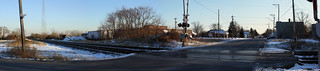
The modern view toward the east as you approach the Ainsworth crossing from the north, just after 3 o'clock on a December afternoon. Trees that now line the tracks were not there in 1916. The small depot stood approximately even with that yellow left-curve warning sign, but closer to the tracks.
(Click on image to enlarge)


Ninety-four years later, a note of perplexity still echoes in the newspaper accounts of the accident — how could this have happened? Eastward of the Grand Trunk crossing at Ainsworth, the track ran straight and level for almost a mile, through open, treeless fields. With no obstruction to the view other than a small depot set well back from the road, anyone approaching the tracks from the north on the Hobart-Ainsworth road (State Road 51) could see a westbound train well before it reached the crossing. Especially on a clear afternoon.

And yet on the afternoon of December 12, 1916, a southbound Ford automobile drove onto the tracks just as a speeding westbound train entered the crossing. The resulting collision killed two young men. And no one had been near enough, had seen enough to understand why it had happened. "The exact cause leading to the accident will never be known," the Gazette said, "and conditions that might have caused it are problematical. Results are sufficiently horrifying."

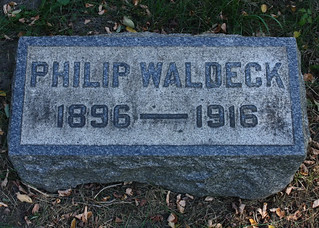
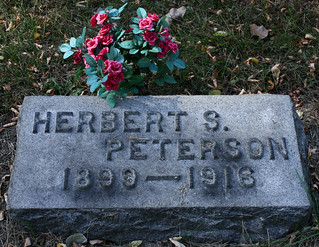
The two young men killed were Philip Waldeck, 20, and Herbert Peterson, 17. It was Herbert's Ford, and he had been at the wheel. He was the eldest son of Frank and Mabel Peterson, who lived and farmed south of Ainsworth — one of their five children, and a grandson of William Smith. Philip, as we know, was the only child of William and Augusta Waldeck of Deep River.

Herbert and Philip had driven up to Hobart to do some shopping that day. They started home around 3:00, going south on State Road 51. The Grand Trunk express train due through Ainsworth at 2:15 was running about an hour late, and, according to some witnesses, speeding to make up for lost time.

Someone who saw the accident from a distance said that Herbert's Ford was moving south on State Road 51 at a leisurely enough pace, but seemed to speed up as it approached the Grand Trunk tracks. At the same time, the train was flying toward the crossing. When they met, the train caught the car squarely in the middle and carried it about a hundred feet before it fell away to the side. The train took a mile to stop. Dr. C.C. Brink of Hobart was sent for, but there was nothing he could do. Both young men had been killed instantly.

There was nothing anyone else could do, either, but look at each other and helplessly ask: How could this have happened? The theory that the boys had tried to beat the train was supported by the witness who thought Herbert had sped up near the crossing. On the other hand, they would not have been expecting a train — there was none scheduled at that time. A moment's lapse of attention, maybe, or of judgment … just a moment's lapse, but it cost the Peterson family dearly, and it cost the Waldecks their all.

The double funeral was held in the Hobart High School auditorium the afternoon of Friday, December 15. Crowds of mourners filed in, family and friends, young and old, faculty and students. Herbert had attended Hobart High until the middle of his junior year; Philip had graduated the previous spring, and had been planning to attend an alumni party that evening. The girls' quartet from his graduating class sang at the funeral service. The pallbearers were all classmates; among Herbert's was Will Wollenberg, Jr., and among Philip's, Ed Wollenberg and another Ainsworth-area boy, Will Buchfuehrer.

Philip and Herbert were laid to rest in adjacent rows in Crown Hill Cemetery.

WaldeckPhilip
(Click on images to enlarge)

PetersonHerbert

Three months before his death, Herbert Peterson had bought a life insurance policy through John A. McDaniel, local agent for Farmers' National of Indiana. The policy carried a double-indemnity clause in case of accident.


Sources:
♦ "Card of Thanks." Hobart Gazette 22 Dec. 1916.
♦ "Funeral of Herbert Peterson and Philip Waldeck Largely Attended." Hobart News 21 Dec. 1916.
♦ "Herbert Peterson and Philip Waldeck Instantly Killed." Hobart News 14 Dec. 1916.
♦ "Local Drifts." Hobart Gazette 15 Dec. 1916.
♦ "Train Kills Two Young Men." Hobart Gazette 15 Dec. 1916.

Thursday, December 9, 2010

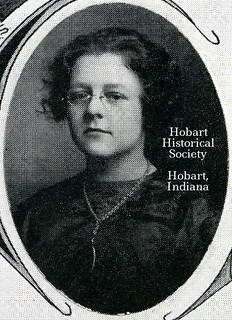
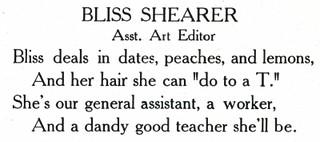
Hobart High School Class of 1912: Bliss Shearer

blissshearer1912srportrait
blissshearer1912caption
Images courtesy of the Hobart Historical Society.

Bliss did indeed become a teacher — by December 1913, she was teaching in a Ross Township school. We know this because early that month she and Delbert* Fisher (another Ross Township teacher) were on their way to their school, riding a motorcycle in a heavy fog, when they collided with a car driven by Fred Bowman of Merrillville. None of them was seriously hurt, but the motorcycle was smashed up so badly as to be undriveable. William Wollenberg gave the two bruised but undaunted teachers a ride to their school.

Bliss' teaching probably ended in the summer of 1915 with her marriage to Paul Emery.

♦    ♦    ♦

That same morning fog of December 5, 1913, caused a collision on the Grand Trunk tracks. The four men of the Ainsworth section gang were on a handcar on the south tracks, waiting for a westbound freight train to pass. Between the blinding fog and the roar of the passing train, they did not realize that an eastbound freight was bearing down on them. When the engine suddenly loomed up out of the fog, the men could only make a desperate leap to the side. All four escaped with their lives.

____________________________
*This may be a misprint for "Delmer."


Sources:
♦ "Fog Accidents." Hobart Gazette 12 Dec. 1913.
♦ Hobart High School Aurora yearbook, 1912.

Sunday, April 18, 2010

The Horse That Died for Morgan

Yesterday I mentioned that a horse had been killed at the Ainsworth crossing in 1899. The horse belonged to Morgan Blachly, a Ross township farmer who was about 49 years old at the time of this incident. He made it to 50 because of his horse.

On the morning of Wednesday, September 13, 1899, Morgan Blachly drove his horse and buggy to the store in Ainsworth, and when he finished his business there, he got back in the rig and drove north on State Road 51.

Perhaps he was so busy being impressed by the newly graveled road that he wasn't paying attention to anything else. As his rig started over the Grand Trunk crossing, Morgan suddenly realized that an express freight train was bearing down on him, seconds away. In a panic, he yanked on the reins as hard as he could. The horse instantly responded, not only stopping but backing up, pushing the buggy off the track and placing itself in the train's path.

The horse was struck and killed. Morgan was thrown out of the buggy onto the ground. Although he was bruised and battered painfully enough that he had to be carried home, nothing was broken and he recovered quickly.

The report makes no mention of the horse's name.

Sources:
♦ 1900 Census.
♦ "Narrowly Escaped Death." Hobart Gazette 15 Sept. 1899.

Saturday, April 17, 2010

The Danger of a Dark Crossing

In spite of the astonishing number of railroad fatalities in northwest Indiana in the first decade of the twentieth century, I had not read of any occurring at the Ainsworth Grand Trunk crossing until now — "now" being December 1909.

The casualty was Hugh Thompson, a 32-year-old Hobart man. His parents' farm, where he had been born (on New Year's Day 1878) and raised, lay south of Ainsworth, abutting the intersection of present-day Route 30 and State Road 51. He was the youngest son of Alexander and Mary Thompson. Mary was 44 years old when she gave birth to him.

Sometime after 1880 the family moved from the farm up to Hobart, and Hugh graduated from Hobart's high school in 1895. After graduation, he still lived with his parents; he never married. Industrious but unable to settle on a single occupation, Hugh worked at various jobs in and around Hobart. Early in December 1909 he picked up a minor job — hauling a load of hay from Merrillville to Hobart for John Green, a cattle buyer.

On December 6, 1909, Hugh set out with John and two other men, Oscar Meyer and Frank Popp, driving a team and a wagon equipped with a hayrack. At Merrillville they loaded up the wagon with two tons of hay. John set out for home with another neighbor, leaving Hugh, Oscar and Frank to man the wagon. The afternoon was wearing on when they started back for Hobart. By the time they reached Ainsworth it was well after 7:00 p.m. The sun was long gone and the little village had no streetlights. As the team approached the Grand Trunk crossing, it drifted slightly off the side of the road, but in the darkness no one realized it until the team and wagon hit the unshielded rails to the side of the crossing and got stuck.

A freight train was coming from the west — a "fast" train, not scheduled to stop. The engineer had the throttle open, intending to fly past the Ainsworth depot.

The train was on the south tracks; so was most of the wagon, while the team was on the north tracks, and one of the horses seemed to have its hoof caught among the rails and ties. The men must have whipped up the horses, but they could quickly see it was no use. Frank jumped down from the wagon and hastily tried to unfasten the team. There wasn't time to get them free. At the last moment, Frank and Oscar scrambled clear of the tracks, but Hugh stayed on the driver's seat, holding fast to the reins.

The train plowed into the back part of the wagon with an explosion of hay. The team and the front part of the wagon were cut loose. The terrified horses, in the tatters of their harness, galloped off toward Hobart.

Frank and Oscar ran back to check on Hugh. They found him on the ground, alive but unconscious. His head was badly cut and bruised, apparently from striking the ground or the front part of the wagon. They carried him to the Ainsworth depot and phoned to Hobart for a doctor.

Dr. Richard Mackey arrived as quickly as he could, driving his own auto. He gave the still-unconscious Hugh first aid, then the three of them loaded him into the car, and Dr. Mackey drove him to the Thompsons' home.

Overnight, Hugh gradually came to consciousness. By morning, he could converse more or less rationally. Though he was paralyzed from the neck down and running a high fever, his parents began to hope that he might survive. But as the morning wore on, his condition deteriorated; the fever rose; he lapsed back into unconsciousness. About 2:00 in the afternoon, he died.

The Gazette noted:
The crossing at Ainsworth is a bad one and several accidents there have been recorded. An effort will be made to have the railroad company place a lamp there, which is certainly needed and should be done for the protection of the traveling public.
If there had been any recent accidents there fatal to humans, they did not make the paper. A horse fatality was reported in 1899. Other than that, I don't know what the Gazette was referring to.

Hugh Thompson is buried in Crown Hill Cemetery, next to his mother.

HughThompson
(Click on images to enlarge)

Thompsonfamilymarker


Sources:
♦ 1880 Census.
♦ 1891 Plat Book.
♦ 1900 Census.
♦ 1910 Census.
♦ "At Rest." Hobart Gazette 10 Dec. 1909.
♦ "Dies From Accident." Hobart Gazette 10 Dec. 1909.

Monday, December 14, 2009

Grand Trunk Western: Accident, 1963

Continuing on the theme of stuff that relates to Ainsworth only because it relates to the Grand Trunk Railroad, which passes through Ainsworth, here's an ICC report on an accident that happened near Charlotte, Michigan, in April 1963.

ICC Re GTW Charlotte 1963

And I've updated my images map with this, as well as with a few more images.