Showing posts with label Mackey. Show all posts

Tuesday, July 1, 2025

Her Soiled Bedding

Last Sunday at the Merrillville-Ross Township Historical Society museum, we received some items from the estate of the late Jean Halsted. Among them was a book of handwritten probate records recording the settlement of local estates, mostly in the 1920s. Many of the names are familiar to me, from Hobart and from Ross Township. For example, I previously wrote about this young man's accidental death at the Hobart motorcycle racetrack.

2025-07-01. Whisler, E.E. - estate settlement
(Click on image to enlarge)
Image courtesy of the Merrillville-Ross Township Historical Society.
I took this picture with my phone. I hope to get better images if I post any more of these.


I was surprised to see that Mary McAuliffe charged the estate quite a bit of money — $26 would be about $400 in today's terms (CPI Inflation Calculator) — "for bedding soiled by decedent, etc." He had lain in a McAuliffe bed for some 24 hours, until he died the afternoon following the accident[1]. New sheets circa 1919 cost about $2.00 each. This makes me wonder what the "etc." could have been.

Three doctors tried to save him, and failed.

_______________
[1] "Dies as Result of Accident," Hobart Gazette, 27 Aug. 1920; also Indiana Death Certificates.

Monday, September 23, 2024

The Gambling Kingpin's Country Hideaway

This Gazette article from 1978 introduced me to a once-notorious Hobart resident whom I had never heard of before:

2024-09-23. 1978-03-29 Gazette, Robin Hood policy king slain
(Click on image to enlarge)
Hobart Gazette, 29 Mar. 1978


This article included enough information (home on Lake George, reached by a private road from 61st Avenue) for me to identify a likely location for Fred Mackey's home, and reference to the 1972 Plat Book confirmed that I had the right place:

2024-09-23. Mackey, Fred - Hobart Twp. 1972
(Click on image to enlarge)

According to one newspaper article, the house cost $200,000 when it was built[1] — per the county records, in 1958. That would be about $2.2 million in today's money.[2]

Here is an aerial view of the house from 1978:

2024-09-23. 1978 imagery via lake co gis website
(Click on image to enlarge)
Image from the Lake County Surveyor GIS Website.


That's a lot of driveway to plow in the winter, isn't it? But I'm sure Fred could afford to hire someone to do that.

The recent construction of the Amber Creek subdivision has eaten up some of the private road, making the property only slightly less isolated.

♦    ♦    ♦

Fred Mackey's murder made the front page of the Sunday Post-Tribune, which ran this article summarizing his career in Gary:

2024-09-23. 1978-03-26 Post-Tribune, Gary Policy Baron Murdered - 1
2024-09-23. 1978-03-26 Post-Tribune, Gary Policy Baron Murdered - 2
(Click on image to enlarge)
"Gary Policy Baron Murdered," Post-Tribune (Gary, Ind.), 26 Mar. 1978.


His story seems to be the classic American success story gone awry, something like Al Capone's: poor boy works his way to millionaire status, but on the wrong side of the law. Like Al, Fred seems to have been known for his generosity to poor people. Also like Al, Fred went to prison for tax evasion, not for the criminal activity that built his wealth.

My research in the online newspapers did not reveal that anyone was ever convicted of Fred's murder, although police did have suspects.[3]

♦    ♦    ♦

Among the property Fred owned, according to one source, was a "farm in Arkansas."[4] Was it the farm where he had been born in 1902? I wish I knew — I can't find any on-line plat maps for Hickory Ridge Township, Phillips County, Arkansas, to figure that out. But let's visit that farm, and see what else we can find out about Fred's background from the census and other records, shall we?

The 1900 Census shows his parents on the farm where Fred would be born two years later. In May 1900, 37-year-old Bruce Mackey married 16-year-old Jennie Davis. The census, taken the next month, shows the newlyweds along with Bruce's two sons, 18 and 16 years of age, from his previous marriage.[5] The household also includes a boarder. Bruce owned the farm himself.

The enumerator of the 1910 Census may have made a mistake: Bruce and Jennie's oldest child is listed as an 8-year-old daughter named Leler, who is never heard from again. That probably should have been an 8-year-old son named Fred. Jennie and Bruce had four more children by then (Bruce Jr., Ruby, Fanny, and Bob).

By the 1920 Census — if we can trust the enumerator — Fred, 18, had left the family farm in Arkansas. But where he went and what he was doing, I do not know. The rest of his family, which now included three more children, was still on the farm.

The next trace I can find of Fred is in September 1929, when he appears in this list of Lake County, Indiana court cases (compiled by Hobart's own Alvina Killigrew):

2024-09-23. 1929-09-26, The Times, County Court Calendars
(Click on image to enlarge)
Alvina M. Killigrew (comp.), "County Court Calendars," Lake County Times (Hammond, Ind.), 26 Sept. 1929.


And so the 1930 Census records Fred as a prisoner in the "Indiana Reformatory" in Madison County. By then, his parents and some siblings had come up north to Gary. His parents ran a grocery store and lived with their daughter, Fannie, and her husband, Ardie Jenkins (a medical doctor).

By 1940 Fred was free again, living in Gary with his widowed mother (along with other family members, including his now-divorced sister, Fannie) and working in an unspecified "mill." But two years later, we find Fred as some kind of entrepreneur, a member of his own firm:

2024-09-23. 1942 draft card -- Fred Mackey
(Click on image to enlarge)
Image from Ancestry.com.


This may have been his first insurance firm. In a 1948 Gary directory,[6] we find him listed as an insurance agent. Sometime between 1942 and 1948 he married Ella Esmond.

He was the proprietor of an insurance company in the 1950 Census. He was also father: his five-year-old son, Fred Jr., was living with him — but his wife was not, apparently. At least, she is not recorded there. A widowed woman was boarding in Fred's house.

In the online newspapers, I came across the son's name a few times in connection with high-school sports in the early to mid-1960s. He was on the track team at Roosevelt High School in Gary.

In 1957, per the county records, Fred built the Gibraltar Building. In 1958, as mentioned above, he built the limestone house on Lake George.

And that brings us nearly to the start of his legal troubles, where the Post-Tribune article above picked up. I would like to know more about the missing years, but I don't suppose I ever will. I'm not the person to tell that story, anyway, given that I know absolutely nothing about illegal gambling in Gary. And very little about legal gambling anywhere.


_______________
[1] David Mannweiler, "To Many, It Was More Than Just a House ("IRS Auction Set")," Indianapolis News, 17 Mar. 1975.
[2] Bureau of Labor Statistics CPI Inflation Calculator, https://data.bls.gov/cgi-bin/cpicalc.pl.
[3] "Ex-Gang Leader Linked to Slaying," Times (Hammond, Ind.), 15 June 1978; "Lake Drops Charges," Times, 15 May 1979.
[4] Mannweiler, supra.
[5] Per a family tree on Ancestry.com, in 1881 Bruce married Josie Woods, who died in 1885.
[6] Polk's Gary (Lake County, Ind.) City Directory 1948 (Detroit: R.L. Polk & Co., 1948), via Ancestry.com.

Wednesday, December 6, 2023

Where Alice Lived

I have discovered that my favorite house in Hobart has an Ainsworth connection.

2023-12-06. 1953-09-03 Gazette, Mrs. Alice Bullock, Pioneer Hobart Resident, Dies At 94
(Click on image to enlarge)
Hobart Gazette, 3 Sept. 1953.


Gilbert and Alice Estella (Markham) Bullock had left their Ainsworth-area farm and retired to Hobart before house numbers were in use,[1] so it wasn't until Alice died that I realized they had lived in a house I have always loved.

As we know, Gilbert died in March of 1916. The newly widowed Alice put the Center Street house up for rent[2] and went to live with her daughter and son-in-law, Ruth and Dwight Mackey, on Connecticut Street, where the 1920 Census records her. By 1930, however, she had moved back to 404 Center and was living with her other daughter and son-in-law, Margaret and William Killigrew, and their children.

The Bullock farm described in the obituary as being across from what is now Indian Ridge Golf Course was bought sometime after 1890, when it fails to appear in the 1890 Plat Book, and 1908.[3]

I do not know why Alice's grave marker shows 1952 as the year of her death. The Gazette and her death certificate say 1953.

♦    ♦    ♦

The newspaper page above brings in another Ainsworth connection: the death of Pauline Hunter. With her husband, Lee, having died in 1947 and their son, Gilbert, now a resident of Chicago, all connection between the Hunters and Ainsworth was at an end.

_______________
[1] I believe they moved to Hobart in 1902, not 1899 as stated in the obituary, based on contemporary newspaper reports (see "Local Drifts," Hobart Gazette, 17 Jan. 1902; "General News Items," Hobart Gazette, 21 Mar. 1902). Per the Lake County records, the house was built in 1880.
[2] "Local Drifts," Hobart Gazette, 17 Mar. 1916.
[3] Possibly as early as 1901; see "Bullock-Lambert Nuptial," Hobart Gazette, 5 Apr. 1901; see also "Obituary," Hobart Gazette, 10 July 1903.

Monday, December 12, 2022

A Stealth Dentist

I bought this postcard because I didn't have this exact view of the 300 block of Main Street.

2022-12-12. Main Street 1911-02-01 a
(Click on image to enlarge)

It is the east side of Main Street, looking south from Third Street. The postcard is postmarked February 1, 1911.

We've seen all of these things before. What interests me in particular is the second story of 301-305 Main, where we see several awnings and a sign jutting out, all with the word "Dentist." At street level, under the big sign for the law partnership of Bozarth & Bozarth,[1] there is a small plaque with the nearly illegible name of a dentist.

The 1910 Census shows two dentists in town — Fred Werner and Charles Kenward — and of those two names, I think Kenward looks more likely.

But I never heard of Charles Kenward before. How is it possible that I've read so many issues of Hobart newspapers from this era and never heard of one of the two town dentists?

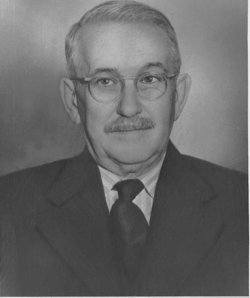
His obituary, from the Hobart Gazette of June 10, 1943, says that he moved to Hobart in 1905 and practiced his profession here until 1918.

2022-12-12. 1943-06-10 Gazette, Dr. Kenward, Former Hobart Dentist, Dies Thursday
(Click on image to enlarge)

2022-12-12. Dr. Charles Franklin Kenward
Image from findagrave.com

♦    ♦    ♦

I already covered most of the other businesses in this photo in another post about a similar postcard, dated the same year, but looking at this side of the 300 block from the other direction.

Notice that the awning of Scheddell's Drug Store reads "The Mackey Drug Store."

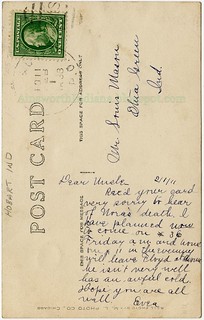
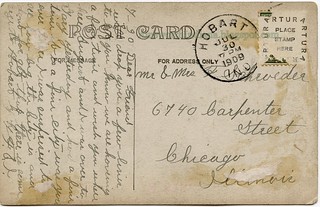
Turning the postcard over, we find it signed "Evea" — I think that's Evea Miller, whom we've met before.

2022-12-12. Main Street 1911-02-01 b

The Floyd with a cold was her toddler-age son. I wonder whom she was planning on leaving him at home with? As for poor Nora, she is a mystery to me.

_______________
[1] I'm not sure who the lawyers were; possibly Nelson and William Bozarth, father and son, who were Valparaiso residents in 1910 but might have had an office in Hobart.

Wednesday, March 20, 2019

Hobart Then and Now: Center Street North from Third

Circa 1909, and 2019

2019-03-20. Center St from 3rd 1909-07-30 a
(Click on images to enlarge)

2019-03-20. Center St from 3rd 2019

This is a depressing update to my previous then-and-now post of the Guyer building.

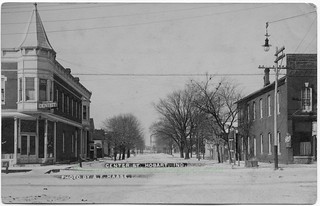
The top photo comes from a postcard postmarked 1909.

2019-03-20. Center St from 3rd 1909-07-30 b

The photo doesn't tell us much about what businesses occupied either of the two commercial buildings on the corners, except that Dr. Fred Werner had his dental office there.

The building on the right might have already been the Amazon restaurant. Somehow, I have the impression that this is where, a few years earlier, Hans Thune had operated the Farmer's Home, but I may be mistaken.

Further down Center Street on the same side is the Rifenburg/Mackey house.

And looking straight up Center Street, you can see in the background the smokestack of the National Fireproofing Co. brickyard.


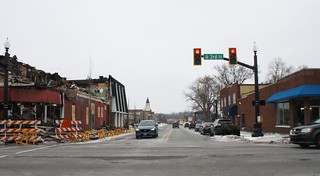
As those of us in Hobart know, the Guyer building was badly damaged by fire on the night of January 15, 2019. Then the second floor had to be knocked down because it was unstable. I am not sure whether the building's ultimate fate has been decided yet.

Tuesday, October 16, 2018

Death at the Rossow Crossing … Again

Two years after witnessing a deadly train-vs.-automobile wreck at the Pennsy crossing near his home on present-day Wisconsin Street, William Rossow was among the first on the scene of another, equally horrifying, at the same crossing.

2018-10-16. Rossow crossing, Gaz, 6-22-1923
(Click on images to enlarge)
Hobart Gazette, June 22, 1923


This story establishes that it was indeed Herman Harms who bought the cottage being moved from New Street, although here its destination is given as the "H. & S. subdivision." So Herman, along with his father Henry, his father-in-law William Rossow, and his brother-in-law Ed Niksch (Miksch is a misprint) were at work on the house a short distance southeast of the Wisconsin Street crossing.

♦    ♦    ♦

An item in the next column to the right mentions the filming of a 1915 celebration in Hobart. That film still exists, I am told, somewhere in the archives of the Hobart Historical Society. It hasn't been digitized, and trying to run the original through a projector would be foolhardy. Someday, perhaps, when both the film and the money to digitize it are found, we'll be able to view motion pictures of Hobart in 1915.

In the right-hand column, we find T.H. Grabowski building an addition to his home — an addition that, fortunately, is identifiable on this current sketch from the Lake County Assessor's website.

2018-10-16. Grabowski house sketch 2018

This confirms what I conjectured: that the old Carlson house is at 6430 Grand Boulevard. Per the county records, it was built in 1879.

Finally, a new bridge was going up over the Deep River where Ainsworth Road crosses it, known as the Nolte bridge since the road passes through the Nolte property there. When I first moved out here in 1990, there was a metal truss bridge similar to the one at 73rd Avenue — I wonder if that could have been the 1923 bridge? It was replaced within about a year of my moving here, and I never thought to take a photo of it.

I am curious to know what sort of bridge was there before 1923.


Additional Source: "Two More Victims of Grade Crossing Saturday When Mrs. John Clark and Daughter Margery Meet Death," Hobart News, June 21, 1923.

Wednesday, November 16, 2016

Let's Get Some Electricity Out Here

From this report on the doings of the Improvement Club of Ross Township, we can gather that by October 1922 Ainsworth still did not have electricity, and its citizens either went without or made their own.

2016-11-16. Electricity
(Click on image to enlarge)
Hobart Gazette, 27 Oct. 1922.


I believe that the Eliza Wood Mackey who "Strangled Herself to Death" was the wife of Robert Mackey, twin brother of the late Richard Mackey. If I have found the right grave, she is buried under the surname Wood, though her maiden name, per her death certificate, would have been Powers. I believe she married Thomas Wood in 1872 (Indiana Marriage Collection).

Monday, August 29, 2016

Main Street, 300 Block, circa 1909

I mentioned having a circa-1909 view of the 300 block of Main Street, so I suppose I had better cough it up now.

2016-8-29. Main Street 300 block ca 1909
(Click on images to enlarge)

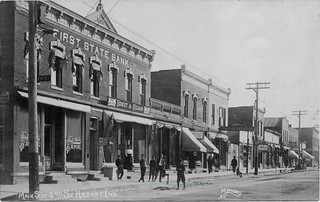
This is the east side, from mid-block north to Third Street. The First State Bank is at the near corner of Main and Third.

I suppose one or two of those awnings next south of the bank cover the Main Street entrance to Scheidt & Keilman's Bee Hive, but there's nothing legible to confirm that.

Two narrower awnings are marked "Buffet," if my eyes don't deceive me, but I don't know who ran that business.

Next we see the two-story building housing the drugstore, with "DRUGS" on the awning (and "Mackey Drug Store" on the front border of the awning). On the south side of that building is what appears to be a ramshackle fence plastered all over with signs, on some of which I can see something about "4th of July" and "Hobart."

South of the fence is the office of the Hobart Gazette.

On the south side of the newspaper office is a two-story building with a saloon operating at street level. The saloon's awnings bear the name "E. Ahrens," but the sign sticking out over the sidewalk reads "Schavey & Ahrens."

The awning at the right edge of the photo is probably the same one that reads "PUMPS, PLUMBING & WELL(?) SUPPLIES" in the 1911 photo, marking Newman's hardware store.

The postmark is October 1909:

2016-8-29. Main Street 300 block ca 1909 verso

Thursday, August 25, 2016

"Our Store"

This view of Main Street comes from a postcard postmarked 1911. The sender has drawn an arrow pointing to "our store":

2016-8-25. Our Store a
(Click on images to enlarge)

The arrow points to a building with a sign reading "Drug Store," topped by a curved embellishment bearing a name that is not legible. That building once housed a drug store operated at various times under the names Mackey and Scheddell.

Having written "our store," the writer then turned the postcard over and clearly signed herself "Edna":

2016-8-25. Our Store b

So far as I have been able to determine, there was no Edna in the Scheddell family or the Mackey family.

However, there was an Edna in the Scheidt family, and Scheidt & Keilman's Bee Hive store was just slightly north of the drugstore.

On this image, blown up to 1200 dpi on the scanner, it's clear which building is marked, but on the original 3.5" x 5.5" postcard, it's not nearly so clear. I think it quite possible that Edna Scheidt marked the wrong building by mistake. That's my theory, and I'm sticking to it.

♦    ♦    ♦

Moving south from the drugstore, let's see what we have here:

2016-8-25. Our Store a marked

(1) A one-story wooden building, probably housing the Gazette office.*

(2) A two story building with a sign advertising Blatz beer, suggesting that it houses a saloon, which I think is operated by Fred Ahrens and Fred Schavey, Jr.*

(3) Newman's Hardware, operated by Paul Newman, who is more generally associated with his later location at Third and Center Streets. (This leads me to wonder if I wrongly categorized the interior shot of the hardware store; it could have been taken inside this Main Street location.)

(4) A saloon, "Hogan's Place," operated by Hugo Zobjeck, who seems to have been called "Hogan" as a nickname.

(5) The bakery operated by Severin Baumer** and, later, his son Fred Baumer.

(6) Real estate and insurance office operated by Lewis E. Barnes.

(7) Real estate office operated by a retired Ainsworth farmer, Gilbert Bullock.

(8) A billiard-and-pool business operated by Calvin L. Fleming, where the cigars he sold may have been of his own making.

________________________
*I'm cheating by looking at another postcard that hasn't been posted to the blog yet, but more clearly shows the mid-block area circa 1909.
**He is recorded as "Siegfried" in the 1910 Census.

Sunday, December 20, 2015

Caught in a Speed Trap

After passing through the "Christian utopia" of Zion City, Illinois, on June 9, 1922, Charles Chester and John C. Cavender had nothing good to say about its justice system or its roads.

2015-12-20. Speed trap in Zion, Illinois
(Click on image to enlarge)
Hobart News 15 June 1922.


(You will notice in the left-hand columns of the page above the news of William Devonshire's death. A childless widower, he left everything he had to the Masons.)

The Gazette's telling of the speed-trap story did not turn out quite so well for Charles:

2015-12-20. Speed trap in Zion, Illinois
(Click on image to enlarge)
Hobart Gazette 16 June 1922.


Over in the "Local Drifts" columns, we are reminded that in Hobart, at least, thievery is done in the dark of night rather than the light of day — and not nearly so methodically; and that in Merrillville, work is going forward to keep "dead man's crossing" from claiming any more victims.


Additional Source: "Oldest Mason Dies in Hobart." Hobart Gazette 16 June 1922.

Saturday, July 25, 2015

The Vote of the Ladies Is Respectfully Solicited

Several acquaintances were running in the primary election in the spring of 1922, and every candidate was asking for the vote of the recently enfranchised women. Earnest Walter was the father of the Walter Bros. Robert Harper lived near Ainsworth and, last I heard (1917), served as its marshal. John Harms lived on Cleveland Avenue and was part of the large Harms family that populates this blog.

2015-7-25. Harper et al. running in primary
(Click on image to enlarge)
Hobart News 23 March 1922.


The "Local and Personal" column is crammed with people we know. The John Crisman, Jr. with rheumatism may be Dorothea's father … or perhaps her 16-year-old brother. Earl Blachly and his second wife, née Annie Witt, had recently shed all their farming-related possessions. Mrs. William Killigrew and Mrs. Dwight Mackey had grown up east of Ainsworth as Etta and Ruth Bullock. And apparently Otto and Lesta (Raschka) Maicke have moved back to Ainsworth, after living in Hobart for some time.

Friday, July 3, 2015

Electrocution on Water Street

The evening of March 10, 1922, former photographer John J. Naumann turned off the light.

2015-7-3. John Naumann death
(Click on image to enlarge)
Hobart News 16 March 1922.


The nearly illegible line in the second paragraph reads, I think, "dining[?] room in the Banks home, Mr." — the Banks home being, I suppose, the home of Nathaniel P. Banks, who was John Naumann's father-in-law (and who had lost his wife a year earlier). The 1920 Census shows the combined Banks and Naumann families living on Water Street, but does not note the house number. The address given for N.P. Banks in the 1930 telephone directory is 600 S. Water Street.

By contrast, the Gazette's report did not mention recent rains, suggesting instead that the tragedy might be explained by the discovery, the next day, of "crossed wires on a pole near George Stoecker's flats, one of the wires carrying a high voltage for running motors." ("John J. Naumann Accidentally Killed Friday Night," Hobart Gazette 17 March 1922.)

Thursday, January 29, 2015

Just Another Airplane Falling Out of the Sky

It wasn't as close to Ainsworth as usual when a U.S. mail plane fell out of the sky on November 18, 1921.

2015-1-19. Airplane falls onto farm
(Click on image to enlarge)
Hobart News 24 Nov. 1921.


The Gazette said that the plane came down in "Wm. Mohl's field," and members of the Louis Boldt family were first on the scene. I can't find the Mohl, or Moehl, land; I can't find a farm owned by Louis Boldt; but here, for what it's worth, is the William Boldt farm on the 1908 Plat Map.

2015-1-29. Boldt 1908
(Click on image to enlarge)

♦    ♦    ♦

Speaking of William Boldt (who was Louis' brother, I believe) — he was up to his own activities at this time: he had just sold his house in Hobart, and was holding an auction to sell off some of its contents.

2015-1-19. Wesley: John Sr. & John Jr.
(Click on image to enlarge)
"Local Drifts." Hobart Gazette 25 Nov. 1921.


I haven't talked about the Wesley family since the autumn of 1920, when John's sister, Anna, had married William Gernenz — except for a "South of Deepriver" column in June 1921 mentioning that John Wesley was pressing hay for H.H. Smith, and I don't know whether that's John Sr. or Jr. John Sr. was farming in the vicinity, of course, but John Jr., although a townie, earned his living by threshing and pressing hay for others with his own machinery.

Here is the Wesley land as shown in the 1926 Plat Book (it was identical in 1891 and 1908, and substantially the same in 1939):

2015-1-19. Wesley 1926
(Click on image to enlarge)

Anyway, it's John Jr. who is now going to farm in Ross Township, and maybe he will provide us with better gossip than his father did (not that I have any reason to hope).

John Jr., born May 25, 1889, was the middle son of three from John Sr.'s first marriage. By the age of 21 he had moved out of his father's house and hired on to work on the farm of William and Jennie Fisher. I'd be tempted to draw an interesting conclusion from that fact (for example, that he couldn't get along with his young stepmother, or, what is worse, got along with her too well), except that it was not uncommon for young men from farming families to hire on with neighbors.

Late in June 1917, John Jr. married Frances Mattmiller in Chicago. I'd be tempted to suppose that his having filled out his draft card a few weeks earlier had given him marriage fever, but really I have no evidence of that and I ought to stop thinking such things. And furthermore, he stayed married to Frances through 1940 at least, so no doubt it was a true love match. Anyway, in 1920 there they were in Hobart with one little son, being utterly respectable citizens.

By 1940 they had three children. Let us hope at least that one of the children will commit a youthful indiscretion.


Additional Sources:
♦ 1900 Census.
♦ 1910 Census.
♦ 1920 Census.
♦ 1940 Census.
♦ Cook County, Illinois, Marriages Index.
♦ WWI Draft Cards.

Tuesday, December 2, 2014

Carolyn Sykes Guernsey Santonge

We now get another glimpse of life in the Otis Guernsey family, thanks to Annamarie Dunford, great-great-granddaughter of Otis and Amanda by their youngest daughter, Carolyn (aka Carrie), born circa 1901.

This is the daughter whom Otis and Minnie visited in St. Louis in the spring of 1921, by which time apparently she was married to Joseph Santonge. I reported on that visit so off-handedly, knowing none of the background … but Carrie's oldest daughter Irene has left us an idea of the years of unhappiness and separation preceding that visit, in these few lines written at some point in her life (and I wish she'd written more):

Text by Irene Santonge
(Click on images to enlarge)
Images courtesy of Annamarie Dunford.


My transcription:
Carolyn Guernsey ran away from home at the age of nine. Her father Oatis kept track of her but never forced her to return. Her mother [Amanda], a full blooded Cherokee, had been burnt to death when [Carolyn] was only two. Amanda worked in a shoe factory on the second floor to help supplement their income during a drought year. When fire broke out she had no chance. Oatis married a woman [Minnie] who mistreated and abused the younger children. Oatis was found in his cornfield in 1926 with his head bashed in. Assailants unknown.
You will notice, first of all, that the story of Amanda's death came down to this granddaughter in an altered version — retaining the essential horror of death in a fire, but scrubbed of the scandalous details of her lover and their elopement.

That's an interesting remark about Otis being attacked in his cornfield, isn't it? It sounds as if Irene was telling about his death — which actually occurred in 1927, but that could easily be misremembered by a grandchild. This is the first I've heard of any attack on Otis that may have killed him, but then again I haven't read the 1926-1927 newspapers in any detail. Annamarie relates that her grandmother told her Otis was killed because he had married an American Indian (Amanda). And yet his death certificate contains no mention of head wounds:

Otis Guernsey death certificate

"Chronic valvular heart disease" is the cause of death. Surely Dr. Dwight Mackey would have known a fractured skull when he saw one. This is very intriguing, and perhaps as I continue to read the microfilm I will eventually find out what really happened — or what was reported at the time, which is the best I can hope for.

While reading the binder of genealogy notes at the Merrillville museum, I came across another little portrait of life in Otis Guernsey's household, apparently from an undated interview with his oldest daughter, Nellie:
They all worked very hard. They were without a mother from the time Nellie was two. Father [Otis Guernsey] had to care for them. Nellie grew up in Deep River — her father raised them and was very strict with them. He really raised the switch to them. They were very poor, so poor that Otis put bibbed-overalls on Nellie and sent her to school. Nellie worked hard on her childhood home and had very little enjoyment like most young girls. She worked hard all her life. Also after marriage she just got used to hard work. Raised 6 children and worked hard for them.
I don't know quite what to make of that remark about being without a mother "from the time Nellie was two." Nellie was born in June 1895 (1900 Census), so she was eight when Amanda died in October 1903. It's possible the interviewer misunderstood Nellie, or made a mistake in the notes; it's possible that, so many years later, Nellie was a bit confused about dates; or perhaps this means that Amanda was not consistently in the home throughout her marriage to Otis, so Nellie felt motherless even while her mother was still living.

♦    ♦    ♦

So, getting back to Carrie: by 1921 she had married Joseph Santonge. I can't find a record of the marriage, so I don't have an exact date. Though I can't find either of them in the 1920 census, we know from the spring 1921 visit that Carrie was living in St. Louis (and that she was on good enough terms with her father and step-mother to allow them to visit her).

Carolyn and Joseph Santonge had three children: Irene was born March 26, 1921; Dorothea June 25, 1923, and Anna Marie September 18, 1925.

Here is Carrie with her three young daughters in 1925:

Carolyn and the kids


Here are the children in 1928:

Santonge kids + 1

Front row, left to right: Dorothea, Anna Marie, unidentified; the tall girl in back is Irene.


And this is Carolyn in 1939:

Carolyn Guernsey Santonge

♦    ♦    ♦

For Guernsey genealogists, Annamarie has sent me some of her research:

Guernsey-Garnsey family tree

Chester Smith Guernsey was Otis Guernsey's father.

Guernsey, Chester Smith

C.S. married Elizabeth Dibble.

Dibble, Elizabeth

C.S.'s father, Hosea …

Garnsey, Hosea

… had married Seviah Cunningham.

Cunningham, Seviah


Details of Otis' marriage to Minnie:

Guernsey-Jones marriage

♦    ♦    ♦

12/6/2014 update — Just a little more information to add, from Annamarie:

(1) An interesting detail about Amanda Rex (McDonald?) Guernsey has been handed down through the descendants of her daughter, Caroline — namely, that Amanda used to ride horses at the state fair.

(2) Carolyn Guernsey married Joseph Santonge in 1920. They divorced sometime time after the birth of their third daughter (Anna Marie). Sometime in 1934 Carolyn married Albert Berendt; they lived in St. Louis City, Missouri. She was born 4-3-1902, and she died 12-25-1941.


Here is her death certificate:

Berendt, Caroline - death certificate
(Click on image to enlarge)
Image courtesy of Missouri Digital Heritage.

Tuesday, November 18, 2014

A Little Mackey

A year and a half after the loss of their daughter, Dr. Dwight and Ruth Mackey welcomed a son into the world: David Marvin Mackey was born September 5, 1921, at Mercy Hospital in Gary.

The next evening, Dr. Dwight celebrated with his buddies at the American Legion:

2014-11-18. Cigars
(Click on image to enlarge)
Hobart Gazette 9 Sept. 1921.


Ruth and the baby came home from the hospital about two weeks later.


Additional Sources:
♦ "Births." Hobart Gazette 9 Sept. 1921.
♦ "Births." Hobart News 8 Sept. 1921.
♦ "Local and Personal." Hobart News 22 Sept. 1921.

Friday, October 24, 2014

Good Times and Bad Among the Dairy Farmers

The Lake County Milk Producers' Association made big plans for a picnic in August 1921, enticing potential attendees with an offer of free milk as well as lots of fun.

2014-10-24. Free Milk
(Click on image to enlarge)
Hobart News 11 Aug. 1921.


Meanwhile, Everett Newman wins another "away" race; and the mysterious Miss Kipp attends a family reunion of her sister's in-laws, accompanied as usual by Dr. Clara Faulkner, and unexpectedly (to me, at least) by Mr. and Mrs. Lewis Roper.

The picnic was a success — well attended and fun.

2014-10-24. Picnic
(Click on image to enlarge)
Hobart News 25 Aug. 1921.


But this was gaiety in the face of hard times: just a week later, the Gazette was complaining that prices paid to milk producers were falling while retail prices remained almost the same — somebody was making money, but it wasn't the farmers, and now their marketing company's bad financial condition was about to force its Gary office to shut down.

2014-10-24. Milk
(Click on image to enlarge)
"Local Drifts." Hobart Gazette 2 Sept. 1921.


(Also, Mabel's younger brother has a dislocated arm.)

Whatever happened at that meeting in the old town hall was not reported, but a week later the Gazette expressed hopes that the Milk Producers' Association proposition would "be saved from the rocks and placed on a sound working basis." That remains to be seen.


Additional Sources:
♦ "Local Drifts." Hobart Gazette 9 Sept. 1921.
♦ "Milk Producers of Lake County to Have Big Picnic." Hobart Gazette 12 Aug. 1921.
♦ "Notice to Milk Shippers." Hobart News 1 Sept. 1921.

Sunday, October 5, 2014

Bliss to Be Back (Paul Too)

The last we heard of Bliss (Shearer) Emery, she had pulled up roots and left Hobart for Chicago, as her husband, Paul, wanted to try his hand at the publishing business and live in the city. Of course, with her family still in Hobart, the Emerys returned for the occasional visit.

It seems that the publishing business disagreed strongly with Paul. Just a few months later he sold his interest in that firm. He and Bliss were still living in the city, but reportedly were considering moving back to Hobart.

By mid-July 1921, they had made up their minds. Bliss was coming back to her old home, and Paul to his old job.

2014-10-5. Paul & Bliss Emery to return
(Click on image to enlarge)

Also, Dr. Dwight Mackey would be making his house calls in a new Oldmobile, just purchased from the Walter Brothers, one of whom was Bliss's brother-in-law.

(And yes, those attending the Gem Theater on Sunday would be seeing Mary Pickford's brother.)


Sources: "Local and Personal." Hobart News 9 June 1921; 14 July 1921; 21 July 1921.

Wednesday, September 10, 2014

Two Bloody Days

Twice in two days — the last days of June 1921 — Dr. Jacob Ader and Dr. Dwight Mackey were called on to deal with the carnage of railroad accidents.

2014-9-10. Accident at Ainsworth crossing
(Click on image to enlarge)
Hobart Gazette 1 July 1921.


The following week's Gazette reported that Louis Hershall had died the afternoon of the same day. His remains were shipped back to New York.


Another story on the page above concerned the farmer-owned milk-marketing company, which was "in a bad way financially"; but the story gave no clue as to the reason — whether poor management, or the effects of the depression the country had been going through since early 1920, or some other cause.