Showing posts with label disease - tuberculosis. Show all posts

Thursday, September 10, 2026

Stoltz Family Stories: The Merrillville Store

This 1911 calendar plate was recently donated to the Merrillville-Ross Township Historical Society museum.

2026-09-10. Stoltz plate
(Click on image to enlarge)

I started looking into the newspapers of the time to figure out if this plate marked any special occasion, or if the Stoltz store was simply in the habit of handing out yearly promotional items, as this might have been. I didn't find the answer, but I did find some stories that I had previously overlooked.

Many years ago I posted a brief history of the Stoltz store in Merrillville. I was relying on A Pictorial History of Merrillville, which seems to be largely based on oral history — in other words, human memory. As so often happens, memory got it close but not 100% correct.

Memory was off by only a couple of years regarding the year when the store at 40 W. 73rd Avenue was built — it was not 1905, as per A Pictorial History, but 1907. The project started in July 1906 with the destruction by fire of the building that previously stood there:

2026-09-10. 1906-07-03 Lake County Times (Hammond, Ind.), Business Section Burning, p. 1
(Click on image to enlarge)
Lake County Times (Hammond, Ind.), 3 July 1906, p. 1


That earlier store may have been built circa 1860: that is the build date listed for the current structure in the Lake County assessor's records, which apparently were not updated to reflect the fire. Perhaps the destruction was not complete enough.

Mike Weis had been born around 1873 to immigrant parents, John and Elizabeth, who spent some time in St. John Township before relocating to Ross Township around the time of the Civil War. In 1902 Mike had married Elizabeth Gerlach.

The "Weis" store, we soon learn, was actually owned by Marion F. Pierce:

2026-09-10. 1906-07-19 To Rebuild Merrillville Store, Lake County Times (Hammond, Ind.), p. 1
(Click on image to enlarge)

Marion gave his occupation for the 1900 Census as "general merchant." Writing in 1904, T.H. Ball described him as a "merchant and well-known business man of Merrillville, Ross township, [and] one of the oldest native sons of Lake county still engaged in the active pursuits of life. Three generations of the Pierce family have been identified with the industrial and commercial affairs of the county, covering a period of seventy years…"[1]

Mike Weis' health, incidentally, was a serious matter. He had tuberculosis. His visit to Rome City may have involved the Kneipps Springs sanatorium, but he did not find a cure there. After relocating to St. John, he and his family went to New Mexico and Texas, probably in search of a climate cure that failed to materialize. They were on their way back to St. John when Mike died in Topeka, Kansas, on April 3, 1910.[2]

But to return to the store: by April 1907, Carl Gerlach had purchased the land from Marion F. Pierce and announced his plan to rebuild the store, possibly in partnership with John Stoltz.

2026-09-10. 1907-04-10 Carl Gerlach Will Build Store in Merrillville, Lake County Times (Hammond, Ind.), p. 1
(Click on image to enlarge)
Lake County Times (Hammond, Ind.), 10 Apr. 1907, p. 1.


Carl Gerlach, born in St. John in 1887, was one of a large family. Among his sisters were Elizabeth Weis (Mike's wife) and Margaret Stoltz, wife of John Stoltz. So there were family connections around the store, even before the original one burned.

John Stoltz's parents were Gottfried Franciscus ("Frank") and Elizabeth, both German (or Prussian) by birth but U.S. residents from childhood. Frank Stoltz served in the Civil War, then came home and married Elizabeth Weis (yet another family connection to the store?). The family moved around a bit between Illinois and Indiana, then settled in Hammond, where Frank worked in the slaughterhouse (1880 Census). With the 1890 census missing and John Stoltz unidentifiable in the 1900 census, I don't know exactly what he was doing in his early adulthood.[3] He married Margaret Gerlach in the summer of 1900. They lived in Hammond, as we can gather from a few Hammond social-column items from 1906 into early 1907. His story, as far as we can tell it, starts in 1907 with the proposed new store in Merrillville.

The new store was completed in May 1907.[4] Per this social column, by September 1907 John Stoltz had become "the merchant" to Merrillville, and Margaret was part of Merrillville's social news.

2026-09-10. 1907-09-14 Lake County Times (Hammond, Ind.), p. 6
(Click on image to enlarge)
Lake County Times (Hammond, Ind.), 14 Sept. 1907, p. 6.


According to A Pictorial History: "Business was good but the operation was not profitable enough to support two families, so John and Margaret bought her brother [Carl Gerlach] out …." The buyout happened only a few months after the store's opening — by August 1907.[5] Carl moved to St. John; the 1910 Census finds him there, working as a salesman for a general store.

The Stoltz store was a Merrillville fixture for decades. My earlier post gives an outline of its subsequent history per A Pictorial History, and I'm not going to double-check all the dates because the Stoltz store is not really what I came in here to talk about! — that is another story I came across while researching the 1911 plate that started this whole thing. But it will have to wait for another post, because I have worn myself out with this origin story.


_______________
[1] Lake County Encyclopedia, p. 218. See also his entry in Alice Flora Smedstad's Soldiers & Veterans Memorialized at the Merrillville Cemetery, pp. 40-41.
[2] "Death of Mr. Weis," Lake County Times (Hammond, Ind.), 6 Apr. 1910, p. 6; "Funeral of Mr. Weis," Lake County Times (Hammond, Ind.), 8 Apr. 1910, p. 1.
[3] Per a Hammond directory of 1891-92, he might have been working for the "C&E Ry" (Hammond, IN, 1891-92. Hammond, IN, USA: Frank E. Gero, 1891, via Ancestry.com).
[4] "St. Johns News," Lake County Times (Hammond, Ind.), 8 May 1907.
[5] "It is reported that Carl Gerlach has sold his interest in the new store to his partner, John Stultz." "Merrillville News," Lake County Times (Hammond, Ind.), 1 Aug. 1907.

Wednesday, July 8, 2026

What Happened to Lillian

This doesn't concern Ainsworth, but it concerns the Ainsworth historian.

When I was 16 or 17, I bought a little 1883 diary … somewhere. I think it was in Michigan, where I was in the habit of buying antique items on family vacations; but it may have been on a trip to New England. I wish I could remember, because this 1883 diary came from New York, and if it ended up in Michigan, how it got there would be an interesting puzzle to solve.

2026-07-08. Diary 001 - cover
(Click on images to enlarge)

The diary itself presents a mystery. Its writer is the teenaged Lillian Todd, who lives in Penn Yan, New York.

2026-07-08. Diary 002 - inscription

Her entries run from January 1 to October 4, 1883. As the months go by, her handwriting gradually deteriorates from a delicate, controlled script to a blotted scrawl. Compare her first entries …

2026-07-08. Diary 1883-01-01

… to her last:

2026-07-08. Diary 1883-10-04

The diary is clear on one point: Lillian is not well. She is tired all the time; she can't do the things she used to; she is headachy, irritable and nervous. She takes some unnamed medicine on a daily basis, while friends and relatives send her recipes for home remedies. She alludes to some serious illness that happened before the diary opened, perhaps the previous autumn. "I have felt real well today. How good it would be to be entirely well again. I little thought I would be sick so long …" (Jan. 15); "I made a pie crust today. That is worthy of note for it is the first baking I have done since I was sick" (Jan. 20); "I took a good long walk today[,] … the longest I have taken since the middle of October. I think that is quite encouraging but my hand trembles worse than ever. This is the pay for my walk, but I don't care if it doesn't make me worse" (Jan. 26). On her 17th birthday — March 7, 1883 — she spends much of the day lying down, and then some well-meaning person arrives with a recipe for homemade cough medicine.

2026-07-08. Diary 1883-04-07

"Howard Woodrough called and left a receipt for cough medicine. I wonder what would become of me if I should take everything prescribed."

In this April 4 entry, she wishes she could return to school:

2026-07-08. Diary 1883-04-04

That entry mentions painting, one of the few things Lillian could still do. On a blank page (rare before October; she generally made an entry every day, even when there was nothing much to note), she gives us an example of her artwork:

2026-07-08. Diary 1883-04-15

Lillian painted pictures and cards, and on ribbons and in autograph albums, for family and friends. In early February, she made her first attempt at a landscape, which she gave to (I believe) her eight-year-old half-brother. She records the event with her typical self-deprecating humor:

2026-07-08. Diary 1883-02-12

Her family tree, by the way, is complicated. Lillian was one of four children born to Eli Gilbert and Sarah (Miller) Todd, who were married circa 1858. Sometime around 1869, her parents divorced. Her father remarried, took himself off westward, and started a new family. Lillian never mentions him in the diary, although he was still living. Around 1870, her mother married John Crakes, a man with children from past relationships — he had been widowed once, and possibly divorced once — and had two more children with him. So Lillian had stepsiblings and half-siblings in her life. Her stepfather died in 1881, and her mother did not remarry.

As I've looked through the diary now and then over the years, it has occurred to me to wonder if the deterioration in Lillian's handwriting was due less to her illness than to the medicines she was taking. In 1883, as we all know, there would have been patent medicines available that contained intoxicating and addictive ingredients. In this June 12 entry, she goes to the doctor's office and gets some kind of medicine.

2026-07-08. Diary 1883-06-12

Even medicine given by a doctor might contain such things as opium derivatives and alcohol. After that visit to the doctor, Lillian spends the next day resting — "that is all I do about two thirds of the time now." In her July 10 entry, she says: "This morning I have felt as if I was about used up; perhaps it is because I haven't taken any medicine today."

Surprisingly, the latter part of the diary records a lengthy trip, with Lillian setting out on July 18 and returning home October 2. She takes a boat down Keuka Lake to Hammondsport, and after staying a few days with friends there, takes a train to Campbell. There she stays with relatives, I believe, in the house where she was born. She visits family, old friends, and scenes of her childhood. She makes side trips to nearby towns. (On July 10, in the town of Corning, she and her companions have their pictures taken; how I wish I had that picture!) It's a remarkable exertion for one in her condition.

The vacation doesn't do anything for her health, however. As the weeks pass, she is still tired; she is coughing; her uncle brings her a bottle of medicine. Near the end of September, Lillian sees two different doctors. Neither gives her good news.

2026-07-08. Diary 1883-09-22
"Dr. Everitt … examined my lungs[;] he thought they were very bad but did not say much about it."

2026-07-08. Diary 1883-09-29
"Rob Cristler took Sarah and I to Corning to day to see Dr. Bryan[;] he examined my lungs and said they were very bad and he did not know wether they could be helped or not."

The vacation ends October 2, with a strenuous trip back to Penn Yan involving a 4:00 a.m. wake-up call, a train that was two hours late, and torrential rain. Lillian arrives home safely, but comments the following day that she is "about played out."

The diary ends on October 4 with this very ordinary entry:

2026-07-08. Diary 1883-10-04 last entry

After that, silence.

♦    ♦    ♦

What happened to Lillian? Did the diary end because she suddenly became too ill to write? Did her disease claim her at 17? Or, perhaps, did she recover and go on to lead a full life? I have been wondering for 50 years.

When I first got an Ancestry.com subscription, of course I looked for her, and found her, easily enough, in the 1880 census, living in Milo, Yates County, New York, with her widowed mother, three siblings and two half-siblings.

2026-07-08. 1880 Census - Lillian Todd
(Click on image to enlarge)
Image from Ancestry.com


Go back ten years, and we find the family in Campbell, Steuben County.

2026-07-08. 1870 Census - Lillian Todd
(Click on image to enlarge)
Image from Ancestry.com


Beyond that, I could find nothing. No record of her death. No record of the events that might have marked her recovery, like marriage and children.

But when I first researched her, Ancestry.com and Findagrave.com had not yet become the resources they are now. I just recently thought to take another look on both websites for more information about her. This time I found it. There are now some family trees on Ancestry.com to explain the complicated history of the Todd/Crakes family, which gives me a better idea of who some of the people mentioned in the diary were.

And further, some helpful history detectives have done the reading of old newspapers and posted their discoveries to Findagrave.com. So, at last, I finally know what happened to Lillian.

Sometime after her diary ended, she, along with her Uncle Newman Miller (and possibly his wife, Carrie) left Penn Yan for Bernalillo, New Mexico, in the hope that the New Mexico climate would cure Lillian's tuberculosis. It was a vain hope. Lillian died there on March 17, 1884, ten days after her 18th birthday. She is buried in an unmarked grave.

I am grateful to those people who have solved this mystery for me, 50 years after I first encountered it. I have made my own contribution to Lillian's Findagrave entry by adding some images from her diary.

Ten years after Lillian's death, Uncle Newman died in the same place of the same cause. His grave is at least somewhat marked.

♦    ♦    ♦

There's just one more thing I want to add. Let's look again at Lillian's last entry:

2026-07-08. Diary 1883-10-04 last entry

"Fannie and Herman came up a little while …" Fannie was Lillian's sister, Frances, who was about three years older. Fannie is a recurring figure in the diary, visiting Lillian's home often although she no longer lived there, helping around the house, keeping Lillian company.

Herman was Fannie's husband. They had married in 1879. Can you guess what Herman's surname was?

It was … Ainsworth. Yes. This is one of those weird little coincidences that make me think the universe is winking at me.

Sadly, Fannie did not long survive her sister. She died exactly one year after Lillian: March 17, 1885. Fannie was laid to rest back home in Penn Yan, some two thousand miles from Lillian's unmarked grave.

Herman Ainsworth remarried before the year was out and fathered two children with his second wife, but when he died in 1923, he was buried beside Fannie.

Wednesday, December 24, 2025

Happy Christmas

2025-12-24. Mueller, Bertha 1922 - Happy Christmas001
(Click on images to enlarge)

This postcard shows that the "Happy Christmas and Merry New Year" message I posted last year was not necessarily facetious. Apparently, people used to wish you a happy Christmas in perfect accord with religion and decorum.

Sending this happy wish was a lady with a sick baby:

2025-12-24. Mueller, Bertha 1922 - Happy Christmas002

Transcription:
Dear Aunt I heard you was sick hope you are better. My baby was very sick she is some better the Dr. don't come eney more. wish you and Uncle John a most Joyfull Xmas. Bertha M.
The year in the postmark is not really legible, but it has to be 1922 or later, based on that 1922 Christmas seal (sold by the National Tuberculosis Association).

I believe the writer, "Bertha M.," was Bertha Mueller, the daughter of Uncle John's sister, Pauline, and her husband, August Czerwonke. Bertha had been born in Germany in 1882, brought to this country later that decade, and grew up (as far as I can tell) in LaPorte County, where she married August Mueller in 1909. By 1910, the young family was in Hobart. The sick baby was probably Lucy Frances, who had been born December 10, 1921.

Here is the family in the 1930 Census:

2025-12-24. 1930 Census Mueller, Bertha
(Click on image to enlarge)
Image from Ancestry.com.


Not listed is their eldest daughter, Mary Elizabeth — who, in a sad twist of fate given Bertha's support of the anti-tuberculosis crusade, would die in 1936 at the age of 26 from pulmonary tuberculosis.[1]

Bertha died in 1962, surviving her husband by four years.

As for Aunt Agnes and Uncle John, they lived out their lives in Wanatah, and are buried in Porter County.

And a Happy Christmas to you.

_______________
[1] Her death certificate gives her occupation as nurse, so in 1930 she may have been away from home training or working in that field.

Friday, January 18, 2019

Hot Weather

The last two weeks of June 1923 were so hot that the strawberry crop withered and the M.E. church held its services in the basement. The Gem Theatre in Hobart enticed its patrons with "12 big fans" to cool them off. (The movies had not yet become the talkies so there was no spoken dialogue to be drowned out by those fans.) When sundown brought a little relief, you could go dancing at the pavilion just north of the old Liverpool schoolhouse, on the northeast corner of the Old Ridge Road-Liverpool Road intersection. The brave young people playing tennis on Stommel's lot did so early in the morning or late in the afternoon, I hope.

Nothing much was planned in Hobart for Independence Day, but on its eve Camp 133 promised a big fireworks display. If you didn't care for fireworks, you could go dance at the old Deepriver schoolhouse to music "with real pep" played by Perry's Big Six (I have no idea).

2019-01-18. Lee, Gazette, 6-29-1923
(Click on image to enlarge)
Hobart Gazette, June 29, 1923.


Still, work had to go on. Planning for the future Roosevelt Gym building was going forward, and our favorite plumbers, Lee & Rhodes, as the only bidders for the plumbing work, were awarded the contract.

Some unpleasant business involving tuberculosis-testing of cattle occurred on "the big farm of Roper Bros." (and even more unpleasant business later at a Chicago slaughterhouse). I don't know where that farm was. I can't find any land owned by a Roper in Union Township on the Lincoln Highway in the 1921 or 1928 plat maps.

Friday, April 20, 2018

Fast Time

Our friend Fred Rossow lost nearly all his cows in April 1923, as the tuberculosis testing of local herds finished up.

2018-4-20. Fast Time
(Click on image to enlarge)
Hobart Gazette, April 20, 1923.


No one else lost as many in this round of testing, and most of the herds tested clean. "John Harnes" is a misprint for "John Harms."

There is so much material on this page! In the far-left column, Bess Hayward is selling off livestock and farming implements from her parents' estate.

In the next column, just below the cow-testing story, confusion arises from the inconsistent adoption of "fast time" — Daylight Saving Time. (And below that, yet another dance at the Niksches' Deep River Hall.)

In the right-hand column, we find an entertainment planned at the W.G. Haan School.

2018-4-20. brookdale farm synopsis
From Plays of the 19th and 20th Centuries, Volume 27 (1884)

And at the bottom of the column, some Severance-Yager socializing. From the 1920 Census, it would appear that George (Sr.) and Agnes Severance, who always rented the farms they operated, had moved from their previous home, a Ross Township farm west of Hobart,[1] to land in southeastern Hobart Township: their neighbors are Malones, Ensigns and Fasels.

♦    ♦    ♦

I was able to confirm the Harnes/Harms misprint above through the News version of the cow-testing story. That paper also carried a story about Ruby Fisher's marriage to a Hobart chiropractor named Alfred[2] C. Wickham, whom I never heard of before …

2018-4-20. Fisher wedding
(Click on image to enlarge)
Hobart News, April 19, 1923


… or after, either — I can't find them in the 1930 Census.

_______________
[1] "Celebrate Silver Wedding," Hobart Gazette, July 20, 1917.
[2] Indiana Marriage Collection.

Sunday, March 18, 2018

Now, About All Those Other Guys

Mayor Sherman Henderson's instructions to Police Chief Fred Rose in early April 1923 testified that, in spite of all those recent acquittals, plenty of people in Hobart were selling and buying vice in the form of liquor and gambling.

2018-3-18. Punchboards etc.
(Click on image to enlarge)
Hobart News, April 5, 1923.


I had to ask Professor Google what punch boards are. In his letter, His Honor sounds as if he were still mad about losing money on them.[1]

In the left-hand column, we find another type of eradication underway, as local cattle were getting tested for tuberculosis, and many failing.


_________________________________
[1] I'm kidding.

Thursday, January 25, 2018

"Old Fasel Homestead Destroyed by Fire"

2018-1-25. Fasel homestead burs
(Click on image to enlarge)
Hobart News Mar. 23, 1923.


Once or twice, when we were driving along Tenth Street, Eldon Harms pointed out a two-story house on the south side of the road and told me, "That's the old Fasel homestead." Maybe that's the house that replaced the old Fasel homestead after it burned down in 1923? The County Assessor's records do not agree with that theory, but the County Assessor's records are not reliable.

In the right-hand column, we find James Chester working as an auctioneer.

Among the farmers who lost cows (in the article above the one marked) are some of our acquaintances, including Mike (aka Helmuth) Foreman of Ainsworth. We've also met Duffy DeFrance before. For the location of the "old DeFrance farm," we can go back to the 1870 Census and Duffy's parents, Charles and Catherine, living in Portage Township, Porter County; and the Portage Township plat map of 1876 shows them owning 120 acres in two parcels, one of which borders E. 37th Ave. not far east of where it is now crossed by the Prairie Duneland Trail, the old EJ&E line.

2018-1-25. DeFrance - Portage-1876
(Click on image to enlarge)
Image from http://www.inportercounty.org/Data/Maps/1876Plats/Portage-1876.jpg.


Sunday, November 29, 2015

Lester Fisher, 1901-1922

We had a warning about Lester Fisher's health. The 21-year-old died on the last day of May 1922.

2015-11-29. Lester Fisher obituary
(Click on image to enlarge)
Hobart News 1 June 1922.


It was tuberculosis that killed him, according to the Gazette.

The Gazette also stated that the family was residing in "the Kramer house on Center street." We do find the Jacob Kramer, Jr. family on Center Street in the 1920 Census, but I can't say whether the Fishers occupied the former Stocker house.


Additional Source: "Death of Lester Fisher." Hobart Gazette 2 June 1922.

Sunday, May 27, 2012

Tuberculosis Yet Again

On June 23, 1919, the youngest of the Nolte brothers died.

E. Nolte obituary
(Click on image to enlarge)
From the Hobart Gazette of June 27, 1919.


That's all very touching, but it was left up to the News to give the actual cause of death:

E. Nolte death notice
From the Hobart News of June 26, 1919.

Yes, the old family curse.

What's really strange is this:

Edward Nolte
(Click on images to enlarge)

Now, I can certainly understand getting a sibling's birth year wrong. But if you're burying your brother in 1919, don't you know it's 1919?

I'm embarrassed to admit how long I was puzzled by that, especially since, in the adjacent row, there's this:

Louis Nolte

Once again, the birth year is wrong, but the year of death is right. Stones identical. Eventually it dawned on me: Henry, Louis and Bertha did not buy a grave marker for poor Edward. Some 14 years later, when Henry had to bury Louis, he had an attack of conscience or belated brotherly love, and so he ordered a marker for Edward as he was ordering one for Louis. But by then he'd forgotten exactly when Edward died.

Either that or they didn't buy one until 1920; the stone cutter mistakenly carved "1920," and Henry, being such a nonconfrontational type (think of his declining to prosecute the guy who stole his wallet and garters), just let it slide. What's a year more or less, to one who has eternal life?

In that case, though, I think at least Bertha would have objected. Personally, I think the first explanation is more likely.

Tuesday, May 1, 2012

In Milk We Trust

The dairy farmers surrounding Chicago had scarcely begun marketing their own products through the Milk Producers' Co-operating Marketing Co. when the federal government began investigating them. The Gazette reported in mid-April:
A thousand or more dealers, farmers and brokers will be summoned before a federal grand jury. It is alleged that the "milk trust" has complete control of milk and butter in the dairy district surrounding Chicago, in violation of the Sherman anti-trust law. Federal officers have had this matter under investigation for some time, and some farmers from this locality have been quizzed.
Secretaries of local branches of the Milk Producers' Association were ordered to bring their books and records to Chicago and turn them over to the grand jury. Locally, those summoned included George Lutz of Hobart, Robert Harper of Ainsworth, Walter Demmon of Merrillville, and L.F. Bay of Gary.

The details of the investigation were not reported in the Hobart papers, but evidently it resulted in the indictment of eight officials of the Milk Producers' Association. Although the case was ready to be heard in June 1919, it was postponed, apparently on the grounds that "keeping a jury locked up for the summer months" during what promised to be a "long drawn out" trial would be inhumane.

♦    ♦    ♦

In somewhat-related news,* the Lake County Commissioners announced in April that they had selected and purchased a site for the county's planned tuberculosis sanatorium — a spread of nearly 80 acres known as the J. Frank Meeker farm, in southern Ross Township about two miles north of Crown Point, and conveniently near a trolley line running to that town. The commissioners had $100,000 to work with, consisting of funds from the sale of bonds. The land cost about $13,000. The remainder would be used for buildings and fixtures.

Tuberculosis Sanatorium site
(Click on image to enlarge)
This excerpt from the 1926 Plat Book shows what I believe to be the land purchased in 1919 by the Board of Commissioner's for Lake County's tuberculosis sanatorium. This land is now the site of the Lake County Government Center.


_____________________
*As we know, there is a link between dairy cows and tuberculosis in humans.


Sources:
♦ "County Commissioners Purchase Sanitarium Site." Hobart News 24 Apr. 1919.
♦ "Government to Probe Milk Trust." Hobart Gazette 18 Apr. 1919.
♦ "Indiana Milk Shippers Summoned Before Federal Authorities." Hobart News 24 Apr. 1919.
♦ "Local Drifts." Hobart Gazette 20 June 1919.

Monday, November 15, 2010

Another Case of Tuberculosis

I mentioned John Witt, Jr. earlier, when his sister, Bertha, married Daisy Chester's widower, E.D. Scroggins. Bertha and E.D. might have met while Bertha was living in her brother's household, as he rented a farm just south of Ainsworth along present-day 73rd Avenue.

John had grown up on a farm, and had farmed on his own since he left his parents' home to marry Louise Sievert in 1903. But in late 1912 he began having serious health problems, and after nearly a year of poor health (ranging from "congestion of the kidneys" to "a stroke of paralysis") he decided in September 1913 to give up farming. He held a public auction and sold off all his livestock, his farming implements, and 25 acres of corn in the shock. Then he moved his family to Hobart, to the Melin subdivision where he'd bought the house his brother August had built the previous year.

His health rallied briefly, then deteriorated again, and this time it was tuberculosis. By 1915 he was in Longcliff Hospital in Logansport, Indiana, which, though it primarily served the mentally ill, seems to have had a tuberculosis ward as well. There John probably received the standard treatment for tuberculosis — rest, fresh air and good nutrition. In December 1915 his father and brother Albert visited him and returned to Hobart with optimistic reports of his progress.

That progress proved illusory, and only temporary. By late spring 1916 John had come home — evidently Longcliff could do no more for him. His family could only provide comfort and hope against hope as over several weeks his condition worsened. He died July 2, at the age of 34, leaving his wife and three little children, aged 7, 5 and 3.

According to both Hobart newspapers, he was buried in Crown Hill Cemetery, but I have not been able to find his grave marker, nor could the people who read the markers there in 1988 and 1993. So that's another mystery of Crown Hill.


Sources:
♦ 1926 Plat Book.
♦ "Additional Local News." Hobart Gazette 25 Apr. 1913; 19 Sept. 1913; 14 Nov. 1913.
♦ "Death of John Witt, Jr." Hobart Gazette 7 July 1916.
♦ "Funeral of John Witt Jr. Held Wednesday Afternoon." Hobart News 6 July 1916.
♦ "General News Items." Hobart Gazette 14 Aug. 1908.
♦ "Local Drifts." Hobart Gazette 6 Dec. 1912.
♦ Northwest Indiana Genealogical Society. Hobart Township Cemeteries. Valparaiso: Northwest Indiana Genealogical Society, 1994.
♦ "Personal and Local Mention." Hobart News 23 Jan. 1913; 24 Apr. 1913; 23 Dec. 1915.
♦ "Public Sale." Hobart Gazette 26 Sept. 1913.

Tuesday, July 20, 2010

"The Children Will Stay Together"

It took some seven or eight years, but the Gazette's 1903 mistake about Henry Nolte's "lung trouble" finally came true. The family curse caught up with him. His tuberculosis developed over several years; throughout 1912 he had been increasingly debilitated; but when the end came, it came suddenly, from a hemorrhage of the lungs. He died on the afternoon of March 7, 1913. He was 59 years old.

His wife, Mary, had died in July 1908, at the age of 42, also of tuberculosis. So the four surviving children were now orphans, and only the eldest, 22-year-old Henry junior, had reached the age of majority. Bertha, recently married to Claude Campbell, was 20. Louis and Edward were schoolboys of 15 and 13, respectively.

I find it touching that the Noltes, who (aside from Bertha) almost never publicized their private business, apparently got the message out loud and clear that the family was not to be broken up. The Gazette reported: "Mr. Nolte left a will designating his son Henry T. as executor of his estate and with request that he operate the farm and maintain a home for the two minor boys." And the News: "The children will stay together and remain on the farm."

Bertha had remained on the farm, it seems, even after her marriage in 1912, probably running the household and acting as a second mother to the younger boys. No doubt her help was much needed during her father's illness and after his death. Her husband, Claude, likely helped with the farm work. Had they left, Henry junior would have been solely responsible for managing the farm and the household and two teenage boys, a heavy burden for any 22-year-old. I don't know yet how long Bertha and Claude stayed. By 1920 they were living with his family. But by then, of course, the Louis and Edward were grown.

Every parent of minor children who makes a will includes some provision for their care. That's the wise thing to do, because you never know what might happen to you. But I can't help feeling that when Henry senior made that provision in his will, he knew exactly what was going to happen to him. As for Henry junior, he carried out his father's last request with the utmost fidelity, providing a home for his brothers until neither had any need of a home, and running the farm, and running it well, to the end of his days.


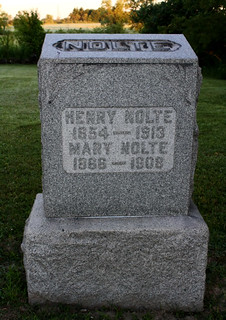
Henry senior was buried beside his wife in Chester Cemetery.

HenryMaryNolte
(Click on image to enlarge)


Sources:
♦ 1920 Census.
♦ "Death of Mrs. Nolte." Hobart Gazette 17 July 1908.
♦ "Henry R. Nolte Succumbs to the White Plague." Hobart News 13 March 1913.
♦ "Obituary." Hobart Gazette 14 March 1913.

Sunday, April 11, 2010

Foot in Mouth

I must confess to a basic ignorance about how social news got into the papers in the early twentieth century. The Gazette's "Local Drifts" and "General News Items" columns are full of people's visits, parties, travels, purchases, illnesses and recoveries, births and deaths, and so on. But how did such news get to the paper?

In one 1904 issue, the editor solicited news via the new telephone technology — "When you have friends visiting you, call up phone 16 and tell us about it" — as if expecting these news items to be supplied by the people to whom they happened. It just seems odd to me that if, for example, your uncle from Valpo visits you, you call up the newspaper so they can tell everyone in town about it.

A few of the Ainsworth news columns mentioned "our correspondent" as if there were someone in Ainsworth collecting local news and conveying it to the Gazette.

This speculation is inspired by a "General News Item" that appeared on Christmas Day, 1903: "Henry Nolte who lives near Ainsworth is quite sick and has been for three weeks, suffering from lung trouble."

"Lung trouble" must have been a very painful topic for Henry at the time: within the previous two years, he had lost both his teenaged daughters, at least one of them a victim of tuberculosis.

A month later, the Gazette printed this retraction: "We are informed that the report that Henry Nolte who lives near Deepriver has been suffering from lung trouble is untrue. He is said to be now enjoying good health."

So, how did they get the first report — idle gossip that they overheard at the saloon and memorialized in print? And how did they know it needed retracting? — did some better informed neighbor, perhaps, clue the editor in to what an awkward and insensitive mistake it was? Or did Henry himself write to object, or did he "call up phone 16" and give them an earful?

Sources: "General News Items." Hobart Gazette 25 Dec. 1903; 29 Jan. 1904.

Saturday, March 13, 2010

Tuberculosis Again

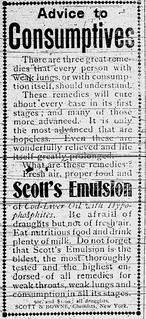
ScottsEmulsion
(Click on image to enlarge)
An 1898 advertisement for a quack tuberculosis remedy, from the Hobart Gazette.


I've been paying particular attention to tuberculosis since I came across stories from 1908 about the new governmental anti-tuberculosis regulations that had dairy farmers around Ainsworth in an uproar. Since I live in a time and a place where I'm very unlikely to get tuberculosis, it's hard for me to get a feeling for how real and threatening it was to my neighbors a century ago.

In 2005, tuberculosis caused just 0.2 deaths per 100,000 people in the United States. In 1900, it caused 194.4 deaths per 100,000 — only slightly fewer than influenza and pneumonia combined — while major cardiovascular disease caused 345.2 deaths per 100,000, and cancer 64.0. In 1904, nearly five thousand people in Indiana died of tuberculosis.

On the personal level, we've already seen how it devastated the Nolte family. In 1901 the Gazette reported on a Hobart family profoundly affected by it: Mr. and Mrs. J.P. Johnson, both infected with TB, had become so ill and weak that their 13-year-old daughter had to take on full responsibility for the care of her four little sisters, the youngest being only a few weeks old.

Other local deaths from tuberculosis:
  • Charles Niles, 30, died at his home in Deep River on May 30, 1900. Funeral services had to be held in the house because his wife was too weak to go to the church.
  • In September 1900 a 32-year-old railroad employee, David Hartland — working in spite of his tuberculosis — collapsed on the job near Deep River and died the same day.
  • In Lake Station, Miss Jennie Ringberg died in 1902 at the age of 21.
  • Also in 1902, Randolph Guernsey, who had gone to Colorado to try for a cure, died there at the age of 29, leaving a wife and two sons.
  • In 1905, Mrs. Amanda Bullock died at age 23.
From these reports I get the impression that tuberculosis liked to take people in the prime of their lives.

By the early twentieth century, the bacterium that causes tuberculosis had been identified, and with the new X-ray technology doctors could better diagnose the disease and track its progress in a patient; but there was no medical cure. TB sufferers were advised to get plenty of rest, fresh air and good nutrition, and to the extent such treatment strengthened the body's own immune system it could help in fighting off the infection. There were many sanatoria that offered this treatment (with the added benefit to the general population of isolating infected people), but patients had to be able to bear the financial burden involved — not only the fees charged by the sanatorium, but also the loss of work during the patient's stay there, which often stretched into months or even years. It was not until 1944, when the antibiotic streptomycin became available for use in humans, that doctors could actively cure tuberculosis.

Sources:
♦ "A Sorrowful Sight." Hobart Gazette 24 May 1901.
♦ "Advice to Consumptives" (advertisement). Hobart Gazette 9 December 1898.
♦ Dunne, Mike. "Former TB sanatorium in Placer County awash in poignant history." Sacramento Bee 7 Jan. 2010. http://www.sacbee.com/2010/01/07/2442723/former-tb-sanatorium-in-placer.html (accessed 13 March 2010).
♦ "General News Items." Hobart Gazette. 27 Jan. 1905.
♦ "Late Pick-Ups." Hobart Gazette 28 Feb. 1902.
♦ "Local Drifts." Hobart Gazette 28 Sept. 1900.
♦ "Mortuary Record." Hobart Gazette 1 June 1900; 21 March 1902; 3 March 1905.
♦ Pearson Education, Inc. "Death Rates by Cause of Death, 1900–2005." Infoplease 2007 (abstracting U.S. Public Health Service, Vital Statistics of the United States, annual, Vol. I and Vol II). http://www.infoplease.com/ipa/A0922292.html (accessed 12 March 2010).
♦ University of Medicine and Dentistry of New Jersey. Brief History of Tuberculosis. July 23, 1996. http://www.umdnj.edu/~ntbcweb/history.htm (access 13 March 2010).

Tuesday, February 9, 2010

Tuberculosis and the Nolte Family

Earlier I mentioned the tragic history of the Nolte family. Let me lay it out for you simply:

NameCause of DeathAge at Death
Henry R. (father)Tuberculosis59 yrs.
Mary (mother)Tuberculosis*42 yrs.
WilliamUnknown1 day
LouisaTuberculosis**16 yrs.
AlvenaTuberculosis15 yrs.
OttoUnknown1.5 mos.
Henry T.Gunshot wound (murder)45 yrs.
BerthaUnknownUnknown, but more than 28 yrs.
LouisKidney disease33 yrs.
EdwardTuberculosis20 yrs.
_______________________
*"Lung trouble."
**"Consumption."

I still haven't been able to trace Bertha beyond 1920; she may have lived to a ripe old age. The infant or child whose name is unknown died in January 1897. The newspaper notice of the burial did not give a name — a practice you sometimes see in the case of an infant or very young child. (I have not found a grave marker for this child, but I will have to go and look again when the weather gets better.)

No cause of death is given in Alvena's obituary. In a family so infected with the disease, it may well have been tuberculosis, but we just don't know. 6/28/10 update — I have come across an obituary of Henry R. Nolte that states, "All the deaths in this family have been from tuburculosis [sic]." I hesitate to accept that as a cause of the two infant deaths, but in Alvena's case it is probably true.

So that's five who died of tuberculosis in a family of ten. This brings home how real a threat it was, this disease that nobody around here gives a second thought to these days.