Showing posts with label Wollenberg. Show all posts

Wednesday, February 5, 2014

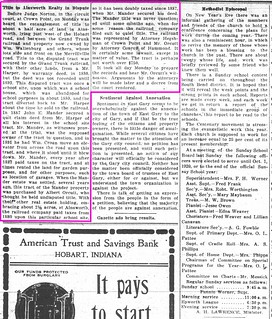
Caroline Abel and Her Carpenters

Caroline Abel obit
(Click on image to enlarge)
From the Hobart Gazette 1 Apr. 1921.


Aside from being an early settler, Caroline (Feiler) Abel was the wife and mother of carpenters who were responsible for a lot of building in the vicinity of Ainsworth; my notes are full of "Contractor Abel" and "F. Abel" shipping lumber to Ainsworth and putting up this house and that barn in the surrounding area. Problem is, I'm not sure exactly which Abel is being referred to, since all these references are after the 1900 census, in which both Frank Abel, Sr. and his son, Frank, Jr., described themselves as carpenters. In 1910 they both described themselves as contractors doing carpentry work (Frank Jr. being married with his own household), and 16-year-old Edward Abel also called himself a carpenter.

Let's just take a look at what we can attribute to one or more of the Abels:
  • Nov. 1901: "Walter Blachely [Blachly] will build an addition to his barn on the Mid Harper farm. Frank Abel sold him a carload of lumber with which to do the work."
  • March 1902: "On Wednesday Contractor Abel began building a house for John Miller at Ainsworth, having the contract for the labor and the furnishing of lumber."
  • April 1902: "Contractor Abel … has just shipped a carload of lumber to Ainsworth for C. Hill for repairs on a house and several outbuildings, which he will shortly build."
  • May 1902: "Contractor Abel received another carload of lumber this week for his contracts. He is building an addition to the house of Wm. Foreman, south of Ainsworth."
  • May 1902: "Contractor Abel has just shipped two carloads of lumber to Ainsworth to be used in a large barn that he will build for Frank Bayor…."
  • June 1902: "Contractor Abel this week finished Fred Miller's new house at Ainsworth."
  • September 1902: "An old-fashioned barn raising was held at John Gruel's yesterday and both of his new barns were raised. Quite a number from town attended. Contractor Abel is doing the carpenter work."
  • May 1903: "Contractor Abel has had three cars of lumber shipped to Ainsworth, to be used in the construction of a new barn for Howard Smith who lives south of Deepriver."
  • August 1904: "Contractor Abel is building the new Deepriver church."
  • June 1906: "A week ago Contractor Abel began building a big barn for Chas. Sievert who lives southwest of town. The building will be 34 by 84 feet, with 20-foot posts."
  • September 1906: "Contractor Abel has begun the erection of a new barn, 32 by 48 feet and 18 feet high, on the Mike Ormond farm southeast of Hobart. The dwelling is also to be raised about eighteen inches and a new addition built thereto."
  • October 1909: "Contractor Abel who is building a new barn on the Kramer farm south of town hopes to have the structure completed within a few days."
  • March 1911: "Abel & Sons have been doing a lot of repair work on the Chas. Chester farm near Ainsworth and are now doing work for Ed Batterman."
… and those are just the projects I happened to make note of over the years.

Frank Sr. died in 1915; Edward died in 1918; and Frank Jr. died in 1919 of tuberculosis.

♦    ♦    ♦

Just look at all those Ross Township names in the "Notice of Road Petition" on the Gazette page above. Many acquaintances, some farmers, some Ainsworth businessmen such as Gust Lindborg and Charles Goldman, and even William Wollenberg, who I suppose still owned the saloon building in Ross Township though he lived in Chicago.

I suppose the road in question is E. 101st Avenue.


Sources:
♦ 1880 Census.
♦ 1900 Census.
♦ 1910 Census.
♦ "Early Settler Passes Away." Hobart Gazette 1 Apr. 1921.
♦ "General News Items." Hobart Gazette 8 Nov. 1901; 21 Mar. 1902; 4 Apr. 1902; 2 May 1902; 23 May 1902; 15 May 1903; 26 Aug. 1904; 8 June 1906; 21 Sept. 1906.
♦ "Hobart." Hammond Lake County Times 22 Jan. 1919.
♦ Indiana WPA Death Records Index.
♦ "Local Drifts." Hobart Gazette 27 June 1902; 19 Sept. 1902; 29 Oct. 1909; 10 Mar. 1911.

Friday, January 10, 2014

Ice Cream and Soft Drink Parlor

Imagine my surprise to discover that in February 1921 there was an ice cream and soft drink parlor in Ainsworth!

Ice Cream parlor in Ainsworth
(Click on image to enlarge)

I suspect this parlor occupied the former saloon building, rented from the Wollenbergs.

Harry Sherman is a mystery. There was someone by that name who grew up on a farm in Ross Township, but he apparently spent the early 1920s living and working in Gary. Another possibility would be some Chicago relative of the Wollenbergs — I find a 1911 reference to the Wollenberg boys visiting an aunt in Chicago, "Mrs. Sherman" … perhaps she had a son named Harry who wanted to try running a business in Uncle Bill's defunct saloon. Makes sense, doesn't it? — even it's if all in my imagination.

♦    ♦    ♦

There are too many Fasels around for me to feel sure that the Frank Fasel who is mentioned on the page above is the same one who once faced a "serious charge" by Christ Ols, or who was little Mable's uncle, or even the Frank Fasel who turns up in the 1920 census running a dairy farm on his own land in Ross Township — why would he leave his own farm to move to the "old Bodamer farm"? If he did, it was an ill-fated move; in January 1921, while the Fasel family was away from home, the barn caught fire and burned down, taking with it other outbuildings, as well as some pigs and chickens, and hay and grain.

Where exactly was said "old Bodamer farm," anyway? The 1921 Union Township plat map shows several Bodamer parcels along the Lincoln Highway.

You know what? I hope Frank goes and lives happily ever after east of Chesterton so I don't have to worry about him anymore.

Frank Fasel public sale


Sources:
♦ 1900 Census.
♦ 1910 Census.
♦ 1920 Census.
♦ "Ainsworth." Hobart News 17 Aug. 1911.
♦ Ancestry.com. Polk's Gary (Indiana) City Directory 1922. R.L. Polk & Co. (1922).
♦ "Local and Personal." Hobart News 13 Jan. 1921; 24 Feb. 1921.

Saturday, November 30, 2013

Long-Timer Gone, Short-Timer Back

Carl William Bach was a long-time Ross Township resident whom I completely ignored until he died. By comparison, William Wollenberg, Jr. — now back for a visit — was a short-timer, and yet I've written loads about him and his saloon-keeping family.

C.W. Bach
(Click on images to enlarge)

It took me a long time to figure out where the Bach homestead was. You'd think people who had been here since 1846 would have acquired more land than this: [12/1/13 update: They did. The DeWell family archivist points out that I missed a second 40-acre Bach parcel, outlined in green on the map below. Now I don't know which parcel to get all sentimental over. And I can't figure out which road the green parcel sits on — W. 86th? W. 89th?]

Bach land 1908

The daughter, Mrs. Henry Kuehl, mentioned in the obituary as living with him was the former Henrietta "Hattie" Bach. She had married Henry Kuehl in 1896 and left the old homestead for a few years, but by 1910 she and Henry had come back. In the intervening years, her brother, George, and his wife and children had lived with their father. So as far as I know Carl William Bach was never alone there.


Sources:
♦ 1900 Census.
♦ 1908 Plat Map.
♦ 1910 Census.
♦ 1920 Census.
♦ Indiana Marriage Collection.
♦ "Local and Personal." Hobart News 6 Jan. 1921.
♦ "Obituary." Hobart Gazette 7 Jan. 1921.
♦ "William Bach." Hobart News 6 Jan. 1921.

Monday, October 29, 2012

Big Fight Over a Little Land

It was only a half acre, but someone thought it was worth fighting over.

Land dispute
(Click on image to enlarge)
From the Hobart Gazette of Jan. 2, 1920.


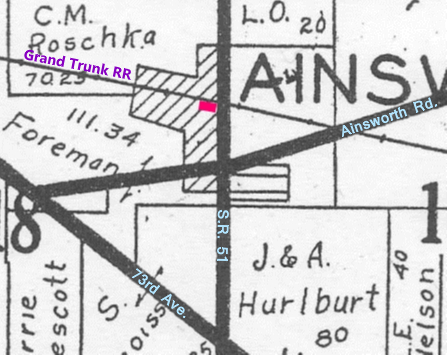
This excerpt from the 1926 Plat Book shows approximately where the little parcel was located (the red rectangle):

Disputed land

Well, that's right in the heart of the Ainsworth business district! Location, location, location!

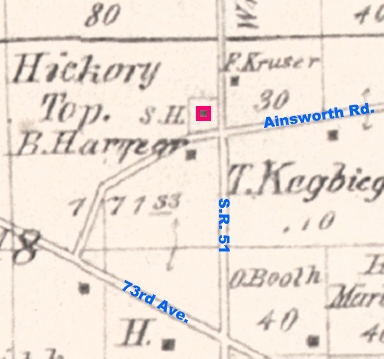
The one bit of information I found surprising in this article is that there was once a schoolhouse on that land, and that it was abandoned, not moved. Actually, this is not inconsistent with the 1874 Plat Map (schoolhouse marked in red):

Schoolhouse 1874

But the little frame building generally considered Ainsworth's first school stood further west along Ainsworth Road.

Wednesday, April 4, 2012

Ball Game near Ainsworth (WWI-Era Photo Album)

Or: Bait and Switch.

Ball Game Near Ainsworth (21b)
(Click on images to enlarge)
Images courtesy of the Hobart Historical Society.


There's a handwritten caption and a description that should be stuck behind the photo … but there's no photo. And how I would have loved to see that ball game.

This is on the same page as this photo of the Sauter/Wollenberg place in Ainsworth, which we've see before, but are now going to see again. Because I love it!

Wollenberg Place (21a)

The handwritten note behind that one reads:
Wollenberg Place
Summer 1918
I think these guys have just gotten through playing a game of baseball and have gone to Wollenberg's for soft drinks.

Thursday, February 9, 2012

Ross Township Trustee's Annual Report: 1918

Ross Twp. trustee's annual report
(Click on image to enlarge)
From the Hobart Gazette of January 31, 1919.


If I hadn't heard of any of these people, this would make for very dry reading. (I suppose for some of you, it makes for dry reading anyway.) But I like to hear what old friends have been up to, and to be reminded of the existence of some people who've been quiet lately.

I see our friends Jennie Chester, Elsie Gruel and Pearl Ols are still teaching (as well as Pearl's older sister, Bessie); also Olive Wood.

Gust Lindborg is still repairing school busses. Charles Goldman furnished the schools with two brooms and other unspecified supplies, and the schoolrooms were kept warm with coal and wood from Shearer & Emery, and William Wollenberg.

So many familiar names working on the roads, shoveling snow, driving school busses. Apparently even Charles Chester got involved in "extra buss service," whatever that might be.

Lena Hunter and Owen Nelson, among others, lost chickens to roaming dogs.

There are a few local names that I'm surprised to find absent from the report, such as Gruel (aside from Elsie), Nolte and Waldeck.

Thursday, October 13, 2011

William Wollenberg, Jr. as Romantic Lead

The Wollenbergs have left Ainsworth, never (so far as I know right now) to return, but I came across a memento while rooting around in the files at the museum: Will Jr. and his fellow actors in costume for the high school play of 1917, "Anne of Old Salem."

W. Wollenberg, 1917
(Click on image to enlarge)
Image courtesy of the Hobart Historical Society.


According to handwritten notes on the back of the original, this picture includes "William Wollenberg [in back, at left], Elsa Rossow, Helen Wild, Gladys Flynn?, Geneva Gill, Ralph Melin?, Grace Henderson, Algot Nelson?, Elsie Gruel, Wayne Thompson?." Yes, the question marks are in the original.

Ruth Miller reportedly was in the play as well, but she's not listed by our note-writer. If I were really interested, I'd go get the microfilm and look up an article entitled "Cast of characters, H.S. Play, Friday Evening," from the Hobart News of May 17, 1917, to compare its listing with this (since I didn't print it out back when I was reading it the first time, or take full notes). But I'm not.

Sunday, September 25, 2011

Exeunt Wollenbergs

Ainsworth saloon building circa 1920
(Click on image to enlarge)
The Ainsworth (former) saloon and Wollenberg family residence, in the summer of 1918. Image courtesy of the Hobart Historical Society.


In September 1918 the Wollenbergs evidently decided they'd had enough of Indiana. It had already put them out of the saloon business and then arrested one of them on a liquor violation.

Fortunately they had their coal business to fall back on, and William Jr. had been developing the Chicago side of that. So the Wollenberg family left Ainsworth and settled in at 11405 Prairie Avenue, in southern Chicago.

Our old friends Shearer & Emery bought out the Ainsworth coal operation. But for the moment, anyway, the Wollenbergs retained ownership of the former saloon building, in the hope of renting it out for some non-alcoholic purpose.


Sources:
♦ "Additional Local News." Hobart Gazette 20 Sept. 1918.
♦ "Local Drifts." Hobart Gazette 20 Sept. 1918.

Sunday, August 28, 2011

The Land of Lincoln and Liquor

The Indiana supreme court had confirmed the state's dry status, but Hoosiers in northwest Indiana were showing an unexpected ingratitude: not content with their earthly paradise of sobriety and clean living, they persisted in trying to quench their devilish thirst, and many of them fled across the Illinois state line to do it.

Among the pioneer lawbreakers was Ainsworth's own William Wollenberg. He was arrested in Hammond on July 3, carrying a jug of whiskey and a case of beer that he had bought in Illinois. (The report doesn't specify whether it was William Sr. or Jr.) He may have been fined $80, the usual penalty in Hammond for lawbreaking "saloonists."

Authorities near the state line were on alert, and people coming in from Illinois were "being carefully watched"; sometimes eastbound auto parties were followed and surveilled; Gary police inspected the luggage of travelers alighting from eastbound trains. As official vigilance increased, so did criminal ingenuity. "Many are the deceptions used for the conveyance of booze from Illinois into Indiana since the dry law went into effect," said the Hobart News, citing hearses, hay wagons, automobiles, suitcases, egg crates and milk cans among the disguises that liquor traveled in.

Less daring drinkers simply went to some convenient saloon over the state line, drank and then came back empty-handed. That practice was both legal and popular. The News related a story of an unnamed Hobart resident who, on his way home from visiting Chicago one Saturday evening, stopped in for a drink at a saloon in Lansing, Illinois, a border town. As he looked around at the other drinkers — there were 22 in all — he thought some looked familiar, so he conducted a poll to find out where they all had come from. As it turned out, every last one of them was from Hobart — according to the story, anyway. The News concluded: "Lansing, Ill., is on a straight line west from [Hobart] over the Ridge road, and with a good auto it is only a few minutes' run, and Saturday night was quite warm, anyway."

In August a Gary city judge ruled that a person could legally possess one gallon or less of whiskey, provided it was for personal consumption, not to be sold or given away. That merciful interpretation gave some small relief to thirsty people in Gary, at least, though how they were to get their gallon was another question.

♦    ♦    ♦

If you really wanted to lose your soul, however, you didn't have to go to Illinois — just travel a little further south in Lake County, to the resort town of Cedar Lake. There, "the laws of Indiana and of common decency are being flagrantly violated," according to a resolution passed by the Lake County Council of Defense on July 1. The resolution alleged "that intoxicating liquor is being sold and that lewd women are allowed to frequent houses in that locality …." The Council authorized Sheriff Lewis Barnes to take steps to clean up the town. Accordingly, on the morning of Sunday, July 7, the sheriff and his deputies swooped down upon Cedar Lake, raiding the resorts and making a number of arrests. The County Council of Defense insisted that Cedar Lake resorts would be closed "for all time to come."


Sources:
♦ "Booze Comes Across State Line Camouflaged in Many Ways." Hobart News 25 July 1918.
♦ "Conditions at Cedar Lake Again Reported to Be Deplorable." Hobart News 11 July 1918.
♦ "Dangerous Business." Hobart Gazette 12 July 1918.
♦ "Judge Dunn Rules on Liquor Law." Hobart Gazette 9 Aug. 1918.
♦ "Local and Personal." Hobart News 8 Aug. 1918.

Saturday, July 2, 2011

No Class of 1918

Would you believe nobody from Ainsworth graduated with the Hobart High School Class of 1918?

But there were a few Ainsworth underclasspersons in that school, so I'm going to post their pictures.

W. Dorman, W. Cullman, 1918 yearbook.
(Click on images to enlarge)
All images in this post courtesy of the Hobart Historical Society.


Here we have Willard Dorman, son of John and Ella Dorman whose farm is now the Indian Ridge Golf Course. Wilma Cullman was a Deep River girl; we've already taken notice of her triumph over disaster.


7-2-2011 Wollenberg, Ed. 1918

Here we have Edward Wollenberg, the second son of William and Adelphine Wollenberg, owners of the Ainsworth saloon. I don't know if Eddie will prove to be as talented as his older brother; thus far his only public performance has been on a church basketball team.


Nelson, Paine, 1918 yearbook.

Grace Nelson, the younger daughter of Lovisa Chester Nelson, had just recently become an aunt.

Alice Paine was living on the old Bullock homestead with her parents, Albion and Ethel. She looks rather severe, doesn't she?


Sources:
♦ "Basket Ball Games at M.E. Gym Thanksgiving Evening." Hobart News 6 Dec. 1917.
♦ Hobart High School Aurora Yearbook, 1918.

Saturday, May 14, 2011

Hopeful Spirits

As 1918 opened, those Hoosiers who earned their living from the sale of liquor were watching the clock wind down toward April 2, 1918, the day Indiana would go dry.

In mid-February a ray of hope beamed up from near the state's southern border. The F.W. Cook Brewing Company brought suit in the Vanderburgh County superior court seeking to restrain Evansville's chief of police from enforcing the Indiana prohibition law when it went into effect.

Judge Fred M. Hostetter heard the case and ruled in the brewers' favor, on the basis of venerable case law — the 1855 decision in Beebe v. State, in which the Indiana Supreme Court had struck down an early legislative attempt at state-wide prohibition. Judge Hostetter said that his ruling applied the principle established in Beebe that "by the very Constitution now in force the people did not empower their legislature to enact any law prohibitory of the proper and temperate use of alcoholic beverages."

Naturally, the Evansville side of that case appealed to the supreme court.

And just as naturally, a wave of optimism swept over Indiana's saloonkeepers. As the Gazette pointed out, the women's suffrage law had not survived the supreme court; the general attitude toward the prohibition challenge now viewed it as "a fifty-fifty question with odds in favor of the 'wets.'"

Liquor licenses in the state would expire on April 2, the same day the prohibition law was scheduled to go into effect. But a blizzard of license-renewal notices in the early March newspapers gave evidence of the hopeful mood of local saloonkeepers, including Ainsworth's William F. Wollenberg. In March the Lake County Commissioners granted 38 licenses — valid for one month.

On the other side, the dry forces were equally confident. The Rev. Edward S. Schumaker, superintendent of the Indiana Anti-Saloon League, pointed out several court cases within the last 30 years that he believed superseded the 1855 Beebe decision. The county option law, which had allowed prohibition on the county level, had survived constitutional challenge. "There can be no doubt," Schumaker said, "that the Indiana supreme court will sustain the new prohibition law."

By coincidence, the supreme court heard the case on April 2. Both sides presented their arguments, then the justices retired to think about it.

While they thought about it, prohibition became the law of the state — outside Vanderburgh County, at any rate. All liquor licenses had expired at the close of business on Tuesday, April 2. That deadline passed with little excitement in Hobart, aside from some saloon patrons taking "a long last draught in anticipation of a long dry spell." Wednesday dawned with "the saloons all closed tight and the prohibition law in full force and effect." While the News stated that liquor dealers had ten days in which to remove their stocks from the state, the Gazette suggested that there would be no enforcement of that requirement pending the supreme court's decision (which was expected within ten days). Some saloons owners now kept their doors open, selling "near beer," soft drinks and cigars to stay afloat until, they hoped, they could get back to selling the real stuff.

Ten days passed with no decision from the supreme court. The justices announced that they were going on vacation until April 23. They might not rule until sometime in May.

In Hobart, Charles Klausen, Jake Ittel and Henry Ittel lost hope. They closed their businesses and removed the furniture and fixtures.

Others kept their spirits up, and waited.


Sources:
♦ Ashanin, Michael. "Beebe Temperance Case." The Encyclopedia of Indianapolis. (David J. Bodenhamer and Robert G. Barrows, eds.) Bloomington: Indiana University Press, 1994.
♦ "'Dry' Law Before Supreme Court." Hobart Gazette 22 Mar. 1918.
♦ "Have You a Prediction?" Hobart Gazette 22 Feb. 1918.
♦ "Indiana Became Bone Dry at Midnight, April 2nd." Hobart News 4 Apr. 1918.
♦ "Local and Personal." Hobart News 18 Apr. 1918.
♦ "Local Drifts." Hobart Gazette 29 Mar. 1918.
♦ "No Supreme Court Decision." Hobart Gazette 19 Apr. 1918.
♦ "Notice of Extension and Renewal of Liquor License." Hobart News 7 Mar. 1918.
♦ "Prohibition Law Held Unconstitutional." Hobart Gazette 22 Feb. 1918.
♦ "Saloonkeepers Advertise for Renewal of Their Licenses." Hobart News 7 Mar. 1918.
♦ "Saloons All Closed." Hobart Gazette 5 Apr. 1918.
♦ "State Goes Dry April 2." Hobart Gazette 15 Mar. 1918.
♦ "'Wets' Win First Round in Their Fight Against Closing Law." Hobart News 14 Feb. 1918.

Wednesday, March 23, 2011

It's All About Saloonkeepers

Reader, did you know that a part of Hobart is named after Claus Ziegler, the long-ago Ainsworth saloonkeeper? It's true: Ziegler's Addition to Hobart.

ZieglersAddition
(Click on image to enlarge)
This map, dated 1944, shows Ziegler's Addition lying west of State Road 51 and south of 39th (Rand St.). Image courtesy of the Hobart Historical Society.


I mention this because the "Hobart Real Estate Transfers" column in the Gazette of November 9, 1917, contained this cryptic message: "Lts. 23, 24, 25, B. 3.; lts. 30, 31, 32, B.3, C. Ziegler's add. Pt. S½ NE 18-35-7. William Wollenberg and wife to Herman Suhr, $6,000."

So apparently the current Ainsworth saloonkeeper owned some lots in the Former Ainsworth Saloonkeeper's Addition to Hobart. And now he was selling them. Why should anyone care? I don't know. I suppose because Prohibition is looming, I'm just getting all sentimental about Ainsworth saloonkeepers.

Also — if I'm interpreting that telegraphic notation correctly — I think that "Pt. S½ NE 18-35-7" might be the land the Ainsworth saloon is sitting on. Hmmm….

Sunday, March 6, 2011

An Evening for the Books

VictoriaHotelca1910
The Victoria Hotel in Gary, Indiana, circa 1910. Image courtesy of the Northwest Indiana Genealogical Society.

The Victoria Hotel was the venue for a dance on the evening of October 2, 1917, sponsored by the staff of the Gary public library. Its purpose was to raise money for a library fund to benefit soldiers and sailors. Bessie Banks of Hobart had been on the Gary library staff for three years, and she probably urged her Hobart friends to attend.

A dozen young people from the Hobart-Ainsworth area came to dance the night away, including our own Will Wollenberg, Jr. With his musical and athletic talents, Will Jr. was probably a good dancer. Frank Ferguson, George Barnes, William and Howard Krull, and Ralph Banks went with him. Perhaps those six paired up with the half dozen young Hobart ladies who also attended — Harriet Morris, Bessie Banks, Vera Barnes, Maude Scholl, Myrtle Wild and Florence Pio. (Myrtle Wild and Howard Krull married about three months later.)

I don't know what it says about Will Jr.'s military ambitions that in September he accepted a position with the American Trust and Savings Bank in Hobart. Had he given up on his West Point hopes? — or was he just trying to make a little money while waiting for that nomination to come through?

Anyway, by mid-October Will had left the bank, hired by his own father to "look after coal yards" in Chicago. Back in March 1915 Will Sr. had expanded his business operations to include coal sales, having built some storage sheds at Ainsworth, so perhaps Will Jr. was to act as a purchasing agent; or perhaps Will Sr. actually owned coal yards in Chicago.


Sources:
♦ "Krull-Wild." Hobart News 17 Jan. 1918.
♦ "Local and Personal." Hobart News 13 Sept. 1917; 4 Oct. 1917.
♦ "Many Changes of Employes Taking Place in Hobart." Hobart News 18 Oct. 1917.
♦ "Miss Bessie Banks Resigns From Gary Library Staff." Hobart News 10 Jan. 1918.
♦ "Personal and Local Mention." Hobart News 11 Mar. 1915.

Monday, February 28, 2011

The Last Saloon License of Ainsworth?

2-28-2011 Wollenberg license HN 10-11-1917
(Click on image to enlarge)

I just had to post this notice from the October 1917 News — it represents probably the last time William F. Wollenberg, Sr. will ever renew his liquor license for the Ainsworth saloon, and perhaps even the last time anyone got a liquor license for an Ainsworth saloon, since I'm not sure whether Ainsworth ever had a saloon again after Repeal.

At this point we have only half a year until Indiana's state-wide prohibition law goes into effect. Perhaps somewhere deep in his heart, Will Sr. was cherishing a hope that the law might still be challenged, as the women's suffrage law had been.


Source: "Notice to the Citizens of the Town of Ainsworth, in the Township of Ross, County of Lake and State of Indiana." Hobart News 11 Oct. 1917.

Wednesday, January 12, 2011

Hobart High School Class of 1917: Elsa Gruel

ElsaGruel1917
(Click on image to enlarge)

Elsa Gruel was Vice-President of the Class of 1917, not surprisingly. She also appeared in the school play, although she was not the female lead (surprisingly).

She had already decided upon teaching as her goal. Her immediate plan was to enter Valparaiso University for a teacher's training course. She hoped to teach at the Ainsworth school in the coming year.

We already know that Elsa achieved her goal, and teaching became her life's work.

♦    ♦    ♦

Here's a page from the yearbook with the autographs and a verbal sketch of all three of our 1917 graduates.

Autographs
(Click on image to enlarge)


Sources:
♦ "Cast of characters, H.S. Play, Friday Evening." Hobart News 17 May 1917.
♦ "Commencement Exercises Closing Event of Hobart Schools." Hobart News 31 May 1917.
♦ Hobart High School Aurora yearbook, 1917.

Monday, January 10, 2011

Hobart High School Class of 1917:
William F. Wollenberg, Jr.

1-10-2011 Will Wollenberg 1917
(Click on image to enlarge)
Image courtesy of the Hobart Historical Society.


The talented Will Jr. gave his last public performance (for the time being, anyway) as the romantic lead in the senior class play, "Anne of Old Salem," which revolved around the Salem witchcraft trials of 1692.

His goal for the immediate future, Will said, was to gain admission to the West Point Military Academy — easier said than done; we'll see if he succeeded.


Sources:
♦ "Cast of characters, H.S. Play, Friday Evening." Hobart News 17 May 1917.
♦ "Commencement Exercises Closing Event of Hobart Schools." Hobart News 31 May 1917.
♦ Hobart High School Aurora yearbook, 1917.

Wednesday, December 22, 2010

Extended Forecast: Dry

The campaign leading up to the November 1916 election was surprisingly quiet about prohibition. The Republican candidate for governor, James P. Goodrich, refused to take a position on the topic, although he was "a devout Presbyterian with strong ties to the church-based dry cause" and was known to favor temperance; his Democratic opponent, John Adair, likewise avoided the issue. The Prohibition party fielded its own candidate, and the Progressive party candidate was former governor James F. Hanly, who had signed county-option prohibition into law in 1908; but these latter two were trounced in the election, and Goodrich won a narrow victory over Adair. Even after winning, Goodrich did not take a definite stand on prohibition.

As 1916 neared its close, however, (in the words of a contemporary historian) "a great agitation began to be manifest throughout the state." In December the state's dry forces formed a coalition called the Indiana Dry Federation, which soon came to include the powerful Indiana Anti-Saloon League. With centralized leadership and hard-won political savvy, the Indiana Dry Federation was able to rally intense grass-roots efforts. Petitions and delegates rained down on the state capitol as the 1917 General Assembly convened.

Thanks to dry lobbying, the assembly's first month saw the introduction of the Wright prohibition bill, named for its drafter, Congressmen Frank Wright. A newspaper article described its terms as "drastic" and "written with the intention of making traffic in liquor illegal."

As the proposed bill was under consideration by the legislature, the dry forces stepped up their lobbying efforts. They presented legislators with petitions signed by some 400,000 prohibition advocates. They held rallies in the statehouse daily — sometimes several times a day. This was in addition to demonstrations in other towns and cities, and the "propaganda" in newspapers and other publications across the state. William Jennings Bryan, on a visit to Indianapolis, personally lobbied the governor and the legislature for prohibition.

The Wright bill passed the House with a wide margin of victory — 70 to 28. As the bill went to the Senate, the drys kept up the pressure, with more petitions, more lobbying delegations and more demonstrations.

The day the Senate voted on the bill saw "one of the most stirring scenes ever witnessed at the state capitol," according to a contemporary news article. In spite of bitterly cold temperatures, "[t]housands of prohibition workers crowded the corridors of the capitol building and lined up in the street, awaiting the vote which was to be cast, and would reap the harvest of their efforts…."

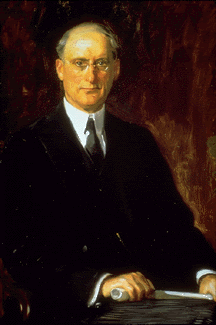
On February 2, the Wright bill passed the Senate by a 38-to-11 vote. And a week later Governor Goodrich finally made clear his stance on prohibition when, at a public ceremony and under the unblinking gaze of a motion-picture camera, he signed the bill into law.

JamesPGoodrich
Indiana Governor James P. Goodrich
(Image credit: Indiana Historical Society.)


The essence of the bill was this:
After the second day of April, 1918, it shall be unlawful for any person to manufacture, sell, barter, exchange, give away, furnish or otherwise dispose of any liquors except as in this act provided.
The few exceptions included the manufacture of wine, cider and other non-spirituous liquids for private, domestic use (you could even serve such drinks to guests in your home, so long as your home really was private, "not used as a public resort of any kind"); sacramental wine; pure grain alcohol used for medical, scientific or industrial purposes; and liquor prescribed by a physician for medical reasons, which could be sold by druggists in small quantities. People already in possession of properly bonded alcohol before the law's effective date could still ship it to states where it was not prohibited.

Violators of the law faced, for their first offense, a fine of $100 to $500 and a jail sentence of 30 days to six months; and for second and later offenses, the minimum fine was raised to $200 and the minimum jail sentence 60 days.

♦    ♦    ♦

… So, it had finally happened. Back in Ainsworth, in their rooms over the saloon, William and Adelphine Wollenberg must have asked each other, "Now what?" The saloon had supported their family for nearly 10 years. One more year, then Will would have to find a new line of work, and the terra cotta building where the local men had gathered since 1899 to drink and to smoke, to talk and to fight, would have to find a new use.

Meanwhile, the News noted how fitting it was that the well on Charles Borger's Third Street lot, which had supplied the neighborhood with good drinking water for a dozen years — suddenly, mysteriously, dried up. Mr. Borger had to dig a new well.


Sources:
♦ Canup, Charles. "Temperance Movements and Legislation in Indiana." Indiana Magazine of History XVI:1 (March 1920).
♦ "Indiana Dry Bill Is Signed." Hobart Gazette 16 Feb. 1917.
♦ "Indiana To Be Dry April 2, 1918." Hobart Gazette 9 Feb. 1917.
♦ Lantzer, Jason S. "Prohibition Is Here To Stay": The Reverence Edward S. Shumaker and the Dry Crusade in America. Notre Dame: University of Notre Dame Press, 2009.
♦ "Personal and Local Mention." Hobart News 1 Mar. 1917.
♦ "Senate Passes 'Dry' Measure." Hobart News 8 Feb. 1917.

Friday, December 17, 2010

Playing Penguin

A cold snap froze up Lake County in mid-January 1917. On the 14th, temperatures dropped to 10 or 15 below zero, and on that Sunday afternoon, with nothing better to do, young daredevils found the frozen Deep River and Lake George irresistible. Ben Bodamer and H.D. Green took their motorcycles out onto the ice and performed every stunt they could think of.

Everett Newman (Paul Newman's son) took his small, light Ford and loaded it up with three of his friends: another young Hobartite named Fred Bowlby, and from Ainsworth, Will Wollenberg, Jr. and Will's younger brother Eddie. The four of them rode the car out onto the frozen river. They went racing and spinning around Lake George for awhile, and then drove upstream as far as the E.J.& E. bridge and back, about a mile's trip. It was great fun, but in that unheated car, with the bitter wind blowing freely over the ice, the boys couldn't last too long. Everett decided to land his craft. From the lake, he drove under the Third Street bridge and toward the riverbank near the streetcar barns (where today there is a tiny riverfront park).

Just as he braked near the shore, the ice gave way beneath them. The car and the four boys plunged into six feet of icy water. The car apparently capsized, as the Gazette described the scene: "In scrambling to get out, the boys would catch hold of a wheel, and it would turn and give them another plunge, so by the time the boys reached safety they had been thoroughly wet through several times."

They had to leave the car to fend for itself — they were soaked and in danger of frostbite or hypothermia in that bitterly cold air. Everett went home; the other three boys went to Fred's house; they all got dried off and warmed up, and fortunately none suffered any ill effects. Someone eventually hauled the car out of the river using a rope and pulley. The Gazette described the car as "uninjured" but I find that hard to believe. It was taken to the Newman garage to be thawed out.


Sources:
♦ "Auto Fell Through Ice." Hobart Gazette 19 Jan. 1917.
♦ "Four Boys Get Cold Bath in Deep River Sunday Afternoon." Hobart News 18 Jan. 1917.
♦ "Local Drifts." Hobart Gazette 19 Jan. 1917.

Friday, December 10, 2010

How Could This Have Happened?

Ainsworthcrossing315pm
The modern view toward the east as you approach the Ainsworth crossing from the north, just after 3 o'clock on a December afternoon. Trees that now line the tracks were not there in 1916. The small depot stood approximately even with that yellow left-curve warning sign, but closer to the tracks.
(Click on image to enlarge)


Ninety-four years later, a note of perplexity still echoes in the newspaper accounts of the accident — how could this have happened? Eastward of the Grand Trunk crossing at Ainsworth, the track ran straight and level for almost a mile, through open, treeless fields. With no obstruction to the view other than a small depot set well back from the road, anyone approaching the tracks from the north on the Hobart-Ainsworth road (State Road 51) could see a westbound train well before it reached the crossing. Especially on a clear afternoon.

And yet on the afternoon of December 12, 1916, a southbound Ford automobile drove onto the tracks just as a speeding westbound train entered the crossing. The resulting collision killed two young men. And no one had been near enough, had seen enough to understand why it had happened. "The exact cause leading to the accident will never be known," the Gazette said, "and conditions that might have caused it are problematical. Results are sufficiently horrifying."

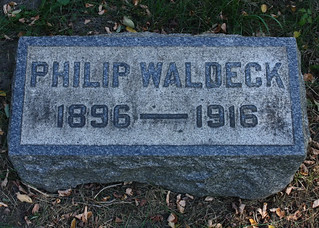
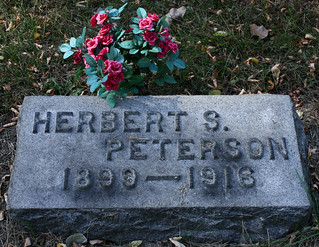
The two young men killed were Philip Waldeck, 20, and Herbert Peterson, 17. It was Herbert's Ford, and he had been at the wheel. He was the eldest son of Frank and Mabel Peterson, who lived and farmed south of Ainsworth — one of their five children, and a grandson of William Smith. Philip, as we know, was the only child of William and Augusta Waldeck of Deep River.

Herbert and Philip had driven up to Hobart to do some shopping that day. They started home around 3:00, going south on State Road 51. The Grand Trunk express train due through Ainsworth at 2:15 was running about an hour late, and, according to some witnesses, speeding to make up for lost time.

Someone who saw the accident from a distance said that Herbert's Ford was moving south on State Road 51 at a leisurely enough pace, but seemed to speed up as it approached the Grand Trunk tracks. At the same time, the train was flying toward the crossing. When they met, the train caught the car squarely in the middle and carried it about a hundred feet before it fell away to the side. The train took a mile to stop. Dr. C.C. Brink of Hobart was sent for, but there was nothing he could do. Both young men had been killed instantly.

There was nothing anyone else could do, either, but look at each other and helplessly ask: How could this have happened? The theory that the boys had tried to beat the train was supported by the witness who thought Herbert had sped up near the crossing. On the other hand, they would not have been expecting a train — there was none scheduled at that time. A moment's lapse of attention, maybe, or of judgment … just a moment's lapse, but it cost the Peterson family dearly, and it cost the Waldecks their all.

The double funeral was held in the Hobart High School auditorium the afternoon of Friday, December 15. Crowds of mourners filed in, family and friends, young and old, faculty and students. Herbert had attended Hobart High until the middle of his junior year; Philip had graduated the previous spring, and had been planning to attend an alumni party that evening. The girls' quartet from his graduating class sang at the funeral service. The pallbearers were all classmates; among Herbert's was Will Wollenberg, Jr., and among Philip's, Ed Wollenberg and another Ainsworth-area boy, Will Buchfuehrer.

Philip and Herbert were laid to rest in adjacent rows in Crown Hill Cemetery.

WaldeckPhilip
(Click on images to enlarge)

PetersonHerbert

Three months before his death, Herbert Peterson had bought a life insurance policy through John A. McDaniel, local agent for Farmers' National of Indiana. The policy carried a double-indemnity clause in case of accident.


Sources:
♦ "Card of Thanks." Hobart Gazette 22 Dec. 1916.
♦ "Funeral of Herbert Peterson and Philip Waldeck Largely Attended." Hobart News 21 Dec. 1916.
♦ "Herbert Peterson and Philip Waldeck Instantly Killed." Hobart News 14 Dec. 1916.
♦ "Local Drifts." Hobart Gazette 15 Dec. 1916.
♦ "Train Kills Two Young Men." Hobart Gazette 15 Dec. 1916.

Thursday, December 9, 2010

Hobart High School Class of 1912: Bliss Shearer

blissshearer1912srportrait
blissshearer1912caption
Images courtesy of the Hobart Historical Society.

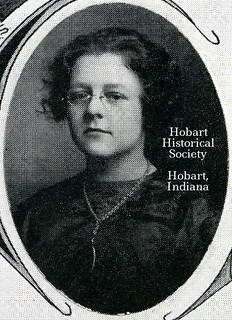
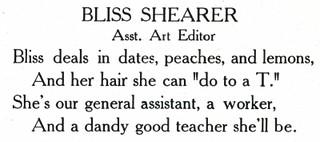
Bliss did indeed become a teacher — by December 1913, she was teaching in a Ross Township school. We know this because early that month she and Delbert* Fisher (another Ross Township teacher) were on their way to their school, riding a motorcycle in a heavy fog, when they collided with a car driven by Fred Bowman of Merrillville. None of them was seriously hurt, but the motorcycle was smashed up so badly as to be undriveable. William Wollenberg gave the two bruised but undaunted teachers a ride to their school.

Bliss' teaching probably ended in the summer of 1915 with her marriage to Paul Emery.

♦    ♦    ♦

That same morning fog of December 5, 1913, caused a collision on the Grand Trunk tracks. The four men of the Ainsworth section gang were on a handcar on the south tracks, waiting for a westbound freight train to pass. Between the blinding fog and the roar of the passing train, they did not realize that an eastbound freight was bearing down on them. When the engine suddenly loomed up out of the fog, the men could only make a desperate leap to the side. All four escaped with their lives.

____________________________
*This may be a misprint for "Delmer."


Sources:
♦ "Fog Accidents." Hobart Gazette 12 Dec. 1913.
♦ Hobart High School Aurora yearbook, 1912.