Showing posts with label Merrill. Show all posts

Friday, March 6, 2026

Bastardy in Merrillville

Local historian Michael White, who has already contributed some interesting material to this blog, has been working at the Calumet Regional Archives and has shared some items he came across that relate to Hobart and Merrillville.

Among them is a disturbing transcript from 1846 of George Earle's interrogation, as a justice of the peace, of a 27-year-old woman named Rachel Campbell. Rachel had brought a complaint of bastardy against William Merrill (one of the brothers who in 1848 gave Merrillville its name). That is to say, of course, that she accused him of fathering her illegitimate child. As we get into the transcript, we find that her testimony brings up an even more serious accusation.

♦    ♦    ♦

William Merrill, born in Vermont in 1808, came to Lake County with his younger brother, Dudley, in 1836,[1] settling in the area that eventually became Merrillville. In 1842, he married the 20-year-old Caroline Campbell.[2] That is the earliest vital record I have been able to find for Caroline. From later censuses, we know she was born in Pennsylvania.

Rachel Campbell was also born in Pennsylvania, circa 1817. Her family left Pennsylvania sometime after 1839, and was living in Indiana by about 1846 (or perhaps earlier), as we see by the 1850 Census recording them in Portage Township, Porter County:

2026-03-06. 1850 census (2 pages)
(Click on image to enlarge)

The reason I believe this to be the Rachel Campbell in question is because the trial testimony states that she had a brother named Stephen; also, Rachel's age in 1850 agrees roughly with the age she gives in her 1846 testimony.

The two families are linked in other ways. Another brother listed on the 1850 census, Henry, turns up in Caroline Campbell Merrill's household in 1870. According to A Pictorial History of Merrillville, Caroline eventually sold her farm to Venila, listed as 11 years old in the 1850 census (and who in 1855 married Samuel White).

While it's impossible to establish with certainty the family relationship between Rachel and Caroline, since I can't trace either of them back any further than the early to mid-1840s, I believe they were sisters.

♦    ♦    ♦

The transcript of the questioning is a little spotty, but it establishes that the trial is taking place in August of 1846. Rachel starts her testimony with September 1845.

2026-03-06. transcript - beginning
(Click on image to enlarge)
Image from the Calumet Regional Archives (via Michael White).


At that time, Caroline Campbell Merrill was about six months' pregnant[3] and ill, though not bedridden.[4] Rachel was on an extended visit in Merrill house, probably to help Caroline with her two-year-old daughter and housework. The Merrill house, as Rachel describes it, sounds like a settler's cabin that had been added on to over the years: two sections, east and west (perhaps just two ground-floor rooms), with an upstairs room reached by a staircase in the east room. There was no interior door: to go from one room to the other, you had to walk outside.

One night around the middle of September 1845, Rachel testifies, she had gone to bed alone in the west room around 8 o'clock. (William and Caroline Merrill slept in the east room, and Orrin Pierce,[5] also staying there, slept in the upstairs room.) About an hour later, just as Rachel was drifting off to sleep, William Merrill came into her room, and to her bed. That night, she said, he had sex with her three times over the course of about two hours. Here are Rachel's responses to George Earle's questions:
Question   Had you and he made any previous bargain that he was to come there?

[Answer] No.

Question   Did you make any noise?

[Answer] Not a great deal.

Question   Did he ask you if he might have connection with you?

[Answer] I told him no.
In her laconic way, she is saying he raped her.

There is nothing in the testimony indicating that Rachel told Caroline about this incident. At some point she did tell her mother that William had had sex with her.

Rachel remained in the Merrill house for several more weeks, then apparently left, but returned in the latter part of October. Around the 18th or 20th of October, she says, William came to her in the middle of the night, this time in the east room, and woke her out of sleep to have sex with her again. That was the last time.

She later gave birth to a baby girl, whom she said had been fathered by William.

In another part of her testimony, we learn something interesting about Rachel.
Question   Are you married?

[Answer] I am not.

Question   Were you ever married?

[Answer] Never.

Question   Did you ever have any children before?

[Answer] One.
She had already had one child out of wedlock, at a time when this carried significant social stigma. Rachel was already bearing a social and emotional burden before September 1845. I do wonder how George Earle knew to pursue this line of questioning. Had William Merrill given him information that Caroline had told him privately? Or was Rachel's past indiscretion known among the locals?

At one point in the transcript, the writer notes that it is William ("the defendant") asking Rachel a question ("How old are you?"). I think it is possible that William is asking questions at other times that are not noted. If George Earle is the one asking the questions, evidently he is already familiar with William's defense to the charge of bastardy: namely, that someone else was the baby's father. William may have counted on Rachel's precarious social status to support his implication that she was sexually promiscuous. The questioning introduces two mysterious figures, Mr. Vandermark and Mr. Rowdabaum.
Question   Do you know a person by the name of Vandermark?

[Answer] I do.

. . .

Question   Did you and Mr. Vandermark stay in a house alone during any time between the 15 of September and the 20th of October last?

[Answer] No, at no time.

Question   Did you or did you [not?] stay alone with Mr. Vandermark in a house alone between the 15th day of September and 20th of October last?

[Answer] I did not.

Question   Did you or did you not go with Mr. Vandermark up to his house about the 25th day of October last?

[Answer] I went but don't know the time.

. . .

Question   Who went with you that night?

[Answer] My brother Stephen.

Question   Was Vandermark['s] wife at home?

[Answer] She was not home that night.

Question   Who slept in the room that night?

[Answer] Vandermark, Stephen and Rowdabaum & wife.

Question   Who slept with you?

[Answer] No body.

Question   Did Mr. Vandermark lay on the foot of your bed that night?

[Answer] He did not.

Question   Had you connection with Mr. Rowdabaum that night?

[Answer] I had not.
No doubt these two men existed, since Rachel says so herself, but I have searched in history books, censuses, and other records, using these names and variations I could think of (e.g., Van der Mark, Raudebaum) and failed to find the slightest bit of information about them.

We have nothing directly from William Merrill's side of the case. I do not know if he entirely denied ever having sex with Rachel, or rather said that it would be unfair to deem him the father when, as he seemingly argued, there were at least two other candidates.

Nor do we know the verdict in this case.


The original handwritten transcript, courtesy of the Calumet Regional Archives (via Michael White): click here

My transcription, with some punctuation and spelling altered for clarity: click here

♦    ♦    ♦

I am inclined to believe Rachel — maybe because I tend to root for the underdog. William Merrill was 38 years old, a family man, an established businessman, a justice of the peace,[6] among the most prominent citizens in his small town. Rachel was a 27-year-old single woman with skeletons in her closet, from an obscure farming family.

I do not know if this Campbell family was related to the more prominent Campbells of Porter County, some of whom also came from New York, like Rachel's father, Henry.

2026-03-06. 1850 census (2 pages)
(Click on image to enlarge)
Image from Ancestry.com.


That is to say — I assume Henry is her father. I should learn not to make assumptions, though. When I first started researching the case and found this family, I assumed that this census listing, like so many others I've seen, recorded a father and his six children. And I wondered what had become of Rachel's children! Now I realize they are probably hiding in plain sight, right there. Semira is four years old, just the age to have been born in 1846 to Rachel. And Venila, 11 years old, was born back in Pennsylvania when Rachel was about 22 years old: it is certainly possible that Venila was Rachel's first child.

As I've said, there were some Campbells in Porter County whose lives and deaths are recorded. These Campbells are not among them. These Campbells seem to have come out of nowhere and, for the most part, slipped away into the unknown: for example, Rachel's mother — I don't even know her name — who evidently was living in the 1840s, when Rachel told her of the incident with William, but who is nowhere to be found in the 1850 census. I cannot find any recorded death notice or grave for her.[7] Likewise, Henry Campbell (the elder), after the 1850 census, simply vanishes.

As for Rachel's brother, Stephen — well, I can find numerous Stephen Campbells after 1850, including some in Indiana, but none that I can positively connect with this family. The same goes for "Lou," the 22-year-old sister noted in the margin of the 1850 census — never positively identified again.

Rachel's brother Henry (and Rachel herself) may be at the Porter County Poor Farm in the 1860 census.[8] By 1870, Henry was in the household of Caroline Campbell Merrill. As you may know, William Merrill had died in 1860.

In 1875, Caroline married William's brother, Dudley (3 months after the death of his third wife). Their cozy household in 1880 does not include Henry Campbell. He, I believe, was in the Lake County "Asylum," aka the Poor Farm, which lists a 46-year-old native of Pennsylvania by that name among its inmates in the 1880 census. I can't trace Henry further than that. He may be lying in an unmarked grave on the former poor-farm grounds. Caroline, on the other hand, lived another nine comfortable years, dying in 1889.

While trying to trace little Semira Campbell of the 1850 census, I was surprised to find another young woman of about the same age, with the same unusual name; but the other Semira Campbell was born in Vermont, not Indiana. So the story of our little four-year-old is uncertain.

Rachel herself can be traced as far as 1860. If she was indeed in the Porter County Poor Farm in June 1860, when that census was taken, by the time the Lake County census was taken in July, we find her in Venila Campbell White's household, in Center Township, Lake County:

2026-03-06. 1860 Census, Rachel Campbell
(Click on image to enlarge)
Image from Ancestry.com.


After that, I cannot find her living or dead.

Aside from Caroline, Venila is the only one whose life story I can follow to the end. In 1855, when she was about 16, she and Samuel White slipped over the border to Berrien County, Michigan, to be married. As we just saw above in the 1860 census, they came back to Center Township to farm and begin a family. I expect they were somewhere local in the 1870 census, though the search function on Ancestry.com can't find them. In 1880 they were farming in Ross Township. By 1900, they were living in the Merrillville area, no longer farming, but well fixed enough for Samuel to describe himself as a "capitalist." In 1908, Samuel died. The 1910 census shows Venila in Merrillville, living alone on her own income. In the spring of 1915, she decided to move to Cozad, Nebraska[9] to join her daughter, Sarah — her only surviving child — who in 1877 had married Byron Dutton. The following year, Venila died, and was brought home to Merrillville for burial.

2026-03-06. White, Venila - obituary - Cozad Local (Cozad, Dawson County, Nebr.), 1916 02 25, p. 4
(Click on image to enlarge)
Cozad Local (Cozad, Dawson County, Nebr.), 25 Feb. 1916.


In all the censuses that asked for parents' birthplaces, Venila gave, as both her father's and her mother's birthplace, Pennsylvania — not New York, as she should have said if Henry Campbell, Sr., was her father. Now, this may reflect the inability of a stressed family to pass along its own history, or confusion in Venila's memory … but maybe she was right.


_______________
[1] Lake County 1834-1872 at 38.
[2] Indiana Marriage Collection. She was his second wife, according to a family genealogy on Ancestry.com, his first having died circa 1836 after bearing two children. One of those children, George, is listed in the household of William and Caroline in the 1850 census.
[3] Caroline and William's son, John, was born December 30, 1845 (Cook County, Illinois, Deaths Index).
[4] I am drawing this and the following information from the transcript, which I will append in full below. The questioning is hard to follow — it jumps from topic to topic, including topics that have no seeming relevance — so I have to piece together the various incidents as best I can.
[5] Orrin Pierce (1813-1895) came to Lake County from New York sometime in the early to mid-1840s; in June 1845 he married Ruth Vincent in Lake County.
[6] This we know from a document relating to another (less sensational) 1846 case involving William Merrill.
[7] There is one interesting stone in the Hebron Cemetery that is just legible enough to make out the surname Campbell and the death date in August 1850 (the census was taken in October).
[8] There is a listing in Center Township, Porter County, of a Henry Campbell who is approximately the right age, and a pauper at the Porter County Poor Farm, along with a Rachel Campbell, who is not the right age — but then whoever gave the enumerator his information did not even know where the two Campbells were born.
[9] "Merrillville," Lake County Times (Hammond, Ind.), 17 Mar. 1915.

Thursday, October 2, 2025

More Litigious Settlers

Here is another page from James H. Cassady's records of his activities as administrator of the Jeremiah Wiggins estate.

2025-10-02. Wiggins estate 29a
(Click on image to enlarge)
This image courtesy of Alice Flora Smedstad.


My transcription:

2025-10-02. 29a transcription

The December 19 entry mentions an appearance before George Earle concerning a lawsuit involving two people: Saxton and Merrill.

The first was probably Ebenezer Saxton, Sr. (1797-1877), who came to Lake County in 1837 and eventually settled on Jeremiah Wiggins' farm. The following biographical sketch was written by one of his descendants:
Ebenezer Saxton was the 6th generation of the Saxton family in America. His father (also an Ebenezer) was a Revolutionary soldier from Massachusetts. Ebenezer Saxton was born in Vermont, later (1829) moving to a farm in East Flamboro, Canada at the time of the Patriot War. When the rebellion was brushed in 1837 he sold his farm on credit and hurriedly left Canada to escape the rebel punishment of hanging. On the way to Fort Dearborn (Chicago), his wagon got stuck in the mud in the Turkey Creek area. Spending nearly all of his money to recover his belongings, the family decided to stay in Wiggins' Point (one of Merrillville's early names).[1]
Ebenezer and his wife, Minerva, raised a large family and lived out the rest of their lives on the former Wiggins farm. They are buried in the Merrillville Cemetery.

♦    ♦    ♦

The second name mentioned in connection with a lawsuit was either Dudley Merrill (1814-1890) or William Merrill (1808-1860), brothers who came to Lake County in 1836 or '37.[2] The brothers became prominent citizens of the town then known as Centerville, building homes and operating farms as well as businesses that included a cheese factory, a hotel, and a store. In 1848, the town was renamed in their honor.

They are buried in the Merrillville Cemetery. Dudley's four wives (one of whom had been William's widow) are also buried there.

The Dudley Merrill house, built in 1849 according to Lake County records, still stands at 12 W. 73rd Avenue.

♦    ♦    ♦

The man whose name is written as "M. Steickleman" in the document above was probably Johann Michael Steichelman, whom I have discussed before in connection with these estate papers.

♦    ♦    ♦

Myiel Pierce, Sr. (1801-1847), arrived in Lake County from New York in 1836.[3] He inspired T.H. Ball to playfully date of the founding of Centerville/Merrillville to 1842:
I place the date of the commencement of the village when Miles[4] Pierce built the first tavern here, and pouring out a bottle of whisky or breaking it upon the frame, after the manner of naming ships, called it "Centreville Hotel." Well would it have been for that village and many others, if all the whisky had gone the same way.[5]
In a previous post about his son, Myiel, Jr., I mentioned his early death and the hardship it caused his family.

Three sons of Myiel, Sr., and his wife, Marcia, served in the Civil War, one dying while in the service. Myiel and Marcia, who died in 1889, are buried in the Merrillville Cemetery, along with numerous family members.

_______________
[1] Alice Flora Smedstad, Soldiers & Veterans Memorialized at the Merrillville Cemetery (self-published, 2007) at p. 50.
[2] Lake County 1834-1872 at pp. 38, 301.
[3] Lake County 1834-1872 at p. 54.
[4] Myiel's unusual first name appears in several variants in local histories, including "Miles" and "Milo."
[5] Lake County 1834-1872 at pp. 152-153.

Monday, April 5, 2021

The Not-So-Dearly Departed Jeremiah Wiggins

This post is made possible by the research of Merrillville historian Alice Flora Smedstad.[1]

Jeremiah Wiggins, the first white immigrant to settle in Ross Township,[2] passed through the early history of the area that eventually became Merrillville without leaving much evidence. He lived there, but he was never recorded in a census. He farmed there, but his name never appears on a plat map. He died there, but his grave is unmarked, its exact location unknown. He left behind no family to preserve his memory.

Writing 66 years after Jeremiah's death, the Rev. T.H. Ball said of him: "He seems to have been a lone man without much connection with any one."[3] A 1915 history cited the Rev. Ball's assessment and added:
Jeremiah Wiggins appears to have been one of those mysterious men who are ever wandering into new communities, who come from out of the shadow of Somewhere and merge into the shade of Nowhere. The Claim Register does not record him, although most of the pioneers agree that he appeared at the site of the Indian village some time in 1836.[4]
In 1956 a former Post-Tribune editor, Harold Van Dusen,[5] wrote an article for that paper in which he embroidered upon some stories about Jeremiah that I have found in a plainer form in earlier histories.[6] Unfortunately, Van Dusen cites no sources, so I don't know whether the threads of his embroidery were spun only from his own imagination. And in light of the fact that he consistently gives Jeremiah's surname as Higgins, I am not sure how reliable the article is.

According to Van Dusen, Jeremiah, "big, brawny, bearded," came into Ross Township in March of 1835 and stopped at the Native American crossroads known as McGwinn's Village, which included a ceremonial dancing area and a large burying ground with as many as a hundred Native American graves. Jeremiah was able to speak with the local Potawatomi people in their own language, and he had a persuasive manner. He allayed their suspicions by trading with them and offering to let them use some of the land he would plow up to grow their own crops. He settled there, built a cabin, and began farming.

Incidentally, Van Dusen does not give details about the exact location of Jeremiah's claim, but other sources seem to point to the southeast corner of the intersection of what is now E. 73rd Avenue and Broadway. A Standard History of Lake County tells us that the Wiggins land soon passed into the hands of Ebenezer Saxton,[7] and that later Dudley and William Merrill "secured land on the north side of the old Indian trail [i.e., the Sauk Trail, now 73rd Avenue], opposite the Wiggins-Saxton claim."[8] The (1874 Plat Map) shows Saxton and Merrill land lying on opposite sides of 73rd:

2021-04-05. 1874 Saxton-Merrill
(Click on image to enlarge)

Assuming that the Saxton and Merrill land had not passed out of those families' hands in the thirty-some years between their first arrival and the making of the map, this locality seems to match the description.

But let's get back to Van Dusen: he tells us that Jeremiah's friendly relations with the Potawatomi did not last.

The trouble started one morning when a fresh grave in the Native American cemetery was found to have been opened and the body in it stolen. Potawatomi searchers traced wagon tracks past the cemetery northward to the coach road to Michigan City, and concluded that the desecration was done by a passing traveler, who would never be identified for certain. So they had no specific target at which they could direct their hurt and anger. Van Dusen says:
A few days after the grave robbery two Indian braves, threateningly armed with rifles, walking into the field where Higgins [sic] was at work alone. They … walked to the open grave, not far distant, sat there with their rifles, looking across the field at Higgins every few moments.
The men eventually left without violence, but Jeremiah went nuclear: he filled in the opened grave and then "used his breaking plow to turn the sod of the entire cemetery, making it a part of his field," allegedly "in the hope that he could get the villagers to forget their burying grounds."

I have a hard time believing that Jeremiah seriously expected this action to make the Native people living in the area "forget their burying grounds." The earlier source of this story (Howat, 1915) doesn't try to explain Jeremiah's motive.

The Potawatomi were, of course, deeply grieved at this mass desecration of sacred ground. They did not react violently, but they did not forget, and word of the event spread. Both Van Dusen and Howat describe an incident in 1840 — after Jeremiah's death — when 1,100 Potawatomi from Michigan, being "relocated" westward by the U.S. Army, stopped for the night at McGwinn's Village; even these Michigan residents knew where the burying ground was, and many of them sought it out and mourned over what had been done to it.

Nearly half a century after these events, a book on local history noted that this "burial-ground may still be traced on the old Saxton place."[9]

♦    ♦    ♦

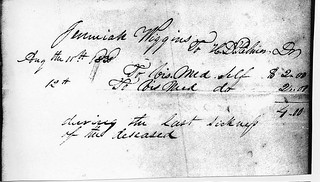
For all his "brawn" and his brazenness, Jeremiah died in his bed. He fell ill during the summer of 1838, probably early in August, and died on or shortly after August 12. We know this because Dr. Henry D. Palmer, the first formally trained physician to practice in Lake County, submitted a bill to Jeremiah's estate for medical services "during the last sickness of the deceased":

2021-04-05. Wiggins estate 17a
(Click on image to enlarge)
Image courtesy of Alice Flora Smedstad.


Jeremiah's was the first estate to be probated in Lake County.

2021-04-05. Wiggins estate 01
(Click on image to enlarge)
Image courtesy of Alice Flora Smedstad.


Amazingly, documents from the handling of this estate survived on microfilm. Looking through them, we can see that while Jeremiah may have had no close emotional relations, he had business relations. The names that crop up give us a glimpse of some of the people who were here in the mid-1830s and a bit of what they were doing. The estate papers also let us peek inside Jeremiah's cabin.

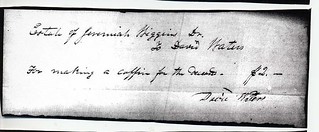
Jeremiah's fellow white settlers gave him a decent burial, apparently ("near the old Indian cemetery," according to Van Dusen). His coffin was built by David Waters, who was recorded in the 1840 Census in a household that included two small children and two teenagers, as well as two adults, in equal numbers of male and female — so we can gather he was a family man. Beyond 1840 I cannot trace him.

The coffin cost Jeremiah's estate $2.00.

2021-04-05. Wiggins estate 16c
(Click on image to enlarge)
Image courtesy of Alice Flora Smedstad.


I suppose it's some sort of poetic justice that the man who desecrated the graves of others should himself lie in an unmarked grave, where no one can come to pay respects, where no one celebrating the 50th anniversary, this year, of Merrillville's incorporation may place flowers. But then again, Jeremiah doesn't seem the sort of man to care much for anyone's respects or flowers.

_______________
[1] Alice was kind enough to share with me some material she had unearthed (some of which I would never have found on my own), but all transcriptions, commentary, conclusions, and mistakes are mine.
[2] Weston A. Goodspeed and Charles Blanchard (eds.). Counties of Porter and Lake Indiana. Historical and Biographical. Illustrated. Chicago: F.A. Battey & Co., 1882, at p. 544.
[3] T.H. Ball, Encyclopedia of Genealogy and Biography of Lake County, Indiana, with a Compendium of History 1834 – 1904 (Chicago: The Lewis Publishing Company, 1904), at p. 124.
[4] William Frederick Howat, M.D. (ed.). A Standard History of Lake County, Indiana and the Calumet Region. Chicago: The Lewis Publishing Company, 1915, at p. 183.
[5] Harold Van Dusen, "When Merrillville Was McGwinn's Village," The Gary Post-Tribune, Jan. 8, 1956. A note above the byline reads:
Harold Van Dusen is a former telegraph editor of The Gary Post-Tribune, serving in that capacity during World War II. He was editor of the national Purple Heart publication at that time, having been wounded while serving in France in World War I. He now is on the news staff of the Corning Leader, Corning, N.Y.
He was born circa 1895 (records giving his age are inconsistent) in North Dakota, and I believe he is buried in New York. He appears in the 1940 Census living in Gary with his wife, Helen, and son, Alan, employed as an "assistant editor" on an unnamed "daily paper."
[6] E.g., Ball (1904) at 138; Howat (1915) at 41 and 96.
[7] P. 253.
[8] P. 54.
[9] Goodspeed and Blanchard (1882) at 547.

Tuesday, January 28, 2020

Cantankerous Hank and Truculent Chuck

While searching for something else, I came across information about another bad day for Henry and Charles Chester, among unnamed others. This one happened sometime around late August of 1898.

2020-01-28. Chester, CPRegister, 9-2-1898
(Click on image to enlarge)
Crown Point Register, Sept. 2, 1898.


I will try to fill in the details: Homer L. Iddings, as "Superintendent" of something (I don't know what; he was also Ross Township trustee at that time), had ordered that a drainage ditch be built along the Chicago & Grand Trunk Railroad,[1] which crossed Henry Chester's land. Henry Chester had some objection to that. When the men building the ditch came onto his land to do their work, he and his sons, including Charles,[2] attacked them.

Or his sons did, anyway; it seems Henry himself was found not guilty:

2020-01-28. Chester, CPRegister, 9-16-1898
(Click on image to enlarge)
Crown Point Register, Sept. 16, 1898.


In the next column over, the Merrillville correspondent is sorry to see the end of this exciting case … and further down, we see that the ditch-diggers are continuing about their business.

The last I heard of this case was this item in the "Hobart News" column of the October 21, 1898 Crown Point Register: "H. Merril has commenced suit against Hank Chester for permanently disabling him on the occasion of the late ditch melee. Merril asks $3,000 damage." Whether he got any part of $3,000, I don't know. This is the first evidence I have that anyone ever called Henry Chester "Hank." I have no evidence that anyone ever called Charles Chester "Chuck."

♦    ♦    ♦

I tried but failed to positively identify the two ditch-diggers.

The H.G. Merrill might possibly have been H.C. Merrill — Henry Cass Merrill, one of the Merrill brothers, born (1852) and raised in Ross Township; but by 1880, it appears he had left the area and was never again counted in a Ross Township census. The 1900 Census shows him living in Chicago and working as a bank clerk.

As for the other man, who is variously referred to as "Hartner," "Hartnip," and "Hartman," he might have been Edgar Hartnup of Hobart, who was described in the 1900 Census as a 46-year-old day laborer. If not, I'm out of ideas.


_______________
[1] "H.G. Merrill has the C. & G.T.R. ditch completed and will now commence on the Hayward-Goodrich ditch." "Merrillville," Crown Point Register, Oct. 21, 1898.
[2] An item in the "Additional Locals" column of the Hobart Gazette of October 14, 1898, mentions that Charles Chester of Ross Township had recently been through a criminal trial.


Wednesday, May 29, 2019

People I've Been Ignoring

The first thing that caught my eye on this page was the announcement about Henry Paulus and the premiums he awarded to lucky locals on July 28, 1923.

2019-05-29. Paulus, News, 8-2-1923
(Click on image to enlarge)
Hobart News, Aug. 2, 1923.


Of course we know who John Miller was, and Mrs. Ernest Sitzenstock might be Mrs. Ernest Sr. or Mrs. Ernest Jr. But Mrs. Frank Steiner? — why don't I know who she is? After poking around in the records, my best guess at her identity is this: she had been Bertha Grosch, who shows up in the 1910 Census at the age of 27, living with her aunt and uncle in Chicago, working as a saleslady in a department store. Somehow she met and fell in love with Frank Stiener[1] (Jr.), who in 1910 was working as a hired man on a farm in Eagle Creek Township, Lake County, Indiana. He was the son of Frank (Sr.) and Susan Stiener, Austro-Hungarian immigrants and farmers in Winfield Township.

Frank Stiener, Jr. and Bertha Grosch were married December 20, 1911, and they came back to the farmland of northwest Indiana. In the "Personal and Local Mention" column of the Hobart News of November 18, 1915, I find this item: "The 3-months-old baby of Mr. and Mrs. Frank Steiner [sic], living south of Ainsworth, is seriously ill with bronchial pneumonia." In the 1920 Census, we find Frank and Bertha living on rented land in southern Ross Township, operating a dairy farm. They had three children under the age of seven: Frances, Robert, and Clayton. And now, 1923, they have an aluminum kettle.

Moving along … the Argo orchestra is still a mystery.

We've met Clinton and Ida Peck before. Linus Peck was their son, born ca. 1897 (1910 Census). In 1919 he had married Martha Frame[2] in Chicago (Cook County, Illinois, Marriages Index), and they lived in Hobart.

We know Ezra Gilpin and we know he worked the Lake Street "J" crossing. Somebody else can investigate Patrick Glynn.

Just below that, another new (to me) name. Martha Schiesser was the daughter of Michael and Catherine Wehner, a farming family. In the 1900 Census, they lived in Center Township, but by 1908 had moved to Ross Township and owned 148 acres surrounding Lottaville:

2019-05-29. Wehner-Thiel 1908
(Click on image to enlarge)
Image from the 1908 Plat Map.


On May 11, 1920, Martha married Frank Schiesser (Indiana Marriage Collection). He was one of the many sons of Adam and Mary (Dumbsky) Schiesser, who owned land in Ross Township as early as 1900, though I can't find it on the 1908 Plat Map … but Adam's father, I believe, died young, and his mother, Catherine, took as her second husband Nickolaus Thiel, which might explain why the land owned by Cath. Thiel in the 1908 map above would end up in the hands of A. Schiesser in the 1926 Plat Book. The land north and east of it, belonging to Chas. L. Merrill in 1908, would belong to B. Schiesser by 1926, but that's another story.

I interpret the statement about her being buried at Turkey Creek to mean Ss. Peter and Paul Cemetery, but findagrave.com lists her in Calumet Park Cemetery.


_______________
[1] The censuses and other records usually spell it Stiener (as does the record of his grave on findagrave.com, though I have not been out there myself to see the grave marker), while the only two newspaper references I have noted spell it Steiner.
[2] Her parents were Newton and Annie Frame, and I have no idea if these were any relation to the various Frames who are all over the "South of Deepriver" columns.

Sunday, August 21, 2016

Jacob William Hazelgreen

2016-8-21. hazel024
(Click on image to enlarge)

He was born April 15, 1881 (WWI Draft Cards) to Haken and Christine Hazelgreen of Lake Station.

By the 1910 Census, he had moved to Washington State, and there he stayed, I gather, and there lie his earthly remains.

The photographer was A.O. Merrill of Hobart, Indiana, who, as we know, was in business from the autumn of 1899 to the autumn of 1902. The fact that William (he seemed to prefer his middle name) was around to be photographed in that era suggests he should have been counted in the local 1900 Census, but I cannot find him. The Lake Station/East Gary enumerator of 1900 seems to have been a bit overwhelmed by his task and has left us with some confusing records.

Tuesday, July 5, 2016

The First Automobile in Lake County, Revisited

I came across this tidbit in the "General News Items" of the Hobart Gazette of December 22, 1899: "The Hammond News says Oliver W. Merrill, of Merrillville, has purchased an automobile at a cost of $1,000, which will be the first one in Lake county."

I've read the 1900 microfilm already, and failed to notice any items about the abilities of Oliver's new $1000 machine, such as those that adorned the social columns after Charles F. Blank's 1901 Locomobile purchase. So perhaps the "Hammond News" was mistaken.

Tuesday, September 16, 2014

A Country Wedding Portrait

After the less-than-dignified photo in that previous post, I thought I had better show you the formal wedding portrait of Robert and Bertha (Berndt*) Rossow, lest you think he went through the ceremony in his gingham workshirt, and she in her calico apron.

2014-9-16. img036
(Click on image to enlarge)
Image courtesy of the Hobart Historical Society and Tom Rainford.


It's interesting that the photographer was A.O. Merrill of Hobart. Just recently, he had sold his photograph business to August Haase — the sale being reported in the Hobart Gazette of November 28, 1902, and the wedding took place November 29; so this was probably among the last photographs he ever took in his Hobart studio.

_________________________
*Or Burchman, according to the marriage records I'm finding on Ancestry.com, and I do not know which is correct.

Wednesday, November 28, 2012

Not Spanish Influenza

The winter of 1920 was a sickly one, the prevailing complaint being flu — but no report called it Spanish influenza. The last News of January noted that although doctors around Hobart were being "kept on the go day and night," no one in town had yet died from the flu. After that hopeful remark came a list of out-of-town fatalities with local connections — a middle-aged dairy farmer, prominent in the business; Mrs. Louis Randolph, the former Ella Merrill, brought home to Merrillville for burial from South Chicago; in Miller, a 35-year-old husband and father, and two women who left husbands and children; a 35-year-old bachelor at Crown Point.

During the first week of February alone, 50 cases of flu were reported to Dr. Clara Faulkner, Hobart's health officer.

The "South of Deepriver" social column in early February was a sick list: Dorothea Crisman, a high-school student; the Deep River miller, Tony Cullman, and his two youngest children; Zelda and Thelma Huffman, 9-year-old twins; a 17-year-old farm boy, Richard Fisher, whose mother cut short a vacation in Missouri to return to his bedside — all ill with flu or its complications.

In Hobart, illness kept many children out of school, though the schools remained open. In the Calvin Scholler home, the two school-aged children came down with flu, and so did Calvin himself. His wife, the former Lillie Rose, nursed them through the worst of it; just as her patients began to recover, Lillie fell ill, and died on February 1 at the age of 29 — Hobart's first flu fatality that year. On the 7th, Carolina Ahrens, age 67, became another fatality. On February 11, flu took the life of George and Susan Schnabel's 9-month-old son, Robert.

Richard Fisher was taken from his parents' farmhouse to the hospital in Gary, where he died in spite of all the doctors could do. At her home in Deep River, Mrs. Frank Shoup — née Alice Baker — died of flu at the age of 33 years.


Sources:
♦ 1920 Census.
♦ "Funeral of Mrs. Frank Shoup Held in Deep River, Wednesday." Hobart News 12 Feb. 1920
♦ "Funeral of Mrs. John Ahrens Held at Lutheran Church Tuesday." Hobart News 12 Feb. 1920.
♦ "Local and Personal." Hobart News 29 Jan. 1920; 12 Feb. 1920.
♦ "Local Drifts." Hobart Gazette 6 Feb. 1920.
♦ "Mrs. Calvin Scholler Laid at Rest in Hobart Cemetery Wednesday." Hobart News 5 Feb. 1920.
♦ "Mrs. Calvin Scholler Passes Away." Hobart Gazette 6 Feb. 1920.
♦ "Much Sickness and Many Deaths In and About Hobart." Hobart News 29 Jan. 1920.
♦ "South of Deepriver." Hobart News 5 Feb. 1920.