Showing posts with label Cassady. Show all posts

Saturday, December 6, 2025

Selling Off Jeremiah's Stuff (Part 3) and That Other Wiggins Again

The administrator of Jeremiah Wiggins' estate held a second sale on March 4, 1839, to dispose of whatever hadn't been sold in October 1838.

2025-12-06. Wiggins estate 20d
(Click on image to enlarge)
Image courtesy of Alice Flora Smedstad.


My transcription:

2025-12-06. Wiggins estate 20d - transcription
(Click on image to enlarge)


I can't make sense out of that scribbling in the line detailing what Wiatt Wiggins bought. Does it mean Jeremiah's informal claim to the land? (The official government sale of Lake County land would begin on March 19, 1839.[1]) Does it mean just the house sitting on the land? The $25 Wiatt paid in 1839 was just short of $900 in today's money.

The slay/sleigh that James Cassady bought seems not to have been noted in the original inventory. He paid very little for it — about $56 in today's money — which makes me wonder if I'm reading the word correctly.


As I've said before, Wiatt Wiggins has escaped all notice in the Lake County census and other official records as well as the early local histories. We would not know he existed but for these estate papers.


_______________
[1] Lake County 1834 - 1872 at 64.

Wednesday, December 3, 2025

Selling Off Jeremiah's Stuff (Part 2) and a Liverpool J.P.

This is the second and last page recording the sale of October 4, 1838.

2025-12-03. Wiggins estate 09
(Click on image to enlarge)
Image courtesy of Alice Flora Smedstad.


My transcription:

2025-12-03. Wiggins estate 09 - transcription
(Click on image to enlarge)

The final amount looks like $111.26 on the page, but the figures add up to $111.64, as spelled out below. But the $111.26 error is repeated in the sideways notation.

There is only one new name here: P. Russel, the justice of the peace before whom J.V. Johns swore that this is a true account.

I believe that is Peyton Russel (or Russell): in 1837, he was elected justice of the peace for North Township, which at the time was one of only three townships comprising Lake County.[1] He spent only a short time in Lake County. Solon Robinson, writing in 1847, said: "[He] lived at Liverpool and like the town, has gone to parts unknown."

A native of Maryland born circa 1806 (1850 and 1860 censuses), Russel first shows up in the Indiana records in February 1836, in Elkhart County, where he married Susana (or Susan) Rooney (or Roney, or Raney). Later that year he arrived here: a Hobart-area merchant's daybook records him buying a bottle of "ague syrup" in October 1836:

2025-12-03. AccB1835 030, 031
(Click on image to enlarge)
Image courtesy of the Hobart Historical Society, Hobart, Indiana.


(The ague syrup was probably some concoction intended to treat malaria; whether it involved quinine is up for question. Also, that's likely Peyton on the opposite page buying — what, ammunition? But with only a first initial, we can't know for sure.)

This February 1837 entry, if I understand it correctly, records him paying $5 to have his wife delivered of a baby:

2025-12-03. AccB1835 068, 069
(Click on image to enlarge)
Image courtesy of the Hobart Historical Society, Hobart, Indiana.


The baby may have been his son, Byron Homer (or was it Homer Byron?).

The Russell family was not counted in Lake County in the census of 1840 because by then they had relocated to Wisconsin. Peyton and Susan spent the rest of their lives in Janesville, and both are buried there.


_______________
[1] Lake County 1834-1872 at 51; Lake County 1929 at 46.

Sunday, November 30, 2025

Selling Off Jeremiah's Stuff (Part 1) and a Mystery Wiggins

On October 4, 1838, settlers gathered at Wiggins' Point to buy up the worldly goods left behind by Jeremiah Wiggins, who had died about two months before.

Here is the first page of the record that J.V. Johns kept of who bought what and for how much, and whether they paid in cash or a promissory note.

2025-11-30. Wiggins estate 08
(Click on image to enlarge)
Image courtesy of Alice Flora Smedstad.


My transcription:

2025-11-30. Wiggins estate 08 - transcription
(Click on image to enlarge)

With one exception, we have seen these names before and turned up whatever information we could about them.

The exception is Wiatt Wiggins. I have not been able to determine whether he was any relation to Jeremiah. In fact, I haven't been able to find out a single thing about him. These estate papers contain the only mention of him I have ever seen. He's absent from the local histories and from the 1840 Census.[1] His name hasn't surfaced in the early merchants' records at the Hobart Historical Society museum — that is, not in the ones I have indexed so far.

If Wiatt were any kind of close relation to Jeremiah, like a brother, I would expect him to inherit Jeremiah's goods, not have to buy them at a sale like any non-relative. On the other hand, I don't know what the Indiana laws of intestate succession were in 1838.

_______________
[1] On Ancestry.com, I found a family tree that included a Wyatt Wiggin whose father was named Jeremiah! But that Jeremiah died in 1876.

Saturday, September 13, 2025

Echoes of an Ancient Lawsuit

Here is the next episode of "James H. Cassady, Estate Administrator."

2025-09-13. Wiggins estate 22
(Click on image to enlarge)
Image courtesy of Alice Flora Smedstad.


My transcription:

2025-09-13. 22 transcription
(Click on image to enlarge)

Looking at the differences between the handwriting in the body of the document and the signature at the bottom, I am not at all sure that James H. Cassady himself wrote anything but the signature.

♦    ♦    ♦

We have already met the clerk at the estate sale, J.V. Johns. I have only to add that I have done the math involved in this passage from his son's 1882 biographical sketch …
JOHN W. JOHNS, M. D., was born in Lake County, Ind., in 1845, and is a son of Joshua V. and Caroline M. (Demmons) Johns, the former a native of Pennsylvania, the latter of Vermont. Dr. Johns was a common school scholar until he was eight years of age, when his parents died and he went to live with Dr. Henry D. Palmer, of Merrillville, by whom he was reared to manhood.[1]
… to figure out that Joshua V. and Caroline (Demmon) Johns both died circa 1853. The circumstances of their deaths and the locations of their graves remain unknown.

♦    ♦    ♦

George Zuvers, who collected the payment of the amount won from the lawsuit against the estate, was born probably around 1795 (per unsourced information in family trees on Ancestry.com), was a veteran of the War of 1812, and "a cabinet-maker and carpenter by trade."[2] In 1822, he married Winnifred Branhan in Bartholomew County, Indiana, and there they spent the early years of their marriage. They had nine children who survived to adulthood. In June of 1836 George came into Lake County with his eldest son, Solomon,[3] who was then about 14 years old. George probably brought the rest of his family here later.

The Zuvers settled in the short-lived town of Liverpool, where George at various times operated a store and a hotel.[4]Apparently, he also bought and sold land; between 1840 and 1842 he is recorded buying over 100 acres of farmland north and south of Hobart as well as numerous town lots in Liverpool.[5]

George died in 1845.[6] The 1850 census shows Winnifred remarried, but she was again widowed by the 1860 census. She died sometime after 1880. Her final resting place, like George's, is unknown, but they may both lie in the Merrillvillle Cemetery (Smedstad 2007 at 60).[7]

The estate papers do not include anything that would tell us what George Zuvers' suit against the Wiggins estate was based on.

Incidentally, George's son, Solomon, was the father of Silas E. Zuvers, who had a long connection with Ross Township schools, including the Ainsworth school. Solomon was described thus, in 1882:[8]
The second house built in [Merrillville] is still standing, and is occupied by Solomon Zuvers. It is a log structure, and is now weather-boarded. This Mr. Zuvers is an eccentric character. According to his own account, he grew to manhood in the almost exclusive society of the Indians. He ate, drank, slept, worked, trapped, traveled and traded with them. He learned Indian as he did English, and talked it as fluently. At one time, he employed eight or nine Indians to trap for him, and found them trusty and true — more so than most of the whites. Mr. Zuvers has been twice across the continent, and his " By golly, stranger," and his "By George, neighbor," doubtless often ring in the memory of many who have met him, as it does in ours.
According to A Pictorial History of Merrillville, the Zuvers log cabin stood on 73rd Avenue but was "removed" in 1946 (p. 93).

♦    ♦    ♦

We have very little information about James Prentice, who was apparently the estate's opponent in the lawsuit. He probably came into Lake County in 1836 and laid claim as a squatter to some land north of the future Crown Point,[9]and he served as a juror during the October 1837 term of the Circuit Court.[10] After that, he disappears from the records. I cannot find him in the 1840 census. Early Land Sales, Lake County does not list him as having purchased his 1836 claim from the U.S. government

♦    ♦    ♦

The last person named in the document above, John M. Stevens, is a mystery. He does not appear in the early histories of Lake County, the land sales records, or the 1840 census.

_______________
[1] Porter and Lake Counties (Goodspeed-Blanchard) at 729.
[2] Ibid. at 686.
[3] Ibid. at 544.
[4] Ibid. at 524, 525.
[5] Early Land Sales, Lake County at 173, 199, 219.
[6] Goodspeed-Blanchard at 686.
[7] Alice Flora Smedstad, Soldiers & Veterans Memorialized at the Merrillville Cemetery (self-published, 2007), at 60.
[8] Goodspeed-Blanchard at 546.
[9] Lake County 1834-1872 at 38.
[10] Goodspeed-Blanchard at 423.

Monday, September 1, 2025

Horse Drama at Liverpool

Continuing in the Jeremiah Wiggins estate papers, we now come to James Cassady's itemized invoices recording the details of his activities as estate administrator. There are several pages of them, but I can't post them all at once because my brain can't handle it.

I think he wrote these out at the end of his service, perhaps from notes he had jotted down during the year or so that he was working for the estate. In the following list, which seems to be the start of his activities after being appointed administrator in late August 1838, he mistakenly wrote "1839" instead of "1838" at the top of the left column.

2025-09-01. Wiggins estate 25
(Click on images to enlarge)
Image courtesy of Alice Flora Smedstad.


My transcription:

2025-09-01. 25 transcription

So his earliest work consisted, naturally enough, of figuring out what Jeremiah Wiggins had owned at his death. Somehow he realized that one of Jeremiah's two bay horses had gotten into the hands of someone not entitled to it, who didn't want to give it up. I'm not clear on whether that someone and the horse were in Liverpool, or Liverpool was the site for such legal business as getting a writ of replevin to allow James to seize the horse.

T.H. Ball tells us that Liverpool became the county seat for a short time in 1839 (Lake County 1834-1873 at 156), but he also tells a story in which Liverpool seems to be the site of legal business in the spring or summer of 1838:
In March, 1838, [Ebenezer Saxton] bought, of a man from Michigan City going to Crown Point, fifteen hundred pounds of flour. He was to pay in team work at two dollars a day. The work was to be done at Michigan City. He went with his team; did one-half of the amount of work, and was ready to do the other half; then the man discharged him, as he wanted no more work. Some time afterward the Michigan City man entered suit at Liverpool for the remainder that was due to be paid in money. A capias came for E. Saxton to appear at Liverpool. He took Wiggins along behind him on his horse. Passing out of Turkey Creek, Wiggins unfortunately slipped off into the water. He did not drown, and remounting, proceeded. The trial came on, the bargain was proved, and the Justice decided fifty cents in favor of the plaintiff. (Lake County 1834-1873 at 332.)
I'd like to know who it was that had Jeremiah's horse and why he or she wouldn't give it back. The last item in the list mentions a suit against one "Stephens" but I don't know if that is the horse suit. (It might help if I could figure out that last word.) I can't identify anyone with the surname Stephens in Lake County in the 1830s.

Another item in the list shows that James had to hire a team of horses to bring back, from some unspecified location, a sled that had belonged to Jeremiah. But the inventories of Wiggins property that we've seen don't mention a sled.

Wednesday, June 30, 2021

Jeremiah's Estate Administrator and His Evaluating Assistants

Following up on my earlier post about the contents of Jeremiah Wiggins' estate — I wanted to research the other names that came up on those inventory pages.

2021-06-21. Wiggins estate 19d
(Click on images to enlarge)
Image above and image below courtesy of Alice Flora Smedstad.


2021-06-21. Wiggins estate 15

The administrator, James H. Cassady, is a mystery. The estate papers tell us that in addition to his administrator duties, he was a justice of the peace, so he must have been a fairly prominent citizen. But beyond these papers, I can find no evidence that he ever lived in Lake County, Indiana, though he did own land here: Early Land Sales, Lake County shows him, in 1839, buying some 120 acres in Township 36 N., Range 9 W., Section 18 — i.e., what is now south Hammond. Still, I can't find him in any census or other record. He's not mentioned in any of my usual local history books, nor does he show up in any of the Hobart-area ledgers I've indexed thus far.

But he's all over these papers, and apparently was a friend of George Earle: this page, from the Wiggins papers, records that James Cassady and George Earle posted $400 bond to ensure that they "truly & faithfully discharge the duties" of administrator of Jeremiah's estate.

2021-06-30. Wiggins estate 30
(Click on image to enlarge)
Image courtesy of Alice Flora Smedstad.


Note how James uses the old-fashioned long s. And below that, we see George Earle's familiar signature.


The first of James' assistants is Charles Walton. We have met him before, under sad circumstances. I still can't find him anywhere except the 1840 Census of Lake County, which doesn't tell us much about him, and the indexed ledgers, where he shows up only in 1839 and 1840.


Next we have Levi D. Jones. According to the Hobart ledgers, he was in this area by the summer of 1840, but I can't find him in the 1840 Census. He does show up in 1850 and 1860, farming in Ross Township. In the 1850 Census he is married to Elizabeth (Vanvolkenburg), whom he married in 1847 per the Indiana Marriage Collection. There are two children in the household, one of whom, a seven-year-old boy named Homer, could not be a child of this marriage. The other is a year-old girl named Louisa. In 1856 Levi D. Jones is recorded marrying Lucy Sly in Lake County; if that is our Levi, I wonder what happened to Elizabeth? When the 1860 Census comes around, we find Levi D. Jones farming in Ross Township, living with an 11-year-old girl, Mary L., whose relation to him is not described, while Homer Jones is now living in the household of Abram Vanvolkenburg. Elizabeth, Louisa,[1] and Lucy are nowhere to be found. And that is as far as I can trace any of them.


The third assistant, David Fowler, shows up in the Hobart-area ledgers as early as October 1836, and makes appearances through 1841 (at this point in my indexing). The 1840 Census also records him, in a household of 11 people, in what appears to be western Ross Township — the same area where he, circa 1843, purchased 80 acres of land.
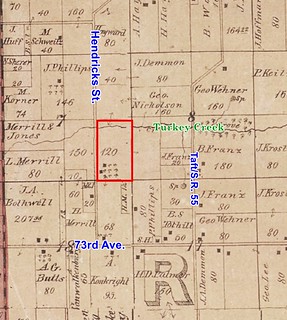
2021-06-30. Fowler, David 1874
(Click on image to enlarge)
From the 1874 Plat Map. By that time, David Fowler's land was owned by George Nicholson.


The Indiana Marriage Collection records David Fowler marrying Rebeca Deyo (or Dezo) in 1840, and the 1850 Census places them, with two children, in Cedar Creek Township, where apparently David died in 1860.


The last of these assistants is Michael "Stieckelman," but we will use the spelling on his grave marker in the Merrillville Cemetery: Steichelman. He was born in Germany in 1800, and there married and began a family. According to a findagrave.com biography of his daughter, the family came to the U.S. circa 1835 and to Indiana about 1837. It was a relatively small family for those days: just Michael, his wife Margaret, and their two children, Mary and John. The 1840 Census shows five people in the household, so one is unidentified.

Here is a page from an unknown Hobart-area merchant's ledger showing Michael purchasing nails and thread in 1840.

2021-06-30. Steichelman, Michael - DayB1840 66, 67
(Click on image to enlarge)
Image courtesy of the Hobart Historical Society.


If he ever bought land here, I have not found a record of it. That record may be hidden by some creative spelling of his name; I have seen many variations.

By the 1850 Census the family had moved to Illinois. So I don't know why, when Michael died in 1851, his remains were brought back here for burial. According to a note on the findagrave.com entry for Michael's wife, Margaret, she died in 1880 and was buried in the Merrillville Cemetery, but later her remains were moved to the cemetery in Iowa where their daughter is buried. The only other Steichelman in the Merrillville Cemetery is a little girl, Hattie, born to Michael and Margaret's son, John. He had married Mary Towl in 1855. After John was killed in the Civil War, Mary remarried and is now buried in Kansas.


Well, it was interesting to look into these names, but I didn't learn a whole lot. How these people flitted through our early local history, leaving so few traces! They didn't know, apparently, that the purpose of their lives was to furnish material for amateur historians' blogs.


_______________
[1] [Jan. 2026 update: Now that I think about it a little more, I bet that Louisa from the 1850 census and Mary L. from the 1860 census are the same person. But I still don't know what happened to her after 1860.]