Showing posts with label 1870s. Show all posts

Wednesday, March 6, 2013

"Such a Hard Pain"

Today's post comes from Suzi, with my thanks! Suzi writes:
A copy of this letter was found in the Chester family file at the Hobart Historical Society Museum, Hobart, IN. The letter writer appears to be Harriet Lovisa Hanks Chester (1836-1878), the second wife of Henry W. Chester of Ainsworth, IN. Harriet and Henry were married in 1866. The date on the letter appears to be Sunday, April __th,1 1872 and was written to her friend,2 Alice. Harriet refers to the ages of her children which would correlate the year 1872 with the information on the family in the 1870 census and her son Charles' birthday in November of 1871. It is difficult to read in some places due to damage, but I have done my best to transcribe it. It is a very soulful, poignant expression of the feelings of a young woman, wife and mother in rural Indiana in the 19th century. She would have been in her mid 30's when this was written and would have two more children before her death in 1878. I believe that the "Lucy" she refers to was her sister, Lucy M. Hanks Spencer (1850, 1860, 1870 Federal Censuses). They were about 2 or three years apart in age. Lucy married Orsemus H. Spencer in Lake Co., IN in 1867, and by 1880 he is remarried and living in Kansas. I believe she was his second wife, as in the 1870 census they are listed along with two sons, ages 13 and 11, which were most likely his children by a previous marriage. So Lucy most likely died between 1870 and when this letter was written. As of this date I do not know who "georgy" was.

Harriet Chester Letter 1872 by AinsworthIN


(Suzi did 99% of the work in preparing the following transcription, but I also went through it and added where I thought I could; since I was less cautious in guessing at words, any errors are probably mine! Blank line = illegible word; question mark = uncertainty.)

Sunday, April __th, 1872

Dear Alice

I received your letter(?) dated Feb.(?) __ and most heartily thank(?) you for writing, why did you __________ I did not want(? wait?) to hear(? bear?) ______ ______ I have thought of you often and wondered if you ever thought of me I have not written to my friends as often as I should, but it has not been want of affection but of health, and it makes me hurt(?) every time I __________ I am sorry you have been sick ______ ______ family(?) gone(?) _______ you are lonely to to bad your family are all broken up have your Mother and Losica(?) forsaken you all together I wish I could see you Alice I could give you some advice that might be useful

Now it is June 2(?) and you(?) … [page 2] to write if I want to, now Alice I have got more to do then a woman had ought to have with my health we milk five cows and henry has to do all the churning and all the heavy work I can not lift my babe and I have not lifted a pail of water in most two years, henry has bought me a sewing machine it was 85 dollars but I cant stand it to sew more than an hour at a time, if I could have had it when I was well I would enjoyed it so much for I think a great deal of it and I like to have all things orderly and sewing done up in season

Now it is June 30 and I will try to finish this but it is hard work to write for I have such a hard pain in my right side with evry breath I draw Samuel Fullers(?) family live in the house with us they have been here since March Janes(?) has three chrildren her health is not [page 3] rearl good her youngest is a boy 18 months old and my youngest is a boy 7 months old and just as smart and pretty as georgy3 was we think there never was another such a boy the girls are five and three and very near of a size I have been making them some white lace hats I trimed them in pink flowers and green grapes and corn collord riban and I have made me one of white tarlton and black edging, we are having verry warm weather now so warm I can't write decent and it has been verry dry but yesterday we had two nice showers and it looks like rain now, Jame(?) has gone to meeting I could not go for I cannot ride in enny but the easiest wagon there is, and ours is to hobart getting repaird henry is verry patient with me more so then I should think one as stout and healthy as he is could be father and mother chester lived with us awhile after they sold their farm but now they have built a house just in [page 4] the next yard so we three familys make quite a setelment of our own I wanted to see Jane for a long time before she came for I have felt verry lonely since dear lucys death and I want to see you alice and I hope that you have learned in your short life that afflictions though they seem severe in mercy oft are sent. I hope that you have chosen the good way the only way to get to heaven, never let the troubles of this brief life worry you but ever sing we'll stand the storm it wont be long we'll anchor by and by,4 now alice I _____ set(?) the day for more then one year ___ write to your father I do want to hear from him so bad and pa too and I have waited so long now that I don’t know where to write now do write and tell me and I will write if not more then one line(?), you are single(?) come and see me …[The rest of the line is illegible. The letter resumes at the top of page 4, written upside-down] … all inquiring friends dont fail to write this from your affectionate Aunt(?)

Harriet L. Chester
Henry W. Chester

____ ____ ____ ____ [four illegible words, circled]
_______________________
1 Sundays in April 1872 fell on the 7th, 14th, 21st and 28th; what Harriet wrote looks like "20th," and of course it's possible she did not have a calendar to hand and got the date wrong.
2 Or possibly her niece.
3 I don't know who Georgy was, either, but I can't help theorizing! Perhaps he was another child, born to Henry and either this Harriet or the first Harriet, who died in infancy. A little boy named George lies in Chester Cemetery under a stone that describes him as the "son of Henry & M.E." Chester — according to earlier readers, that is; the stone itself is now weathered beyond legibility. According to those earlier readers (in the Northwest Indiana Genealogical Society's compilation), little George died August 15, 1860, aged two years and two days. Beside him lies his sister, Olive, listed in the NWIGS compilation as the daughter of "Henry & M.E." Chester, but looking at the stone itself (and it's even more clear in person), I'm inclined to think the "M.E." is more correctly read as "H.E." — which could be the first Harriet, though I don't know what her middle name was — and thus I'm inclined to think that one initial on George's grave marker was misread as well. However, the way our letter-writing Harriet describes "Georgy" sounds as if she knew him herself; and since the 1860 Census found her in New York State, I don't think she could have known the little boy in Chester Cemetery, assuming the date of his death was read correctly. And that's as far as my theorizing has got me.
4 These words come from a hymn, "We'll Stand the Storm."

♦    ♦    ♦

Harriet L. Chester 1878
(Click on image to enlarge)
Harriet Lovisa Hanks Chester's grave marker, in Chester Cemetery.

Wednesday, May 2, 2012

A Letter to Cousin Mary

A recent acquisition. This letter was written to Mary Wood of Deep River in June 1870, by her cousin Emily in Massachusetts (where Mary's parents, John and Hannah Wood, had lived before coming to Indiana). For purposes of Deep River history, it's pretty well useless, but I found it interesting anyway. Perhaps just because I like to wonder about Mary's reaction to the letter.

Without a surname, I have not been able to find Emily in the census, so I know next to nothing about her. And with only one letter to go on, I can't say whether she had a morbid turn of mind and always concentrated on bad news, or simply happened at this time to find herself surrounded by illness, death and other misfortunes. [8/27/2019 update: I have identified Emily.]

Mary Wood was about 30 years old when she received this letter. The 1870 Census shows her living with her parents in Deep River and working as a dressmaker. At the end of that year, she married Dr. Alonzo Vincent (Indiana Marriage Collection).


Here is my transcription of the letter, as best I can read it:

Andover June 19th/70

Dear cousin Mary,

I intended to have written you at an earlier date, but have had my time occupied in duties that could not well be neglected. I presume you received a Lawrence American* in May containing a notice of sister Hattie's death which occurred on the eleventh of that month. Her sufferings though borne with great patience were extreme, and we felt glad to have her relieved of them. We miss her very much and I cannot refrain from tears at times when I go into her room and see all the varieties of things she had collected together, and think how much she enjoyed in arranging them so as to please the eye. They are all left now for others to enjoy and will soon, by her wish be distributed among her relatives and friends. It falls to my lot to make the distribution and it will cause many feelings of sadness. I think she would like to have lived and she did not give up the hope that she should get well until six weeks before she died, but when told that she could not get well she made up her mind to be resigned. You know how unwilling she always was to have others wait upon her and do for her, and not till the first of March did she yield to others in that respect. She told me at that time she would allow me to take care of her and I willingly devoted my whole time to her from that time till she died. She went up and down stairs as long as she could and just four weeks before she passed away we had her bed put into the sitting room and she did not go out of it after that. She was entirely helpless the most of the time of course it was rather hard taking care of her. I took care of her through the day and Lucy and Mary Ann in turn took care of her nights, previous to her keeping her room I took care of her both night and day getting up from two to four times every night. I spent six weeks at Mrs Johnsons in the winter and my health improved in that time except for that I could not have held out to do what I did for her. I feel very thankfull that I was able to do for her as long as she lived. I have been very unwell the most of the time since but am in hope to feel better soon. Mary Ann & Lucy were about used up from loss of sleep and they have had to work very hard since as much was left undone during her sickness and has to be done now. I hope they will have a chance to rest before long. We are however feeling quite anxious about our mother. She has taken cold and coughs very badly at times. We think she has failed a great deal since Hattie died. Her flower garden is looking very nice just now Mary Ann takes care of it. The season has been favorable as we have had considerable rain. We had a fire a few weeks since quite near us. I think you will recollect the old house just above us and opposite Mrs Prichards[?] that was occupied by Trisk[?]. The fire commenced there and was not subdued until Mr Higgins Paint shop and John Cornells stable. Herman Abbots furniture establishment and Mrs Merrills House were consumed. The most of the contents of the buildings were saved. I was in Boston when it occurred. Melville Johnson came home with me and stayed four days. He had a fall about six weeks since and injured his head. He has fits every few days and if they continue I fear the result will be serious. Addie has been very sick in Philadelphia Mrs Johnson is feeling anxious about both of them. Mr Mason has moved from the house they occupied when we were there last summer. Mrs Tapla has burried her husband. He died two or three months since and she has broken up in Danvers and is tending in a fancy goods store in Lawrence. I have not seen any of Fidelia Taplas family since we were there last summer. I received a letter from Hattie Holliday last week. She is at Mr Mudges in Belvidere, has been keeping house for Mary E. while she makes a visit at her fathers and Michigan City. She says her health is poor and her cough is bad. I do not think she will ever be well. Mrs Mudge is very miserable or was when she left home. How is your health this summer? I wish you could look into our garden and see the raspberry bushes. If all ripen that have set we shall have three times as many as we had last year. The prospect for an apple crop has not been so good in many years as it is now. In fact we have had a good season and every think is looking well. Would you not like to be here? I hope this will find you all in good health. Please write soon[?] and tell us all the news. Mother Lucy & Mary Ann join me in love to your father & mother and all the cousins also accept a large share for yourself, from your cousin

Emily


[written crosswise in the margins of pp. 2-4:] I hope you will excuse the blots I have got on this. I have got some new ink and it is so thin it drops off of the pen. What do you think of Ellens going to Colorado?

_______________________
*An Andover newspaper.

Monday, July 4, 2011

July 4, 1876

July 4, 1876
(Click on image to enlarge)
Image courtesy of the Hobart Historical Society.


We've all seen this image before. It's a parade down Main Street in celebration of the centennial Independence Day.

I scanned a reproduction of the photo. They had the original at the museum as well, but it was so faded and battered, I thought this might work better. Maybe next year I'll try scanning the original.

All I recognize for sure in this photo are the Hobart House and the old mill, off in the distance. I say the "old mill," but in 1876 it was only about 30 years old.

Sunday, February 28, 2010

Evidence for a Pre-1900 Schoolhouse

In spite of the "1900" over the door of Ainsworth's original schoolhouse, I believe Jan Clemens' statement, quoted earlier, that part of the schoolhouse may have dated back as far as 1870.

My primary evidence comes from An Illustrated Historical Atlas of the State of Indiana 1876. Back in August I posted some scans of the single page I had of that Atlas. I noted that there was a house symbol where Ainsworth would be, but I didn't know what the symbol meant because I didn't have the complete Atlas with its key.

As I mentioned yesterday, since I've found the complete Atlas at the Central Library. Now I know that the little house symbol stands for a schoolhouse. So here we have a mapmaker showing a schoolhouse in Ainsworth in 1876.

My secondary evidence comes from the Hobart Gazette of June and July, 1900. on June 22, 1900, Dr. H.L. Iddings, Ross Township Trustee, published a Notice seeking bids "for the erection of a frame addition to the school building in District No. 2 (Ainsworth)." On July 20 the Gazette reported that the contract for the "new addition to the school-house" had been let. Thus the "1900" on the schoolhouse refers to the year it became a two-room schoolhouse.

It just seems to me that the wording of these items suggests that the schoolhouse had been standing for some time — otherwise, I would have expected to read something along the lines of "to expand the new schoolhouse" or "to add a room to the schoolhouse recently built." Yeah, that's pretty weak evidence. I wouldn't have mentioned it but for the Atlas. If I come up with anything better, I'll let you know.


Sources:
♦ Clemens, Jan. A Pictorial History of Merrillville. Hobart: Review Printers, Inc., 1978.
♦ "General News Items." Hobart Gazette (Hobart, Ind.) 20 July 1900.
♦ Illustrated Historical Atlas of the State of Indiana 1876. Chicago: Baskin, Forster & Co., 1876.
♦ "Notice to Contractors." Hobart Gazette (Hobart, Ind.) 22 June 1900.

Saturday, February 27, 2010

How to Kill Yourself in Indiana in 1870

Speaking of hanging oneself, I find that it was by far the most popular form of suicide among Hoosiers in 1870. In An Illustrated Historical Atlas of the State of Indiana 1876 (Chicago: Baskin, Forster & Co., 1876), available in the Indiana Room at the Central Library, you will find a listing of deaths in Indiana in 1870, arranged by causes and ages.

Out of a total of 9,208 recorded deaths that year, 32 were suicides. Under "Accidents and Injuries," we find a listing of the methods used and the number of people who used each:
Gunshot: 7
Cutting throat: 4
Drowning: 5
Hanging: 14
Not specified: 2

And if you think I'm callous in the way I speak about suicide, you should go read the Hobart Gazette of the early 20th century. In one case that sticks in my mind, although I didn't note the exact date, the editor said, of someone's unsuccessful attempt to kill himself by cutting his own throat, "he didn't do the right kind of job."

Monday, February 15, 2010

Ainsworth School 1900

AinsworthSchool1900
(Click on image to enlarge)
Photo courtesy of the Hobart Historical Society.


All I know about this photo is what's in the title.

Jan Clemens, in A Pictorial History of Merrillville, has this to say about the Ainsworth school:
Originally, the structure was a one room school with a fieldstone foundation that may have been erected around 1870.

Sometime later, a second room was added and the newer section had a brick foundation. A coat closet separated the two rooms. There is a wooden sign on the building dating it to 1900, but the stone foundation is representative of an earlier period of time.
The same source gives the building date of the brick schoolhouse as 1912.

Friday, August 21, 2009

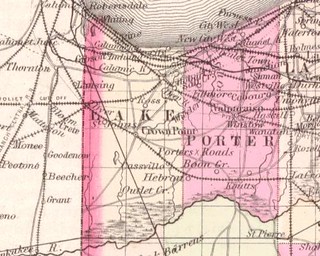
Lake County 1873

1873LakeCounty
(Click to enlarge)

No Ainsworth. The "Calumet" River is here given as "Calumic," a spelling that shows up occasionally on old maps. A variant transcription of the Indian name for that river? White people couldn't make up their minds what to call it? — I don't know.

Boring entry, but I feel like crap today.

Just to make up for this stupid entry, here's a pretty picture of some clouds after the storm the other day (click on image to enlarge):

P1000175

Thursday, August 20, 2009

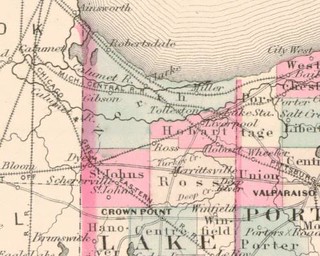
Lake County 1870 (northern half)

1870LakeCountynorth
(Click to enlarge)

Via the U. of Alabama, from Alvin J. Johnson, Johnson's Indiana (New York: A.J. Johnson, c.1870).

Merrillville is still "Merrittsville." No Ainsworth, at least not in Indiana. There is one just over the border in Illinois, along a railroad that may be either the Michigan Southern or the Cincinnati, Peru & Chicago — hard to tell on this map. Those Ainsworths got around, didn't they?

Miller, but no Gary. Robertsdale, but no Whiting.

* * *

Freight trains still stop here in Ainsworth — when their own train-traffic reasons require it — occasionally blocking State Road 51. Sometimes they stop so quietly that if I'm inside the house and not paying attention I don't realize the train has stopped rather than just passed out of hearing. But presently the continual whoosh ... whoosh ... whoosh of cars down Ainsworth Road draws my notice, and a glance out the window confirms: stopped freight train. The cars are looking for a way around the train, and it's either make a U-turn and go back north on State Road 51, or turn east onto Ainsworth Road. Sometimes the train stops for 20 minutes, or more, while some drivers sit there — fuming, or listening to the radio, or shouting into their cellphones, "Hey, I'm going to be late — yeah, there's a damn freight train..." or just thinking about how their lives have turned out — and others drive around in unaccustomed routes or back roads they've known for years, looking for a clear crossing. So at least in that way the Grand Trunk Railroad still has a powerful effect here in the ghost of Ainsworth.

Saturday, August 15, 2009

Lake County 1876

I have a single page from an atlas published in 1876. One side shows Lake County, the other side Porter County. I have scanned the Lake County side. It wouldn't all fit on the platen so I had to scan it in pieces.

Here is northern Lake County, including the Ainsworth area, which is not marked except for the little house icon I referred to in an earlier post and which I don't know the meaning of and I'm not going to pay $16.00 plus S&H on Amazon.com to buy a reproduction of this atlas in order to find out. Note the absence of the Grand Trunk Railroad. This part of the map includes a street map of Lowell.

Southern Lake County, not that anybody cares.

Street map of Hobart.

Street map of Crown Point.

Source: Baskin, Forster & Co., Illustrated Historical Atlas of the State of Indiana (Chicago, 1876).

Monday, August 3, 2009

Ainsworth Station

I believe it was in Bad Land: An American Romance by Jonathan Rabin (a book I highly recommend) that I read of the establishment of towns along new railroads crossing the Great Plains — towns set up entirely by the agents of the railroad, who were instructed to locate a town every so many miles along the railroad, and who assigned each town a name pulled out of their own whimsy. And so a station would be built, and the town would grow up around it, with no more basis than that the railroad happened to pick that spot.

I don't know in what way Ainsworth existed before the Grand Trunk Railroad was built through Lake County in 1880 and established the "Ainsworth" station. I have a map of Lake County published in 1876 on which Ainsworth does not appear, although such distinguished metropolises as Liverpool, Tollestone and Ross appear, as does Hobart, of course.

On this 1876 map I do see a road resembling Ainsworth Road, and there's a little house icon where Ainsworth Road crosses what seems to be the beginnings of Grand Boulevard. I don't have the whole atlas with its key, so I don't know what the house icon represents.

(By the way, I will start publishing images as soon as my new memory card arrives and I install it. Right now my computer is teetering on the brink of the Chasm of Unremembering and can't handle the scanning of images.)

Then comes 1880, and the Grand Trunk Railroad builds a station with a day telegraph office, somewhere close to the junction of the railroad, Grand Boulevard and Ainsworth Road. I have no idea what induced the railroad to put a station there, whether it was a matter of a station every X number of miles, or a promising junction of roads, or some person(s) with influence.

Trains traveling westward toward Chicago, originating in Ft. Gratiot, Michigan, or Valparaiso, Indiana, stopped in Ainsworth daily at 7:03 AM and 5:08 PM. Eastbound trains, from Chicago to Fort Gratiot or Valparaiso, made the Ainsworth stop at 11:07 AM and 7:21 PM daily, with a Sunday train at 3:17 PM. Local farmers shipped milk from the Ainsworth station to Chicago by the morning trains; evening trains returned the empty milk cans.

By 1882 Ainsworth had a post office (closed 1934); by 1900 the Rev. T.H. Ball described Ainsworth as "quite a shipping point for milk" with "some other business interests, with a population now of about fifty, fourteen families. It has a school house but no church." (Whether the school house referred to is the two-story brick one still standing, I'm not sure. Kenneth J. Schoon gives two dates for the building of an Ainsworth school — 1900 and 1912.)

I don't know the precise location of the station, but I have an idea, based on the 1939 aerial image. More on that later.

Somehow I have the idea that the station ceased operation in 1971, but I don't know where I got that figure.

By the time I moved here in 1990, Ainsworth as a town was imperceptible. The town itself was not incorporated, and no signs on the road bade you welcome to Ainsworth. My first month here, a neighbor who stopped by to talk to the guy pumping out my septic tank said something to me about "us folks here in Ainsworth," and that was the first I heard of such a place. As Hobart's fight to annex the Ainsworth area intensified, I would notice, as I drove around, that some yards had signs reading "Freedom for Ainsworth," or similar slogans. Ainsworth didn't get its freedom, as we know; it disappeared into Hobart. Its only revenge was that the Hobart mayor who had presided over the annexation effort, Robert Malizzo, was voted out of office largely by Ainsworth-area voters.

Sources:
  • Ball, the Rev. Timothy Horton, Northwest Indiana from 1800 to 1900 (1900).
  • Ball, the Rev. Timothy Horton, Encyclopedia of Genealogy and Biography of Lake County, Indiana (1904), as transcribed at Genealogy Trails.
  • Chicago and Grand Trunk Railway Gazette, Vol. 1, No. 1 (September 1883).
  • Schoon, Kenneth J., Calumet Beginnings: Ancient Shorelines and Settlements at the South End of Lake Michigan (2003).