Showing posts with label Thompson. Show all posts

Sunday, March 15, 2026

Never Trust a Cute Goat Story

I thought this goat story was cute, and its being on the front page of this small-town newspaper was cute, too.

2026-03-15. 1924-01-24 News, There Are Goats, and Goats, and Goats
(Click on image to enlarge)
Hobart News, 24 Jan. 1924.


As everyone in Hobart in 1924 did, we know the Veal family: Walter Veal married Hazel Thompson in August 1922, and we saw the announcement in November 1923 of the birth of that little daughter.

Reading further in the microfilm, I found this item in the "Local Drifts" of the Hobart Gazette of March 21, 1924.
Baby Ruth Olivia, infant daughter of Mr. and Mrs. Walter Veal, who live on South Center street, died suddenly about 7 o'clock Wednesday morning, March 19, aged 3 months and 20 days. The child had seemed rather delicate all along, and gave the parents much anxiety. Funeral services will be held Saturday afternoon at 2 o'clock from the Church of Christ by Rev. R. Warren Main.
The death certificate gives the cause of death as maramus, with bronchitis contributory.

At this point the goat story stopped being cute, and became a story of worried parents trying ineffectually to help their very sick baby. I was moved to look further into this family, and found a long history of trouble and grief.

We know that Myrtle, Walter's previous wife, had a nervous breakdown and then died "due to a complication of diseases." When we check the death certificate, we find a grim situation: the contributory cause was interstitial nephritis; the main cause was dementia praecox, which, as I understand it, is an outdated term for schizophrenia.

I initially thought Myrtle had been Walter's second wife. A little digging on Ancestry.com brought me to a family tree that had dived deep and found two wives before her. The first, Iva Ball, had married Walter in 1900 in Preble County, Ohio (not too far from his hometown of Greens Fork, Indiana); they were divorced sometime before May of 1907, when she remarried. (I believe the stepdaughter referenced in Myrtle's obituary was born during this marriage: Lucille Veal Fye (1901-1973).) In 1907 Walter married Florence Olvey in Wayne County, Indiana; they were divorced in Colorado in 1910. In 1911 came his marriage to Myrtle Mantauk in Cass County, Indiana.

One man with two divorces was unusual in the early 20th century. It didn't bode well, then or now. Did Hazel Thompson know about Walter's past when she decided to marry him?

Less than a year after Walter and Hazel lost their little daughter, they had another: Ellwyn Lorraine, born in Hobart on January 5, 1925, who would be known by her middle name. The Veal family was still in Hobart when Kenneth Lee Enos was born in March 1927. By June 1929, when Mary Margaret was born, they had moved to the unincorporated village of Mexico, Indiana, where they remained at least through April 1930 when the 1930 census was taken.

They were in the small town of Akron, Indiana for the births of their next two children: Enos Glen (January 1931) and Robert Glen (July 1932).[1]

Then the family moved to Nappanee, where Doris Jean was born in October 1934 and George Morris (named for Hazel's dead father) in December 1936.

That's a lot of children and a lot of moving in ten years. This was all happening during the Great Depression, while Walter was practiced a dying trade (blacksmithing), so I imagine the family's life was not easy.

This 1937 story came out of Nappanee:

2026-03-15. Children Find Journey Short, South Bend Tribune, 1937-06-25, p. 21
(Click on image to enlarge)
South Bend Tribune, 25 June 1937.


The children were probably Kenneth (10) and Enos (6). The grandmother in question was Nancy Thompson. I remember Eldon Harms telling me that Nancy sewed clothing for her grandchildren, and the Eva Thompson collection includes an envelope sent to Nancy from Nappanee on which someone has noted a measurement for Nancy's use in sewing a dress for the eldest Veal child, Lorraine:

EvaT053
(Click on images to enlarge)
Images above and below courtesy of Eldon Harms.


EvaT054

But something tells me that the 1937 story about the hitchhiking children is not as whimsical as it sounds. The kids might have wanted to go see their nice grandma, yes; but they might also have wanted to escape from a home that was stressful and perhaps even violent. The "something" telling me that is a 1939 story:

2026-03-15. Circuit Court, Elkhart Truth (Elkhart, Ind.), 24 Feb. 1939
(Click on image to enlarge)
"Circuit Court," Elkhart Truth, 24 Feb. 1939.


The 1940 census, taken in April and May, records a scattered family. Walter was still an inmate at the Putnam County penal farm. Hazel was in St. Joseph County, keeping house for a widowed farmer with four children; her youngest child, George, was living there too.[2] The three boys, Kenneth, Enos, and Robert,[3] were all in Elkhart County, living at the Bashor Children's Home. The two oldest girls, Lorraine and Mary Margaret, were in Wabash County, inmates of the White Manual Labor Institute.[4] Five-year-old Doris Jean had been adopted by a childless Indianapolis couple, William and Hazel Hart, and was now named Carolyn.[5]

Hazel was finished with Walter. By November 1940, she had moved to South Bend and filed for divorce.

2026-03-15. Beating Victim Seeks Divorce from Prisoner, South Bend Tribune, 13 Nov.  1940
(Click on image to enlarge)
South Bend Tribune, 13 Nov. 1940.


In January 1941, Hazel married the 55-year-old Otto Keck, whose wife had died in the spring of 1940. He had three adult children,[6] and lived in the village of Wyatt, southeast of South Bend, where he operated his own well-drilling business. There Hazel joined him. No doubt she brought little George with her; I'd like to think she brought her other children as well.

On July 11, 1942, at the age of 41, Hazel gave birth to twins — Jerry Alan and Joyce Ann. The following year, they died within a day of each other.

2026-03-15. Joyce and Jerry Keck, Bremen Enquirer, 4 Nov. 1943
(Click on image to enlarge)
Bremen Inquirer, 4 Nov. 1943.


According to their death certificates, Joyce died of scurvy, Jerry of broncho-pneumonia, but both suffered from malnutrition. Perhaps the disorder that had killed little Ruth in 1924 had surfaced again. But unlike Ruth, who seems to be lying in an unmarked grave in Crown Hill Cemetery, these little ones' graves are marked with an impressive stone.

By the way, I am not reassured by the fact that of all Hazel's own children, only George is listed among the survivors in the twins' death notice. The others may have still been scattered. But Robert, at least, joined Otto and Hazel's household in time to be counted with them, and his brother George, in the 1950 census.

After the twins, Hazel had no more children, and — aside from losing her mother in 1944 — no more heartbreak, I hope, at least until Otto died in 1959. All her other children were still living at Hazel's death in 1972.


When Eldon Harms was telling me about the Thompson family, he never hinted that Hazel's life had been so difficult. Perhaps he didn't know.

_______________
[1] I can't find a birth certificate for Enos. I got his birth date from his Korean War draft registration.
[2] To the enumerator (or maybe to her employer), she described herself as widowed.
[3] The census enumerator put him down as "Lester" Veal, but his age is right for Robert.
[4] The enumerator added a note to the name: "home for problem children." This institution, during the latter part of the 19th century, had been one of the notorious boarding schools in which Native American children were forcibly placed.
[5] I owe this information to a family tree on Ancestry.com; I would never have figured it out on my own. The 1940 census reported that Carolyn had been living in the Hart home since 1935, which would mean she was adopted as an infant, but that may have been an assumption on the enumerator's part. (I mean, the enumerator might have asked one of the adults, "Where were you living in 1935?"; that person said, "Here"; and the enumerator assumed the answer applied to the child too.)
[6] Still living, that is; one son had been killed in an accident in 1938.

Friday, July 18, 2025

How Jeremiah Earned Some Money

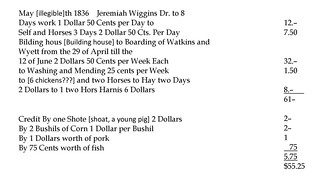
This summary of amounts owed to Jeremiah Wiggins is in the same handwriting (and spelling) as the Charles Sloat note, but, as we shall see, Charles wasn't involved in these transactions, except maybe as the scribe of this summing-up written well after the transactions took place.

2025-07-18. Wiggins estate 27b
(Click on image to enlarge)
Image courtesy of Alice Flora Smedstad.


My attempted transcription:

2025-07-18. Wiggins estate 27b transcription
(Click on image to enlarge)

This document was a challenge: the copy is bad, the spelling non-standard, and the writer did not start a new line for every item. But this is what I have teased out regarding what Jeremiah did or supplied to earn these amounts:
  • eight days' unspecified work by Jeremiah
  • work by Jeremiah and his horses for 3 days to help build a house
  • boarding (i.e., feeding) Watkins and Wyett, whoever they may have been (we'll get to that below), from April 29 to June 12 of — 1835? (the document is being written in May of 1836)
  • washing and mending
  • hay for two horses and (almost illegible but looks like) six chickens
  • one two-horse harness
All of that is reasonable enough except for the washing and mending. "Washing," I suppose, meant laundry. Now, does a tough frontiersman do laundry and mending by the week for other people? Do tough frontiersmen want their laundry done every week? Maybe my notion of tough frontiersmen is wrong. Or maybe Jeremiah subcontracted that work.

The person owing Jeremiah these amounts set off part of his debt by furnishing to Jeremiah one young pig, two bushels of corn, some pork, and some fish.

Here is the description noted on the back of the document by Solon Robinson, the court clerk:

2025-07-18. Wiggins estate 27a
(Click on image to enlarge)
Image courtesy of Alice Flora Smedstad.


My transcription:
No. 1
Wiggins Estate

Barney's a/c.
Balance due 55.25

Filed March 28th 1839
Solon Robinson
Clk. L.P.C.
So, while the body of the document does not name the debtor, the clerk's description supplies a name: Barney.

This may have been Francis Barney, who was in Lake County by 1836 (Lake County 1834-1872 at 55) and is listed in the 1840 census. Around 1842 he married Amanda Strong (Indiana Marriage Collection). The Barney family, with three children, is listed in eastern Ross Township in the 1850 Census. One of their daughters married Austin Thompson in 1863 and raised a family of five children, all of whom went on to raise their own families in Lake and Porter Counties.[1] I have not been able to trace any other Barney family member beyond 1850 (not that I've tried very hard!).

Let's look again at the two people whom Jeremiah boarded: Watkins and Wyett. I have found two possible matches for those names:
  • William Watkins, an early settler of northeast Ross Township, who appears as early as 1837 in records of Hobart merchants, and in the 1840 census
  • Thomas J. Wyatt, an early settler of Liberty Township, Porter County (Porter and Lake Counties (Goodspeed-Blanchard) at 38, 209, 211)
But I simply don't have enough information to identify either man positively. As to why Francis Barney would have owed Jeremiah Wiggins the cost of boarding them or any member of their families, I don't have a clue.

_______________
[1] One of their sons, George, was the father of Eva Thompson.

Friday, October 2, 2020

Back to 1923 Temporari-Lee

I still have a couple of items from the 1923 newspaper, from back in the good old days when you didn't need an appointment to go to the library. May those days return soon.

Speaking of returning, that is what Lee Thompson, our barber, has done — from Seattle, where he had gone in October 1922. He was just in time to meet his brand-new niece.

2020-10-02. Thompson, Lee, News, 11-29-1923.
(Click on image to enlarge)
Hobart News, Nov. 29, 1923.


Below that, a surprise birthday party for Asa Strong, who was 54 years old. Born November 24, 1869 (Indiana Death Certificates) and named for his grandfather, he was the first child of Augustus and Sarah (Culver) Strong, who had been married in 1868. In 1900, Asa had married Ida Roper. They lived in Hobart (1920 Census). Mrs. Ross Graham was the former Ruby Roper.

Friday, June 12, 2020

The Dunes Highway Opens

Construction on the Dunes Highway had started in 1922. By mid-November 1923, the Highway was ready to be opened to public use. The dedication ceremony would be attended by some prominent Hobart citizens.

2020-06-12. Dunes Hwy, Gazette, 11-9-1923
(Click on image to enlarge)
Hobart Gazette, Nov. 9, 1923.


The following week's Gazette reported that the ceremony included an odd incident that was resolved with "a bottle" …

2020-06-12. Dunes Hwy, Gazette, 11-16-1923
(Click on image to enlarge)
Hobart Gazette, Nov. 16, 1923.


… which I'm inclined to interpret as a flouting of Prohibition, which (as we know) was not uncommon — but this case would be uncommonly open and public.

The "Local Drifts" of the same issue mentioned that "Paul Bruebach of this city was a member of Perry's Municipal Band that furnished music last Friday afternoon at the dedication of the Dunes Highway."

Incidentally, in spite of the November 9 issue's giving November 14 as the planned date of the ceremony, and the inclusion in the Route 12 Wikipedia entry of a picture of a historic marker also giving November 14 as the date of the highway's opening, the two November 16 items name "Friday," that is, November 16, as the date of the ceremony. So does this article from the Hobart News of November 22, 1923:

2020-06-12. Dunes Hwy, News, 11-22-1923
(Click on image to enlarge)
Hobart News, Nov. 22, 1923.


The "Local and Personal" column of the same issue mentioned a few more locals who attended the ceremony: "Paul Emery, W.J. Killigrew, Evan Roper, Leslie Walters, A.J. Smith, O.L. Pattee; and John Dorman and Alex Boyd of Ross Township."

In the November 22 issue above, an article in the second column to the right mentions a "Bootjack extension" that was planned to connect the Dunes Highway and the Lincoln Highway. An online article about the Lincoln Highway in Indiana includes a map from 1924 showing the "Boot Jack Corner" near Rolling Prairie, and even today in that vicinity there is an "East Bootjack Road." Add this to the collection of random facts I have learned accidentally since I started the blog.

♦    ♦    ♦

Also in the November 22 issue, we see an announcement of a law-and-real-estate partnership between F.E. Demmon and C.L. Fleming. We've already met Calvin L. Fleming, former cigar-maker and billiard-room operator, now concentrating on real estate. The lawyer would be, I suppose, Floyd E. Demmon, whom the 1920 Census records as a 28-year-old lawyer for an unnamed railroad, living on Cleveland Avenue with his mother-in-law, Harriett Mundell. Floyd had married Alice Mundell in 1918 (Cook County, Illinois, Marriages Index).

Thursday, May 28, 2020

Ready to Cut the Wheat

2020-05-28. EvaT027
(Click on image to enlarge)
Image courtesy of Eldon Harms.


The photographer is standing on Ainsworth Road just west of County Line road and pointing the camera south(west), toward the big barn on the farm the Thompson family rented.

There are four horses, two men, a woman, and two dogs. The photo isn't clear enough to identify anyone, although, to me, the woman looks vaguely like Nancy Thompson.

There is no date. I'm guessing, very roughly, at the early to mid-1920s.

As for the machine, here are the notes I took as Eldon Harms told me about it:
The machine is a binder. The rotating arms with horizontal planks knock the grain against the sickle bar at the bottom to cut it. It cuts wheat/oats and binds bundles of grain (ties it up themselves), continues filling up with bundles to a set number, at which point it drops them all at once so you can shock them. Grain is left to dry and cure (maybe days or weeks); then you gather all your bundles and haul them to one place to be threshed. How to tell if grain ready for threshing? You can rub it on your hand to see how dry it is. Some guys chewed on a grain to judge.


If the big barn was still standing in 1939 (at which time the land was owned by Michael and Julie Carrozzo), we can tell where it stood from the aerial photo of that time.

2020-05-28. Large outbuilding 1939
(Click on image to enlarge)
Photo from https://igws.indiana.edu/IHAPI/.


Saturday, February 29, 2020

Hood Ornaments

2020-02-29. EvaT033
(Click on image to enlarge)
Image courtesy of Eldon Harms.


Eva Thompson is at left, sitting on the car; her mother, Nancy, is at the far right. The other two are unidentified.

There is no date on this photo. In my notes, I wrote: "The car is a Chevy like Lester Dye's"; Eldon Harms must have told me that. But the Ainsworth vintage-car expert tells me that — based on what little he can see of it — he thinks the car might be a 1926 or '27 Dodge. The fashions are consistent with that era.

Eva and Nancy are coatless and hatless, which suggests that they are at home. But the location is unidentified. Behind Nancy is a substantial two-story brick building; that, plus the rolling landscape in the background, tells me that we're not at the old James Chester place east of Ainsworth, where the Thompsons once lived. If I had time, I'd go driving around to look at the land surrounding their other known homes, to see if any combination of home and landscape might resemble this photo. But, of course, I don't have time.

Eva seems to be wearing her "good" clothes. Her dress shines like silk, but I wonder if it could be rayon? My mother, who reached young womanhood in the late 1930s, told me that in her day rayon was looked down upon as "poor man's silk" and you had to be pretty hard up to resort to wearing it. I really don't know how prosperous the Thompson family was. In the same vein, I don't know if Eva's long necklace is made up of real pearls.

At about knee level, her costume gets so complicated: the dress seems to be lined, or maybe that's a slip; and then — bloomers? And stockings held up with pretty lace-edged garters, which she doesn't care if the camera memorializes.

Which leads me to wonder who was operating the camera.

Tuesday, March 6, 2018

Saved for the Wrecking Ball

Thank goodness for the fine work of Hobart's fire department and its "most splendid motor fire truck" in March 1923 — or what would there have been to raze 17 years later?

2018-3-6. Fire at Hobart House
(Click on image to enlarge)
Hobart Gazette, March 30, 1923.


The "Fasel fire" was the subject of an earlier post.

Notice Axel Strom's advertisement lower down in the right-hand column. I suppose he had to move all his things back from the Fleck residence.

Saturday, May 6, 2017

Aunt Nancy's Birthday Pictures

These photos of Nancy Thompson, taken on two consecutive birthdays, survived among the many photos owned by the Harms family.

The first was taken on February 20, 1943, when she was 75 years old.

2017-5-6. redalbum147
(Click on images to enlarge)
Images courtesy of Eldon Harms.


The second was taken exactly a year later.

2017-5-6. redalbum146

Nancy was born February 20, 1868, the first child of Valentine and Rebecca aka Anna (Winsell) Swartz, who had been married in Porter County in February 1867. The family shows up in the 1870 Census farming in Union Township.

Then they started moving around, it seems: if I've found the right people, for the 1880 Census the Swartzes were living in Cass County, Nebraska. By the 1900 Census, they had moved to Elk Falls, Kansas, and Valentine gave his occupation as a guard at a penitentiary. Valentine and Rebecca both ended their days there.

However, I would not be surprised to learn that between 1880 and 1900 they had come back to Indiana for a time — why else would Nancy, in 1898, have married George Morris Thompson of Porter County (Indiana Marriage Collection), rather than some nice young man in Nebraska or Kansas?

At the time of their marriage, the young couple planned to live in Hobart ("Local Drifts," Hobart Gazette 16 Sept. 1898), but, as I have tried to trace, they moved about a good deal.

I do not know much about where Nancy lived after being widowed in 1928, nor do I know where either of the two photos above were taken.

Not two months after the second photo, Nancy died in Hobart (Indiana Death Certificates). She was buried beside her husband in Salem Cemetery.

I am classifying these photos as belonging to the Eva Thompson collection even though, technically, that's not where I got them.

Friday, March 17, 2017

Bobsled on a Snowy Day

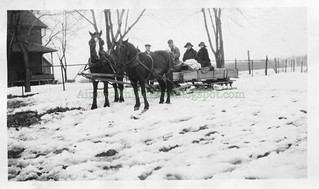
In honor of the (let us hope) last snowfall of the season, which is now turning the ground into mud, here's a picture of some snowy transportation.

2017-3-17. EvaT032
(Click on image to enlarge)
Image courtesy of Eldon Harms.


The photo is undated; based on general appearances I'd put it in the 1920s. The location is not specified. It might possibly be the old James Chester place, but I can't say for sure.

The woman second from the right looks like "Aunt" Nancy Thompson (as she was known to the young Harmses), Eva's mother. The rest of the people are unidentified.

The sled was probably a wagon for three seasons out of four. When snow fell, you'd take the wagon wheels off and put on skids.

Sunday, October 23, 2016

Breaking Camp

Mrs. George Thompson was Lee's (and Eva's) mother. Her maiden name was Swartz and per the 1900 Census she had married George Thompson in 1899, but I've not yet been able to find the record of their marriage.

2016-10-23. Nancy Thompson
(Click on image to enlarge)
Hobart News, 19 Oct. 1922.


The little Amlong family started camping out near the village of Deep River in June. They must have spent a few chilly nights in their tent before finally moving into a house for the winter. The "Humes residence south of the city" was likely on what's now State Road 51, though I still don't know exactly where.

Tuesday, October 18, 2016

What Was It About Seattle?

The "Local and Personal" column of the Hobart News of October 5, 1922, included this item: "Lee Thompson, residing south of Ainsworth, formerly of Hobart, left Monday evening for Seattle, Wash. where he expects to be employed in the markets in that city."

I think "south of Ainsworth" referred to their rented farm near the Vincent schoolhouse.

Perhaps Lee had heard from the Hazelgreens how great Seattle was. Or maybe there was some boom going on there in 1922 that could draw him out of Indiana.

This might explain why I couldn't find him around here in the 1930 Census; on the other hand, we already know he was back in Hobart by 1940.

♦    ♦    ♦

The fact that 60 property owners were petitioning for an "asphaltic concrete top dressing" for Cleveland Avenue in October 1922 suggests that it was still a gravel road at the time … if not a dirt road.

2016-10-18. Road improvement petition
(Click on image to enlarge)
Hobart Gazette 6 Oct. 1922.


That was the route of the Yellowstone Trail, competing for traffic against the Dunes Highway (still under construction, I think) to the north and the Lincoln Highway to the south. And crews had been at work on the Lincoln Highway during summer of 1922, pouring fresh cement.

The "south road … between Hobart and the Lincoln Highway" refers State Road 51.

Monday, October 10, 2016

She Was a V, A, M, P …

My only memory of the Sonny & Cher Comedy Hour is Cher's recurring vamp song, which comes to mind now that I'm delivering on my promise to dish the dirt about Emma Shearer.

I will let this newspaper article from October 2, 1908, tell the story:

2016-10-10. Shearer 1 of 2
2016-10-10. Shearer 2 of 2
(Click on images to enlarge)
Lake County Times (Hammond, Ind.) 2 Oct. 1908.


Although the article gives her earlier husband's name as James Adams, per the county records it was Anthony S. Adams, and the date of their marriage February 28, 1901. She was then about 34 years old, he about 28 — old enough to know what he was doing, you'd think. But what "disclosures" could he have made to provoke her to kick him out of the buggy? My guess is that he hadn't gotten around to divorcing a previous wife … or perhaps had a lot of debt.

After divorcing Mr. Adams, Emma appears not to have married anyone else until November 17, 1906, when she and John Kroledge joined their hearts together. He was ten years her junior. Their marital bliss lasted almost two years, it seems.

Several weeks after the above publicity about their impending divorce, another disgruntled hired man came forward:

2016-10-10. Shearer - Mattas
Lake County Times (Hammond, Ind.) 20 Nov. 1908.

I have not been able to learn the outcome of any of these cases. I assume the divorce came through, since John Kroledge married again during Emma's lifetime.

But I did come across this tantalizing tidbit from the spring of 1909 …

2016-10-10. Shearer Ohearn
Lake County Times (Hammond, Ind.) 13 Apr. 1909.

… which stirred up in my mind a vague memory of Emma and Michael O'Hearn being connected somehow, long ago; so I went searching among my notes and found that yes, indeed, they had been closely connected. I don't know exactly when it started, but by the spring of 1895 they were secret lovers. She was about 29, he about 33. In the spring of 1896 their quiet romance ended — loudly.

2016-10-10. Shearer-Ohearn
Hobart Gazette 17 Apr. 1896.

2016-10-10. Goes Free
Hobart Gazette 8 May 1896.

♦    ♦    ♦

I have yet to learn much about the rest of Emma's life, but at the moment it appears there were no more marriages. In 1910, Emma — living alone, apparently, on her farm on Tenth Street — gave her surname as Kroledge and her status as widowed (the enumerator was Charles A. Blank, who, as a resident of Miller, might not have heard the real story). In 1920, she was still Emma Kroledge, but now "divorced." In her household was a 51-year-old hired man; let us hope he was satisfied with his wages. I cannot find Emma in the 1930 Census.

Emma Kroledge, "widow," died in the Lake County Poor Asylum on May 7, 1932.

2016-10-10. Emma Kroledge obit
Hobart Gazette 12 May 1932.

What little I know of Emma's siblings suggests that all of them were, shall we say, unsettled. I believe brother Charles served a short time in prison in the 1890s; someday I will discuss him in more detail.

Her sister, Mary Ellen, had married John Mander in 1873, and, as we've learned, the marriage was not happy.

"Mrs. Nora Ensign" is somewhat mysterious, because I can't find that Emma ever had a sister named Nora; she did, however, have a sister named Elizabeth E., born in 1857, whose death certificate (1934) described her as the widow of William Ensign … who, according to the marriage records as transcribed on Ancestry.com, married "F. Ellen Shearer" in 1881. We've met Elizabeth Ensign before and learned that she described herself as widowed in 1910 and divorced in 1920. She had two sons, John and Walter (and through John she was the grandmother of Richard Ensign). I can't find Elizabeth in 1930, but I do find a Nora Ensign living in Hobart — about three years older than you would expect Elizabeth to be. Which leads to something else interesting: the marriage records show a Nora Ensign marrying a Fred Kappelman in 1899; and the 1900 census shows John and Walter Ensign living with their mother, whose name is nearly illegible but looks as if it could be "Kappelman, Norra" (you can see for yourself here), and who told the enumerator she had been married for one year. The question is: where was Fred Kappelman in 1900? I have no idea. I have reason to think he was still alive, though I can't find him outside of the local newspapers.

As for William Ensign, I don't know what became of him. I can't find any record of his death.

And as for the "family lot in the Hobart cemetery" mentioned in Emma Kroledge's obituary: I cannot find Emma, nor her parents, nor her sisters in Hobart Cemetery — or anywhere else, for that matter.


Additional Sources:
♦ 1880 Census.
♦ 1900 Census.
♦ 1910 Census.
♦ 1920 Census.
♦ 1930 Census.
♦ 1940 Census.
♦ Indiana Death Certificates.
♦ Indiana Marriage Collection.

Sunday, July 24, 2016

Alta

2016-7-24. st037
(Click on image to enlarge)
Image courtesy of Eldon Harms.


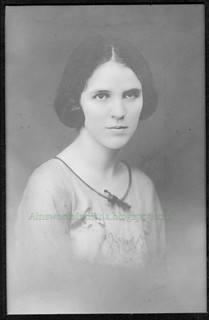
This photo comes from Minnie Rossow Harms' steamer trunk. The young woman is identified only by a handwritten note on the photo's cardboard frame: "Alta." The frame also bears the stamp of the photographer, Krudup of Crown Point, Indiana, about whom I know nothing.

I think she resembles a young Alta Thompson, and since the families were friends, Alta might well have given Minnie a photo from her youth. If this is Alta Thompson, who was born circa 1905 and in this photo looks about — well, your guess is as good as mine; mid-teens to early 20s, maybe? — then this photo would date to somewhere from 1920 to 1927. I wish I could see more of her dress.

Friday, June 24, 2016

My Latest Half-Baked Theory

As I was writing about Hazel Thompson's marriage to Walter Veal in my last post, I happened to remember a photo left to us by Eva Thompson in which two adults were unidentified. The two thoughts suddenly connected in a flashing arc across my brain — oh! so that's who they were!

Upon further examination, I began to think it was just a case of faulty wiring, but I'll tell you my bright idea anyway.

Here's the photo in question:

2016-6-24. EvaT008
(Click on images to enlarge)
Images courtesy of Eldon Harms.


In the front row, we have (left to right): Nancy Thompson; Alta Thompson Dye with an unidentified child on her lap; Minnie Rossow Harms with an unidentified child on her lap; Herman Harms, Sr.; and Eldon Harms. Eldon, born in 1924, looks about six years old here, so we can date the photo to approximately 1930.*

The two in back are unidentified — no, wait! They must be Walter and Hazel (Thompson) Veal!

In another photo taken probably within minutes of the first, Herman Harms, Sr. has taken the place of the unidentified guy in back, and Eva Thompson has taken Herman's place in the front row, with an unidentified baby on her lap.

2016-6-24. EvaT005

In the 1930 Census, taken in April of that year, we find Walter and Hazel Veal in Jefferson County, Indiana, with three children: Lorraine (five years old), Kenneth (three years and five months), and Mary (ten months). So maybe Kenneth and Mary are the children in this second photo. (The unidentified child on Minnie's lap in the first photo might be Norma Harms, who was then about two years old.)

Mystery solved! … or not. Now that I look at that unidentified man, I have to admit he has some resemblance to Walter Dye, Alta's husband. And in the 1930 Census, Walter and Alta Dye had two boys, Robert (two years old) and James (six months), who could account for the two children in the second photo (although the baby on Eva's lap seems to be dressed more in the style of a girl). Furthermore, in 1930 Walter Veal would have been almost 50 years old; could that unidentified man pass for 50? But he could pass for 29, Walter Dye's age.

I should mention also that in looking at these photos, Eldon Harms did not recognize either of the unidentified people.** On the one hand, if Walter and Hazel Thompson Veal were friends of the Harms family, you'd expect him to recognize them; on the other hand, if they only ever visited during his early childhood, then 80-some years later and with weakened eyesight, he might not pick them out of a photo.

The Dye hypothesis still leaves the woman in back unidentified. Let's just say she's the Mystery Woman of Ainsworth.

__________________
*A copy of this photo found in another collection had "31" written on the back; it's not clear whether that means 1931.
**That's why they're unidentified, duh.

Wednesday, June 22, 2016

August Weddings

Two couples tying the knot in August 1922 were acquaintances of ours.

2016-6-22. Thompson/Veal, Baumer/Fleck weddings
(Click on image to enlarge)
Hobart News 24 Aug. 1922.


George Fleck had lost a sister just 13 days before he gained a wife.

I suppose the Baumer bakery produced the wedding cake.


Walter Veal, widowed about one year earlier, was now marrying Eva Thompson's eldest sister. Hazel was about 19 years old, Walter nearly 40 (1920 Census) and twice widowed (Indiana Marriage Collection).

I don't know exactly where Amelia Thompson's house was (nor have I figured out yet whether Amelia was any relation to the bride's family).

Thursday, April 14, 2016

"We Have Come to Stay"

Two smiling young women, a bicycle, and a snowy landscape.

2016-4-14. hazel001_a
(Click on images to enlarge)

Handwritten notes on the back identify them:

2016-4-14. hazel001 b

The photo has no date, but based on their leg-of-mutton sleeves and apparent ages (Clara was born circa 1877, Lena circa 1879), I would put it close to the turn of the 20th century.

I'm not sure which is Lena and which is Clara. Comparing them both to the person identified as Lena Triebess in the Old Maids' Basketball Team, I think Lena is on the left. Also, here's a photo of Lena in 1916:

2016-4-14. Lena Triebess Peterson, 1916
(Click on image to enlarge)
Image courtesy of the Hobart Historical Society.


Lena and Clara worked together as schoolteachers at the Miller school during the school year beginning September 3, 1900. Lena continued teaching there for at least two more school years; Clara did not. The school's principal was a G.F. Peterson — this may have been the George F. Peterson who in June 1907 became Lena's husband.

Their marriage is the first time I can find either Lena or George in the official records. I naturally wondered whether Lena was related to Ainsworth's own Julius Triebess. In January 1900, "Julius and Tillie Triebess made a short visit with their sister Lena" in Miller — I just haven't been able to find anything to show me if that was our Julius. (In 1910, we find a 29-year-old Tillie Triebess living in Miller, teaching school, but that doesn't prove anything. There was also a Triebess family in Hobart — one of whom married Fred Thompson — but based on the matriarch's obituary, I don't think she could have had any closer relation than aunt to Lena or Julius, if related at all.)

Here's the Gazette's story of Lena and George's wedding:
One of the prettiest weddings occurring in Hobart took place at the home of Mr. and Mrs. W.B. Owen last Monday evening, June 24, 1907, when Miss Lena A. Triebess of this place and George F. Peterson, of Miller, were united in marriage. The ceremony was performed at 8:30 o'clock in the presence of about forty relatives and friends by the Rev. Bruce Brown, Ph.D., pastor of the Christian church at Valparaiso. The Methodist Episcopal service was used.

The bridge was attired in white and presented a most handsome appearance. She carried a shower bouquet of pink sweet peas. Mr. and Mrs. Owen's little daughter Jessie was flower girl and gracefully performed her part. The Owen home was extensively decorated, suitable for the occasion.

After congratulations, a fine wedding dinner was served, following which the bride and groom departed to their new home, which, for the present, will be a cottage on the beach at Lake Michigan north of Miller. Their future residence will be either at Miller or at Gary, where at present the groom is engaged in his chosen profession, that of electrical engineer.

The groom was raised at Miller, educated at our public schools and two years ago he graduated from the department of electrical engineering at the Purdue University. The past year and a half he was engaged in teaching manual training in the public schools at St. Paul, Minn., while the bride has claimed Hobart as her home, having lived for a number of years at the Owen residence. After attending our public schools, she began teaching eight years ago, having taught five years in Miller and the past three years in the Hobart schools, having been very successful in her school work. Both young people are very popular among their friends and acquaintances and are highly respected in our community. We join their numerous friends in extending well-wishes and happiness.

Those present from out of town were: From Miller — Mrs. Hannah Peterson, the groom's mother, and his sister Clara, Mrs. Aug. Olson and two daughters and Prof. Frank Fitzpatrick; from Lake [Station] — Mrs. V.P. Babcock [née Esther Hazelgreen] and Misses Clara and Eleanor Hazelgreen; from Chicago — the bride's brother Julius and family and sisters Amanda and Annie; from Valpo — the bride's sister Tillie, Mr. and Mrs. Albert Kitchen, Mr. and Mrs. Rodney Kitchen and Mr. and Mrs. Frank Foster; from Cincinnati — Chas. Langeman, a classmate of the groom while in colleage, and from Kentucky, Dr. and Mrs. J.C. Boone.
That still doesn't tell us if this Julius Triebess was the Ainsworth Julius.

♦    ♦    ♦

As for Clara Hazelgreen, by 1910 she had left northwest Indiana and, along with several of her siblings, was living in Seattle, Washington, describing herself as a missionary teacher. It appears she lived out her life in Seattle, and now rests there. (Her findagrave.com entry includes photo of three people identified as Lena, George, and Clara.)

This undated portrait of Clara Hazelgreen was taken in Seattle:

2016-4-14. hazel004


Sources:
♦ 1910 Census.
♦ 1920 Census.
♦ 1930 Census.
♦ 1940 Census.
♦ Indiana Marriage Collection.
♦ "A Pleasant June Wedding." Hobart Gazette 28 June 1907.
♦ "Deaths." "Mrs. Minnie Triebess." Hobart Gazette 14 Feb. 1935.
♦ "Miller Murmurings." Hobart Gazette 12 Jan. 1900.
♦ "School Begins Sept. 3rd." Hobart Gazette 24 Aug. 1900.
♦ "School Teachers For Next Year." Hobart Gazette 26 July 1901.

Monday, January 11, 2016

In a One-Horse Open Sled

Oh, what fun! Here's Eva Thompson making the best of the snow and cold.

2016-1-11. EvaT031
(Click on image to enlarge)
Image courtesy of Eldon Harms.


The unidentified child's sled is tied to the back of Eva's sled.

We have no date and no location for this photo.

In the background, toward the left, you can see a one-horse buggy; at right, part of a windmill, and a pump house that looks as if it might have a stock watering tank beside it.

Saturday, August 29, 2015

Bathing Beauties of Ainsworth

Probably on their way to or from the Deep River swimming hole, Walter Dye and Herman Harms stopped for a picture with Eva Thompson.

Walter Dye, Eva Thompson, Herman Harms
(Click on image to enlarge)
Image courtesy of Eldon Harms.


The notes on the bottom of the photo identify the man on the left only as "Walter," but the photo's present owner believes it's Walter Dye, and it would certainly be natural for Eva's brother-in-law to be hanging around with her and her neighbors.

Walter, born in 1900, was one of five children of George and Anna Dye, who farmed in Winfield Township. After marrying Eva's sister, Alta, around 1925, Walter got out of farming; by 1940 he and Alta got out of Indiana, moving to California.

Looking at this photo, I think Walter Dye also appeared in the swimming-hole photo, second from the left. These photos may have been taken the same day.


Sources:
♦ 1900 Census.
♦ 1910 Census.
♦ 1920 Census.
♦ 1930 Census.
♦ 1940 Census.
♦ WWI Draft Cards.

Monday, July 6, 2015

Deep River Swimming Hole

Swimming hole in Deep River
(Click on image to enlarge)
Image courtesy of Eldon Harms.


This photo comes down to us with no identifying notes on the back, but its present owner recognizes the spot — it was the swimming hole in the Deep River, where it ran along the southern border of the Harms farm east of Ainsworth. Up the bank behind the swimmers, you will notice two fence posts next to each other; they mark the boundary between the Nolte land and the Harms land.

These days, if you go through the Ainsworth Road entrance of Deep River County Park and follow the path that goes along the river (on a day when it's not flooded), at some point not too far along you will be walking opposite to the swimming hole, but I couldn't tell you exactly where it was.

No one in the photograph is identified. In my opinion, the man fourth from the left looks like Lee Thompson, and fifth from the left looks a bit like Herman Harms, Sr.

Wednesday, June 10, 2015

Students at the Vincent School

I have mentioned that in the spring of 1918 Evie Thompson's family moved to the vicinity of the Vincent school, and Evie became a student there. We have a photo of her with her classmates.

2015-6-10. EvaT012
(Click on images to enlarge)
Images courtesy of Eldon Harms.


On the back, someone has hinted at the identities of the children …

2015-6-10. EvaT013

… failing to include a full surname, or to indicate which name belongs with which child. The only one we can recognize is Eva Thompson herself, the tall girl with glasses, second from the left in the back row.

Looking through the 1920 Census, I have come up with possible surnames for these children, based on the matching first letter and the apparent proximity of their families to the Vincent school:
Elmer Reithel, Harry Sullivan, Clarence Reithel, Theodore Henning, Delmer Henning, Donald Weiler, Eva Thompson, Mathilde Prochno, and Mabel Burkley
These are only guesses on my part, and I still don't know which name goes with which child.

The former Vincent schoolhouse still stands on the southwest corner of the intersection of Clay St. and 83rd Ave., and you can still see that pattern in the brick on its side wall.

Incidentally, I suspect that when the Gazette, in June 1912, mentioned that Gust Lindborg had "bought the old Sullivan schoolhouse" and moved it to Ainsworth to serve as his residence, the building referred to was the old frame Vincent schoolhouse. At that writing, per the 1891 Plat Book, the Sullivans had owned for some twenty years what was originally the Vincent land (per the 1874 Plat Map), and the schoolhouse had always been catercorner to that land, so I can understand why either name might be applied to the schoolhouse.

Also, this obituary of Mercy Vincent suggests that the Vincents had owned the land from circa 1844 until circa 1890, which really has nothing to do with anything, but I didn't post this before so I might as well do it now.

2015-6-10. Mercy Vincent obituary
(Click on image to enlarge)
Hobart Gazette 12 Jan. 1906.