
In January 1923, the Hobart Gazette tells us, John and Mary (Baird Chester) McDaniel moved from Ainsworth to Knightstown, Indiana, near Indianapolis. But the Gazette fails to give us even a hint of why.
In other moving news, the Arment house and 20 acres, recently abandoned by its previous tenant, had just been leased for two years to Edward Maicke … who might possible be the brother of Otto Maicke, but I don't know for sure.
Source: "Local Drifts," Hobart Gazette 26 Jan. 1923.
Showing posts with label McDaniel. Show all posts
Showing posts with label McDaniel. Show all posts
Saturday, June 10, 2017

Monday, April 6, 2015
Ross Twp. Farmers' Institute
I gather that in January 1922 Mary Baird Chester McDaniel was still living on the Chester farm, or somewhere in Ross Township, with her granddaughters, since one of them — Helen, now about 13 or 14 years old — walked away with three first prizes at the Ross Township Farmers' Institute.

(Click on image to enlarge)
Hobart News 2 Feb. 1922.
Glen Peterson didn't do so badly either. About 13 years old, he was the youngest son of Mabel Peterson, Secretary of the Institute and writer of this report.
Vernon and Emery Hurlburt were the only children of Jacob and Augusta, who farmed some 80 acres at the northeast corner of E. 73rd Ave. and Grand Blvd.
Irvin Wojahn was the oldest child of Louis and Lena (Fasel) Wojahn, who had supposedly retired from farming in 1917 — but I can't find them in the 1920 census to see what they were up to.
Dorothy Mankey was the only daughter of William and Lena (Springman) Mankey.
Additional Sources:
♦ 1910 Census.
♦ 1920 Census.
♦ "Ross Twp. Farmers Hold Big Meeting." Hobart Gazette 3 Feb. 1922.
Friday, October 17, 2014
Return-to-Hobart Report
Paul and Bliss Emery are back in Hobart, living with her parents, Calvin and Huldah Shearer. John and Mary McDaniel have left her stepson's house and are living with her son, John Chester, while they think about moving back to Hobart.

(Click on image to enlarge)
Hobart Gazette 5 Aug. 1921.
I found that story about the Kulage brickyard interesting not only because it had shut down for a while, perhaps due to the general hard times the nation was going through, but also because of the "subway" under "Chicago street," by which I suppose they mean the Chicago road, now known as Old Ridge Road.
And, speaking of the Chicago road, it's about to get improved, "from the brick yards west to Gary city limits," according to the article at the top of the right-hand column.
Tuesday, January 28, 2014
Checked Out of the Hotel McDaniel
"March has been a splendid month so far," said the Gazette, but in the home of George and Mabel Sauter it was miserable. George, who'd been through several illnesses already, was again confined to his bed with some unspecified ailment, unable to work in his grocery store. Mabel was "quite ill with rheumatism" — with a 15-month-old child to care for.
And now we hear from Mary Baird Chester McDaniel, whose ill health perhaps prompted her and her husband, John, to give up operating their Chicago hospitality business, whatever it was — the Gazette now calls it a "rooming house," but had described their 1917 purchase as an 84-room hotel. It's possible they had downsized in the interim. Anyway, the McDaniels were contemplating a move to Hobart or Valpo, probably in search of peace and quiet and fresh air; for a few days now they were enjoying the fresh air at the farm she had once presided over as Henry Chester's wife, now owned by her step-son, Charles Chester. The two granddaughters mentioned in the item below were Helen and Edna Scroggins.

From the Hobart Gazette of 18 Mar. 1921.
(Click on image to enlarge)
Sources:
♦ "Local and Personal." Hobart News 10 Mar. 1921.
♦ "Local Drifts." Hobart Gazette 18 Mar. 1921.
And now we hear from Mary Baird Chester McDaniel, whose ill health perhaps prompted her and her husband, John, to give up operating their Chicago hospitality business, whatever it was — the Gazette now calls it a "rooming house," but had described their 1917 purchase as an 84-room hotel. It's possible they had downsized in the interim. Anyway, the McDaniels were contemplating a move to Hobart or Valpo, probably in search of peace and quiet and fresh air; for a few days now they were enjoying the fresh air at the farm she had once presided over as Henry Chester's wife, now owned by her step-son, Charles Chester. The two granddaughters mentioned in the item below were Helen and Edna Scroggins.
From the Hobart Gazette of 18 Mar. 1921.
(Click on image to enlarge)
Sources:
♦ "Local and Personal." Hobart News 10 Mar. 1921.
♦ "Local Drifts." Hobart Gazette 18 Mar. 1921.
Monday, March 12, 2012
A New Guardian for Daisy's Daughters
Toward the latter part of January 1919, Mrs. John A. McDaniel (Henry Chester's widow) came down from Chicago to attend "to some business affairs." The Gazette did not mention the nature of her business, but it may have involved guardianship of her Scroggins granddaughters. She had been in Hobart the previous October on just such business.
The next month, the Gazette noted:
♦ ♦ ♦
Smallpox had recently "invaded" Crown Point and Merrillville, but the young people of Hobart were not troubled about that. Their concern, according to the Gazette, was that they had no place to dance. The Strattan hall was being used for storage; the Black hall (location unknown) was just too small for a proper dance; and the Odd Fellows weren't renting out their hall at the moment, as they were about to begin remodeling. "Can you blame the young people for feeling bad?" asked the Gazette. "They like to dance and want to dance, but where can they? Only by going out of town, and that is very undesirable. Who will build a dance hall?"
The next week's Gazette amended that report at the protest of Simeon Bullock, an Odd Fellow. Their hall, he said, was indeed available and could be rented whenever it was not in use by the Odd Fellows, or otherwise previously engaged. So, after all, the young people of Hobart did have somewhere to dance, and to spread smallpox.
Sources:
♦ "Local Drifts." Hobart Gazette 11 Oct. 1918; 24 Jan. 1919; 7 Mar. 1919.
♦ "No Place in Town to Dance." Hobart Gazette 7 Mar. 1919.
♦ "Will Rent Hall For Dances." Hobart Gazette 14 Mar. 1919.
The next month, the Gazette noted:
Last Friday [Feb. 28] the judge of the Lake circuit court appointed Chas. Chester as guardian for the two Scroggins children, daughters of [E.D.] Scroggins of this city. The girls, who are aged about 9 and 11 years, are living with their grandmother, Mrs. J.A. McDaniel, in Chicago. They have quite a little estate left them by their mother.That inheritance was, of course, their mother's share of the estate of her father, Henry Chester.
Smallpox had recently "invaded" Crown Point and Merrillville, but the young people of Hobart were not troubled about that. Their concern, according to the Gazette, was that they had no place to dance. The Strattan hall was being used for storage; the Black hall (location unknown) was just too small for a proper dance; and the Odd Fellows weren't renting out their hall at the moment, as they were about to begin remodeling. "Can you blame the young people for feeling bad?" asked the Gazette. "They like to dance and want to dance, but where can they? Only by going out of town, and that is very undesirable. Who will build a dance hall?"
The next week's Gazette amended that report at the protest of Simeon Bullock, an Odd Fellow. Their hall, he said, was indeed available and could be rented whenever it was not in use by the Odd Fellows, or otherwise previously engaged. So, after all, the young people of Hobart did have somewhere to dance, and to spread smallpox.
Sources:
♦ "Local Drifts." Hobart Gazette 11 Oct. 1918; 24 Jan. 1919; 7 Mar. 1919.
♦ "No Place in Town to Dance." Hobart Gazette 7 Mar. 1919.
♦ "Will Rent Hall For Dances." Hobart Gazette 14 Mar. 1919.
Sunday, May 8, 2011
Forget Something, John?

(Click on image to enlarge)
Up at the Westminster Hotel in Chicago, John McDaniel went about his hotel-managing duties with a nagging feeling that he'd forgotten something.
Or maybe not. Maybe he knew perfectly well he hadn't paid off that debt, but figured Charles Bradley wouldn't pursue it.
Or maybe the hotel business was going badly, and he just didn't have the money.
I don't know the details of the suit, but unrelated articles suggest that Charles Bradley had a garage in Hobart and did auto repairs, so perhaps he had fixed John's car, or sold it to him.
Sources:
♦ "Chas. Bradley Rounds Up Auto After Thieves Make Their Getaway," Hobart News 11 Apr. 1918.
♦ "Local Drifts." Hobart Gazette 3 May 1918.
♦ "Notice to Non-Resident." Hobart News 31 Jan. 1918.
Tuesday, February 22, 2011
The Hotel McDaniel
So far nothing interesting has come of the McDaniel action to quiet title, but I begin to get a notion of why John and Mary might have been interested, just now, in settling their ownership rights. They had plans that likely required capital.
Perhaps that was the motive in their decision to "clear their 40 acres of wooded land near Ainsworth" — possibly the northern 40 in dispute. They hired a man to look after the cutting and sawing of the timber, and I expect the McDaniels would sell the lumber or firewood thus produced.
That was just one minor announcement out of several that appeared in the October 5 Gazette. The other news was more surprising.
We now learn that in mid-summer 1917 John McDaniel had purchased the Transfer Hotel at 1162 North Clark Street in Chicago. He'd been operating it for three months, and evidently he liked the business so well that he meant to expand his holdings.
So he and Mary made a deal with George M. Grace, owner of the Westminster Hotel at 1219-1223 North Clark. Mr. Grace got the McDaniels' Hobart property, consisting of their Devonshire Street home and a rental house on Michigan Avenue that sat on two acres of land; the McDaniels got the Westminster Hotel.
John and Mary announced a public auction to be held on Tuesday afternoon, October 9, in their home on Devonshire, where they would offer all their household and kitchen furnishings for sale. The sale took place as scheduled, and the next day the McDaniels packed up whatever remained of their possessions and moved to the Westminster Hotel. Hobartites no longer, now they were Chicago hoteliers.
I've not been able to find any information on either of these hotels, although they seem to have been substantial establishments. The Gazette describes both as "modern four-story structures," with the Transfer Hotel having 42 rooms and the Westminster 84. (On the other hand, when the owner of an 84-room hotel in Chicago considers two houses in Hobart a fair trade for it, it probably wasn't a five-star hotel.) In 1893 there was a Westminster Hotel at 264-266 North Clark; in 1894, another Westminster Hotel operated at 462 North Clark. But to suppose that the Gazette made a mistake in the address (mentioned two separate times) and one of these eventually became the McDaniels' property is a little far-fetched even for me. As for the Transfer Hotel, apparently it foundered and vanished into the ocean of time without so much as a ripple of history* (none perceptible, at any rate, to a half-hearted on-line researcher like me). I can only hope that future issues of the Hobart papers will have progress reports on the McDaniels that may give me more information.
_______________________
*Is that an awesome metaphor, or what?
Sources:
♦ A Week at the Fair. Chicago: Rand, McNally & Company, 1893. http://books.google.com/books?id=9BlAAAAAYAAJ&dq (accessed 12 Dec. 2010).
♦ Chicago Blue Book. Chicago: The Chicago Directory Company, 1894. http://www.archive.org/stream/chicagobluebooko1895chic#page/xii/mode/2up (accessed 12 Dec. 2010).
♦ "Local Drifts." Hobart Gazette 5 Oct. 1917; 12 Oct. 1917.
♦ "McDaniel Buys Hotel." Hobart Gazette 5 Oct. 1917.
♦ "Public Sale." Hobart Gazette 5 Oct. 1917.
Friday, February 4, 2011
McDaniel v. Everybody
In September 1917 John McDaniel brought an action to quiet title against everybody who might possibly ever had anything to do with a couple of parcels east of Ainsworth. He published this "Notice to Non-Resident" to tell them about it:

(Click on image to enlarge — if you dare)
Not residents of the state of Indiana — I expect that by 1917 some of them were not residents of this world.
That's all pretty boring, isn't it? But I find it interesting because some of the land involved is now mine.
The only reason John McDaniel had anything to do with the matter was because he had married Henry Chester's third wife and widow. The parcels in question were part of the old Chester land.

The disputed parcels as shown on the 1926 plat map.
Some of the names I recognize. Willard O. Halsted sold the Ainsworth general store to the Raschkas in 1901. Lucy M. Hanks was, according to Homer Ghearart, the sister of Henry Chester's second wife, Harriet (and Lucy's husband's surname was Spencer).
Charles Chester, of course, we know well — he was Henry and Harriet's son. And what's up with that "Mrs. Chas. Chester, his wife, whose true Christian name is unknown"? Constance Chester was John McDaniel's stepdaughter-in-law-by marriage; you'd think he'd know her name. Perhaps this is evidence that relations between Mary Chester McDaniel and her stepchildren were a bit strained.
Source: "Notice to Non-Resident." Hobart Gazette 7 Sept. 1917.
(Click on image to enlarge — if you dare)
Not residents of the state of Indiana — I expect that by 1917 some of them were not residents of this world.
That's all pretty boring, isn't it? But I find it interesting because some of the land involved is now mine.
The only reason John McDaniel had anything to do with the matter was because he had married Henry Chester's third wife and widow. The parcels in question were part of the old Chester land.
The disputed parcels as shown on the 1926 plat map.
Some of the names I recognize. Willard O. Halsted sold the Ainsworth general store to the Raschkas in 1901. Lucy M. Hanks was, according to Homer Ghearart, the sister of Henry Chester's second wife, Harriet (and Lucy's husband's surname was Spencer).
Charles Chester, of course, we know well — he was Henry and Harriet's son. And what's up with that "Mrs. Chas. Chester, his wife, whose true Christian name is unknown"? Constance Chester was John McDaniel's stepdaughter-in-law-by marriage; you'd think he'd know her name. Perhaps this is evidence that relations between Mary Chester McDaniel and her stepchildren were a bit strained.
Source: "Notice to Non-Resident." Hobart Gazette 7 Sept. 1917.
Sunday, December 12, 2010
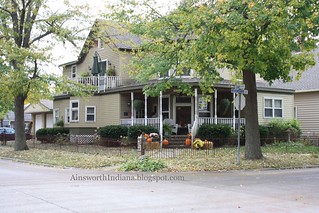
McDaniel House?
(Click on image to enlarge)
I am beginning to think that this beautiful old house on the southwest corner of the Ohio-Devonshire Street intersection was the "large and commodious home" of Mary Chester McDaniel and her second husband, John.
I base this conjecture on an item from the Gazette of October 13, 1916:
Mr. and Mrs. J.A. McDaniel are improving their home residence, corner Ohio and Devonshire streets, by building a bedroom at the southeast corner and a 9-foot porch on the east and north sides, which will be both convenient and beautifying.And, hmmm, what do you know? — even today there's a large and commodious home on the corner of Ohio and Devonshire with a porch on the east and north sides.
… I know, this doesn't allow for the possibility of later remodeling, which is why I put a question mark in the title.
Sunday, October 31, 2010
A Thief in the Night
Throughout the wee hours of the morning of April 6, 1916, a little crime wave washed over the heart of Hobart.
It began on Center Street at the home of Harry and Fay Paxton. About 12:30 a.m., Fay heard the clinking of a bottle against on the cement sidewalk outside their house. She went to investigate. When she saw a flashlight shining through one of their windows, she quickly got on the phone to "Central" and alerted the town's Night Policeman, Burt Guyer. The would-be burglars apparently noticed her, too, and they slipped away into the night.
While Officer Guyer was checking out the Paxton house, the burglars were probably two blocks over on New Street, checking out the home of Harry Gutelius. This time they managed to get in without waking up the occupants. It would not be until morning that the Guteliuses realized they'd had nocturnal visitors who made off with a suit of clothes, a gold watch and chain, and about $175 in cash taken from Harry's clothing and his wife's purse.
Sometime later, the widowed Emeline Lounsbury was startled awake by a mysterious noise somewhere in her Cleveland Avenue house. Upon investigation, she found that someone had broken a window lock by prying one of her windows open. Frightened by their own noise, or perhaps by Emeline's approach, the burglars had fled.
Around 2:00 a.m., John W. Thiel was awakened by one of his children crying. When he got up, he noticed that the bathroom window had been pried open. Checking around, he found the kitchen door open as well, and just outside, a spade that didn't belong to him lying on the ground — the tool the burglars had used to pry the window open, he guessed. But the child's cry that had awakened John probably alarmed the burglars as well, and they left the house richer than they had found it — "a spade ahead," as John said. He phoned in his report to "Central," and now Marshal Fred Rose joined Officer Guyer in the search.
Around 5:00 a.m., another call came in, this time from John and Mary McDaniel. They had just awakened in their Devonshire Street home to the horrifying realization that burglars had been in the very room where they were sleeping. A suit of John's was missing, with its watch and chain and about $1.20 in its pockets; the other contents of its pockets — papers, keys, a pair of tweezers, a screwdriver — were scattered about the floor. The thieves had probably entered through the cellar, which in turn led them into the bedroom; and apparently John and Mary were heavy sleepers.
Officer Guyer and Marshal Rose had spent a frustrating night, always behind the quick-footed burglars, but now dawn was approaching and the crime spree was over. The culprits had gotten away — for the moment, anyway; there remained the hope that they might be stupid enough to wear the stolen clothes and thus be recognized.
Later that day Paul Newman reported a visit to his garage the previous evening by two mysterious young men. They stopped in to have a tire on their Empire car fixed, but they had no money to pay for it. They gave him the White Garage in Valparaiso as their reference for credit; Paul preferred something tangible — say, a watch and chain. The young men refused that deal, and left the garage driving east on a flat tire. Sometime later, a couple of Hobartites returning from Crown Point noticed a strange car parked just south of the Unitarian Church.
On hearing Paul's report, Marshal Rose called the White Garage in Valpo to found out if anyone there recognized the names the young men had given, or the description of their car. Nobody did. A call to the Secretary of State to check out the car's license plate number (Paul Newman had made a note of it) proved it registered to George Boyd, who lived in western Ross Township. Evidently the two young men were car thieves, traveling under fake names, which made them the best suspects in all the burglaries that night. The task remaining was to find out who they really were and track them down.
Sources:
♦ "Additional Local News." Hobart Gazette 14 Apr. 1916.
♦ "Homes Visited by Thieves." Hobart Gazette 7 Apr. 1916.
♦ "May Have Been the Robbers." Hobart Gazette 14 Apr. 1916.
Saturday, October 23, 2010
Jerome of Ithaca
It's been a while since we've heard from Ainsworth's one-man crime wave, Jerome Chester, but in January of 1916 he returned to Hobart … not from Chicago, as I had expected, but from Ithaca, New York, where he was working for a structural iron firm and where he had injured his thumb. So he came to visit his mother and rest his thumb.
History does not record how long he stayed, but apparently he got through the visit without committing any crimes.
Source: "Local Drifts." Hobart Gazette 14 Jan. 1916.
History does not record how long he stayed, but apparently he got through the visit without committing any crimes.
Source: "Local Drifts." Hobart Gazette 14 Jan. 1916.
Thursday, August 19, 2010
Fishy Humor
When John McDaniel (Mary Baird Chester's second husband and the host with the most) went on a business/fishing trip, the Hobart News decided to exercise what might be called its wit:

(Click on image to enlarge)
From the "Personal and Local Mention" column of the Hobart News of August 13, 1914.
Note the item at the top — I don't know who Clara Hough was, but she had the bad luck to be on a tour of Europe when World War I broke out.
(Click on image to enlarge)
From the "Personal and Local Mention" column of the Hobart News of August 13, 1914.
Note the item at the top — I don't know who Clara Hough was, but she had the bad luck to be on a tour of Europe when World War I broke out.
Monday, August 9, 2010
Thy Will Be Undone
I said earlier that I had no evidence that Henry Chester was ever unkind to any of his own children. Well, now I do: he cut his eldest daughter, Mary Marchant, out of his will entirely.
As we know, Mary had died before her father, but she left at least one son, William Harvey Marchant. William thought the will unfair, so in November 1913 he filed suit in the Lake County superior court to contest it, seeking one-tenth of Henry Chester's estate — a good sum, since the estate totaled about $100,000 in real and personal property (and that's in 1913 dollars). According to the Hobart News, another plaintiff party to the suit was Martin Stroman, the son of Mrs. Etta Wood, who was the daughter of Henry Chester. This is the first I've heard of Henry's having a daughter named Etta, and I can find no mention of her in the census, Henry's biographical profile or any of the newspapers I've read thus far.
The News stated that Henry had made the will early in 1910. As we know, at that time he was already in failing health. William's suit alleged that the will was invalid because Henry had been "of unsound mind, and because the instrument was unduly executed and was procured by undue influence."
The suit was dismissed by the Lake County superior court on the grounds that the county circuit court (which had probated the will) had exclusive jurisdiction. William appealed that decision all the way to the Indiana Supreme Court, which in 1915 decided against him.
I don't know whether William ever got anything. On December 26, 1913, the Gazette announced: "The Henry Chester heirs on Wednesday satisfactorily closed the settlement of their remaining real estate interests and each received his and her respective share." That William was still appealing in 1915 suggests that the other heirs did not choose to allow him any part of the estate.
♦ ♦ ♦
Since Henry Chester's death, Chester news has been dominated by Jerome's antics. Let's look at what was going on among the more respectable Chesters.
In March 1911, the widowed Lovisa Nelson, who had been living in Chicago, rented a farm north of Ainsworth from her brother, Charles Chester. She moved her children there and operated the farm on shares. A couple years later, she bought out Charles' interest in the stock and equipment, thereafter operating the farm for herself and paying cash rent.
In the autumn of 1911, James Chester gave up farming. He rented out his farm, which sat along the county line north of Deep River; he sold off his livestock, wagons and farming equipment (along with 965 shocks of corn), and moved with his wife, Effie, to Water Street in Hobart. To the 1920 census taker, he would describe himself as a buyer and seller of stock (livestock, probably).
In May 1913, Charles and James bought out all the real estate holdings of their stepbrother John, consisting of 89 acres "east of the old homestead" as well as an interest in the original estate. I am not sure how John occupied himself after that. He apparently ran a feed mill at Ainsworth for a while, but Earl Blachly took over that in December. John also seems to have continued doing some farm work — in October he managed to get himself run over by a hay press, fortunately escaping without serious injury. ("John must have fallen asleep," joked the News. I have yet to account for the physical injuries described on John's World War I draft card.). John and Emma suffered a tragedy in September 1913 with the loss of their infant son, Otto.
Charles and Constance Chester continued farming. I get the impression that they were comfortable financially, and they seem to have recovered enough from the loss of their little daughter and infant son to be able to enjoy life. In August 1913 they set out in company with Sam Faulkner and his wife, Dr. Clara Faulkner, Mary Kipp and Bessie Banks on an extended auto tour to the east coast, Charles driving a Winton Six. Over three weeks they traveled to Niagara Falls, New York and other cities, and returned through the mountains of Pennsylvania — "a delightful trip."
Luella and Charles Olson remained in Fort Wayne, occasionally visiting back and forth with their Lake County relatives. Carrie and William Raschka were still pillars of the Ainsworth community.
And as for Mary E. Baird Chester, by November 1912 she had remarried. Her new husband was John A. McDaniel (or McDaniels; it appears both ways), and he is a mystery to me. I've not been able to find any record of the date or location of their marriage. Nor have I been able to find out where John came from or how they might have met.
Immediately after their marriage, they lived together in the old Chester house east of Ainsworth. In November 1913 they announced a public sale to be held there, at which they would sell "25 head of milch cows, a Holstein bull, 20 head of hogs, 10 head of work horses, 2,000 bushels of corn, about a hundred tons of baled hay, straw and fodder, farming tools and implements of every kind and nature, harnesses, gasoline engine, chickens and household and kitchen furniture." That sounded as if they intended to quit farming and move — and indeed, by August 1914 they were living on Devonshire Street in Hobart in a "large and commodious home."

(Click on image to enlarge)
Devonshire Street, from an undated postcard, but probably roughly the same era as the McDaniels' move. Image courtesy of the Hobart Historical Society.
Such was the description used by the Gazette in reporting on a lavish wedding hosted in the McDaniels' home in August 1914. The bride was a Chicago relative of Mary's, the groom an assistant manager in the Chicago office of the Heinz Pickle Co. The Rev. W.A. Howard of the Congregational Church officiated.
Sources:
♦ 1920 Census.
♦ "Additional Local News." Hobart Gazette 28 Mar. 1913; 9 May 1913; 26 Sept. 1913.
♦ "Big Wedding Celebration." Hobart Gazette 7 Aug. 1914.
♦ "Local Drifts." Hobart Gazette 3 Mar. 1911; 8 Mar. 1912; 26 Dec. 1913.
♦ "Marchant et al. v. Olson et al." The Northeastern Reporter, Volume 110. St. Paul: West Publishing Co., 1916.
♦ "Notice." Hobart Gazette 26 Dec. 1913.
♦ "Personal and Local Mention." Hobart News 14 Nov. 1912; 21 Aug. 1913; 9 Oct. 1913.
♦ "Public Sale." Hobart Gazette 27 Oct. 1911; 14 Nov. 1913.
♦ "Return From New York." Hobart Gazette 19 Sept. 1913.
♦ "The Henry Chester Estate Is In Court Once More." Hobart News 6 Nov. 1913.
As we know, Mary had died before her father, but she left at least one son, William Harvey Marchant. William thought the will unfair, so in November 1913 he filed suit in the Lake County superior court to contest it, seeking one-tenth of Henry Chester's estate — a good sum, since the estate totaled about $100,000 in real and personal property (and that's in 1913 dollars). According to the Hobart News, another plaintiff party to the suit was Martin Stroman, the son of Mrs. Etta Wood, who was the daughter of Henry Chester. This is the first I've heard of Henry's having a daughter named Etta, and I can find no mention of her in the census, Henry's biographical profile or any of the newspapers I've read thus far.
The News stated that Henry had made the will early in 1910. As we know, at that time he was already in failing health. William's suit alleged that the will was invalid because Henry had been "of unsound mind, and because the instrument was unduly executed and was procured by undue influence."
The suit was dismissed by the Lake County superior court on the grounds that the county circuit court (which had probated the will) had exclusive jurisdiction. William appealed that decision all the way to the Indiana Supreme Court, which in 1915 decided against him.
I don't know whether William ever got anything. On December 26, 1913, the Gazette announced: "The Henry Chester heirs on Wednesday satisfactorily closed the settlement of their remaining real estate interests and each received his and her respective share." That William was still appealing in 1915 suggests that the other heirs did not choose to allow him any part of the estate.
Since Henry Chester's death, Chester news has been dominated by Jerome's antics. Let's look at what was going on among the more respectable Chesters.
In March 1911, the widowed Lovisa Nelson, who had been living in Chicago, rented a farm north of Ainsworth from her brother, Charles Chester. She moved her children there and operated the farm on shares. A couple years later, she bought out Charles' interest in the stock and equipment, thereafter operating the farm for herself and paying cash rent.
In the autumn of 1911, James Chester gave up farming. He rented out his farm, which sat along the county line north of Deep River; he sold off his livestock, wagons and farming equipment (along with 965 shocks of corn), and moved with his wife, Effie, to Water Street in Hobart. To the 1920 census taker, he would describe himself as a buyer and seller of stock (livestock, probably).
In May 1913, Charles and James bought out all the real estate holdings of their stepbrother John, consisting of 89 acres "east of the old homestead" as well as an interest in the original estate. I am not sure how John occupied himself after that. He apparently ran a feed mill at Ainsworth for a while, but Earl Blachly took over that in December. John also seems to have continued doing some farm work — in October he managed to get himself run over by a hay press, fortunately escaping without serious injury. ("John must have fallen asleep," joked the News. I have yet to account for the physical injuries described on John's World War I draft card.). John and Emma suffered a tragedy in September 1913 with the loss of their infant son, Otto.
Charles and Constance Chester continued farming. I get the impression that they were comfortable financially, and they seem to have recovered enough from the loss of their little daughter and infant son to be able to enjoy life. In August 1913 they set out in company with Sam Faulkner and his wife, Dr. Clara Faulkner, Mary Kipp and Bessie Banks on an extended auto tour to the east coast, Charles driving a Winton Six. Over three weeks they traveled to Niagara Falls, New York and other cities, and returned through the mountains of Pennsylvania — "a delightful trip."
Luella and Charles Olson remained in Fort Wayne, occasionally visiting back and forth with their Lake County relatives. Carrie and William Raschka were still pillars of the Ainsworth community.
And as for Mary E. Baird Chester, by November 1912 she had remarried. Her new husband was John A. McDaniel (or McDaniels; it appears both ways), and he is a mystery to me. I've not been able to find any record of the date or location of their marriage. Nor have I been able to find out where John came from or how they might have met.
Immediately after their marriage, they lived together in the old Chester house east of Ainsworth. In November 1913 they announced a public sale to be held there, at which they would sell "25 head of milch cows, a Holstein bull, 20 head of hogs, 10 head of work horses, 2,000 bushels of corn, about a hundred tons of baled hay, straw and fodder, farming tools and implements of every kind and nature, harnesses, gasoline engine, chickens and household and kitchen furniture." That sounded as if they intended to quit farming and move — and indeed, by August 1914 they were living on Devonshire Street in Hobart in a "large and commodious home."
(Click on image to enlarge)
Devonshire Street, from an undated postcard, but probably roughly the same era as the McDaniels' move. Image courtesy of the Hobart Historical Society.
Such was the description used by the Gazette in reporting on a lavish wedding hosted in the McDaniels' home in August 1914. The bride was a Chicago relative of Mary's, the groom an assistant manager in the Chicago office of the Heinz Pickle Co. The Rev. W.A. Howard of the Congregational Church officiated.
Miss Tillie Kucaba, chief operator at the telephone exchange, appeared at the piano and during her skillful execution of Mendelssohn's march the wedding party … proceeded to the large bay window of the front room, the contracting couple standing beneath a [huge] bell covered on top with lilies of the valley and beneath with carnations and red roses. … The bride was handsomely gowned in white crepe de chine with [tulle] veil and carried a shower [bouquet] of white roses and lilies of the valley. … After the hearty congratulations by the guests, the wedding party autoed to the Naumann studio where several sittings were made. … A sumptuous wedding dinner served in courses was greatly enjoyed …. The evening was passed in social enjoyments and singing and later by dancing. The hospitality of Mr. and Mrs. McDaniel seemed unbounded and they proved charming entertainers throughout. The festivities continued late into the night and most of the out of town guests remained over Sunday.It sounds splendid (although perhaps we should bear in mind that among the guests as A.J. Smith, the Gazette's editor). It also sounds to me quite a contrast to the seemingly harried life Mary had been leading over the last few years — what with her husband's increasing irritability, her sons' misbehavior, and the daily pressures of managing a large farm household that included numerous hired workers, not to mention that deluge of bereavement during the spring of 1910. When I said, back in May, that Mary would find consolation in a second marriage, I was speaking conventionally, but perhaps it was truer than I suspected.
Sources:
♦ 1920 Census.
♦ "Additional Local News." Hobart Gazette 28 Mar. 1913; 9 May 1913; 26 Sept. 1913.
♦ "Big Wedding Celebration." Hobart Gazette 7 Aug. 1914.
♦ "Local Drifts." Hobart Gazette 3 Mar. 1911; 8 Mar. 1912; 26 Dec. 1913.
♦ "Marchant et al. v. Olson et al." The Northeastern Reporter, Volume 110. St. Paul: West Publishing Co., 1916.
♦ "Notice." Hobart Gazette 26 Dec. 1913.
♦ "Personal and Local Mention." Hobart News 14 Nov. 1912; 21 Aug. 1913; 9 Oct. 1913.
♦ "Public Sale." Hobart Gazette 27 Oct. 1911; 14 Nov. 1913.
♦ "Return From New York." Hobart Gazette 19 Sept. 1913.
♦ "The Henry Chester Estate Is In Court Once More." Hobart News 6 Nov. 1913.
Subscribe to:
Posts (Atom)

