Showing posts with label Merrillville Cemetery. Show all posts

Friday, March 6, 2026

Bastardy in Merrillville

Local historian Michael White, who has already contributed some interesting material to this blog, has been working at the Calumet Regional Archives and has shared some items he came across that relate to Hobart and Merrillville.

Among them is a disturbing transcript from 1846 of George Earle's interrogation, as a justice of the peace, of a 27-year-old woman named Rachel Campbell. Rachel had brought a complaint of bastardy against William Merrill (one of the brothers who in 1848 gave Merrillville its name). That is to say, of course, that she accused him of fathering her illegitimate child. As we get into the transcript, we find that her testimony brings up an even more serious accusation.

♦    ♦    ♦

William Merrill, born in Vermont in 1808, came to Lake County with his younger brother, Dudley, in 1836,[1] settling in the area that eventually became Merrillville. In 1842, he married the 20-year-old Caroline Campbell.[2] That is the earliest vital record I have been able to find for Caroline. From later censuses, we know she was born in Pennsylvania.

Rachel Campbell was also born in Pennsylvania, circa 1817. Her family left Pennsylvania sometime after 1839, and was living in Indiana by about 1846 (or perhaps earlier), as we see by the 1850 Census recording them in Portage Township, Porter County:

2026-03-06. 1850 census (2 pages)
(Click on image to enlarge)

The reason I believe this to be the Rachel Campbell in question is because the trial testimony states that she had a brother named Stephen; also, Rachel's age in 1850 agrees roughly with the age she gives in her 1846 testimony.

The two families are linked in other ways. Another brother listed on the 1850 census, Henry, turns up in Caroline Campbell Merrill's household in 1870. According to A Pictorial History of Merrillville, Caroline eventually sold her farm to Venila, listed as 11 years old in the 1850 census (and who in 1855 married Samuel White).

While it's impossible to establish with certainty the family relationship between Rachel and Caroline, since I can't trace either of them back any further than the early to mid-1840s, I believe they were sisters.

♦    ♦    ♦

The transcript of the questioning is a little spotty, but it establishes that the trial is taking place in August of 1846. Rachel starts her testimony with September 1845.

2026-03-06. transcript - beginning
(Click on image to enlarge)
Image from the Calumet Regional Archives (via Michael White).


At that time, Caroline Campbell Merrill was about six months' pregnant[3] and ill, though not bedridden.[4] Rachel was on an extended visit in Merrill house, probably to help Caroline with her two-year-old daughter and housework. The Merrill house, as Rachel describes it, sounds like a settler's cabin that had been added on to over the years: two sections, east and west (perhaps just two ground-floor rooms), with an upstairs room reached by a staircase in the east room. There was no interior door: to go from one room to the other, you had to walk outside.

One night around the middle of September 1845, Rachel testifies, she had gone to bed alone in the west room around 8 o'clock. (William and Caroline Merrill slept in the east room, and Orrin Pierce,[5] also staying there, slept in the upstairs room.) About an hour later, just as Rachel was drifting off to sleep, William Merrill came into her room, and to her bed. That night, she said, he had sex with her three times over the course of about two hours. Here are Rachel's responses to George Earle's questions:
Question   Had you and he made any previous bargain that he was to come there?

[Answer] No.

Question   Did you make any noise?

[Answer] Not a great deal.

Question   Did he ask you if he might have connection with you?

[Answer] I told him no.
In her laconic way, she is saying he raped her.

There is nothing in the testimony indicating that Rachel told Caroline about this incident. At some point she did tell her mother that William had had sex with her.

Rachel remained in the Merrill house for several more weeks, then apparently left, but returned in the latter part of October. Around the 18th or 20th of October, she says, William came to her in the middle of the night, this time in the east room, and woke her out of sleep to have sex with her again. That was the last time.

She later gave birth to a baby girl, whom she said had been fathered by William.

In another part of her testimony, we learn something interesting about Rachel.
Question   Are you married?

[Answer] I am not.

Question   Were you ever married?

[Answer] Never.

Question   Did you ever have any children before?

[Answer] One.
She had already had one child out of wedlock, at a time when this carried significant social stigma. Rachel was already bearing a social and emotional burden before September 1845. I do wonder how George Earle knew to pursue this line of questioning. Had William Merrill given him information that Caroline had told him privately? Or was Rachel's past indiscretion known among the locals?

At one point in the transcript, the writer notes that it is William ("the defendant") asking Rachel a question ("How old are you?"). I think it is possible that William is asking questions at other times that are not noted. If George Earle is the one asking the questions, evidently he is already familiar with William's defense to the charge of bastardy: namely, that someone else was the baby's father. William may have counted on Rachel's precarious social status to support his implication that she was sexually promiscuous. The questioning introduces two mysterious figures, Mr. Vandermark and Mr. Rowdabaum.
Question   Do you know a person by the name of Vandermark?

[Answer] I do.

. . .

Question   Did you and Mr. Vandermark stay in a house alone during any time between the 15 of September and the 20th of October last?

[Answer] No, at no time.

Question   Did you or did you [not?] stay alone with Mr. Vandermark in a house alone between the 15th day of September and 20th of October last?

[Answer] I did not.

Question   Did you or did you not go with Mr. Vandermark up to his house about the 25th day of October last?

[Answer] I went but don't know the time.

. . .

Question   Who went with you that night?

[Answer] My brother Stephen.

Question   Was Vandermark['s] wife at home?

[Answer] She was not home that night.

Question   Who slept in the room that night?

[Answer] Vandermark, Stephen and Rowdabaum & wife.

Question   Who slept with you?

[Answer] No body.

Question   Did Mr. Vandermark lay on the foot of your bed that night?

[Answer] He did not.

Question   Had you connection with Mr. Rowdabaum that night?

[Answer] I had not.
No doubt these two men existed, since Rachel says so herself, but I have searched in history books, censuses, and other records, using these names and variations I could think of (e.g., Van der Mark, Raudebaum) and failed to find the slightest bit of information about them.

We have nothing directly from William Merrill's side of the case. I do not know if he entirely denied ever having sex with Rachel, or rather said that it would be unfair to deem him the father when, as he seemingly argued, there were at least two other candidates.

Nor do we know the verdict in this case.


The original handwritten transcript, courtesy of the Calumet Regional Archives (via Michael White): click here

My transcription, with some punctuation and spelling altered for clarity: click here

♦    ♦    ♦

I am inclined to believe Rachel — maybe because I tend to root for the underdog. William Merrill was 38 years old, a family man, an established businessman, a justice of the peace,[6] among the most prominent citizens in his small town. Rachel was a 27-year-old single woman with skeletons in her closet, from an obscure farming family.

I do not know if this Campbell family was related to the more prominent Campbells of Porter County, some of whom also came from New York, like Rachel's father, Henry.

2026-03-06. 1850 census (2 pages)
(Click on image to enlarge)
Image from Ancestry.com.


That is to say — I assume Henry is her father. I should learn not to make assumptions, though. When I first started researching the case and found this family, I assumed that this census listing, like so many others I've seen, recorded a father and his six children. And I wondered what had become of Rachel's children! Now I realize they are probably hiding in plain sight, right there. Semira is four years old, just the age to have been born in 1846 to Rachel. And Venila, 11 years old, was born back in Pennsylvania when Rachel was about 22 years old: it is certainly possible that Venila was Rachel's first child.

As I've said, there were some Campbells in Porter County whose lives and deaths are recorded. These Campbells are not among them. These Campbells seem to have come out of nowhere and, for the most part, slipped away into the unknown: for example, Rachel's mother — I don't even know her name — who evidently was living in the 1840s, when Rachel told her of the incident with William, but who is nowhere to be found in the 1850 census. I cannot find any recorded death notice or grave for her.[7] Likewise, Henry Campbell (the elder), after the 1850 census, simply vanishes.

As for Rachel's brother, Stephen — well, I can find numerous Stephen Campbells after 1850, including some in Indiana, but none that I can positively connect with this family. The same goes for "Lou," the 22-year-old sister noted in the margin of the 1850 census — never positively identified again.

Rachel's brother Henry (and Rachel herself) may be at the Porter County Poor Farm in the 1860 census.[8] By 1870, Henry was in the household of Caroline Campbell Merrill. As you may know, William Merrill had died in 1860.

In 1875, Caroline married William's brother, Dudley (3 months after the death of his third wife). Their cozy household in 1880 does not include Henry Campbell. He, I believe, was in the Lake County "Asylum," aka the Poor Farm, which lists a 46-year-old native of Pennsylvania by that name among its inmates in the 1880 census. I can't trace Henry further than that. He may be lying in an unmarked grave on the former poor-farm grounds. Caroline, on the other hand, lived another nine comfortable years, dying in 1889.

While trying to trace little Semira Campbell of the 1850 census, I was surprised to find another young woman of about the same age, with the same unusual name; but the other Semira Campbell was born in Vermont, not Indiana. So the story of our little four-year-old is uncertain.

Rachel herself can be traced as far as 1860. If she was indeed in the Porter County Poor Farm in June 1860, when that census was taken, by the time the Lake County census was taken in July, we find her in Venila Campbell White's household, in Center Township, Lake County:

2026-03-06. 1860 Census, Rachel Campbell
(Click on image to enlarge)
Image from Ancestry.com.


After that, I cannot find her living or dead.

Aside from Caroline, Venila is the only one whose life story I can follow to the end. In 1855, when she was about 16, she and Samuel White slipped over the border to Berrien County, Michigan, to be married. As we just saw above in the 1860 census, they came back to Center Township to farm and begin a family. I expect they were somewhere local in the 1870 census, though the search function on Ancestry.com can't find them. In 1880 they were farming in Ross Township. By 1900, they were living in the Merrillville area, no longer farming, but well fixed enough for Samuel to describe himself as a "capitalist." In 1908, Samuel died. The 1910 census shows Venila in Merrillville, living alone on her own income. In the spring of 1915, she decided to move to Cozad, Nebraska[9] to join her daughter, Sarah — her only surviving child — who in 1877 had married Byron Dutton. The following year, Venila died, and was brought home to Merrillville for burial.

2026-03-06. White, Venila - obituary - Cozad Local (Cozad, Dawson County, Nebr.), 1916 02 25, p. 4
(Click on image to enlarge)
Cozad Local (Cozad, Dawson County, Nebr.), 25 Feb. 1916.


In all the censuses that asked for parents' birthplaces, Venila gave, as both her father's and her mother's birthplace, Pennsylvania — not New York, as she should have said if Henry Campbell, Sr., was her father. Now, this may reflect the inability of a stressed family to pass along its own history, or confusion in Venila's memory … but maybe she was right.


_______________
[1] Lake County 1834-1872 at 38.
[2] Indiana Marriage Collection. She was his second wife, according to a family genealogy on Ancestry.com, his first having died circa 1836 after bearing two children. One of those children, George, is listed in the household of William and Caroline in the 1850 census.
[3] Caroline and William's son, John, was born December 30, 1845 (Cook County, Illinois, Deaths Index).
[4] I am drawing this and the following information from the transcript, which I will append in full below. The questioning is hard to follow — it jumps from topic to topic, including topics that have no seeming relevance — so I have to piece together the various incidents as best I can.
[5] Orrin Pierce (1813-1895) came to Lake County from New York sometime in the early to mid-1840s; in June 1845 he married Ruth Vincent in Lake County.
[6] This we know from a document relating to another (less sensational) 1846 case involving William Merrill.
[7] There is one interesting stone in the Hebron Cemetery that is just legible enough to make out the surname Campbell and the death date in August 1850 (the census was taken in October).
[8] There is a listing in Center Township, Porter County, of a Henry Campbell who is approximately the right age, and a pauper at the Porter County Poor Farm, along with a Rachel Campbell, who is not the right age — but then whoever gave the enumerator his information did not even know where the two Campbells were born.
[9] "Merrillville," Lake County Times (Hammond, Ind.), 17 Mar. 1915.

Thursday, October 2, 2025

More Litigious Settlers

Here is another page from James H. Cassady's records of his activities as administrator of the Jeremiah Wiggins estate.

2025-10-02. Wiggins estate 29a
(Click on image to enlarge)
This image courtesy of Alice Flora Smedstad.


My transcription:

2025-10-02. 29a transcription

The December 19 entry mentions an appearance before George Earle concerning a lawsuit involving two people: Saxton and Merrill.

The first was probably Ebenezer Saxton, Sr. (1797-1877), who came to Lake County in 1837 and eventually settled on Jeremiah Wiggins' farm. The following biographical sketch was written by one of his descendants:
Ebenezer Saxton was the 6th generation of the Saxton family in America. His father (also an Ebenezer) was a Revolutionary soldier from Massachusetts. Ebenezer Saxton was born in Vermont, later (1829) moving to a farm in East Flamboro, Canada at the time of the Patriot War. When the rebellion was brushed in 1837 he sold his farm on credit and hurriedly left Canada to escape the rebel punishment of hanging. On the way to Fort Dearborn (Chicago), his wagon got stuck in the mud in the Turkey Creek area. Spending nearly all of his money to recover his belongings, the family decided to stay in Wiggins' Point (one of Merrillville's early names).[1]
Ebenezer and his wife, Minerva, raised a large family and lived out the rest of their lives on the former Wiggins farm. They are buried in the Merrillville Cemetery.

♦    ♦    ♦

The second name mentioned in connection with a lawsuit was either Dudley Merrill (1814-1890) or William Merrill (1808-1860), brothers who came to Lake County in 1836 or '37.[2] The brothers became prominent citizens of the town then known as Centerville, building homes and operating farms as well as businesses that included a cheese factory, a hotel, and a store. In 1848, the town was renamed in their honor.

They are buried in the Merrillville Cemetery. Dudley's four wives (one of whom had been William's widow) are also buried there.

The Dudley Merrill house, built in 1849 according to Lake County records, still stands at 12 W. 73rd Avenue.

♦    ♦    ♦

The man whose name is written as "M. Steickleman" in the document above was probably Johann Michael Steichelman, whom I have discussed before in connection with these estate papers.

♦    ♦    ♦

Myiel Pierce, Sr. (1801-1847), arrived in Lake County from New York in 1836.[3] He inspired T.H. Ball to playfully date of the founding of Centerville/Merrillville to 1842:
I place the date of the commencement of the village when Miles[4] Pierce built the first tavern here, and pouring out a bottle of whisky or breaking it upon the frame, after the manner of naming ships, called it "Centreville Hotel." Well would it have been for that village and many others, if all the whisky had gone the same way.[5]
In a previous post about his son, Myiel, Jr., I mentioned his early death and the hardship it caused his family.

Three sons of Myiel, Sr., and his wife, Marcia, served in the Civil War, one dying while in the service. Myiel and Marcia, who died in 1889, are buried in the Merrillville Cemetery, along with numerous family members.

_______________
[1] Alice Flora Smedstad, Soldiers & Veterans Memorialized at the Merrillville Cemetery (self-published, 2007) at p. 50.
[2] Lake County 1834-1872 at pp. 38, 301.
[3] Lake County 1834-1872 at p. 54.
[4] Myiel's unusual first name appears in several variants in local histories, including "Miles" and "Milo."
[5] Lake County 1834-1872 at pp. 152-153.

Friday, July 25, 2025

Epaphras!

This item from the estate papers of Jeremiah Wiggins shows him buying 50 pounds of flour on May 10, 1838, from E.P. Butler:

2025-07-25. Wiggins estate 27c
(Click on image to enlarge)
Image courtesy of Alice Flora Smedstad.


My transcription:
Lake County Ia.

The Estate of Jeremiah Wiggins, De'd

To E.P. Butler, Dr.

For 50 lbs. of Flour, furnished said Wiggins in his life time, to wit, on the 10th day of May, 1838 at $4.00 per 100 lbs _________ $2.00
In his discussion of the earliest Lake County settlers, T.H. Ball mentions an encampment of U.S. surveyors during the summer of 1834, and goes on to say:
After the surveyors came the claim seekers. There is evidence that either before or soon after that week of encampment just mentioned, one Wm. Butler was on this ground before Solon Robinson came, and made four claims, for himself, for his brother E.P. Butler, for George Wells, and for Theodore Wells. He also erected cabins and departed. I find the existence of three cabins recognized by those who are called Lake county's earliest settlers. I think they were the Butler cabins. (Lake County 1834-1872 at 21.)
The E.P. Butler mentioned by Ball was probably the same one in our document. The 1840 Census lists E.P. Butler as the head of a household in Lake County.

The first clue I came across as to his first name was a mention of one Epaphrous P. Butler as a non-resident taxpayer of North Township in 1839 (Porter and Lake Counties (Goodspeed-Blanchard) at 533). Early Land Sales, Lake County has more variations on that name: Epaphenas P. Butler, in 1843, purchased 160 acres west of Merrillville[1]; in 1855, Ephrain P. Butler bought nearly 80 acres northwest of Merrillville.[2]

The 1850 Census shows E.P. and his wife, Jane, farming in Ross Township:

2025-07-25. Census, 1850, E.P. Butler
(Click on image to enlarge)
Image from Ancestry.com.


Jane died sometime in 1856 (information from Findagrave.com is filling in here where there are no official records or newspaper reports). On December 31, 1856, E.P. married Saphrona Mears (Indiana Marriage Collection), whose name appears in other places as Myars and Miars.

Based on what we see in the 1860 Census, Saphrona must have been a widow with her own children:

2025-07-25. Census, 1860, E.P. Butler
(Click on image to enlarge)
Image from Ancestry.com.


Judging by the names recorded near them in the census, I believe the Butler farm was in far western Ross Township. Perhaps it was this land that still bore E.P.'s name on the 1874 Plat Map (half of which "Ephrain P. Butler" had purchased in 1855):

2025-07-25. Butler 1874
(Click on image to enlarge)

But E.P. had been dead for some ten years by the time this map was made. He died in 1864 and is buried in Schererville's Pleasant View Cemetery with his first wife, Jane.[3]

♦    ♦    ♦

Thanks to Findagrave.com and family trees on Ancestry.com, I've been able to look into E.P.'s family. He was the second (I believe) child of Jonathan and Elizabeth Butler of Hartford, Connecticut. His siblings were Jonathan, William, Maria, George, Eliza, and Nathan.

So it was only for this second son that his parents pulled a name out of left field — or, to be precise, out of the New Testament, where an otherwise obscure figure in the early church gets a few mentions in Paul's letters. I'm glad E.P.'s parents had that whim, though, because it makes him easier to identify.

Here is his father's will, written in 1853:

2025-07-25. Will of Jonathan Butler
(Click on image to enlarge)
Image from Ancestry.com.


E.P. and William seem to be grouped together in their father's mind, and not exactly as favorite children: each gets only $100, as opposed to the $500 given to Maria. In item #4, we learn that these two, well into their 50s when the will was written, still owed their dad money. But he forgave their debts.

William was by then a Michigan resident. If we go looking for him on Findagrave.com, we see that he did not stay long in Lake County, Indiana, after making those early claims, and that he was drawn to settling in wild places.

_______________
[1] Specifically, the northwest quarter of Section 17, Twp. 35 N., Range 8 West (p. 182).
[2] Two purchases dated December 21, 1855, of the SW quarter of the NW quarter, and then the SW quarter of the SW quarter, Section 6, Twp. 35 N., Range 8 West (p. 175).
[3] His second wife died in 1879 and is buried in Merrillville Cemetery as the widow of William Miars.

Saturday, March 29, 2025

A Natural-Born Water-Witcher

This newspaper article from 1968 told me something I didn't know about Charles Fasel.

2025-03-29. 1968-03-07 Gazette, Willow Wand Divining Rod For C. Fasel
(Click on image to enlarge)
Hobart Gazette, 7 Mar. 1968.


Charles was one of the many children of Henry and Mary Ann (Springman) Fasel. We met him, briefly, in 1918 when his first wife, Cora Goodrich, died of the Spanish influenza. Charles married again about three years later, to Elsie Volland. Together they had half a dozen children; he already had four from his first marriage.

A year after he was featured in the Gazette, Charles died.

2025-03-29. 1969-04-10, Obituaries, Valparaiso Vidette Messenger, p. 11
(Click on image to enlarge)
"Obituaries," Vidette-Messenger (Valparaiso, Ind.), 10 Apr. 1969.


He is buried, with both of his wives, in the Merrillville Cemetery.

♦    ♦    ♦

I had an uncle who swore by dowsing (he objected to words like "witching" or "divining"). If I recall correctly, he dowsed for gold in Alaska. He was adventurous, but he wasn't rich.

The scientific consensus based on controlled experiments is that dowsing works as well as random chance. Wikipedia overview here; another article here; and one on wells and aquifers here.

Wednesday, June 30, 2021

Jeremiah's Estate Administrator and His Evaluating Assistants

Following up on my earlier post about the contents of Jeremiah Wiggins' estate — I wanted to research the other names that came up on those inventory pages.

2021-06-21. Wiggins estate 19d
(Click on images to enlarge)
Image above and image below courtesy of Alice Flora Smedstad.


2021-06-21. Wiggins estate 15

The administrator, James H. Cassady, is a mystery. The estate papers tell us that in addition to his administrator duties, he was a justice of the peace, so he must have been a fairly prominent citizen. But beyond these papers, I can find no evidence that he ever lived in Lake County, Indiana, though he did own land here: Early Land Sales, Lake County shows him, in 1839, buying some 120 acres in Township 36 N., Range 9 W., Section 18 — i.e., what is now south Hammond. Still, I can't find him in any census or other record. He's not mentioned in any of my usual local history books, nor does he show up in any of the Hobart-area ledgers I've indexed thus far.

But he's all over these papers, and apparently was a friend of George Earle: this page, from the Wiggins papers, records that James Cassady and George Earle posted $400 bond to ensure that they "truly & faithfully discharge the duties" of administrator of Jeremiah's estate.

2021-06-30. Wiggins estate 30
(Click on image to enlarge)
Image courtesy of Alice Flora Smedstad.


Note how James uses the old-fashioned long s. And below that, we see George Earle's familiar signature.


The first of James' assistants is Charles Walton. We have met him before, under sad circumstances. I still can't find him anywhere except the 1840 Census of Lake County, which doesn't tell us much about him, and the indexed ledgers, where he shows up only in 1839 and 1840.


Next we have Levi D. Jones. According to the Hobart ledgers, he was in this area by the summer of 1840, but I can't find him in the 1840 Census. He does show up in 1850 and 1860, farming in Ross Township. In the 1850 Census he is married to Elizabeth (Vanvolkenburg), whom he married in 1847 per the Indiana Marriage Collection. There are two children in the household, one of whom, a seven-year-old boy named Homer, could not be a child of this marriage. The other is a year-old girl named Louisa. In 1856 Levi D. Jones is recorded marrying Lucy Sly in Lake County; if that is our Levi, I wonder what happened to Elizabeth? When the 1860 Census comes around, we find Levi D. Jones farming in Ross Township, living with an 11-year-old girl, Mary L., whose relation to him is not described, while Homer Jones is now living in the household of Abram Vanvolkenburg. Elizabeth, Louisa,[1] and Lucy are nowhere to be found. And that is as far as I can trace any of them.


The third assistant, David Fowler, shows up in the Hobart-area ledgers as early as October 1836, and makes appearances through 1841 (at this point in my indexing). The 1840 Census also records him, in a household of 11 people, in what appears to be western Ross Township — the same area where he, circa 1843, purchased 80 acres of land.

2021-06-30. Fowler, David 1874
(Click on image to enlarge)
From the 1874 Plat Map. By that time, David Fowler's land was owned by George Nicholson.


The Indiana Marriage Collection records David Fowler marrying Rebeca Deyo (or Dezo) in 1840, and the 1850 Census places them, with two children, in Cedar Creek Township, where apparently David died in 1860.


The last of these assistants is Michael "Stieckelman," but we will use the spelling on his grave marker in the Merrillville Cemetery: Steichelman. He was born in Germany in 1800, and there married and began a family. According to a findagrave.com biography of his daughter, the family came to the U.S. circa 1835 and to Indiana about 1837. It was a relatively small family for those days: just Michael, his wife Margaret, and their two children, Mary and John. The 1840 Census shows five people in the household, so one is unidentified.

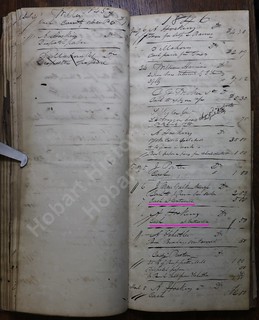
Here is a page from an unknown Hobart-area merchant's ledger showing Michael purchasing nails and thread in 1840.

2021-06-30. Steichelman, Michael - DayB1840 66, 67
(Click on image to enlarge)
Image courtesy of the Hobart Historical Society.


If he ever bought land here, I have not found a record of it. That record may be hidden by some creative spelling of his name; I have seen many variations.

By the 1850 Census the family had moved to Illinois. So I don't know why, when Michael died in 1851, his remains were brought back here for burial. According to a note on the findagrave.com entry for Michael's wife, Margaret, she died in 1880 and was buried in the Merrillville Cemetery, but later her remains were moved to the cemetery in Iowa where their daughter is buried. The only other Steichelman in the Merrillville Cemetery is a little girl, Hattie, born to Michael and Margaret's son, John. He had married Mary Towl in 1855. After John was killed in the Civil War, Mary remarried and is now buried in Kansas.


Well, it was interesting to look into these names, but I didn't learn a whole lot. How these people flitted through our early local history, leaving so few traces! They didn't know, apparently, that the purpose of their lives was to furnish material for amateur historians' blogs.


_______________
[1] [Jan. 2026 update: Now that I think about it a little more, I bet that Louisa from the 1850 census and Mary L. from the 1860 census are the same person. But I still don't know what happened to her after 1860.]

Thursday, January 2, 2020

Carrie Cunningham Price

In October 1923, Mrs. Fremont B. Price died in her farm home on the southeast corner of Colorado and 69th. It took this sad event to teach me that she was the daughter of Henry "Harry" and Elizabeth Cunningham, whose name clung so tenaciously to their farm south of Ainsworth.

2020-01-02. Price, Gazette, 10-26-1923
(Click on image to enlarge)
Hobart Gazette, Oct. 26, 1923.


I was a bit surprised to find her marrying Fremont Price at Devil's Lake, Ramsey County, North Dakota, of all places. The Cunningham family must have moved there after the 1880 Census, when they were in Chicago. The 1900 Census shows her widowed father farming with one son in Ramsey County. When Henry Sr. died in 1902, his body was brought back to Indiana to be laid to rest beside his wife.

Carrie was somewhat unusual in that all of her nine children survived childhood. But, as we know, there was heartbreak enough in store for her. We have previously discussed the death of her son, James, and his belated funeral.

2020-01-02. Price, Carrie Cunningham
Carrie Cunningham Price circa 1914. Image from Ancestry.com

♦    ♦    ♦

The other obituary on the page above — of Mrs. Miles Allen McNiece, née Caroline Lembke — clears up the mystery of why I found her sister, Mary, involved with the Hobart Union Sunday School in 1876. The Lembke family did indeed live in Hobart "in the early days of the village," whatever that may mean, and M.A. McNiece ran a bakery there in the 1870s.

Caroline Lembke McNiece is buried in Blachly Cemetery.

Saturday, August 17, 2019

George Earle and the Orphans

On this page of the 1848 daybook, we find some clues to the identity of its keeper.

2019-08-17. DayB1848 029
(Click on image to enlarge)
Image courtesy of the Hobart Historical Society.


On October 22, 1849, the writer made an agreement with Mr. Spencer whereby the writer, along with John and Philip, will board at the Spencer place (and wash their quilts) for $2.50 per week, including the use of the household soap and some of the household potatoes, while John will chop wood for the stove. But as for candles, "G.E." agrees to supply his own — now, who could that be but George Earle?

And indeed, when I went looking in the 1850 Census for households that contained both a John and a Philip, I found the George Earle household:

2019-08-17. Hodson, Earle 1850 census
(Click on image to enlarge)
Image from Ancestry.com.


George himself is listed as the head of the household. Mary is his wife (and Charles Devonshire, listed last, is probably Mary's father). John G(eorge) E(dward) is George and Mary's son. Mary Ann may be one of George's twelve siblings.[1]

But who were these Hodson boys, John and Philip, and why were they living in the Earle household?

Looking in my index, I find I've encountered the name Hodson before, most significantly in an earlier daybook. In the autumn of 1845, we find the writer dealing with the estate of W. Hodson:

2019-08-17. DayB1840 150
(Click on image to enlarge)
Image courtesy of the Hobart Historical Society.


This is apparently a crop of oats that W. Hodson did not live to harvest — 7 bushels to "G.E."; 24 bushels to E. Saunders; the money to the Hodson estate.

In October 1848, we find the writer making another payment to E. Saunders to cover boarding two of the Hodson boys, William and Philip:

2019-08-17. DayB1840 208
(Click on image to enlarge)
Image courtesy of the Hobart Historical Society.


I am convinced that Mr. Saunders' first name was Edward, and that he bought part of the farm that had belonged to the estate of William Hodson, Sr.

William Hodson was in LaPorte County for the 1840 Census, apparently, but by 1843 Early Land Sales shows him buying two parcels in Ross Township. One parcel of 40 acres, the northwest quarter of the southeast quarter of Section 8, R. 7 W., lies north of Big Maple Lake and is now owned by the Lake County Parks Department. The other parcel was the full southeast quarter (160 acres) of Section 12, R. 8 W. — which eventually passed into Bullock and Markham hands, and was the site of the Bullock homestead. But earlier, in 1845 (according to Early Land Sales) the west 80 acres of that latter parcel was purchased by Edward Sanders.[2]

To try to fill in the rest of the story, we have to turn to information supplied by anonymous people online — specifically, information on findagrave.com and a family tree compiled on Ancestry.com. According to these anonymous online sources, William Hodson, Sr. was born in England in 1800, and there, in 1830, married Ann Lister; they then set sail to America. A daughter was born at sea;[3] some three children were born in Pennsylvania, including one of these sons we've found mentioned in the daybooks — John, born in 1835. The last two boys were born in Lake County, Indiana: William, Jr. in 1841 and Philip in 1844.

In 1845, both parents died — Ann in February and William, Sr. in March. Both are buried in the Merrillville Cemetery.

Then Edward Saunders, also an Englishman by birth, bought some of the Hodson land, and I suppose it was logical enough for him to agree to board some of the orphaned children. What I'm wondering is — why did George Earle take on the responsibility of arranging and paying for their board, whether with Mr. Saunders or Mr. Spencer? Was there some family connection? Was it his duty as executor of the estate? Or was he just acting from the kindness of his heart?

There were also three surviving daughters, ranging in age from 15 to 8, who (so far) have not been mentioned in the daybooks. If I had more time, I'd trying to trace them.[4]


_______________
[1] Most of what I know about the Earles comes from Dorothy Dunning Ballantyne's pamphlet, George Earle and Family of Hobart, Indiana (Hobart Historial Society, 1972). Copies can be purchased at the Hobart Historical Society museum.
[2] Early Land Sales designated that land and hundreds of nearby acres as "Canal Land." I don't know the story behind that, and I haven't got time to research it.
[3] William and Ann married in May 1830, their first child was born in June 1830 and survived. Also, according to the family tree on Ancestry.com, that child (among others) is buried in Ainsworth, Iowa.
[4] According to Lake County Encyclopedia (p. 145), during the Civil War a Miss Elizabeth Hodson went from Lake County to nurse the sick and wounded at a military hospital in Memphis, Tennessee; I think this is the daughter born at sea in 1830. That is all I know of the daughters' histories.

Friday, March 30, 2018

A Heavenly Exclamation Point

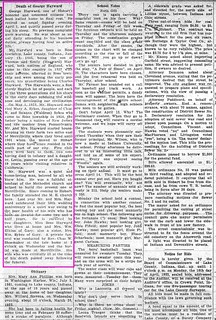
It is simply the natural course of events when an aged man, after a life of useful work, passes quietly to his rest; and so George Hayward's death on April 1, 1923, no doubt saddened but did not greatly surprise those he left behind.

2018-3-30. George Hayward obit
(Click on image to enlarge)
Hobart Gazette, April 6, 1923.


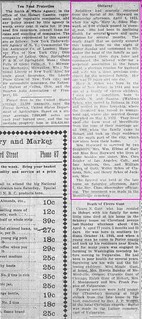
Yes, that last sentence is a little surprising — it is not the usual course of events that the aged man's wife, who (according to another account) was too ill to know that he had died, should follow him out of this world just after his funeral; but thus it was with Mary Sykes Hayward.

2018-3-30. Mary Sykes Hayward obit
(Click on image to enlarge)
Hobart Gazette, April 13, 1923.


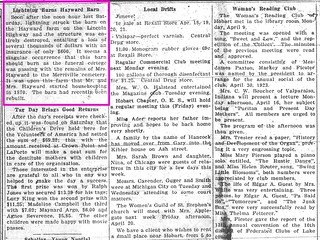
The really astonishing event happened as Mary's funeral cortege left Hobart, heading southeast toward the Merrillville Cemetery.

2018-3-30. Fire
(Click on image to enlarge)
Hobart Gazette, April 13, 1923.


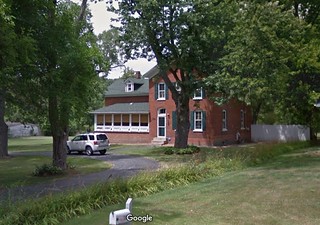
The barn may have been rebuilt again after the fire, but these days there is no barn on the old Hayward place. Still, if you've traveled along the Old Lincoln Highway east of Mississippi Street, you've probably noticed, on the north side of the road, the sturdy brick farmhouse where the Haywards lived and worked and raised their children for three decades.

2018-3-30. Hayward house Google street view
(Click on image to enlarge)
Image from Google street view.


Additional Sources:
♦ "Mr. and Mrs. George Hayward Pass Away," Hobart News, April 5, 1923.
♦ "Mrs. Hayward Passes on," Hobart Gazette, April 6, 1923.

Tuesday, March 27, 2018

"Cash at Centreville"

This ledger page recording transactions during the winter of 1846 reminds us that Merrillville was once Centreville.

2018-3-27. DayB1836 058, 059
(Click on image to enlarge)
Image courtesy of the Hobart Historical Society.


The first marked transaction involves, I believe, Jacob Vanvolkenburg.[1] According to Early Land Sales, Lake County, in 1839 he bought 40 acres in St. John Township, right on its border with Ross Township. He shows up in Lake County in the 1840 Census, and while that census does not specify townships, I see among his neighbors other names that appear in our ledgers. By the 1850 Census he was living in Ross Township, describing himself as a millwright. The 1860 Census shows him still in Ross Township, now farming. His land lay in Section 19, according to the 1874 Plat Map,[2] — but by 1874 poor Jacob himself lay in Merrillville Cemetery, having died (according to the coroner's inquest) a cold and lonely death in October 1862.

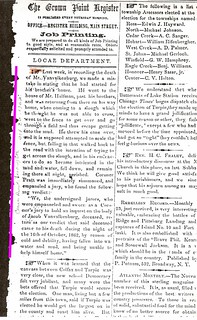
2018-3-27. CP Register 1862-10-30
(Click on image to enlarge)
Crown Point Register, Oct. 30, 1862.


As for the second marked transaction, I am not entirely sure who A. Hoskins was: the Hobart area contained both an Alexander and an Ariel old enough to transact business in 1846.

Alexander bought land in Section 5, south of the town of Hobart, as early as 1843 (Early Land Sales, Lake County). He thus lived near Old Settlers Cemetery; and since his wife had been Emma L. Colburn (Indiana Marriage Collection), it would appear that the infant Allen Hoskins whom NWIGS recorded in that cemetery was theirs — "son of A. & E.L."

Ariel, on the other hand, lived slightly northeast of Hobart. Early Land Sales, Lake County records him buying land in Section 28 in 1848. I believe he shows up in my index once as "Rial Hoskins," so perhaps we're better off betting on Alexander as the "A. Hoskins" of the ledger.

Beyond that I know very little about either of them.

_______________

[1] The name shows up in various spellings. I am using the spelling that appears in NWIGS' Ross Township Cemeteries listing.
[2] If I'm reading the plat map correctly, Jacob's land was on the northeast corner of the intersection of U.S. 30 and Whitcomb Street … but I'm not sure I'm reading it correctly.

Friday, August 18, 2017

A Mysterious Case

Or: When an Amateur Historian Runs Out of Microfilm Material

I have been too busy to get over to the library and read more in the 1923 newspapers, so I have to post random things, such as from the digitizing project (which is a part of what's been keeping me busy).

In the Union Sunday School records of August 1868, I came across a Madora Case:

2017-8-18. USUN1868-053, 054
(Click on image to enlarge)
Image courtesy of the Hobart Historical Society.


I had not encountered Madora before, but naturally I wondered if she was one of the Ross Township Cases.

After some quick research, all I can say is: maybe.

We first find Madora in Ross Township in the 1860 Census, where she is four years old. Her father, Hiram A. Case, is a 36-year-old farm laborer. Her mother, Amanda, is 26. Her sister Eunice is 7.

Also is the household is a 21-year-old Derias Case, who surely can't be Hiram and Amanda's son. In the 1850 Census, we find a ten-year-old Darias in the household of David and Daty Case … who live near the young married couple, Hiram and Amanda. All of this suggests a family relationship between Hiram and Darias — perhaps they were brothers? But I can't find a record to prove that.

Looking forward to the 1870 Census, we find our Madora Case, along with Eunice and a little seven-year-old Hiram, in Joliet, Illinois; Amanda is there, with her new husband, C.J. Coburn — Cornelius J., that is, whom she married in Lake County in either 1865 or 1868, depending on which record in the Indiana Marriage Collection you want to believe.

So something happened to the elder Hiram … but we're not sure exactly what. Turning to Alice Flora Smedstad's book, Soldiers & Veterans Memorialized at the Merrillville Cemetery, we learn that Hiram enlisted in the 99th Indiana Regiment during the Civil War. Per the official regimental history, he died on March 10, 1863. Around that time, Alice reports, the 99th was near LaGrange, Tennessee, guarding a railroad. "Conditions were very hard and over fifty men died of typhoid fever. Most likely this group included Hiram Case."

According to the Northwest Indiana Genealogical Society's index of Ross Township Cemeteries, there was a grave marker in the Merrillville Cemetery bearing the name of Hiram Case, but without birth or death dates, so it could possibly be for another Hiram. On a recent visit to the cemetery I could not find the grave marker at all.

The widowed Amanda Case, with three minor children to support, likely could not afford to bring Hiram's body back from Tennessee. If she placed a stone in the cemetery, it probably marked his memory, not his earthly resting place.

As for Madora, I believe she married Byron S. Frey of Joliet in 1871* and never returned to this area.

Finding out for sure how these Cases were related to the other Cases, not to mention what exactly happened to Hiram, would require more research than I have time for.

_______________

* Ancestry.com. Illinois, Marriage Index, 1860-1920 [database on-line]. Provo, UT, USA: Ancestry.com Operations, Inc., 2015.
Original data: Illinois State Marriage Records. Online index. Illinois State Public Record Offices.

Wednesday, May 31, 2017

Myiel Pierce, Jr.

2017-5-31. Pierce Myiel as an old soldier
(Click on image to enlarge)
Image courtesy of Alice Smedstad.


In a resolution honoring him after his passing, the Ross Township Farmers Institute described Myiel Pierce, Jr. as "the first white child born in Merrillville" ("Merrillville," Lake County Times (Hammond, Ind.) 30 Jan. 1923). And Myiel Jr. was a Civil War veteran. So you'd think he'd get a more substantial obituary than this:

2017-5-31. Myiel Pierce Jr. obituary
(Click on image to enlarge)
Hobart News 23 Jan. 1923.


But thanks to his descendant, Alice Flora Smedstad, we know a bit more about him. In her book, Soldiers & Veterans Memorialized at the Merrillville Cemetery,[1] Alice mentions some military events that Myiel may have participated in — since they were were circled in his own personal copy of Daniel R. Lucas' History of the 99th Indiana Infantry (1865). She also includes a poem that the soldier Myiel sent to his sweetheart, Maria Prudence Muzzall.

This page from the Crown Point Register of September 2, 1862, lists the then members of the 99th.

2017-5-31. Pierce crownpointregister-sep041862-3
(Click on image to enlarge)

Maria Muzzall must have liked the poem, and the young soldier who sent it: she married him on November 12, 1866. The 1880 Census shows them with five young children: Alfred, Marion, Claudie, Arthur, and Maud. (Little Arthur died in 1882, Maud in 1883, Claude in 1916.) About 1884 they had another daughter, Nora, who would become the Mrs. Herbert Saxton of Myiel's obit.

About two months short of their 40th wedding anniversary, Maria died suddenly.[2]

2017-5-31. Pierce, Maria (Muzzall)
(Click on image to enlarge)
Portrait of Maria (Muzzall) Pierce courtesy of Alice Smedstad.


A year later, Myiel married Alice Coffey (sometimes spelled Coffee). Since she was then 50 years old, it is not surprising that they had no children. Alice survived her husband by about seven years. It is interesting that, although the Pierce family grave marker bears her name and year of birth, her date of death was never added, and Alice's remains rest in the Coffey family plot. According to the gossip handed down through the family, Myiel's relatives did not like Alice (reason unknown), and perhaps she'd had enough of the Pierce name.

Our subject's father, Myiel Pierce, Sr., had built the California Exchange Hotel in Merrillville in the 1840s. Before the decade was out, Myiel Sr. met an untimely death, leaving his widow, Marcia, with young children in difficult circumstances — she being, in the words of Timothy H. Ball, "compelled to go into the hayfield and do a man's labor in order to maintain her family and home" (Lake County Encyclopedia). Even Marcia's obituary, over 40 years later, did not fail to mention that early hardship:

2017-5-31. Pierce crownpointregister-jan311890-7
(Click on image to enlarge)
Crown Point Register 31 Jan. 1890.


The fact that the California Exchange Hotel served liquor suggests that Myiel Sr. was not abstemious. Now Alice Smedstad has a pet theory that the father's attitude toward alcohol and his early death and the son's Prohibitionism are all somehow connected. I love this theory as if it were my own, but of course we'll never know if it's true.

♦    ♦    ♦

Here is Myiel Pierce's farm as it looked in 1908:

2017-5-31. Pierce M 1908
(Click on image to enlarge)
From the 1908 Plat Map.


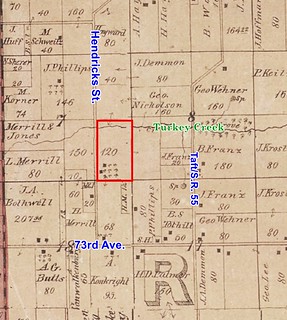
The western and southern boundaries coincided with Broadway and E. 73rd Avenue, but there are no modern streets marking the other boundaries exactly; the closest would be 68th Place on the north and Delaware Street on the east.

Clifford Pierce Middle School is on land that was once the Pierce farm. So is Maxim's Restaurant.

Finally, an accidental shooting in May 1921 may or may not have happened on his farm, depending on whether you believe a Hammond newspaper ("Death From Forgotten Revolver," Lake County Times (Hammond, Ind.) 19 May 1921).

__________________
[1] On sale at the Merrillville History Museum (and can be ordered through their website).
[2] "General News Items," Hobart Gazette 14 Sept. 1906.

Tuesday, December 13, 2016

Caroline Campbell

On October 29, 1922, Caroline Campbell died at home on the family farm in southern Ross Township.

2016-12-13. Caroline Campbell
(Click on image to enlarge)
Hobart Gazette 3 Nov. 1922.


Her husband was Samuel, born ca. 1867; the son was Claude, born ca. 1889 (he married Bertha Nolte); but I can account for only two daughters — Fannie, born ca. 1897, and Nora, born ca. 1899.

The Campbells had been living on that farm since 1891, perhaps earlier.


In Hobart in the following weeks, several more long-time residents passed to a better world:

2016-12-13. Deaths
(Click on image to enlarge)
Hobart Gazette 10 Nov. 1922.


Before moving to Hobart, Frank Bayor had spent some three decades in Ross Township; "the farm" belonged to his wife's parents, James and Mary Adams. Early Land Sales, Lake County shows James Adams buying, in 1847, the 80 acres shown here on the 1874 Plat Map:

2016-12-13. Adams 1874
(Click on image to enlarge)

The Bayors lived on the Adams farm from the 1880 Census through the 1910 Census. The 1926 Plat Book shows the farm owned by F.J. & M. Bayor — perhaps their son, Floyd James, and daughter, Mamie (for if Floyd was married by that time, I can find no proof of it).

Saturday, April 16, 2016

The Death of Harold Boyd

After the heartbreak of her early widowhood, Lizzie Sauter Boyd Epps' life had gone more happily, as she raised her two sons and eventually found love again. But the summer of 1922 brought her fresh and indelible grief.

2016-4-16. Harold Boyd
(Click on image to enlarge)
Hobart News 3 Aug. 1922.


Additional Source: "Harold Boyd Drowns in Michigan." Hobart Gazette 4 Aug. 1922.

Sunday, January 17, 2016

Harriet Towl Ragen

An early resident of Ross Township, Harriet Ragen died in June 1922, just short of her 79th birthday.

2016-1-17. Harriet Towl Ragen obit
(Click on images to enlarge)
Hobart Gazette 30 June 1922.


Here is the Ragen farm as it appeared on the 1874 Plat Map.

2016-1-17. Ragen 1874

This map suggests a house in the approximate location of 4012 E. 73rd Ave., where there now stands a house and large barn along with other outbuildings, most of which date to 1921 if the county property records are correct.

After moving to Hobart in 1896, the Ragens rented out their farm. Charles and Lovisa (Chester) Nelson rented it in the spring of 1903; by August of that year, the Ragens had rented it to a Wilhelm Neuman (or Newman), reportedly for a five-year term. By December 1908 George Ragen was advertising for a new tenant. In September 1914, the widowed Harriet, now living in Gary, offered it for sale or rent. She sold it in January 1915 to May Blachly (who sold it to S.J. Craig, who sold it to Emil Wojahn … who probably built that house and barn, etc.).

I believe "Mrs. Cora Maybaum of Gary" was married to Louis Maybaum, the streetcar motorman whose photo we've seen.

Harriet Ragen's husband, George, was not only a veteran of the Civil War but also a brother of Amanda Ragen Bullock, as we learn from his obituary:

2016-1-17. George Ragen obit
(Click on image to enlarge)
Hobart Gazette 1 Mar. 1912.


That would explain why Joseph (aka Josiah) Halladay came down from Chicago in June 1922 to attend Harriet Ragen's funeral — he was the husband of Amanda Ragen Bullock's daughter, Ruth. (I don't know why Ruth did not accompany him.)

From George's obituary, also, we also learn that the "Mrs. Mary Stevens of Gary" who survived Harriet was the wife of Hobart's one-time baker and restaurateur, Willard Stevens (so I suppose she is the Mate Stevens identified in one of the photos in that first link).

In closing, I will add this random item I came across in the 1901 microfilm: "A carload of laborers, men and women of the African type, have pitched camp upon George Ragon's farm near the Grand Trunk railroad and will be engaged in work on the double track grading. They are said to be a jolly crowd."

♦    ♦    ♦

The second story marked on the 1922 image above tells us that the elder Severances, George and Anna, had celebrated their 30th wedding anniversary. I believe Bunge is a misprint for Burge — the married name of their daughter, Mary.


Additional Sources:
♦ 1920 Census.
♦ "For Sale or Rent." Hobart Gazette 25 Sept. 1914.
♦ "General News Items." Hobart Gazette 19 Apr. 1901; 24 Apr. 1903; 28 Aug. 1903; 11 Mar. 1904; 11 Dec. 1908.
♦ "Local and Personal." Hobart News 6 July 1922.

Tuesday, May 20, 2014

Merrillville Then and Now: C.C. & L.R.R. Depot

Circa 1909, and 2014.

5-20-2014 CCLRR depot by Haase
5-20-2014 CCLRR depot site 2014
(Click on images to enlarge)

Not exactly illuminating, is it? The former railroad is now a bike path, and all traces of the depot are gone.

Someone tried to explain its location to me as we looked out the front window of the Merrillville/Ross Township Historical Society Museum on 73rd, just west of Broadway. "It was behind that second evergreen," she said.

5-20-2014 Second evergreen

Let's hope those evergreens never get cut down.

The postcard is postmarked Dec. 1909, meaning that the depot had but a short time to bear the name of the Chicago, Cincinnati & Louisville Railroad. By July 1910 it would be the Chesapeake & Ohio RR depot.


Here's the verso:

5-20-2014 CCLRR Depot verso

I believe the sender was 19-year-old Hattie Nasshahn McCarty, writing to her brother, Emil (about 22 years old). The Nasshahn family lived in Merrillville — from when, I'm not sure, as I can't find records of them earlier than 1900, but an infant sister, Lydia, who died in 1885, is buried in Merrillville Cemetery, as is their father, Emil Sr. (d. 1891), their mother, Elizabeth (d. 1911), and another sister who died in childhood.

The family earned a mentioned in A Pictorial History of Merrillville, which states that the widowed Elizabeth and her children ran a grocery out of their own home, "located on West 73rd Avenue across from the old Iddings house and adjacent to the Perry Goodrich home."

In 1908 Hattie married Frank McCarty, a railroad telegraph operator — I do wonder if he is one of the men pictured on the postcard! Sometime between 1910 and 1920, the McCarty family moved to Noble County, Indiana, where Frank and Hattie lived out the rest of their lives. As for Emil, he lived, married, fathered, and died in Oregon.


Sources:
♦ 1900 Census.
♦ 1910 Census.
♦ 1920 Census.
♦ Clemens, Jan, and Merrillville/Ross Twp. Historical Society. A Pictorial History of Merrillville. 1976, updated 1991.
♦ Indiana Marriage Collection.
♦ Northwest Indiana Genealogical Society. Ross Township Cemeteries. 1995.

Tuesday, March 18, 2014

Two Old-Timers

And now we lose two old-timers.

Parker and Case obituaries
(Click on image to enlarge)
From the Hobart Gazette 15 Apr. 1921.


Jeremy Parker's name is given as Josiah in the News, but perhaps that was the second "J." Here is J.J. Parker's land in Hobart Township, 1908:

Parker land

I believe there was once a Parker School on the northeast corner of the Liverpool-Old Ridge intersection, and nowadays there is a Parker Road in the north part of the old farm — which may be coincidence; I don't know. The nameless widow mentioned in the obituary was born Cornelia Hutton, who had married J.J. in 1876.

And southwest of Ainsworth, on the farm formerly belonging to Benjamin Case, Dayton T. Case lost his wife, née Eliza Jane "Jennie" Toothill. They had married in 1881. (Dayton was Benjamin's nephew, the son of Benjamin's brother, William.)

I suppose this is the "farm near Merrillville" where Jane was born and raised:

Toothill land 1874
From the 1874 Plat Map.

So it's now part of Calumet Park Cemetery.

Dayton and Jane's two daughters were their only children (to survive infancy, anyway). The elder daughter, Bessie, married Archie Brooks in 1916; they lived in Hobart and he worked at a steel mill. In 1914 Ada had married Paul Henning (brother of Elsie Henning Nelson). They farmed rented land in Ross Township — to judge by the 1920 census, somewhere south of Ainsworth.


Sources:
♦ 1874 Plat Map.
♦ 1900 Census.
♦ 1908 Plat Map.
♦ 1920 Census.
♦ "Death of Mrs. Case." Hobart Gazette 15 Apr. 1921.
♦ "Funeral of Josiah Parker Held Sunday Afternoon." Hobart News 14 Apr. 1921.
♦ "Funeral of Mrs. D.T. Case Will be Held Saturday Afternoon." Hobart News 14 Apr. 1921.
♦ Indiana Marriage Collection.
♦ "J.J. Parker Dies April 7." Hobart Gazette 15 Apr. 1921.