Showing posts with label Ittel. Show all posts

Thursday, March 30, 2023

Gay-Mill Gardens

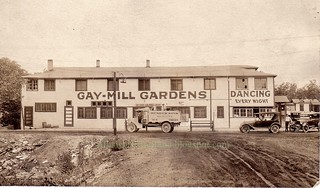
Miller is outside my bailiwick, but having previously encountered a 1922 ad in the Hobart newspaper for the Gay-Mill Gardens, I couldn't help but be thrilled to receive a photo of the place.

2023-03-30. Buchfuehrer gay-mill-gardens
(Click on image to enlarge)
Image courtesy of R.F.


The 1922 ad described the location as Lake and Forrest Avenues, so I suppose the photographer was standing on Forest Avenue and looking west toward Lake Street.

This photo was among a group relating to the Buchfuehrer family. William Buchfuehrer may have been driving the Henderson Ice Cream truck out front of the Gay-Mill Gardens. He was employed by the Henderson factory in Hobart off and on during the 1920s and '30s. In fact, in 1937 he (in partnership with William Ittel) purchased the factory, and went on to operate it for some 20 years. But this photo predates that purchase — by 1937 the Gay-Mill was abandoned. The cars in the photo are from the early 1920s (as the Ainsworth vintage-car expert tells me), so the photo probably was taken not long after the Gay-Mill first opened.

Friday, July 25, 2014

From Hard to Soft, Again

Martin Scheer proved a flash in the pan. The next we hear of the Hillman soft-drink parlor, the business of the late Fred had been bought, and the room of the surviving John rented, by Jake Ittel and Bert Ream.

Jacob Ittel was the son of a saloonkeeper (and the brother-in-law of the former Bessie Ols). By the age of 23 Jake had been in the saloon business — either in partnership with his father, or on his own; eventually he did have his own saloon, and he employed Bert Ream as his bartender.

Of course, the prohibition of alcohol had put an end to that. Unlike John Hillman, who smoothly converted his saloon to a soft-drink parlor, Jake Ittel had closed the doors of his and gone off to do goodness knows what, for I can't find him in the 1920 census, while Bert Ream went into the steel mills.

(Incidentally, we've met other members of Bert's family before, he being a son of Henry and Josephine Ream; we've also seen a photo of "Bertie" as a child.*)

But now Jake and Bert were in business together again, and it was not so very different from their old saloon days. Indeed, given all the reports we've seen of drunkenness and the brewing of illicit liquor, I suspect their new soft-drink parlor may have been even less unlike their old saloon than you'd think, only now they had to keep any hard stuff hidden.

_______________________
*I suspect the Edith "Reams" of the caption was Bertie's five-year-old sister.


Sources:
♦ 1910 Census.
♦ 1920 Census.
♦ "The Hillman Stand Re-Rented." Hobart Gazette 3 June 1921.
♦ WWI Draft Cards.

Friday, June 20, 2014

The Camp Ground in McAfee's Woods

Since January 1921 the Hobart Commercial Club had been working with Paul Newman, trailsman, to develop a camping ground near Hobart for tourists on the Yellowstone Trail. At a Commercial Club meeting in March, the camping-ground committee reported on its progress: it had entered negotiations with William McAfee to rent four acres of his "7-acre wood lot east of town"; it had planned what improvements would be built and roughly how much those improvements would cost (about $250, to be raised by subscription); it had already received donations of over $100.

I do not know exactly where these four acres were. William McAfee had owned land along the south side of Cleveland Avenue, east of town, for many years (indeed, his parents had owned land there at least since the 1870s), but it's in different places per the 1908 Plat Map …

2014-6-20. W. McAfee 1908
(Click on images to enlarge)

…and the 1926 Plat Book.

2014-6-20. W. McAfee 1926

Nor can I see anything recognizable as a camping ground in the 1939 aerial photos, though we do see what looks like a wooded tract on the southeast corner of Cleveland and S.R. 51. But it's a long time between 1921 and 1939, and the camping ground may not have been in existence by then, even if it could be identified from the air.


Anyway, work went forward during the spring of 1921, and by the end of April, the camping ground was nearly completed.

2014-6-20. Camping ground

The Commercial Club had exceeded its own goal in raising money. So many local individuals and businesses had contributed that I can't index them all. The Kulage Brick Works even donated bricks.

2014-6-20. Report


Sources:
♦ "Commercial Club Holds Good Meeting." Hobart Gazette 11 Mar. 1921.
♦ "Report on Tourists' Camp Ground." Hobart News 19 May 1921.
♦ "Tourists' Camp Ground About Ready." Hobart Gazette 29 Apr. 1921.

Sunday, October 13, 2013

A Complicated House for Bessie

Is it any wonder I can't get anything done? — I come across an announcement like this:
Chas. Ols has purchased from the heirs of Anna Medrow through the administrator, Paul Born, the Born house and lot on Lake street, consideration being $3,000. Mr. and Mrs. Ols' daughter and husband, Mr. and Mrs. Wm. Ittel, have moved into the house.
— and feel the need to spend half an hour poking around in the records to try to find out who these Medrows and Borns were, when it doesn't really matter. (We already know who these Olses and Ittels were.)

Then again, I suppose I had to make sure there wasn't any Ainsworth connection. Which there doesn't seem to be. Paul and Anna Born were siblings, I believe, who lived in Hobart in 1880. Sometime before 1900 Anna married William Medrow. She spent the rest of her life in Chicago, died May 17, 1920, and was brought home for burial in Crown Hill Cemetery.

No word on whether Charles Ols ever got his dog back.


Sources:
♦ 1880 Census.
♦ 1900 Census.
♦ 1920 Census.
♦ Ancestry.com. Illinois, Deaths and Stillbirths Index, 1916-1947 [database on-line]. Provo, UT, USA: Ancestry.com Operations, Inc., 2011. Original data: "Illinois Deaths and Stillbirths, 1916–1947." Index. FamilySearch, Salt Lake City, Utah, 2010.
♦ "Local Drifts." Hobart Gazette 3 Dec. 1920.

Monday, March 25, 2013

His Dog and His Daughter

In June 1920 Charles Ols lost his dog and his daughter. He wanted the dog back.

Weddings: Bessie Ols, Margaret Boldt
(Click on image to enlarge)

We've previously met Bessie's younger sister, Pearl. Irvin Ols was an eight-year-old cousin, a son of their Uncle Christ and Aunt Alpha (who now farmed rented land east of Ainsworth — I believe it was the former James Chester place, at the county line). As for little Totsie, I can only guess that she was one of Irvin's sisters.

Earlier that month, some of Bessie's friends had thrown a bridal shower for her, held at farmhouse of her neighbors, Albion and Ethel Paine.

Here is Bessie, in her senior portrait in the Hobart High School Aurora yearbook of 1915:

Bessie Ols

♦    ♦    ♦

A day after Bessie's wedding, Margaret Boldt became Mrs. Raymond E. Cosgrove. Margaret, as you may or may not remember, had an Ainsworth connection through her mother, the former Mary Sullivan, who did not live to see the wedding.


Sources:
♦ 1880 Census.
♦ 1910 Census.
♦ 1920 Census.
♦ "All kinds of Wants." Hobart Gazette 25 June 1920.
♦ "Boldt-Cosgrove." Hobart Gazette 25 June 1920.
♦ "Boldt-Cosgrove." Hobart News 24 June 1920.
♦ "Ittel-Ols." Hobart Gazette 25 June 1920.
♦ "Ittel-Ols." Hobart News 24 June 1920.
♦ "Local Drifts." Hobart Gazette 6 Mar. 1914; 11 June 1920.

Sunday, December 23, 2012

Scarlet Fever

Adding to the miseries of the winter of 1919-20 — on top of influenza and smallpox — we now find scarlet fever. By early March, it had caused the quarantine of three homes in Hobart: those of Albert Witt, Henry Ittel and Alvin Shafer.

The miseries of the approaching spring threatened to include Albert Halsted, a Ross Township farmer, running for Lake County sheriff.

♦    ♦    ♦

This little item caught my eye, as it concerns two of our acquaintances — William Schavey (Hattie's husband and Mable's uncle) and John Harms.

Harms-Schavey sale
(Click on image to enlarge)

According to the 1930 census, the address where William and Hattie Schavey were living was 750 Lincoln Street. (I can't find them in the 1920 census.)


Sources:
♦ 1920 Census.
♦ 1930 Census.
♦ "Local and Personal." Hobart News 11 Mar. 1920.
♦ "Local Drifts." Hobart Gazette 12 Mar. 1920.

Saturday, May 14, 2011

Hopeful Spirits

As 1918 opened, those Hoosiers who earned their living from the sale of liquor were watching the clock wind down toward April 2, 1918, the day Indiana would go dry.

In mid-February a ray of hope beamed up from near the state's southern border. The F.W. Cook Brewing Company brought suit in the Vanderburgh County superior court seeking to restrain Evansville's chief of police from enforcing the Indiana prohibition law when it went into effect.

Judge Fred M. Hostetter heard the case and ruled in the brewers' favor, on the basis of venerable case law — the 1855 decision in Beebe v. State, in which the Indiana Supreme Court had struck down an early legislative attempt at state-wide prohibition. Judge Hostetter said that his ruling applied the principle established in Beebe that "by the very Constitution now in force the people did not empower their legislature to enact any law prohibitory of the proper and temperate use of alcoholic beverages."

Naturally, the Evansville side of that case appealed to the supreme court.

And just as naturally, a wave of optimism swept over Indiana's saloonkeepers. As the Gazette pointed out, the women's suffrage law had not survived the supreme court; the general attitude toward the prohibition challenge now viewed it as "a fifty-fifty question with odds in favor of the 'wets.'"

Liquor licenses in the state would expire on April 2, the same day the prohibition law was scheduled to go into effect. But a blizzard of license-renewal notices in the early March newspapers gave evidence of the hopeful mood of local saloonkeepers, including Ainsworth's William F. Wollenberg. In March the Lake County Commissioners granted 38 licenses — valid for one month.

On the other side, the dry forces were equally confident. The Rev. Edward S. Schumaker, superintendent of the Indiana Anti-Saloon League, pointed out several court cases within the last 30 years that he believed superseded the 1855 Beebe decision. The county option law, which had allowed prohibition on the county level, had survived constitutional challenge. "There can be no doubt," Schumaker said, "that the Indiana supreme court will sustain the new prohibition law."

By coincidence, the supreme court heard the case on April 2. Both sides presented their arguments, then the justices retired to think about it.

While they thought about it, prohibition became the law of the state — outside Vanderburgh County, at any rate. All liquor licenses had expired at the close of business on Tuesday, April 2. That deadline passed with little excitement in Hobart, aside from some saloon patrons taking "a long last draught in anticipation of a long dry spell." Wednesday dawned with "the saloons all closed tight and the prohibition law in full force and effect." While the News stated that liquor dealers had ten days in which to remove their stocks from the state, the Gazette suggested that there would be no enforcement of that requirement pending the supreme court's decision (which was expected within ten days). Some saloons owners now kept their doors open, selling "near beer," soft drinks and cigars to stay afloat until, they hoped, they could get back to selling the real stuff.

Ten days passed with no decision from the supreme court. The justices announced that they were going on vacation until April 23. They might not rule until sometime in May.

In Hobart, Charles Klausen, Jake Ittel and Henry Ittel lost hope. They closed their businesses and removed the furniture and fixtures.

Others kept their spirits up, and waited.


Sources:
♦ Ashanin, Michael. "Beebe Temperance Case." The Encyclopedia of Indianapolis. (David J. Bodenhamer and Robert G. Barrows, eds.) Bloomington: Indiana University Press, 1994.
♦ "'Dry' Law Before Supreme Court." Hobart Gazette 22 Mar. 1918.
♦ "Have You a Prediction?" Hobart Gazette 22 Feb. 1918.
♦ "Indiana Became Bone Dry at Midnight, April 2nd." Hobart News 4 Apr. 1918.
♦ "Local and Personal." Hobart News 18 Apr. 1918.
♦ "Local Drifts." Hobart Gazette 29 Mar. 1918.
♦ "No Supreme Court Decision." Hobart Gazette 19 Apr. 1918.
♦ "Notice of Extension and Renewal of Liquor License." Hobart News 7 Mar. 1918.
♦ "Prohibition Law Held Unconstitutional." Hobart Gazette 22 Feb. 1918.
♦ "Saloonkeepers Advertise for Renewal of Their Licenses." Hobart News 7 Mar. 1918.
♦ "Saloons All Closed." Hobart Gazette 5 Apr. 1918.
♦ "State Goes Dry April 2." Hobart Gazette 15 Mar. 1918.
♦ "'Wets' Win First Round in Their Fight Against Closing Law." Hobart News 14 Feb. 1918.

Wednesday, April 20, 2011

Hobart Then and Now: 829 East Third Street

Circa 1902 and 2011.

Ittlessaloonon3rdundated
829EastThird
(Click on images to enlarge)
Top image courtesy of the Hobart Historical Society.


The top photo on display at the museum is captioned, "Ittle's saloon. Hobart, Ind./829 E. Third." I believe the two people at the back are Henry and Catherine Ittel, and in front, probably their four children: the two older boys are Henry and Jacob, and then daughter Mary and youngest son William. Since William was four years old in 1900 (per the census), I'm guessing that this photo was taken around 1902.

A Henry Ittel still ran a saloon by the time state-wide prohibition went into effect, but I don't know whether it was the father or the son. And from the wording of the newspaper reports, it sounds as if Jacob had his own saloon by then.

I don't know whether the building at that address now is the same one (with some remodeling); I'm inclined to think it's not — the proportions are so different.