Showing posts with label Bodamer. Show all posts

Tuesday, July 9, 2024

Bertha's Second Marriage: It Was Bad

Even today I still think, sometimes, of that strange and touching poem written (I'm guessing) by Bertha Mueller Bodamer in memory of her husband, Benjamin, who died in 1917. To judge by the emotions that poem conveys, one would think their marriage was very happy.

After Ben's death, Bertha and her sons, Harry, Ralph, and Carlton, continued farming their 35 acres (more or less[1]) on S. Hobart Rd., marked with "BB" on the plat map from the 1926 Plat Book:

2024-02-26. Bodamer 1926
(Click on image to enlarge)
As I mentioned in an earlier post, this map fails to show the 34-acre farm of Bertha's brother-in-law, John, bordering on the south side of her land.


In 1928, Ralph married Florence Wyant and set up a separate household close to his mother's; the following year Carlton married Helen Hardesty and moved to Hobart. The 1930 Census records only Bertha's unmarried eldest son, Harry, still under her roof.

By then, Bertha had been widowed over a decade. With her nest emptying, I suppose she was feeling lonely, and perhaps wishing for a pleasant and helpful companion, such as Ben had been. Anyway, somewhere she saw an advertisement by a man seeking a wife, and she answered it. The man was Fred Reuter, a widower living in West Virginia, about whom I know almost nothing. Fred came to Indiana, where he met Bertha. Evidently they liked each other.

Bertha's sons were not happy about this development. I wish I knew why! — did they object to a stranger moving in on what they viewed as their inheritance, or was there something about Fred in particular that they didn't like?

Around this time, possibly in February 1931,[2] Bertha's eldest son, Harry, married Ida Hollett[3] of Valparaiso.

Bertha soon went ahead with her own marriage. In April of 1931, she became Mrs. Fred Reuter (Indiana Marriage Collection). Shortly before the marriage, Fred lent her $2,000 to make improvements on her farm, with Bertha giving him a mortgage on property she owned in Porter County known as the "old Bodamer homestead," shown here on a 1938 plat map:

2024-07-09. Bodamer -- Union-1938
(Click on image to enlarge)
Image from https://www.inportercounty.org/Data/Maps/1938Plats/Union-1938.gif.


If there was a honeymoon period, it was short. Everything soon started to fall apart. In December 1932, Bertha suffered a personal loss when her son, Harry, died at only 32 years of age, leaving a widow and no children. Fred Reuter failed to provide the companionship and help Bertha wanted; in fact, he left the home (or was thrown out by Bertha's sons) and went to Idaho. Bertha filed for divorce. Fred came back and began proceedings to foreclose on the mortgage he held. The unpleasant details started appearing in local papers in the autumn of 1934.

2024-07-09. Valparaiso-Vidette-Messenger-October,19-1934-p-1
(Click on image to enlarge)
Vidette-Messenger (Valparaiso, Ind.), 19 Oct. 1934.


2024-07-09. Valparaiso-Vidette-Messenger-April,26-1935-p-2
(Click on image to enlarge)
Vidette-Messenger (Valparaiso, Ind.), 26 Apr. 1935.


2024-07-09. Valparaiso-Vidette-Messenger-May,28-1935-p-2
(Click on image to enlarge)
Vidette-Messenger (Valparaiso, Ind.), 28 May 1935.


I can't find any follow-up articles beyond this. But it appears that Fred lost his mortgage case, if the 1938 plat map, above, can be relied on. The local papers soon went back to calling Bertha "Mrs. Ben Bodamer"[4] (notwithstanding the 1938 plat map).

The 1940 Census records a widow, Bertha Bodamer, living with her widowed daughter-in-law, Ida, on the farm. Her son, Carlton, had moved back to her neighborhood with his wife and three daughters, not farming but employed as a truck driver with the WPA. Her other son, Ralph, lived with his family and several relatives in Hobart Township and worked in a steel mill.

Both sons were back in the farm neighborhood for the 1950 Census, both working in steel mills. Bertha, 81 years of age, lived in Ralph's household. Ida was nowhere to be found.

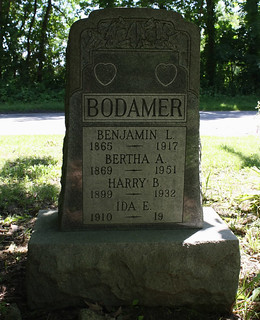
Bertha died the following year — August 16, 1951 (Indiana Death Certificates). She was buried beside her pleasant and helpful companion, Ben, in the Woodvale Cemetery.

I still don't know what became of Ida, whose name is next to her husband's on the family grave marker without a death date.


_______________
[1] The size varies slightly from one plat map to another.
[2] I'm getting the date from a family tree on Ancestry.com that does not cite a source. I cannot find a record of the marriage, nor any mention of it in on-line local papers.
[3] The surname comes from family trees on Ancestry.com, none of which cite a source. Occasionally it turns up spelled Hallett. Her middle name is given as Eve. (Just to make things more confusing, there was a longtime Valpo resident named Ida Mae Hollett, who was considerably older than our Ida.)
[4] E.g., "Hobart," Hammond Times, 13 May 1938.

Monday, February 26, 2024

Another Branch on the Bodamer Tree

But who (I asked myself) was this John Bodamer who in 1930 sold his 34 acres to the Wiernasciewicz family? — who exactly, I meant, since obviously he was one of the many Bodamers who farmed in eastern Ross Township over so much of its history.

It didn't take much research to figure out that he was a brother of George and Benjamin, and the son of Christopher F. and Elizabeth (Lortz) Bodamer.

According to information someone has added to Christopher's findagrave.com entry, the family came to Lake County from New York in 1854. John was born in 1855. The 1860 Census shows the Bodamer family farming in Ross Township — exact location unknown, but to judge by the names recorded near them, they probably already occupied the Randolph Street (S. Hobart Rd.) area that would be continue to belong to Bodamers well into the 20th century. On the 1874 Plat Map, I believe the "C. Batlmer" who owned 160 acres in Section 9 was just C. Bodamer with his name misspelled:

2024-02-26. Bodamer 1874
(Click on image to enlarge)

The 1876 plat map of Union Township in Porter County shows that Christopher and Elizabeth also owned two good-sized farms near Union Center.

In 1878, John Bodamer married 18-year-old Adelia Nicholas of Center Township, an Ohio native whose family had come to Porter County sometime after 1867. With all those Bodamer farms around here, I was surprised to find John and Adelia in the 1880 Census farming in St. Joseph County, Indiana. They had one baby son, Alvah. They would go on to have two more sons, Vernon (b. 1882) and Herman (b. 1887).

In 1894, John's father, Christopher, died and was buried in Jasper County, Indiana, where he had been living separately from his wife (or former wife), Elizabeth. I do not know whether John and Adelia returned to this area soon after his father's death, as I cannot find them at all in the 1900 Census. But the 1906 Union Township plat map shows two farms under the name of J.F. Bodamer …

2024-02-26. Union-1906
Image from https://www.inportercounty.org/Data/Maps/1906Plats/Union-1906.jpg.

… and by the 1910 Census, they were living on their own farm in Union Township, described as being on the Joliet Road.

By then their three children were grown and out of the house. In 1907, their eldest, Alvah, had married Carrie Wolfe. In 1910 that young couple were farming rented land in Ross Township, with Alvah's unmarried brother, Vernon, in their household. It was in this time frame that we've encountered Alvah and Vernon, the "Bodamer brothers," hiring themselves and their machinery out to do threshing for their Ross Township neighbors. In 1915, Vernon married Anna Murray. Per the 1920 Census, Vernon and Anna took over farming the rented land in Ross Township (apparently part of the Randolph St. land of their grandparents); Alvah and Carrie moved to Porter County and the youngest brother, Herman, lived with them. (Herman never married, and apparently was a bit of a loner. When he died in 1957, some ten days passed before his body was found.[1])

In 1920, John and Adelia were still farming their Union Township land. I haven't found any evidence that John and Adelia, after their marriage, ever actually lived on the Ross Township farm. I suspect he just inherited it or bought it from his father's estate, and rented it out.

In February 1925, Adelia died at the age of 64. She is buried in the Mosier Cemetery.

I think the 1926 Plat Map contains an error, in that it fails to show John's Ross Township farm:

2024-02-26. Bodamer 1926
(Click on image to enlarge)

The highlighted "B.B." would be John's brother, Benjamin — or rather, his widow, Bertha, since Ben died in 1917. John's 34-acre farm lay on the south border of B.B.'s. John owned those 34 acres in 1930 when he sold them to the Wiernasciewiczes, and the 1939 Plat Map shows the subject of that sale. I have a hard time believing John Bodamer sold the land to John Gruel sometime after 1908, then bought it back in time to sell it again in 1930.

In the 1930 Census, John was living alone in his farm home in Union Township. Alvah and Carrie and their three foster children lived nearby. As much as I'd like to think all was family harmony and bucolic peace around Union Center, I have found suggestions otherwise; for example:

2024-02-26. Punished For Attack on Whiting Man, Hammond-Times-June,22-1925-p-1
(Click on image to enlarge)
Lake County Times (Hammond, Ind.), 22 June 1925.


Was John always like that, I wonder, or did his wife's death, several months earlier, change him for the worse?

And a few years later, we have conflict in the family:

2024-02-26. Note Holder Loses Case, Vidette_Messenger_of_Porter_County_Thu__May_9__1929_
(Click on image to enlarge)
Vidette-Messenger (Valparaiso, Ind.), 9 May 1929.


But all such concerns came to an end for John in 1932.

2024-02-26. John Bodamer Dies at 82, Valparaiso-Vidette-Messenger-November,25-1932-p-1
(Click on image to enlarge)
Vidette-Messenger (Valparaiso, Ind.), 24 Nov. 1932.


(He was 77, actually, and it had been seven years since Adelia died.)

_______________
[1] "Herman Bodamer's Body Is Found; Dead About 10 Days," Vidette -Messenger (Valparaiso, Ind.), 11 Mar. 1957.

Thursday, January 4, 2024

The Glass-Coffin Madness

Eight or ten years ago, a long-time Hobartite told me a story about something that happened near Ainsworth, back (as she recalled) in the late fifties or early sixties: a rumor had started somehow that a man who lived down on County Road K (now known as South Hobart Road or Randolph Street) was keeping a woman's dead body in a glass coffin in his house, so people started driving by the house trying to catch a glimpse of the glass coffin.

When I mentioned the story to Eldon Harms, he recalled the incident, and even showed me where the house in question had been. I took away the impression that it was just a matter of some bored teenagers acting silly, so I was surprised to find not only that the glass-coffin madness had earned a mention in the Gazette, but that I had underestimated its magnitude …

2024-01-04. 1961-10-05 Where Is The Casket, Gazette
(Click on image to enlarge)
Hobart Gazette, 5 Oct. 1961.


… and I was shocked by the tragic way it all ended.

2024-01-04. 1961-10-12 Area Man Takes His Own Life, Gazette
(Click on image to enlarge)
Hobart Gazette, 12 Oct. 1961.


Stories about Stanley Wiernasiewicz's suicide and the bizarre events that led up to it appeared in newspapers as far away as Texas and California.

♦    ♦    ♦

These articles have prompted me to take a closer look at the area where all this happened.

On this screenshot from the Google satellite view on the area, the arrow marks approximately where Eldon said, "Here!" as we were driving down the road:

2024-01-04. screenshot aerial view marked
(Click on image to enlarge)
Image from Google.com/maps.


The 1939 Plat Map shows the original Wiernasiewicz farm of 34 acres, purchased in April 1930 from John Bodamer.[1] Later, the family would also buy the 40 acres across the street.[2]

2024-01-04. 1939 plat map Wiernasiewicz farm
(Click on image to enlarge)

The 1930 purchaser, technically, was Mary Wiernasiewicz. The plat map shows the owner's first name as Chester. I have tried and failed to identify a Chester among the Wiernasiewiczes. I suspect that might be an error on the part of the plat-map maker.

Here is the farm in a 1939 aerial photo (I hope I got the boundaries right):

2024-01-04. 1939 aerial Wiernasiewicz farm marked
(Click on image to enlarge)

♦    ♦    ♦

For the first time since I started researching Ainsworth history, I have looked into the Wiernasiewicz family. The research wasn't easy: in dealing with a last name like Wiernasiewicz, you naturally get alternate spellings and mistranscriptions. (In fact, one member of the family ended up amputating all but the first syllable of his surname, to make his own life easier, I suppose.)

It appears this family included some interesting people — interesting and enterprising; perhaps a bit too enterprising.

The story begins with Andrew Wiernasiewicz and Mary Fusko, who both came from Poland, but separately: she in 1900 at about 6 years of age, he in 1902[3] when he was about 13, according to the 1930 Census. They were married circa 1910 (I can't find the record), possibly in Pennsylvania, where their first son, Stanley, was born. By 1913 they had come to Indiana. The 1920 Census shows them living at 1949 Virginia Street in Gary, now with another son, Michael, born in 1913.[4] (In 1916, they had had a little girl, Aniela, who lived only a few months.) Also in their household in 1920 was a roomer, another Polish immigrant who, at the age of 86, was still working in a steel mill. Andrew worked in a steel mill too. Mary's occupation is given as "none"; however, three years later we find her operating a "soft drink parlor":

2024-01-04. Close Up Soft Drink Parlor -- The_Times_Sat__Apr_14__1923_
(Click on image to enlarge)
The Lake County Times (Hammond, Ind.), 14 Apr. 1923.


The 1930 census shows the Wiernasiewicz family living at 1837 Virginia, with yet another son, nine-year-old Walter, as well as two roomers. Andrew worked as a machinist in a bolt factory. Mary managed a grocery store.

Andrew may have had a side job, if this is our guy (and I can't find anyone else by that name in Gary):

2024-01-04. Gary, The_Times_1933_06_23_page_13 (Andrew Wiernasiewicz)
(Click on image to enlarge)
"Gary," The Lake County Times (Hammond, Ind.), 14 Apr. 1923.


In April 1930, as we know, the farm on County Road K had been purchased. But it doesn't look as if the Wiernasiewiczes became full-time farmers. A 1935 Gary directory shows the family both living and operating a grocery store at 1839 Virginia Street. They may have rented their farm out, or hired someone to run it for them.

In spite of the repeal of Prohibition, Mary still found ways to violate liquor laws.

2024-01-04. Wiernasiewicz, Mary -- The_Times_Mon__Dec_23__1935_
(Click on image to enlarge)
The Lake County Times (Hammond, Ind.), 23 Dec. 1935.


The 1940 Census records the family still in Gary. It doesn't say anything about Andrew's or Mary's occupation, but I find it difficult to believe that they were idle. Stanley was working in a steel mill, Mike bartending in a tavern, and 18-year-old Walter was described as a "New Worker" (meaning, I believe, that he was an inexperienced person in search of a job).

In 1946 we come across a previously unheard-of Wiernasiewicz who followed the family tradition of running afoul of liquor laws:

2024-01-04. Lily Ann Wiernasiewicz, The_Star_Press_1946_10_15_Page_5
(Click on image to enlarge)
The Star Press (Muncie, Ind.), 15 Oct. 1946.


Lily Ann turned out to be Walter's wife, or possibly at this point his live-in girlfriend using his last name — the only record of I can find of Walter Wiernasiewicz marrying a Lily Ann (maiden name Brewer) comes in 1953.[5]

When Mary Wiernasiewicz died in 1948, her address, and Andrew's, were given as Rural Route #2, Hobart (Indiana Death Certificates), which sounds like the farm on "County K." And that is where Andrew and two of his sons, Stanley and Michael, were living when the 1950 census came around.

The census records Walter and Lily, along with a 70-year-old lodger but no children, living in a separate household on what sounds (per the enumerator's notes) like the same road as the Wiernasiewicz farm. Walter described himself as a farmer. By 1950 the family had bought the 40 acres across the road from their original 34 acres, which may account for the separate households.

In 1951, Michael died at the age of 37, unmarried and with no children I know of. Andrew's being named as the informant on Michael's death certificate is his last appearance in any record I can find. I suspect that Andrew died sometime between 1951 and 1961. When Stanley died in 1961, it was not his father who reported his death and applied for a veteran's grave marker, but his brother (going by the name Walter Weir). No news story mentions Andrew. I cannot find Andrew's death certificate; it may be among the illegible ones listed on Ancestry.com, or the name may have been hopelessly mistranscribed.

Andrew probably lies in Calvary Cemetery with the rest of his family, though perhaps in an unmarked grave. If Stanley ever got his veteran's marker, it hasn't been photographed for findagrave.com.


_______________
[1] "Real Estate Transfers," Lake County Times (Hammond, Ind.), 14 Apr. 1930.
[2] I believe the "L.E. Nelson" who owned that 40-acre parcel in 1939 was someone we've met before: Lovisa Elizabeth (Chester) Nelson.
[3] Sources vary on this.
[4] I got his birth year from his death certificate; the 1920 enumerator appears to have been confused. It is possible that Michael sometimes went by another name. I have found a 1913 birth certificate for a Jan Wiernasiewicz, born to Andrew and Mary the same day as Michael — but no birth certificate for Michael. I have also found a 1937 Gary directory listing showing an occupant of the Wiernasiewicz household named Joseph, which was Michael's middle name (per the death certificate). But no census calls him anything except Michael.
[5] Maybe they were divorced earlier and remarried in 1953. Unfortunately, I don't think the 1953 marriage lasted long, as Lily Ann Brewer shows up in 1954 marrying somebody else. But there is also a record of Walter Weir getting a license to marry Lily Brewer (both described as Hobart residents) in Berrien County, Michigan, in 1955 ("Marriage Licenses," The Herald-Palladium (Benton Harbor, Mich.), 28 Sept. 1955). Walter's 1980 death certificate describes him as divorced.

Tuesday, June 13, 2023

My Barn's Centennial

One of my earliest posts on this blog concerned the graffiti on my barn that made me believe it was built in June of 1923. Which would mean that it is 100 years old this month.

It's not looking very good, but it's still standing.

2023-06-13. Barn 2023
(Click on images to enlarge)

Here's a detail from a photo of the back yard I took not long after I bought this place in 1990 …

2023-06-13. Barn 1990

… and here it is circa 1998:

2023-06-13. Barn 1998

Yes, I let it go to pieces. It's returning to the earth whence it came.

The barn was probably built by George Bodamer — or perhaps I should say, by people hired by George Bodamer, who in 1923 was 70 years old.

Sunday, September 29, 2019

The Hay Press and George Bodamer

Hay press runs over George Bodamer, ruptures an artery in his leg. If it was the femoral artery, he could easily have bled to death. He gets first aid, then — goes to the hospital? Not George!

2019-09-29. Bodamer, Gazette, 9-7-1923
(Click on image to enlarge)
"Local Drifts," Hobart Gazette, Sept. 7, 1923.


I think this is the George Bodamer who first separated my 3.5 acres from the Chester land. I hope it is, since I'm now going to spend some of my precious time researching him.

He, like Benjamin, was one of the children of Christopher (aka Christian) and Elizabeth (Lortz) Bodamer. (For a little background information on those two, visit Christopher's entry on findagrave.com.)

George was born in Indiana on October 12, 1853 (Indiana Death Certificates) — about the time the family came to Lake County from New York. The 1860 Census records the family farming in Ross Township. I can't find them in the 1870 Census, but the 1876 plat map of Union Township, Porter County, shows them owning 80 acres:

2019-09-29. Bodamer Union-1876
(Click on image to enlarge)
Image from https://www.inportercounty.org/Data/Maps/1876Plats/Union-1876.jpg.


And that is where the 1880 Census places them.

On June 3, 1885,[1] in Porter County, George Bodamer married Christina Frederika (Gross) Stoeckert, widow of George Stoeckert. The next record we have of them is the 1900 Census, which shows George and Frederika (or Freeda) owning a farm in Ross Township. To judge by their neighbors, it is in the vicinity of these Bodamer parcels that appear on the 1908 Plat Map:

2019-09-29. Bodamer Ross-1908

All of this land (and more) had been owned by C.F. Bodamer in 1891, per the 1891 Plat Book.

The 1900 census shows George and Freeda with three children: Elizabeth (14), Christopher (12), and Henry (9).

In April 1901, Christine Frederika Gross Stoeckert Bodamer died.

2019-09-29. Bodamer, C.F., Gazette, 4-5-1901
(Click on image to enlarge)
Hobart Gazette, Apr. 5, 1901.


I can't account for the six children mentioned in the obituary vis-à-vis the three in the 1900 census; the others were probably from her previous marriage.

On March 19, 1904,[2] George's daughter Elizabeth married Earl Blachly. (The marriage did not last.)

I cannot find George Bodamer at all in the 1910 Census. One son, Christopher, was farming on the old Bodamer place in Union Township, Porter County, living with his grandmother; the other son, Henry, lived in Wheeler in the home of a Walsh family and worked in a mill.

The "Local Drifts" in the Hobart Gazette of April 3, 1914, included this item: "James Chester has sold four acres off the old Flaherty farm to Geo. Rodamer for $525." If "Rodamer" is a misprint for "Bodamer," that could be our George. Looking on the 1908 plat map image above, we see below the Bodamer parcels two parcels belonging to Hy. Chester and T.&E. Flaherty. Henry Chester apparently bought those ten acres from a D. Flaherty around 1891 (1891 Plat Book). After Henry's death in 1910, his son James may have owned that land at the south end of S. Hobart Road.

Later that year, George's older son, Christopher, shows up in Michigan marrying a Lavina Hilliker.[3] It appears that Christopher and Lavina settled and lived out their lives in Michigan.

In October 1915, George's younger son, Henry, married Minnie Baessler. By the 1920 Census, the two of them were living in Gary, so Henry must be the son in Gary to whom George went with his ruptured artery in 1923.

I cannot find George in the 1920 census, and (spoiler alert!) he died in 1929 (Indiana Death Certificates).

_______________
[1] Indiana Marriage Collection; other sources say June 4.
[2] Indiana Marriage Collection; March 23, 1904, per "General News Items," Hobart Gazette, Apr. 1, 1904.
[3] Ancestry.com. Michigan, Marriage Records, 1867-1952 [database on-line]. Provo, UT, USA: Ancestry.com Operations, Inc., 2015. Original data: Michigan, Marriage Records, 1867–1952. Michigan Department of Community Health, Division for Vital Records and Health Statistics.

Friday, July 17, 2015

Eggs, Eggs, Eggs

Among the people selling eggs in March 1922 were our friends Mary McAuliffe and "Mrs. L. Nelson," whom I believe to be Lovisa Chester Nelson.

2015-7-17. Eggs for sale
(Click on image to enlarge)
Hobart News 23 March 1922.


My print-out cut off the "Births" column, which contained the announcement that on March 17 a daughter had been born to Vernon and Anna Bodamer. No name was given for the baby. After about 45 minutes of research, I have concluded that her name might have been Thelma, or maybe Selma.

Wednesday, December 24, 2014

Merry Christmas from the Ainsworth School!

2014-12-24. Ainsworth school Xmas program 1939-40
(Click on image to enlarge)
Image courtesy of Eldon Harms.


There is no date on this program, but one of the participants estimates that it took place in the very late 1930s, or 1940 at the latest. The Ainsworth school had a Christmas program every year (she tells me), as well as a Halloween masquerade party and some sort of program in the spring. And every month during the school year, a "community meeting."

I wish I could index every surname, but Blogger won't let me. So I will just type them out for the search engine: Baldner, Bergman, Blimel, Bodamer, Bowers, Bryant, Buchfuehrer, Bush, Busselburg, Carden, Collins, Dick, Doepping, Dorman, Engstrom, Ford, Gernenz, Harms, Hartin, Homeier, Johnson, Jones, Kissinger, Klemm, Kuntz, Lines, Madura, Maihofer, Mitchell, Moreland, Nelson, O'Brien, Olson, O'Neil, Peterson, Pike, Piske, Ready, Robb, Robinson, Schmidt, Shaw, Sullivan, Tonagel, Watts, Weiler, Wesley, Willy, Wise, Witham, Wojahn, Yager, Ziemanski.

Tuesday, December 9, 2014

Some Men We Know, or Would Have Known Sooner If I'd Been Paying More Attention

2014-12-9. img915
(Click on image to enlarge)
Image courtesy of the Hobart Historical Society and Fred Ols.


Notes on the back identify these men (left to right) as "John Ols (Chris's son), Charley Ols, John Baessler, John Thiede, Henry Bodamer, Martin Ols, Grandpa Henry Ols, Henry Thiede, Chris Ols."

We already know the Christ Ols family; son John was born circa 1906. Charley and "Grandpa" Henry Ols were brothers of Christ. And Henry Ols was Martin's father.

John Baessler had married Sophia Ols in 1888, so he was brother-in-law to Christ, Charles and Henry.

Henry Bodamer had married Minnie Baessler (John and Sophia's daughter) in 1915. Henry was a son of George and Freeda Bodamer, born in 1891. We encountered him once before, I believe, as a nine-year-old schoolboy, but I don't know how he is connected (if at all) to the Bodamers who have figured in more prominently in this blog (Benjamin and Bertha, and Alvah and Vernon).

Now, as for the Thiede family — I have done a good job of ignoring them. The name has popped up in the microfilm now and then, but I've rarely made note of it and only once mentioned it in the blog, when William Thiede bought a Water Street house from Charles Maybaum. At the time I had no clue who William Thiede was, but since then I have learned that he entered the Ols family way back in 1881, when he married Mary Ols (sister of Christ, Charley, and Henry). The two Thiede men in this photograph were children of that marriage: Henry was born in 1882, John in 1890.

So, I hope we have all that straight now!

The only information we have about the date of this photo is that it was taken before 1930. Most of these men have reached that middle point in life where you must guess their age within a range of decades, not years. But John Ols (at the far left) looks to be in his late teens or early twenties, which would place the photo roughly around 1926.

Monday, December 8, 2014

Fire and Ice

I don't know exactly what one should expect to find in a barn belonging to the Barnes Ice Co. Me, I'd expect to find ice. I'd be mistaken, apparently, either because no ice was put up during the winter of 1920-21, or because by September 1921 the ice was all used up anyway, or because this was the barn, not the ice house. For whatever reason, when it caught fire, there was no ice inside to melt and put the fire out.*

2014-12-8. Barnes ice house burns
(Click on image to enlarge)
"Local and Personal." Hobart News 22 Sept. 1922.


According to the Gazette, Fred Rose, Jr. first noticed the fire as he was standing at Main and Third around 8:00 that evening. He gave the alarm and ran to get his dad's fire truck, and with several other members of the fire department who happened to be nearby, rushed to the scene … but to no avail.

I wonder if this is the fire referenced in the 1979 article of downtown Hobart memories.


In other news, Bertha Bodamer's social life continues active and reported.

____________________
*I know, I know — fire goes up, meltwater goes down.


Additional Source: "Local Drifts." Hobart Gazette 23 Sept. 1921.

Sunday, November 16, 2014

Bus Drivers

We see some familiar names among the bus drivers (Hobart Township, I believe) as the 1921-22 school year begins. Also, a Lincoln Highway progress report, and general social news. "Mrs. Bertha Bodamer" and "Mrs. Ben Bodamer" are the same person.

2014-11-16. Bus drivers
(Click on image to enlarge)
Hobart News 1 Sept. 1921.


The previous year's annual report for Hobart schools gives us an idea of how much extra money bus-driving brought into a household. Beyond that, lots of people we know earned money by work or supplies furnished to the schools.

2014-11-16. Hobart Schools Annual Report
(Click on image to enlarge)
Hobart News 15 Sept. 1921.

Friday, October 10, 2014

Orphans

In the wee hours of the morning on Thursday, July 21, 1921, a car carrying two men and two women was speeding north on Broadway in Gary when it slammed into a parked car. The impact sent the woman in the front seat flying through the windshield. Unconscious and critically injured, she was rushed to a hospital. Oddly, no one seemed know her name, only that she lived somewhere "between Hobart and Ainsworth" — or, at any rate, that was the sketchy report that reached the offices of the Hobart News around noon that day. With the paper about to go to press, the staff scrambled to confirm the report and get more information. They failed. The paper came out with no mention of the accident.

The woman died soon after reaching the hospital, without ever regaining consciousness. Her body was taken to the Gary morgue. Gary authorities, having somehow reached a tentative identification, got in touch with a Hobart resident, Jesse Peas, who had just finished a day's work with the EJ&E railroad, and asked him to come to the Gary morgue. He did. There he identified the dead woman as his 31-year-old wife, Carrie.

The next week's Hobart papers printed Carrie's obituary. Hers was a touching story.

2014-10-10. Carrie Peas
(Click on image to enlarge)

As a child, Carrie had been placed in the Julia E. Work Training School in Marshall County, Indiana; and Jesse* in the Rush County Poor Asylum & Orphans Home. Sometime after 1900, Adolph and Augusta Mueller took these two children into their home. The Muellers' only natural child, Bertha, had married Ben Bodamer in 1898, so perhaps they were feeling lonely, and they probably needed help around the farm.

The only census showing the Muellers and Peases together (1910) describes Jesse as a "handman" and Carrie as a "servant." By then Jesse and Carrie had a three-year-old boy, Albert, and had lost one child. This joint household farmed rented land in Winfield Township. Apparently these folks moved around a bit. In 1907 the Adolph Muellers lived on "the Ainsworth-Deepriver road" (probably E. 73rd Ave.). In October 1908 the Gazette reported that "Mr. and Mrs. Jesse Peas who formerly lived west of Deepriver have moved upon a farm near Hebron" — suggesting that the two little families separated for a time.

Adolph Mueller died in May 1914; Augusta in December of that year, at which time her home had been with Jesse and Carrie somewhere south of Ainsworth, "near Deer Creek." In February 1915, Jesse and Carrie moved to Hobart, to "the Dr. Friedrich house on Lillian street." A year and a half later, they had moved to Ainsworth, where Jesse was "working on the railroad" — the Grand Trunk, presumably. The following spring they moved back to Hobart, to "the Gordon house on Lake street." They remained in Hobart, as far as I can tell. Jesse got work in a Gary steel mill for several years before joining the EJ&E railroad.

I'd like to think that this was a story of two orphans, adopted by kindly old folks, finding true love and happiness together for a few precious years. The only thing that puzzles me — and no newspaper had a word of explanation — was why Carrie was running around in Gary at 1:30 a.m. with some man who was not her husband. The driver of the car was George Akers of Gary. Their other companions were Rush Harmon of Gary and Mrs. Myrtle Seeps of Indiana Harbor. Who were these people?

Well, all I can say is that if Carrie had not been behaving exactly as she ought to, I can see plenty in her background that might push a person toward instability: her being orphaned by the age of 9, and becoming a wife and mother by the age of 16; the frequent moves of her household and Jesse's job changes; the loss of a child early on in the marriage, and then the death of her three-year-old daughter from diphtheria in November 1920.

Within a week of the accident, Jesse filed an affidavit against this mysterious George Akers, charging him with manslaughter, alleging that he "did drive a car at a high and unlawful rate of speed and thereby [cause] the death of Mrs. Carrie Pease."

We may learn more from this case.

For now, I'm not sure what Jesse's future holds. I can't find him in the 1930 census. By 1940, he may have remarried and moved back to Rushville.

If Carrie's final resting place remains Crown Hill Cemetery, her grave is unmarked.

______________________________________
*Jesse's surname turns up spelled various ways over the years, including "Pea," "Peas" and "Pease."


Sources:
♦ 1900 Census.
♦ 1910 Census.
♦ 1920 Census.
♦ 1930 Census.
♦ 1940 Census.
♦ "Additional Local News." Hobart Gazette 16 June 1916.
♦ Ancestry.com. Lake County, Indiana Index to Birth Records, 1882-1920 [database on-line]. Provo, UT, USA: Ancestry.com Operations Inc, 2002. Original data: Indiana Works Progress Administration, comp. Index to birth records, Lake County, Indiana, 1882-1920. Crown Point, IN, USA: The Administration, 1938.
♦ "Death of Mrs. Mueller." Hobart Gazette 18 Dec. 1914.
♦ "Funeral of Mrs. Jesse Pease Held at Christian Church Sunday P.M." Hobart News 28 July 1921.
♦ "General News Items." Hobart Gazette 31 May 1907.
♦ "Identity of Mrs. Pease Not Known Until Thursday Afternoon." Hobart News 28 July 1921.
♦ Indiana WPA Death Records Index.
♦ "Local Drifts." Hobart Gazette 16 Oct. 1908; 19 Feb. 1915; 16 Mar. 1917.
♦ "Mrs. Peas Meets Death by Accident." Hobart Gazette 29 July 1921.

Friday, January 10, 2014

Ice Cream and Soft Drink Parlor

Imagine my surprise to discover that in February 1921 there was an ice cream and soft drink parlor in Ainsworth!

Ice Cream parlor in Ainsworth
(Click on image to enlarge)

I suspect this parlor occupied the former saloon building, rented from the Wollenbergs.

Harry Sherman is a mystery. There was someone by that name who grew up on a farm in Ross Township, but he apparently spent the early 1920s living and working in Gary. Another possibility would be some Chicago relative of the Wollenbergs — I find a 1911 reference to the Wollenberg boys visiting an aunt in Chicago, "Mrs. Sherman" … perhaps she had a son named Harry who wanted to try running a business in Uncle Bill's defunct saloon. Makes sense, doesn't it? — even it's if all in my imagination.

♦    ♦    ♦

There are too many Fasels around for me to feel sure that the Frank Fasel who is mentioned on the page above is the same one who once faced a "serious charge" by Christ Ols, or who was little Mable's uncle, or even the Frank Fasel who turns up in the 1920 census running a dairy farm on his own land in Ross Township — why would he leave his own farm to move to the "old Bodamer farm"? If he did, it was an ill-fated move; in January 1921, while the Fasel family was away from home, the barn caught fire and burned down, taking with it other outbuildings, as well as some pigs and chickens, and hay and grain.

Where exactly was said "old Bodamer farm," anyway? The 1921 Union Township plat map shows several Bodamer parcels along the Lincoln Highway.

You know what? I hope Frank goes and lives happily ever after east of Chesterton so I don't have to worry about him anymore.

Frank Fasel public sale


Sources:
♦ 1900 Census.
♦ 1910 Census.
♦ 1920 Census.
♦ "Ainsworth." Hobart News 17 Aug. 1911.
♦ Ancestry.com. Polk's Gary (Indiana) City Directory 1922. R.L. Polk & Co. (1922).
♦ "Local and Personal." Hobart News 13 Jan. 1921; 24 Feb. 1921.

Tuesday, October 8, 2013

It Was Just a Little Stroll for Elizabeth Bodamer

Elizabeth Bodamer
(Click on image to enlarge)
From the Hobart News of Dec. 2, 1920.


"Mrs. Ben Bodamer" was her daughter-in-law, the widowed Bertha. The Bodamer farm was on S. Hobart Rd., just south of 61st Ave.

In addition to going for two-mile walks, Elizabeth also lived alone, according to the 1920 Census, and farmed her own land (through hired labor, I expect). If I'm reading the 1921 plat map correctly, her farm consisted of 80 acres in Union Township, Porter County, at the southeast corner of W 300 N and N 600 W.

Friday, June 21, 2013

Vern, There's A Man at the Door, Wants to Gas Up His Flying Machine

It wasn't quite true that people no longer bothered looking up at airplanes — witnesses reconstructed the route of this plane as it ran out of gas, came down in an oat-field, and eventually took off again. But probably the path of the plane's flight, or the sound of its engine, alerted people that it was in trouble, and who can resist looking, under those circumstances?

Airplane and Lincoln Hwy work
(Click on image to enlarge)
From the Hobart Gazette of Sept. 3, 1920.


Airplane route
(Click on image to enlarge)
My reconstruction of the incident. Think the NTSB will hire me?


The Bodamer who supplied the gas is not specified, and while the 1920 Census shows two Bodamer households nearby (on what's now South Hobart Road), Vernon Bodamer seems a more likely candidate than his widowed Aunt Bertha.

(Below the plane story, a little news about work on the Lincoln Highway.)

Tuesday, April 2, 2013

School-Year Souvenir

From the steamer trunk.

1900-01 school souvenir p. 1
(Click on images to enlarge)
Images courtesy of E.H.


1900-01 school souvenir p. 2

I'd really like to think that this souvenir was from the Ainsworth school. Just three things make me question that: first, the number of pupils is so small, and (to the extent I know where their families lived) they all come from east of Ainsworth; secondly, there is only one teacher, and I believe that by the 1900-01 school year the Ainsworth school had two rooms; and thirdly, I know that there used to be a schoolhouse on the corner of present-day Ainsworth Road and Spencer Street (known as the Green school, I think), quite suitable for east-of-Ainsworth children to attend. I don't know when that school was decommissioned.

The first reference I find in my notes to Mary Herlitz as a teacher comes in 1904 and places her at the Ainsworth school, teaching one room while Silas Zuvers taught the other. But, of course, my notes are anything but comprehensive.

So — there we are, for now.

Many of these names are already familiar; only a few I don't remember seeing before. Clarence and Vivian Casper were grandchildren of Reuben Bridle (father of Edith and Blanche Bridle), who in 1907 was farming "one and one-quarter miles north of Deepriver on the county line road"; I wish I knew the story behind the absence of Clarence and Vivian's parents. I can't identify the Cooper children in the 1900 census, nor Robert Lydle.

It's touching to see Alvena Nolte there, just a schoolgirl, about 12 years old. Another three years and tuberculosis would cut her life short.


Sources:
♦ 1900 Census.
♦ "General News Items." Hobart Gazette 29 Nov. 1907.
♦ "Local Drifts," Hobart Gazette 11 Mar. 1904.

Friday, December 16, 2011

Random Changes

It's December 1918, and things are changing.

Our old acquaintance Alvah Bodamer has given up his threshing business, left Deep River and moved to Valparaiso to take a job with the Grand Trunk Railroad.

Jerome Chester of Chicago has severed his last ties to the soil of Ainsworth by selling his share of the Henry Chester estate, namely 117.5 acres of farmland, to his half-brother Charles, who paid him $10,500 for it.

In Hobart, William and Antonia Rossow have sold 30 acres lying north of the Pennsy Railroad and west of Wisconsin Street, part of the land that they have farmed for 14 years. They retain about 2.5 acres where their home and outbuildings sit, and some acreage south of the tracks. The event is so momentous as to rate its own story in both of Hobart's newspapers — or perhaps that is owing to the media savvy of the buyers, a couple of real estate dealers from Valparaiso. The buyers intend to subdivide the land and sell it as home lots. "The land is advantageously situated for subdivision purposes," says the Gazette, and indeed it is (for the moment), being right on the streetcar line. The News notes that the Rossows had given the streetcar company right-of-way through their land for free. The story that has come down in the family is that William did that to persuade the streetcar company to run the line through his land, so this may be the culmination of his clever plan to increase the value of the land and then sell it.


Sources:
♦ "Local Drifts." Hobart Gazette 13 Dec. 1918; 12 Dec. 1918.
♦ "Mr. and Mrs. Wm. Rossow Sell Their Farm to Real Estate Firm." Hobart News 19 Dec. 1918.
♦ "Wm. Rossow Farm Sold." Hobart Gazette 20 Dec. 1918.

Wednesday, October 19, 2011

"If Pneumonia Set In …"

A week after the first reports of Spanish influenza in and around Hobart, some 50 people had fallen ill with it. A week later, there were about 100 cases. (Among them was W.B. Owen, of brickyard fame; after several days of serious illness, he began to recover.) The whole force of the post office was out sick, except for Postmaster Kostbade himself. At the Pennsy depot, Agent Sayger struggled along with a depleted crew.

The Red Cross appealed to all nurses with any degree of training to help with nursing the sick.

By October 10 Indiana's Health Commissioner, Dr. J.E. Hurty — acting on a request by the federal government — ordered the closing of all places where people congregate, including schools and churches, theaters and pool halls. Worship services and public funerals were forbidden, along with all other public meetings. These measures, Dr. Hurty, insisted, were "wholly as a preventative against an epidemic."

The local newspapers ran advice for avoiding the contagion. Some of it was both sensible and effective (avoid crowds; stay at home if you feel sick), but some was useless (regulate your bodily functions, gargle with salt water, wear a mask). Dr. Hurty offered his own advice on how not to catch Spanish influenza: seek out fresh air, sunlight, exercise, clean surroundings, and avoid "the use of brushes and dusting"! That such an eminent doctor could offer such quaint advice is a reminder of the state of medicine in 1918.

Influenza was then widely and mistakenly thought to be caused by a bacillus. (While that was true of pneumonia, a common and sometimes deadly complication of Spanish influenza, the discovery of penicillin was a decade away, and the age of antibiotics would not come until the next world war.) A few late-19th-century experiments had demonstrated the existence of an infectious agent smaller than bacteria, but no one knew what that agent was or how it operated. No one had ever yet seen a virus: microscopes of that era were not powerful enough to capture those tiny, mysterious things. In the words of historian Alfred Crosby, researchers trying to find the cause of Spanish influenza "were in the position of looking for an invisible needle in a haystack crowded with visible needles and of not knowing that the visible needles were not what they were seeking."

And he is speaking of research conducted in the wake of the epidemic. At its height, overburdened doctors could do no more than hurry from one sickbed to the next, giving out words of reassurance and useless medicine. Those nurses called for by the Red Cross were the best remedy; again quoting Alfred Crosby: "Warm food, warm blankets, fresh air, and what nurses ironically called TLC — Tender Loving Care — to keep the patient alive until the disease passed away: that was the miracle drug of 1918."

♦    ♦    ♦

Ulric Blickensderfer left the little Ainsworth home where he had lived since 1903 for a visit to Chicago. There he caught influenza and died of pneumonia on October 5. His body was brought back to Hobart and buried in Crown Hill Cemetery beside his wife, Susan, who had died in 1911.*

From Chicago also came the sad news of the death of Florence "Flossie" Carey. Her family had spent several years farming southwest of Ainsworth before relocating near Wheeler, so she had grown up in the area. As a young woman she moved to Chicago and trained as a nurse, hiring herself out to work cases in private homes and, according to reports, becoming highly in demand among wealthy and prominent Chicagoans for her skill. Most recently, she had nursed a Catholic priest stricken with Spanish influenza. Just as he recovered, she fell ill. Her knowledge of the disease and its methods led her to remark that "if pneumonia set in she would never recover." She judged her last case correctly. Her parents brought her body home for burial in the McCool Cemetery.

Back in Ainsworth, August and Dora Maybaum heard from their son, Harold, late in September: he was now stationed at a training camp near London, England. The next news they had was of his death from pneumonia. That the newspapers could not agree on the date of his death may have been bad reporting, or may have reflected the disruption of the army's organization as the epidemic swept through its camps.

A couple days later, Bertha Bodamer left for Wheatfield, Indiana to attend the funeral of a nephew who had died of influenza at Camp Sherman in Ohio. Another nephew lay ill in a camp in Alabama.

___________________________
*The Blickensderfers can no longer be found there; either their remains were later moved, or their grave markers lost.


Sources:
♦ "Additional Local News." Hobart Gazette 27 Sept. 1918.
♦ Crosby, Alfred W. America's Forgotten Epidemic: The Influenza of 1918. Cambridge: Cambridge University Press, 2003.
♦ Davies, Pete. The Devil's Flu: The World's Deadliest Influenza Epidemic and the Scientific Hunt for the Virus That Caused It. New York: Henry Holt and Company, LLC, 2000.
♦ "Death of Florence M. Carey." Hobart Gazette 11 Oct. 1918.
♦ "Death of Harold Maybaum." Hobart Gazette 11 Oct. 1918.
♦ "Local and Personal." Hobart News 10 Oct. 1918; 17 Oct. 1918.
♦ "Local Drifts." Hobart Gazette 11 Oct. 1918; 18 Oct. 1918.
♦ "Mrs. Blickensderfer Dead." Hobart News 11 Nov. 1911.
♦ "Nurses Are Wanted For Red Cross Work." Hobart News 10 Oct. 1918.
♦ "Quarantine May Be Lifted Sunday." Hobart Gazette 18 Oct. 1918.
♦ "Schools and Public Places Closed." Hobart Gazette 11 Oct. 1918.
♦ "Schools to Be Closed Until Oct. 20 Is the Order Received Today." Hobart News 10 Oct. 1918.
♦ "Spanish Influenza Claims Miss Flossie Carey as a Victim." Hobart News 10 Oct. 1918.
♦ "Suggestions Regarding Influenza Epidemic." Hobart News 10 Oct. 1918.
♦ "Ulrick Blickensderfer Buried at Crown Hill Tuesday." Hobart News 10 Oct. 1918.
♦ Untitled obituary. Hobart Gazette 11 Oct. 1918.

Wednesday, April 27, 2011

Strange Poetry

To mark the one-year anniversary of Ben Bodamer's death, Bertha and her children placed a poem in the Hobart News:

In Kind Remembrance
(Click on image to enlarge)

While the placement of memorial poetry in the newspapers was common practice, the verses almost always conformed to standard structures of rhyme and meter, and, if not original, came from popular religious or sentimental poetry. For example, when Mary Nolte died, her family requested the Gazette to print these lines with her obituary:
Weep not that her toils are over;
Weep not that her race is done.
God grant that we rest as calmly,
When our work, like hers, is done.
Till then we yield with gladness,
Our mother to Him to keep.
And rejoice in the sweet assurance
He giveth His loved one sleep.
Plug that first line into a search engine, and you come up with a plethora of similar uses; those verses were taken from an anonymous poem, usually called He Giveth His Loved Ones Sleep, that my hasty internet search found used as memorial poetry as far back as 1872.

But plug the first line (or the second, or third) of Ben Bodamer's poem into a search engine and you get nothing.

It doesn't scan. It's ungrammatical. It is raw and blunt. And while it expresses the New Testament hope in the standard language, it also, Ecclesiastes-like, alludes to the indifferent passage of time and the smallness of human endeavor — highly unusual topics in that context.

All in all, pretty strange. I wonder if perhaps it's a translation of a German poem? I wouldn't know how to begin tracking down the original. But I think that more likely it's original poetry by a non-native English speaker — and indeed Bertha Mueller Bodamer was born in Germany; but she came to this country at about the age of 13, so I would expect her to have a pretty good handle on English by the age of 49, unless she lived in a household, and socialized in a circle, that was mostly German-speaking. That might explain the poem's departures from grammar and idiom … but then I wonder that her sons didn't correct it for her.

I'm just saying whatever comes into my head, but I'm curious, not critical. For all its strangeness, I like this poem. It's memorable. In just a couple of lines it paints a distinctive portrait of Ben: "your happy and light-hearted disposition … [a]lways you were happy and always making fun" — something I'm going to think of every time I'm in Woodvale Cemetery and I see that gravestone with the hearts carved into the granite.

(On the other hand, I don't mean to suggest that people who didn't compose their own memorial poetry felt their bereavement any less. In the case of those quiet Noltes, the fact that they made even that much public demonstration of sentiment suggests to me that they were in the extremes of grief.)


Sources:
♦ 1910 Census.
♦ "Death of Mrs. Nolte." Hobart Gazette 17 July 1908.
♦ "In Kind Remembrance." Hobart News 3 Jan. 1918.
♦ The Bible Christian Magazine, for the Year 1872. London: Bible Christian Book Room, 1872. http://books.google.com/books?id=E_kDAAAAQAAJ&pg=PA373&lpg=PA373&dq#v=onepage&q&f=false (accessed 10 Jan. 2010).

Friday, February 18, 2011

A Man of Mystery

After Morgan Blachly's death in 1910, his widow, Amelia, retained ownership of at least part of the 180-acre homestead, although she and their only daughter, May, went to live in Hobart. In 1912 Amelia sold the southeast 40 acres to Christian Weiler. As for the rest, she may have rented or sold parts of it to the three Blachly sons, Walter, J.B. and Earl, as all of them were farmers.

In 1913 Earl got tired of farming, bought a partnership in B.C. Wells' Hobart garage and sold all his livestock and farming equipment — but he didn't sell his land, just rented it to someone else. After about a year in the garage business, Earl had enough of that and returned to the farming life. His wife of 12 years, Elizabeth (née Bodamer), divorced him in 1916 and was awarded custody of their daughter. Earl consoled himself in 1917 by marrying Annie Witt — yes, of that same Witt family whose members have been all over the Ainsworth area. (Elizabeth married Walter J. Tutwiler of Hobart in December 1917.)

By contrast, J.B. and Walter Blachly had more stable lives. Their farming and their marriages went on without interruption.

In 1915 May Blachly traded three lots she owned in Hobart for 75 acres of farmland, known as the old Ragen farm and lying across the Joliet road (73rd Ave.) from the Blachly homestead. A couple years later, she and her mother left their Hobart home and moved to May's farm. After living there about four months, May began advertising her farm for sale.

MayBlachly75
(Click on image to enlarge)
Outlined in green is the 75-acre parcel May Blachly bought in 1915 — just north of the old Blachly homestead, outlined in red.


She found a buyer in S.J. Craig, Lake County's agricultural agent and the author of this immortal tome:

AgriAdvisor
(Click on image to enlarge)

I wonder if there was any awkwardness about his coming into the neighborhood, considering the unpleasantness of 1914 — following the outbreak hoof-and-mouth disease that year, local farmers John Gruel and William Shults (along with Fred Bowman of Lowell) led an effort to remove S.J. from office, and the petitions they circulated eventually garnered 200 signatures. But perhaps by 1917 that was all bygones.

As for S.J. himself, he's a man of mystery. I don't even know his given name, since he never used it, even, it seems, hiding out from census enumerators so he wouldn't have to give it — which also means I know nothing about his family, if he had one. I've seen him now and then in the news, but only in his official capacity, e.g., haranguing people to produce food for the war effort.

Perhaps if he comes to live on this farm, we'll find out more about him.

CraigontheJob
County Agent S.J. Craig (right) on the job, from The Lake County Agricultural Advisor. Note how he carefully hides his face from the camera.


Sources:
♦ 1891 Plat Book.
♦ 1926 Plat Book.
♦ "Additional Local News." Hobart Gazette 21 Sept. 1917.
♦ "Blachly-Witt." Hobart News 19 Apr. 1917.
♦ Craig, S.J. The Lake County Agricultural Advisor. Crown Point: Lake County Star, 1916.
♦ Indiana Marriage Collection.
♦ "Local Drifts." Hobart Gazette 30 Jan. 1914; 1 May 1914; 3 Aug. 1917.
♦ "Personal and Local Mention." Hobart News 31 July 1913; 10 Dec. 1914; 28 Jan. 1915; 4 Feb. 1915; 9 Mar. 1916.
♦ "Personal Mention." Hobart News 8 Aug. 1912.
♦ "Public Sale." Hobart News 20 Feb. 1913.
♦ "Tutwiler-Blachly Nuptial." Hobart Gazette 7 Dec. 1917.
♦ Untitled social column. Hobart News 19 Apr. 1917; 2 Aug. 1917; 11 Oct. 1917.
♦ "Wells & Blachly Is Name of New Garage Firm." Hobart News 3 Apr. 1913.

Wednesday, December 15, 2010

Benjamin Bodamer

Everyone and everything with even the most remote connection to my own little three-acre parcel is a person or thing of earth-shattering importance. So I have to mention Benjamin Bodamer. The new year, 1917, was only three days old when Benjamin passed away, and since I suspect he was a younger brother of the George Bodamer who first separated my parcel from the old Chester homestead in 1921, I can't let the poor man rest in peace.

Here you go:

BodamerBenjamin
(Click on image to enlarge)
(No, I don't know what became of Ida.)


If I'm doing the math correctly, he was born February 28, 1865, on a farm east of Ainsworth, somewhere near the Lake-Porter County line — probably in Porter County, since the old Bodamer homestead doesn't show up on the plat maps I've got. On April 27, 1898 he married Bertha Mueller (or Miller, as the family sometimes Americanized it). The two of them also owned some Ross Township land that apparently was sold at a sheriff's sale in 1906. They must have run into money troubles. But that was 11 years ago, and it's all water under the bridge now.

He was survived by his wife and three sons, Harry, Ralph and Carlton, the oldest of whom was only 17. The boys were probably students of the Ainsworth school, as the school contributed flowers to the funeral.

If I've got these family connections straight, he was an uncle of Alvah and Vernon Bodamer. (And keeping these family connections straight is not easy, believe you me.)

Got all that? OK. Now we can leave Benjamin to his rest.


Sources:
♦ "Benjamin Bodamer Passes Away at His Home Last Evening." Hobart News 4 Jan. 1917.
♦ "Card of Thanks." Hobart News 11 Jan. 1917.
♦ Indiana Marriage Collection.
♦ "Local Drifts." Hobart Gazette 5 Jan. 1917.
♦ "Obituary." Hobart Gazette 12 Jan. 1917.
♦ "Sheriff's Sale." Hobart Gazette 22 June 1906.