Showing posts with label Weiler. Show all posts

Monday, June 17, 2024

Car Wreck Caught on Camera (1915)

Considering that this happened circa 1915, it was against all odds that the photographer happened to be there beside the road with a camera to capture the moment of impact:

2024-06-17. Henning car wreck postcard 1915
(Click on images to enlarge)

I have not been able to find out anything about this accident. It was not reported in the Hobart newspapers — surprising, since there must have been injuries, at least to the two men ejected from the car.

♦    ♦    ♦

OK, I've had my little joke. Here's the verso:

2024-06-17. Henning car wreck postcard 1915 verso

This gag postcard was made by Alfred Stanley Johnson, the same photographer who created the two 1912 postcards we saw earlier, sent by Herman Harms to his very good friend, Minnie Rossow. I suppose the senders picked this one up on a stop in Ainsworth.

This card is postmarked April 12, with no year. We know the year must be 1915 or later, from the copyright date on the front.

It is addressed to Frank Henning. He had been born in 1880 to Theodore Henning and his first wife, Mary.[1] In 1904 Frank married Bertha Gauger in Lake County, Indiana (Indiana Marriage Collection). Subsequent censuses, 1910 through 1940, show them farming in Union Township, Porter County, so the "Hobart" in their address referred to the post office that handled R.F.D. route #2. Here is their farm in the Union Township plat map of 1921:

2024-06-17. Henning Union-1921
(Click on image to enlarge)
Image from https://www.inportercounty.org/Data/Maps/1921Plats/Union-1921.jpg.


Their house is still standing. Its address is now 609 W 450 N. It was built in 1921, per the Porter County Assessor's records, so there must have been an earlier house where they lived when they first moved there. An outbuilding dates to "1900," which in assessor parlance tends to mean "a long time ago but nobody remembers exactly when."

Frank and Bertha farmed that land for upwards of three decades. They had two children: a daughter, Margaret, born in 1905, who died before her second birthday; and a son, Elmer, born in 1906. Around 1931, Elmer married Florence Mounce. The 1940 Census showed the young couple, and their son, Harold, living on the farm with Frank and Bertha. By the 1950 Census all had left farming: Frank and Bertha retired to Hobart; Elmer and Florence moved to Valparaiso where both took jobs.

Frank died in 1953 …

2024-06-17. 1953-01-03 Vidette-Messenger, Frank J. Henning Services
(Click on image to enlarge)
Vidette-Messenger (Valparaiso, Ind.), 3 Jan. 1953.


… and Bertha in 1962:

2024-06-17. 1962-02-03 Vidette-Messenger, Mrs. Frank Henning
(Click on image to enlarge)
Vidette-Messenger (Valparaiso, Ind.), 3 Feb. 1962.


The postcard's senders were probably Frank's half-sister, Amanda, and her husband, Albert Weiler, whom I talked about in an earlier post.

Albert died of injuries he suffered in an accident on his farm in 1944:

2024-06-17. Albert Weiler The_Times_1944_01_18_2
(Click on image to enlarge)
Hammond Times, 18 Jan. 1944.


A few months later, Amanda sold the farm and its contents:

2024-06-17. Weiler farm The_Times_1944_04_13_2
Hammond Times, 13 Apr. 1944.
(Click on image to enlarge)


The description of the farm's location sounds like the old Michael Weiler farm shown in my previous post, linked above. It had lost about ten acres — some of that, likely, when the new U.S. 30 bisected the farm.

Amanda survived her husband by 16 years, dying in March 1960. She also survived one of her sons.


We[2] don't know exactly who "Uncle & Aunt Holmstrom" were. I have found a record of a Louise Hennings marrying a Carl Holmstrom in Chicago in 1875, but can't find enough information on her to determine if she was related to our Hennings.

_______________
[1] She and Theodore had been married in Cook County in 1877 and lived in Chicago. Mary died in 1881, before Theodore came to Ross Township.
[2] The Henning family genealogist and I.

Friday, December 6, 2019

Threshing Circa 1919

2019-12-06. EvaT015
(Click on images to enlarge)
Images courtesy of Eldon Harms.


There is no date on this photograph. I'm guessing at roughly 1919 based two things: first, the tractor is an International Harvester Titan 10-20, a model produced between 1915 and 1921 according to online information.

Secondly, the men in the photo are named on the back …

2019-12-06. EvaT016

… and the three I've been able to identify lived in the vicinity of the Sela Smith farm in Ross Township, where Eva Thompson (who gave the photo to Eldon Harms, who let me scan it) moved with her family in 1918.

Spade was the Americanized spelling of the German name Spaeth. Richard was born in 1874 to Edward and Alvina Spaeth (1900 Census). In 1897 he married Minnie Keiser (Indiana Marriage Collection). The Spaeth family lived and farmed on the west side of Clay Street at 83rd Avenue.

Albert Wilier, I'm willing to bet, was actually Albert Weiler.

Gust Kaiser is a mystery to me at this point. It seems possible that he was related to Mrs. Richard Spade, née Minnie Keiser, whom I think I've found in Hanover Township, Lake County, in the 1880 Census, but I can't find a brother or other relative of hers named Gust (August).

We've met Harry Sullivan before; he was Arthur's brother.

Friday, July 5, 2019

There's Only One Merrillville?

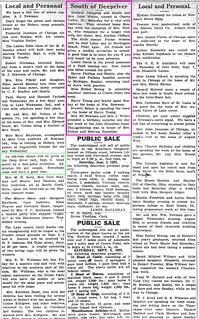
I'm sure everyone who's done online research knows the pain of chasing down wild geese that happen to have the same name as your own goose. There are towns in Iowa and Nebraska called Ainsworth, and both of them still exist, unlike this little Ainsworth of mine, and they clog up my search results. And in looking for Hobart, Indiana, I keep turning up things about towns in Tasmania, New York, Oklahoma, and Washington. The good thing about Merrillville is that there's only one … or so I thought, until I saw the first item in this "South of Deepriver" column:

2019-07-05. SoDR, News, 8-9-1923
(Click on image to enlarge)
Hobart News, Aug. 9, 1923.


Internet research fails to turn up the location of this town in Missouri. It does turn up references from the 19th century to a town called Merrellsville, but no one seems to know exactly where that town was. Google Maps, which identify such obscure places as my Ainsworth, don't acknowledge the existence of any Merrillville or Merrellsville in Missouri.

So if there is a Merrillville in Missouri, it keeps quiet. Very quiet.

Beyond that, the news south of Deepriver is not very thrilling.

Wednesday, May 3, 2017

So Where Was Albert Weiler's Farm?

That was what I asked myself in a recent post.

Albert, like the rest of the Weilers, is still something of a mystery to me. Thus far I've found out that he was born on November 10, 1888* to Michael and Fredericka Weiler (Indiana Death Certificates). Per the 1920 Census he farmed rented land … which might have been a farm of some 120 acres belonging to a Michael Weiler (his father?), shown here in the 1926 Plat Book:

2017-5-3. M Weiler 1926
(Click on image to enlarge)

That farm was next door to William Foreman's, so any roving dogs would not have had far to go to kill geese on both farms in one night. In terms of what's there today — I guess all those times we've visited the Albanese candy factory, we've been walking on the old Weiler farm (just my estimate; I haven't checked the legal description of that land).

Michael Weiler bought that land in late 1899 or early 1900 from heirs of J.P. Jones.** In the 1910 Census, Michael and Fredericka are living on what appears to be the same farm (to judge by their neighbors). Albert, age 21, is still in their household, along with his younger siblings, Minnie, Emory, and Emma.

Later that year Albert married Amanda Henning (Indiana Marriage Collection). Per the 1930 Census, they had two sons: Donald and Gerald. In that census, they seem to be at the same location. Someday I hope to find out exactly when Route 30 came through and bisected their farm; I think it was circa 1937. In the 1940 Census, to judge by their location in the enumerator's report, they seem to have moved a bit southeast — but that's just my guess.

As to Albert's relation to the many other Weilers of Ross Township … that is going to have to wait for some obituaries.

______________________
*Or 1889, if you believe the WWI Draft Cards.
**"General News Items," Hobart Gazette 5 Jan. 1900.

Wednesday, April 26, 2017

Ross Township Trustee's Report for 1922

Too many familiar names to index them all here, but I will add this to my list of Ross Township Trustee's reports and someday, someday, I will get around to creating an index.

2017-4-26. Ross Twp Trustee Report, 1922
(Click on image to enlarge)
Hobart Gazette 12 Jan. 1923.


Looking at the Dog Fund Disbursements, I learned that Gust Lindborg kept rabbits … which I'm guessing were destined for sale, or for the Lindborg family's dinner table. On other farms a lot of geese were killed — on the Harms farm, the William Foreman farm, and the farm of Albert Weiler.

But where (I ask myself) was the farm of Albert Weiler? — and I realize I don't know. I shall have to spend some time in the near future trying to find out.

Tuesday, October 4, 2016

Cursing, and Other Unpleasantness

Some nice local news … a new silo on the Gruel farm, innocent social activities South of Deepriver, blah, blah, blah …

2016-10-4. Gruel et al.
(Click on image to enlarge)
Hobart News 5 Oct. 1922.


… but also some juicy stuff, like "Mr. Traeger" cussing out Dr. Friedrich, a city health officer.

I do not want to guess at the identity of Mr. Traeger, whose first name is not given; but the location, I suppose, was the building at 235 Main Street. In 1922 it was only a former "saloon," as we use the word, since liquor could not legally be sold there.

And in the next column, we have a report of a big Ku Klux Klan recruitment rally in Hammond which gives us a look at how the Klan presented itself at that time and place. The open avowal of white supremacism is jarring, but otherwise the speaker was saying things that you can still commonly hear in both public and private discussions, and his concern that "a foreigner can come in here with a bomb in his hand" could have been voiced five minutes ago.

Monday, July 18, 2016

South of Deepriver, August 1922

Today is South-of-Deepriver Day, also known as Blogger-Takes-a-Nap Day.

2016-7-18. South of Deepriver
(Click on image to enlarge)
Hobart News 31 Aug. 1922.


And at the Niksches' Deep River Hall, an old-time dance, whatever that meant in 1922.

Monday, August 17, 2015

South of Deep River

First of all, I think that the reference to "Mrs. Carl Harper" as the secretary of the League of Women Voters' Ainsworth chapter was the newspaper's mistake for Pearl Harper, aka Mrs. Robert Harper. In the April 6, 1922 issue of the Hobart News, we find her placing a "Notice to Women Voters of Ainsworth" to announce a meeting at Lena Hunter's house, and signing herself as Secretary. Mystery solved.

Now, on to the social news from the countryside south of Deep River:

2015-8-17. South of Deepriver
(Click on image to enlarge)
Hobart News 6 Apr. 1922.


I suppose M.J. Guernsey was Melvin Guernsey, son of D.L. (David) and Stella Guernsey.

I'm having a little trouble identifying this newcomer, John Arnson. I suspect that the un-Americanized version of his name was Anders Johan Aronson, and the land he bought was in Union Township, Porter County, near Huffman's mill.

2015-8-17. Aronson 1928
(Click on image to enlarge)
Union Township plat map, 1928, from http://www.inportercounty.org/Data/Maps/1928Plats/Union-1928.jpg, courtesy of Steven R. Shook.


If I've identified him correctly, he was born in Sweden circa 1868, came to the U.S. circa 1886, and married Cora Burge on August 17, 1910. I suppose she was related to the Burges, a large family that went back to the 1830s locally, but I can't identify her precisely. As far as I can tell, John and Cora had no children. She died in 1939, he in 1944.


Additional Sources:
♦ 1920 Census.
♦ "Hold Rites for Mrs. Aronson." Vidette-Messenger (Valparaiso), 26 May 1939.
♦ Indiana Marriage Collection.
♦ "Johan Aronson, Age 74, Dies Sunday Night." Vidette-Messenger (Valparaiso), 21 Aug. 1944.

Wednesday, June 10, 2015

Students at the Vincent School

I have mentioned that in the spring of 1918 Evie Thompson's family moved to the vicinity of the Vincent school, and Evie became a student there. We have a photo of her with her classmates.

2015-6-10. EvaT012
(Click on images to enlarge)
Images courtesy of Eldon Harms.


On the back, someone has hinted at the identities of the children …

2015-6-10. EvaT013

… failing to include a full surname, or to indicate which name belongs with which child. The only one we can recognize is Eva Thompson herself, the tall girl with glasses, second from the left in the back row.

Looking through the 1920 Census, I have come up with possible surnames for these children, based on the matching first letter and the apparent proximity of their families to the Vincent school:
Elmer Reithel, Harry Sullivan, Clarence Reithel, Theodore Henning, Delmer Henning, Donald Weiler, Eva Thompson, Mathilde Prochno, and Mabel Burkley
These are only guesses on my part, and I still don't know which name goes with which child.

The former Vincent schoolhouse still stands on the southwest corner of the intersection of Clay St. and 83rd Ave., and you can still see that pattern in the brick on its side wall.

Incidentally, I suspect that when the Gazette, in June 1912, mentioned that Gust Lindborg had "bought the old Sullivan schoolhouse" and moved it to Ainsworth to serve as his residence, the building referred to was the old frame Vincent schoolhouse. At that writing, per the 1891 Plat Book, the Sullivans had owned for some twenty years what was originally the Vincent land (per the 1874 Plat Map), and the schoolhouse had always been catercorner to that land, so I can understand why either name might be applied to the schoolhouse.

Also, this obituary of Mercy Vincent suggests that the Vincents had owned the land from circa 1844 until circa 1890, which really has nothing to do with anything, but I didn't post this before so I might as well do it now.

2015-6-10. Mercy Vincent obituary
(Click on image to enlarge)
Hobart Gazette 12 Jan. 1906.

Wednesday, December 24, 2014

Merry Christmas from the Ainsworth School!

2014-12-24. Ainsworth school Xmas program 1939-40
(Click on image to enlarge)
Image courtesy of Eldon Harms.


There is no date on this program, but one of the participants estimates that it took place in the very late 1930s, or 1940 at the latest. The Ainsworth school had a Christmas program every year (she tells me), as well as a Halloween masquerade party and some sort of program in the spring. And every month during the school year, a "community meeting."

I wish I could index every surname, but Blogger won't let me. So I will just type them out for the search engine: Baldner, Bergman, Blimel, Bodamer, Bowers, Bryant, Buchfuehrer, Bush, Busselburg, Carden, Collins, Dick, Doepping, Dorman, Engstrom, Ford, Gernenz, Harms, Hartin, Homeier, Johnson, Jones, Kissinger, Klemm, Kuntz, Lines, Madura, Maihofer, Mitchell, Moreland, Nelson, O'Brien, Olson, O'Neil, Peterson, Pike, Piske, Ready, Robb, Robinson, Schmidt, Shaw, Sullivan, Tonagel, Watts, Weiler, Wesley, Willy, Wise, Witham, Wojahn, Yager, Ziemanski.

Tuesday, December 10, 2013

South of Deepriver

Here's a South of Deepriver social column that might be mildly interesting if you're related to these people. Also, John Killigrew, moving up in politics, is attending the inauguration of Warren T. McCray; John's brother, William, seems to be doing well in his oil business with Lewis Barnes and Calvin Shearer.


South of Deepriver social column
(Click on image to enlarge)
From the Hobart News, 13 Jan. 1921.

Saturday, November 23, 2013

Still Not Tuberculosis

The last "South of Deepriver" column of 1920 tells us, among other things, that poor Bertha Nolte Campbell was, in the family tradition, continuing to suffer poor health; but her illness probably wasn't tuberculosis, as the treatment for that would not be surgery.

South of Deepriver
(Click on image to enlarge)
From the Hobart News of 30 Dec. 1920.


Also, a big party for the little Sauter born on Christmas Day.

Thursday, October 10, 2013

The Great Cattle Drive of 1920

This social column from the Hobart News of December 2, 1920, finds H.H. Smith going to Chicago and bringing back cattle, as if Ainsworth didn't have enough cattle already.

South of Deepriver column
(Click on image to enlarge)

So who (I ask myself) was this H.H. Smith, since I find myself knowing absolutely nothing about him? — which turns out to be surprising, because a little research shows that these Smiths have been in the area since 1860 at least.

I believe "H.H." was Howard H. Smith, son of Homer and Rachel Smith, grandson of George and Caroline Smith, whom the 1860 Census finds farming in Union Township, Porter County, having come from Ohio, apparently, via Michigan. The 1870 Census records the Smith family farming in Ross Township, Lake County, with Homer still single and living at home, but in December of that year he married Rachel Hurlburt (Indiana Marriage Collection). By the 1880 Census Homer and Rachel had four children — Abbie (8), Howard (6), Rudie (4) and Millie (2). Their farm was, I believe, 80 acres on the county line in southeast Ross Township; that parcel belongs to "H. Smith" per the 1874 Plat Map, and per the 1926 Plat Book is owned by "Rachael Smith."

In the 1920 Census, the widowed Rachel is living there with her son, Howard, who at the age of 45 is still single. The other children have gone, I don't know where.

But you can see it was a fair distance to drive 24 cattle from the Ainsworth depot, especially when you had to dodge reckless motorists.

Rachael Smith land

Checking my notes, I find a few references to this branch of the Smith family. In fact I've been neglecting them since 1903!
  • "Contractor Abel has had three cars of lumber shipped to Ainsworth, to be used in the construction of a new barn for Howard Smith who lives south of Deepriver." ("General News Items, Hobart Gazette 15 May 1903.)
  • "John Hann, a farm hand employed on the Smith farm, near Deepriver, had his right hand badly mangled in a corn shredder Tuesday. Part of the hand had to be amputated." ("General News Items," Hobart Gazette 4 Nov. 1904 [not entirely sure that's the right Smith farm].)
  • "T.A. Strong has the job of building a barn for Howard Smith south of Deep River." ("Personal and Local Mention," Hobart News 9 Apr. 1913.)
  • "H.H. Smith helped to car wheat at Ainsworth Monday and Tuesday of this week for Wm. Raschka." ("South of Deepriver," Hobart News 27 Apr. 1916.)
  • H.H. Smith bought a team of horses. ("South of Deepriver," Hobart News 20 Feb. 1919.)
  • The John Dick family visited H.H. Smith and his mother. ("South of Deepriver," Hobart News 1 Jan. 1920.)
  • H.H. Smith and his mother joined members of the Fisher, Crisman and Ripley families in visited Mr. and Mrs. Ben Edwards at Gary. ("South of Deepriver," Hobart News 7 Oct. 1920.)
And then the great cattle drive is the next recorded event. You know what? — I think I may just go right on neglecting these people.

Wednesday, June 12, 2013

A Threshing Party

…and a load of fertilizer, and a lot of minor socializing.

South of Deepriver column
(Click on image to enlarge)
From the Hobart News of Sept. 2, 1920.

Saturday, June 8, 2013

Goodbye Horses, Hello Tractor

The Price farm gets mechanized, August 1920.

F.B. Price news
(Click on images to enlarge)
From the Hobart News of August 26, 1920.


♦    ♦    ♦

The "South of Deepriver" column from the same paper includes an interesting item about a schoolteacher off to teach in the wilds of South Dakota (or maybe the biggest city there, for all I know). While there were loads of Pecks in the area, I hadn't encountered the name "Myrl" before. I do wonder if it mightn't be Margaret Peck, a 21-year-old woman who had been working as a clerk in the Deep River store of William and Sadie Baker … and perhaps dying of boredom … but that's just my wild speculation.

"South of Deepriver" social column

Thursday, September 27, 2012

Meanwhile, At the Weilers' …

There were a whole lot of Weilers farming around Ainsworth, and I haven't yet figured out their relations to each other, if any.

One of them, Mrs. Mary Weiler, announced in the autumn of 1919 her intention to quit farming:

Weiler public sale
(Click on image to enlarge)

This Weiler, I believe, was the widow of the Christian (Christ) Weiler who bought some Blachly land in 1912. Christ died May 28, 1916.

C. Weiler obit

I am mystified by "Mrs. Louise Weiler of Chicago" — she sounds like the widow of a deceased son, but the only children recorded in the census are the four boys named in this obituary. If they had an older brother, he must have left home early, before the 1900 census. And he must have died before 1912, since Louis, when he married Martha Klemm in that year, was described as the eldest Weiler son. The youngest, Will, may have been the soldier lately returned from overseas.

On the 1908 plat map, I find more than one parcel labeled "C. Weiler," plus there was the 1912 purchase.

C. Weiler land 1908
(Click on image to enlarge)

From the directions in the sale notice, I think the sale happened at the southernmost parcel. The Vincent schoolhouse was well south of present-day U.S. 30.

Once the sale was over, Mary would lease the farm to her son George, who would carry on with farming, while Mary would "make her home with her children," in the cryptic words of the News.

♦    ♦    ♦

Next to Mary's public sale notice, above, ran a similar notice placed by Eugene Chandler. His sale, as we know, was in preparation for the move to his new farm.

Construction was still underway on the new farm. The News listed the buildings going up: "a modern brick house, barn, granary and chicken house." Eugene had even hired Lee & Rhodes to install a "Standard" electric lighting plant, to give his farm electricity at about half the cost of town power.

The new brick house, built by James Carpenter, Walter Boal and Willard Stevens, was now ready for the plasterers. The Halsted brothers were building the barn. Who had the honor of building the granary and chicken house is not recorded.

E. Chandler 1926
(Click on image to enlarge)
I believe this is the Chandler farm as it appeared in 1926. I wonder if the lovely old brick house at 5501 S. Liverpool Road is the "modern brick house" that the Chandler family moved into?


Sources:
♦ 1900 Census.
♦ 1908 Plat Map.
♦ 1910 Census.
♦ 1926 Plat Book.
♦ "Local and Personal." Hobart News 13 Nov. 1919; 20 Nov. 1919.
♦ "Local Drifts." Hobart Gazette 14 Nov. 1919.
♦ "Public Sale." Hobart News 13 Nov. 1919.

Wednesday, June 27, 2012

Ross Township Column!

Like Nessie breaking through the surface of the loch for an instant, a Ross Township column makes a sudden, brief appearance in the Hobart News of July 18, 1919. How long has it been since we've had an Ainsworth social column?

Ross Township Pick-Ups
(Click on image to enlarge)

After this one issue, the Ross Township gossip vanishes again.

Sunday, April 15, 2012

Stay for Supper

"Stay for supper, won't you?" Minnie Osborne urged her sister, Ethel Meyers. The little Meyers family — Ethel, Warren and their nine-year-old daughter, Marie — had come out from their Porter County farm to spend Saturday, March 29, in Hobart with the Osbornes.

It was a tempting offer. Ethel and Warren wavered, but finally duty won out: there were chores that needed to be done before dark, and a drive of nearly 20 country miles lay between Hobart and their farm northeast of Hebron. So around 5 o'clock the Meyers climbed into their Ford and set out, heading southeast. Their route was through Wheeler.

At Wheeler, William Raschka sat in his car near the railroad depot, looking toward the west crossing. Two sets of railroad tracks, the Pennsy and the Nickel Plate, ran side-by-side through the town. William could probably already hear the rumble of the Nickel Plate mail train, approaching from the east. It was running late, and with no need to stop in Wheeler, the engineer could throw open the throttle to make up for lost time.

As William watched, two autos approached the crossing: from the north, the Meyers' Ford, and from the south, a car driven by Clarence Burge of Wheeler. There were, of course, no lights or gates at the crossing. Clarence cleared the Nickel Plate tracks, but he had noticed the train flying toward the crossing, so he called out a warning to Warren, who was just then crossing the Pennsy tracks.

What happened next mystified Clarence. Later he theorized that his shouting may have confused Warren. For whatever reason, the Meyers' Ford slowed down, and then, as it rolled onto the Nickel Plate tracks, it stopped.

The speeding train caught the Ford square in the middle. Pieces of the car were flung toward the south, scattered for a hundred feet along the tracks, but the top of the car and the three occupants it sheltered were caught by the engine's pilot and carried for the half-mile it took the train to stop.

Clarence and William left their cars and ran to catch up with the engine.

William knew the Meyers family, so it must have been a shock when the men pulled aside the wrecked car top and found Warren and Marie dead, killed instantly. Ethel, remarkably, was alive and conscious, though badly injured. She recognized William. He asked her if he could do anything to help, if he could notify anyone. She told him no, and added that she would be all right as soon as the pain stopped.

She and the bodies of her husband and child were loaded onto the train that had hit them, bound for Hobart. Someone probably called ahead to alert doctor and undertaker; when the train stopped at Hobart, the bodies were removed, to be taken to Alwin Wild's undertaking parlor, while Dr. C.C. Brink boarded the train to accompany Ethel to Mercy Hospital in Gary.

She died on the ambulance on the way to the hospital.

Warren was survived by his father, Henry Meyers of Crown Point, and one brother. Ethel was survived by her parents, Wallace and Mary Thompson of Hebron, two twin brothers, and — besides her sister, Minnie Osborne — another sister, Olive, now married to Arthur Weiler of Deep River.

The little family's funeral took place that Wednesday in Hebron, and they were laid to rest in the Salem Cemetery.

I expect that Minnie Osborne suffered a little from the kind of guilty hindsight that tends to afflict survivors in such cases — that she spent some time wishing she had been more forceful in urging her sister and brother-in-law to stop worrying about the chores so much, just this once, and stay for supper.


Sources:
♦ 1900 Census.
♦ 1910 Census.
♦ 1920 Census.
♦ 1930 Census.
♦ "Family of Three Killed at Wheeler." Hobart Gazette 4 Apr. 1919.
♦ "Myers Family Killed in R.R. Accident at Wheeler." Hobart News 3 Apr. 1919.

Friday, February 17, 2012

"Practically All His Life"

Late in January 1919, Charles Maybaum, Jr. left his Ross Township home to move in with Arthur and Olive Weiler in Porter County. The Gazette noted that he had "spent practically all his life on the farm south of Ainsworth." Omitted from "practically all his life" were the first five years of it, spent in Germany where he was born, and the journey of over 4,000 miles that brought him to Ainsworth. Aside from that, then, let us say that he was an unadventurous homebody, at the age of 52 still a bachelor living in the old family home with his widowed mother, Caroline.

A week later comes news that gives us an idea of the reason for the move: the 76-year-old Caroline was sick, and had been for several weeks. She was under the care of her daughter, Hattie Sizelove. Hattie may have come to Caroline's house, or brought Caroline to her own; either way, apparently the old Maybaum household was disrupted enough to make Charles leave the home where he had spent practically all his life.


Sources: "Local Drifts." Hobart Gazette 31 Jan. 1919; 7 Jan. 1919.

Friday, February 18, 2011

A Man of Mystery

After Morgan Blachly's death in 1910, his widow, Amelia, retained ownership of at least part of the 180-acre homestead, although she and their only daughter, May, went to live in Hobart. In 1912 Amelia sold the southeast 40 acres to Christian Weiler. As for the rest, she may have rented or sold parts of it to the three Blachly sons, Walter, J.B. and Earl, as all of them were farmers.

In 1913 Earl got tired of farming, bought a partnership in B.C. Wells' Hobart garage and sold all his livestock and farming equipment — but he didn't sell his land, just rented it to someone else. After about a year in the garage business, Earl had enough of that and returned to the farming life. His wife of 12 years, Elizabeth (née Bodamer), divorced him in 1916 and was awarded custody of their daughter. Earl consoled himself in 1917 by marrying Annie Witt — yes, of that same Witt family whose members have been all over the Ainsworth area. (Elizabeth married Walter J. Tutwiler of Hobart in December 1917.)

By contrast, J.B. and Walter Blachly had more stable lives. Their farming and their marriages went on without interruption.

In 1915 May Blachly traded three lots she owned in Hobart for 75 acres of farmland, known as the old Ragen farm and lying across the Joliet road (73rd Ave.) from the Blachly homestead. A couple years later, she and her mother left their Hobart home and moved to May's farm. After living there about four months, May began advertising her farm for sale.

MayBlachly75
(Click on image to enlarge)
Outlined in green is the 75-acre parcel May Blachly bought in 1915 — just north of the old Blachly homestead, outlined in red.


She found a buyer in S.J. Craig, Lake County's agricultural agent and the author of this immortal tome:

AgriAdvisor
(Click on image to enlarge)

I wonder if there was any awkwardness about his coming into the neighborhood, considering the unpleasantness of 1914 — following the outbreak hoof-and-mouth disease that year, local farmers John Gruel and William Shults (along with Fred Bowman of Lowell) led an effort to remove S.J. from office, and the petitions they circulated eventually garnered 200 signatures. But perhaps by 1917 that was all bygones.

As for S.J. himself, he's a man of mystery. I don't even know his given name, since he never used it, even, it seems, hiding out from census enumerators so he wouldn't have to give it — which also means I know nothing about his family, if he had one. I've seen him now and then in the news, but only in his official capacity, e.g., haranguing people to produce food for the war effort.

Perhaps if he comes to live on this farm, we'll find out more about him.

CraigontheJob
County Agent S.J. Craig (right) on the job, from The Lake County Agricultural Advisor. Note how he carefully hides his face from the camera.


Sources:
♦ 1891 Plat Book.
♦ 1926 Plat Book.
♦ "Additional Local News." Hobart Gazette 21 Sept. 1917.
♦ "Blachly-Witt." Hobart News 19 Apr. 1917.
♦ Craig, S.J. The Lake County Agricultural Advisor. Crown Point: Lake County Star, 1916.
♦ Indiana Marriage Collection.
♦ "Local Drifts." Hobart Gazette 30 Jan. 1914; 1 May 1914; 3 Aug. 1917.
♦ "Personal and Local Mention." Hobart News 31 July 1913; 10 Dec. 1914; 28 Jan. 1915; 4 Feb. 1915; 9 Mar. 1916.
♦ "Personal Mention." Hobart News 8 Aug. 1912.
♦ "Public Sale." Hobart News 20 Feb. 1913.
♦ "Tutwiler-Blachly Nuptial." Hobart Gazette 7 Dec. 1917.
♦ Untitled social column. Hobart News 19 Apr. 1917; 2 Aug. 1917; 11 Oct. 1917.
♦ "Wells & Blachly Is Name of New Garage Firm." Hobart News 3 Apr. 1913.