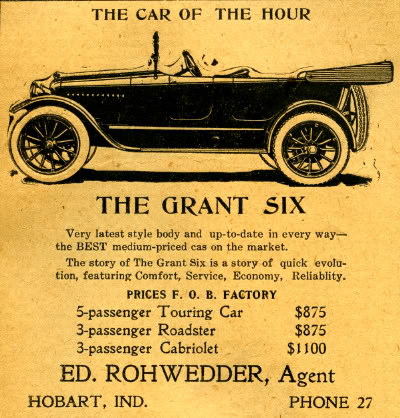
 From the Hobart Gazette of July 6, 1917.
Like his older brother
Charles, James Chester once got involved in a chase after car thieves. But since James is the boring Chester, he did it in a far less exciting way.
It all began about 4:30 in the morning on Saturday, April 14, 1917. Someone stirring in the George Lutz farmhouse southeast of Hobart happened to notice, out near the road, a bonfire surrounded by what looked to be about six young men, warming themselves. Nearby stood a car. The observer thought nothing of it. When daylight came, the young men had disappeared, the bonfire had gone out — but the car was still there, and it was a brand-new Grant Six. Someone got on the phone to tell Marshal Fred Rose about the abandoned car.
The Marshal had just gotten back downtown from a little trip to the west side of the Deep River. On the Nickel Plate right-of-way near the old amusement park, he'd found six young men standing around a burning pile of scrap wood.
Calvin Fleming had bought and paid for that wood, so Rose warned them not to burn any more of it. The young men, who looked to range in age from late teens to early 20s, said that they were just trying to stay warm while they waited to catch an eastbound freight out of town. The Marshal decided to let them go their way, and he went his.
When he got the phone call about the abandoned car near the Lutz farm, however, something clicked in his mind and he decided to have another talk with those six young men. He went back to the Nickel Plate tracks, spotted the young men — they'd moved along toward the "J" tower — but as soon as they saw him, they took off running.
Now the Marshal
really wanted to talk to them.
He knew that he, alone and unarmed, was no match for six young men. He hurried to the Nickel Plate Garage, where he found the garage owners, Clarence Frailey and Cal Beltzhoover, and James Chester. He enlisted their help — and Clarence's shotgun — and they all set out after the six fugitives.
Soon it occurred to Clarence, Cal and James that the young men would probably return to the car they'd abandoned. They doubled back to the garage, got one of the livery autos and drove to the Lutz farm to stake out the Grant Six.
That left the Marshal in sole pursuit of the fugitives, but this time he had a shotgun.
He followed them east, then southeast, along the Nickel Plate tracks. At the William Bach farm, the young men veered from the tracks and took off across the open fields. The Marshal was right behind them — now gaining on them. He yelled at them to stop. Four obeyed; two kept running. That's when Rose finally fired the shotgun. He hit one of the young men in the legs, slightly wounding him. Both were scared into stopping. And so the Marshal single-handedly corralled six fugitives, hauled them back to town and lodged them in jail.
Eventually he got word to James and his two companions that their services on stakeout were no longer needed.
It was the wounded man who first broke down and confessed that he and his friends had stolen the Grant Six in Cleveland on Thursday night. Hard driving had carried them over 300 miles in little more than a day, but near Hobart they'd taken a rough railroad crossing too fast and damaged an axle so badly that the car could only limp along, which was why they'd abandoned it.
The Marshal telegraphed the Cleveland police. They soon responded that the Grant Six was indeed the stolen property of the National Acme Co. of Cleveland. The salesman who drove it, one Frank Spencer, came out to collect his car, and after getting the axle repaired, he drove it back to Cleveland.
Meanwhile, the Cleveland police also sent someone out, and the young men were carried back home to Ohio via the Nickel Plate.
Thus was the crime solved, and while James Chester's role in the drama was not very exciting, let us remember that "they also serve who only stand and wait."
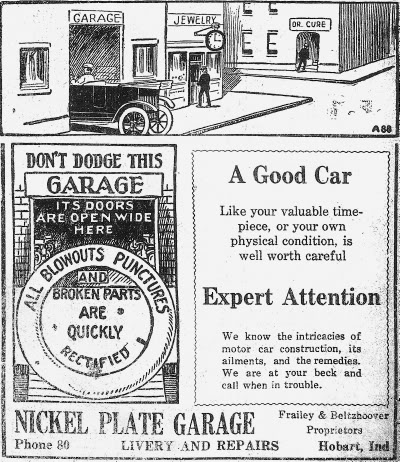 From the Hobart News of May 31, 1917.
Sources:
♦ "Marshal Rose Captures Auto Thieves." Hobart Gazette 20 Apr. 1917.
♦ "Marshal Rose Picks Up Six Young Auto Thieves Saturday A.M." Hobart News 19 Apr. 1917.


