Showing posts with label Harms 73rd Ave farm history. Show all posts

Wednesday, August 24, 2022

Series Finale: The Harms 73rd Ave. Farm History

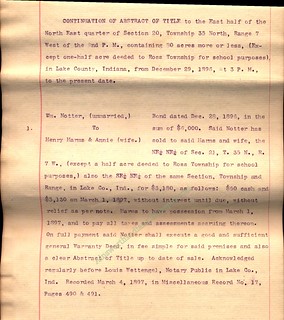
And now we come to the waning days of 1896 — December 28, to be exact — and William Notter is selling his 79.5 acres to Henry and Annie (born Johanna Springman) Harms, who were living on and farming their old homestead to the northeast of this property. The Harmses were to pay $3,180 for the land (about $112,000 in today's money) in installments.

2022-08-24. 1896-12-28 Notter to Harms -- Harms 73rd Ave farm history
(Click on images to enlarge)
Images courtesy of the Eldon Harms family.


The transaction included an action to quiet title, a review of the property's owners — not all of them, in this case, as you can see. I'm guessing the action named only the ones who might conceivably have some claim to the land.

2022-08-24. 1896-12-28 Notter to Harms -- quiet title 1

2022-08-24. 1896-12-28 Notter to Harms -- quiet title 2

2022-08-24. 1896-12-28 Notter to Harms -- quiet title 3

The only new information we get from this concerns Emma Smith, daughter of Luther and Sarah: in 1881 she married William J. Hatch in Chicago; they had five children, and then Emma died in 1893. None of the surviving Hatches turned up to contest the title to the farm.

This is the title bond that William Notter gave to Henry and Annie Harms on December 28, 1896, promising to deliver title to the land and "a clear abstract of title" upon payment of the full purchase price, without interest.

2022-08-24. 1896-12-28 Notter to Harms title bond - Harms 73rd Ave farm history

On the outside of the title bond, William Notter jotted down a payment by the Harmses of $300 on the "noat" in January 1897. Below that, someone with more polished handwriting (Louis Wettengel, probably) recorded a larger payment, and William signed his name.

2022-08-24. 1896-12-28 Notter to Harms -- title bond verso 1 - Harms 73rd Ave farm history

And this, also from the verso of the title bond, is why I think the person with the polished handwriting was Louis Wettengel.

2022-08-24. 1896-12-28 Notter to Harms title bond verso 2 - Harms 73rd Ave farm

Louis was a resident of Hobart, who appeared in the 1870 Census as a saloonkeeper, but by the 1880 Census had made a lawyer of himself. He and his wife, Emmeline (Shearer), had many children, lived out their lives in Hobart and are now buried in Hobart Cemetery.

By October 16, 1897, Henry and Annie Harms had paid off the purchase price of the land, and William Notter gave them the deed.

2022-08-24. 1897-10-16 Notter to Harms - warranty deed - Harms 73rd Ave farm

2022-08-24. 1897-10-16 Notter to Harms - warranty deed verso 1 - Harms 73rd Ave farm

2022-08-24. 1897-10-16 Notter to Harms - warranty deed verso 2 - Harms 73rd Ave farm

And so we come to the end — not of the history of the farm, but of this abstract. I'm afraid I've already given away an episode of the sequel, when Henry and Annie sold 9 acres of the land to Herman and Minnie Harms in 1938. From a comparison of the 1939 Plat Book to the 1950 Plat Book, we can see that a lot more dividing and selling of the land went on over the course of that decade. I shall see if I come across any details in the future.

Tuesday, August 9, 2022

A Naughty Notter

As we saw in our last post, Gustave and Wilhelmine Wegner bought the northern 39.5 acres of the Harms 73rd Avenue farm on April 16, 1878. On October 5 of that year, they sold their land to William and Catharine[1] (known as Kate) Notter …

2022-08-09. 1878-10-05 Wegner to Notter - Harms 73rd Ave farm history
(Click on images to enlarge)
Title abstract images courtesy of the Eldon Harms family.


… who assumed the remainder of the mortgage on the land. By 1880 they had paid it off:

2022-08-09. 1880-12-30 Kenneke-Wegner release of mortgage - Harms 73rd Ave farm history

In 1886 the Notters bought the southern 40 acres of the future Harms farm from Christian and Johanna Beilfuss.
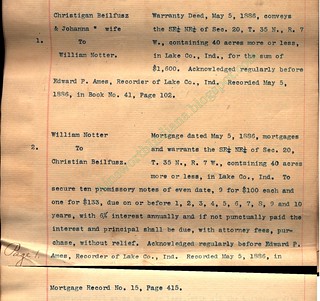
2022-08-09. 1886-05-05 Beilfuss to Notter - Harms 73rd Ave farm history

The day of that sale, the Notters borrowed money from the State of Indiana, mortgaging their northern 40 again.
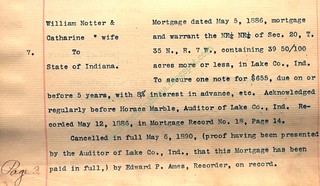
2022-08-09. 1886-05-05 Notter to Indiana - mortgage  - Harms 73rd Ave farm history

In 1890 and 1894, the Notters again borrowed money from the state, securing the debt with mortgages on both the northern and southern halves of their farm. I have no idea what was going on here.
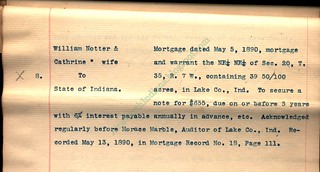
2022-08-09. 1890-05-05 Notter to Indiana - mortgage  - Harms 73rd Ave farm history

2022-08-09. 1894-11-10 Notter to Indiana - mortgage - Harms 73rd Ave farm history

They did pay off their debt to the Beilfusses in 1893.

2022-08-09. 1893-10-23 Beilfuss to Notter  - release - Harms 73rd Ave farm history

♦    ♦    ♦

William Notter was a native of Canada, born circa 1837. He came to the U.S. probably in the early 1860s, since he married an Illinois-born woman, Catharine Golden, before 1864.[2] In the 1870 Census, the Notter[3] family was recorded in Chicago, with three sons: William (born circa 1864), Thomas (1867), and Edward (1869).

As we've seen, in 1878 they bought their first 40 acres and presumably relocated to Ross Township, where the 1880 Census records them. Their eldest son, William, was not accounted for in that census; possibly he had died; it's also possible he left home at 15 or 16 years of age. The Notter children accounted for in 1880 were Thomas and Edward, and a daughter, Fannie, born circa 1875.

In 1891, William and Catharine leased their 79.5 acres in 1891 to Christ Springman:
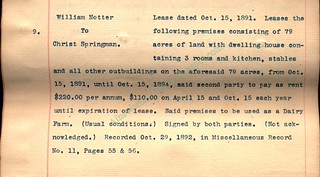
2022-08-09. 1891-10-15 Notter to Springman - lease - Harms 73rd Ave farm history

Since two families had once occupied those 80 acres, perhaps there was a spare house for the Notters to live in while Christ Springman ran the dairy farm. But at some point William bought another 13 acres on the northeast corner of the intersection of Randolph and 73rd, per the 1908 Plat Map.

Sometime before 1900, Catharine died — when and where, I don't know. I can't find any record of the death, or a grave, either here in Ross Township, or in Illinois. The last mention we have of her is the 1894 reference in the title abstract.[4] The 1900 Census shows William, a widower, living alone in Ross Township, farming his own land (probably the 13 acres). The children had grown up and left home.

The "General News Items" of the Hobart Gazette of February 8, 1901, carried an item noting that William Notter "who lives about one-half mile west of Deep River" had sold all his goods and was planning to move to Chicago. But it wasn't until the September 20, 1901 issue that this notice appeared:
"For Sale — My chicken and truck farm one mile west of Deep River, Indiana, comprising 13 acres, a new brick and terra cotta house, frame barn, corn crib and terra cotta chicken house; good water. Will sell for cash or on terms to suit purchaser. Wm. Notter, 396 W. Polk street, Chicago, Ill."
Per the pre-1916 Illinois on-line death records, William died in 1904, but I can't find his grave.

♦    ♦    ♦

The title of this post promised you a naughty Notter. To find him, we must go back to 1896, to the August 21 issue of the Hobart Gazette:
Thomas Notter in Trouble

A special from Crown Point to the Chicago Times-Herald, dated Aug. 19, reads as follows: Thomas Notter was arrested this morning at Deep River, this county, for a clear case of bigamy on complaint of wife No. 1, a resident of Chicago. The bigamist and his wife were taken before Judge Van Winkle this morning. Notter was bound over to the circuit court in the sum of $1,000, and wife No. 2 was held in bonds of $200. In 1892 wife No. 1 was married to Notter at South Omaha, Neb., by Father Thomas. They then moved to Chicago and lived in that city for over three years. During this time three children were born to them. Unknown to Mrs. Notter No. 1, Notter was secretly married to Miss Hock of Laporte, Ind., in December, 1895, by Father Welch of Chicago, and took up quarters in Chicago, and there they remained about two months. They then moved out to Deep River, off a railroad, and located on a farm, where they have remained up to today. Mrs. Notter No. 1 began a search soon after her husband disappeared in Chicago and finally located the couple at Deep River.
This Thomas was the son born to William and Kate circa 1867.

A family tree on Ancestry.com includes the paperwork for a marriage in Omaha, Nebraska in 1889:

2022-08-09. 1889-18-12 Notter, Thomas - Nebraska marriage record
(Click on image to enlarge)
Image from Nebraska, U.S., Select County Marriage Records, 1855-1908 via Ancestry.com.


Was this yet another marriage, or did the article quoted above get the date of the first marriage wrong? (It's unfortunate that the article doesn't give the first wife's name.) The Cook County, Illinois, Marriages Index does indeed show Thomas marrying 21-year-old Frances Hock in December 1895.

I don't know any more about the bigamy case — for example, whether Thomas served time in prison, or paid a fine.

Thomas and his first wife may have kissed and made up after all this mess. In the 1900 Census Thomas is recorded with a wife named Mary. However, as noted by the enumerator, he claimed to have married her only a year prior. I can find no record of that marriage. In the 1910 Census, Thomas was living alone, saying he was a widower. In June of 1913, there's a record of a Thomas Notter marrying an Anna Daley in Cook County; in December 1921, a Thomas Notter married an Anna Powers, same place. One of these (or maybe both) might be our Thomas, whose wife, at the time of his death in 1925 per the Illinois Deaths and Stillbirths Index, was named Anna. But her maiden name is not included in that record.

To top off the story, I will just add that in 1898 Thomas' brother, Edward, married a young lady named Anna Louise Hock, whom I believe to be the sister of Thomas' partner in crime. The 1880 Census shows a Hock family in LaPorte, Indiana, which includes two young girls named Frances and Anna. The girls' ages in that census correspond to their ages in subsequent records: the 1895 marriage record in the case of Frances, and later censuses in the case of Anna.

Edward and Anna were married in Chicago. I can't find them in the 1900 Census, but the 1910 Census shows them living in Ross Township, by which time they had a son, George, and a daughter, Vernet(te). They owned a farm in the vicinity of Deep River (possibly Edward bought his father's 13 acres) and made occasional appearances in the local newspaper social columns. In 1913 Edward sold his farm and relocated to Charlestown, Clark County, Indiana, allegedly "to assist his brother in farming," according to the Gazette[5] — what brother, I'd like to know! Was this the long-lost William, or did Thomas slip out of the city between the 1910 and 1920 censuses, to farm a bit? Or maybe there was another brother I've missed? I can't identify any Notters in that location except for Edward and family, who appear in the 1920 Census (by which time there was another son, Brent). It's possible, of course, that the Gazette got the "brother" part wrong. But if the brother was Thomas, well, all I can say is … awkward.

_______________
[1] Spellings of her name vary. I chose one at random.
[2] I can't find a record of this marriage. I'm going by the age of their eldest child per the census.
[3] The enumerator spelled their surname Knotter.
[4] Someday I have to read the 1890s Hobart and other local newspapers on microfilm. I have only skimmed through them without taking notes, back when when very few names meant much to me.
[5] "Additional Locals News," Hobart Gazette, 14 Mar. 1913.

Sunday, July 31, 2022

Finally Getting Back to the Harms 73rd Ave. Farm

Back in 2021 I started exploring the history of the Harms 73rd Avenue farm. I was making good progress when some shiny object passed before my eyes and I got totally distracted and lost my momentum. I have to go back and try to figure out how to pick up where I left off. This happens to me all the time.

Anyway …

Regarding the northern 40 acres, we left off with the elusive Ehrfurths buying the parcel in 1875.

Over the next few years, other elusive people bought and sold the land.

Even before the Ehrfurths' mortgage was released in February 1878, they turned around the sold their farm to one Henrich Kenneke.

2022-07-31. 1877-09-05 Ehrfurth to Kenneke - Harms 73rd Ave. farm abstract
(Click on images to enlarge)
Images courtesy of the Eldon Harms family.


I can't positively identify Henrich (whom one might also expect to encounter as Heinrich or even Henry). Tax assessment records from the 1860s show Henry Kenneke operating a hotel, selling liquor, and giving public exhibitions in Terre Haute.[1] In 1875, Heinrich Kenneke married a Johanne Bethke in Cook County, Illinois;[2] I think that may be our guy, although I would expect the 1877 sale record above to mention the wife. A wife by that name does get mentioned a year later, when she and Henrich sell the land.

2022-07-31. 1878-04-16 Kenneke to Wegner - Harms 73rd Ave. farm abstract

And that is all I've been able to find out about either of the Kennekes.

The buyers in that sale were Gustave and Wilhelmine Wegner. I may have found them in the 1880 Census, living in Chicago with their two small children. By then they themselves had sold the farm as well. About six months' ownership of 40 acres is all the contact I can find between them and Ross Township.

♦    ♦    ♦

Looking at the southern 40 acres, we pick up in 1882, when Frederick Suhr, a widower of just a few months, sold his farm to Christian Beilfuss.

2022-07-31. 1882-09-14 Suhr to Beilfuss - Harms 73rd Ave. farm history

2022-07-31. Beilfuss - abstract of title for Harms 73rd Ave. farm

Christian was a German immigrant, about 55 years old at the time. He and his wife, Johanna,[3] had both arrived in this country in 1872, the same year they married in Cook County, Illinois.[4] I can't actually place their family in Ross Township, but then I can't find them at all in the 1880 Census. The only other record I can find of them is the 1900 Census, where they are living in Chicago with their son, 19-year-old Louis. The record of their children is a bit mysterious. Per the 1900 census, Johanna had only one child, ever. And yet I've found a death certificate for a Martha Burge, born in 1879, who died in 1963 in Crown Point, and whose parents' names are recorded as Christian Beilfuss and Johanna Orgel. She had married Orrin Burge in Cook County in 1896, and subsequent censuses record them and their growing family in Lake County — farming in Winfield Township through 1930, then moving to Crown Point by 1940. Orrin was the son of Milo Burge and Lucy Sturtevant; thus the Beilfusses would have had a connection to two old local families.

Perhaps the 1900 enumerator made a mistake in noting that Johanna was the mother of only one child. Perhaps Johanna misunderstood the question.

Christian and Johanna Beilfuss sold their Ross Township farm four years after they bought it. As I said, I can't establish that they ever lived on that farm, or anywhere in Lake County, Indiana.

Christian died in Chicago in 1905, Johanna in 1925.[5]

_______________
[1] Ancestry.com, U.S., IRS Tax Assessment Lists, 1862-1918. This hotelkeeper might never have left Terre Haute, where he is buried.
[2] Cook County, Illinois, Marriages Index.
[3] Her maiden name is transcribed various ways, but most commonly "Oergel" or "Orgel."
[4] Cook County, Illinois, Marriages Index.
[5] Someone on findagrave.com has credited them with yet two more children, one of whom (William) might be Christian's son from a previous marriage, and the other of whom (Johanna) I cannot account for.

Friday, October 29, 2021

Mr. and Mrs. Johann Christian Traugott Erfurth, Just Passing Through

Now let's get back to the northern 40 acres of the Harms 73rd Avenue farm. We left off in 1870, at which time ownership of those 40 acres was transferred from Charles Smith to Albert Van Doozer. Charles' parents, Jacob and Hannah, may or may not have still been leasing the land and farming it themselves.

Five years later, it appears that the elder Smiths had no further want of the land, for whatever reason that may have been. On New Year's Day, 1875, Albert and Emma Van Doozer sold the land to someone named Johann Christian Traugott Erfourth.

2021-10-29. 1875-01-01 Van Doozer to Erfourth - Harms Abstract of Title 018
(Click on images to enlarge)
Images courtesy of the Eldon Harms family.


Johann aka John, and his wife, Eliza Rosalia, borrowed the money to purchase the land from one Emma P. Smith …

2021-10-29. 1875-01-01 Mortgage - Erfourth to Smith - Harms Abstract of Title 019

… who was, I'm guessing, the daughter of Luther and Sarah Smith. If my guess is correct, Emma was about 20 years old (born circa 1855 per the 1860 Census). I do not know where a 20-year-old would get $500 to lend out, unless she inherited it from her mother, or perhaps a grandparent (we know that both her grandparents were dead by September 1877). I have not been able to find out anything about Emma's life after her father's estate was distributed, beyond the fact that she became an orphan in 1871.

The surname of the purchasers has already appeared in two different spellings: Erfourth and Erfurth. Later it shows up as Ehrfurth. Even with all those options I cannot identify Johann and Eliza in any other record, such as a census, that would give us details about them.

A lien search two years later (when the Erfurths were selling the land) showed that Johann had been active enough, during the previous ten years, to be involved in a couple of lawsuits:

2021-10-29. 1877-09-12 lien search Harms Abstract of Title 021

That first lawsuit, Ehrfurth v. Kline, might have involved an Ainsworth-area Kleine/Kline, but without a first name we can't know.

The second lawsuit, Steinfeld v. Ehrfurth & Bommerschein, tells us that the Erfurths were in business with a Martin Bommerschein — but I can't find any information about him, either. Nor can I identify this Steinfeld person who sued them.

So this episode in the history of the Harms 73rd Avenue farm is a big "I don't know."

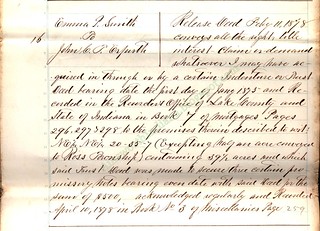
Finally, in 1878 — several months after the Erfurths had sold the land — Emma Smith released the mortgage on it.

2021-10-29. 1878-02-11 Release - Harms Abstract of Title 022


I just have to add that I think "Traugott" is an interesting name. It means "trust in God."

Thursday, September 23, 2021

Frederick and Fredericke

2021-09-23. Suhr, Fredericke and Frederick
(Click on image to enlarge)
Fredericke and Frederick Suhr. Images from findagrave.com.


Returning to the Harms 73rd Avenue farm, we left off in 1873 when Mary Chester bought the lower forty of the 80-acre parcel.

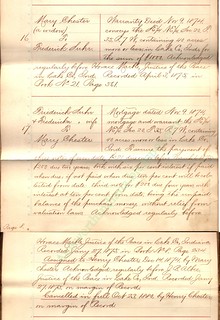
In September 1874, Mary lost her husband, Charles. In November, she sold her 40 acres to a German immigrant family by the name of Suhr, lending them $921 of the $1,000 purchase price.

2021-09-23. 1874 Chester to Suhr - Harms Abstract of Title
(Click on image to enlarge)
Image courtesy of the Eldon Harms family.


I did not recognize that name at first, but I should have: from the early days of this blog, when I was researching the Chester Cemetery, as that is the final resting place of the couple who bought these 40 acres. Back then, I was able to find very little information on them: just the 1880 Census showing Frederick and Fredericke, along with their 27-year-old son, Henry, farming somewhere in Ross Township.

Since 2009, I have discovered findagrave.com, which, through the collective effort of many people, has become a remarkable resource. From information there, I can now fill in some of the missing background, as well as post photos of the Suhrs (above) from the same source.

Frederick and Fredericke (Lichtwarle) Suhr had been married in Germany, their native land, where Frederick worked as a miller. (It was Fredericke's second marriage; her first had produced one son, Charles Schmidt, named for his father.[1]) They came to the U.S. in 1870, evidently just missing the census, and brought with them their three children: Fredrika, Henry, and Emma.[2] They lived in South Chicago at first, but, as we see from our documents above, by 1874 the family moved to Indiana.

Their children all married — most importantly, Emma, in 1887, to Conrad Bender, a man prominent enough in Porter County to rate a biographical sketch in a regional history book, whence I have gleaned some of this information.[3] The other children, Fredrika and Henry, appear to have spent much of their married lives in Illinois.

The Suhrs evidently did well enough on their farm to pay off their mortgage by 1880.

In 1882, at only 65 years of age, Fredericke Suhr died. She was buried in the Chester Cemetery, west of their farm. Frederick then sold the farm and left Indiana to spend the next 15 years in Illinois, probably with one or both of his married children there. He died in 1897, and they brought his body back to Ainsworth, to rest beside Fredericke.

Through their daughter, Emma Bender, their descendants were spread around northwest Indiana. Emma, who died in 1918, was survived by seven children: "Edward F. Bender, of Gary; Mrs. Martha Lute, of Hobart; Mrs. Ida Schenelter of Crown Point; Mrs. Bertha Malone, who lived with her mother in Hobart; Albert C. Bender and Frank J. Bender, who live on and operate the Bender farm in Portage township and Walter F. Bender, of Chesterton."[4]

♦    ♦    ♦

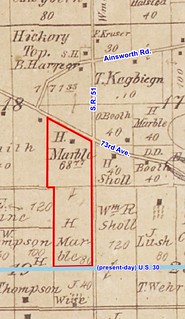
The real estate transaction we're looking at brought up two other names I recognize from past posts. The mortgage of the land in October 1874 was acknowledged before Justice of the Peace Horace Marble, whose 140-acre parcel just south of Ainsworth included the cemetery. (He was listed there, as a farmer, in the 1870 Census, but by 1880 had moved to Hobart and become a "commission merchant.")

2021-09-23. Marble, H., 1874
(Click on image to enlarge)
The Horace Marble farm as it appeared on the 1874 Plat Map. Hickory Top had not yet been renamed "Ainsworth."


The assignment of the mortgage, in December 1874, by Mary Chester to her son, Henry, involved J.P. Jesse B. Albee.

_______________
[1] Pictorial and Biographical Record of La Porte, Porter, Lake and Starke Counties, Indiana. Chicago: Goodspeed Brothers, 1894.
[2] "Long Illness Proves Fatal to Mrs. E. Bender," Vidette-Messenger (Valparaiso), Oct. 20, 1933 (transcribed at findagrave.com).
[3] Goodspeed (1894).
[4] "Long Illness Proves Fatal," 1933.

Sunday, August 22, 2021

Heartbreak, Nebraska

In our tracing of the history of the Harms farm on 73rd Avenue, we left off in May of 1869, when Jacob and Hannah Smith had just bought back the 80-acre parcel from the estate of their deceased son, Luther.

In October 1869, Jacob and Hannah sold those 80 acres to their only surviving son, Charles L., for $1400.

2021-08-22. Smith, Charles, 1869-10-27
(Click on images to enlarge)
Images courtesy of the Eldon Harms family.


Charles, in turn, immediately gave his parents a lifetime lease on the northern half of that parcel, along with a pledge of support in the amount of $800, if needed.

2021-08-22. Smith, Charles, 1869-10-27 lease

Possibly Charles was farming the southern half for himself.

Not quite a year later, Charles gives up all ownership of the 40 acres his parents were farming.

2021-08-22. Smith, Charles, 1870-10-11

From this transaction we learn that Charles, now about 33 years old, was a single man.

In 1873, Charles — who is now in Clay County, Iowa — sells the southern 40 acres back to Mary Chester (who, with her husband, had sold the land to Charles' parents in 1857).

2021-08-22. Smith, Charles, 1873-03-24

Thus we learn that in the two and a half years between October 1870 and March 1873, Charles had found and then lost a wife. I have no idea who the wife was. I can't identify any record during these years of Charles' marriage. Of course, my galloping imagination races to the conclusion that he left Indiana to get away from the heartrending memories after his wife died. But he may have married her in Nebraska. I just don't know.

A year later we find Charles in Hamilton County, Nebraska, as he recruits James Sanders to collect his mortgage money from Mary Chester.

2021-08-22. Smith, Charles, 1874-12-08

In 1876 Charles married Mary Jones,[1] who apparently had had an earlier marriage with at least one child (1880 Census). But previously Charles had entered yet another marriage, according to the 1910 Census, which notes that Charles was on his third marriage and Mary her second. So between 1873 and 1876 Charles may have suffered heartbreak yet again.

♦    ♦    ♦

Albert Van Doozer, who bought the northern 40 acres, is a bit of a mystery. We encountered him for the first time in my earlier post about the Smith family, when (for quiet-title purposes, I believe) he wrote letters saying that he had been "well acquainted" with the late Jacob and Hannah Smith and their late daughter-in-law, Sarah.

I don't know how he became acquainted with this family of farmers, or what he wanted with farmland: he doesn't seem to have been the farming type himself. Born in New York in 1838, he shows up in the 1850 Census as a city boy, living in Buffalo, New York. His father was a joiner. Then I lose track of him until 1866, when he marries Emma Bevans — but the marriage is recorded in both Lake County, Indiana and Cook County, Illinois.

Not coincidentally, I'm sure, this was the same Emma Bevans, or Bevins, who had appeared in the 1850 Census living in the household of Jacob and Hannah Smith. She was a native of Canada. How and why did she get to Ross Township, Indiana, and into this particular household? I have no clue.

In the 1880 Census, Albert and Emma were living in Chicago and he worked as a shoemaker. By 1900, they were living in Wheatfield, Jasper County, Indiana; Albert described himself as a watchmaker. Ten years later, in the same town, he owned a jewelry shop. In 1920, at the age of 81, he was still a jeweler, still making watches, but Emma had died. Albert lived only three more years and was probably making watches to the end.


_______________
[1] Ancestry.com. Nebraska, U.S., Select County Marriage Records, 1855-1908 [database on-line]. Lehi, UT, USA: Ancestry.com Operations, Inc., 2017.

Saturday, July 10, 2021

Death and Dollars

When we left off with the Harms 73rd Avenue farm, Charles Chester had just bought those 80 acres.

That was August 1856. Some seven months later, in March 1857, Charles and his wife, Mary, sold the land to Luther and Sarah Smith for $900. The purchase was financed with six promissory notes coming due at intervals over the next six years, their payment secured by a mortgage.

2021-07-10. 1857 Harms Abstract of Title 003 a - Chester sale to L. Smith, mortgage
(Click on image to enlarge)
Image courtesy of the Eldon Harms family.


The Smith family and the Chester family had been neighbors for a few years before this sale. If we look at Early Land Sales, Lake County, we find that in May of 1850, Charles and Mary Chester bought the northwest quarter of Section 17. The following year, Jacob and Hannah Smith (Luther's parents) bought the adjacent northwest quarter of the northeast quarter — that is, the land where someday Henry Chester would build his brick farmhouse.

Chester 1850, Smith 1851 on 1874 map
(Click on image to enlarge)
This image is from the 1874 Plat Map.


The Smiths had been in Ross Township early enough to be counted in the 1850 Census: Jacob, 49, a native of Connecticut; his wife, Hannah, also 51, born in New York; and their children, Luther and Charles L. (16 and 13, respectively, and both born in Ohio), plus a 19-year-old woman named Emma Bevins, of Canadian birth. They were recorded with only one intervening entry between them and the Chester family, so perhaps the Smiths were renting farmland nearby.

In 1854, Luther Smith married Sarah Maxwell (Indiana Marriage Collection), who was only about 15 years old.[1]

Then in 1857 comes this sale to Luther and Sarah of the Chester 80 acres along Randolph Street. And that is where the 1860 Census finds them, with their children, Emma (5), Albert (2), and Sarah (10 months). Also in the home were Luther's parents, Jacob and Hannah.[2]

The mortgage on the land was cancelled in 1861, a year before the final promissory note was due. It may have been paid off early with money raised through what happened in 1859: Luther gave his parents a life-long lease on the land, for which they paid him $600.

2021-07-10. 1859 lease
(Click on images to enlarge)
This image and the images below courtesy of the Eldon Harms family.


In January 1865, Luther enlisted in the Union Army. By August of that year he was at home (not discharged yet, so perhaps on leave, possibly due to poor health). On August 10, he died.

He had made no will, and it seems that for a few years, his survivors went on farming that land together peaceably, not even seeking to have Luther's estate probated. But in 1868, something began to stir, and that's when the county court finally appointed an estate administrator.

2021-07-10. 1868 estate administrator
(Click on image to enlarge)
Image courtesy of the Eldon Harms family.


And in 1869 Jacob and Hannah sued the estate for the return of the $600 they had paid Luther ten years earlier.

2021-07-10. 1869 suit

The 1859 transaction between them and their son, they said, wasn't just a lease for $600. It was a promise of a home: "these claimants were to live with said Luther Smith upon said premises and help to till the same and to share the benefits thereof throughout their natural lives," and if ever Luther sold the farm out from under them, Jacob and Hannah would get their $600 back. But that provision was not included in the lease "through a misunderstanding of the Justice [of the Peace] drawing said agreement, and through their own ignorance of the modes of doing business and the force of written contracts."

Reading between the lines of the last paragraph, it sounds as if, in August of 1865, Luther did not expect to recover from his sickness — he and his parents "talked over" these arrangements, "and the final understanding was that in the event of his death the farm must be sold." He did die, as we know, but the farm wasn't sold, and his parents went on without their $600 for several years.

I wonder if Sarah — still a young woman — was getting restless around 1868, wanting to sell the farm, take her share of the money, and move on with her life somewhere else.

A sympathetic court decided that the lease of the farm should be cancelled, and the $600 returned to Jacob and Hannah.

2021-07-10. 1869 ruling

The estate administrator then petitioned the court to be allowed to sell the farm, and summarized the estate:

2021-07-10. 1869 summary

After the required publications to advise potential buyers, the sale went forward. And Jacob and Hannah bought the farm.

2021-07-10. 1869 report of sale

Luther's widow and four minor children received a total of $506.22 from the estate (about $10,000 in today's money).

2021-07-10. 1869 summary

The estate administrator duly conveyed the land to the elder Smiths.

2021-07-10. 1869 transfer of title

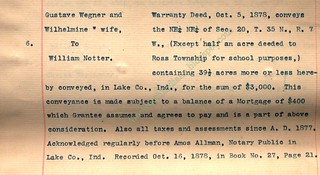
Sarah may have moved on with her life, but unfortunately she did not have much life left. According to the penciled note in the bottom margin of page 6 of the abstract, above, "Sarah P. Smith died Aug 9th 71." Perhaps that was written circa 1896, when Henry and Johanna Harms were buying the land. But a statement from 1878 says approximately the same thing:

2021-07-10. 1878 statement re Sarah Smith

By 1877, Jacob and Hannah had died too.

2021-07-10. 1877 statement re Jacob and Hannah Smith

Concerning the four minor heirs of Luther's estate, someone jotted notes on the abstract, again probably circa 1896: Emma, Elbert, and Ambrose were dead; Adna was living in Denver (where he is now buried). The little Sarah from the 1860 census is unaccounted for; she may have died in infancy. The rest of Luther's survivors named in the abstract are a mystery to me — their lives, their deaths, their final resting places.

Luther Smith himself is buried in the Woodvale Cemetery, but he is not alone. His and Sarah's son rests there too — a two-month-old infant, named Jacob for his grandfather.

_______________
[1] I don't know much about Sarah's family of origin. Her marriage is the earliest record I can find of her locally.
[2] The other son, Charles L., was not in the household and in fact I can't find him in 1860, but we will hear from him again.

Tuesday, May 18, 2021

Episodes in the History of the Harms' 73rd Avenue Farm

Thanks to the Harms family, I have a copy of an abstract of title to the second farm owned by Henry and Johanna (Anna) Harms. It comprised 80 acres on the west side of Randolph Street, straddling 73rd Avenue. They bought it while still living on the old Harms place.

The abstract starts with the 40 acres that lie on the northwest corner of the intersection of Randolph Street and U.S. 30, marked here on Google satellite view (and I hope I got the upper boundary right):

2021-05-18. Satellite view of SE 1-4 NE 1-4 sec 20 twp 35 n range 7 west
(Click on image to enlarge)

The first page tells us that those 40 acres (plus the 40 acres lying immediately north) were bought by Zachariah Elliott from the U.S. government (at the Winamac land office on January 10, 1852.

That would seem to indicate that Zachariah was the first private owner since the Potawatomi ceded the land to the federal government. Occasionally you find abstracts of title that actually give the name of the Native American who signed the treaty whereby the land was transferred. Unfortunately, this isn't one of them.

After holding the land for nearly two years, Zachariah sold it to John D. Willson (or Wilson).

2021-05-18. Elliott, Zachariah 1852 to John Willson 1853
(Click on image to enlarge)
Image courtesy of the Eldon Harms family.


I cannot positively identify either of these men in census or any other records besides land-sales records. I don't know where they came from, why they bought land in Lake County, or where they went afterward.

I love the name of the justice of the peace involved in the second sale — Socrates Griswold. Him I can find in the 1850 Census, a Vermonter born in 1807, living and farming in eastern Ross Township. Early Land Sales, Lake County shows him buying up some 230 acres in the same general area throughout the course of 1853. But he didn't stick around: by the 1860 Census, he had moved to Valparaiso and become a drayman.[1]

The next sale, in 1856, brings up a name we know.

2021-05-18. Willson, John to Chester, Charles 1856

This Charles Chester is not, of course, Truculent Chuck, but his grandfather. We don't know much about this Charles. From the biographical sketch of his son, Henry, we learn just a little about this Charles and his father:
His [father], John Chester, was a native of England, whence he came at an early day to Pennsylvania, and for seven years fought in the ranks of the patriots in the Revolutionary war, becoming an officer in the Continental army. He saw and talked with General Washington and was a prominent man. His son Charles, father of Henry, was born in Pennsylvania, and came out to Lake county, Indiana, as a pioneer in 1847, living here until his death in 1874. He married Mary E. Price, a native of Pennsylvania and of German descent, and they were the parents of two daughters and one son that reached maturity.
From the stones in the Chester Cemetery, we learn that Charles lived from 1798 to 1874, and Mary Price Chester from 1811 to 1878.[2]

Here is the first appearance of the Charles Chester family in Ross Township, in the 1850 Census:

2021-05-18. Chester, Charles, 1850 Census
Image from Ancestry.com.

There are three children: Rebecca, Henry, and Roxanna.[3] In December 1850, Rebecca married George Miller in Lake County, Indiana. They lived in Hobart Township (1860), then moved to Ross Township (1870), where they and their children lived on a farm somewhere southwest of Merrillville (to judge by their neighbors). By 1880 it appears they had moved to Black Hawk County, Iowa; there Rebecca died in 1881.

In July 1856 Henry Chester married Harriet Perry, daughter of Ezekiel and Olive Perry of Porter County. The Perrys are recorded in the 1850 Census farming in Center Township; by 1860 the parents had moved to Union Township. We need say no more about Henry: so much of this blog has been devoted to him.

Not quite two months later, in August 1856, Roxanna married her brother-in-law, Allen Perry (some 14 years her senior). They remained in Ross Township through the 1860 Census, but then moved to Black Hawk County, Iowa. (I wonder if things got awkward after Henry and Harriet divorced.)


To be continued.

_______________
[1] In 1856 he married Mary Frasier in Porter County (Indiana Marriage Collection). They remained in Valparaiso through the 1870 Census; the 1880 Census records them in Wisconsin, apparently visiting a niece; but they may have settled there, because both Socrates and Mary died there in December 1893, within a few days of each other. And I wonder if there is a story behind that.
[2] Someone has posted a photo of a Mary Chester on the findagrave.com entry, but unfortunately the photo is not of Mary Price, Charles' wife, but Mary Baird, the third wife of Charles' son, Henry.
[3] The wording of the biographical sketch quoted above suggests that Charles and Mary had at least one other child that did not live to maturity, but I can't find any information about any such child.