Showing posts with label Ensign. Show all posts

Thursday, October 10, 2019

Granny Ensign's House

One day several years ago, I was driving with Eldon Harms along South Hobart Road when he pointed to a house on the east side of the road (number 1395) and said, "That was Granny Ensign's house."

"Who was Granny Ensign?" I asked him.

"I don't know," he said. "I just knew that as Granny Ensign's house." He went on to tell me that the house originally consisted of only the front part, and the larger back part was a later addition.

The house in question was built in 1925 according to the county records. If it started as only the "front part," it would have been very small — about 400 square feet, according to the sketch on the Assessor's website.

I bring this up now because the September 13, 1923 issue of the Hobart News, in an article entitled "Building of Residences Here Not Active This Year," mentions an exception in "Mrs. Elizabeth Ensign" who was building a house described as being southeast of Hobart, across the road from her present home. Well, we know who Elizabeth aka Nora Ensign was, and we know her "present home" was on the west side of South Hobart Road, so maybe I've finally found the Granny Ensign of Granny Ensign's house.

♦    ♦    ♦

Elsewhere in the same issue, a story about our old friend, Calvin C. Shearer:

2019-10-10. Shearer Sedan, News, 9-13-1923
(Click on image to enlarge)
Hobart News, Sept. 13, 1923.


Two columns to the left of that story, we find an article about the wedding of Erna Piornack. I have been following her outside the blog because her mother, née Emma Zobjeck, was the sister of Hobart's own Hugo Zobjeck. Emma had married Charles Piornack in Chicago in 1896.[1]. According to the 1920 Census, they had only two children: Erna and George.


_______________
[1] Ancestry.com. Cook County, Illinois, Marriages Index, 1871-1920 [database on-line]. Provo, UT, USA: Ancestry.com Operations, Inc., 2011. Original data: "Illinois, Cook County Marriages, 1871–1920." Index. FamilySearch, Salt Lake City, Utah, 2010. Illinois Department of Public Health records. "Marriage Records, 1871–present." Division of Vital Records, Springfield, Illinois.

Thursday, September 12, 2019

Haying with Horses

These photos were taken in the summer of 1937 on the old Harms homestead. In the first one, we are near the barn on the south side of the road.

2019-09-12. 5e
(Click on images to enlarge)
Images courtesy of Eldon Harms.


Here are my notes based on what Eldon Harms told me about the photo:
The team is pulling a hay wagon. Note the ladder on the wagon: as the hay piled up on the wagon, you climbed the ladder to drive the team so that you weren't buried in the hay. The building in the background is the corn crib, which held the dried ears of corn on the cob that would eventually be taken to the mill in town (Hobart) and ground up for cattle feed.
The horses are Nel and Topsy. Eldon is at left. The two girls are probably his sisters. His father, Herman, is holding the reins.

In this photo, we are out in the hay field:

2019-09-12. 4d

My notes based on what Eldon told me about it:
At left you can see the hay loader, which picked up the hay from the field and deposited it on top of the wagon.

When you cut the hay, you raked it into long windrows lying on the field. Then you hitched your double team to the hay wagon and drove them over each windrow — one horse on each side of the windrow — and the hay loader, attached to the rear of the wagon, ran along picking up the hay and dropping it onto the wagon.

In this picture Bud Ensign (at right) is driving the team, and Herman Harms, Sr., is raking the hay to distribute the load evenly over the wagon. The wheels of the wagon are just barely visible under the hay hanging down, and at the lower right of the photo you can see the horses' legs.

Bud Ensign's father had died, so Bud wanted to earn extra money to help his family; that is why he hired on with the Harmses. He was only 14 at this time.

The hay wagon could be converted into a box wagon, by removing the back section and attaching a box. That was more convenient for driving when you weren't carrying a load of hay.
We've already discussed how you got the hay from the wagon to the loft of the barn.

♦    ♦    ♦

I'm not sure if I ever asked Eldon who exactly "Bud" Ensign was; if he told me, I've forgotten.

Looking into the census records for a local Ensign boy who would have been about 14 in 1937, I find Richard Elden Ensign. We've seen Richard before, but I had his nickname down as "Dick." Perhaps a 14-year-old Bud might, within a few years, be able to make people call him a slightly more formal name.

Richard's father, John Ensign, had died in October 1935 (Indiana Death Certificates), leaving a widow, Goldie, with some half-a-dozen children, the youngest of which was about three years old.[1] And this was in the midst of the Great Depression.

Incidentally, John's mother had been Elizabeth aka Nora (Shearer) Ensign.


_______________
[1] The 1930 Census and 1940 Census are not consistent regarding some of the children's ages.

Sunday, July 28, 2019

Those Eternal Muskrats

I am in the process of indexing a daybook that begins in 1848. Early on, I came across another muskrats-vs.-dam story that took place in May of 1850. Muskrats tried to undermine what I believe is the Earle's Mill dam — but Isaac Spencer foiled their scheme.

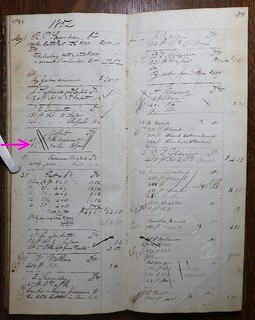
2019-07-28. DayB1848 009, 010
(Click on image to enlarge)
Image courtesy of the Hobart Historical Society.


Did he spend all those marked days working on the muskrat hole? — that must have been a very impressive hole.

The journal-keeper uses only his first initial, I, so I went looking in the 1850 Census and found Isaac Spencer, a 35-year-old carpenter, living in Hobart with his wife, Lucretia, and their children, Orsemus, Caroline, and Charles. We have previously heard of Orsemus, who married Lucy Hanks, sister of Henry Chester's second wife. Caroline eventually married Jesse B. Albee. As for Charles, he made music for local entertainments until his death in 1920.

According to Early Land Sales, in 1853 Isaac purchased Lots 57 and 58 in Section 32 of Hobart Township, which — assuming those lots are part of the original town of Hobart — would be on the northeast corner of Center and Second Streets, the site of the Rifenburg house and the parking lot next to it.

Isaac and Lucretia show up in Hobart Township in every census through 1880, then they vanish. I can't find out when either died or where they are buried.

♦    ♦    ♦

Below Isaac's entry in the ledger, we find someone who, it appears, may have worked with him on the dam for the last two days of May 1850. I had to stare at that name for about 15 seconds before I realized that it wasn't a woman's name, but a phonetic spelling of Lucius.

The 1850 Census shows Lucius in Hobart, working as a cooper (barrel-maker) like Edward Ensign, whom we've met before (and who also was born in Ohio, so I suppose there was some family connection). Lucius' household included his wife, Ellen, and four children, ranging in age from 13 to 3. Per the Indiana Marriage Collection, Lucius and Ellen were married in Porter County in 1845, so only the two youngest children could be theirs; the other might be from a previous marriage. Also in the household is a 70-year-old Hannah Ensign — perhaps Lucius' mother.

After 1850 the whole family vanishes, except for the youngest child, Linus, whom I think I've found in the 1870 Census living and working on the farm of Jacob Hale, along with Jacob's son-in-law, Edmund Ensign … who might be the same person as the Edward Ensign I mentioned above. (Exactly what relation he was to Linus, I don't know.) If I've found the right person, Linus soon married and moved to Kansas.

Saturday, September 22, 2018

No Pine Boxes

Their graves may be unmarked, but they rest in walnut and oak.

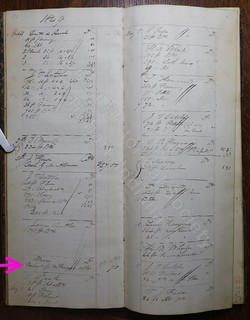
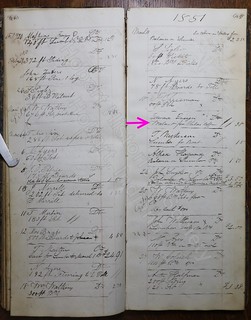
2018-9-22. DBHM1846 032, 033
(Click on images to enlarge)
Images courtesy of the Hobart Historical Society.


2018-9-22. DBHM1846 066, 067

2018-9-22. DBHM1846 078, 079

Of all these names I can identify only Edward Ensign, who appears in the 1850 Census in Hobart Township. To judge by his neighbors, he lived northeast of the village of Hobart near the county line. He was by trade a cooper; that is, a barrel-maker. He and his wife, Emmarilla (married in Ohio in 1844[1]), had three children: Clarissa (4 years old), Sarah (2), and Linus (3 months). I can't find the family in the 1860 Census, so I can't guess which of those little ones the walnut coffin of 1851 was meant for.

_______________
[1] Ancestry.com. Ohio, County Marriage Records, 1774-1993 [database on-line]. Lehi, UT, USA: Ancestry.com Operations, Inc., 2016. Original data: Marriage Records. Ohio Marriages. Various Ohio County Courthouses.

Monday, December 11, 2017

Nickel-Plate Nostalgia

On March 19, 1923, Thomas Maloney turned 71 — who, you ask? Good question. I never heard of him before, but he takes us back to old times, to the coming of the Nickel Plate through Hobart in 1881 (so the article says and I don't have time to research that). While constructing the railroad, Thomas boarded at the Morton building, eating the home cooking of one of those spirited Shearer sisters: Nora (aka Elizabeth) Shearer Ensign.

2017-12-11. Ensign, Maloney
(Click on image to enlarge)
Hobart News 22 March 1923.


Since first looking into Nora's history, I have learned that she was divorced from Fred Kappelman in 1903.1 The marriage had been a mistake from the start, apparently, since it happened in 1899 and by the 1900 Census they were living apart. I still haven't been able to find out when her first husband, William Ensign, died.

Elsewhere on the page above, we learn that Hobart was hit with a late-winter blizzard in March 1923. A natural curiosity about the low temperature, and the kids' leaving their toys on the porch, cost Mrs. Charles Koeppen a broken knee. She was the former Tena Rohwedder — daughter of Hans and Margaret (Thune),2 sister of Edward. The Charles Koeppen farm lay just at the eastern outskirts of Wheeler:

2017-12-11. Koeppen 1921
(Click on image to enlarge)
Image from http://www.inportercounty.org/Data/Maps/1921Plats/Union-1921.jpg.


Finally, 'way out in New York, Ellsworth Humes hears of all those liquor-related arrests in Lake County.

________________________
[1] "Court Doings," Hobart Gazette 6 March 1903.
[2] Indiana Death Certificates.

Wednesday, April 12, 2017

Gone But Not Forgotten

Back in September 1916, Kenneth Humes had lost a finger to farm machinery on a Blachly farm. More than six years later, his suit for damages was finally being heard.

2017-4-12. Amputation litigation
(Click on image to enlarge)
Hobart News 11 Jan. 1923.


After several hours' deliberation, the jury would award Kenneth $100 and his costs ("Local and Personal," Hobart News 18 Jan. 1923).


Elsewhere on the page above we find Herman Harms, Jr., aka "Bud" — about four years old — sick with pneumonia at his maternal grandparents' house. His own parents, having been ill so recently, might have found it difficult to care for him.

Among the deaths reported in the right-hand column was that of the infant son of John and Goldie Ensign who had probably been named for his Uncle Walter. According to his death certificate, little Walter was buried in Crown Hill Cemetery, but it seems that his grave is unmarked.

Friday, November 11, 2016

From a Soldier to His Mother

2016-11-11. Harms misc 001
(Click on images to enlarge)
Images courtesy of Eldon Harms.


2016-11-11. Harms misc 002

We know that Walter Ensign served in the armed forces during World War I. Evidently he sent this postcard "From Walter to Mother" while he was in camp in Mississippi. (According to his 1921 passport application on Ancestry.com, he was eventually sent to France.)

I think that much is in Walter's own handwriting. Someone else came along and added the surname, thank goodness, or we might not have known who Walter was. And I don't actually know which of these soldiers is Walter.

"Mother" was Elizabeth-or-was-it-Nora (Shearer) Ensign.

Monday, October 10, 2016

She Was a V, A, M, P …

My only memory of the Sonny & Cher Comedy Hour is Cher's recurring vamp song, which comes to mind now that I'm delivering on my promise to dish the dirt about Emma Shearer.

I will let this newspaper article from October 2, 1908, tell the story:

2016-10-10. Shearer 1 of 2
2016-10-10. Shearer 2 of 2
(Click on images to enlarge)
Lake County Times (Hammond, Ind.) 2 Oct. 1908.


Although the article gives her earlier husband's name as James Adams, per the county records it was Anthony S. Adams, and the date of their marriage February 28, 1901. She was then about 34 years old, he about 28 — old enough to know what he was doing, you'd think. But what "disclosures" could he have made to provoke her to kick him out of the buggy? My guess is that he hadn't gotten around to divorcing a previous wife … or perhaps had a lot of debt.

After divorcing Mr. Adams, Emma appears not to have married anyone else until November 17, 1906, when she and John Kroledge joined their hearts together. He was ten years her junior. Their marital bliss lasted almost two years, it seems.

Several weeks after the above publicity about their impending divorce, another disgruntled hired man came forward:

2016-10-10. Shearer - Mattas
Lake County Times (Hammond, Ind.) 20 Nov. 1908.

I have not been able to learn the outcome of any of these cases. I assume the divorce came through, since John Kroledge married again during Emma's lifetime.

But I did come across this tantalizing tidbit from the spring of 1909 …

2016-10-10. Shearer Ohearn
Lake County Times (Hammond, Ind.) 13 Apr. 1909.

… which stirred up in my mind a vague memory of Emma and Michael O'Hearn being connected somehow, long ago; so I went searching among my notes and found that yes, indeed, they had been closely connected. I don't know exactly when it started, but by the spring of 1895 they were secret lovers. She was about 29, he about 33. In the spring of 1896 their quiet romance ended — loudly.

2016-10-10. Shearer-Ohearn
Hobart Gazette 17 Apr. 1896.

2016-10-10. Goes Free
Hobart Gazette 8 May 1896.

♦    ♦    ♦

I have yet to learn much about the rest of Emma's life, but at the moment it appears there were no more marriages. In 1910, Emma — living alone, apparently, on her farm on Tenth Street — gave her surname as Kroledge and her status as widowed (the enumerator was Charles A. Blank, who, as a resident of Miller, might not have heard the real story). In 1920, she was still Emma Kroledge, but now "divorced." In her household was a 51-year-old hired man; let us hope he was satisfied with his wages. I cannot find Emma in the 1930 Census.

Emma Kroledge, "widow," died in the Lake County Poor Asylum on May 7, 1932.

2016-10-10. Emma Kroledge obit
Hobart Gazette 12 May 1932.

What little I know of Emma's siblings suggests that all of them were, shall we say, unsettled. I believe brother Charles served a short time in prison in the 1890s; someday I will discuss him in more detail.

Her sister, Mary Ellen, had married John Mander in 1873, and, as we've learned, the marriage was not happy.

"Mrs. Nora Ensign" is somewhat mysterious, because I can't find that Emma ever had a sister named Nora; she did, however, have a sister named Elizabeth E., born in 1857, whose death certificate (1934) described her as the widow of William Ensign … who, according to the marriage records as transcribed on Ancestry.com, married "F. Ellen Shearer" in 1881. We've met Elizabeth Ensign before and learned that she described herself as widowed in 1910 and divorced in 1920. She had two sons, John and Walter (and through John she was the grandmother of Richard Ensign). I can't find Elizabeth in 1930, but I do find a Nora Ensign living in Hobart — about three years older than you would expect Elizabeth to be. Which leads to something else interesting: the marriage records show a Nora Ensign marrying a Fred Kappelman in 1899; and the 1900 census shows John and Walter Ensign living with their mother, whose name is nearly illegible but looks as if it could be "Kappelman, Norra" (you can see for yourself here), and who told the enumerator she had been married for one year. The question is: where was Fred Kappelman in 1900? I have no idea. I have reason to think he was still alive, though I can't find him outside of the local newspapers.

As for William Ensign, I don't know what became of him. I can't find any record of his death.

And as for the "family lot in the Hobart cemetery" mentioned in Emma Kroledge's obituary: I cannot find Emma, nor her parents, nor her sisters in Hobart Cemetery — or anywhere else, for that matter.


Additional Sources:
♦ 1880 Census.
♦ 1900 Census.
♦ 1910 Census.
♦ 1920 Census.
♦ 1930 Census.
♦ 1940 Census.
♦ Indiana Death Certificates.
♦ Indiana Marriage Collection.

Wednesday, November 11, 2015

Home on Leave

Here's a young sailor doing his best to smile for the camera even though he's freezing.

2015-11-11. 11c
(Click on images to enlarge)
Images courtesy of Eldon Harms.


This photo of Richard "Dick" Ensign was taken in front of the Ensign home on South Hobart Road. There is no date, but I suspect it was circa 1945, at which time Dick was 20 or 21 years old.

(At left, in the background, is Eldon Harms; at right, Dick's brother, Bob.)


Here he's looking a bit more comfortable.

2015-11-11 11b

Notes on the back of the original say it was taken in the summer of 1945. Location unknown. (Insignia unrecognized, but that's not surprising for me. Wouldn't it have been great if he'd gotten to be Ensign Ensign?)

Wednesday, February 12, 2014

What the Heck?

Now the 1926 Plat Book has me confused again because it shows some land being owned by Christian Heck that he reportedly sold in April 1921:

Heck land sale
(Click on images to enlarge)
From the Hobart News 14 Apr. 1921.


Here it is in 1926:

Heck 1926

I don't know why I care, except that (1) Christian, with his parents, Frederick and Doretta, lived in Ross Township (northwest of Ainsworth) in 1870 and 1880; and (2) in 1900, when he farmed his own land south of Tenth Street, he shows up as a neighbor of Augusta Rossow, the second wife (and by then the widow) of Henry Rossow, who was Minnie Rossow Harms's grandfather. Augusta was renting (I believe) the land shown on the above map as belonging to William Lute, but in her time the land had belonged to Jacob Fiester, so it was known as the Fiester farm.

♦    ♦    ♦

In other news, John and Goldie Ensign had a new baby, John Jr.

Ensign birth


Sources:
♦ 1870 Census.
♦ 1880 Census.
♦ 1900 Census.
♦ 1920 Census.
♦ 1930 Census.
♦ "Births." Hobart News 14 Apr. 1921.
♦ "C.F. Heck Sells His 187-Acre Farm to Louis Kelle of Gary." Hobart News 14 Apr. 1921.

Saturday, December 28, 2013

Didn't It Already Have One?

Paul Newman was selling Fords, among other things, in the winter of 1921. He sold one of them to John Ensign.

Paul's business was doing well, apparently, since he was "planning to build a second story on his garage building." According to the 1979 oral history, his garage was the Third Street part of the building at Third and Center streets. And here I was, thinking that place always had a second floor!


Sources:
♦ "Local and Personal." Hobart News 10 Feb. 1921.
♦ "Local Drifts." Hobart Gazette 11 Feb. 1921.

Sunday, March 10, 2013

From the Crime Files:
The Case of the Roving Ruminant

Ensign cow crime
(Click on images to enlarge)

In the annals of unsolved crime, it's hardly enough for a footnote, but this story gives me the impetus to look into the Ensign family, whom up until now I have mentioned only in passing.

I believe "Mrs. Ensign" in the story would be Elizabeth Ensign, listed in the 1920 census as a divorcée of 62 (the 1910 census described her as widowed). She apparently lived near her son, John, who was married with several children. I think John may be the "J.E." marked on a small parcel in a 1926 plat map:

Ensign 1926

… in which case the cow did not have far to wander to end up in William Bracken's field.

John Ensign describes himself in 1920 as both a farmer and a telegraph operator (with the E.J. & E. R.R., per his draft card). Elizabeth also had a younger son, Walter. I don't know whether she had any other children because this family is proving elusive as we go further back in time.

♦    ♦    ♦

Above the cow story you will note the story about the progress of paving Hobart … or lack of progress, at least temporarily. I don't know how the strike was "adjusted." The Gazette, published a day later, serenely ignored the strike, and a week later reported:
The Powers-Thompson Co. has finished paving 6th street, and Wednesday morning commenced work on Indiana street, at Cleveland avenue. It is probable that South Main street and Garfield will not be done until quite late this summer.

Sources:
♦ 1910 Census.
♦ 1920 Census.
♦ 1926 Plat Book.
♦ "Local and Personal." Hobart News 10 June 1920.
♦ "Local Drifts." Hobart Gazette 11 June 1920; 18 June 1920.
♦ WWI Draft Cards.

Tuesday, September 25, 2012

Overrun with Hunters and Dogs

Notice to Hunters
(Click on image to enlarge)

This inhospitable notice, published on the front page of both local papers, was provoked by the area's growing population, as the News explained:
Farmers in this locality have become tired and disgusted with having their farms overrun with hunting parties with dogs, and have decided to put a stop to the practice. As the Calumet region grows, the hunters naturally increase until they have become a nuisance. A number of names appear in this issue of The News warning hunters to keep off their farms. It may be well for hunters to heed this notice or someone will pay a heavy fine.
♦    ♦    ♦

The "Births" column below the warning to hunters reports good news for some old friends, Charles and Amelia Gernenz — a new addition to the family. It's reported as a son, but later censuses seem to indicate it was in fact a daughter, Bertha.


Sources:
♦ 1920 Census.
♦ 1930 Census.
♦ "Births." Hobart Gazette 14 Nov. 1919.
♦ "Local and Personal." Hobart News 13 Nov. 1919.
♦ "Notice." Hobart News 13 Nov. 1919.
♦ "Warning to Hunters." Hobart Gazette 14 Nov. 1919.