Showing posts with label Grand Trunk Railroad. Show all posts

Wednesday, May 14, 2025

The Great Mayonnaise Derailment of '83

(Also: Junk in the Woods)

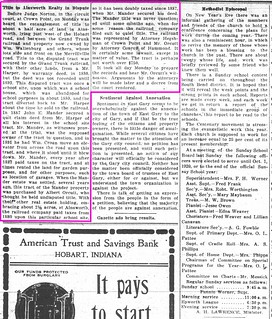
I have been hoping to find this story[1] ever since Eldon Harms told me about a derailment on the Grand Trunk, where local residents who came to gawk at the wreckage walked away with all the mayonnaise they could carry. And why not? It would only go to waste otherwise, wouldn't it?

The story is told in the Hobart Gazette of July 6, 1983, as part of a larger story about massive rainfall and flooding.

2025-05-14. 1983-07-06 - 001
(Click on images to enlarge)

2025-05-14. 1983-07-06 - 002

2025-05-14. 1983-07-06 - 003

♦    ♦    ♦


Junk in the Woods: A Photo Essay

On a possibly related note, here are some pictures I took last fall of the junk in the woods of Deep River County Park, on the south side the train tracks, between the river and County Line Road. This junk may or may not be left over from the Great Mayonnaise Derailment of '83.

Some of these pictures include a 22-pound dog for scale.

2025-05-14. Junk in the Woods 001
(Click on images to enlarge)

2025-05-14. Junk in the Woods 002

2025-05-14. Junk in the Woods 003

2025-05-14. Junk in the Woods 004

2025-05-14. Junk in the Woods 005

2025-05-14. Junk in the Woods 006

2025-05-14. Junk in the Woods 007

2025-05-14. Junk in the Woods 008

2025-05-14. Junk in the Woods 009

2025-05-14. Junk in the Woods 010

2025-05-14. Junk in the Woods 011

2025-05-14. Junk in the Woods 012

2025-05-14. Junk in the Woods 013

2025-05-14. Junk in the Woods 014

2025-05-14. Junk in the Woods 015

2025-05-14. Junk in the Woods 016

2025-05-14. Junk in the Woods 017

On the north side of the tracks in the same area, there is a rusty hunk of metal that looks like a car engine, but it's way up high on the steep embankment and I wasn't going to climb up there (much less walk out there on the tracks) to take a picture.


_______________
[1] I had a little trouble finding it because Eldon remembered it as having occurred in the 1970s, and it didn't turn up in any of the online newspapers I searched.

Tuesday, April 8, 2025

"Send to Ainsworth on the Grand Trunk Road"

In April of 1886, J. Miller of Deep River asked F. Madlener of Chicago to send him numerous bottles of … something.

2025-04-08 1886-04-13 Miller, Deep River order to Madlener 01
(Click on image to enlarge)

2025-04-08 1886-04-13 Miller, Deep River order to Madlener 02

This was a government-issued postal card of the kind that had been authorized by 1872 legislation. Apparently, the F. Madlener firm of Chicago bought a lot of these, stamped its own address on them, and handed them out to people to use for ordering its products.

The Madlener firm manufactured alcoholic beverages. Its most famous and profitable product was Fig Rye, a concoction of figs and rye whiskey touted as a health supplement. Fig Rye was first marketed sometime in the 1880s.[1]

J. Miller didn't bother to specify what was supposed to be in those pint and half-pint bottles, but it had to be some kind of alcohol. The fact that he ordered numerous small bottles, rather than one big one, suggests that his intent was sales, not his own personal use.

Now I'm wondering if he was selling, or trying to sell, alcohol in the village of Deep River. Its founder, John Wood, had been a temperance advocate, and had taken steps to keep saloons out of his village during his lifetime. Now in 1886, just three years after Wood's death, had his anti-saloon policy been abandoned already? Or was J. Miller a grocer, perhaps, who intended to sell Fig Rye as a health aid? … which, incidentally, just happened to produce drunkenness if you drank enough of it.

♦    ♦    ♦

I would like to find out who J. Miller was, but with such a common surname and only an initial for his first name, the task seems hopeless.

Of course, I immediately thought of Ainsworth's John Miller. Born in Germany in 1865, he came to the U.S. in 1880 (1900 Census). It was in Chicago in 1896 that he married Martha Maybaum (Cook County, Illinois, Marriages Index). I do not know where he spent the years between 1880 and 1896, but his meeting and courting Martha, who lived in our area, probably took a little time. However, there is a problem with my hypothesis that the "J. Miller" of the postcard was this John Miller (besides the fact that I have no records to show him here in 1886): the handwriting and wording of the postcard don't suggest, to me, someone whose language until he was at least 15 years of age was German, and who was, in April 1886, just short of 21 years old and six years in this country. The postcard sounds as if it had been written by someone born in the U.S.

I turned to the on-line newspapers to try to find any mention of someone named Miller doing alcoholic business around Deep River circa 1886, and did not find it.

A saloon-keeping John Miller, born in Indiana in 1863, turns up in Griffith, St. John Township, in the 1900 Census. But I have absolutely no evidence that he ever tried doing business in Deep River!

I think our postcard-writer is going to be a mystery forever.

_______________
[1] Source. Unfortunately, that source doesn't cite its own sources, and I could not find any other source giving even a general date for Fig Rye's introduction, nor any newspaper ads for it prior to the late 1890s.

Tuesday, February 16, 2021

A Big Pile of Snow

I bought this photo because I think it shows the aftermath of the Great Blizzard of January 1918:

2021-02-16. img036
(Click on images to enlarge)

Notes on the back identify the location as Chicago, somewhere along the Grand Trunk Railroad …

2021-02-16. img037

… but it looks like my driveway today.


(John Le Grand shows up in the 1920 Census as a railroad foreman living in Chicago. Philmore, or Fillmore, was his son.)

Tuesday, January 28, 2020

Cantankerous Hank and Truculent Chuck

While searching for something else, I came across information about another bad day for Henry and Charles Chester, among unnamed others. This one happened sometime around late August of 1898.

2020-01-28. Chester, CPRegister, 9-2-1898
(Click on image to enlarge)
Crown Point Register, Sept. 2, 1898.


I will try to fill in the details: Homer L. Iddings, as "Superintendent" of something (I don't know what; he was also Ross Township trustee at that time), had ordered that a drainage ditch be built along the Chicago & Grand Trunk Railroad,[1] which crossed Henry Chester's land. Henry Chester had some objection to that. When the men building the ditch came onto his land to do their work, he and his sons, including Charles,[2] attacked them.

Or his sons did, anyway; it seems Henry himself was found not guilty:

2020-01-28. Chester, CPRegister, 9-16-1898
(Click on image to enlarge)
Crown Point Register, Sept. 16, 1898.


In the next column over, the Merrillville correspondent is sorry to see the end of this exciting case … and further down, we see that the ditch-diggers are continuing about their business.

The last I heard of this case was this item in the "Hobart News" column of the October 21, 1898 Crown Point Register: "H. Merril has commenced suit against Hank Chester for permanently disabling him on the occasion of the late ditch melee. Merril asks $3,000 damage." Whether he got any part of $3,000, I don't know. This is the first evidence I have that anyone ever called Henry Chester "Hank." I have no evidence that anyone ever called Charles Chester "Chuck."

♦    ♦    ♦

I tried but failed to positively identify the two ditch-diggers.

The H.G. Merrill might possibly have been H.C. Merrill — Henry Cass Merrill, one of the Merrill brothers, born (1852) and raised in Ross Township; but by 1880, it appears he had left the area and was never again counted in a Ross Township census. The 1900 Census shows him living in Chicago and working as a bank clerk.

As for the other man, who is variously referred to as "Hartner," "Hartnip," and "Hartman," he might have been Edgar Hartnup of Hobart, who was described in the 1900 Census as a 46-year-old day laborer. If not, I'm out of ideas.


_______________
[1] "H.G. Merrill has the C. & G.T.R. ditch completed and will now commence on the Hayward-Goodrich ditch." "Merrillville," Crown Point Register, Oct. 21, 1898.
[2] An item in the "Additional Locals" column of the Hobart Gazette of October 14, 1898, mentions that Charles Chester of Ross Township had recently been through a criminal trial.


Sunday, February 10, 2019

Thomas A. Edison Battery Oil Bottle

I found this little broken bottle below the Grand Trunk (now Canadian National) railroad tracks some months ago, after heavy rains.

2019-02-10. Edison battery oil 1
(Click on images to enlarge)

The text reads:
Edison
Battery Oil
Made in U.S.A.
Thomas A. Edison
Incorporated
Bloomfield, N.J.
U.S.A.

The Bloomfield, N.J. locations means that this bottle dates to 1915 or later.

On the other side of the bottle, a facsimile of Thomas Edison's signature:

2019-02-10. Edison battery oil 2

This site has a picture of a full and unbroken bottle, and a little more information about the use of battery oil. I haven't been able to find much information on when battery oil went out of use, but it could be as late as the 1970s, from what I understand.

You can find a photo of a battery box here (it is the smaller box; the taller one is a relay cabinet).

Saturday, April 29, 2017

Grand Trunk, What a Big Spout You Have!

I'd heard of steam engines stopping to take on water, of course, but I must admit I never thought about the mechanism by which they did so until I saw this photo for sale.

2017-4-29. Grand Trunk waterspout
(Click on image to enlarge)

Looking at other pictures and film clips on-line, I gather that the photo above is a bit unusual in that the spout doesn't just drop down from the water tower, as in this clip. The water tower or reservoir here, while out of the camera's range, must be connected to the spout by underground pipes. I found one clip where the spout is separate from the water tower.

This photo was not taken at Ainsworth, which never had a water tower as far as I know. I believe Lottaville had one, since Lottaville had a pump man, Charles Popp, who might have been in charge of such apparatus as this — or, more likely, the simpler arrangement of a spout attached directly to the water tower. But I'm not suggesting that this photo was taken at Lottaville!

By the way, I'd always thought that the term "jerkwater town" came from this business of drawing water at some minor place along the line … but now I'm finding that I was mistaken, and also that the term has a murky origin.

Nonetheless, in a figurative sense, Ainsworth was a jerkwater village.

Sunday, October 16, 2016

Steam Engine Running Beside a Plowed Field

Here's another entry in my series, "Not Ainsworth But Could Be."

When I first saw this photo, I thought: That's how the Grand Trunk steam engines must have looked running past my field, back when Henry Chester farmed it!

2016-10-16. Grand Trunk steam engine
(Click on images to enlarge)

Unfortunately, the notes on the back give Grand Haven, Michigan as the location and 1947 as the year …

2016-10-16. Grand Trunk steam engine verso

… so I was way off as to place and time. But still — let exactitude fall to the side, let our eyelids droop, and that's a westbound Grand Trunk train slowing down for the Ainsworth depot.


The first car behind the tender belongs to the Pennsylvania Railroad, the third one to the C&O Railroad — both lines that would have been a part of life in Ainsworth, though not quite as large a part as the Grand Trunk Railroad.

Sunday, January 17, 2016

Harriet Towl Ragen

An early resident of Ross Township, Harriet Ragen died in June 1922, just short of her 79th birthday.

2016-1-17. Harriet Towl Ragen obit
(Click on images to enlarge)
Hobart Gazette 30 June 1922.


Here is the Ragen farm as it appeared on the 1874 Plat Map.

2016-1-17. Ragen 1874

This map suggests a house in the approximate location of 4012 E. 73rd Ave., where there now stands a house and large barn along with other outbuildings, most of which date to 1921 if the county property records are correct.

After moving to Hobart in 1896, the Ragens rented out their farm. Charles and Lovisa (Chester) Nelson rented it in the spring of 1903; by August of that year, the Ragens had rented it to a Wilhelm Neuman (or Newman), reportedly for a five-year term. By December 1908 George Ragen was advertising for a new tenant. In September 1914, the widowed Harriet, now living in Gary, offered it for sale or rent. She sold it in January 1915 to May Blachly (who sold it to S.J. Craig, who sold it to Emil Wojahn … who probably built that house and barn, etc.).

I believe "Mrs. Cora Maybaum of Gary" was married to Louis Maybaum, the streetcar motorman whose photo we've seen.

Harriet Ragen's husband, George, was not only a veteran of the Civil War but also a brother of Amanda Ragen Bullock, as we learn from his obituary:

2016-1-17. George Ragen obit
(Click on image to enlarge)
Hobart Gazette 1 Mar. 1912.


That would explain why Joseph (aka Josiah) Halladay came down from Chicago in June 1922 to attend Harriet Ragen's funeral — he was the husband of Amanda Ragen Bullock's daughter, Ruth. (I don't know why Ruth did not accompany him.)

From George's obituary, also, we also learn that the "Mrs. Mary Stevens of Gary" who survived Harriet was the wife of Hobart's one-time baker and restaurateur, Willard Stevens (so I suppose she is the Mate Stevens identified in one of the photos in that first link).

In closing, I will add this random item I came across in the 1901 microfilm: "A carload of laborers, men and women of the African type, have pitched camp upon George Ragon's farm near the Grand Trunk railroad and will be engaged in work on the double track grading. They are said to be a jolly crowd."

♦    ♦    ♦

The second story marked on the 1922 image above tells us that the elder Severances, George and Anna, had celebrated their 30th wedding anniversary. I believe Bunge is a misprint for Burge — the married name of their daughter, Mary.


Additional Sources:
♦ 1920 Census.
♦ "For Sale or Rent." Hobart Gazette 25 Sept. 1914.
♦ "General News Items." Hobart Gazette 19 Apr. 1901; 24 Apr. 1903; 28 Aug. 1903; 11 Mar. 1904; 11 Dec. 1908.
♦ "Local and Personal." Hobart News 6 July 1922.

Wednesday, September 10, 2014

Two Bloody Days

Twice in two days — the last days of June 1921 — Dr. Jacob Ader and Dr. Dwight Mackey were called on to deal with the carnage of railroad accidents.

2014-9-10. Accident at Ainsworth crossing
(Click on image to enlarge)
Hobart Gazette 1 July 1921.


The following week's Gazette reported that Louis Hershall had died the afternoon of the same day. His remains were shipped back to New York.


Another story on the page above concerned the farmer-owned milk-marketing company, which was "in a bad way financially"; but the story gave no clue as to the reason — whether poor management, or the effects of the depression the country had been going through since early 1920, or some other cause.

Wednesday, September 3, 2014

Grand Trunk Western Rules: Maintenance of Way, Signal Depts. (1916)

So, what did a section crew do, anyway? We can get some idea from this booklet printed in 1916 by the Grand Trunk Railway company for the use of its employees in the Maintenance of Way Department.

Grand Trunk Railway System: Rules of the Maintenance of Way Department; Signal Department Rules (Montreal,...


The section foreman took his orders from the Supervisor of Track, who was "responsible for the safe condition and proper maintenance of track, roadbed, right-of-way, station grounds and driveways," among other things.

The section foreman's specific duties start on page 28 of the booklet (p. 16 of this PDF). They included preventing and controlling fires along the track; and keeping ditches and waterways flowing freely, and fences, farm crossing gates and cattle guards in good repair. If cattle or other animals strayed onto the track and got killed, the section crew had to "bury or otherwise remove" them. They also had go along the track and collect anything fallen from the trains, whether freight or parts of the train itself. The maintenance of road crossings was another part of the crew's job, as well as working in cooperation with the signal department to protect and maintain the wires, pipelines and switches that made the crossing bells and other signals work (see p. 44 of the booklet, p. 24 of this PDF). One of the more miserable duties, besides burying dead animals, was going over the track "during storms" to make sure it was not damaged.

And in doing all this, the crews had to avoid being hit by trains themselves, without the benefit of wireless communication. They had to know the timetables and have a reliable watch. In emergencies, communication might depend on visual signals. The section on signals — hand, flag and lamp — starts on p. 9 of the booklet (p. 6 of this PDF), and the train signals described in Rule 28 are illustrated starting on p. 73 of the booklet (p. 39 of this PDF).

Tuesday, June 17, 2014

Grand Trunk Passenger Train

These photos weren't taken in Ainsworth, but still they caught my fancy. They show a Grand Trunk Western passenger train pulled by a steam engine. To judge by the number of gawkers, it's some kind of special train. The slides are stamped "Oct 60F," and a date of 1960 would be consistent with the automobiles in the first picture (thanks, R.F.!).

I especially like this first one, where the photographer climbed atop a boxcar to get a better view:

2014-6-17. Grand Trunk excursion train 1
(Click on images to enlarge)


The second picture immortalizes the backs of some spectators' heads. It was a good spot for a view, I gather, though I haven't a clue what they were standing on.

2014-6-17. Grand Trunk excursion train 2

Tuesday, June 10, 2014

Derailment on the Grand Trunk

We haven't heard much from Ernest and Myrtle (Nelson) Sitzenstock since February 1919, when they moved onto the "Henning farm." I've mentioned before that I couldn't find them in the 1920 Census, but just recently I took the trouble to start reading through it, looking for them, and luckily found them without having to read all 30 pages! Their surname had been transcribed incorrectly. Anyway, the enumerator* listed them as farming rented land, and judging by their neighbors I'd say they were still on the Henning farm.

Now it's May 1921, and they have just rented D.T. Case's 160 acres (which formerly belonged to D.T.'s brother, Benjamin).


Elsewhere in the countryside, a little excitement when a minor derailment on the Grand Trunk sends lumber spilling down the "steep embankment" west of the Deep River bridge, and I can tell you that even today the embankment there is very steep, and very high.

6-10-2014 Grand Trunk derailment
(Click on image to enlarge)
From the Hobart News, 5 May 1921.


____________________________
*Sam B. Woods, who adds an intriguing note on the census form, seemingly about a neighboring farm that is standing empty: "The man that farmed this last year has moved away and the man that is here has been taken" — wish I knew what that was about!

Thursday, March 13, 2014

Grand Trunk Crossing, 1958

While I don't know the location of this crossing, I know it wasn't Ainsworth. That much is obvious from the overpass at the right.

May 12, 1958
(Click on images to enlarge)

But cover up the right side with your hand, suspend your disbelief, and you might think you're looking at the Randolph Street crossing in 1958 … which may have been called the Springman Road crossing back then. Gravel road, no gates, no lights, little traffic; barns and fields, and a steam engine just passing through.

The original is marked "May 12, 1958." I am told that the car in the picture is a 1957 Ford.

♦    ♦    ♦

Ainsworth has had a rash of stopped freight trains lately. Most of the time I don't bother slogging through the snow to photograph any graffiti. And when I do, either the graffiti isn't very good or I can't manage to focus my camera.

Here's Raildog, who says, "Hi Mom."

Raildog 3-10-14

From an intermodal train, we get uninspired scrawlings about a coal train in Jackson, Mississippi …

Jackson MS coal train 2-24-14

… and a sad willow.

Willow 2-24-14

I believe intermodal trains have the second-worst graffiti on the roads.

intermodal

The worst graffiti of all is to be found, or not found, on coal trains.

In other news, work is progressing very slowly.

Monday, October 29, 2012

Big Fight Over a Little Land

It was only a half acre, but someone thought it was worth fighting over.

Land dispute
(Click on image to enlarge)
From the Hobart Gazette of Jan. 2, 1920.


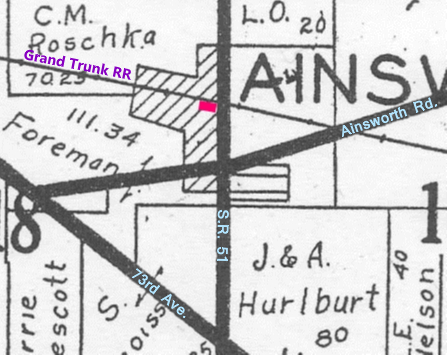
This excerpt from the 1926 Plat Book shows approximately where the little parcel was located (the red rectangle):

Disputed land

Well, that's right in the heart of the Ainsworth business district! Location, location, location!

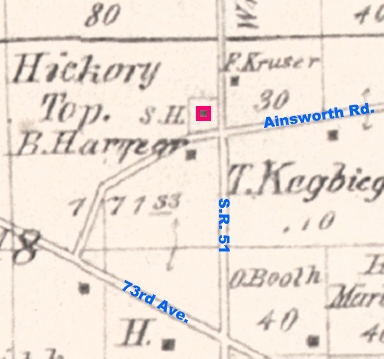
The one bit of information I found surprising in this article is that there was once a schoolhouse on that land, and that it was abandoned, not moved. Actually, this is not inconsistent with the 1874 Plat Map (schoolhouse marked in red):

Schoolhouse 1874

But the little frame building generally considered Ainsworth's first school stood further west along Ainsworth Road.

Friday, December 30, 2011

"An Extra Gang of Italians"

Ainsworth on Christmas Eve 1918 was illumined with the glow of a burning bunkhouse. Fortunately, it seems no one was hurt. The remarkable thing was how the Gazette described the event: "The quarters of an extra gang of Italians on the Grand Trunk railroad were destroyed by fire Tuesday evening at Ainsworth."

The "gang" was a work gang, of course (for example), but this is the first time I've ever seen a railroad work gang described by the ethnicity of its members.

In studying up on the resurgence of the Ku Klux Klan during the 1920s, I've seen mention of an increasing prejudice against southern and eastern European, Catholic immigrants as their numbers swelled after 1890 (my own maternal grandparents among them), leading up to federal immigration-quota laws that would be passed in 1921 and 1924, designed to discriminate against such immigrants, among others.

As I've mentioned before, Hobart and its environs at the time of the first World War were well supplied with immigrants and their children. There were households and churches that still used the languages of their non-English ancestors. But their members were largely of northern and western European origin, and many of them Protestant.

So I'm wondering if that little detail in a one-line story in the Gazette gives us a glimpse of this selective hostility — if the Gazette's editor (perhaps unconsciously) thought of people from Italy, now living and working in the U.S., as still somehow more alien, more defined by their ethnicity, than his German, Irish and Scandinavian friends and neighbors.


Source: "Local Drifts." Hobart Gazette 27 Dec. 1918.

Wednesday, July 6, 2011

1882 Grand Trunk Railway Timetable

Fell off the no-timetables wagon again.

This poor little old thing was originally one big sheet, but it's already disintegrated into three parts, and those parts are crumpled and crumbling.

It doesn't mention Ainsworth, but one can hardly hope that a condensed international timetable would mention a one-horse podunk town where nobody in their right mind would want to go.

Anyway, for what it's worth, I scanned the old thing as best I could, and here it is, in pieces.

7-6-2011 1882 page 1
(Click on images to enlarge)

7-6-2011 1882 page 2

Check out the dining car. If the cuisine was like the décor, those Canadian passengers ate richly:

7-6-2011 1882 reverse 1

7-6-2011 1882 reverse 2

7-6-2011 1882 reverse 3