Showing posts with label Davis. Show all posts

Thursday, June 26, 2025

The Summer of Jeremiah

I have to get back to the estate of Jeremiah Wiggins, because I have taken it upon myself to pull together a little binder for the Merrillville-Ross Township Historical Society museum that will include print-outs of Jeremiah's estate papers and my attempted transcriptions thereof, as well as whatever historical background I can dig up on the other people mentioned in those papers. That historical digging is going to take some time and stop me from doing the research to write about anything else here, so this blog will probably be all Jeremiah for some time.


Here is a claim on the estate:

2025-06-26. Wiggins estate 07a
(Click on images to enlarge)
Images courtesy of Alice Flora Smedstad.


And my transcription:
Estate of J. Wiggins Decd

To John C. Davis Dr. [abbreviation of "debere," indicating an amount owed]

To 5 Ton of Hay used by [illegible word that appears to have been struck out by the writer] the said Wiggins during his life time at $3.00 per Ton $15.00

Allowed
This would be the back of the folded document:

2025-06-26. Wiggins estate 07b

Transcription:
No. 1
Wiggins Estate
J.C. Davis a/c 15$.

Filed & proved in open court Feb. 10th 1840
Solon Robinson Ck. [clerk]
I just briefly mentioned John C. Davis earlier in this blog, and I have not been able to find out any more about him since then. It appears that he came into Lake County from Philadelphia in 1835 or '36, and made some money selling town lots in the future metropolis of Liverpool. Now we know he also made some money selling hay to Jeremiah Wiggins. I don't know where he got the hay, but I'm betting he didn't grow it himself.

In the early account books at the Hobart Historical Society museum that I have indexed so far,[1] he shows up doing business with George Earle as late as 1847. I can't find him in the 1840 Census of Lake County, nor clearly identify him in any other census, here or in Philadelphia.

_______________
[1] A project that has fallen by the wayside. Someday, someday, I will have time to get back to it. Someday.

Wednesday, November 29, 2023

The Humane Society and its Shelter

These articles, from August 1954 through September 1955, tell the story of the Humane Society of Hobart's formation, and the building of its shelter on Rte. 130.

2023-11-29. 1954-08-19. Gazette, Humane Society Organized Here
(Click on images to enlarge)
"Humane Society Organized Here," Hobart Gazette, 19 Aug. 1954.


2023-11-29. 1955-07-07 Gazette, Humane Society's New Shelter Near Completion
Hobart Gazette, 7 July 1955.

2023-11-29. 1955-09-22 Gazette, Humane Society's New Building To Open Monday
Hobart Gazette, 22 Sept. 1955.

I suppose these kind people have all gone to their reward by now. Their president, Morris Cox, died in 1978 and is buried in Evergreen Memorial Park.

The Humane Society is still operating out of the 1955 building. The size of the property is now less than three quarters of an acre; if it's true that Bertha Jacoby originally donated several acres of land, some of it may have been sold off to raise money for construction or operating expenses.

Thursday, December 28, 2017

Updated Index to Ledgers, with Bonus George Earle Autographs

I finished indexing the ledger that begins in 1835, so I have posted an updated index to the Index page.

And here's a page from that ledger with George Earle's autograph (four times).

2017-12-28. AccB1835 100, 101
(Click on images to enlarge)
Images courtesy of the Hobart Historical Society.


The reason I think that is his autograph (as opposed to the ledger-writer's signing his name for him) is that these receipts are among several others on the latter pages of the ledger, each of which has a name signed in distinctive handwriting, e.g.:

2017-12-28. AccB1835 110, 111

The first receipt on this page is made out to "Nath Davis," which could be an abbreviation of "Nathaniel Davis." That might explain the confusion between Timothy H. Ball and the other sources on Liverpool history as to whether the Mr. Davis who was there at the town's beginning had been christened John or Nathaniel — there were two Mr. Davises attending the birth of Liverpool. Both of them show up in this ledger.

Tuesday, November 28, 2017

Breakfast at Liverpool

It's April of 1836, and "Dr. Merchant" has left LaPorte, apparently, as he notes at the top of a fresh page (on the right-hand side) in his account book: "Town of Liverpool."

2017-11-28. AccB1835 006, 007
(Click on image to enlarge)
Image courtesy of the Hobart Historical Society.


A little history, from Howat's A Standard History of Lake County, Indiana, and the Calumet Region (1915):
Either in the later part of 1835, or the fore part of 1836, two Philadelphia men, John C. Davis and Henry Frederickson, and a Western promoter, John B. Chapman, blocked out the town. … The new town on Deep River obtained such notice that during the first sale of lots, which covered three days in 1836, the proprietors realized $16,000. Among the purchasers was John Wood, the builder of Wood's Mill on Deep River. He and a friend bought nine Liverpool lots for $2,000; and many years afterward, when Liverpool had been almost as completely erased from the county map as Indiana City, he would bring forth the deed to his "city property" as a unique relic. The paper was written by John B. Niles, then an attorney, and acknowledged before Judge Samuel C. Sample, of Porter County.
Goodspeed (1882) mentions the same three people — Davis, Frederickson, Chapman — and reprints a survey of the town dated January 30, 1836, by a Newton K. Smith. Ball (1904) gives Mr. Davis' first name as Nathaniel, not John — don't know what to make of that.

The first entry on the account-book page above is "To expenses down to Survey Town — [$]15." That suggests to me that the writer might have been one of the people involved in getting the town surveyed, i.e., John/Nathaniel Davis, Henry Frederickson, or John Chapman.

A few items further down, we find this entry from May 25, 1836: "John's Breakfast 18 ½ [cents]." We've already identified several Johns who could be at the nascent town of Liverpool in the spring of 1836 … but who among them needed his breakfast paid for by someone else? And who among them would have been referred to by his first name, at a time when first names were reserved for use by family members or close friends?

We know, of course, that George Earle had a son named John, who would have been about 3 years old in 1836. We also know that George Earle arrived in Liverpool in 1836 (per Ball) … but would he bring his toddler son to such a place?

If we go back a few pages in the account book, to LaPorte in 1835, we find transactions with "H. Fredrickson," "J.B. Chapman" and "J.C. Davis." Which suggests that the writer wasn't any of these three, but knew them.

… But I've gone off on a tangent and delayed my indexing work, so I'll shut up now. Mystery unsolved.

Wednesday, July 12, 2017

Walter Davis Quits Farming

It's February 1923 — February; a good time to decide you want to join the crowd who've quit farming, and let someone else have a chance at the Krull farm for the spring planting.

2017-7-12. Walter Davis quits farming
(Click on image to enlarge)
Hobart News 8 Feb. 1923.


I just saw that reference to Ainsworth in the farm's location and thought I had better include this, but I have no idea who Walter Davis was. Never heard of him before. I think he might be the guy whose name was transcribed as "Havis" on Ancestry.com, in which case the 1920 Census recorded him living with his wife, Edna, and their four children in Winfield Township, farming rented land. Maybe the Krull farm; I don't know. His eldest son might be the Leslie Davis whose Ford touring car made it into a "South of Deepriver" column in the summer of 1922, when Leslie was about 17.

If so, then by 1930 Walter Davis, true to his word, was in Crown Point not farming, and I have a feeling I need not pay any more attention to him.

Monday, July 18, 2016

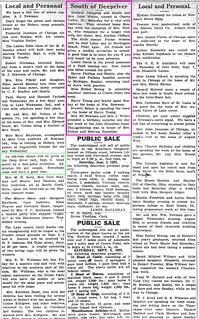
South of Deepriver, August 1922

Today is South-of-Deepriver Day, also known as Blogger-Takes-a-Nap Day.

2016-7-18. South of Deepriver
(Click on image to enlarge)
Hobart News 31 Aug. 1922.


And at the Niksches' Deep River Hall, an old-time dance, whatever that meant in 1922.

Thursday, June 4, 2015

Catherine Mereness Crisman

Catherine Mereness Crisman died in Chicago, I gather, so her remains had to be brought back to the place where she had spent much of her life, to be laid to rest with her husband in Mosier Cemetery.

2015-6-4. Catherine Mereness Crisman obituary
(Click on image to enlarge)
Hobart News 23 Feb. 1922.


I suppose I will have to wait for another obituary to find out if Jane Crisman Maxwell's husband was related to the Lewis and Nettie Maxwell of Deep River.

Sunday, April 14, 2013

Two Chester Sisters at the Centennial

Two more photos from Chester-Raschka descendant Bruce McLain!

The first shows (l to r) Lovisa (Chester) Nelson, Carrie (Chester) Raschka and Lilly Davis in costume for the 1947 Hobart Centennial celebration.

Chester sisters at Centennial

Don't you wonder how much of their clothing is really antique? I know that many people sewed "old-fashioned" costumes for the occasion, but I can image Lovisa and Carrie's mother wearing those black mitts on Lovisa's hands.

I do not know who Lilly Davis was. (Anyone who does is invited to leave a comment.)


Next, we have a summery Christmas greeting card, showing Mabel Brown and her husband, the Rev. Charles A. Brown, pastor of the Methodist church.

Rev. and Mrs. C.A. Brown
(Click on image to enlarge)

The card is undated. The 1920 Census shows the Browns in Lowell; the 1930 Census has them in Hobart (he 64 years old, she 45); and the 1940 Census has them in Chesterton, with the Reverend "retired." Beyond that, I don't know; and, of course, the card could have been sent from anywhere.

Wednesday, December 30, 2009

Two Lives for Five Dollars (Part 1)

On December 30, 1934 — the last night of his life — Henry Nolte went to a party.

He'd been out most of the day. In mid-afternoon, when a young acquaintance named Richard Chapman stopped by the Nolte farmhouse, Henry wasn't home, and a neighbor kid hanging around the yard had no idea where he'd gone. A 45-year-old bachelor, Henry lived entirely alone, and came and went as he pleased.

If he returned to his house at all that afternoon, no one saw him. His dairy cows would have needed tending, of course, but another neighbor boy, 14-year-old Ed Davis, always helped with the morning and evening chores, and may have been able to handle them on his own once in a while.

The evening found Henry at a party in the home of some friends in Miller. The visit went on until nearly midnight, when Henry decided he'd better get going. He had a problem, though — the headlights on his Ford wouldn't come on. That would make for dangerous driving on the dark country roads in Ainsworth. Someone at the party volunteered to drive another car ahead of the Ford, lighting the way, so Henry could at least get back home. He'd have plenty of time when daylight came to get his headlights fixed.

The little convoy arrived safely at the entrance to the Nolte farm. The friend did not get out of his car or even pull into the yard. The two men might have paused to call out a few parting words through rolled-down windows — thanks and goodnight and have a happy New Year! breaking the silence of the frozen countryside. The farmhouse was dark and quiet.

Then they parted. Henry drove into the yard, toward the barn that doubled as a garage. The friend drove off, back toward Miller; anyone inside the house would have heard the crunch of his tires fade down the gravel road.

That helpful friend was the second-to-last person to see Henry Nolte alive.

(To be continued)