Showing posts with label Robinson. Show all posts

Tuesday, January 13, 2026

One Bushel of Buckwheat, One Eternal Mystery

Henry Wells sold Jeremiah Wiggins one bushel of buckwheat in 1837. He also sold him one other thing, but we'll all go to our graves not knowing what it was.

2026-01-13. Wiggins estate 10c
2026-01-13. Wiggins estate 11a reconstructed
(Click on images to enlarge)
Images courtesy of Alice Flora Smedstad.
I had to include the back of the paper just to prove that the amount owed to Wells was $1.00, not $100.


My transcription:

2026-01-13. Wiggins 10c, 11a - transcription

As you can see, if I transcribed "one" correctly in the buckwheat line, then the next line also contains the word "one." But that's the only legible thing in that line.


Henry Willmarth Wells was born in Massachusetts in 1801. Eventually he went west to Michigan, although I do not know when. Solon Robinson describes Henry Wells' coming into Lake County thusly:
On [November 1, 1834], Henry Wells, and Luman A. Fowler, came along on foot, in search of locations. They left their horses back on 20 mile prairie. Cedar Lake was then the center of attraction for land lookers, and thither these, like others, wended their way, without thinking to inquire who kept tavern there. They found a lodging in a leafy tree top, and the leg of a roasted coon for supper. They also found David Horner (father of Amos and Henry), his son Thomas and a man by the name of Brown, looking for claims, upon which they settled the next year, lived there a few years and flitted again. Wells and Fowler came back to our camp next day [in the area of the future Crown Point], so tired and hungry and sick of the country, that they would have sold the whole, Esau like, for a mess of pottage. But after a supper sweetened with honey and hunger, and a night's rest upon the softest kind of a white oak puncheon, the next morning being a bright sunny one, the land looked more inviting, and they bought the claim and two log cabin bodies built by one Huntley upon the south half of Sec. 8, T. 34, R. 8, for which they paid him $50 in cash. Of course cash must have been more plenty with them then than it is now.

Wells went back to his family near Detroit, and Fowler spent the eventful winter of 1834-5 with us in the solitude of the first settlement of what soon became known as Robinson's Prairie. Fowler returned to Detroit in the spring, got married in the fall and returned with his wife and Wells' wife and child, and settled upon their claims. Wells arrived shortly after, and both families have since multiplied after the fashion of all new settlers.
Henry's wife was Adaline (née Witherell, according to family trees on Ancestry.com[1]), but I can't find any records of where and when they married. Together they raised five children.

Henry was very active in Lake County affairs. T.H. Ball notes among his accomplishments: that in 1836 he helped to draw up the constitution of the Squatters' Union (and served as one of its arbitrators); that he was appointed the county's first sheriff upon its organization in 1837, and then went on to serve out the terms of two elected sheriffs before being elected to the office himself for another eight years; that he was one of the commissioners handling funds from the sale of "swamp lands" during the 1850s, but was not implicated in the scandal that arose concerning those funds; and that he was a director of the Lake County Agricultural Society formed in 1851.[2] I believe he was also Treasurer of Lake County at one point.

Here is Henry's obituary, published in the Crown Point Register of May 18, 1876:

2026-01-13. Death of Henry Wells, Crown Point Register, May 18, 1876, p. 3
(Click on image to enlarge)

Now he sleeps in Crown Point's Maplewood Historic Cemetery, and with him sleeps the secret of what he sold Jeremiah Wiggins, besides that bushel of buckwheat.


_______________
[1] The 1906 death certificate of their son, Rodman, gives her maiden name as Witheral; the 1918 death certificate of his brother, Homer, gives it as Eddy.
[2] Lake County 1834-1872.

Thursday, January 1, 2026

A Sad New Year's Day in 1839

On January 1, 1839, Solon Robinson lost his brother and business partner, Milo, to tuberculosis.[1] The settlement of Milo's estate turned out to involve Jeremiah Wiggins' estate.

2026-01-01. Wiggins estate 11b
(Click on image to enlarge)
Image courtesy of Alice Flora Smedstad.


My transcription:

2026-01-01. Wiggins estate 11b - transcription
(Click on image to enlarge)

Milo had come out from New York City in November of 1835 to join Solon in Indiana.[2] In the winter of 1836-7, the brothers opened a store — the first in Lake County — in the settlement that would be the future Crown Point. According to Solon, during that first winter,
we … sold about $3000 worth of goods [over $100,000 in today's money] out of that little old log cabin adjoining the one now [in 1847] used as a Court House.

The best of our customers were the Pottawattomies, who then dwelt here in considerable numbers. (With them commenced my first efforts of a temperance reformation.) Of them we obtained great quantities of furs and cranberries, in pay for goods, (while those calling themselves far superior to the poor Indians in all the moral attributes, gave us promises to pay, some which are promises to this day.)
When Milo died two years later, he was about 38 years of age, and unmarried (so far as I have been able to determine).


The administrator of Milo's estate, Oscar Robinson, may have been another brother, born in 1809 and christened Jacob Oscar. It's odd that Solon doesn't mention him in his history, nor does T.H. Ball. An Oscar Robinson shows up in a Hobart merchant's records in October 1836 (buying ague syrup):

2026-01-01. Robinson, Oscar - AccB1835 036, 037
(Click on image to enlarge)
Image courtesy of the Hobart Historical Society, Hobart, Indiana.


And a Jacob Robbinson is recorded in the Porter County 1840 census. Then the trail goes cold.[3]


Another character in this episode is likewise mysterious: Wilson L.[4] Harrison, of whom Solon Robinson has this to say:
During the same winter [of 1836-7], the first mill in the county was put in operation by Wilson L. Harrison, so that we were able to get a little oak lumber in the spring of '37 for $15 a thousand.
Beyond that, neither Solon Robinson nor T.H. Ball says anything. The 1840 Census shows a Wilson Harrison heading up a household of four in Porter County, but his age is given as 15 to 20, meaning that if this is the person who put into operation the first sawmill in Lake County in 1837, he was between 13 and 17 at the time![5]

The merchants' records at the Hobart Historical Society museum that I have indexed so far turn up a couple of references to Wilson L. Harrison. This one is from June 4, 1837:

2026-01-01. Harrison, Wilson L. - AccB1835 086, 087
(Click on image to enlarge)
Image courtesy of the Hobart Historical Society, Hobart, Indiana.


And this one is from January 13, 1841:

2026-01-01. Harrison, Wilson L. - DayB1840 086, 087
(Click on image to enlarge)
Image courtesy of the Hobart Historical Society, Hobart, Indiana.


After 1841 I cannot find any record of him. Where he came from and where he went remain a mystery.

_______________
[1] Lake County 1834 - 1872 at 63. The location of Milo's grave seems to be unknown.
[2] Lake County 1834 - 1872 at 34.
[3] Some people on Ancestry.com seem to think he was the Oscar L. Robinson who lived in Kenosha, Wisconsin, then moved to Chicago, where he died in 1878 or 1880. By the way, Solon Robinson had a son, Solon Oscar, born in 1831; not that that proves anything.
[4] Lake County 1834 - 1872 at 50 gives his middle initial as S, but no other source does, and in the writing above, the middle initial resembles the L in "Lake County."
[5] Wild hypothesis: the guy in the census is Wilson L. Harrison, Jr., whose father, the mill-builder, had just died. (But none of the history books mentions his death.)

Saturday, December 6, 2025

Selling Off Jeremiah's Stuff (Part 3) and That Other Wiggins Again

The administrator of Jeremiah Wiggins' estate held a second sale on March 4, 1839, to dispose of whatever hadn't been sold in October 1838.

2025-12-06. Wiggins estate 20d
(Click on image to enlarge)
Image courtesy of Alice Flora Smedstad.


My transcription:

2025-12-06. Wiggins estate 20d - transcription
(Click on image to enlarge)


I can't make sense out of that scribbling in the line detailing what Wiatt Wiggins bought. Does it mean Jeremiah's informal claim to the land? (The official government sale of Lake County land would begin on March 19, 1839.[1]) Does it mean just the house sitting on the land? The $25 Wiatt paid in 1839 was just short of $900 in today's money.

The slay/sleigh that James Cassady bought seems not to have been noted in the original inventory. He paid very little for it — about $56 in today's money — which makes me wonder if I'm reading the word correctly.


As I've said before, Wiatt Wiggins has escaped all notice in the Lake County census and other official records as well as the early local histories. We would not know he existed but for these estate papers.


_______________
[1] Lake County 1834 - 1872 at 64.

Thursday, June 26, 2025

The Summer of Jeremiah

I have to get back to the estate of Jeremiah Wiggins, because I have taken it upon myself to pull together a little binder for the Merrillville-Ross Township Historical Society museum that will include print-outs of Jeremiah's estate papers and my attempted transcriptions thereof, as well as whatever historical background I can dig up on the other people mentioned in those papers. That historical digging is going to take some time and stop me from doing the research to write about anything else here, so this blog will probably be all Jeremiah for some time.


Here is a claim on the estate:

2025-06-26. Wiggins estate 07a
(Click on images to enlarge)
Images courtesy of Alice Flora Smedstad.


And my transcription:
Estate of J. Wiggins Decd

To John C. Davis Dr. [abbreviation of "debere," indicating an amount owed]

To 5 Ton of Hay used by [illegible word that appears to have been struck out by the writer] the said Wiggins during his life time at $3.00 per Ton $15.00

Allowed
This would be the back of the folded document:

2025-06-26. Wiggins estate 07b

Transcription:
No. 1
Wiggins Estate
J.C. Davis a/c 15$.

Filed & proved in open court Feb. 10th 1840
Solon Robinson Ck. [clerk]
I just briefly mentioned John C. Davis earlier in this blog, and I have not been able to find out any more about him since then. It appears that he came into Lake County from Philadelphia in 1835 or '36, and made some money selling town lots in the future metropolis of Liverpool. Now we know he also made some money selling hay to Jeremiah Wiggins. I don't know where he got the hay, but I'm betting he didn't grow it himself.

In the early account books at the Hobart Historical Society museum that I have indexed so far,[1] he shows up doing business with George Earle as late as 1847. I can't find him in the 1840 Census of Lake County, nor clearly identify him in any other census, here or in Philadelphia.

_______________
[1] A project that has fallen by the wayside. Someday, someday, I will have time to get back to it. Someday.

Friday, January 24, 2025

Mills of Mystery

Here are some random excerpts from Solon Robinson's "Lake County, 1833 – 1847"[1] that amused me:
In the summer of 1834, most of the land in the county was surveyed by the United States Surveyors, and settlers began to "make claims," and four or five families settled that fall.

One of these I found in October, 1834, in a little shed roof cabin on Sec. 6, T. 35, R. 7, at a place afterward known as "Miller's Mill." His name is already among those that once were, but now are forgotten.

I am inclined to think that an old man by the name of Ross, also settled on the same section that fall. This man was killed by the falling of a tree near Deep river in 1836. (I believe King Alcohol was there to see, and it happened on a Sunday.)[2]

.    .    .

The next family [after Robert Wilkinson's] was that of Lyman Wells; (afterwards well known as "Lying Wells.") With him came "Irish Johnny", now known as John Driscoll.

They came in January, 1835, and settled on Sec. 25, T. 33, R. 9, near where Driscoll now lives. Driscoll was then single, but has since obeyed the scriptural command to multiply and replenish the earth.

Wells had a wife and 4 or 5 children. He lived a few years here and moved further west, and his wife died, and some say the world would not have suffered much loss if he had died too.[3]

.    .    .

Walton's saw mill on Turkey Creek, Wood's and also Dustin's on Deep River and Taylor's on Cedar Creek, were all building during this year [1837]. But with the exception of Wood's they might as well never have been built for the good they have done. The same may be said of the one called "Miller's Saw Mill" on Deep river. Dustin's, Miller's and Walton's have been in utter ruins for years, on account of the difficulty of making a dam of dirt stand, and Taylor's is about half the time without water, and the other half without a dam.[4]

.    .    .

The accommodation of the people of the county was greatly increased this year [1847], in getting grain made into bread stuff, by the mill of Wilson & Saunders on Deep River below Wood's (and as he thinks not quite far enough below).[5]
A little snark livens up history, doesn't it? But I was also intrigued by the references to several local mills I had never heard of before. I wanted to see what information I could find about them (excepting "Taylor's on Cedar Creek," which is outside my bailiwick).

First, let's deal with "Miller's Mill."

Upon learning that this mill was built in Section 6, Township 35 N., Range 7 W., I consulted the 1874 Plat Map and was puzzled because it does not show the Deep River crossing that section:

2025-01-24. Section 6, T. 35 N, R. 7 W -- 1874 plat map
(Click on image to enlarge)

But here is that section as it appears on the Lake County GIS parcel viewer:

2025-01-24. screen shot of Section 6
(Click on image to enlarge)
Screenshot from the Lake County Indiana GIS Hub Parcel Viewer Page.


You can see that 61st Avenue, a/k/a Bracken Road, crosses the river in the southwest part of the section. Also, Solon's Robinson's 1838 map shows the river crossing Section 6. I think we can conclude that the mapmaker of 1874 made a mistake.

The Lake County Encyclopedia, in a chapter containing "Memorial Sketches of Early Settlers," includes this information:
Miller. — There was beyond any room for doubt an early mill seat found and a mill built on Deep River. The Claim Register, which is authority, says: "William Crooks and Samuel Miller in Co. Timber and Mill Seat." Claim made in June, 1835, but settled in November, 1834. Locality, Section 6, Township 35, Range 7. W. Crooks from Montgomery county. This William B. Crooks was elected, in 1837, Associate Judge, and a "Permit" was granted, July 31, "to Samuel Miller to retail foreign merchandise at his store on Deep River." That he had a mill and a store is certain; but of himself very little is known. It is said, and this is tradition and not history, and for its accuracy no good authority can be named, that his wife was part Indian, that he had sold property at Michigan City for eighty thousand dollars in gold and silver, and that much whiskey, as well as other articles of "foreign merchandise," was sold at his store. This last particular is no doubt true. If the gold and silver tradition is true, he must have been the most wealthy adventurer who came into the county in those early years. He made no long stay at that store but sold it to A. Hopkins, who soon sold it to H. Young, and he sold the mill irons to a mill builder, and for himself opened a gun shop which he kept for several years.

A gravel road crosses Deep River now at this locality and a few years ago some of the old timbers of Miller's mill could still be seen in the waters. Somewhere there may be descendants of this Samuel Miller.

Note. — Since the above was written there has come into my hands a little book of autobiography by Dr. James Crooks, a son of Judge William B. Crooks, who it seems was also a physician, and Dr. James Crooks says that his father settled at Michigan City in the spring of 1834. This James Crooks was then eight years of age. He says that Samuel Miller was then the principal business man of that place, that he "owned considerable real estate, houses, a store, warehouse, and a schooner." He also says that his father, Dr. W. B. Crooks, removed into what became Lake county in November, 1834; and that in the spring of 1835 his father and Samuel Miller commenced building a mill on Deep river. After narrating many interesting recollections of his childhood in Lake county he at length says that his father sold out, in the spring of 1838, "his possessions in Lake county to Samuel Miller of Michigan City," for one thousand dollars, and that five hundred dollars was paid "in gold." So Miller must have had some gold. He further adds that "Miller failed a short time afterwards." In June of 1838 the Crooks family left Lake county.[6]
The "gravel road" crossing the Deep River where the mill had been would be 61st Avenue — that is, by 1904, when these "sketches" were published, it was a gravel road; but when the mill was built, it was likely no more than wagon tracks in the dirt.

In a speech delivered in 1884 to the Old Settlers Association, the Rev. T.H. Ball said:
We date our beginning of actual settlement in 1834; yet there is now evidence, which has lately come to light, that at least one family, the first to open a farmer's home in what is now Lake county, spent the winter of 1833 and 1834 on section six, in township thirty-five, range seven west, now in the township of Hobart, formerly in that of Ross. The name of this pioneer was William Ross.[7] … Next came those whom we have learned to call "claim seekers," men seeking locations on the newly surveyed Government lands. Among these we have the now historic names of William B. Crooks, making his claim, near the home of William Ross, in June of 1834, and in company with him Samuel Miller, these selecting "Timber and Mill Seat," and some of the foundation timber of "Miller's Mill" can be seen on this fiftieth year down in the clear water of Deep River.[8]
At the same Old Settlers Association meeting in 1884, Bartlett Woods commented:
William Crooks settled on Deep River near the bridge across that stream on the present road from Merrillville to Hobart. Samuel Miller, of Michigan City, in company with Crooks built a mill there. I knew Miller but do not remember Crooks; the same Crooks was afterwards an associate Judge. There was a store there in an early day, selling a little of everything. Whiskey was part of the stock in trade. Whiskey was cheap then, and was retailed at a shilling a quart. The mill and store were finally abandoned, but the place always was known as Miller's Mill.[9]
I have not found Samuel Miller in the 1840 census of Lake County; in fact, Ancestry.com's search function doesn't return a single Miller in the 1840 census, which is surprising for such a common surname. Early Land Sales, Lake County doesn't list Samuel, either. Among the names I have indexed thus far from the early ledgers at the Hobart Historical Society museum, I find a few references in the 1840s to a "Miller, S.," but there is no way for me to determine what the "S." stands for.[10] It's possible that Samuel Miller came to Ross Township, built his mill, found it didn't pay, and got out of Lake County, all before the 1840 census.

I suppose it's no use walking along the bridge on 61st Avenue and looking down into the river around there. The old pilings that used to be visible have probably long since worn, or been swept, away.

This post has already gotten too long, with too many footnotes, so I am going to have to postpone talking about the other mystery mills for now.


_______________
[1] Printed in Lake County Historical Association (John O. Bowers, Arthur G. Taylor, and Sam B. Woods, eds.), History of Lake County, Vol. 10 (Gary, Ind.: Calumet Press, 1929), p. 35 et seq.
[2] Ibid., p. 37. This is probably the Ross for whom Ross Township was named. See Howat's discussion, which does not mention King Alcohol.
[3] Ibid., pp. 38-39.
[4] Ibid., p. 48.
[5] Ibid., p. 57.
[6] Ibid., pp. 119-120.
[7] Lake County 1884, p. 18.
[8] Ibid., p. 20.
[9] Ibid., p. 80.
[10] I have also failed to turn up any record of William Crooks, or the purchasers of the mill, A. Hopkins and H. Young.

Wednesday, June 30, 2021

Jeremiah's Estate Administrator and His Evaluating Assistants

Following up on my earlier post about the contents of Jeremiah Wiggins' estate — I wanted to research the other names that came up on those inventory pages.

2021-06-21. Wiggins estate 19d
(Click on images to enlarge)
Image above and image below courtesy of Alice Flora Smedstad.


2021-06-21. Wiggins estate 15

The administrator, James H. Cassady, is a mystery. The estate papers tell us that in addition to his administrator duties, he was a justice of the peace, so he must have been a fairly prominent citizen. But beyond these papers, I can find no evidence that he ever lived in Lake County, Indiana, though he did own land here: Early Land Sales, Lake County shows him, in 1839, buying some 120 acres in Township 36 N., Range 9 W., Section 18 — i.e., what is now south Hammond. Still, I can't find him in any census or other record. He's not mentioned in any of my usual local history books, nor does he show up in any of the Hobart-area ledgers I've indexed thus far.

But he's all over these papers, and apparently was a friend of George Earle: this page, from the Wiggins papers, records that James Cassady and George Earle posted $400 bond to ensure that they "truly & faithfully discharge the duties" of administrator of Jeremiah's estate.

2021-06-30. Wiggins estate 30
(Click on image to enlarge)
Image courtesy of Alice Flora Smedstad.


Note how James uses the old-fashioned long s. And below that, we see George Earle's familiar signature.


The first of James' assistants is Charles Walton. We have met him before, under sad circumstances. I still can't find him anywhere except the 1840 Census of Lake County, which doesn't tell us much about him, and the indexed ledgers, where he shows up only in 1839 and 1840.


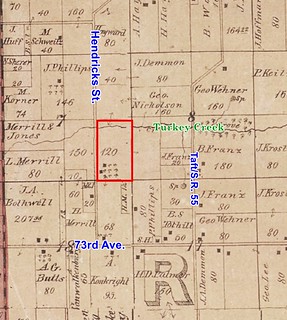
Next we have Levi D. Jones. According to the Hobart ledgers, he was in this area by the summer of 1840, but I can't find him in the 1840 Census. He does show up in 1850 and 1860, farming in Ross Township. In the 1850 Census he is married to Elizabeth (Vanvolkenburg), whom he married in 1847 per the Indiana Marriage Collection. There are two children in the household, one of whom, a seven-year-old boy named Homer, could not be a child of this marriage. The other is a year-old girl named Louisa. In 1856 Levi D. Jones is recorded marrying Lucy Sly in Lake County; if that is our Levi, I wonder what happened to Elizabeth? When the 1860 Census comes around, we find Levi D. Jones farming in Ross Township, living with an 11-year-old girl, Mary L., whose relation to him is not described, while Homer Jones is now living in the household of Abram Vanvolkenburg. Elizabeth, Louisa,[1] and Lucy are nowhere to be found. And that is as far as I can trace any of them.


The third assistant, David Fowler, shows up in the Hobart-area ledgers as early as October 1836, and makes appearances through 1841 (at this point in my indexing). The 1840 Census also records him, in a household of 11 people, in what appears to be western Ross Township — the same area where he, circa 1843, purchased 80 acres of land.

2021-06-30. Fowler, David 1874
(Click on image to enlarge)
From the 1874 Plat Map. By that time, David Fowler's land was owned by George Nicholson.


The Indiana Marriage Collection records David Fowler marrying Rebeca Deyo (or Dezo) in 1840, and the 1850 Census places them, with two children, in Cedar Creek Township, where apparently David died in 1860.


The last of these assistants is Michael "Stieckelman," but we will use the spelling on his grave marker in the Merrillville Cemetery: Steichelman. He was born in Germany in 1800, and there married and began a family. According to a findagrave.com biography of his daughter, the family came to the U.S. circa 1835 and to Indiana about 1837. It was a relatively small family for those days: just Michael, his wife Margaret, and their two children, Mary and John. The 1840 Census shows five people in the household, so one is unidentified.

Here is a page from an unknown Hobart-area merchant's ledger showing Michael purchasing nails and thread in 1840.

2021-06-30. Steichelman, Michael - DayB1840 66, 67
(Click on image to enlarge)
Image courtesy of the Hobart Historical Society.


If he ever bought land here, I have not found a record of it. That record may be hidden by some creative spelling of his name; I have seen many variations.

By the 1850 Census the family had moved to Illinois. So I don't know why, when Michael died in 1851, his remains were brought back here for burial. According to a note on the findagrave.com entry for Michael's wife, Margaret, she died in 1880 and was buried in the Merrillville Cemetery, but later her remains were moved to the cemetery in Iowa where their daughter is buried. The only other Steichelman in the Merrillville Cemetery is a little girl, Hattie, born to Michael and Margaret's son, John. He had married Mary Towl in 1855. After John was killed in the Civil War, Mary remarried and is now buried in Kansas.


Well, it was interesting to look into these names, but I didn't learn a whole lot. How these people flitted through our early local history, leaving so few traces! They didn't know, apparently, that the purpose of their lives was to furnish material for amateur historians' blogs.


_______________
[1] [Jan. 2026 update: Now that I think about it a little more, I bet that Louisa from the 1850 census and Mary L. from the 1860 census are the same person. But I still don't know what happened to her after 1860.]