Showing posts with label land ownership. Show all posts

Sunday, November 27, 2011

The Price of Farmland

Returning to the topic of land purchases remotely related to Ainsworth (yes, I still do sometimes pretend to be writing this blog about Ainsworth), I'm a bit surprised to notice how little noise has been made by the family of Fremont and Carrie Price — surprised, because they had nine children, and look what an impact Henry Chester and his three wives made with the same number. Apparently the Price children were better behaved. I've found occasion to mention the Prices only when their chicken coop got raided in 1916 and when Fremont served as treasurer for the Ross Township Red Cross drive in the spring of 1918.

Now the Prices get into the papers for the respectable activity of buying the Ross Township land they had farmed as renters for the past 12 years or so; namely, 80 acres at the northwest corner of (present-day) Colorado St. and 69th Ave., belonging to Willard O. Halsted.
Price land 1926
(Click on image to enlarge)
The Price farm as it appeared (all 77 acres of it) in the 1926 Plat Book.


The Prices paid $150 an acre for that land. That may have been high, but they were buying "one of the best pieces of farming land in Lake county." ("At least," added the Crown Point Star, "Mr. Price is of that opinion as this year the tract produced wheat that averaged 50 bushels to the acre.") Fremont intended to build a bungalow on the southeast corner of the land, and, according to the Gazette, "become a full-fledged citizen of that community" — whatever community that might be, between Merrillville and Ainsworth.

The Prices already owned land in Montana, a wheat ranch of some 480 acres near Big Sandy. In 1916, they proudly reported that their three eldest sons (Harry, Ray and Gordon) were managing that ranch with great success. A year later their next eldest son, James, followed in his brothers' footsteps to the Montana ranch.

In June 1918 James enlisted in the military; within a month he was in France, and soon in action.

Just about the time that they closed on their farmland purchase, the Prices received a letter from James, dated October 18. He told them he had been wounded in action October 2 — a German bullet in the shoulder — but he was already recovered, and "ready again for the trenches."


Sources:
♦ 1926 Plat Book.
♦ "Another Lake County Hero." Hobart Gazette 27 Dec. 1918.
♦ "Local and Personal." Hobart News 5 Dec. 1918.
♦ "Local Drifts." Hobart Gazette 22 Nov. 1918.
♦ "Price Boys Making Good." Hobart Gazette 14 Jan. 1916.
.

Sunday, November 15, 2009

Chester's Camp: Purchase of Land

I notice that the Northwest Indiana Genealogical Society moved its photograph of Chester's Camp from "Unknown Lake County" to "Ainsworth." You're welcome, NWIGS. (I'm kidding! I doubt anyone affiliated with NWIGS even knows this blog exists.)

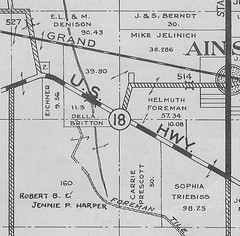
In the following little item from the Vidette-Messenger of July 7, 1926, I think we see John and Emma Chester buying the land where Chester's Camp would be built: "Helmuth Foreman wid to John Chester and wf Emma pt 18-35-7…………..1.00." In other words, part of Section 18, Township 35 North, Range 7 West of the second Principal Meridian — one of the sections comprising Ainsworth, and bisected by the Lincoln Highway. Too bad the newspaper item doesn't say how much land was transferred; that would be helpful to know. Here is Section 18 as it appears in my 1939 plat book:

Section18
(Click on image to enlarge)

In the northwest quarter of Section 18, on the east side of the T-intersection of Lincoln Highway and Dekalb Street (the latter not labeled), is a two-acre parcel without an owner's name. For reasons that I will explain in a later post, I am going to focus on that two-acre parcel.

One of the reasons it will have to be in a later post is because there are so many lines of inquiry branching out from this topic, and I think I have adult ADD. I can feel my brain overheating. I'm not a very adept historian. I have to go take the dog for a walk and let my brain cool off. Maybe tomorrow I can start afresh.

Sources:
♦ Lake County Title Co. Plat Book of Lake County 1939. n.p., n.d. Print.
♦ "Real Estate Transfers." Vidette-Messenger (Valparaiso, Ind.) 7 Jul.1926. Access Newspaper Archive. Lake County (IN) Public Library 15 Nov. 2009 .

Friday, October 23, 2009

Affidavit of William Homer Ghearart, April 12, 1930

William Homer Ghearart being first duly sworn upon his oath deposes and says that he is aged eighty-four years and has been a resident of Porter County, Indiana, since 1850, and was well acquainted with Henry T. Smith, grantee in a warranty deed dated December __, 1857 [sic], conveying the West One Half (1/2) of the Northwest Quarter (1/4) of Section Seventeen (17), Township Thirty-five (35), Range Seven (7) West, containing eighty acres of land . . . .

Affiant further says that Henry T. Smith was an aged man at the time and had been to California in 1849; that said Henry T. Smith died about 1858 and that he left surviving him as his sole and only heirs at law Sarah Smith, his widow, Burnette T. Smith, a son, Mary Smith, a daughter, Hodson T. Smith, a son, and Alfred T. Smith, a son; that the sole and only heirs at law of Henry T. Smith gave a quit claim deed to the above described property to Charles Chester, dated December 19, 1858 . . . .

*   *   *
That the road running in an easterly and westerly direction through the north end of said land was at one time called the old Sac trail, and has been in the same location as long as this affiant can remember.

That this affiant knew of Lucy M. Hanks, who was the sister of the wife of Henry Chester in 1867. That Lucy M. Hanks married a man by the name of Spencer, but April 6, 1867, she was a single woman.
The road he describes in the third paragraph as the old Sac trail (I’ve more commonly seen it spelled “Sauk”) sounds very much like Ainsworth Road. I’ve always wondered why Ainsworth Road was laid out so oddly, at a not-quite-45-degree angle to the more orderly north-south roads it crosses. Its being an old Indian trail would explain that.

In Calumet Beginnings, Kenneth Schoon provides a map of Indian trails in northwest Indiana. He states that the Sauk Trail was chosen as the route for the Lincoln Highway when it was being built in the early part of the 20th century. The map he provides shows the main Sauk Trail roughly corresponding to the Lincoln Highway, aka 73rd Street in the vicinity of Ainsworth, but it also shows a short path branching off from the Sauk Trail a couple miles west of the Lake-Porter county line, moving northeast, crossing Deep River north of Shanoquac’s Town, and joining up in Porter County with another path labeled “To Tassinong and Potawatomi Ford.” Part of this short path resembles Ainsworth Road.

Sources:
♦ Ghearart, William Homer. Affidavit. April 12, 1930. Filed for record in Lake County, Indiana, July 7, 1930.
♦ Schoon, Kenneth J. Calumet Beginnings: Ancient Shorelines and Settlements at the South End of Lake Michigan. Bloomington: Indiana University Press, 2003.

Thursday, October 22, 2009

A Brief History of Three Acres, More or Less

Outline of Title History

This list was compiled by the Chicago Title person doing the search, and I added some details as I typed it up.

I have copies of the documents themselves only from the 1977 warranty deed back to Henry Chester’s 1909 deed to his wife and children. That’s where we decided to stop getting copies because of expenses. If I’m ever so inclined, I can try getting copies of the earlier deeds from the Lake County Recorder of Deeds.

So my little 3-acre parcel came out of the 70-acre parcel in 1921, when Carrie and William Raschka transferred it to George Bodamer. If the barn was in fact built in 1923, then the land was George Bodamer’s at the time. If the house was in fact built in 1937, that was during the first ownership by Hubert (Sr.) and Delilia Lines.

I'm not entirely sure that Theodore Holgebein and Theodore Kagebein weren't one person with bad handwriting.

But my goodness, all these people transferred land as if that were their only source of entertainment.