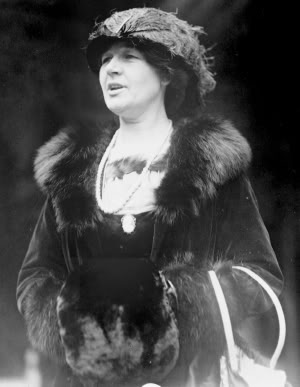
 An unknown woman of respectable appearance, in early 20th century fashions, carrying a muff.
Image credit: National Photo Company Collection/Library of Congress, Washington, D.C. (Digital File Number: cph 3c12574)
I used to devour true-crime books like candy and now do the same to judge shows, which means I've seen case after case of people walking into trouble with their eyes wide shut ("But I
trusted him!") — which has caused me to develop a keen appreciation for those rare stories where someone's gut instinct alerts them to a problem
before they become a victim and they actually heed their instinct.
Just such a case happened in Hobart in November 1915.
On Thanksgiving Day, a couple of strangers arrived in town. They registered at the Hobart House as man and wife; since the newspapers don't report what name they gave, let's just call them Mr. and Mrs. Skinner. Their manner was genteel, their appearance prosperous. They were from Utah, they said, but were traveling, and had just arrived from Chicago. Now they wanted to buy a small touring car to continue their journey and would be glad to hear of anyone in town interested in selling such a vehicle.
They were told that Paul Newman, who kept a garage, sold cars. They came to see him, asking for a new Ford. He had none in stock. But one of his patrons, Thomas Ingram, kept a used Ford touring car there that he was willing to part with. The Skinners got in touch with Mr. Ingram, and on Friday the parties came together to negotiate.
Once they had settled on the price, the Skinners explained that they did not have sufficient cash on hand to pay the full amount. Since they were due in Laporte that evening, they wanted to take the car immediately, so they proposed giving Mr. Ingram a 60-day promissory note along with something of value as security — for instance, the two diamond rings that Mrs. Skinner wore, worth $400 each. Mr. Ingram consented on the condition that the diamonds be determined by a jeweler to be genuine.
So the little party walked over to the Dell F. Beach jewelry store, Mrs. Skinner's ring-bedecked hands snuggling inside the muff she carried for protection from the chilly November air. Once in the store, Mrs. Skinner took off the rings and gave them to Mr. Beach. He examined the diamonds carefully and pronounced them genuine. He handed the rings back to Mrs. Skinner, who put them back on.
Now the Skinners had their own request: they wanted the rings held in safekeeping at a local bank. The three of them agreed upon the American Trust & Savings Bank. As the group walked out of the Beach jewelry store to go to the bank, Mrs. Skinner again slipped her hands into her muff. At the bank, she surrendered her rings, and a cashier placed them in the vault.
All that remained was to go to the Newman garage where Mr. Ingram kept his car, and fill out the paperwork to transfer ownership.
On the walk to the garage, and as he set about with the paperwork, Mr. Ingram found himself increasingly uneasy. The memory of that seemingly insignificant gesture just outside the Beach jewelry store — Mrs. Skinner's hands, with the rings on her fingers, disappearing into her muff — kept intruding into his mind, or rather, into his gut. He couldn't shake the feeling that something was wrong. It occurred to him that a switch might have happened under cover of that muff, and that the rings now safely stowed away in the bank vault were not the rings that Mr. Beach had pronounced genuine. At the same time, it seems, Mr. Ingram did not feel sure enough to make an outright accusation against such a respectable-looking couple. But after a few words privately with Mr. Newman, who advised him to be careful, his made up his mind. Abruptly he announced that he didn't want to go through with the deal; he'd keep his car, give back the promissory note, and the Skinners could go retrieve their rings.
The couple quietly left the garage. Sometime on Friday night they quietly left town as well, in a car, apparently their own, which they had "planted" somewhere in town.
If Mr. Ingram needed confirmation of his suspicions, he got it the next Wednesday when a report turned up in a Chicago paper of just such a con game having been attempted in Elgin, Illinois. The description of the couple involved and their technique of substituting phony diamond rings for real ones was so similar to his experience that he had to believe it was his own Skinners. The Elgin attempt ended with the arrest of the couple. To the police they gave their names as M. Randall and Mrs. Fern Hiller, she being allegedly recognized as a well known diamond thief. Among the couple's personal effects the police found promissory notes for three other autos that had been successfully "purchased" by the same technique.
Marshal Fred Rose lamented that he hadn't been alerted at the first suspicion — he felt sure that he could have collared the thieves. But at least Mr. Ingram's gut saved him from the being skinned.
Sources:
♦ "Diamond Swindlers Couldn't Pull Their Game in Hobart." Hobart News 2 Dec. 1915.
♦ "Diamonds for an Auto." Hobart Gazette 3 Dec. 1915.


