Showing posts with label Buchfuehrer. Show all posts

Thursday, March 30, 2023

Gay-Mill Gardens

Miller is outside my bailiwick, but having previously encountered a 1922 ad in the Hobart newspaper for the Gay-Mill Gardens, I couldn't help but be thrilled to receive a photo of the place.

2023-03-30. Buchfuehrer gay-mill-gardens
(Click on image to enlarge)
Image courtesy of R.F.


The 1922 ad described the location as Lake and Forrest Avenues, so I suppose the photographer was standing on Forest Avenue and looking west toward Lake Street.

This photo was among a group relating to the Buchfuehrer family. William Buchfuehrer may have been driving the Henderson Ice Cream truck out front of the Gay-Mill Gardens. He was employed by the Henderson factory in Hobart off and on during the 1920s and '30s. In fact, in 1937 he (in partnership with William Ittel) purchased the factory, and went on to operate it for some 20 years. But this photo predates that purchase — by 1937 the Gay-Mill was abandoned. The cars in the photo are from the early 1920s (as the Ainsworth vintage-car expert tells me), so the photo probably was taken not long after the Gay-Mill first opened.

Thursday, December 8, 2016

Stop Signs on Main Street

Is it possible that traffic through the intersections of downtown Hobart was not controlled until the autumn of 1922, when Fred Rose, Sr. installed six stop signs?

2016-12-8. Stop
(Click on image to enlarge)
Hobart Gazette 3 Nov. 1922.


In the next column we learn that Charles Shults, having quit farming, moved to the Buchfuehrer house on Lillian Street, and I hope someone comes along pretty soon to tell me where that was.

We also learn that Charles' wife had been a Lute. Per the Indiana Marriage Collection, Charles Shults married Lydia Lute in Porter County in March 1897. The same source tells us that William Shults married Vena Lute in February 1896. I wonder if these were two brothers marrying two sisters?

In the far-right column, we recognize our friend, John Killigrew. I believe he won that election.

♦    ♦    ♦

Elsewhere in the "Local Drifts" of the same issue, we find this little item:
Jacob Yeager [Yager] and son, Adam, and John Sturtevant of near Deepriver, left Monday in a Ford touring car for Frederick and Baltimore, Md. They were equipped for camping out, and may not return for several weeks.
Jacob Yager was in his mid-60s, John Sturtevant about 52 (1920 Census); if they could stand camping out, well, good for them.

Wednesday, March 23, 2016

His Awesome Alfalfa

On July 13, 1922 — about three months after the sudden death of her husband — Maud Hardesty gave birth to his last son. The child's name was not given in the newspaper; it may have been Bruce, but at the moment I'm not sure.

Three days earlier, on their farm southeast of Ainsworth, Emil and Bessie Buchfuehrer welcomed a baby daughter — she would be named Grace, I believe.

But the really surprising thing to happen in July 1922 — surprising to me, anyway — was that Henry Nolte came in to the office of the Gazette to show off his alfalfa.

2016-3-23. Henry Nolte and his alfalfa
(Click on image to enlarge)
Hobart Gazette 21 July 1922.


That page is loaded with news, including visitors at the Paine farm, an expansion of the Wood garage in Deep River, and a thief in the night at the Hayward farm.


Additional Sources:
♦ 1930 Census.
♦ "Births." Hobart Gazette 21 July 1922.

Monday, October 20, 2014

Fred Carbine

Well, guess what. Now I do know where the Hite cottage was, thanks to Suzi Emig's comment on yesterday's post:
My maternal g'father Fred Carbine was the youngest of nine children born to Christian and Caroline Kegebein. He married Anna Buchfuehrer. My mom was their youngest child born in 1921. She said they lived in the house in Ainsworth which is now 7237 Hwy 51 at that time. They moved to 756 Lincoln St. where they raised their family and lived until their deaths. My mom told me that the house originally did not have a basement, so it was raised up and a basement was dug out. I have many happy memories of that house and even got to see the inside with my mom years later when my neighbor's daughter bought the house. My grandfather as a young man worked for the Wood family in Deep River at their store, then delivered for Roper and Brown, so this was probably the grain dealer as per the blurb.
And furthermore she sent me this image of Fred Carbine with a horse-drawn delivery wagon:

2014-10-20. Fred Carbine
(Click on image to enlarge)
Image courtesy of Suzi Emig.


The photo is not dated, but may date to the time when Fred was employed at the Wood store, circa 1910.

From the Hobart News of 26 Oct. 1911, his wedding announcement:

2014-10-20. Carbein-Buchfuehrer wedding
(Click on image to enlarge)


(I began indexing this family under the spelling on the grave marker at Woodvale Cemetery, but apparently the younger generation Americanized it, and I have seen "Carbine" used often in the newspapers. All the same, I'm not going to change my indexing.)

Monday, December 30, 2013

Hoodoo? We Do!

In spite of bad roads, the East Ross Community Association continued holding entertainments at the W.G. Haan school during the winter of 1921. (Also, the "Births" column brings news of some acquaintances, and I do not know where the Buchfuehrer baby was buried.)

East Ross Comm'y Assoc.
(Click on images to enlarge)

I can't identify this "Mrs. O'Leary" who is promising to direct the upcoming play; the 1930 census shows a 64-year-old Margaret O'Leary living on the Sunderman farm in Ross Township, but she is listed as single. As for the play itself, though I can't find its text, other selections from its its author's body of work give you some notion of its tone.

The February 4 meeting felt the effect of the weather on the unpaved roads.

East Ross Comm'y Assoc.

I don't know exactly what that reference to "Dinah and Sambo" means, but I fear the worst, and it may have involved blackface.

(Some sad news in this week's "Births" column about the former Carrie Zobjeck.)


Sources:
♦ 1930 Census.
♦ "Ainsworth Community Meeting." Hobart Gazette 11 Feb. 1921.
♦ "Ainsworth Community Meeting." Hobart News 10 Feb. 1921.
♦ "Births." Hobart News 3 Feb. 1921; 10 Feb. 1921.
♦ "Community Meeting at Ainsworth, Friday Evening, Feb. 4." Hobart News 3 Feb. 1921.
♦ "Local and Personal." Hobart News 3 Feb. 1921.
♦ "Play at Ainsworth, Feb. 18." Hobart Gazette 4 Feb. 1921.

Saturday, October 5, 2013

Come Down Our Way … and Bring John Sapper

From the steamer trunk.

1911-07-11-a
(Click on images to enlarge)
This image and the one below courtesy of Eldon Harms.


Here we have (at right) Martha Granzow. The woman at left is unidentified; she looks too young to be Martha's mother, but might be her older sister, Alma.

This is the message Martha sent to Herman Harms:

1911-07-11-b

My transcription: "Say Kid come down our way next Sunday night rather late. You will find us at my house or at Lily Buchfuehrers or walking down Deep River. Answer this card. Matz." At the top she added: "Send me one of your pictures. Let me know if you are coming." And up the left margin: "Bring John Sapper along."

I sense a vivacious personality behind this card. The postmark was 1911, so Martha was then about 15 years old, her friend Lillie Buchfuehrer maybe a year younger. Herman Harms and John Sapper were both about 17.

♦    ♦    ♦

If I've found the right family, the Granzows had come to Indiana from Wisconsin after 1900. The family in 1900 consisted of father Carl (42), mother Minnie (43), and the children: William (17), Fred (16), Albert (14), Paul (11), Alma (7) and Martha (3). Carl's mother-in-law, Christiana Voss, lived with them.

It appears they first moved to Hobart Township, as the 1908 plat map shows 80 acres in the very southwest corner under the Granzow name. In April 1906, Carl bought from Mary Giese 30 acres near Deepriver — perhaps part of this land still attributed to August Giese in 1908:

Giese land 1908

In 1908 the Buchfuehrers bought the Casbon land, so the two families were neighbors. While the Granzow household had shrunk to just Carl, Minnie, Alma and Martha by 1910, Fred Granzow was around enough to fall in love with Louise Buchfuehrer. Fred and Louise were married in April 1911; they moved first to Hobart, then to Milwaukee in 1912. I do not know what became of the other Granzow brothers, and by 1920 Alma had vanished, too — either I've not been paying attention in my newspaper reading, or they carried on their lives with little publicity.*

In 1918 the Granzows sold their farm to Michael Baessler, Jr. and moved to Lake Street in Hobart, occupying a house and four acres they bought from L.E. Maxwell.

___________________
*It doesn't help that their last name turns up in several different spellings, e.g., Granzow, Granzov, Granson, Granzon; and Carl is also called Charles.


Sources:
♦ 1900 Census.
♦ 1908 Plat Map.
♦ 1910 Census.
♦ 1920 Census.
♦ "Deepriver Items." Hobart Gazette 16 Apr. 1909.
♦ "Local and Personal." Hobart News 31 Jan. 1918.
♦ "Local Drifts." Hobart Gazette 16 Apr. 1909; 3 May 1912.
♦ "Married." Hobart News 20 Apr. 1911.
♦ "Personal Mention." Hobart News 6 Apr. 1911.

Wednesday, September 11, 2013

Did We Say Yes? We Meant No

As early as 1919 some prominent citizens were actively working to incorporate Hobart as a city (with a mayor, as opposed to its original status as a town, governed only by a board of trustees). A petition to the town board for the change was drawn up, and in July 1919 the Hobart Commercial Club set out three copies at convenient locations for signing: one at the First State Bank, another at American Trust & Savings, and the third in the hands of board chairman, E.E. Pierson. Over several months, the required numbers of signatures accumulated — one-third of Hobart's voters — and the petition was formally presented for consideration by the town board on April 27, 1920.

In general I find this whole issue rather dull, but now and then some point of interest crops up. At the last town board meeting of October 1920, a number of men who had signed the original petition in favor of incorporation as a city now presented a new petition asking that their names be stricken from the first petition. Among them are some particular friends of ours, including C.C. Shearer, William Raschka, Paul Emery, Charles Lee, and Louis Buchfuehrer.

Anti-petition petition re: Hobart as a city
(Click on images to enlarge)

As you may gather from that report, Trustee John Thiel (a 42-year-old attorney) opposed anything that would stand in the way of Hobart's becoming a city. The same issue of the Gazette carried his argument in favor of the city form, hinting that under the current form there was a good deal of dubious stuff going on.

J. Thiel article re: city government


Sources:
♦ 1930 Census.
♦ "Petitions Are Out to Transform Hobart Into a City." Hobart News 10 July 1919.
♦ "Reasons for City Government for Hobart." Hobart Gazette 29 Oct. 1920.
♦ "Town Board Doings." Hobart Gazette 29 Oct. 1920.

Wednesday, August 21, 2013

One Saturday, and Many Sundaes To Come

Leo Fifield-Augusta Buchfuehrer wedding photo
(Click on image to enlarge)
Leo Fifield and Augusta Buchfuehrer on their wedding day. Her dress was of yellow chiffon over yellow satin.
Image courtesy of Norma Buchfuehrer Collins.


It was the evening of Saturday, October 9, 1920, when the youngest daughter of the former Ainsworth-dwellers Louis and Frederike Buchfuehrer became Mrs. Leo Fifield.

Fifield-Buchfuehrer wedding
(Click on image to enlarge)

Nine days later, Leo and Gusta became the owners and operators of an ice-cream parlor.

Fifield purchase of Henderson retail business
(Click on image to enlarge)

The ice-cream parlor in question was at 310 Main Street.


Sources:
♦ "Fifield-Buchfuehrer Nuptial." Hobart Gazette 15 Oct. 1920.
♦ "Fifield-Buchfuehrer." Hobart News 14 Oct. 1920.
♦ "Leo Fifield Buys Henderson Confectionery store." Hobart News 21 Oct. 1920.
♦ "Local Drifts." Hobart Gazette 22 Oct. 1920.

Tuesday, February 26, 2013

W.G. Haan School and Personnel, 1938

Another Ainsworth historian sent me these wonderful pictures from 1938, along with their appearance in a newspaper (I don't know which one).

1938-ainsworth-school-wghaan
(Click on images to enlarge)
Images courtesy of R.F.


1938-ainsworthschool-article

1938-ainsworthschool-teachers

1938-ainsworthschool-article-2

Wednesday, September 12, 2012

The Calls of Ainsworth

John and Lillian Call
(Click on image to enlarge)
John and Lillian (Buchfuehrer) Call. Undated.
Image courtesy of Norma Buchfuehrer Collins.


Just two years had passed since Lillian Buchfuehrer left her Ainsworth-area home with her parents; now, in the autumn of 1919, she left her Hobart home with her new husband, John Call.

According to the Gazette, the groom's parents, residents of South Bend, Indiana, "had at one time lived at Ainsworth." That's news to me! I never heard of them before. Their Ainsworth residence may have been pre-1899, or perhaps they slipped in and out so quietly and briefly that they escaped newspaper attention.

Lillian, now about 26, had spent most of 1919 working as a clerk at Scheidt & Keilman's store (the Bee Hive) in Hobart. As for the 24-year-old groom, he had spent the past 16 months in the Army, which had taken him to France and Germany, and brought him back only about a week before the wedding.

The quiet ceremony took place on the afternoon of Saturday, October 18, at the home of the Rev. E.R. Schuelke, witnessed by the bride's brother and sister, William and Augusta. Afterwards, the Buchfuehrers hosted a small reception and dinner at their home.

On Sunday, the young couple left for Harvey, Illinois, where they intended to live, as John held a position with the "car works" there. I do not know how long that lasted, but by January 1920 they had come back to Hobart to live, and John was working in a steel mill.


Sources:
♦ 1920 Census.
♦ "Call-Buchfuehrer." Hobart Gazette 24 Oct. 1919.
♦ "Call-Buchfuehrer." Hobart News 23 Oct. 1919.

Tuesday, September 6, 2011

More Than a Farmhand

Mains, Louis
(Click on image to enlarge)

Wandering around in Woodvale Cemetery, you may come across this lonely grave, not part of any family plot, the only one in the graveyard with that surname.

Louis Mains was a farmhand, working for the Buchfuehrers southeast of Ainsworth. They had taken him from "a home in Terre Haute" — whether private or institutional isn't clear — when he was just 11 years old. His parents were both living, but separated, and apparently neither could provide him a home. At the same time Louis came to Ainsworth, his older sister, Lucile, went to stay with the Frank Schumacher family in Hobart.

When Louis and Frederike Buchfuehrer retired from farming in 1917, their son Emil kept Louis on at the farm. Over the years, Louis had so impressed the Buchfuehrers with his good character and serious work ethic — he "was a splendid boy to work," they would later say — that they had grown quite fond of him. They probably expected him to make a success of his life, in spite of its rather shaky start.

The end came on August 11, 1918. It was a bright Sunday afternoon. Louis and a friend, Ralph Edwards (a hired hand on the Julius Triebess farm), walked over to the Deep River to go swimming. Ralph knew how to swim, but Louis didn't, so he wore "wings" — probably a cork version of our modern-day inflatable water wings. The boys plunged into the water, heading toward the opposite bank. And then something went wrong. Louis yelled; Ralph looked back; Louis' arms flew up; the "wings" had slipped off and were floating away; suddenly Louis disappeared under the water. It all happened so fast — Ralph couldn't reach his friend before he sank, and once he sank, he was lost.

Ralph ran to get help. As the alarm spread, a number of men left their Sunday-afternoon activities to join in the search. After about an hour, William Wood found Louis' body, in about 10 feet of water, and with Robert Thorpe's help pulled it out. They carried the drowned boy home to the Buchfuehrers. Dr. C.C. Brink was summoned from Hobart, but it was as deputy coroner — there was no hope.

The Buchfuehrers, deeply grieved, behaved as if Louis had been their own son. They hired Alwin Wild as undertaker, arranged for the funeral to be held in the Deep River church, and laid the boy to rest in Woodvale Cemetery, near their home.

The funeral was "largely attended." Among the mourners was Louis' father (name unknown); he came up from Covington, Indiana. If sister Lucile was still living with the Schumachers in Hobart, she likely made the short trip down to Deep River that day. But the boy's mother, who resided in either Covington or Terre Haute (depending on which newspaper you read), apparently did not attend.

I don't know who bought that nice grave marker for Louis. I'm inclined to think it was the Buchfuehrers.


Sources:
♦ "Boy Drowns in Deep River." Hobart Gazette 16 Aug. 1918.
♦ "Louis Mains Loses His Life by Drowning Sunday Afternoon." Hobart News 15 Aug. 1918.

Friday, March 18, 2011

Leaving Already? — You Just Got Here!

Buchfuehrerfarm1926
(Click on image to enlarge)
This image from the 1926 Plat Book shows two things: (1) the 185 acres of land the Buchfuehrers bought from Sylvester Casbon in 1908, and (2) how truly creative the 1926 mapmakers could get with the spelling of people's names.


Louis and Frederike Buchfuehrer had been farming in Ross Township, just west of the village of Deep River, for not quite nine years when they announced in the autumn of 1917 that they were making plans to leave. Compared to some of the long-timers we've seen leaving lately, they were relative newcomers.

The Buchfuehrers were both German immigrants. They came to this country in 1887 as a couple, having been married in the old country in 1882. I don't know where they settled at first. They don't appear in the 1891 Plat Book. By 1900 we find them farming rented land west of Hobart. After several years they were doing well enough for themselves that they also purchased a lot in town, on State Street, and built a brick house there. In 1908, when they bought Sylvester Casbon's 185-acre Ross Township farm, that new brick house was included in the purchase price. But in the years that followed, the Buchfuehrers were able to buy their Hobart house back from Sylvester.

Now that Louis was 57 years old and wanting a break from the hard work of farming, they planned to move into their Hobart home. Their eldest son, Emil, would live on the farm with his wife Bessie and their three small children; he would operate the farm for himself and pay his parents rent.

Louis placed a detailed ad for the auction of his livestock and farming equipment.

Buchfuehrerauctionad1917
(Click on image to enlarge)

Although Louis and Frederike themselves spent less than a decade on their Ross Township farm, they had put down roots; they had planted a family tree that still grows on those acres.

♦    ♦    ♦

[1/17/2013 update] Image my surprise when I learned that this auction had been photographed!

This first photo shows, at left, the Buchfuehrers' brick farmhouse on the north side of the old Lincoln Highway, aka E. 73rd Ave. So here the camera is pointing more or less eastward, and if you stepped onto that road and started walking into the background of the photo, you'd eventually find yourself in the village of Deep River.

Buchfuehrer auction 1917 1
(Click on images to enlarge)
Images courtesy of Norma Buchfuehrer Collins.


That brick house, I suppose, was built by Sylvester Casbon and came with the farm that the Buchfuehrers bought from him. It is no longer standing.

The second photo was taken from the south side of 73rd Ave., looking north. Once again we can see the original house, in the background at left.

Buchfuehrer auction 1917 2

♦    ♦    ♦

[1/18/2013 update] After I posted the two photos above, another Ainsworth historian volunteered the following four pictures of the same event.

I believe this first one shows some of the buggies and farm equipment to be auctioned.

Buchfuehrer auction 1917 02
(Click on images to enlarge)
Images courtesy of R.F.


The newspaper announcement mentioned that lunch would be served by the Ladies' Aid Society (of Deep River, probably), so I think that's what we're looking at in this next photo. "Sadie Baker" may be the wife of William Baker, who later bought a general store in Deep River.

Buchfuehrer auction 1917 03

In the following photo, the caption and mark in blue ink suggest that the man at center with his hand on his hip is John Call. We do have that other photo of John, but this one really isn't clear enough for me to declare them a match.

Buchfuehrer auction 1917 04

That is the front porch of the Buchfuehrer house at the extreme left, so we're on the north side of 73rd Ave., looking eastward.

The last photo includes a nice shot of the front of the house. The auction announcement didn't mention any automobiles for sale, so perhaps the photographer just liked cars, or just wanted to show what fine vehicles the local farmers drove.

Buchfuehrer farm auction 1917 07

♦    ♦    ♦

[1/25/2013 update] Still more photos of this auction! Thanks to Suzi Emig for sending these in, and thanks to the unknown photographer, wherever he/she may have been, for taking all these photos in the first place.

Here we're looking eastward along the old Lincoln Highway, with the old Buchfuehrer house at center-left.

Buchfuehrer farm auction 1917
(Click on images to enlarge)
Images courtesy of Suzi Emig.


In this one, I'm not sure which way we're facing. More interesting is the condition of the road. It looks as if it might have some gravel among the dirt … and a nice dip down the center.

Buchfuehrer farm auction 1917

I suppose there's bidding going on in this next one; I just wish it were a little clearer, so that maybe we could see what they are bidding on.

Buchfuehrer farm auction 1917

And that's all the Buchfuehrer auction photos for now. The way things have been going, I expect another batch to turn up soon.


Sources:
♦ 1891 Plat Book.
♦ 1900 Census.
♦ 1910 Census.
♦ 1920 Census.
♦ "Auction Sale." Hobart Gazette 26 Oct. 1917.
♦ "General News Items." Hobart Gazette 4 Sept. 1908.
♦ "Local and Personal." Hobart News 18 Oct. 1917.
♦ "Local Drifts." Hobart Gazette 26 Oct. 1917; 15 Feb. 1918.
♦ "Public Sale." Hobart News 25 Oct. 1917.

Friday, December 10, 2010

How Could This Have Happened?

Ainsworthcrossing315pm
The modern view toward the east as you approach the Ainsworth crossing from the north, just after 3 o'clock on a December afternoon. Trees that now line the tracks were not there in 1916. The small depot stood approximately even with that yellow left-curve warning sign, but closer to the tracks.
(Click on image to enlarge)


Ninety-four years later, a note of perplexity still echoes in the newspaper accounts of the accident — how could this have happened? Eastward of the Grand Trunk crossing at Ainsworth, the track ran straight and level for almost a mile, through open, treeless fields. With no obstruction to the view other than a small depot set well back from the road, anyone approaching the tracks from the north on the Hobart-Ainsworth road (State Road 51) could see a westbound train well before it reached the crossing. Especially on a clear afternoon.

And yet on the afternoon of December 12, 1916, a southbound Ford automobile drove onto the tracks just as a speeding westbound train entered the crossing. The resulting collision killed two young men. And no one had been near enough, had seen enough to understand why it had happened. "The exact cause leading to the accident will never be known," the Gazette said, "and conditions that might have caused it are problematical. Results are sufficiently horrifying."

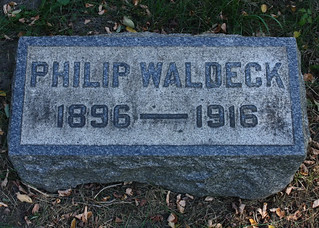
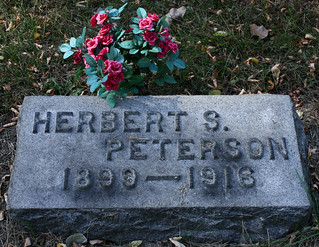
The two young men killed were Philip Waldeck, 20, and Herbert Peterson, 17. It was Herbert's Ford, and he had been at the wheel. He was the eldest son of Frank and Mabel Peterson, who lived and farmed south of Ainsworth — one of their five children, and a grandson of William Smith. Philip, as we know, was the only child of William and Augusta Waldeck of Deep River.

Herbert and Philip had driven up to Hobart to do some shopping that day. They started home around 3:00, going south on State Road 51. The Grand Trunk express train due through Ainsworth at 2:15 was running about an hour late, and, according to some witnesses, speeding to make up for lost time.

Someone who saw the accident from a distance said that Herbert's Ford was moving south on State Road 51 at a leisurely enough pace, but seemed to speed up as it approached the Grand Trunk tracks. At the same time, the train was flying toward the crossing. When they met, the train caught the car squarely in the middle and carried it about a hundred feet before it fell away to the side. The train took a mile to stop. Dr. C.C. Brink of Hobart was sent for, but there was nothing he could do. Both young men had been killed instantly.

There was nothing anyone else could do, either, but look at each other and helplessly ask: How could this have happened? The theory that the boys had tried to beat the train was supported by the witness who thought Herbert had sped up near the crossing. On the other hand, they would not have been expecting a train — there was none scheduled at that time. A moment's lapse of attention, maybe, or of judgment … just a moment's lapse, but it cost the Peterson family dearly, and it cost the Waldecks their all.

The double funeral was held in the Hobart High School auditorium the afternoon of Friday, December 15. Crowds of mourners filed in, family and friends, young and old, faculty and students. Herbert had attended Hobart High until the middle of his junior year; Philip had graduated the previous spring, and had been planning to attend an alumni party that evening. The girls' quartet from his graduating class sang at the funeral service. The pallbearers were all classmates; among Herbert's was Will Wollenberg, Jr., and among Philip's, Ed Wollenberg and another Ainsworth-area boy, Will Buchfuehrer.

Philip and Herbert were laid to rest in adjacent rows in Crown Hill Cemetery.

WaldeckPhilip
(Click on images to enlarge)

PetersonHerbert

Three months before his death, Herbert Peterson had bought a life insurance policy through John A. McDaniel, local agent for Farmers' National of Indiana. The policy carried a double-indemnity clause in case of accident.


Sources:
♦ "Card of Thanks." Hobart Gazette 22 Dec. 1916.
♦ "Funeral of Herbert Peterson and Philip Waldeck Largely Attended." Hobart News 21 Dec. 1916.
♦ "Herbert Peterson and Philip Waldeck Instantly Killed." Hobart News 14 Dec. 1916.
♦ "Local Drifts." Hobart Gazette 15 Dec. 1916.
♦ "Train Kills Two Young Men." Hobart Gazette 15 Dec. 1916.