Showing posts with label Civil War. Show all posts

Tuesday, October 7, 2025

Angle-Worm Oil On His Knee

We interrupt the Jeremiah Wiggins show to bring you a report from Israel Pierce. A veteran of the Civil War, Israel applied for an invalid's pension in the early 1880s because he was partially disabled by rheumatism contracted during his service in the Union Army. Investigation ensued. Much paperwork, many depositions.

This particular deposition, taken in October 1882, brought to my attention something I had never heard of before in all my life: angle-worm oil.

2025-10-07. 1882-10-17 deposition of Israel Pierce p. 1
(Click on images to enlarge)
Images courtesy of Alice Flora Smedstad.


2025-10-07. 1882-10-17 deposition of Israel Pierce p. 2

My transcription:
Israel R. Pierce being sworn says he is applicant for pension, claim No. 349856. That for 5 years immediately preceding his enlistment he lived in Ross Township, Lake County, Indiana and was occupied as a farmer. That from the date of his discharge and return home from the army said Ross Township, Lake County, Indiana has been his residence all the time and is now. That he claims pension on account of Rheumatism contracted at and near Atlanta, Ga. in or about June 1864 caused from very great exposure and hardships, hard & forced marches, getting wet & other hardships incident to the service. That he was treated by Surgeon W. Butterworth & also Hospital Steward M.J. Whitman[?] prescribed for him in the army for his Rheumatism but so long a time has elapsed they are unable to remember his case. That he was wasn't treated by Drs. Poffenberger or Robinson of the 99th. That Dr. Vincent of Hobart, Ind. treated him from his discharge until 1870 since which time he has received no medical treatment but has used some liniments of home manufacture such as angle worm oil & skunk's oil which he procured himself & used to limber his right knee joint. He has also tried St. Jacob's Oil. He respectfully asks the acceptance of neighbors Banks & Ragen's testimony filed herewith as to existence of his rheumatism since 1870. They are his nearest neighbors. He also asks their testimony be received proving his soundness at enlistment for the reason that he was at said time an able bodied man and perfectly free from Rheumatism & never required or had the attendance of a physician at said time. Has had no disease since discharge [except] Rheumatism. That from the date of his return home from the army until the present time he has lost 1/3 of his time each year by reason of Rheumatism.
So Israel was treating his rheumatism with oil of angleworm, which is another name for earthworm. And that of home manufacture. How do you manufacture earthworm oil? For a recipe, please consult the Museum of Ridiculously Interesting Things. We can imagine Israel (or his wife, Calista) collecting earthworms from their yard, boiling them in wine on the kitchen stove, and rubbing the resulting concoction on his stiff and painful knee.

My first impulse is to declare that the stuff had to be completely useless, aside from the possible placebo effect, but a little internet research turns up articles suggesting that extracts of some species of earthworms might help with skin wounds or inflammation and fever. In Israel's case, however, the stuff was completely useless, or nearly so, since his rheumatism persisted.

I'm trying to find a recipe for skunk oil. "Boil the fat of several skunks and add a couple of tablespoons of male skunk glandular secretion before the oil coagulate[s]," says the Wisconsin Historical Society. Israel would have had to trap or shoot the skunks himself, I suppose. Skunk oil as folk medicine seems to have been used more for diseases of the respiratory system than for sore joints. In Israel's case, again, it didn't cure anything.

And neither did the commercially manufactured St. Jacob's Oil.


Someday I hope to have time for more posts about Israel Pierce, his endless paperwork, and his tragic death.

Thursday, January 5, 2023

Letters to Fonso

It's 1897, and B.E. Smith has left Hobart to work as a teamster in Chicago. His older brother, Frank, remains in Hobart, dealing in groceries and writing business-like letters to B.E.

2023-01-05. Smith, Frank J. to B.E. Smith 1897 1
(Click on images to enlarge)

2023-01-05. Smith, Frank J. to B.E. Smith 1897 2

The first is dated January 2th, 1897.

Fonso I shiped you 27 bush & 30 lbs at 22 per bush. You can get it Thursday & be shure & send the bags rite back & you speak a bout sum Potatoes if they are good you can send a Baral & I would like a barel of good onions & a baral box of good celery if good & cheap but don't want no frosen stock but if you can't send them as well as not let them go but if you can send them send them rite a way & if you want more corn send sacks & I will try & get sum more
Yours Resp[ectfully] F. Smith
If you could send Bbl of parsnips
The second is undated, but seems to involve the same 27 bushels, along with some advice about how B.E. should feed his horses:
Fonso I Paid the freight 144 [illegible scrawl]
If you ar feading oates be carfal in changing fead a little corn with the oate & salt well un till they get youst to the corn
Now if you can get me sum Potatos & sum good onions & sum good celer[y] jest as well as not & [illegible] or Rhodab Rhudabages they are jest the same to me
27 B 30# at 22 X  604
freight                    144
                                 748

That make the corn stand you a bout 27 per Bushul then let me no what it is worth then [or "there"?] is there ena [any?] saven [or "sance"?] in it
Cr BE S. 3.50
I will try to interpret these: Frank has sent Fonso 27 bushels plus 30 pounds of corn at 22 cents per bushel. He has shipped the corn in sacks and wants his sacks back right away. At least some of the corn is for Fonso's horses (he's a teamster, remember?); Frank is concerned that if Fonso has been feeding his horses oats, the sudden switch to corn will upset their stomachs, so he advises mixing the corn gradually into the oats.

Apparently Fonso, up in Chicago, is able to scout out good produce in the various wholesale markets, so Frank wants him to send a barrel of potatoes, a barrel of onions, and a box of celery, so long as it's not frozen (which was a possibility in January[1]). Oh, and a barrel of parsnips. Also, some [illegible] or some rutabagas; Frank doesn't care, [illegible] and rutabagas are just the same as far as he's concerned. (Part of the [illegible] looks like "bananas" to me, but in what universe are rutabagas and bananas just the same to anyone?)

All these barrels of potatoes, etc., would be resold in Hobart, I'm guessing.

The "and Son" part of this business was probably Frank's son, Henry Sylvester (born ca. 1879 and named for his grandfather).

♦    ♦    ♦

Frank's obituary, printed in the Hobart Gazette of January 21, 1927, gives some of the family history going back to Hobart's earliest days.

2023-01-05. Death of Hobart's Oldest Pioneer, Gazette, 01-21-1927
(Click on image to enlarge)

This part about Frank's father is interesting:
Henry S. and Fannie (Wheeler) Smith, natives of Pennsylvania, … emigrated to Ohio and later to Michigan in pioneer days. Mr. Smith visited City West as early as 1838, where he became a great friend of the Indians and learned their language, ways, customs and desires. The Smiths and the Wheelers came to Hobart together and were active in its early growth. This pioneer Smith built the first sawmill for the late George Earle and also the first gristmill which gave service to the community in those early days. When the Mexican War broke out, Mr. Smith became an Indian interpreter for the government and was with Gen. Freemont [sic] in the west. He later entered the gold rush to California but soon returned to Hobart where he died Aug. 5, 1856.
Henry Sylvester Smith is buried in the Old Settlers Cemetery.

It's also interesting that Frank's older brother, Charlie, was probably the first fatality of the Hobart sawmill. That accident would have occurred in 1846 if Frank was then two years old. I do not know where young Charlie is buried.

Nor do I know where Frank's three wives are buried. We know from the obituary that Clara Loague Smith died in 1913 and her death certificate states that she was buried in Hobart, but I can't find a record of her grave. Harriet Ferrin Smith died of tuberculosis on February 6, 1887, [2] but again I can't find a grave. In the case of the first wife, Rosana Eastwood Smith, I don't even know when she died.

As a Civil War veteran, Frank lies beneath a military marker that has nothing to say about his birth or death, only his service.

I've identified only five of the seven children that the obituary attributes to Frank. One was Almantha Smith Bullock, born ca. 1882. The others are Henry Sylvester (b. ca. 1879, as mentioned above), Eugene (ca. 1884), Charles (ca. 1897), and Loleta Smith Havrilla (ca. 1901).

_______________
[1] To be perfectly honest, I don't know how they would prevent freezing during winter shipping in 1897. I'm profoundly ignorant of how wholesale produce was handled in Chicago in 1897.
[2] "Hobart Items," Crown Point Register, 10 Feb. 1887.


Friday, March 29, 2019

Napoleon McPherson

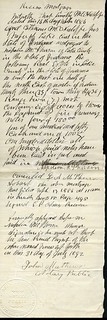
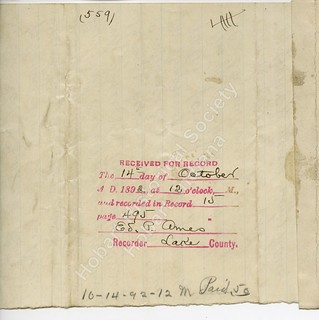
In 1886 Timothy McAuliffe mortgaged the 80 acres he had bought in 1867 to secure a loan of $700. By July 1892 he had paid off the debt and the mortgage was cancelled (as notarized by John Mathews):

2019-03-29. 1892 Mortgage
(Click on images to enlarge)
Images courtesy of the Hobart Historical Society and Jocelyn Hahn Johnson.


Verso of Parts 1/2. Source: Jocelyn Hahn Johnson.

This transaction introduces us to the fancifully named Napoleon McPherson. To learn more about him, let us turn to the eulogy delivered by his friend, William H. Rifenburg, and printed in the Hobart Gazette of July 12, 1895:
OBITUARY
The following sketch of Mr. McPherson was read by W.H. Rifenburg at the funeral last Monday [July 8, 1895] at the Unitarian Church.
Napoleon McPherson was born Jan. 11th, 1826, at London, Franklin Co., Pa., and died at Hobart, July 6th, 1895, making him 69 years 5 months and 26 days old at the time of his death. His boyhood was spent upon his father's farm attending the district school in the winter and working upon the farm in the summer. At the age of 18 he was apprenticed to a Mr. Hastings for 3 years to learn the carpenter's trade and after serving his time he joined a company of emigrants which was made up of his master and neighbors, numbering 42 persons. This company came all the way from Pa. to Galena, Ill., in covered wagons as did so many of the early western pioneers. At Galena he engaged in the lead mining business. He lived in Galena a few years after which he traveled and worked in nearly every state of the Union, generally spending the winters in the south and the summers in the north. In 1854 he settled in Chicago where he commenced work for the I.C.R.R. in their Chicago shops having charge of the wood working department. In Chicago he met his wife, Miss Lucinda Johnson, and from this union came 7 children, two only now living.

At the first call for soldiers to defend the flag and maintain the union he listed in Co. A, 12 Ill. infantry. He was in the army about 3 months when he was attacked by inflammatory rheumatism, sent home and discharged from the army. He has been a constant sufferer from that time until his death. After trying every known remedy and spending nearly all of his property in the vain pursuit or relief from his terrible suffering, he came to Hobart to live, thinking he had found a quiet place to end his earthly existence. This was in 1874, about 21 years ago, since which time he lived among us as a neighbor and friend. I became acquainted with him when he first came, I can't remember exactly how nor when, but probably in a business way when he came to live in town. I was intimately acquainted with him, I always enjoyed his company very much.

He was in many ways a remarkable man in spite of his long and intense suffering. His mind was always clear and active. He had no difficulty in reading and digesting the most difficult scientific books. I got him interested in the study of evolution and from the time he commenced to read Darwin's works he was never tired of studying and explaining them. He always seemed so pleased to think that he had found a reasonable and a rational theory for the origin of Life from the potentiality of matter, co-ordinate with all life — God.

As to his religious side, I think I was closer to him than any other person. On all the superstitions that enter so largely in the religious beliefs of so many, he was positively free. He believed in the universality of law and order, in the universe without a break, in matters that are unknowable. As to what becomes of us after death he could probably be called an agnostic. He put much more stress on an upright life than upon the acceptance of any dogma. In his dealings he was honest to the last cent and in his opinions he was outspoken and had nothing to conceal. If the world had more such men, we would have fewer hypocrites. If all dealt like him jails and prisons could be done away with.

I want to take this opportunity to say that to the everlasting credit of the family they have made every possible sacrifice and have lovingly administered to his every wish and want, during his 30 years of suffering. What a satisfaction it must be for them to look back upon a duty so well and faithfully done. In this short biography I have endeavored to tell the truth and in doing so hope I have not given offense.

Only in the 1880 Census do we find Napoleon's family together in Hobart: he and his wife, Lucinda, with their two surviving children, Frank (20 years old), and Harriet (11). Napoleon gives his occupation as carpenter, but in the column where the enumerator is asked to specify any disease that may have the named person "sick or temporarily disabled, so as to be unable to attend to ordinary business or duties," we find a scribble that looks like "Rheumatism."

In 1897, Napoleon's widow, Lucinda, married Sylvester Hampton (Indiana Marriage Collection). Naturally, this marriage produced no children, and when Lucinda died in 1915 (Indiana Death Certificates), she was buried beside her first husband, under his surname … or so we learn from the Northwest Indiana Genealogy Society's book of gravestone readings, and we have to rely on that, since the gravestones themselves are too worn to be legible now.

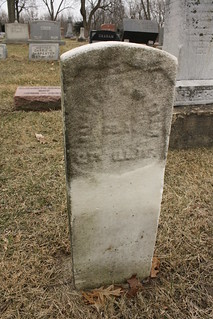
This, I suppose, is Napoleon's military grave marker …

2019-03-29. McPherson, Napoleon - military
(Click on images to enlarge)

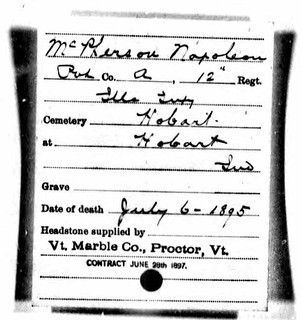
… ordered for him in 1897:

2019-03-29. McPherson, Napoleon - order for stone
Ancestry.com. Headstones Provided for Deceased Union Civil War Veterans, 1861-1904 [database on-line]. Lehi, UT, USA: Ancestry.com Operations Inc, 2007. Original data: Card Records of Headstones Provided for Deceased Union Civil War Veterans, ca. 1879-ca. 1903; (National Archives Microfilm Publication M1845, 22 rolls); Records of the Office of the Quartermaster General, Record Group 92; National Archives, Washington, D.C.

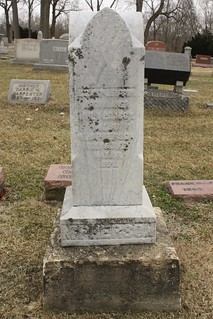
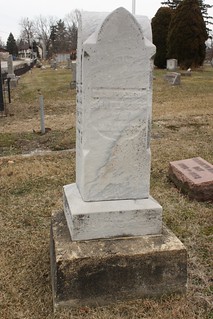
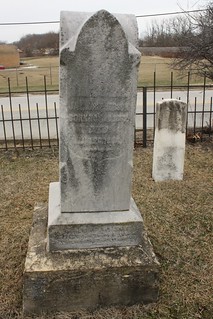
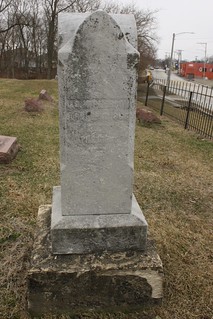
On this four-sided stone, you can read the name MacPherson, and here and there a word or date.

2019-03-29. McPherson stone 1 of 4

2019-03-29. McPherson stone 2 of 4

2019-03-29. McPherson stone 3 of 4

2019-03-29. McPherson stone 4 of 4

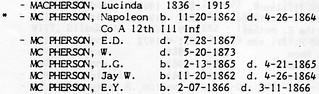
Between the two stones, the Northwest Indiana Genealogical Society says the readers found the following inscriptions:

2019-03-29. McPherson names per NWIGS
From Hobart Township Cemeteries, Northwest Indiana Genealogical Society (June 1994).

That would account for the five of their seven children who did not survive (per W.H. Rifenburg's eulogy), but Napoleon and Lucinda were living in Chicago when the children died,[1] so these are probably memorial inscriptions for children whose remains lie elsewhere.[2]


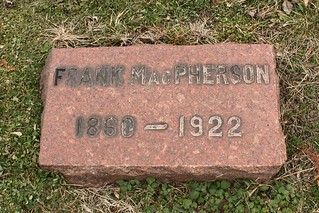
Nearby are the graves of Napoleon and Lucinda's son, Frank …

2019-03-29. MacPherson, Frank

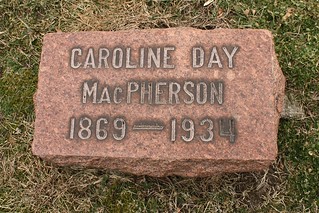
… his wife, Caroline …

2019-03-29. MacPherson, Caroline (Day)

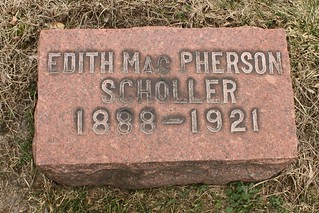
… and their daughter, Edith, who had been the second Mrs. Calvin Scholler:

2019-03-29. Scholler, Edith


_______________
[1] According to listings in Chicago directories dated 1862, 1865, and 1874; I cannot find them in the 1860 Census or 1870 Census.
[2] The dates, "b. 11-20-1862 d. 4-26-1864," that seem to be associated with Napoleon's name make no sense. Those are not his dates of birth and death, nor the dates of his military service. If this is another child (named after his father), that would bring the total number of children to eight, not seven as W.H. Rifenburg said.

Thursday, September 6, 2018

Fanny's Finery

In my post about the Lake County courthouse, I said I was going to talk about John Premer. But first I want to talk about Fanny Premer.

She makes her first appearance on the first page of the Liverpool merchant's daybook: on May 15, 1840, she came to the store and bought nothing but finery, including a Dunstable bonnet (that would be imported from England, I believe).

2018-9-6. DayB1840 001
(Click on images to enlarge)
This image and the following image courtesy of the Hobart Historical Society.


She comes back over the next couple of weeks and buys gloves, stay laces (for lacing up her corset), and muslin.

2018-9-6. DayB1840 002, 003

And so it goes, throughout the summer and into the autumn of 1840. She buys more dress fabric, and ribbon; several pairs of stockings; an artificial flower and a cape; a child's bonnet; ornamental combs; a pair of shoes. She buys one book (title unknown), and one pocket-knife. In September, along with a comb and thread, she buys ten cents' worth of raisins. But never does she buy mundane items like molasses, coffee, sugar, tobacco, whiskey — those purchases are made by John Premer. In December, Fanny buys another pair of shoes. Her last appearance is in January 1841, when she buys eight yards of calico.

Apparently Fanny was well dressed; that's one of the two things I know about her. The other thing is: on January 13, 1842, she married a man named Abraham Balts (Indiana Marriage Collection). I can't find her (or him, for that matter) in any other record, anywhere. Was she related to John Premer? — seems likely, but I can't prove it. I can't put them in the same household in any census. Sometimes they came to the Liverpool store on the same day; sometimes not.

Now, as for John Premer, he is all over the ledgers (so far, I've indexed him 66 times as "John Premer," more than a dozen times, probably, as "J. Premer," and once as "Mr. Premer"), and he is only a little less elusive than Fanny in the official records.

John was born circa 1794 in Virginia. The earliest I can find him in Lake County is in the 1840 census:

2018-9-6 1840 Premer, John
(Click on image to enlarge)
Image from Ancestry.com.


… At least, I think that's our John; with so little information given about him, it's hard to be sure. But we know from the ledgers he was in this area by 1840, and among his neighbors on the census page are the names of early local settlers, including Sigler, Zuvers, Hayward, and Merrill.

The 1850 Census is a little more informative.

2018-9-6. 1850 Premer, John
(Click on image to enlarge)
Image from Ancestry.com.


John gives his occupation as "miller" so perhaps he worked in one of George Earle's mills. One assumes that Olive is his wife and the younger folks are all his children … but there are two boys named John, with different middle initials. That's odd.

Per the Indiana Marriage Collection, John married Olive Sperling in 1847. The children in the 1850 census can't be children of that marriage; they must be from previous marriages. Perhaps that can explain the two young Johns — one of them is Olive's, and he was young enough when his mother remarried to take his new stepfather's surname.

From the same source we find another marriage involving a John Premer, in Lawrence County, Indiana in 1820, to Susan Burns (but per the 1850 census, they would have had to move to Ohio for the birth of Valentine and the next two children). The Ohio marriage records[1] show John Premer marrying Mary Ann Vandermark in 1817 in Wayne County, which sounds more likely: it would account for the birthplace of the first three children, as well as the first daughter's being named for her mother. At the same place in 1836, John Premer married Elizabeth Caston. If the family then moved to Indiana, Elizabeth could be the mother of some of the children in the 1850 census.

I can't find any land belonging to John Premer (the eldest) in Early Land Sales, Lake County, or on any plat map I have. His son(?), Valentine, did buy a few parcels: in 1850, he bought 80 acres northwest of Hobart from Jesse Albee (and later sold them to George Earle); in 1854, 80 acres just northwest of Hobart (also sold to George Earle the next year); and in 1854, 40 acres on the west side of S.R. 51 where it meets 61st Avenue. By the time of the 1874 Plat Map, there is no land under the Premer name.

In the 1860 Census, I can find only two Premers still in this area. The John born circa 1833 is a "farm laborer" on the farm of George and Margaret Guernsey in Ross Township; the younger John (born ca. 1841) is likewise employed by Jerry and Susan Vanness in Hobart Township.[2] I cannot locate any other members of this family locally — or anywhere else, for that matter.

Two Premer boys, Jacob and one of the Johns, joined the military during the Civil War and lost their lives before it ended. The veterans' headstones to mark their graves (or at least memorialize them, if they were buried in some distant place where they died) were intended, as of 1888, to be located in Hobart …

2018-9-6. Premer Civil War veterans
(Click on image to enlarge)
Ancestry.com. Headstones Provided for Deceased Union Civil War Veterans, 1861-1904 [database on-line]. Lehi, UT, USA: Ancestry.com Operations Inc, 2007. Original data: Card Records of Headstones Provided for Deceased Union Civil War Veterans, ca. 1879-ca. 1903; (National Archives Microfilm Publication M1845, 22 rolls); Records of the Office of the Quartermaster General, Record Group 92; National Archives, Washington, D.C.


… but both of them ended up in the Blake Cemetery in Porter County — Jacob and John.


_______________
[1] Ancestry.com. Ohio, County Marriage Records, 1774-1993 [database on-line]. Lehi, UT, USA: Ancestry.com Operations, Inc., 2016. Original data: Marriage Records. Ohio Marriages. Various Ohio County Courthouses.
[2] There is a John Premer born in Ohio circa 1838 working for a "hotel proprietor" named David Young (this would be the father of George Young) in Hobart Township. If he wasn't a relative who'd come out here from Ohio, he might have been the youngest John, accidentally counted twice in the census and understandably assigned an age a few years off from the correct one by whoever was talking to the enumerator.

Friday, August 18, 2017

A Mysterious Case

Or: When an Amateur Historian Runs Out of Microfilm Material

I have been too busy to get over to the library and read more in the 1923 newspapers, so I have to post random things, such as from the digitizing project (which is a part of what's been keeping me busy).

In the Union Sunday School records of August 1868, I came across a Madora Case:

2017-8-18. USUN1868-053, 054
(Click on image to enlarge)
Image courtesy of the Hobart Historical Society.


I had not encountered Madora before, but naturally I wondered if she was one of the Ross Township Cases.

After some quick research, all I can say is: maybe.

We first find Madora in Ross Township in the 1860 Census, where she is four years old. Her father, Hiram A. Case, is a 36-year-old farm laborer. Her mother, Amanda, is 26. Her sister Eunice is 7.

Also is the household is a 21-year-old Derias Case, who surely can't be Hiram and Amanda's son. In the 1850 Census, we find a ten-year-old Darias in the household of David and Daty Case … who live near the young married couple, Hiram and Amanda. All of this suggests a family relationship between Hiram and Darias — perhaps they were brothers? But I can't find a record to prove that.

Looking forward to the 1870 Census, we find our Madora Case, along with Eunice and a little seven-year-old Hiram, in Joliet, Illinois; Amanda is there, with her new husband, C.J. Coburn — Cornelius J., that is, whom she married in Lake County in either 1865 or 1868, depending on which record in the Indiana Marriage Collection you want to believe.

So something happened to the elder Hiram … but we're not sure exactly what. Turning to Alice Flora Smedstad's book, Soldiers & Veterans Memorialized at the Merrillville Cemetery, we learn that Hiram enlisted in the 99th Indiana Regiment during the Civil War. Per the official regimental history, he died on March 10, 1863. Around that time, Alice reports, the 99th was near LaGrange, Tennessee, guarding a railroad. "Conditions were very hard and over fifty men died of typhoid fever. Most likely this group included Hiram Case."

According to the Northwest Indiana Genealogical Society's index of Ross Township Cemeteries, there was a grave marker in the Merrillville Cemetery bearing the name of Hiram Case, but without birth or death dates, so it could possibly be for another Hiram. On a recent visit to the cemetery I could not find the grave marker at all.

The widowed Amanda Case, with three minor children to support, likely could not afford to bring Hiram's body back from Tennessee. If she placed a stone in the cemetery, it probably marked his memory, not his earthly resting place.

As for Madora, I believe she married Byron S. Frey of Joliet in 1871* and never returned to this area.

Finding out for sure how these Cases were related to the other Cases, not to mention what exactly happened to Hiram, would require more research than I have time for.

_______________

* Ancestry.com. Illinois, Marriage Index, 1860-1920 [database on-line]. Provo, UT, USA: Ancestry.com Operations, Inc., 2015.
Original data: Illinois State Marriage Records. Online index. Illinois State Public Record Offices.

Sunday, January 17, 2016

Harriet Towl Ragen

An early resident of Ross Township, Harriet Ragen died in June 1922, just short of her 79th birthday.

2016-1-17. Harriet Towl Ragen obit
(Click on images to enlarge)
Hobart Gazette 30 June 1922.


Here is the Ragen farm as it appeared on the 1874 Plat Map.

2016-1-17. Ragen 1874

This map suggests a house in the approximate location of 4012 E. 73rd Ave., where there now stands a house and large barn along with other outbuildings, most of which date to 1921 if the county property records are correct.

After moving to Hobart in 1896, the Ragens rented out their farm. Charles and Lovisa (Chester) Nelson rented it in the spring of 1903; by August of that year, the Ragens had rented it to a Wilhelm Neuman (or Newman), reportedly for a five-year term. By December 1908 George Ragen was advertising for a new tenant. In September 1914, the widowed Harriet, now living in Gary, offered it for sale or rent. She sold it in January 1915 to May Blachly (who sold it to S.J. Craig, who sold it to Emil Wojahn … who probably built that house and barn, etc.).

I believe "Mrs. Cora Maybaum of Gary" was married to Louis Maybaum, the streetcar motorman whose photo we've seen.

Harriet Ragen's husband, George, was not only a veteran of the Civil War but also a brother of Amanda Ragen Bullock, as we learn from his obituary:

2016-1-17. George Ragen obit
(Click on image to enlarge)
Hobart Gazette 1 Mar. 1912.


That would explain why Joseph (aka Josiah) Halladay came down from Chicago in June 1922 to attend Harriet Ragen's funeral — he was the husband of Amanda Ragen Bullock's daughter, Ruth. (I don't know why Ruth did not accompany him.)

From George's obituary, also, we also learn that the "Mrs. Mary Stevens of Gary" who survived Harriet was the wife of Hobart's one-time baker and restaurateur, Willard Stevens (so I suppose she is the Mate Stevens identified in one of the photos in that first link).

In closing, I will add this random item I came across in the 1901 microfilm: "A carload of laborers, men and women of the African type, have pitched camp upon George Ragon's farm near the Grand Trunk railroad and will be engaged in work on the double track grading. They are said to be a jolly crowd."

♦    ♦    ♦

The second story marked on the 1922 image above tells us that the elder Severances, George and Anna, had celebrated their 30th wedding anniversary. I believe Bunge is a misprint for Burge — the married name of their daughter, Mary.


Additional Sources:
♦ 1920 Census.
♦ "For Sale or Rent." Hobart Gazette 25 Sept. 1914.
♦ "General News Items." Hobart Gazette 19 Apr. 1901; 24 Apr. 1903; 28 Aug. 1903; 11 Mar. 1904; 11 Dec. 1908.
♦ "Local and Personal." Hobart News 6 July 1922.

Monday, November 16, 2015

Elmer Bullock, Crown Point Class of 1922

Elmer Bullock's proud grandmother, along with Mary Kipp and her sisters, went to Crown Point on May 19, 1922, to see him graduate from high school.

2015-11-16. Elmer Bullock graduation
(Click on image to enlarge)
Hobart News 25 May 1922.


Just above that item we hear from the Carlson brothers, Charles and Richard, whom I thought I wrote about earlier … but if I did, I can't find the story now.

Their fruit farm was on the west side of Grand Blvd./S.R. 51, just a part of the 80-acre farm that had belonged to their parents, Swan Peter and Hedvig Carlson. The 1926 Plat Book does not show ownership for the small parcels in that area. We have to go to the 1939 Plat Book to find a parcel with the name Carlson, which seems to be in roughly the right place, but whether it was exactly the location of the 1922 Carlson farm is something I can't tell you.

2015-11-16. Carlson 1939

In the 1920 Census we find the 42-year-old Charles living in that area with his widowed mother, operating a "market garden." Richard, some ten years younger, was then living in Hobart with his wife, but the wording of the news item suggests they had moved to, or near, the farm by 1922.

♦    ♦    ♦

In the right-hand column we read of the loss of another local Civil War veteran, Conrad Bender.


Additional Source: "Death of Conrad Bender." Hobart Gazette 26 May 1922.

Saturday, October 10, 2015

William H. "Pap" Carey

2015-10-10. img052
(Click on image to enlarge)
Image courtesy of the Hobart Historical Society and Tom Rainford.


This is William H. Carey, known to his Rossow stepchildren as "Pap," photographed circa 1910 by August Haase.

We do not have a photograph of his first wife — only her obituary:
Mrs. Mary A. Carey, wife of Wm. H. Carey near Wheeler, died at her home last Sunday night at 11:30, Feb. 22d, 1903, after a prolonged illness, of paralysis, aged 63 years 3 months and 7 days. She was the daughter of Harry Davis and born in Maryland, but has been a resident of Porter county and this vicinity since 1879.

The funeral services were held at 10:30 on Tuesday forenoon at Wheeler M.E. church but the interment occurred at the Hobart cemetery. Besides a husband, the deceased is mourned by five children, four sons and one daughter.
Mary had borne a total of eight children, three of whom had died before 1900.

Less than two months after Mary's death, William found solace for his broken heart:
Wm. H. Carey and Mrs. H. Rossow were united in marriage at the groom's home on the farm near Wheeler at 3 p.m. on Wednesday, April 15th, 1903. The ages of the couple are 63 and 46 respectively. The bride formerly lived in Hobart. A large circle of relatives and friends were present at the tying of the nuptial knot and to assist in the proper celebration of the event. The groom is a pioneer in this section and possesses many warm friends to wish him and his estimable bride a long and pleasant married life.
They had 14 years, and let's hope it was pleasant.
William Henry Carey, who had been in failing health for several weeks this spring, died at his home in the south part of town on Thursday, April 27, 1916, at the age of 76 years, 1 month and 18 days. He had always enjoyed good health until taken down with the grippe, followed by pneumonia.

Mr. Carey was born March 8, 1840, in Gunborough, Sussex Co., Delaware, being the youngest of thirteen children born to Stephen and Sophia Carey. His mother died two hours after his birth.

He was raised on a farm, and when 18 years of age, on March 18, 1858, he was married to Mary Ann Davis, and to their union were born eight children, five sons and three daughters. Those surviving are Thomas J. and Harvey F. of Wheeler, Lorenzo A. of New London, Wis., and Everett M. of New Philadelphia.

Mr. Carey served in the Union army the last year of the Civil War, being a member of Company K, 6th Regiment, Delaware Volunteer Infantry. He was detailed by the government to buy provisions for the army … and was not active in battles.

He came to Plymouth, Ind., July 4, 1870, and engaged in farming, which vocation he followed in Porter and Lake counties until about ten years ago, when he came to Hobart to reside.

On April 15, 1903, he was married to Mrs. Augusta Rossow ….

In the fall of 1911 Mr. Carey was elected a member of the town board as trustee and served until January of this year. During his term as trustee he took an active part in the affairs of the town, as well as the annexation and dis-annexation propositions.

The funeral was held on Sunday afternoon, April 30, at 2 o'clock, at the Christian church, the Rev. W.A. Howard officiating. The burial was made at the Hobart cemetery, where the Grand Army Post conducted the last rites to their departed comrade.
Another obituary, while less precise about his history, gave a little more information about his personality:

2015-10-10. W.H. Carey obit
(Click on image to enlarge)


His grave is marked with the simplest of stones …

2015-10-10. Carey, Wm - Hobart Cemetery
(Click on images to enlarge)

… but that's more than his first wife got. Although her obituary stated that she was buried in Hobart Cemetery, the NWIGS's reading of all the grave markers there recorded no Mary Carey.

2015-10-10. Carey family plot - Hobart Cemetery

As you can see, there is room enough near William for his first wife to rest there, but nothing to indicate that she does.

It's likely that his daughter, Sarah Jane, also lies nearby in an unmarked grave. We will get to her story next.


Sources:
♦ 1880 Census.
♦ 1900 Census.
♦ "Local Drifts." Hobart Gazette 17 Apr. 1903.
♦ "Mortuary Record." Hobart Gazette 27 Feb. 1903.
♦ "Obituary." Hobart Gazette 5 May 1916.
♦ "W.H. Carey Passes Away at Home in Hobart." Porter County Vidette (Valparaiso, Ind.) 3 May 1916 (newspaperarchive.com).

Saturday, September 19, 2015

Anything to Get Out of Paying the Road Tax!

Here's an odd little thing I recently acquired:

2015-9-19. img008
(Click on images to enlarge)

All joking aside, the loss of bone in his leg may have happened in the Civil War — W.G. Cook was a veteran — or a train may have done it: he worked in the vicinity of trains, as a railroad telegrapher.

That's assuming I've identified him correctly as the William G. Cook who was recorded in the 1880 census as 37-year-old Ohio native living in North Township, his occupation described as telegraph operator and agent. He then had a wife, Christina, and three young sons, Karl, Clarence, and Horace.

From his obituary, I gather that two daughters were born later, and one son had preceded him in death when W.G. died on August 16, 1897:
W.G. Cook, a prominent and well-known citizen of this township, died at his home in Miller at 2 o'clock Monday afternoon, of consumption, aged 54 years. Mr. Cook had been a citizen of Miller for about 30 years and occupied the position of station agent during that time for the B. & O. and L.S. & M.S. railroads. The funeral services were conducted at Miller on Wednesday at 2 o'clock by Rev. H.A. Young, and the interment occurred at that place. The deceased was born and raised in Ohio, where his relatives still reside.

He was an old veteran, having served his country faithfully during the Civil War.

Miller has lost a most obliging and enterprising citizen and the railroads have been deprived of a faithful servant.

It was thought last fall that Mr. Cook was suffering from cancer on the tongue but an operation at the Rush Medical College in Chicago proved such not to be the case. The patient never recovered from the operation and gradually declined in health until death ended all. A wife, two sons and two daughters are left to mourn his loss.
The trustee who signed this exemption was on friendly enough terms with W.G. to send it to him with his compliments …

2015-9-19. img009

… perhaps because (among other things) they were both Civil War veterans.

Michael J. Cooke had been elected Hobart Township Trustee (for the second time) in 1882, at the age of about 52. We can learn more about his life from his obituary:

2015-9-19. Cooke obituary
(Click on image to enlarge)

I wish I knew which four-room schoolhouse the article refers to.


Sources:
♦ 1870 Census.
♦ 1880 Census.
♦ 1900 Census.
♦ "Death of M.J. Cooke." Hobart Gazette 31 July 1914.
♦ "Hobart." Crown Point Register 6 Apr. 1882.
♦ "W.G. Cook." Hobart Gazette 20 Aug. 1897.

Sunday, February 8, 2015

Edward and Tillie (Harms) Niksch

2015-2-8. redalbum037
(Click on image to enlarge)
Image courtesy of Eldon Harms.


It was Thanksgiving Day 1964, and someone took this photo of Mathilda "Tillie" and Edward Niksch at the celebration of their 60th wedding anniversary.

As I was writing about their purchase of the former Deep River schoolhouse (yesterday's post), I realized that I've scarcely mentioned these folks in the blog, and I had better take some time to make up for that oversight. They were Ainsworthites, after all: Tillie grew up in the Harms farmhouse east of Ainsworth, and she and Edward moved onto the Lincoln Highway/Randolph St. farm in the spring of 1912.

Tillie was born November 12, 1884, so she had just turned 20 when she married Edward Niksch.

2015-2-8. Niksch-Harms wedding
(Click on images to enlarge)

Numerous unnamed Ainsworth-area residents also attended the wedding. (The "bride's home on south Main street" probably refers to Harms house at the southwest corner of Lincoln and 7th.)

Minnie Rossow Harms' family history gives us a brief summary of the next 16 years:
After Mathilda (Tilly) and Ed were married in 1904, they moved into his home on Devonshire street* in Hobart (Leona and son still** live there). Tilly had attended Valparaiso University and worked as a compositor for the Hobart Gazette. Leona was born December 28, 1907 and Laverne April 9, 1909. They had a great desire to go farming and soon Grandfather Harms purchased his Lincoln Highway farm where they raised their family. Donald was born July 3, 1916 and Edward Jr. July 28, 1920.
♦    ♦    ♦

I've talked a lot about the Harms family in this blog, but what about Edward Niksch and his people?

Edward was born May 13, 1882, in Hobart, one of ten children of Louis and Minnie (Niemann) Niksch, who by 1891 owned and farmed this land northeast of town:

2015-2-8. Niksch 1908
Image from the 1908 Plat Map.


His mother died in June 1909.

2015-2-8. Minnie Niksch obituary

(Yes, it was Edward's sister, Rosa, who had conquered the heart of the redoubtable Michael O'Hearn.)


Louis Niksch followed his wife to the grave in January 1912.

2015-2-8. Louis Niksch obituary

(While the 1900 enumerator recorded Louis' immigration year as 1860, the 1910 enumerator agreed with the obituary on 1854.)


Edward Niksch is described in the 1900 census as a farm hand, living and possibly working on his parents' own farm. Sometime between then and his marriage in 1904, he went to work in the brickyard, and bought that house in town. He remained a brickie through 1910 — probably until 1912, when he and Tillie moved onto the farm. After that, he stuck with farming, even through the Great Depression, as the 1940 census records him still farming on the Lincoln Highway land.

My notes record only pleasant events for the Niksches until 1917, when Edward became ill. Early in November he was in Chicago getting medical treatment for "serious affection of the eyes." The November 15 News included these unpleasant details:
Edward Niksch, who has been suffering with his eyes, underwent an operation at Dr. Dahlman's hospital in Chicago last Saturday for affected glands and another operation on Monday for pus forming on his face and for his jaws being set. Late reports were that he was some better.
In early December the Gazette reported that, after a couple weeks' treatment and much suffering, he was back home:
Edward Niksch who was operated upon Nov. 9th at the South Shore hospital by Drs. Werelius and Dahlberg for necrosis of the upper jaw bone and joint was able to return home the forepart of last week and indications are that he will meet with a full recovery. His head was so bandaged when he came home he was scarcely recognizable, except by voice. He has been returning every third day to the city for dressing of the wound. He says the pain he suffered before the operation was almost unbearable.
Either he recovered in good time or I was negligent in taking notes, as I have no further information on that illness.

So Edward and Tillie quietly got on with life in the neighborhood of Ainsworth, farming and raising their family. In May 1921, their eldest child, Leona, took part in the first commencement at the new W.G. Haan school.

Late that autumn, the Niksches bought the old Deep River schoolhouse, which started this digression.


_____________________
*1019 Devonshire, per Polk's Hobart City Directory 1962.
**I believe Minnie wrote this in 1952.


Sources:
♦ 1880 Census.
♦ 1891 Plat Book.
♦ 1900 Census.
♦ 1910 Census.
♦ 1920 Census.
♦ 1930 Census.
♦ 1940 Census.
♦ "Ainsworth Pick-Ups." Hobart Gazette 2 Dec. 1904.
♦ Harms, Minnie Rossow. As It Was Told to Me. 1952 – 1978. MS. Hobart Historical Society, Hobart, Indiana.
♦ "Local and Personal." Hobart News 8 Nov. 1917; 15 Nov. 1917.
♦ "Local Drifts." Hobart Gazette 16 Mar. 1912; 16 Nov. 1917; 7 Dec. 1917.
♦ "Niksch-Harms Nuptial." Hobart Gazette 2 Dec. 1904.
♦ "Obituary." Hobart Gazette 25 June 1909.
♦ "Two Pioneers Pass Away." Hobart News 11 Jan. 1912.
♦ WWII Army Enlistment Records.

Tuesday, March 18, 2014

Two Old-Timers

And now we lose two old-timers.

Parker and Case obituaries
(Click on image to enlarge)
From the Hobart Gazette 15 Apr. 1921.


Jeremy Parker's name is given as Josiah in the News, but perhaps that was the second "J." Here is J.J. Parker's land in Hobart Township, 1908:

Parker land

I believe there was once a Parker School on the northeast corner of the Liverpool-Old Ridge intersection, and nowadays there is a Parker Road in the north part of the old farm — which may be coincidence; I don't know. The nameless widow mentioned in the obituary was born Cornelia Hutton, who had married J.J. in 1876.

And southwest of Ainsworth, on the farm formerly belonging to Benjamin Case, Dayton T. Case lost his wife, née Eliza Jane "Jennie" Toothill. They had married in 1881. (Dayton was Benjamin's nephew, the son of Benjamin's brother, William.)

I suppose this is the "farm near Merrillville" where Jane was born and raised:

Toothill land 1874
From the 1874 Plat Map.

So it's now part of Calumet Park Cemetery.

Dayton and Jane's two daughters were their only children (to survive infancy, anyway). The elder daughter, Bessie, married Archie Brooks in 1916; they lived in Hobart and he worked at a steel mill. In 1914 Ada had married Paul Henning (brother of Elsie Henning Nelson). They farmed rented land in Ross Township — to judge by the 1920 census, somewhere south of Ainsworth.


Sources:
♦ 1874 Plat Map.
♦ 1900 Census.
♦ 1908 Plat Map.
♦ 1920 Census.
♦ "Death of Mrs. Case." Hobart Gazette 15 Apr. 1921.
♦ "Funeral of Josiah Parker Held Sunday Afternoon." Hobart News 14 Apr. 1921.
♦ "Funeral of Mrs. D.T. Case Will be Held Saturday Afternoon." Hobart News 14 Apr. 1921.
♦ Indiana Marriage Collection.
♦ "J.J. Parker Dies April 7." Hobart Gazette 15 Apr. 1921.

Wednesday, August 19, 2009

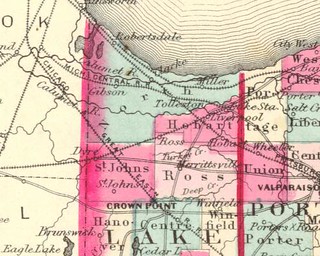
Lake County 1864 (northern half)

1864northernLake
(Click to enlarge)

Via U. of Alabama, from Alvin J. Johnson, Johnson's Indiana (New York: A.J. Johnson, c. 1864).

No Ainsworth. Merrillville given as "Merrittsville."

In the course of the American Civil War, Indiana furnished 196,363 soldiers, sailors and marines. Of those, 26,672 died, in battle, in prison, of disease, or from other causes. (Source)

Lake County casualties, from the Rev. T.H. Ball's Lake County, Indiana : from 1834 to 1872 (Chicago: J.W. Goodspeed, 1873), as transcribed at Genealogy Trails.