Showing posts with label Ingram. Show all posts

Sunday, June 26, 2016

A Busy Season at the Yellowstone Trail Campground

The last I heard about Lee & Rhodes' public fountain was in April 1922, when it had been put in working order. Evidently by August it had gotten out of working order and people were going thirsty under the glaring sun.

While the story about Yellowstone Trail campground doesn't say so, I suppose that the registration box had been set out there when the camp officially opened on May 6, 1922.

2016-6-26. Lee fountain, Yellowstone Trail
(Click on image to enlarge)
Hobart Gazette 25 Aug. 1922.


I don't know where exactly the Harmon house was, but it doesn't matter since apparently you couldn't get any moonshine there. (I wonder if the Harmon who lived there had any connection to the Rush Harmon who had been hanging around with Carrie Peas.)

And lastly, the bereaved Alfred Ingram and Anna Fleck left to close up the empty house in Boston.

Wednesday, June 8, 2016

Anne Fleck Ingram

Her surgery for gallstones had gone well, and Anne Fleck Ingram seemed on the road to recovery. But on August 11, 1922, suddenly and unexpectedly, she died.

2016-6-8. Anne Fleck Ingram obituary
(Click on image to enlarge)
Hobart News 17 Aug. 1922.


The cause of death, according to the Gazette, was a blood clot. Anne was only 37 years old.

I am not sure where the "old Fleck homestead" was, but my guess is a parcel of land northwest of Hobart, shown here on the 1874 Plat Map as belonging to Peter Fleck, Anne's grandfather:

2016-6-8. Fleck 1874

Peter had owned 80 acres in that vicinity as early as 1854. (I suppose he lost a little acreage to the Pittsburgh, Ft. Wayne and Chicago Railroad when it came through in 1858.) So it was possible for Anne's father, Michael, to have been born there in 1862.

If you look at that parcel now, some of it looks as empty as Peter might have found it in 1854.


Additional Sources:
♦ "Mrs. Anne Ingram Dies Suddenly." Hobart Gazette 18 Aug. 1922.
♦ Northwest Indiana Genealogical Society. Early Land Sales and Purchases, Lake County, Indiana, 1837 – 1857. Valparaiso: Northwest Indiana Genealogical Society, 2006.

Wednesday, May 25, 2016

Jawbreaker

This is not the first barn dance I've heard of at the Houck farm, which I believe was in Winfield Township, but it's the first jaw-breaking I've heard of there. The alleged jawbreaker was one of the Hahn boys who had lived on the McAuliffe farm, but by 1922 I expect he was out on his own. Kenneth Humes had long ago left a finger in Ainsworth.

2016-5-25. Jaws
(Click on image to enlarge)
"Local Drifts." Hobart Gazette 11 Aug. 1922.


Elsewhere, news of other acquaintances … Mrs. A.G. Ingram had been born Anne Fleck.

If I've got the right Triebesses, these are Julius and Sophia Triebess, who were living in Chicago while renting their Ainsworth-area farm. I leave it to people with more time than I have to figure out exactly how Sophia was Mrs. Christ Passow's niece, if they are interested.

I believe the farm Harve Carey was moving back to consisted of 160 acres in southeast Portage Township, Porter County.

The Epps family was recently bereaved.

And on his small farm in Union Township, Jacob Yager was breaking his back again picking strawberries.

Friday, April 1, 2016

Lost Sight

This poor kid — he lost the sight in one eye, and no one knew (or cared to tell) more about him than his surname.

2016-4-1. Ray Brink accident
(Click on image to enlarge)
Hobart News 27 July 1922.


The Gazette described him as an "orphan boy." I think he might possibly be the orphaned Raymond Brink whom the 1920 Census shows living in the household of Marcene and Helen Haxton, in Union Township, Porter County. If so, he was about 20 years old at the time of this accident. He had a twin brother, Roy, who has already caused me some confusion.

(At the bottom of that column is an item about the newly established Little Red Hen restaurant, with most of its business from out-of-town tourists, which makes me wonder if it was located along the Yellowstone Trail. Its proprietor was Hobart's first librarian, by this time married to the man with whom she had climbed the water tower.)

♦    ♦    ♦

Elsewhere in the same issue of the News, we find Carrie Raschka spending a week at Koontz Lake with her daughters and (I believe) her mother-in-law …

2016-4-1. Rashka vacation
(Click on image to enlarge)
Hobart News 27 July 1922.


… while Charlie DeWell and the former Anne Fleck (now Mrs. Alfred G. Ingram) were dealing with health problems.

Last and least, drainage was being installed on the east side of the Ainsworth road, now known as Grand Boulevard/State Road 51 — this would be near the township line, where the road had been in a bad condition the previous spring.


Additional Sources:
♦ "General News." Hobart Gazette 28 July 1922.
♦ "Raymond Brink Dies at Age 71." Hobart Gazette 4 Oct. 1973.

Wednesday, November 26, 2014

Minnie and Miss Fleck

Here is little Minnie Rossow's third-grade report card, from the 1905-06 school year:

2014-11-26. reportcard003
(Click on images to enlarge)
Images above and immediately below courtesy of Eldon Harms.


On the back, William Rossow duly signed his daughter's report card every month.

2014-11-26. reportcard004


Minnie's teacher was Anne Fleck. We have her portrait from 1907, as a member of the Old Maids' Basket Ball Team:

2014-11-26. Anne Fleck Ingram
(Click on image to enlarge)
Image courtesy of the Hobart Historical Society.


Anne (or Anna) was born in 1885, so she was about 20 years old when she taught Minnie. Per the Indiana Marriage Collection, in 1916 she married Alfred G. Ingram (the same year her brother, John, married Daisy Raschka). Sadly, it seems that Anne Fleck Ingram died in her thirties. She rests in Crown Hill Cemetery.

Friday, August 8, 2014

On the Ainsworth Stone Road

We know it as Grand Boulevard or State Road 51, but to the 1920 census enumerator it was the "South Hobart Road to Ainsworth," and to editor of the Hobart News, writing in 1921, it was the "Ainsworth stone road." Edwin and Carry Humes had been living in a rented house along that road, with their four children, when the 1920 Census recorded them. In June 1921 they bought that house — the "Hettie Ryan residence," which was in Hobart Township, but since the plat maps don't show parcels of three acres, I don't know exactly where.

Further south on the same road, in Ross Township, the Grabowskis continued their improvements to the old Carlson place. My current theory is that the red brick house on the west side of S.R. 51, on the north bank of the Deep River, is the old Carlson place, but that's just my current theory.

Also, the Yellowstone Trail got re-routed through the heart of Hobart …

2014-8-8. Humes house purchase
(Click on image to enlarge)
"Local and Personal," Hobart News 16 June 1921.


… and a Buick report.

Sunday, October 17, 2010

Saved by His Gut

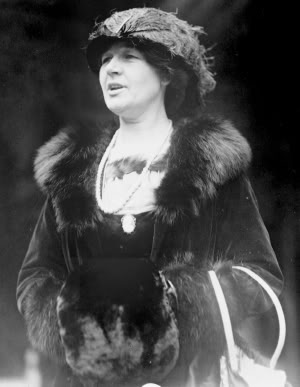
Ladywithmuff
An unknown woman of respectable appearance, in early 20th century fashions, carrying a muff.
Image credit: National Photo Company Collection/Library of Congress, Washington, D.C. (Digital File Number: cph 3c12574)

I used to devour true-crime books like candy and now do the same to judge shows, which means I've seen case after case of people walking into trouble with their eyes wide shut ("But I trusted him!") — which has caused me to develop a keen appreciation for those rare stories where someone's gut instinct alerts them to a problem before they become a victim and they actually heed their instinct.

Just such a case happened in Hobart in November 1915.

On Thanksgiving Day, a couple of strangers arrived in town. They registered at the Hobart House as man and wife; since the newspapers don't report what name they gave, let's just call them Mr. and Mrs. Skinner. Their manner was genteel, their appearance prosperous. They were from Utah, they said, but were traveling, and had just arrived from Chicago. Now they wanted to buy a small touring car to continue their journey and would be glad to hear of anyone in town interested in selling such a vehicle.

They were told that Paul Newman, who kept a garage, sold cars. They came to see him, asking for a new Ford. He had none in stock. But one of his patrons, Thomas Ingram, kept a used Ford touring car there that he was willing to part with. The Skinners got in touch with Mr. Ingram, and on Friday the parties came together to negotiate.

Once they had settled on the price, the Skinners explained that they did not have sufficient cash on hand to pay the full amount. Since they were due in Laporte that evening, they wanted to take the car immediately, so they proposed giving Mr. Ingram a 60-day promissory note along with something of value as security — for instance, the two diamond rings that Mrs. Skinner wore, worth $400 each. Mr. Ingram consented on the condition that the diamonds be determined by a jeweler to be genuine.

So the little party walked over to the Dell F. Beach jewelry store, Mrs. Skinner's ring-bedecked hands snuggling inside the muff she carried for protection from the chilly November air. Once in the store, Mrs. Skinner took off the rings and gave them to Mr. Beach. He examined the diamonds carefully and pronounced them genuine. He handed the rings back to Mrs. Skinner, who put them back on.

Now the Skinners had their own request: they wanted the rings held in safekeeping at a local bank. The three of them agreed upon the American Trust & Savings Bank. As the group walked out of the Beach jewelry store to go to the bank, Mrs. Skinner again slipped her hands into her muff. At the bank, she surrendered her rings, and a cashier placed them in the vault.

All that remained was to go to the Newman garage where Mr. Ingram kept his car, and fill out the paperwork to transfer ownership.

On the walk to the garage, and as he set about with the paperwork, Mr. Ingram found himself increasingly uneasy. The memory of that seemingly insignificant gesture just outside the Beach jewelry store — Mrs. Skinner's hands, with the rings on her fingers, disappearing into her muff — kept intruding into his mind, or rather, into his gut. He couldn't shake the feeling that something was wrong. It occurred to him that a switch might have happened under cover of that muff, and that the rings now safely stowed away in the bank vault were not the rings that Mr. Beach had pronounced genuine. At the same time, it seems, Mr. Ingram did not feel sure enough to make an outright accusation against such a respectable-looking couple. But after a few words privately with Mr. Newman, who advised him to be careful, his made up his mind. Abruptly he announced that he didn't want to go through with the deal; he'd keep his car, give back the promissory note, and the Skinners could go retrieve their rings.

The couple quietly left the garage. Sometime on Friday night they quietly left town as well, in a car, apparently their own, which they had "planted" somewhere in town.

If Mr. Ingram needed confirmation of his suspicions, he got it the next Wednesday when a report turned up in a Chicago paper of just such a con game having been attempted in Elgin, Illinois. The description of the couple involved and their technique of substituting phony diamond rings for real ones was so similar to his experience that he had to believe it was his own Skinners. The Elgin attempt ended with the arrest of the couple. To the police they gave their names as M. Randall and Mrs. Fern Hiller, she being allegedly recognized as a well known diamond thief. Among the couple's personal effects the police found promissory notes for three other autos that had been successfully "purchased" by the same technique.

Marshal Fred Rose lamented that he hadn't been alerted at the first suspicion — he felt sure that he could have collared the thieves. But at least Mr. Ingram's gut saved him from the being skinned.


Sources:
♦ "Diamond Swindlers Couldn't Pull Their Game in Hobart." Hobart News 2 Dec. 1915.
♦ "Diamonds for an Auto." Hobart Gazette 3 Dec. 1915.