Showing posts with label brickyard. Show all posts

Monday, July 13, 2026

Just In Case You Want Some Bricks

2026-07-13. Kulage postcard 1
(Click on images to enlarge)

2026-07-13. Kulage postcard 2


I'm guessing maybe this thing was handed out by salesmen calling on prospective clients?

As we know, the Kulage Brick Works operated for about 30 years, starting circa 1892[1] and ending sometime during the 1920s. I previously posted about the brickyard's being indefinitely shut down in 1921, but I don't know if that was the end of it.[2]

The one-cent McKinley postage stamp tells us that the postcard must date to 1902 or later, since a president must be dead for at least a year before appearing on a postage stamp. [7/16/2026 update: the stamp dates to 1907 or later; see the comments to this post.] I have found an Ebay listing for such a postcard with a 1910 postmark; another listing elsewhere dates an unused postcard ca. 1907. But I can't find any information about when this particular stamp stopped being used.[3]

_______________
[1] I previously posted a 1919 article stating that Otto Kulage "purchased the plant about twenty-seven years ago," i.e., 1892.
[2] Notes on the back of some photos at the Hobart Historical Society give the approximate starting and ending dates as 1885 to 1925-26. Per the 1919 article cited above, the brickyard was already operating when Otto Kulage bought it and gave it his name.
[3] A history of postage rates for postcards can be found here.

Thursday, January 5, 2023

Letters to Fonso

It's 1897, and B.E. Smith has left Hobart to work as a teamster in Chicago. His older brother, Frank, remains in Hobart, dealing in groceries and writing business-like letters to B.E.

2023-01-05. Smith, Frank J. to B.E. Smith 1897 1
(Click on images to enlarge)

2023-01-05. Smith, Frank J. to B.E. Smith 1897 2

The first is dated January 2th, 1897.

Fonso I shiped you 27 bush & 30 lbs at 22 per bush. You can get it Thursday & be shure & send the bags rite back & you speak a bout sum Potatoes if they are good you can send a Baral & I would like a barel of good onions & a baral box of good celery if good & cheap but don't want no frosen stock but if you can't send them as well as not let them go but if you can send them send them rite a way & if you want more corn send sacks & I will try & get sum more
Yours Resp[ectfully] F. Smith
If you could send Bbl of parsnips
The second is undated, but seems to involve the same 27 bushels, along with some advice about how B.E. should feed his horses:
Fonso I Paid the freight 144 [illegible scrawl]
If you ar feading oates be carfal in changing fead a little corn with the oate & salt well un till they get youst to the corn
Now if you can get me sum Potatos & sum good onions & sum good celer[y] jest as well as not & [illegible] or Rhodab Rhudabages they are jest the same to me
27 B 30# at 22 X  604
freight                    144
                                 748

That make the corn stand you a bout 27 per Bushul then let me no what it is worth then [or "there"?] is there ena [any?] saven [or "sance"?] in it
Cr BE S. 3.50
I will try to interpret these: Frank has sent Fonso 27 bushels plus 30 pounds of corn at 22 cents per bushel. He has shipped the corn in sacks and wants his sacks back right away. At least some of the corn is for Fonso's horses (he's a teamster, remember?); Frank is concerned that if Fonso has been feeding his horses oats, the sudden switch to corn will upset their stomachs, so he advises mixing the corn gradually into the oats.

Apparently Fonso, up in Chicago, is able to scout out good produce in the various wholesale markets, so Frank wants him to send a barrel of potatoes, a barrel of onions, and a box of celery, so long as it's not frozen (which was a possibility in January[1]). Oh, and a barrel of parsnips. Also, some [illegible] or some rutabagas; Frank doesn't care, [illegible] and rutabagas are just the same as far as he's concerned. (Part of the [illegible] looks like "bananas" to me, but in what universe are rutabagas and bananas just the same to anyone?)

All these barrels of potatoes, etc., would be resold in Hobart, I'm guessing.

The "and Son" part of this business was probably Frank's son, Henry Sylvester (born ca. 1879 and named for his grandfather).

♦    ♦    ♦

Frank's obituary, printed in the Hobart Gazette of January 21, 1927, gives some of the family history going back to Hobart's earliest days.

2023-01-05. Death of Hobart's Oldest Pioneer, Gazette, 01-21-1927
(Click on image to enlarge)

This part about Frank's father is interesting:
Henry S. and Fannie (Wheeler) Smith, natives of Pennsylvania, … emigrated to Ohio and later to Michigan in pioneer days. Mr. Smith visited City West as early as 1838, where he became a great friend of the Indians and learned their language, ways, customs and desires. The Smiths and the Wheelers came to Hobart together and were active in its early growth. This pioneer Smith built the first sawmill for the late George Earle and also the first gristmill which gave service to the community in those early days. When the Mexican War broke out, Mr. Smith became an Indian interpreter for the government and was with Gen. Freemont [sic] in the west. He later entered the gold rush to California but soon returned to Hobart where he died Aug. 5, 1856.
Henry Sylvester Smith is buried in the Old Settlers Cemetery.

It's also interesting that Frank's older brother, Charlie, was probably the first fatality of the Hobart sawmill. That accident would have occurred in 1846 if Frank was then two years old. I do not know where young Charlie is buried.

Nor do I know where Frank's three wives are buried. We know from the obituary that Clara Loague Smith died in 1913 and her death certificate states that she was buried in Hobart, but I can't find a record of her grave. Harriet Ferrin Smith died of tuberculosis on February 6, 1887, [2] but again I can't find a grave. In the case of the first wife, Rosana Eastwood Smith, I don't even know when she died.

As a Civil War veteran, Frank lies beneath a military marker that has nothing to say about his birth or death, only his service.

I've identified only five of the seven children that the obituary attributes to Frank. One was Almantha Smith Bullock, born ca. 1882. The others are Henry Sylvester (b. ca. 1879, as mentioned above), Eugene (ca. 1884), Charles (ca. 1897), and Loleta Smith Havrilla (ca. 1901).

_______________
[1] To be perfectly honest, I don't know how they would prevent freezing during winter shipping in 1897. I'm profoundly ignorant of how wholesale produce was handled in Chicago in 1897.
[2] "Hobart Items," Crown Point Register, 10 Feb. 1887.


Sunday, March 7, 2021

Below the Dam, Hobart, Indiana

I have been overloaded with work lately, so here's a low-effort post: from a postcard, a random shot of some guy fishing "Below the Dam, Hobart, Indiana."

2021-03-07. Below the Dam, Hobart, IN a
(Click on images to enlarge)
Ainsworthiana collection.


The photographer stood on the south side of the dam, pointing the camera north. In the upper-right background you can see brickyard chimneys.

The postcard is unused …

2021-03-07. Below the Dam, Hobart, IN b

… but from what we know about the Wayne Paper Box & Printing Corp., we can date it to around 1948.

Wednesday, March 20, 2019

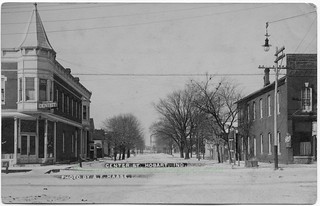
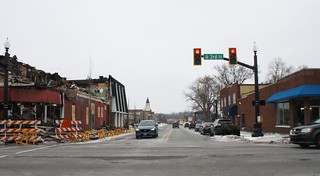
Hobart Then and Now: Center Street North from Third

Circa 1909, and 2019

2019-03-20. Center St from 3rd 1909-07-30 a
(Click on images to enlarge)

2019-03-20. Center St from 3rd 2019

This is a depressing update to my previous then-and-now post of the Guyer building.

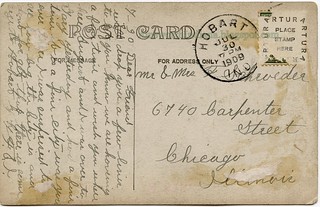
The top photo comes from a postcard postmarked 1909.

2019-03-20. Center St from 3rd 1909-07-30 b

The photo doesn't tell us much about what businesses occupied either of the two commercial buildings on the corners, except that Dr. Fred Werner had his dental office there.

The building on the right might have already been the Amazon restaurant. Somehow, I have the impression that this is where, a few years earlier, Hans Thune had operated the Farmer's Home, but I may be mistaken.

Further down Center Street on the same side is the Rifenburg/Mackey house.

And looking straight up Center Street, you can see in the background the smokestack of the National Fireproofing Co. brickyard.


As those of us in Hobart know, the Guyer building was badly damaged by fire on the night of January 15, 2019. Then the second floor had to be knocked down because it was unstable. I am not sure whether the building's ultimate fate has been decided yet.

Sunday, November 27, 2016

Steam Shovel, National Fireproofing Co.

2016-11-27. Steam shovel postcard
(Click on images to enlarge)

The caption at the bottom of this postcard reads: "Steam Shovel/National Fireproofing Co., Hobart, Ind." The photo is attributed to "M.L. Photo," which isn't very helpful since I still don't know much about that enterprise.

The back of the postcard is no help, either, in narrowing down a date.

2016-11-27. Steam shovel postcard verso

No postmark, no stamp box, no printer's name. The vertical dividing line at center seems to be composed of letters, but even at 4800 dpi I can't read them.

The postcard is now the property of the Hobart Historical Society.

I wonder if this steam shovel was ever operated by our friend, Charles Dewell?

Sunday, November 30, 2014

Hard Times at the Brickyard

The Kulage Brick Works had gone through some kind of slowdown, if not shutdown, in the summer of 1921; now, in September, the brickyard is shutting down "indefinitely," throwing forty men out of work.

2014-11-30. Kulage Brick Works shutdown
(Click on image to enlarge)
Hobart News 15 Sept. 1921.


Whoever, in the midst of these hard times, could afford a car would soon have some improved Lincoln Highway mileage to drive it on.

Friday, October 17, 2014

Return-to-Hobart Report

Paul and Bliss Emery are back in Hobart, living with her parents, Calvin and Huldah Shearer. John and Mary McDaniel have left her stepson's house and are living with her son, John Chester, while they think about moving back to Hobart.

2014-10-17. Emery et al.
(Click on image to enlarge)
Hobart Gazette 5 Aug. 1921.


I found that story about the Kulage brickyard interesting not only because it had shut down for a while, perhaps due to the general hard times the nation was going through, but also because of the "subway" under "Chicago street," by which I suppose they mean the Chicago road, now known as Old Ridge Road.

And, speaking of the Chicago road, it's about to get improved, "from the brick yards west to Gary city limits," according to the article at the top of the right-hand column.

Thursday, October 16, 2014

Brickyard Buddies

A member of the Ols family has allowed the Hobart Historical Society to copy a number of photographs and documents. We shall begin looking at some of those here.

By the Ols family I mean John and Charlotte Ols and their descendants. We have already met two of their sons: Christ (and I shall have an update on that story), and Charles. It is their eldest son, Henry, we are to deal with now.

Henry was born around 1860, when the family was still in Germany (Prussia). They arrived in this country in the early to mid-1870s,* and by 1880 were farming in Hobart Township. In 1884 Henry married Bertha Wischman of Hobart. They had five children, three of whom survived infancy: Herman (born 1887), Elizabeth (1889) and Martin (1894).


Let's start with this photo that has come down to us from Henry:

2014-10-16. img913
(Click on image to enlarge)
Image courtesy of the Hobart Historical Society and Fred Ols.


Handwritten notes on the back: "Henry buddies from brickyard (probably Natco)." We don't have a date for this photo. It is printed on postcard with a divided back, but no printer's name or other helpful information.

I am not sure whether Henry is in the photo at all. I don't recognize him, but then again the faces of a few of these men are so blurred their own mothers wouldn't recognize them. Nor do I know whether Henry ever worked in any brickyard. To the census-takers, he gave different occupations: farm laborer (1880), day laborer (1900), carpenter (1910 through 1930).**

So we don't know who these brickies are, but it's a nice brickyard picture.

________________________
*Henry gave different dates to different census-takers.
**The 1920 census is illegible on that point, but it looks as if it might possibly have "carpenter" as his occupation.