Showing posts with label Ainsworth school. Show all posts

Thursday, October 15, 2026

The Ainsworth School Loses Its Principal

2026-10-15. William Shaver
(Click on image to enlarge)
Image originally posted to Ancestry.com by user mksrnbsn.


William Shaver was the principal of the W.G. Haan School when he died in 1924 at only 38 years of age.

2026-10-15. 1924-02-21 News, Funeral of William E. Schaver, principal of Ainsworth School
(Click on image to enlarge)
Hobart News, 21 Feb. 1924.


I am not sure the obituary gets the timeline exactly correct. The 1910 Census shows William as a boarder in the home of Edward and Anna Notter near Deepriver, giving his occupation as teacher in a public school. He was only on his second month of marriage, and living apart from his wife. This may have been a matter of convenience for his job, but apparently the marriage ultimately did not succeed, as his death certificate lists his marital status as divorced.

However, William and Grace spent enough time together to have two children: a son, Leslie, born in Valparaiso in 1911, and a daughter, Winnifred, born in Ainsworth in 1913.

The divorce probably happened "some time" previously, about the "some time" when his son and daughter went to live with his mother in Cairo.

I believe that the two men who accompanied William's body to Cairo — Oscar Carlson and John Thiel — were not relatives but fellow members of one of the fraternal organizations to which William had belonged.

Thursday, January 27, 2022

Schoolteachers, Fall Term, 1886

While searching for something else, I came across this mildly interesting list of schoolteachers in Lake County for the fall term of 1886.

2022-01-27. LAKE CO. TEACHERS - Crown-Point-Register-Nov-25-1886-p-2
(Click on image to enlarge)
Crown Point Register, 25 Nov. 1886.


"Names and addresses," it says at the top, so perhaps the towns are where they lived but not necessarily where they were teaching, although where they lived would seem to be less important.

Many of these names are familiar.

Among the teachers in Ainsworth, if Alice Palmer was living there she must have been teaching there as well; otherwise she would have stayed at her father's home in Merrillville.

I wonder if A.H. Swain was related to our 1904 Grand Trunk station agent, P.H. Swain? I can't find out anything about either of them.

The only Charles Jones I can find in the 1880 Census would have been about 19 years old in 1886 — old enough to teach school. His father was a farmer named James. His mother, in the 1870 Census, is named Eliza, but in 1880 she's Jennie. Stepmother, or just using her middle name? Eliza J. Jones shows up in the 1890 Plat Book owning 142 acres in Section 19. Much of that land, I believe, was later purchased by Michael Weiler. Beyond that, I can't find out anything about Charles or his family.[1]

Kate Marble was the daughter of Horace and Mary Ellen (Booth). In June 1887 she married John Wesley Ott.


I don't have the time or energy today to look into all the names listed under Merrillville and Hobart, many of which are familiar. I will just say that among the Hobart teachers, Mary Sullivan was known to all Ainsworthites, and the Gadsbys were a teaching family, as well as being active in the Union Sunday School: here George is listed with two daughters, Annie and Nettie.

Just for search-engine purposes, I will list all the Hobart, Ainsworth, and Merrillville surnames list that I haven't discussed: Booth, Collins, Cook, Davis, Flick, Frazier, Halfman, Kern, Nash, Parks, Pattee, Smith, Spencer, Spray, Zuvers.


_______________
[1] The 1860 Census shows a 25-year-old Jacob Jones working as a stagecoach driver and living with Lewis Merrill, stagecoach proprietor. The age is right for this to be our James, and of course James is the Anglicized form of Jacob.

Friday, November 19, 2021

The Farm Under the Big Boxes

Standing at the intersection of U.S. 30 and Colorado street today and looking west, you see a vast expanse of asphalt surrounding big-box stores such as Sam's Club, Wal-Mart, and Home Depot, as well as restaurants and gas stations. Thousands of vehicles pass through the intersection, day and night. The parking lots are never empty. The lights never go out.

You can hardly imagine those hundred-plus acres as quiet farmland. You can hardly imagine U.S. 30 ending there, either; and yet all the maps we have show the road that is now U.S. 30 going no further east than Colorado, until the new Lincoln Highway came through in the mid-1930s.

I have been researching that area because the Merrillville-Ross Township Historical Society received an inquiry about the farm that once lay there — specifically, the farm of Frank and Catherine Willy, which comprised approximately 115 acres on the west side of Colorado Street, cut in half by the road that is now U.S. 30.

Here is my attempt to outline the Willy farm on the modern-day Google satellite view:

2021-11-19. Willy farm outlines, 2021 satellite view
(Click on image to enlarge)
Image from Google.com.


This farm, under various owners, had retained nearly the same dimensions for over a century. The earliest record I can find of it comes from the NWIGS' Early Land Sales, Lake County: on October 18, 1852, Harmon Underwood bought a total of 160 acres.[1] On January 11, 1854, those 160 acres became the property of John Underwood, who I believe was Harmon's son.[2]

Sometime between 1854 and circa 1874, the farm lost 40 acres on the west, as we can see on the 1874 Plat Map:

2021-11-19. 1874 Ross Twp. - future Willy farm
(Click on image to enlarge)

The new owner of those 40 acres, P.A. Banks, was probably Parley A. Banks. You can also see that H[armon?] Underwood owned another 200 acres east of the original farm.

And lastly, you can see that the mapmaker has clearly drawn a road from the west up to what is now Colorado Street, but eastward of that point, there is no trace of a road.

The 1891 Plat book does not include Section 23, so next we have to jump forward to 1908. Now we find the farm owned by Mary Burge.

2021-11-19. 1908 Ross Twp. - future Willy farm
(Click on image to enlarge)

We also find the parcel reduced in size by almost five acres, taken, I believe, by the Chicago, Cincinnati & Louisville (later Chesapeake & Ohio) Railroad, which began buying up right-of-way through Ross Township circa 1903.

My best guess as to the identity of Mary Burge is that she was a daughter of Julius and Nancy Demmon and married Winfield Scott Burge in 1878. The 1900 Census shows Winfield and Mary, with numerous children, living on their own farm in Ross Township in the general area of Colorado and U.S. 30 (to judge by their neighbors). Mary died in 1922. By the mid-1920s the farm had been sold: we find a new owner in the 1926 Plat Book.

2021-11-19. 1926 Ross Twp - future Willy farm
(Click on image to enlarge)

I cannot identify Caroline Schwer.

In 1932 the farm changed hands again. I will let the new owner tell the story of how that came about, as he told it to his descendants:
Three Ears of Corn

by Frank Anthony Willy

After Frank and Catherine were married, they moved onto a farm in Dyer, Indiana, which Frank rented from his father August. Besides charging rent, August required his son to hire his brothers to work the farm. This was a difficult situation at best for Frank and Catherine. During the Depression they had little money to spend and Frank's brothers were teenagers, with poor work ethics. Eventually Frank and Catherine realized that they could no longer afford to rent the farm in Dyer. They knew they would have to go out on their own and start a new life away from Frank's family.

Frank set out to visit three farms that were for sale nearby. The first was in Wisconsin. The ears of corn in the fields were large and well-formed and the house was well built with a natural spring underneath that could be used to keep food cold. This farm, he thought, would be an excellent choice.

The second farm he visited was in Illinois. Once again, the corn in the field was large, showing that the soil had been well taken care of. The outbuildings and home were also in excellent shape. He believed this would be a good farm to own.

Lastly, Frank visited a farm for sale in Indiana. This corn was just "nubbin."[3] The soil seemed to be spent, with most of the nutrients used long ago. The farm and its buildings were neglected and in very poor shape. As he took pictures of this farm he thought, "This is a very poor farm. It would be difficult to make a go of it here." As Frank returned to Catherine to tell her of his trip, his heart was heavy. He laid an ear of corn from each farm in front of her and then began to cry, for he knew the only farm they could afford was the neglected one in Indiana. And so it came to pass, that in 1932, Frank and Catherine Willy moved their family of eight and all they owned to the neglected Indiana farm with "nubbin" corn. Little did either of them realize what an excellent choice it would turn out to be.
(Story courtesy of Nick Hopman.)

Frank was then about 35 years old, Catherine (née Alber) about 32. They had been married in 1920.

Frank mentions taking photos of the farm when he first visited it. That may be the source of these two photos of the farmhouse and barn.

2021-11-19. 1932 Farmhouse in country
(Click on images to enlarge)
This and the following image courtesy of Nick Hopman.
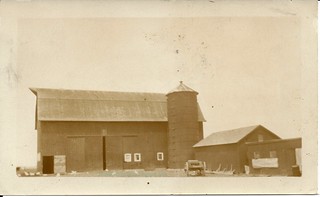

2021-11-19. 1932 Farm in Crown Point 1932

Again, thanks to Nick Hopman, we have Frank Willy's own story about the early days on the farm, and what the construction of the new Lincoln Highway did for the family:
You kids first went to St. Peter and Paul's School. I had to drive you. But when I had no money to buy gas, I sent you to the Ainsworth school as the bus passed our house. The first day you came home you said you needed about $14.60 for books. Had to sell corn for $.12 a bushel. Had about $.60 over on that truckload. That shows you what the Great Depression was like. I did not sell any more, as Henry Bloom[4] said, "Don’t sell. I will go along with you if it takes ten years. I won't foreclose on the mortgage!" The mortgage was for $7,000. The next year we had the cinch bugs. Twenty acres of corn barely filled my little silo. The next year we had the great dust storm. Steady wind from the southwest. In Kansas the dust covered fences and buildings. People left their farms. We bit our lips and held on.

Had 12 acres of fine wheat. Wanted to cut it on Monday. Henry Bloom was out on Saturday. "You ought to cut it. Sometimes it don't pay to wait 'til it has fully ripe." Sunday night it hailed. Shocked everything flat. Holes in the tarpaper roofs. Cut off branches of trees. It was a quarter-inch thick on the ground. I raked the wheat field and got Hank Homeier[5] to come and thrash it. Blew the straw into the barn and got 60 bushels of wheat. I needed that straw. Also paid Koehler[6] $10 so I could cut some slough grass, and Old Nick (our hired hand) herded the cattle there. In 1934 the new highway (US 30-the Lincoln Highway) came through. Then I had it made. When US 30 road work was being done I rented a small area to the state for material storage. When the work was done, instead of having the state clean up the storage area by removing the remaining sand, gravel, and steel, I negotiated to do it myself, for a price of course. But instead of cleaning up the mess, I just sold the materials until they were gone.
For some reason, the 1939 Plat Book fails to show the new highway east of Colorado:

2021-11-19. 1939 Ross Twp - Willy farm
(Click on image to enlarge)

But the 1939 aerial view shows it clearly:

2021-11-19. Aerial photo 1939 Willy Farm (LakeBFJ-04-043)
(Click on image to enlarge)
Image from https://igws.indiana.edu/IHAPI/Map/.


This raises the question whether the 1874 cartographer just made a mistake about the road extending east of Colorado, and that mistake was perpetuated by subsequent map-makers who didn't bother to investigate for themselves. But I am going to ignore that possibility because it's just no fun at all.

Anyway, the 1950 Plat Book shows the new U.S. 30:

2021-11-19. 1950 Ross Twp. - Willy farm
(Click on image to enlarge)


As you can see from the 1939 aerial view above, the Willys' house and farm buildings stood on the west side of Colorado Street, north of U.S. 30. This photograph shows more clearly how the buildings were arranged in relation to Colorado Street, which runs diagonally across the bottom of the photo:

2021-11-19. Willy farm, Crown Point mail address
Image courtesy of Nick Hopman.


Frank and Catherine Willy farmed that land for 30 years, through the Great Depression, through World War II, and beyond. Their children grew up, moved out, started families of their own. Frank and Catherine bought a modern ranch house in the Green Acres neighborhood. In 1962, they sold their farm.

Here is the former Willy farm as it appears in the 1972 Plat Book:
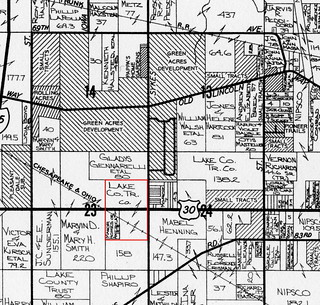
2021-11-19. 1972 Ross Twp. - former Willy farm
(Click on image to enlarge)

The new owner probably rented most of the land to locals who were still in the farming business.

This 1978 aerial view from the Lake County GIS website shows that the farmhouse and outbuildings have been removed, and some kind of business is operating in the northwest corner of the U.S. 30/Colorado intersection:

2021-11-19. 1978 aerial view (Lake County IN GIS)
(Click on image to enlarge)

The 1990s brought the era of the big-box store, and the landscape of the old farm was utterly transformed.


_______________
[1] He bought the south half of the northeast quarter, and the north half of the southeast quarter.
[2] Cf. Lake County Encyclopedia, p. 80. I'm a bit confused.
[3] "Nubbin" — a small or imperfect ear of corn [per the author].
[4] We don't know for certain who Henry Bloom was. My best guess is Henry Blume (1867-1958), who shows up in the 1910 Census farming his own land in Center Township, but in all subsequent censuses he gives no occupation. He and his wife, Mary, had only one child, who died in 1920.
[5] I think this was Henry Homeier, who farmed northeast of Merrillville.
[6] I give up.


Saturday, October 24, 2020

Ainsworth School-Year Souvenir, 1897-98 (Conclusion)

(continued from Part 7)


2020-10-24. Switzer, Ainsworth school souvenir 1897-98 b
(Click on image to enlarge)

My last entry in this series is a disappointment, because I simply can't identify any Bessie (or Elizabeth) Switzer with any clear connection to Ainsworth.

Checking my notes, however, I do find a local connection to the surname Switzer in this "General News Item" from the Hobart Gazette of September 20, 1907:
A family reunion in which fifty-two people participated was held last Sunday at the home of Chas. Maybaum, Sr., south of Ainsworth, in honor of his sister, Mrs. Rudolph Switzer, and her daughter Carrie who are here from Ness City, Kas., visiting relatives for a few months. Those present from Hobart were Mrs. Geo. Stocker who is a sister of Mrs. Switzer and Jacob Kramer, Jr., and family. The day was very pleasantly passed.
And in the Indiana Marriage Collection we find Rudolph Sweitzer marrying Augusta Maibaum in Lake County, Indiana, on March 4, 1871. Rudolph first shows up in Hobart in the 1860 Census (age 11) with his parents, Daniel and Anna, both of whom died within a few years and are buried in Hobart Cemetery. Rudolph also makes some appearances in the Union Sunday School record books and the Hobart Township Trustee's ledger between 1869 and 1875, though I can't find him in the 1870 Census.

However, Rudolph and Augusta Switzer were in living in Kansas from the 1880 Census onward, and as far as I can tell they never had a child named Bessie.

Thursday, September 24, 2020

Ainsworth School-Year Souvenir, 1897-98 (Part 6)

(continued from Part 5)

2020-09-24. Selen. Ainsworth school souvenir 1897-98 b
(Click on image to enlarge)


I can find no reference in my notes to the surname Selen, but a search on Ancestry.com easily turns up the 1900 Census, which shows Peter and Freeda Selen, with their four children, farming rented land in Ross Township — probably southeast of Ainsworth, to judge by their landowning neighbors: Larson, Wojahn, and Yager can all be placed along 73rd Avenue between S.R. 51 and Randolph between the 1891 Plat Book and the 1908 Plat Map.

Annie, born in Illinois in 1888,[1] was about 10 years old during this school year. She had a brother, Albert, born 1891, who ought to have been in school with her; also a sister, Ester, born 1892; and then in June 1897 along came little Alexander.

Peter Selen had come to this country from Sweden in the mid-1880s. In 1888, he married Fredericka Dorette Ellene "Freeda" Wilkens, a German immigrant. They lived in Illinois through Ester's birth in 1892, at least. Why they came down to farm in Ross Township, I have no clue. The 1910 Census shows the family living in Chicago, Peter working as a carpenter — but they had lived in Indiana through about 1907, when their youngest child was born.

Per the Cook County, Illinois, Deaths Index, Annie Selen died, unmarried, on February 12, 1919.

[to be continued]

_______________
[1] Her death record says September 17, 1888; the 1900 Census says September 1887; her parents' marriage (if I've found the right people) took place April 7, 1888.

Wednesday, September 9, 2020

Ainsworth School-Year Souvenir, 1897-98 (Part 5)

(continued from Part 4)

2020-09-09. Ainsworth school souvenir 1897-98 b - Glattli, Mankey
(Click on image to enlarge)

Now I shall deal with the names Glattli and Mankey, because I think they are related. Why do I think that? First, here is Edward Mankey's 1963 death notice:

2020-09-09. Mankey, Edward, Valparaiso Vidette Messenger, 05-06-1963, p. 6
Vidette-Messenger (Valparaiso), May 6, 1963.

Who on earth (I asked myself) was this surviving sister, Mrs. Louise Mounts? The only Mankey girl I knew of was Sophie Mankey Triebess. So I went looking for Louise, and eventually found her death certificate.

2020-09-09. Mounts, Louise Glattli - Death Certificate
(Click on image to enlarge)
Image from Ancestry.com.


Louise's mother was Dorothea Mankey.

Dorothea had become a widow in 1889, when her husband, William, died. William was the father of Henry, Eddie, and Willie, as well as Sophie.

William and Dorothea are elusive. I can't find them in the 1880 Census or any earlier one, nor can I find a marriage record for them. They likely were married around 1880, if Sophie, born in 1881, was their first child. Her birthplace was Indiana, while the boys all were born in Illinois (William, 1883; Edward, 1885; Henry, 1888). Dorothea had a local connection here: her sister, Minnie Brockmiller, became Mrs. Christ Passow in 1885 and resided in Hobart. That marriage had taken place in Cook County, Illinois, so perhaps the Brockmillers lived in the Chicago area.

After William's death, apparently Dorothea married Carl aka Charles Glattli — but again, I can't find a record of that marriage. According to a family tree someone compiled on Ancestry.com, Anna Glattli was born in November 1890, so Dorothea may have been her mother. (Anna died in Illinois in 1920; her death certificate is not online.) That would account for the Anna Glattli on our 1897-98 souvenir. Then Louise Antonie Glattli, the future Mrs. Mounts, was born in 1891.

Dorothea Brockmiller Mankey Glattli died in 1899 and is buried under the Mankey name. (She died in Chicago, but her residence was Ainsworth, Indiana, per the Cook County, Illinois, Deaths Index. I cannot find a death notice in the local newspaper.) Carl/Charles Glattli survived her, and apparently remarried soon and moved to Chicago, if I've found the right people in the 1900 Census (and if the enumerator made a mistake in the "How many years married" column).

The Mankey children did not go to Chicago with their stepfather. The 1900 Census shows them scattered. While I can't find Sophie at all, I suspect she was living with relatives in Chicago, where she married Julius Triebess in 1901. William, age 16, was a hired farmhand living in the household of Michael and Mary Foreman. The 14-year-old Edward was living in the home of a Calumet Township farmer named William Gallagher; Eddie is described as a "servant" but is also "at school." I can't find their younger brother, Henry, in 1900, but in the 1910 Census he turns up in Hobart, in the home of Aunt Minnie and Uncle Christ, employed in a brickyard.

William married Lena Springman in 1906, and they farmed in Ross Township through the 1920 Census, but it looks as if they moved to Chicago by the 1930 Census.

Edward married Alvina Koeppen in 1911. They farmed in Porter County through the 1940 Census, but then moved to Hobart.

Henry got out of the sticks, married and resided in Chicago, but had moved to Calumet City by 1974, when he died.

Anna Glattli married a man named Charles Mosel in 1911 and lived out the rest of her short life in Blue Island, Illinois.

Louise Glattli married a Joseph Jackson in Blackford County, Indiana, in 1916, and after his death in 1937, married the Rev. Claude Mounts in Gary, Indiana, in 1938.

I can't believe how many hours of my life went into figuring this all out.

Finally, here is the death notice of Dorothea Brockmiller Mankey Glattli's mother, from the "Mortuary Record" column of the Hobart Gazette of March 31, 1905:
Mrs. Dora Brockmiller, mother of Mrs. Christ Passow, Jr., of this place, died suddenly at 3948 State street, Chicago, on Tuesday, March 28, 1905, aged 71 years. Services were held at the late residence at 12:15 yesterday and the remains were shipped to Hobart on the Milk Train and taken to the German Lutheran Church where services were conducted by Rev. Schuelke. The interment occurred in the Hobart cemetery.

The deceased is mourned by three children, Mrs. Minnie Passow, Henry Brockmiller and Mrs. Ida Quade.
No mention of the daughter who predeceased her, the ever-elusive Dorothea.

[to be continued]

Wednesday, September 2, 2020

Ainsworth School-Year Souvenir, 1897-98 (Part 4)

(continued from Part 3)

2020-09-02. Ainsworth school souvenir 1897-98 b - Kleine
(Click on image to enlarge)

Let us move on to — Kleine, which I can't say is completely new to me, since I've already referenced it once in the blog, but I've never paid much attention to the Kleine family.

Our Edgar Kleine is neatly summed up in his obituary:

2020-09-02. Kleine, Hammond Times, March 26, 1940
(Click on image to enlarge)
Hammond Times, Mar. 26, 1940.


Edgar's parents, Richard and Fredericka, were born in Germany. Their early married life was spent in Wisconsin, apparently, since that is where their eldest child, Bruno, was born circa 1867. The 1870 Census records them here in Ross Township, as does the 1880 Census.

The 1874 Plat Map shows the Kleine farm on the Joliet Road (E. 73rd Avenue) — I believe so, anyway, although the surname is spelled Kline and the first initial is hard to read.

2020-09-02. Klein, R.M., 1874
(Click on image to enlarge)

And the 1880 census enumerator recorded the Kleine family close to such names as Bullock, Harper, Ragen, and Smith, which suggests that the "R?. M. Kline" of the 1874 map is indeed Richard Maximillian Kleine.

You will notice that O.L.E. Kleine owns a big parcel just touching the southeast corner of Richard and Fredericka's farm. I believe O.L.E. was Richard's older brother, Oswald. The 1880 Census records Oswald living in Hobart with their mother, Christina; but apparently he later moved (back?) to Wisconsin, where he died in 1899. He was the Oswald Kleine involved in George Chester's action to quiet title.

But getting back to Edgar's family — after the close of the school year, perhaps, they moved to Porter County, where Richard died in December of 1898. The 1900 Census shows the widowed Fredericka still farming in Porter County, with the help of the three sons old enough to work the farm (they ranged in age from 32 to 17); there was also a 15-year-old, a 13-year-old, and a toddler born in August 1898.

In 1901, Edgar married Lillian Frailey in Porter County.

Fredericka died in 1902.

[to be continued]

Tuesday, August 25, 2020

Ainsworth School-Year Souvenir, 1897-98 (Part 3)

(continued from Part 2)

And now I shall educate myself about the names I don't recognize.

2020-08-25. Ainsworth school souvenir 1897-98 b - Dumas
(Click on image to enlarge)

Rosa Dumas was about 15 years old, while Charlie, Maggie, and Moses ranged from 11 to 7. At home were two more siblings: Lucy, age four, apparently was not in school yet, nor, of course, was the two-year-old James. Their parents, Lucien and Hannah, rented a house somewhere in the village of Ainsworth (1900 Census). Lucien worked as a railroad section boss, perhaps on the Grand Trunk Railroad. In 1899, Hannah would give birth to twins, but only one, Genevieve, would survive — yes, I did note that down while reading microfilm,[1] but the Dumas name meant nothing to me and I quickly forgot about it.

I found a few other forgotten references in my notes. This one, from January 1905, suggests that Maggie was a popular young lady.

2020-08-25. Dumas, Maggie, Gazette, 1-6-1905
(Click on images to enlarge)
Hobart Gazette, Jan. 6, 1905.


From the same issue, we learn that Rosa had moved out of the family home.

2020-08-25. Dumas, Rose, Gazette, 1-6-1905

Sometime after 1905 (I find no mention of any Dumas later than that in my notes), the family moved to Chicago, where both the 1910 Census and the 1920 Census record them. The 1930 Census shows that they had moved to Otsego, Michigan. Lucien and Hannah lived out the rest of their lives there, but when Hannah died in 1937[2] and Lucien in 1940[3], each was brought back to Valparaiso for burial.

Both Lucien and Hannah had grown up in Porter County. The 1870 Census records the eight-year-old Lucien in Valparaiso with his parents, Levi and Lucy. By 1880 he was working in a woolen factory. I can't find Hannah in 1870, but in the 1880 Census she was counted twice: once at home in the village of Hebron with her parents, Andrew and Margaret, and once as a servant in the household of Thomas and Mary McKay, who farmed in Winfield Township, Lake County. Lucien and Hannah were married in 1883.

I wonder if this Dumas family has any connection to Dumas Street in Valpo?


[to be continued]

_______________
[1] "Local Drifts," Hobart Gazette, Oct. 13, 1899.
[2] "Sister of Local Woman Succumbs at Home in Michigan," Vidette-Messenger (Valparaiso), Mar. 27, 1937.
[3] "Lucien Dumas Death Victim," Vidette-Messenger (Valparaiso), Feb. 5, 1940.

Friday, August 14, 2020

Ainsworth School-Year Souvenir, 1897-98 (Part 2)

(continued from Part 1)

As we now turn our attention to the pupils listed on the souvenir, I find there are more names here than I can index, so I'm going to have to split this up still further.

2020-08-14. Ainsworth school souvenir 1897-98 b
(Click on image to enlarge)

I'll deal first with the names I've encountered before.

Blachly — Earl and May were siblings, the children of Morgan and Amelia. Earl had been born in 1882, May in 1884. By the way, I think the house at 4301 E. 73rd Ave. was the Blachly house, built in 1905[1] to replace whatever the family had been living in until then.

Bullock — Hubert probably met up with the Blachly kids as he walked down from the Bullock home, unless he walked along the Grand Trunk Railroad tracks or cut across the fields … but the latter would be some rough walking.

Chase — I thought this would be easy, since I know of a Chase (aka Chace) family recorded in Ross Township in the 1870 Census and 1880 Census, members of whom were residing in Hobart into the 1920s (Minnie Chase Smith and Gust Chase). But I can't place Gracie in any census. She might not have belonged to the local Chases, but to some Chase family just passing through.

Coyle — Nina, Stella, and Arlie were the daughters of Ainsworth's postmaster, Frank Coyle. Nina, the youngest, was the only one born in Indiana (1892). Her older sisters had been born in Kansas. Why the family moved from Kansas to Ainsworth, Indiana, is a mystery, but I suspect it might have something to do with Frank's wife, Susanne, having been born a Chase — possibly she had some relation to the local Chases. The Coyle family left this area probably around 1904 (when Frank resigned as postmaster) and moved permanently to Kansas City, Missouri.

Halsted — Howard lived above the Ainsworth general store with his parents, Willard O. and Barbara (Fiester) Halsted. He probably was a promising student, since he went on to law school. As we know, he died before his time.

Kagabein aka Kegebein — Frieda lived on a farm north of Ainsworth. Her parents were John and Carolina "Lena" (Eick) Kegebein. Frieda was born in 1891. In 1911, she became Mrs. Albert Witt.

Maybaum — There were so many Maybaums around here that I can't keep them straight. These two, Louis and Hattie, were cousins, I believe. Hattie was the youngest child of Charles and Caroline, born in 1886. In 1907 she became Mrs. R.D. Sizelove. Charles and Caroline's (I believe) eldest child, August, begat Louis in 1891. The 1900 Census shows the family — August and Dora, with Louis and his two younger brothers, Harold and Clarence — farming rented land among southeast Ross Township neighbors such as Bragington, Campbell, and Doepping.[2] In 1916 Louis married Ruby Man in Porter County. By 1917 they had moved to Battle Creek, Michigan,[3] and by the 1930 Census they were running an "oil station" in San Antonio, California.

Ols — Edward was the grandson of John and Charlotte Ols, born in 1890 to their son, John Jr., and Alta (Whittemore/Whitmer). Based on the 1900 Census, I believe they owned the 80-acre parcel in the southeast corner of Section 7 that later passed to Henry Chester, then Charles Chester, then John Berndt. The census records after 1900 show Edward in various places like Starke County and Gary, Indiana; as far as I know he never lived in Ainsworth after the family sold their 80 acres.

Pierce — Ruth (b. 1882) and Jennie (b. 1884) lived with their father, Reuben, and stepmother, Catherine. Their mother, Caroline (née Kegebein), had died in June 1895, not quite a week after their grandfather, Orrin Pierce, who had owned the farm where they lived as far back as 1874:

2020-08-14. Pierce, Orrin - 1874
(Click on image to enlarge)
From the 1874 Plat Map.


I don't know what, if any, relation they had to their Pierce neighbors.

Ruth Pierce married William Kelleher in Chicago in 1908; they lived and raised their family in Chicago. All I know about Jennie is that she is buried in the Hobart Cemetery under her maiden name.

Smith — Pearl Smith was the adopted daughter of Cyrus and Ellen Smith. So she was also the adopted cousin of the teacher, Mabel Smith Peterson.

Wojohn aka Wojahn — Frieda, Emil, Gust and Paul were some of the children of Julius and Alvina Wojahn. These four were born between 1884 and 1889. We've already met another of their children — Elsie, who married Howard Shearer. The Wojahn family lived on Ainsworth Road just west of the Lindborgs.[4] The schoolhouse was an easy walk west.

[to be continued]

_______________
[1] Per the county records; also in my notes I find a reference in 1907 to Morgan Blachly's "new" house being blown off its foundation during a storm ("General News Items," Hobart Gazette, Mar. 29, 1907).
[2] From that location, they may have been attending a different school, such as the Deep River school, or the Hurlburt school if it was still operating.
[3] "General News," Hobart Gazette, Dec. 21, 1917.
[4] I believe the house at 6222 Ainsworth was built for the Wojahn family, in 1930 according to the county records, so it would have replaced an earlier house.

Wednesday, August 5, 2020

Ainsworth School-Year Souvenir, 1897-98 (Part 1)

Here is the first page of another recent acquisition.

2020-08-05. Ainsworth school souvenir 1897-98 a
(Click on image to enlarge)

This program must date back to the era when the old Ainsworth school had only one room — otherwise, there would have been more than one teacher.

The teacher, Mabel Peterson, was the daughter of William and Cassie (Booth) Smith (and niece of Cyrus Smith). She had been born in 1872. In 1896 she married Frank Peterson (Indiana Marriage Collection), but in 1897-98 they had no children yet (1910 Census). I believe they were living somewhere near the Ainsworth schoolhouse: according to the 1908 Plat Map, they hadn't yet bought the farm in southern Ross Township; and the 1900 Census shows them farming rented land near her father and Uncle Cyrus — possibly her father's farm on 73rd Street (where Exceptional Equestrians Unlimited is now). From there, it was a walk of perhaps 2,000 feet up (present-day) Greene Street and Ainsworth Road to the schoolhouse.

Dr. Homer L. Iddings, Ross Township trustee, was a practicing physician in Merrillville, and himself a former schoolteacher, according to a 1904 biographical sketch.

Francis "Frank" Ebenezer Cooper, the Lake County superintendent of schools, was likewise a former schoolteacher (1880 Census), and a resident of Crown Point, where he is buried.


Next, we'll get to the pupils.

Friday, April 20, 2018

Fast Time

Our friend Fred Rossow lost nearly all his cows in April 1923, as the tuberculosis testing of local herds finished up.

2018-4-20. Fast Time
(Click on image to enlarge)
Hobart Gazette, April 20, 1923.


No one else lost as many in this round of testing, and most of the herds tested clean. "John Harnes" is a misprint for "John Harms."

There is so much material on this page! In the far-left column, Bess Hayward is selling off livestock and farming implements from her parents' estate.

In the next column, just below the cow-testing story, confusion arises from the inconsistent adoption of "fast time" — Daylight Saving Time. (And below that, yet another dance at the Niksches' Deep River Hall.)

In the right-hand column, we find an entertainment planned at the W.G. Haan School.

2018-4-20. brookdale farm synopsis
From Plays of the 19th and 20th Centuries, Volume 27 (1884)

And at the bottom of the column, some Severance-Yager socializing. From the 1920 Census, it would appear that George (Sr.) and Agnes Severance, who always rented the farms they operated, had moved from their previous home, a Ross Township farm west of Hobart,[1] to land in southeastern Hobart Township: their neighbors are Malones, Ensigns and Fasels.

♦    ♦    ♦

I was able to confirm the Harnes/Harms misprint above through the News version of the cow-testing story. That paper also carried a story about Ruby Fisher's marriage to a Hobart chiropractor named Alfred[2] C. Wickham, whom I never heard of before …

2018-4-20. Fisher wedding
(Click on image to enlarge)
Hobart News, April 19, 1923


… or after, either — I can't find them in the 1930 Census.

_______________
[1] "Celebrate Silver Wedding," Hobart Gazette, July 20, 1917.
[2] Indiana Marriage Collection.

Friday, December 1, 2017

Ainsworth Basketball Team, 1941-42

Ainsworth Basketball Team, 1941-42
(Click on image to enlarge)
Image courtesy of the Hobart Historical Society.


This photo comes to us with the following IDs:

Back row, L to R: Young Johnson, Pat Sullivan, unknown, unknown, Donald Tonagel, Ron (last name unknown), Jack Dick, Don Carpenter.

Front row, L to R: Dick Julian, unknown, unknown, Jerry Kuntz, Wayne Johnson, Jack Woodland, Principal George Garland. Little boy in front may be Frankie Foreman.

To the extent I've been able to find these boys in the 1940 Census, they are all around 11-13 years of age, and, I suppose, students at the W.G. Haan School in Ainsworth. Here are my notes on each:

Young Johnson — don't know if "Young" is a first name or an adjective. If it's a first name, I can't find him; but see Wayne Johnson below.

Pat Sullivan — have no evidence that he's related to the Ross Twp. Sullivans; can't really find who is he is related to.

Donald Tonagel — As we learned a long time ago, he was the elder of the two children of Cecil and Ruby Tonagel.

Ron (last name unknown) — can't find any Ron in Ross Twp. who would be the right age.

Jack Dick — his family farmed in southeastern Ross Township. His parents were Sherman and Anna.

Don Carpenter — maybe son of Lawrence and LaRiatha, born 1930 in Ross Township; by 1940 lived in Gary.

Dick Julian — possibly the son of Ralph and Rachael Julian of Hobart Township. Ralph is a described as a "laborer" in a "W.P.A. project."

Jerry Kuntz — Paul Gerald "Jerry" Kuntz, son of William and Iva, who in 1940 were living in Ross Township, somewhere (to judge by their neighbors) along the old Lincoln Highway near S.R. 51. Jerry Kuntz went on to serve in the Korean War and to work with Eldon Harms at NIPSCO.

Wayne Johnson — may be the son of Clarence and Bernice Johnson of Hobart. The 1940 Census confusingly describes him as their daughter; however, the 1930 Census shows him as their one-year-old son. If "Young" Johnson (above) is a description, then that boy might be Wayne's younger brother, Richard.

Jack Woodland — can't find in Ross Township 1940 census. Eldon Harms told me that Jack was a resident of the Cozy Camp (successor to Chester's Camp, situated on the north side of the Old Lincoln Highway just east of DeKalb Street), his family having come down from Kenosha, Wisconsin.

Principal Garland is George Bronson Garland.

The little boy in front holding the basketball is probably Frankie Foreman, youngest son of Otto and Louise Foreman. Between Frankie and his next oldest brother, there were about 10 years. Frankie was a surprise baby, who came at a time when his parents had stopped expecting any more children.

Friday, July 21, 2017

Kenneth Humes Puts a Ring on His Finger

After winning $100 in damages for his lost finger, Kenneth Humes could afford to buy a nice set of wedding rings, I suppose.

2017-7-21. Kenneth Humes marriage
(Click on images to enlarge)
Hobart News 15 Feb. 1923.


I still don't know exactly where the Humes residence was, or is, if it's still standing. Nor do I know where the Bradley garage was — but it might have had something to do with Charles Bradley.

An item in the "Local and Personal" column of the same issue reports that a sister of Kenneth who married a William Hill came to town for the happy occasion. As far as I know, Edwin and Carrie Humes' only daughter was Gladys … but Gladys shows up in the 1930 Census, married, with the surname Stevens (living with her parents; husband not recorded in the household), and with a child old enough to have been very young in 1923, surname also Stevens. Hm!

2017-7-21. Grace Nelson

I hope Grace Nelson got well in time to attend the program at the W.H. Haan School.

Thursday, December 15, 2016

W.G. Haan Staff

We've seen these people before. Now we get to see them in front of the great emptiness that used to inhabit the west side of State Road 51, opposite the W.G. Haan school.

2016-12-15. img895
(Click on image to enlarge)
Image courtesy of the Hobart Historical Society.


Notes on the back of the original identify them as "Mr. Garland, Mrs. Zieseniss, Miss Frame, Miss Tabor."

Mr. Garland was, I believe, George Bronson Garland, born in 1904. I can find him locally in the 1930 Census, but not at all after that. If I've found the right person, he married a woman named Esta, and they both rest in Adams County, Indiana.

Ella Zieseniss was born Ella Kretschmar (Indiana Death Certificates) in 1899. She married Wayland Zieseniss, a farmer, about 1929 (1930 Census). She became a schoolteacher after Wayland's untimely death in July 1930 (Indiana Death Certificates). More than half a century later, she joined her husband in Maplewood Cemetery, in Crown Point.

Allene Frame was born in 1915 to James and Rose (Stegmeier) Frame (Indiana Birth Certificates). She is the only one of these four whom I can find in the 1940 Census. At that time she was a teacher, single and living with her parents, but according to information transcribed from her 2010 obituary on Ancestry.com, the following year she married George Chermak, and they had five children.

Bernice Tabor descended from a long line of locals. The 1850 Census shows her great-grandparents, George and Chloe, living in Ross Township near the Guernseys and Strongs (in the neighborhood that would eventually be chronicled in the "South of Deepriver" columns). In their household is a five-year-old Charles — Bernice's grandfather. In 1865 Charles married Margaret Hooseline (Indiana Marriage Collection), and in 1884 they became the parents of Grover Cleveland "Cleve" Tabor. Cleve married Clara Klemm in 1908 (id.), and eight years later Bernice came into the world. According to information on findagrave.com, after some years of teaching, Bernice married Dr. Arthur Nelson (a chiropractor), and operated the Hobart Employment Agency at 449 E. Third Street.

Sunday, November 20, 2016

The Farmers Win One

It's an old story, you see. Little guy criticizes something big guy did, big guy sues little guy for defamation to shut little guy up. Sometimes little guy shuts up, since fighting a lawsuit is expensive and big guy's pockets are deep. Sometimes little guy fights it out.

2016-11-20. Farmers
(Click on image to enlarge)
Hobart News 26 Oct. 1922.


All right, I admit that Sam Woods, Alex Boyd, and Roy Hack were not exactly little guys in Ross Township, but when they went up against the Federal Paving Co. "backed by practically all of the large contracting companies of the United States," I suppose you could say it was a David-versus-Goliath situation.


Over in the left-hand column is a little notice for a community Halloween masquerade to be held in the basement of the W.G. Haan School.

♦    ♦    ♦

At the top of the left-hand column is a fragment of a story out of Hammond that, even though it nothing to do with Ainsworth, I was considering writing about just because it was so bizarre. However, a little Googling into the Hazel McNally "twin-doll murder case" revealed that other bloggers have saved me the trouble, and if you are interested, you can read about the case in various places, like this one.

Wednesday, November 16, 2016

Let's Get Some Electricity Out Here

From this report on the doings of the Improvement Club of Ross Township, we can gather that by October 1922 Ainsworth still did not have electricity, and its citizens either went without or made their own.

2016-11-16. Electricity
(Click on image to enlarge)
Hobart Gazette, 27 Oct. 1922.


I believe that the Eliza Wood Mackey who "Strangled Herself to Death" was the wife of Robert Mackey, twin brother of the late Richard Mackey. If I have found the right grave, she is buried under the surname Wood, though her maiden name, per her death certificate, would have been Powers. I believe she married Thomas Wood in 1872 (Indiana Marriage Collection).

Thursday, September 22, 2016

Women Voters and a Woman Pioneer

The mid-term election of 1922 was approaching, which may be why the Ainsworth League of Women Voters planned a meeting in the W.G. Haan school; but then again, in those days people held meetings for any reason.

2016-9-22. League of Women Voters meeting
(Click on image to enlarge)
"Local and Personal." Hobart News 21 Sept. 1922.


The death of Mrs. J.E. Small, mentioned at the bottom of that column, got a fuller treatment from the next day's Gazette.

2016-9-22. Mary Jane Riley Small obit
(Click on image to enlarge)
Hobart Gazette 22 Sept. 1922.


Her daughter, Mrs. Crisman — christened Elizabeth — was the wife of John Crisman, Sr., and the grandmother of Dorothea.

Mary Hardesty, the daughter with whom Mrs. Small had lived, was a widow (1920 Census), but I'm not sure of her deceased husband's name. It might have been Adolphus (Indiana Marriage Collection).

Mary Jane Riley Small rests in Mosier Cemetery.


In the pages above and elsewhere in old newspapers I have come across references to "Small's Crossing," and thus far nobody I've asked has known exactly where it was. Based on the people whose names came up in connection with Small's Crossing, I gathered it was in Porter County but not far from the village of Deep River. In common parlance around the turn of the 20th century, the name likely referred to a road crossing a railroad line near a piece of land owned by a Small. So, let's take a look at the plat map of Union Township, Porter County, in 1895, by which time all the railroads were in place:

2016-9-22. Small 1895
(Click on image to enlarge)
Image from http://www.inportercounty.org/Data/Maps/1895Plats/Union-1895.jpg, courtesy of Steven R. Shook.


There's a Small farm, there's the Grand Trunk Railroad, there's the road now known as N 725 W crossing the railroad. Just over the county line is the village of Deep River. I think this is a pretty good candidate for Small's Crossing. If you can find a better one, please let me know about it.

Monday, August 15, 2016

Ainsworth School Teachers 1922

As the new school year began on September 5, 1922, the W.G. Haan school in Ainsworth was staffed by: "Primary, Miss Elsie Brennon; intermediate, Miss Frieda Stark; 7th and 8th grades, J.E. Drillette; high school, Miss Olive Wood."

Elsie's name shows up in the vital records as Brannon, so that is how I shall index it. She came from a farming family in Center Township.

The last time we met Frieda Stark, in June 1922, she was planning to attend the Indiana State Normal School at Terre Haute. She had graduated from Hobart High School in 1921.

2016-8-15. FriedaStark1921
(Click on image to enlarge)
From the Hobart High School Memories yearbook of 1921, via Ancestry.com.


J.E. Drillette was, I believe, Jacob Edward Drillette, about 49 years of age, who had been teaching in Lowell, Indiana, when he filled out his draft card in 1918. He was a Hoosier by birth, but not a local.

Olive Wood had been teaching since 1917 that I know of, and would continue teaching for many years.

♦    ♦    ♦

Evelyn Fredrick (who had taught at Ainsworth in the past) was now teaching in a Hobart school — "4A and 4B," which I take to mean the fourth grade.


Sources:
♦ 1910 Census.
♦ 1920 Census.
♦ "Local and Personal." Hobart News 7 Sept. 1922.
♦ "Local Teaching Staff Complete for the Coming Year." Hobart News 7 Sept. 1922.
♦ "School Opens on Tuesday." Hobart Gazette 8 Sept. 1922.
♦ WWI Draft Cards.

Thursday, June 30, 2016

Glen Nelson Quits Farming

Though Ross Township would pay him to haul pupils to the W.G. Haan School, Glen Nelson had to buy his own bus. The item doesn't tell us whether the bus was horse-drawn or motorized.

2016-6-30. Glen Nelson bus
(Click on image to enlarge)
Hobart News 24 Aug. 1922.


A couple of showers for our friend, Mabel Schavey, soon to be Mabel Breyfogle, one at the home of Uncle Henry and Aunt Christine Springman of Hobart. As you may remember, Mabel's mother, Frances, had been born a Springman.

(And we all know where to go to locate Walter Miscevich's Sunnyside Addition, don't we?)

A week later, Glen Nelson announced the planned sale of all his many accoutrements of the farming life:

2016-6-30. Glen Nelson sale
(Click on image to enlarge)
Hobart News 31 Aug. 1922.


To find the "old Wm. Burkely farm," let us look at the 1908 Plat Map:

2016-6-30. Burkley 1908
(Click on image to enlarge)

That land is still ascribed to William Burkley in the 1926 Plat Book, so Glen apparently was farming a nice parcel of nearly 160 acres. I believe that land would have been on a Crown Point rural delivery route, which may explain the reference in October 1921 to the Nelsons and Crown Point.

On the 1874 Plat Map, we find some land in that area owned by "G. Burkle," which I believe to be Gottlieb Bürkle, William's father. At some point the surname got Americanized.

Thursday, March 17, 2016

Fun with the Farm Bureau

The farming families of Ross Township enjoyed themselves in the Ainsworth school on the evening of July 17, 1922.

2016-3-17. Farm Bureau at Ainsworth school
(Click on image to enlarge)
Hobart Gazette 21 July 1922.


I don't know for sure who "President Krieter" was; my guess is the 66-year-old Frederick Krieter (1920 Census), who farmed in northeastern Ross Township under the name "Kreiter" per the 1926 Plat Book. The Gazette editor, of course, was Andrew J. Smith.