Showing posts with label Scroggins. Show all posts

Monday, April 6, 2015

Ross Twp. Farmers' Institute

I gather that in January 1922 Mary Baird Chester McDaniel was still living on the Chester farm, or somewhere in Ross Township, with her granddaughters, since one of them — Helen, now about 13 or 14 years old — walked away with three first prizes at the Ross Township Farmers' Institute.

2015-4-6. Ross Twp. Farmers Institute meeting
(Click on image to enlarge)
Hobart News 2 Feb. 1922.


Glen Peterson didn't do so badly either. About 13 years old, he was the youngest son of Mabel Peterson, Secretary of the Institute and writer of this report.

Vernon and Emery Hurlburt were the only children of Jacob and Augusta, who farmed some 80 acres at the northeast corner of E. 73rd Ave. and Grand Blvd.

Irvin Wojahn was the oldest child of Louis and Lena (Fasel) Wojahn, who had supposedly retired from farming in 1917 — but I can't find them in the 1920 census to see what they were up to.

Dorothy Mankey was the only daughter of William and Lena (Springman) Mankey.


Additional Sources:
♦ 1910 Census.
♦ 1920 Census.
♦ "Ross Twp. Farmers Hold Big Meeting." Hobart Gazette 3 Feb. 1922.

Tuesday, January 28, 2014

Checked Out of the Hotel McDaniel

"March has been a splendid month so far," said the Gazette, but in the home of George and Mabel Sauter it was miserable. George, who'd been through several illnesses already, was again confined to his bed with some unspecified ailment, unable to work in his grocery store. Mabel was "quite ill with rheumatism" — with a 15-month-old child to care for.

And now we hear from Mary Baird Chester McDaniel, whose ill health perhaps prompted her and her husband, John, to give up operating their Chicago hospitality business, whatever it was — the Gazette now calls it a "rooming house," but had described their 1917 purchase as an 84-room hotel. It's possible they had downsized in the interim. Anyway, the McDaniels were contemplating a move to Hobart or Valpo, probably in search of peace and quiet and fresh air; for a few days now they were enjoying the fresh air at the farm she had once presided over as Henry Chester's wife, now owned by her step-son, Charles Chester. The two granddaughters mentioned in the item below were Helen and Edna Scroggins.

McDaniel news
From the Hobart Gazette of 18 Mar. 1921.
(Click on image to enlarge)


Sources:
♦ "Local and Personal." Hobart News 10 Mar. 1921.
♦ "Local Drifts." Hobart Gazette 18 Mar. 1921.

Thursday, December 12, 2013

Irene Esther

John and Lillie (Buchfuehrer) Call had their first child in January 1921.

Call birth announcement
(Click on image to enlarge)
From the Hobart News, 20 Jan. 1921.


… Plus a few minor news items, including poor George Sauter being ill again.

He wasn't the only one on the sick list.

Charles Chester's appendix, etc.
(Click on image to enlarge)
From the Hobart News, 20 Jan. 1921.


Some happier news about Fred and Mayme (Harms) Harney. And it took that item about Paul Newman to teach me that there ever was (and is) such a thing as the Yellowstone Trail — a coast-to-coast highway similar to the Lincoln Highway, I gather, only for some reason not nearly as famous.

Thursday, September 19, 2013

The Moehls Get Flats and the Flats Get Tenants

There were two William Moehls in Hobart in 1920, father and son. I'm not sure which one the Gazette was talking about when it announced: "Wm. Moehl is converting his brick house, corner Second and East streets, into a double flat building, with modern improvements." But I'm inclined to think it was the 45-year-old William Sr., since William Jr., only 18 years old, was a bit young to have acquired a two-story brick house.

Since both the 1930 census and the 1930 phone directory shows William living at 200 East Street, I wonder if the house still there now was his? It's still a two-flat, if I'm not mistaken, and I think it's brick under that stucco siding.

What the house had been doing up until its conversion to a two-flat, I don't know. The 1920 census shows William and Bertha Moehl, with their three sons (Ernest, William, and Elmer), farming rented land — somewhere west of Hobart, it appears, since the enumerator recorded them near Eugene and Carrie Chandler, who lived on Liverpool Road north of 61st.

In less than a month, William already had prospective tenants for his two-flat, though the conversion was not yet completed:

Peck-Erhardt wedding
(Click on image to enlarge)

"Miss Nellie" was the daughter of Clinton and Ida Peck, who had formerly been among the numerous Pecks living in Union Township, Porter County. The 1906 plat map shows their farm of about 60 acres in the center of Section 27.* The family's move to Hobart must have been pretty recent — the 1920 census shows them there, but as late as February 1919 Clinton's name cropped up in the "South of Deepriver" social column. Nellie, the youngest of five children, was about 20 years old. Nick Ehrhardt, Jr., was about a year older. His was a farming family in southeastern Hobart Township.

And these were to be William Moehl's tenants for the upper flat.

For the lower flat, a prospective tenant soon turned up. Our old friend Edward Scroggins, with his second wife, Bertha, and their two young children, rented the flat in late December, planning to occupy it in January 1921.

________________________________
*My brain is too tired to figure out where the farm would have been in relation to present-day roads.


Sources:
♦ 1900 Census.
♦ 1910 Census.
♦ 1920 Census.
♦ 1930 Census.
♦ "Ehrhardt-Peck Nuptial." Hobart Gazette 19 Nov. 1920.
♦ "Ehrhardt-Peck." Hobart News 18 Nov. 1920.
♦ "Local Drifts." Hobart Gazette 24 Dec. 1920.
♦ "Local Drifts." Hobart Gazette 29 Oct. 1920.
♦ "South of Deepriver." Hobart News 20 Feb. 1919.


Tuesday, December 11, 2012

Remarried-Widower Report

The social column of the Hobart Gazette of February 20, 1920, just happened to include tidbits about two acquaintances: Asa Bullock, who when last caught sight of was in New York, and E.D. Scroggins, who was once Daisy Chester's husband.

Asa Bullock, E.D. Scroggins news
(Click on image to enlarge)

Saturday, August 4, 2012

Babies of August

In Hobart, the second Mrs. Scroggins gave birth on August 16 to a little girl, Mabel Louise. Mabel's five-year-old brother, Edward Jr., was there to help celebrate, but her stepsisters were living with their grandmother, Mary Chester McDaniel, in Chicago.

On a farm southeast of Ainsworth, James and Iva Pecinka also had a new daughter: Lois, born August 26. She was their fifth child.

I've scarcely mentioned the Pecinkas, aside from James' signing of the high-school petition. They appear sometimes in the social and birth columns — a quietly sociable farming family; no scandals or tragedies. In August 1917, when their fourth child was born, they had been living near Deer Creek in Winfield Township. In March 1918, they moved into Ross Township, to rent the D.L. Guernsey land. I believe they were still there in 1920, as the census seems to place them near Milon Hurlburt and Otis Guernsey.

DLGuernsey land 1926
(Click on image to enlarge)
From the 1926 Plat Book.


I think that land belonged to David L. and Stella Guernsey, Iva Pecinka's parents.


Sources:
♦ 1900 Census.
♦ 1910 Census.
♦ 1920 Census.
♦ "Births." Hobart Gazette 3 Aug. 1917; 29 Aug. 1919.
♦ "Births." Hobart News 28 Aug. 1919.
♦ Indiana Marriage Collection.
♦ "South of Deepriver." Hobart News 7 Mar. 1918.

Monday, March 12, 2012

A New Guardian for Daisy's Daughters

Toward the latter part of January 1919, Mrs. John A. McDaniel (Henry Chester's widow) came down from Chicago to attend "to some business affairs." The Gazette did not mention the nature of her business, but it may have involved guardianship of her Scroggins granddaughters. She had been in Hobart the previous October on just such business.

The next month, the Gazette noted:
Last Friday [Feb. 28] the judge of the Lake circuit court appointed Chas. Chester as guardian for the two Scroggins children, daughters of [E.D.] Scroggins of this city. The girls, who are aged about 9 and 11 years, are living with their grandmother, Mrs. J.A. McDaniel, in Chicago. They have quite a little estate left them by their mother.
That inheritance was, of course, their mother's share of the estate of her father, Henry Chester.

♦    ♦    ♦

Smallpox had recently "invaded" Crown Point and Merrillville, but the young people of Hobart were not troubled about that. Their concern, according to the Gazette, was that they had no place to dance. The Strattan hall was being used for storage; the Black hall (location unknown) was just too small for a proper dance; and the Odd Fellows weren't renting out their hall at the moment, as they were about to begin remodeling. "Can you blame the young people for feeling bad?" asked the Gazette. "They like to dance and want to dance, but where can they? Only by going out of town, and that is very undesirable. Who will build a dance hall?"

The next week's Gazette amended that report at the protest of Simeon Bullock, an Odd Fellow. Their hall, he said, was indeed available and could be rented whenever it was not in use by the Odd Fellows, or otherwise previously engaged. So, after all, the young people of Hobart did have somewhere to dance, and to spread smallpox.


Sources:
♦ "Local Drifts." Hobart Gazette 11 Oct. 1918; 24 Jan. 1919; 7 Mar. 1919.
♦ "No Place in Town to Dance." Hobart Gazette 7 Mar. 1919.
♦ "Will Rent Hall For Dances." Hobart Gazette 14 Mar. 1919.

Monday, October 10, 2011

Helen Scroggins

Helen Scroggins, ca. 1914
(Click on image to enlarge)
Image courtesy of the Hobart Historical Society.


By the handwritten notes below it, this photo purports to show us Helen Scroggins, daughter of Daisy Chester and Edward DeWitt Scroggins. Unfortunately those arrows are a little confusing. I'm not sure if Helen is the little girl in front at right, or the other little girl just behind that one, peeking over her shoulder.

If this is circa 1914, Helen was six or seven years old.

I don't even know at this point if she was still living with her father and stepmother, since I don't know when her grandmother became her guardian.

Monday, April 25, 2011

A Guardian for Daisy's Daughters

Scroggins guardian

From this announcement in the Hobart News of January 3, 1918, I was surprised to learn that Roscoe R. Peddicord had been appointed guardian of 10-year-old Helen and 8-year-old Edna Scroggins.

Why would those little girls need a guardian? True, their mother was dead, but their father, Edward DeWitt Scroggins, was alive and well enough to have been admitted to the militia, and furthermore his second wife, Bertha, was a young woman, the mother of a 3-year-old and presumably able to be a mother to her stepdaughters.

Somehow I suppose this may have had something to do with Grandpa Henry Chester's having been a (moderately) rich man when he died.

Sunday, June 27, 2010

The Second Mrs. Scroggins

Edward D. Scroggins had married Daisy Chester sometime between 1900 and 1907 (probably closer to the latter), and throughout their short marriage, they wandered. They lived in Minnesota for nearly a year, and then — interspersed with visits to her sister Carrie Raschka in Ainsworth — briefly in La Moille and then Steward, Illinois (where their first daughter was born); and when Daisy returned to say farewell to her dying father, she came from Flint, Michigan.

But after Daisy's untimely death in 1910, E.D. (as he preferred to be called) ceased his wandering. He and his two little daughters moved in with his mother-in-law, the newly widowed Mary Chester, and there they stayed. No doubt the extended Chester family gave E.D. much-needed help in caring for his little girls, the younger being only a few months old.

I don't know what E.D.'s usual line of work was. While at Steward, Illinois, he had worked as an operator with the Chicago, Burlington and Quincy line, and he may have continued railroad work in Flint, Michigan, possibly even with the Grand Trunk Railroad. By 1920, he would be an electrician at a steel mill. When he first came to live in Ainsworth, I expect he worked on the Chester farm. But within a year of his coming here, he had found a novel way to earn money — as an auto liveryman.

In March of 1911, he purchased a Badger touring car through the Dorman Brothers agency. He and Carlisle Dorman traveled to the Badger factory at Columbus, Wisconsin, to fetch the car, and drove it back.

In May, E.D. placed an ad in the Hobart Gazette:

Car For Hire

I am prepared to accommodate those wishing to hire automobile livery service. Car carries five. Terms reasonable. E.D. Scroggins. Phone 371.
That ad would continue running weekly.

His brothers-in-law must have been impressed with E.D.'s Badger: in June 1911 John bought one for himself; the following month Charles bought one too, and E.D. helped him drive it home. E.D. maintained friendly relations with all of his in-laws. The Ainsworth news columns often reported his outings with one Chester or another — a trip to Chicago with Mary; a drive with John to Elgin, Illinois, to watch the auto races; a visit to Knox, Indiana, for the wedding of Carrie and William Raschka's daughter, Minnie.

In August 1911, he rented his 80 acres of the Henry Chester farmland (which may have come to him through Daisy) to another Ainsworth farmer, thus gaining a second source of income.

At some point amid all these activities, he met Bertha Witt. She was a daughter of the John Witt whose cow had needed avenging in one of the shotgun stories. A few years earlier, her older brother, John Jr., married Louise Sievert, who had lived along the county line mid-way between Hobart and Ainsworth, and in 1908, the young couple moved onto a rented farm south of Ainsworth. By 1910, Bertha was living there in her brother's household, describing herself to the census enumerator as a servant.

Not a word ever made it into the social columns of Bertha and E.D. even being in each other's company. In fact, they were well apart during January 1912, as E.D. went on a long trip to Kansas to visit his brother there, and Bertha moved back in with her parents to recuperate from a bad burn she had suffered while working in the kitchen in her brother's house.

But she did recover; E.D. did come back; and at the end of May 1912 came the sudden announcement that the two of them had married. The wedding took place in her parents' home west of Hobart.

And that's all I know thus far. The 1920 census finds E.D. and Bertha living in Hobart, with their six-year-old son, Edward, and four-month-old daughter, Mabel. And E.D.'s daughters by Daisy were living in a Chicago rooming-house with their grandmother, Mary Chester McDaniel, and their step-grandfather John. But that's seven years' worth of microfilm away.


Sources:
♦ 1910 Census.
♦ 1920 Census.
♦ "Ainsworth." Hobart News 24 Aug. 1911; 31 Aug. 1911; 14 Dec. 1911; 4 Jan. 1912.
♦ "Car For Hire." Hobart Gazette 19 May 1911 and passim.
♦ "General News Items." Hobart Gazette 3 Jan. 1908; 7 Feb. 1908; 6 Mar. 1908; 10 Apr. 1908.
♦ "Local Drifts." Hobart Gazette 18 Sept. 1908; 2 July 1908; 31 Mar. 1911; 23 June 1911; 28 July 1911; 26 Jan. 1912.
♦ "Personal Mention." Hobart News 30 May 1912.
♦ "Ross Township Notes." Hobart Gazette 25 Aug. 1911.

Wednesday, May 5, 2010

"She Now Has Much to Look After"

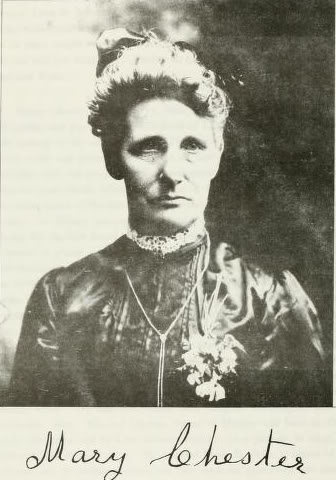
MaryChester
Mary E. (Baird) Chester, from the Lake County Encyclopedia

The Hobart Gazette of June 24, 1910, in noting that Henry Chester's widow had gone to Hobart on business the previous week, added, "She now has much to look after."

Indeed she did. Although earlier that month her stepson Charles had been appointed administrator of Henry's estate, so at least Mary did not have that burden, she still had to manage a large and busy household — twelve people besides Mary, according to the 1910 census, recorded in May. Jerome Chester, still unmarried, was nominally the head of the house. There were two female live-in domestics, one of them with a teenaged son. Six hired men also slept and ate under the Chester roof. And last but not least, Edward Scroggins, the widower of Mary's daughter Daisy, had come to live with the Chesters, along with his little daughters, two-year-old Helen and the infant Edna.

I don't know much about Mary beyond the few lines that the Rev. T.H. Ball devoted to her in Henry's profile:
Mrs. Chester was born in Westmoreland county, Pennsylvania, November 8, 1854, being the eldest of the ten children, four sons and six daughters, born to Samuel and Jane (Oakes) Baird. When she was a girl of twelve years her parents moved west to Bureau county, Illinois, where she completed the education begun in her native state.
She had married Henry in Lake County, Indiana, on August 15, 1878, about four months after the death of his second wife.

While Henry's financial success meant that Mary did not have to worry about money, she still had troubles, thanks to the men in her life. There were Henry's arrests on charges of assault and battery; her son Jerome's arrests, first on a charge of bastardy, which led to a very public trial and a guilty verdict, and then on assault and battery; and even her son John had been through legal troubles and one arrest.

Only Daisy, it seems, had given her mother no trouble, but Daisy was cut down in the bloom of youth.

In that crowded 1910 household, I expect Mary found some consolation in caring for her grandchildren. They were all she had left of her only daughter.

She would soon find further consolation — my deed search shows that when she transferred my land to the Chester descendants in 1913, she did so as the wife of John McDaniel.


Sources:
♦ 1910 Census.
♦ "Ainsworth Pick-Ups."Hobart Gazette 24 June 1910.
♦ Indiana Marriage Collection.
♦ Lake County Encyclopedia.
♦ "Local Drifts." Hobart Gazette. 10 June 1910.

Sunday, May 2, 2010

A Season of Death

As flies to wanton boys are we to the gods, they kill us for their sport.   (Shakespeare, King Lear)
The spring of 1910 was a season of death among the Chesters.

For several weeks Henry Chester's health had been deteriorating. Sometime early in March 1910, he took to his bed, probably expecting never to rise from it again.

Hearing of his condition, his children left their various households to come back to the old Ainsworth home, so Henry was surrounded by family. Considering the state of medicine during his lifetime, he had been fortunate: though he had lost at least one child in infancy, nine others survived to adulthood, and of those only one had died before him — his eldest, Mary. Now Ella, at 43, was the eldest, and the youngest was Daisy, just 21, who six weeks earlier had given birth to her second child.

So they gathered to say their last farewell to their father, while Death hovered in the background.

And then, it seems, Death decided to play a cruel and macabre joke.

A few days after her arrival in Ainsworth, Daisy fell ill with quinsy (peritonsillar abscess). On Sunday, March 13, she suddenly died.

Her funeral took place in the Chester home on Wednesday. I don't know whether Henry was able to rise from his bed for the occasion, but the same issue of the Gazette that carried Daisy's obituary also reported that "Henry Chester's condition [was] slightly improved."

Daisy is buried in Chester Cemetery. Her first name was actually Hallie, but she always went by her middle name, and now it's graven in stone.

DaisyChesterScroggins
(Click on images to enlarge)

GraveofDaisy

According to the Northwest Indiana Genealogical Society's Ross Township Cemeteries, Daisy's husband Edward was buried here too (in spite of that fact that he later remarried), but I haven't been able to find his grave marker. Perhaps it is the broken one next to hers.

EDScroggins

(To be continued)


Sources:
♦ "Dies Suddenly." Hobart Gazette 18 March 1910.
♦ "Local Drifts." Hobart Gazette 18 March 1910.