Showing posts with label Wood. Show all posts

Thursday, October 23, 2025

Joshua R. Shedd, and Shedd-Related Tragedies

These two documents from the Jeremiah Wiggins estate tell us of some strange transaction whereby Joshua R. Shedd paid off Jeremiah's account to Robinson & Co.[1] and then filed for reimbursement by the estate.

2025-10-23. Wiggins estate 19b
(Click on image to enlarge)
Image courtesy of Alice Flora Smedstad.


My transcription:
Jeremiah Wiggins Dr.
To Joshua R. Shedd

To the balance of account due the firm
of Robinson & Co. for merchandise — $5.09
Interest from June 5th 1837 to date .87
Lake C.H. Ia. March 2, 1939 $5.96
He was, in fact, reimbursed:

2025-10-23. Wiggins estate 05c
(Click on image to enlarge)
Image courtesy of Alice Flora Smedstad.


My transcription:
Recd of the Clerk of the Probate Court of Lake County
the amount for my account of $5.09 originally due to
Robinson & Co. filed in the office of the said Clerk as a
claim against the estate of Jeremiah Wiggins, deceased.
March 2, 1839

Michigan City Ia. ) J.R. Shedd
Nov. 25th 1839. )
With a full name, including middle initial, not to mention two possible locations (Lake County and Michigan City), you'd think it would be possible to identify him, wouldn't you? But you'd be wrong. My best guess is that he was the Joshua Rundle Shedd who died in Cook County in 1854 and is now buried in the southern part of the city. But that's just a guess, based on his date of birth and the coincidence of names and middle initial. I can't find anything clearly tying Joshua Rundle Shedd to Lake County or Michigan City.

♦    ♦    ♦

However, in searching Chicago newspapers for any information about that Joshua Shedd, I came across a tragic story involving to the Shedd family of Deep River, so let us talk about them now.

William Henry Shedd was born in 1821 in Massachusetts. I know this from his grave marker. The record of his birth fails to include the date (but does mention an older brother named Joshua Rundle Shedd).

2025-10-23. Shedd birth records
(Click on image to enlarge)
Ancestry.com. Massachusetts, U.S., Town and Vital Records, 1620-1988Massachusetts Vital and Town Records. Provo, UT: Holbrook Research Institute (Jay and Delene Holbrook).


I can't find any record of him until a possible sighting in 1852, in California:

2025-10-23. 1852 California census
(Click on image to enlarge)
Ancestry.com. California, U.S., State Census, 1852. Provo, UT, USA: Ancestry.com Operations, Inc., 2010. Original data: California State Census of 1952. (microfilm, M/F 144, 6 rolls). Sacramento, California: California State Library.


The age is about right, the birthplace is right. Did our William get caught up in the Gold Rush?

If that's our guy, he left California very soon after being counted. The next record we have of him is in the autumn of 1853, when he married John Wood's daughter, Abbie.[2] William and Abbie had a daughter, also named Abbie, born in 1855. The following year, Abbie (the mother) died.

William married again, in 1859, to Josephine Blachly in Porter County. The 1860 Census shows William and Josephine, with their infant son, William, living in Union Township, while little Abbie lived with her grandparents in Deep River.

William Sr. gave his occupation as merchant. He may have been running his business in the village of Deep River. There was a mercantile partnership around this time, Shedd & Wood, operating in the area; we are told that George Wood, the fifth child of John and Hannah, worked for that partnership as a clerk "in a country store."[3] On this page from the July 25, 1861 issue of the Crown Point Register, we find both "Wm. H. Shedd, Deep River," and "Wood & Shedd, Woods Mills,"[4] offering patent medicines for sale:

2025-10-23. Crown-Point-Register-Jul-25-1861-p-4
(Click on image to enlarge)

I have found such ads in the Register involving the name Shedd as early as 1859 and as late as 1865. By the way, I don't know which Wood was involved in the partnership; my guess is Augustus.

By the 1870 Census, William and Josephine, with sons William and Orton (b. 1861), had moved to Watseka, Illinois. William gave his occupation as cabinet-maker. The two elder Shedds would live out the rest of their lives in Watseka, and are now buried there.

The tragic story I mentioned above involves the eldest son, William Joshua Shedd:

2025-10-23. November,30-1922-Blue-Island-Sun-Standard-p-1
(Click on images to enlarge)
Blue Island Sun-Standard (Blue Island, Ill.), 30 Nov. 1922.

2025-10-23. November,30-1922-Blue-Island-Sun-Standard-p-9

As you will note, the article mentions his birth in Deep River, Indiana. It also mentions that this was not the first such tragedy in the family.


_______________
[1] We will speak of Robinson & Co. in the future.
[2] Indiana Marriage Collection.
[3] Porter and Lake Counties (Goodspeed-Blanchard) at 718.
[4] "Woods Mills" being another name for the village of Deep River, along with "Woodvale."

Friday, February 7, 2025

Mills of Mystery: Wilson & Saunders

[continued from here]

Wilson & Saunders were the flies in John Wood's ointment, according to Solon Robinson, who, as we know, said: "The accommodation of the people of the county was greatly increased this year [1847], in getting grain made into bread stuff, by the mill of Wilson & Saunders on Deep River below Wood's (and as he thinks not quite far enough below)." This only tells us that Wilson & Saunders' mill was downstream from Wood's mill, and annoyingly close.

Turning to Early Land Sales, Lake County, we find relevant entries that show "Wilson & Sanders"[1] purchasing Lots 8, 11, and 12, and Robert Wilson purchasing Lot 9, of Section 16, Twp. 35 N., Range 7 W., in December 1844.

I'm sure we all remember Section 16 from our encounter with the Wilkinsons. And as you can see, Wood's mill, in Section 21, lay just below Section 16's southern border:

2025-02-07. Sec. 16, Twp. 35 N, Range 7 W (1874) – Wood's mill
(Click on image to enlarge)
Image from the 1874 Plat Map.


The enumerator of the 1850 Census visited the Wilson-Saunders household right after visiting the Wood household:

2025-02-07. 1850 census - Wilson and Saunders
(Click on image to enlarge)
Image from Ancestry.com.


It would be astonishing if they had actually been neighbors, operating two mills next to each other. (You will notice that Benajah Wilkinson's widow, Prudence, and children are further down on the same page.)

The 1840 Census also records a Robert Wilson near John Wood …

2025-02-07. 1840 census - Robert Wilson
(Click on image to enlarge)
Image from Ancestry.com.


… which was probably our Robert, but the census gives so little information that we can't know for sure.

I have not been able to trace either Wilson or Saunders before or after the 1840-1850 timeframe.

♦    ♦    ♦

Where was the Wilson & Saunders mill? Short answer: I don't know.

Thanks to the trails in Deep River County Park, these days you can walk the whole length of the Deep River as it flows through Section 16, from Wood's mill all the way up to the north side of Ainsworth Road.

You can look around for a spot that might have accommodated a water-powered mill. Such a mill needs not only flowing water but also some high ground on which to perch the mill itself, so it isn't flooded or washed away every time the river overflows its banks.

The topography has to allow for damming the river so that the flow of water on the mill's wheel can be controlled. Wood's mill diverted some of the river's water into a millpond; the Cascade/Huffman mill did likewise. George Earle made a millpond of the river itself.

But a mill also needs a road for customers to use when bringing in raw materials and taking out finished products. Even today the river through Section 16 runs a pretty remote course. In 1847, we know Ainsworth Road and 73rd Ave./Joliet Road were in use. Was County Line Road then usable enough that Wilson & Saunders might have built their mill just below Wood's where the river runs past County Line Road's high ground? That would be very close indeed. There is high ground near Ainsworth Road, too, but we thought that area was reserved for the Wilkinsons, didn't we?

Even if I were able to find a source that showed exactly what land was included in the 1844 purchases — lots 8, 9, 11, and 12 of Section 16 — I might not be very far along, since each of those lots contained 40 acres.

♦    ♦    ♦

Here are a few of the entries from the early daybooks at the Hobart Historical Society museum that mention Wilson & Saunders.

The earliest I have found dates to September 7, 1846. It shows (if I understand the entry correctly) a customer at this Hobart store paying here for 100 pounds of flour to be gotten from Wilson & Saunders' mill.

2025-02-07. 1846-09-07 Wilson -Saunders, order for flour, DayB1836 064, 065
(Click on image to enlarge)
Image courtesy of the Hobart Historical Society.


Remember that in 1846 George Earle was operating only a sawmill, so Wilson & Saunders' was probably the closest grist mill.[2] (To judge by all the pills and quinine being bought on these pages, there was a lot of sickness going around in this later summer; also notice that Jesse Albee paid 25 cents to have teeth extracted, and there is no accompanying charge for pain medication.)

Ten days later, some complicated business:

2025-02-07. 1846-09-17 Wilson-Saunders and E. Saunders, DayB1840 164, 165
(Click on image to enlarge)
Image courtesy of the Hobart Historical Society.


I chose that one mostly because on the opposite page we find E. Saunders doing various things that include providing shelter and clothing for two orphaned Hodson boys, and it occurs to me to wonder if John Saunders, the miller, was related to E. (Edward?) Saunders. Of course, I don't have a clue.


On this page, dating to July 1847, we find Wilson & Saunders doing business with Saunders & Scales, and I wonder which Saunders that was.

2025-02-07. 1847-07-06 Wilson-Saunders, payment to other Saunders firm DayB1836 096, 097
(Click on image to enlarge)
Image courtesy of the Hobart Historical Society.


The latest entries I can find date to September-October 1847, and show Wilson & Saunders making a few lumber purchases from George Earle's sawmill.

2025-02-07. 1847-10-10 Wilson-Saunders, latest lumber purchase DBHM1846 010, 011
(Click on image to enlarge)
Image courtesy of the Hobart Historical Society.


So, the next time you're walking along the river in Deep River County Park, you can ask yourself where you would put a mill if you were Robert Wilson or John Saunders in 1844. And I suppose you have to remember that weather and erosion have been working on the river and its banks for nearly two centuries since then, so all you can do is imagine.

[To be continued …]

_______________
[1] "Sanders" shows up now and then as an alternate spelling of "Saunders." Maybe "Saunders" is the phonetic spelling of "Sanders."
[2] "There are two grist mills, Wood's and Wilson & Saunders, (three run of stone). Mr. Earle is also engaged at the present time in building another, which will have from 2 to 4 run." Solon Robinson, "History of Lake County, 1833 – 1847," Lake County 1929, p. 59. In a notice dated December 1, 1847 (on display at the Hobart Historical Society museum), George Earle announced that both his mills (saw and grist) were in operation.

Thursday, January 2, 2025

The Lost Cemetery of Ainsworth Road

This post is based on research by local historian Michael White, who first pieced together the bits of information from various sources that pointed to an unaccounted-for old cemetery in Ross Township along with its general location. He was kind enough to clue me in.


The Rev. T.H. Ball, our legendary Lake County historian, in 1872[1] compiled a list of all the cemeteries he knew of in each township in the county. In the list for Ross Township, he included six cemeteries, five of which clearly correspond to ones we can identify today and can find in the Northwest Indiana Genealogical Society's Ross Township Cemeteries. But one item in Ball's list is a puzzler:
An old burial place near the Wilkinson Ford of Deep River, from which some bodies have been removed, but where many yet remain. This old spot is now part of a cultivated field. It seems a pity that the little ground required to receive the dust of human forms may not remain undisturbed. This spot ought yet to be rescued from the plowshire [sic], consecrated, as it has been, by the burial of old settlers; or the human remains there resting should be removed to a quiet cemetery which is sacred to repose.
Elsewhere in the same book, in listing early settlers of Lake County in the 1830s, Ball says: "The third family arriving was that of Robert Wilkinson, who settled on Deep River, where the only ford known in early times was situated."[2] (I have previously discussed my reasons for thinking that Ainsworth Road was part of the old Sauk Trail, predating white settlement. The indigenous people may have established the trail because there was a natural ford in the Deep River where Ainsworth Road crosses it — a natural ford that the white settlers would then have used as they trickled in along the trail during the 1830s.)

In another of his books, Ball tells us that in the 1830s a bridge "across Deep River at B. Wilkinson's crossing near the Porter county line [was] built by Amsi L. Ball, cost[ing] four hundred dollars."[3] So far we've heard only of Robert Wilkinson; who was B. Wilkinson? To find that out we have to turn to the "History of Lake County, 1833 – 1847" by Solon Robinson, as printed in 1929:[4]
The first family that came after Childers and myself [Solon Robinson] was that of Robert Wilkinson, (at the place where his brother Benijah now lives on Deep River; at that time, the only known crossing place.) He settled about the last of November, 1834. … Wilkinson lived a few years where he settled, when he moved off and his brother took his place.
So "B." stands for Benijah — or, as it is sometimes written, Benajah — and he succeeded his brother Robert on the settlement near the ford of the Deep River.[5]

Robinson's account includes, among a list of bridges built in 1837, a bridge "across Deep River at Benajah Wilkinson's [built] by A. L. Ball, for $400, besides several smaller ones, by means of the 3 per cent fund."[6]

Goodspeed and Blanchard's 1882 county history also mentions this $400 bridge built by A.L. Ball, and specifies that it was in "Section 16, Township 35, Range 7."[7]

Here is that section as it appears on the 1874 plat map:[8]

2025-01-02. Sec. 16, Twp. 35 N, Range 7 W (1874)
(Click on image to enlarge)

The only road that crossed the Deep River in Section 16 was Ainsworth Road, aka the old Sauk Trail.

Incidentally, Goodspeed and Blanchard tell us that in 1837 three township trustees were appointed for Twp. 35, Range 7 (Ross Township): John Wood, whom everybody knows; Robert Wilkinson; and William Hodson (whose orphaned sons I believe we've already met).[9] So Robert Wilkinson was still in Ross Township some three years after settling there.

The only early land purchase record I could find pertaining to the Wilkinson brothers and Section 16 shows Benajah buying 38 acres described as "Part Lot No. 5" on July 27, 1840.[10] That may have been the year Robert moved on.

Benajah appears in the 1840 census for the Ross Township area of Lake County;[11] his brother does not.

2025-01-02. 1840 census, Benajah Wilkinson
(Click on image to enlarge)
Image from Ancestry.com.


In August of 1849, Benajah Wilkinson died.

2025-01-02. U.S. Census Mortality Schedule for Indiana, 1850, Counties L-Z, p. 15
(Click on image to enlarge — a bit; sorry about the quality)
Image from Indiana State Library Digital Collections, U.S. Census Mortality Schedule for Indiana, 1850, Counties L-Z.


There is now no record of where he was buried. I am willing to bet that it was in the lost Wilkinson cemetery.

The 1850 census shows his widow, Prudence, and her children still in Ross Township.

2025-01-02. 1850 Census, Prudence Wilkinson
(Click on image to enlarge)
Image from Ancestry.com. Evidently the family was in Michigan in 1836 when their daughter, Electa, was born. The first of their children to be a native Hoosier was born in 1839.


Sometime after that they left Indiana.[12] Prudence died in 1885 in Minnesota.

♦    ♦    ♦

So where, exactly, is the lost cemetery? It was somewhere along Ainsworth Road, near the Deep River — but how near? which side of the road? which side of the river? I'm thinking that it would probably be on the west side of the river, because on the east side there is a long stretch of river bottom that often floods — but further east the land rises again, and we're back to not knowing how T.H. Ball measured his "near the Wilkinson Ford of Deep River."

It's just possible that his lament about plowing over consecrated ground might have spurred action. I have done a little searching in the on-line newspapers from 1873 onward for any story about relocating the remaining bodies from the Wilkinson cemetery, but I have found nothing.

Some of the land where the cemetery could possibly be now belongs to the Lake County Parks Department. In the years that I have lived here, I have spent many hours walking my dogs all over that land without ever seeing any evidence whatsoever of a cemetery — and, believe me, I am always on the lookout for interesting artifacts in the underbrush.

I suppose this will have to be one of the mysteries of Ainsworth.

_______________
[1] T.H. Ball, Lake County, Indiana, from 1834 to 1872 (Chicago: J.W. Goodspeed, 1873). The Ross Township burial places are listed at pp. 139-140.
[2] Ibid., p. 26.
[3] T.H. Ball, Encyclopedia of Genealogy and Biography of Lake County, Indiana, with a Compendium of History 1834 – 1904 (Chicago: The Lewis Publishing Company, 1904) (hereinafter, "Lake County Encyclopedia"), p. 10.
[4] Lake County Historical Association (John O. Bowers, Arthur G. Taylor, and Sam B. Woods, eds.), History of Lake County, Vol. 10 (Gary, Ind.: Calumet Press, 1929) (hereinafter, "Lake County, Vol. 10"). Solon Robinson's "Lake County, 1833 – 1847" starts on p. 35.
[5] Research on Robert Wilkinson is complicated by the fact that there were two early settlers by that name; in Ball's discussion in Lake County Encyclopedia at pp. 2-3 he mentions both, apparently distinguishing them. The one we're concerned with settled on Deep River for a short time, then gave his farm over to his brother and disappeared from history; the other settled in West Creek Township, and since he was more prominent in society and politics, more is written about him.
[6] Lake County, Vol. 10, p. 48.
[7] Weston A. Goodspeed and Charles Blanchard (eds.), Counties of Porter and Lake Indiana. Historical and Biographical. Illustrated (Chicago: F.A. Battey & Co., 1882), p. 422.
[8] Hardesty's Sectional Map of Lake Co. Indiana (Chicago: Rufus Blanchard, n.d. (the map's date is estimated at circa 1874)).
[9] Goodspeed and Blanchard at p. 421.
[10] Northwest Indiana Genealogical Society, Early Land Sales and Purchases, Lake County, Indiana, 1837 – 1857 (Valparaiso: Northwest Indiana Genealogical Society, 2006), p. 41.
[11] Yes, his name is written as "Benjamin," and no, the census does not specify the township, but among his neighbors are John Wood and some of the people who appeared in the NWIGS' listing of 1840s land purchases for Section 16, Twp. 35 N, Range 7 W.
[12] On Ancestry.com, I have found some records of Prudence Wilkinson buying land in Minnesota in 1860, but I cannot find the family in the 1860 census.

Friday, December 13, 2024

A Very Short History of the Deep River Church

I came across this article in the May 14, 1975 issue of the Hobart Gazette about the Christian Church of Deep River, whose original building is now the Deep River County Park visitors' center.

2024-12-13. 1975-05-14 Gazette, Deep River Church Has Historical Past
(Click on image to enlarge)

It's interesting that the old-timers of 1975 did not remember Contractor Abel, unless he was one of the volunteers mentioned. But I believe he and his family belonged to the German Lutheran Church in Hobart, so it isn't likely that he was volunteering his services to the Deep River church.

The article does me a favor by explaining the "Willing Workers," as I was unclear about its origin. I have seen that ladies' aid society mentioned numerous times in the early 20th-century newspapers (for example, a 1922 social column previously posted announced their fund-raising sale and supper). The earliest such mention I can find in my notes was in June 1906,[1] so I guess the 1975 old-timers' memories were off by just one year. Which is remarkably good.

I only wish the article were clearer about the location of the dance hall! [6/24/2026 update parsonage/dance hall identified]


The photo of the Sunday School class includes some familiar names as well as some I have scarcely looked into.

Mrs. Flora Maxwell, presumably the Sunday-School teacher, had been born into an old Ross Township family, the Sturtevants, and had married Douglas Maxwell. Thus Olive Maxwell, in the first row, was her stepdaughter.

We already know of Philip Waldeck and his untimely death. Through his mother, he was a cousin of Clarence Maybaum ("Maybawm" is a mistake).

George Casbon, born in 1897, was a child of Thomas and Ella Casbon[2] and lived in a brick house on the north side of what is now 73rd Avenue (later owned by the Buchfuehrers).

Raymond Wood was the son of William and Martha Wood, and a great-grandson of John and Hannah, who founded the village of Deep River. The "Ford agency in town" mentioned in the article was run by William and Raymond.

Floyd Yager was born in 1897 to George and Anna. The extended Yager clan has already furnished considerable material for this blog, from Floyd's eccentric uncle, Fred, to his elegant brother, George Jr., but Floyd himself seems to have led a pretty quiet life. His family's farmhouse on 73rd Avenue is still standing.

Now we get to the less familiar names.

I believe that George Sandburg's father, John, bought Huffman's mill in 1903, and his mother, Lucy, had been a Baker.[3] George remained a Porter County resident through the 1940 Census, but by 1950 had moved with his wife to Tennessee, where he is buried.

Thus far I have indexed the surname Ditlow only in connection with "South of Deepriver" social columns (1921 and 1922). Raymond and Cecil Ditlow were brothers, born into a Union Township farming family. This 1942 article about their parents' 50th wedding anniversary gives a little of the family history …

2024-12-13. 1942-09-21, Vidette-Messenger (Valparaiso, Ind.), Golden Wedding Anniversary (Ditlow), p. 2
(Click on image to enlarge)
"Mr. and Mrs. Abe Ditlow Celebrate Golden Wedding," Vidette-Messenger (Valparaiso, Ind.), 21 Sept. 1942.


.. as does their father's 1947 obituary:

2024-12-13. 1947-03-17, Vidette-Messenger (Valparaiso, Inc.), Death Takes Aged Farmer (Abraham Ditlow)
(Click on image to enlarge)
Vidette-Messenger (Valparaiso, Ind.), 17 Mar. 1947.


Raymond and Cecil are both buried in Mosier Cemetery.

As for the surname Riley, I have found it several times in my notes, in connection with minor social news, and once it got into the blog, but I am confused about the relation of the various Rileys to one another, if any. The Riley in this photo, Marion, was the daughter of Edwin Stanton[4] and Rose (Miller) Riley and was born in 1897. In 1917 she married Reid Peck and lived out the rest of her life in Valparaiso. She, too, is buried in Mosier Cemetery.

_______________
[1] "Thursday, June 21st, from two to four o'clock, there will be a ten-cent Tea served by Mrs. B.H. Wood at Deepriver and by other members of the Willing Workers society on Mrs. W.M. Waldeck's lawn. Everybody invited. Mrs. Casbon, President." "General News Items," Hobart Gazette, 15 June 1906.
[2] Per his entry on Findagrave.com, his middle name was Perry — the maiden name of his grandmother.
[3] The surname appears as both "Sandburg" and "Sandberg." Since George himself used "Sandberg" when he signed his WWI draft card, I will be indexing it that way.
[4] He seems to be variously referred to as "E.S.," "Edwin S.," and "Stanton," which contributes to my confusion.

Tuesday, November 29, 2022

Alphonso Smith by Any Other Name

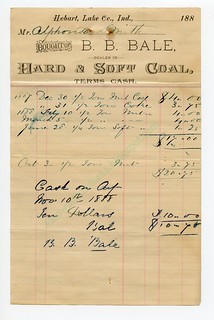
Let's take another look at those statements of account from my last post.

2022-11-04 Bale coal merchant papers 3a

(Reverse of the above:)

2022-11-04 Bale coal merchant papers 3b (verso)

2022-11-04 Bale coal merchant papers 4

Who (you might ask) was that Alphonso Smith guy who bought all that coal from B.B. Bale?

Searching on that name in that place on Ancestry.com brings up only one record: the 1870 Census, where he's a boy of 14 living in the household of Fanny Smith, in Hobart.

2022-11-29. 1870 census - Alphonso Smith
(Click on image to enlarge)
Image from Ancestry.com.


This census did not record how household members were related to each other. It didn't take me long to find out that Mariam Brock was Fannie's daughter, and Carrie Brock her granddaughter. But no other records places Alphonso and Fannie together in one household.

However, in the 1860 Census, Fannie's household includes a boy named Bernett who was then four years old — born the same year as the 1870 Alphonso. Once we assume they are the one and the same, it becomes easier to find this coal-purchasing guy. He was Bernett Elfonso Smith — and yes, it seems he spelled his middle name with an E; only when other people are writing it does the A appear.[1]

I think it was he who signed that promissory note to B.B. Bale:

2022-11-04 Bale coal merchant papers 2

Part of the signature was lost, but you can see the E plainly enough.

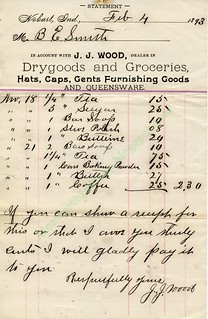
Bernett Elfonso was born to Henry and Fanny (Wheeler) Smith circa 1856. That was probably the same year his father died. His parents were in Porter County for the 1850 Census, but by 1860, as we've seen, the family moved to Hobart. There the widowed Fanny raised her children and spent the rest of her life. Although I can't find the family in the 1880 Census,[2] the Bale coal accounts place him there in the late 1880s, and the promissory note in 1892. And here we have another receipt placing him in Hobart in 1893 — buying some groceries and household goods from John Wood.

2022-11-29. J.J. Wood receipt to B.E. Smith 1893
(Click on image to enlarge)

Notwithstanding these appearances in Hobart, it seems that Bernett Elfonso also spent time in Illinois, probably Chicago: in 1888 he married Helen Brown in Cook County, and by 1900 they were living in Chicago with their young daughter, Sarah. At that time B.E. worked as a teamster.

But sometime after 1900 the family moved to California. The 1910 Census shows them in Pasadena (B.E. working as an "investigator" for a gas and electric company), and the 1920 Census shows B.E. and his wife farming in Fresno County (their daughter having moved out of the house and married). On May 30, 1929, B.E. Smith died in Fresno.[3]

2022-11-29. Smith, B.E. - death notice - The_Fresno_Morning_Republican_1929_06_03_page_3
(Click on image to enlarge)
Fresno Morning Republican, 3 June 1929.


♦    ♦    ♦

Having found that last death notice, I thought I had settled the whole life of Bernett Elfonso Smith, so you can imagine my confusion when I came across this obituary in the Hobart Gazette of October 29, 1942:

2022-11-29. Rites for B.E. Smith Held Tuesday, Hobart Gazette, 10-29-1942
(Click on image to enlarge)

Could there possibly be two Bernett Elfonso Smiths in Hobart's history? Unlikely as it seems, the answer is yes. The one who died in 1942 was the nephew of the one who died in 1929: the son of his elder brother, George.


_______________
[1] In the Union Sunday School record book that begins in 1868, a scholar named "Burnett" and one named "Alphonso" are (or is) recorded, although the actual dates of attendance are unclear.
[2] The 1880 census of Hobart is very hard to read, so the name could easily be mistranscribed; but I have looked through all 30 pages of it on Ancestry.com without being able to find Fannie or Bernett Elfonso — only her son/his brother, Frank Smith.
[3] The commercial papers in this post and my previous post about B.B. Bale (as well as another post to come) all came from a seller in Fresno.

Wednesday, May 26, 2021

Deadly Holdup at Tom Tierney's Chicken Dinner Roadhouse

This story from September 1924 about an attempted holdup at Tierney's restaurant is confusing in several ways.

2021-05-26. Tierney, News, 9-18-1924
(Click on image to enlarge)
Hobart News, Sept. 18, 1924.


Of course one of those names jumped out at me: could it be that John Dillinger? (I wondered.)

The Gazette mentions that this John Dillinger was a Gary resident.

2021-05-26. Tierney, Gazette, 9-19-1924
(Click on image to enlarge)
Hobart News, Sept. 18, 1924.


And indeed, the 1920 Census records a John Dillinger living in Gary: a 31-year-old railroad worker with a wife and child. That's probably our guy. Whether he was convicted of anything in connection with this incident, I don't know. He did not live to see his name become notorious throughout the nation; he died in 1930.

The man who was shot is even more elusive. The only record I can find of Henry Massey is his death certificate, which says he was a married steel worker, born circa 1896 in Tennessee to unknown parents (unknown, that is, to the informant). His burial place is given as Oak Hill Cemetery in Gary, but if that's true, his grave may be unmarked — I can't find it on findagrave.com.

Next question: who on earth was the Patrick Tierney mentioned in the Hobart News account? He is described as Harriet Tierney's son, but my previous research into Harriet turned up only one son, Ernest Woods, from her previous marriage. (Harriet's second husband, Thomas Tierney, had died in August 1923.) The Lake County Times account of this incident[1] says that Harriet was in the restaurant with "the manager, Ernest Woods," which makes more sense. I think the News may have been confused.

We've met the deputy sheriff, Howard Walter, before. He was last seen driving Merrillville school buses.

The Lake County Times gave this description of the restaurant: "Tom Tierney's chicken dinner roadhouse at Merrillville [is] a popular resort on the Lincoln highway, much patronized by motorists and people in the vicinity."

_______________
[1] "Roadhouse Bandit Slain in Holdup," Lake County Times (Hammond, Ind.), Sept. 16, 1924.

Saturday, January 30, 2021

That Big Rock Out Front of Wood's Mill

Beside the main entrance to Deep River County Park stands this boulder fitted with a bronze plaque.

2021-01-30. Wood Memorial Boulder
(Click on image to enlarge)

While looking for something else, I came across the newspaper stories about its dedication on August 16, 1924, at a Wood family reunion combined with a meeting of the Lake County Old Settlers' and Historical Association.

This story from the Hobart Gazette of August 22, 1924, is the most complete:

2021-01-30. Many Old Settlers at Reunion, Gazette, 8-22-1924
(Click on image to enlarge)

I like this cameo of Hannah Pattee Wood, who otherwise gets so little mention:
She is described by one of her daughters-in-law as being "the sweetest woman, always doing good turns for people, a real peacemaker, and to her is due credit for no saloons being allowed in the village while her family was growing up. She was a good wife and mother, truly loved by all."
If I understand correctly, these words, along with the bulk of the article, were part of the "historical sketch of John Wood" delivered by Andrew J. Smith of the Gazette …

2021-01-30. Smith, A.J.
This photo dates to circa 1898. You will have to add a quarter-century's age to imagine what he looked like delivering his speech at Wood's Mill in August 1924.
Image courtesy of the Hobart Historical Society.


… who was the president of the Old Settlers' and Historical Association.

The boulder itself, as the article states, was brought to Wood's Mill from the Douglas Maxwell farm. I do wish someone had photographed the process of getting a two-ton boulder into a truck or horse-drawn wagon.

Here is another article, from the Hobart News of August 14, 1924:

2021-01-30. Wood Monument to Be Unveiled, News, 8-14-1924
(Click on image to enlarge)

And finally, one from the Hobart News of August 21, 1924:

2021-01-30. Wood Monument Unveiled, News, 8-21-1924
(Click on image to enlarge)

Wednesday, March 11, 2020

Grace Wood Mundt

Since my previous post mentioned Grace Mundt, daughter of John Warren Wood and Margaret Hollett, I'm posting the only portrait of her contained in the Wood/Vincent photo album.

Mundt, Grace Wood 019c no verso
(Click on images to enlarge)

Grace was born in 1884. In this photo she looks about 14 years old, so we can estimate that it dates to 1898 or thereabouts. The style of her dress (what little I can see of it) seems consistent with that. Unfortunately, there is no photographer's name on the photo.

She is identified by a handwritten caption.

Mundt, Grace Wood 019c caption

On June 8, 1906, Grace married Dr. Gustoff Henry Mundt in Chicago. His obituary, from 1962, gives you some idea of what sort of people they both were.

Mundt, Dr. Henry, Suburbanite-Economist (Evergreen Park, Ill.), April 04, 1962
Suburbanite-Economist (Evergreen Park, Ill.), April 4, 1962.

Grace's entry at findagrave.com includes a photo of Grace and Henry and two children.

Thursday, March 5, 2020

The Death of Margaret Hollett Wood

A member-by-marriage of the Deep River Wood family died on November 4, 1923.

2020-03-05. Margaret Wood obit, Gazette, 11-9-1923
(Click on image to enlarge)
Hobart Gazette, Nov. 9, 1923.


Her late husband, John W. Wood, had been born to John and Hannah (Pattee) Wood in 1838, after they came to Lake County, Indiana. He was given the name of a brother who had died in childhood, back in Massachusetts.

Margaret was the daughter of Thomas and Deborah Hollett, natives of New York. The 1860 Census is the first that records them in Porter County, farming in Porter Township. It is also the last one that records Margaret under her maiden name. The following year she married John W. Wood.

John gave his occupation as house painter in the 1870 Census, which shows him, Margaret, and their five-year-old daughter, Anna M., living in Valparaiso. By the 1880 Census, John had gone into the grocery business — and stayed there, apparently, since he still gave his occupation as grocer in the 1900 Census. Sometime after 1900 he retired and moved (according to his obituary) to Chicago, and there he died in 1907.

I can't find Margaret in the 1910 Census. The 1920 Census shows her living in Chicago with her daughter, Grace, who was by then the wife of Dr. Henry Mundt and the mother of two young children.

The niece in Gary at whose home Margaret died, Mrs. Otis B. Nesbit, was the Alice Vincent Nesbit who (I suspect) owned the Wood-Vincent photo album.

Margaret's entry on findagrave.com also lists her children who did not survive her.

Friday, February 14, 2020

Unidentified Newlyweds, But I Have a Theory

For Valentine's Day, here's a lovely photo of two unidentified newlyweds.

2020-02-14. st041
(Click on image to enlarge)
Image courtesy of Eldon Harms.


It comes from Minnie Rossow Harms' steamer trunk, which narrows the circle of possibilities.

I think the young man looks like Henry Harms, Jr. That would make the young lady the former Miss Grace Cook.

Here's an identified photo of Henry Jr. and another young woman (named Lena Clark):

2020-02-14. sb132
(Click on image to enlarge)
Image courtesy of Eldon Harms.


Cute, huh? "To Reno," because Reno, Nevada was known as a place where you could get divorced relatively quickly? — not very romantic. But you could get remarried the same day, apparently.

However, the point of the photo is: the Reno-bound Henry Jr. looks to me like the unidentified young husband above.


Although the newlyweds are not identified, their photographer is. He was T.E. Wood, of 6250 Wentworth, Chicago, Illinois. We know that Henry Jr. and Grace were married January 8, 1916; was Mr. Wood working as a photographer then? The 1910 Census shows Thomas E. Wood, at age 70, carrying on his profession while living at 6250 Wentworth. A 1911 Chicago directory, while advertising his photography business, also gives us his middle name: Evert.

2020-02-14. Wood, Thomas Evert
(Click on image to enlarge)
From The Lakeside Annual Directory of the City of Chicago 1911 (Chicago: The Chicago Directory Company, 1911), https://archive.org/details/lakesideannualdi1911unse/page/n3/mode/2up.


Mr. Wood died May 22, 1918. His brief death notice in the Chicago Tribune of May 23 doesn't say whether he was photographing to the end.

Chicago directories between 1911 and 1918 are remarkably scarce online, so I can't prove T.E. Wood was still working as a photographer in 1916. However, he seems to have been devoted to his art, and it's not unreasonable for a man of some 76 years of age to photograph a nice, orderly event like a wedding. I hereby pronounce my theory plausible.

Wednesday, November 6, 2019

Simeon Bullock and the Old Bullock Homestead

It's September 1923 and Simeon Bullock has left us.

2019-11-06. Bullock, News, 9-20-1923
(Click on image to enlarge)
Hobart News, Sept. 20, 1923.


I did not know about his time in Alva, Oklahoma. That might help to explain why his daughter Jessie and her husband, Samuel Quinlan, lived there.

We have already met Simeon's widow, Abbie Wood Bullock, as well as his daughters — Jessie and Ida, and Carolyn (Carrie), who had died in 1917.

Simeon was buried in Crown Hill Cemetery.

♦    ♦    ♦

This obituary clears up for me something I've been a little confused about: the old Bullock homestead where Simeon spent his youth is marked here, on the 1874 Plat Map in red:

2019-11-06. Bullock 1874
(Click on image to enlarge)

The land marked in green, owned also by Moses Bullock, was where Moses' son Gilbert later built the big house that is still standing, but apparently it was not where the original Bullock family lived. I'm glad I got clear on that point.

A few years ago, I received an inquiry about the house at 3720 E. 73rd Avenue, which I was not able to answer very well at that time because I did not have the legal description of the land it stands on. Now, however, I do have that description: "PT. N2.W2.E2.SW. … S.13 T.35 R.8." This description matches up with the western part of the old Bullock homestead. According to the county records, the house was built in 1900; but I am beginning to suspect that "1900" in county records is often code for: "The house was built a long time ago, but nobody knows exactly when."

The earliest purchase I can find relating to the old Bullock farm, in Early Land Sales, was by Elizabeth Ayers, who bought the west half in September 1851. She was probably married to the Nathaniel Ayers who bought part of the east half in 1852.

Here is the Ayers family in Ross Township in the 1850 Census:

2019-11-06. Ayers 1850
(Click on image to enlarge)

Comparing the names of their neighbors to names in Early Land Sales, I am inclined to think they were in the area of their 1851 and 1852 purchases. Since I can't find the Ayers family in the 1860 Census, I don't know how long they stayed in the area. Perhaps they sold their land directly to the Bullocks in 1860.[1] The Ayerses soon migrated completely out of our story, traveling west to Oregon by 1870 and to California by 1900.

The Bullocks owned the land through 1874, as we've seen on the plat map above. Moses Bullock died in 1873. The 1891 Plat Book shows the west half of the old Bullock land being owned by "A. Bullock" — perhaps Moses' widow, Amanda, or his son, Asa.

The eastern half of the land had been purchased by Morgan Blachly, probably around 1883, from what we know of him. By 1908 (per the 1908 Plat Map) he had also purchased the western half of the old Bullock homestead (in addition to other adjacent land; he owned a parcel totaling 256 acres).

Here is the old Bullock homestead in the 1926 Plat Book:

2019-11-06. Ayers-Bullock-Blachly 1926
(Click on image to enlarge)

The west half was owned by two sons of Morgan and Amelia Blachly: Walter and Earl. (I don't know much about Clarinda Hayden except that she apparently lived in Cedar Creek and West Townships at various times, but I can't find her ever living in Ross Township.)

Here is the old Bullock homestead in 1939 Plat Book:

2019-11-06. Bullock 1939
(Click on image to enlarge)

I've found William and Iva Kuntz, owners of the east half, in the 1940 Census, but I can't identify the owners of the west half, Steven and V. Kovac.

The 1950 Plat Book shows the same ownership.

Here is the 1972 Plat Book:

2019-11-06. Bullock 1972
(Click on image to enlarge)

It's still recognizable as the old Bullock farm, though it's lost a few acres on the north. The person who inquired about the house at 3720 E. 73rd told me his parents bought it from an older couple by the name of Walsh, who may be the Walshes shown here. Hartcock, I believe, is a misspelling of Hartsock; see Jones Hartsock's death certificate:

2019-11-06. Hartsock death certificate
(Click on image to enlarge)
Image from Ancestry.com.


1972 is the most recent plat map I have.

Here is my attempt to outline the old Bullock farm on a screenshot from the Lake County GIS site:

2019-11-06. Bullock now
(Click on image to enlarge)

_______________
[1] Simeon's obituary suggests it was 1862 when the Bullocks moved here from LaPorte, but they are recorded here in the 1860 Census, and Moses Bullock's bio tells us that he bought his farm in 1860.