Showing posts with label Gernenz. Show all posts

Wednesday, December 24, 2014

Merry Christmas from the Ainsworth School!

2014-12-24. Ainsworth school Xmas program 1939-40
(Click on image to enlarge)
Image courtesy of Eldon Harms.


There is no date on this program, but one of the participants estimates that it took place in the very late 1930s, or 1940 at the latest. The Ainsworth school had a Christmas program every year (she tells me), as well as a Halloween masquerade party and some sort of program in the spring. And every month during the school year, a "community meeting."

I wish I could index every surname, but Blogger won't let me. So I will just type them out for the search engine: Baldner, Bergman, Blimel, Bodamer, Bowers, Bryant, Buchfuehrer, Bush, Busselburg, Carden, Collins, Dick, Doepping, Dorman, Engstrom, Ford, Gernenz, Harms, Hartin, Homeier, Johnson, Jones, Kissinger, Klemm, Kuntz, Lines, Madura, Maihofer, Mitchell, Moreland, Nelson, O'Brien, Olson, O'Neil, Peterson, Pike, Piske, Ready, Robb, Robinson, Schmidt, Shaw, Sullivan, Tonagel, Watts, Weiler, Wesley, Willy, Wise, Witham, Wojahn, Yager, Ziemanski.

Wednesday, July 31, 2013

Gernenz v. Everybody

Now we find Charles Gernenz seeking to quiet title on this 120-acre parcel:

120 acres in Sec. 20
(Click on images to enlarge)
From the 1926 Plat Book.


Why now? Beats me. The 1908 Plat Map shows that land owned by Daniel B. Sturtevant … who isn't named in the action to quiet title. Per the 1891 Plat Book, the land was jointly owned by Henry Stelling and Albert Buchgert, also not named. The 1874 Plat Map gives the owner's name as "T. Wehrenburg," which may have some connection to the Frederick Wehrburg named in the action.

Gernenz, action to quiet title
From the Hobart News of Oct. 7, 1920.

TLDR summary: Baker, Carter, Davis, Hacker, Larabee, Marston, McDonald, Melbie, Muller, Preston, Raymond, Schneewind, Smith, Summers, Toothill, Wehrburg, Wheeler, Wilcox.

Saturday, July 20, 2013

Marriages and Other Transitions

Two young people with Ainsworth connections; two marriages.

After the coal-gas incident in 1917, William Gernenz was lucky to have a life to pledge to his bride in September 1920.

And Mildred Blachly had grown up on a farm near Ainsworth, a descendant of local farming families. Her grandparents were (the late) Morgan and Amelia Blachly, her parents Walter and Eva (Harper) Blachly.

Gernenz-Wesley; Kostbade-Blachly
(Click on image to enlarge)

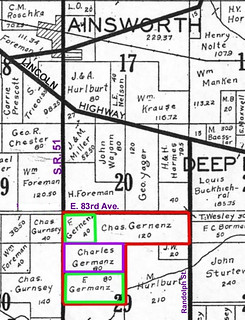
In spite of Anna Wesley's family being "well known people residing south of Ainsworth," I have not seen fit to mention them yet in the blog. I don't even have much on them in my notes. Let us hope this is because they lived quietly happy lives, not because I missed something juicy. It does appear that Anna's father, John, had lost his first wife (name unknown). In 1898 he married the 20-year-old Ida Sonntag, who became stepmother to John's three boys, the oldest of whom was about 13. Ida went on to bear him two daughters, Anna and Theresia. The Wesley land lay mostly at the intersection of (present-day) E. 83rd Ave. and Randolph Street — 40 acres on the northwest corner and 30 acres on the southeast corner, with another 20-acre parcel further south on Randolph. (Anna's oldest half-brother, Edward, had married Martha Sonntag's sister, Selma, in 1906.)

And so the newlywed Gernenzes settled down to farming near Ainsworth, and the young Kostbades took up residence in Valparaiso, washing their hands of both farming and Ainsworth.

♦    ♦    ♦

Another kind of transition — from life to death, or from death to life, by Frances Springman Schavey, without whom there would have been no Schavey envelope.

Frances Schavey obit

This obituary from the Gazette is a little confused — it was six sons and two daughters who survived her. [7/26/2013 update: more than a little confused, as it got her parents wrong too. Correction here.]

♦    ♦    ♦

Lastly, a mundane sort of transition: Amelia and May Blachly moved, yet again.

Amelia and May Blachly move again
(Click on image to enlarge)

The Gazette described Amelia's new house as "opposite the Hobart Lumber Co." (which was on the west side of Main, where the "lumber" part of Hobart Lumber is now). Two weeks early, Amelia had sold her home on Fourth Street, described as the former A.C. Thompson house, to one John Walsh.

Also note the item that mentions a couple of Dr. Clara Faulkner's relations by marriage. But Dr. Clara wasn't married anymore — not if I'm reading the 1920 census correctly. Sometime after the 1910 census, her husband, Samuel, vanished. I can't find him anywhere. I was hoping to see something in the local newspapers about the divorce (or death, if not divorce), but I haven't; either I missed it, or the incident was treated with unusual discretion.


Sources:
♦ 1891 Plat Book.
♦ 1908 Plat Map.
♦ 1910 Census.
♦ 1920 Census.
♦ "Gernenz-Wesley." Hobart News 30 Sept. 1920.
♦ "Hobart Boy Marries." Hobart Gazette 1 Oct. 1920.
♦ Indiana Marriage Collection.
♦ "Kostbade-Blachly." Hobart News 30 Sept. 1920.
♦ "Local and Personal." Hobart News 16 Sept. 1920; 30 Sept. 1920.
♦ "Local Drifts." Hobart Gazette 26 Oct. 1906; 8 Oct. 1920.
♦ "Mrs. Schavey Dies in Chicago." Hobart Gazette 1 Oct. 1920.

Friday, February 1, 2013

A Snowy Funeral

Anna Ziems Gernenz obit

The Saturday night after Anna Gernenz died, snow began to fall. As Easter Sunday dawned, the snow was falling heavily and a northeast wind piling up drifts. With a blizzard between the faithful and their churches, morning services were sparsely attended.

Around noon the streetcars became mired in snow.

The afternoon went on and so did the storm. The churches got the word out — evening services were cancelled. By nightfall a passenger train on the Pennsy line was stuck in snow near Wisconsin Street.

Sometime after midnight on Sunday, the snow tapered off. When Monday came, the air was clear, and town and countryside were white. Snowdrifts lay everywhere; at the center of Hobart, at Main and Third, the drifts were four or five feet high. Roads were dotted with stuck cars. The town snowplow had cleared a path along the major streets, but still they were not passable by automobile — people walked, or got out their sleighs and bobsleds and hitched up their horses.

The family and friends of Anna Gernenz had to brave these conditions to attend her funeral on Monday afternoon. She was laid to rest amidst the snowdrifts in Hobart Cemetery.

Gernenz, Anna & Friedrich
(Click on image to enlarge)

This blizzard reminded locals of the one that hit in 1918, but this time there was no local militia volunteering to dig out the stalled streetcars; hired men, probably, got the streetcars moving again by Tuesday afternoon. And this time it was April, not January; the cold was not so bitter, and though the snowdrifts were tall, they would be short-lived. A week and a half later, the News commented that the Easter snowstorm had melted away without any flooding.

♦    ♦    ♦

We can guess how some of the snowbound people amused themselves — the same way they amused themselves when they weren't snowbound; the same way people have amused themselves since the dawn of time. As the Gazette remarked:
There seem to be more drunks in Hobart these days than there were before the saloons closed. It is quite common to see young men under the influence of liquor.


Sources:
♦ "Funeral of Mrs. Fred Gernenz Held Monday Afternoon." Hobart News 8 Apr. 1920.
♦ "Local and Personal." Hobart News 15 Apr. 1920.
♦ "Local Drifts." Hobart Gazette 9 Apr. 1920.
♦ "Obituary." Hobart Gazette 9 Apr. 1920.
♦ "The Worst Storm of the Season." Hobart Gazette 9 Apr. 1920.
♦ "Worst Storm in Two Years Visits Hobart Sunday." Hobart News 8 Apr. 1920.

Monday, November 12, 2012

Be Thou Faithful Unto Death!

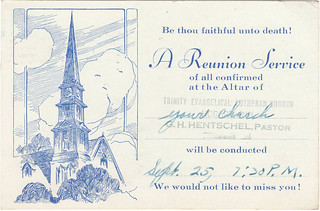
We just recently saw Bertha Gernenz come into the world. Now, thanks to Ebay, we can peek into the future and see her receiving a very serious invitation.

Trinity-Gernenz postcard 1938
(Click on images to enlarge)

Trinity-Gernenz pc 1938 verso

Tuesday, September 25, 2012

Overrun with Hunters and Dogs

Notice to Hunters
(Click on image to enlarge)

This inhospitable notice, published on the front page of both local papers, was provoked by the area's growing population, as the News explained:
Farmers in this locality have become tired and disgusted with having their farms overrun with hunting parties with dogs, and have decided to put a stop to the practice. As the Calumet region grows, the hunters naturally increase until they have become a nuisance. A number of names appear in this issue of The News warning hunters to keep off their farms. It may be well for hunters to heed this notice or someone will pay a heavy fine.
♦    ♦    ♦

The "Births" column below the warning to hunters reports good news for some old friends, Charles and Amelia Gernenz — a new addition to the family. It's reported as a son, but later censuses seem to indicate it was in fact a daughter, Bertha.


Sources:
♦ 1920 Census.
♦ 1930 Census.
♦ "Births." Hobart Gazette 14 Nov. 1919.
♦ "Local and Personal." Hobart News 13 Nov. 1919.
♦ "Notice." Hobart News 13 Nov. 1919.
♦ "Warning to Hunters." Hobart Gazette 14 Nov. 1919.

Tuesday, October 25, 2011

Proud of His Corn

In the eight years that passed after Charles Gernenz raised 15-pound mangel-wurzels, he continued farming successfully but quietly. Then in October 1918, he was so overcome with pride in his corn that he sent four ears to the office of the Hobart Gazette, just to show them, I suppose, what real corn looked like. "If the ears he sent are a sample of this year's crop we can well say he has some mighty fine corn," was the Gazette's comment. "Yes, there is a big crop of good corn this year."


Source: "Local Drifts." Hobart Gazette 18 Oct. 1918.

Sunday, December 26, 2010

Gernenz Report: More Land and More Trouble

12-26-2010 Gernenzland1917
(Click on image to enlarge)
On this image from the 1926 Plat Book, the whole Gernenz farm is outlined in red; the parcels owned by Fred Gernenz at least since 1891 are outlined in green; and Charles' 80-acre purchase from Emil Klemm in 1917 is outlined in purple.


It's been a long time since we've heard from the Gernenz family.

Charles Gernenz's purchase during the summer of 1916 of an 80-acre parcel south of Ainsworth went unreported until February 1917. The land was known as the "old Watts farm," and the 1891 Plat Book shows 80 acres belonging to Joseph Watts sandwiched between two parcels belonging to Fred Gernenz, Charles' father. Sometime after 1891 the land passed into the hands of Otto Klemm, who sold it to Charles. Otto remained on the land for several more months, then announced that he was moving to a farm near Crown Point, and Charles would have possession of this parcel in March. He intended to farm it, along with his other 300 acres, with the help of his four sons, William, Martin, John and Carl, who then ranged in age from 21 to 12.

♦    ♦    ♦

There were two houses on the Gernenz farm, separate but not far apart. One was occupied by the Charles Gernenz family; the other by his elderly parents, Fred and Anna, and their oldest grandson, William.

Bright and early on a Monday morning, February 19, Charles went over to the other house to wake William up. No one answered when he knocked, or called out, so he opened the door to go in — and found himself breathing coal gas. The air inside the house was thick with it. Charles hurried in to check on his parents and son, and to his horror found all three of them unconscious.

He probably carried them out of the house — perhaps his other sons helped him — and laid them down in the warmth and safety of the other house. Several hours passed before Fred and William returned to their senses, and the 80-year-old Anna remained unconscious until evening.

Later they tried to piece together what had happened. William remembered smelling coal gas when he returned to the house around midnight on Sunday. He had checked the stove and found a door open on it, which he closed. Then he went to bed. As to how the stove door had fallen open again, they could only guess that Fred, hearing William come in, had gotten out of bed and bumped against the stove in his grogginess, then retired again without realizing anything was wrong.

All three recovered fully.


Sources:
♦ 1920 Census.
♦ "Family of Three Nearly Asphyxiated." Hobart Gazette 23 Feb. 1917.
♦ "General News." Hobart Gazette 2 Feb. 1917.
♦ "Personal and Local Mention." Hobart News 22 Feb. 1917.

Thursday, August 5, 2010

Chickenpox and Scarlet Fever

I haven't done a Gernenz news summary for a long time because there hasn't been much Gernenz news for a long time. All I've encountered since October 1911 is one little item in mid-February 1913: "Chas. Gernenz's three children are sick with chickenpox."

Chickenpox isn't fun (I remember), but it's rarely fatal. Scarlet fever, on the other hand, could be dangerous in those pre-antibiotic days, and from late autumn 1912 to early 1913, scarlet fever was causing trouble in the area.

By late November 1912, after three Hobart schoolchildren had come down with scarlet fever and many other had been exposed to it, Drs. R.C. and Dwight Mackey (the town and school health inspectors, respectively), had closed down all of Hobart's schools for a week. Workers were set to disinfecting the school buildings. Likewise, all theaters and "public places of amusement" were closed the last week of November. So were the churches, where Thanksgiving services had to be postponed.

The three Hobart children whose illness started the scare apparently recovered. Others were not so fortunate. Over the Porter County line just east of the village of Deep River, scarlet fever devastated at least two families.

In mid-December, all four of Thomas and Sarah Keene's children came down with it. On December 17, four-year-old Irene died; her twin sister, Ada, died on the 22nd. Susan, the baby of the family at one-and-a-half, died five days later. The only child to survive was the Keene's son, six-year-old Thomas Jr.

The family of Edward Hardesty lost a seven-year-old daughter to scarlet fever on December 6. On the 21st, Edward himself died of inflammatory rheumatism. On the following Tuesday night, two of his sons, aged six and three, died of scarlet fever. By the end of the year, the Hardesty family had been reduced to one widow and one baby.

So if the worst that the Gernenz children had was chickenpox, their parents must have counted themselves blessed.


Sources:
♦ "Death in Union Township." Hobart Gazette 27 Dec. 1912.
♦ "Hobart Schools Are Closed For the Week." Hobart News 28 Nov. 1912.
♦ "Personal and Local Mention." Hobart News 26 Dec. 1912; 2 Jan. 1913.
♦ "Ross Township." Hobart News 13 Feb. 1913.

Friday, July 16, 2010

Indian Ridge and Pioneers

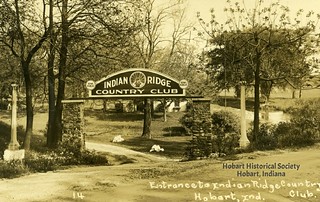
That Indian Ridge Golf Club postcard from earlier motivated me to check in the Indian Ridge file at the Hobart Historical Society Museum. Here are a couple things I found there.

The entrance, from a postcard postmarked 1934:

Indian Ridge entrance
(Click on images to enlarge)
All images in this post courtesy of the Hobart Historical Society.


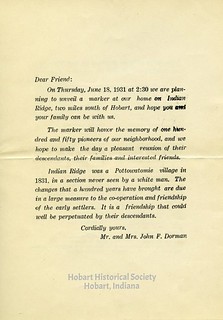
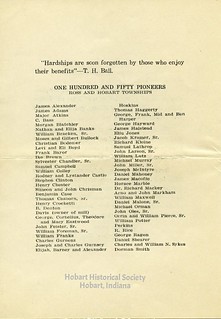
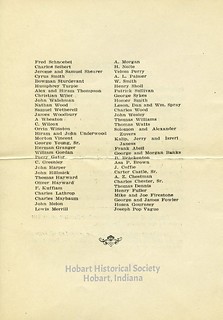
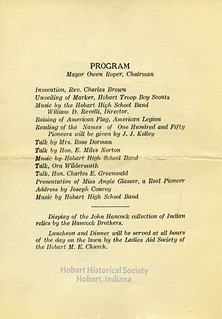
In 1931 the Dormans hosted a ceremony dedicating a monument to 150 pioneers of Hobart and Ross Townships. The program for the ceremony listed the pioneers they had in mind.

Program page 1

Program page 2

Program page 3

Program page 4

*sigh* Most of these men had wives. But there were no women pioneers.

Leaving aside that little injustice, I notice some familiar names on this list. I've already written about, or at least mentioned, Morgan Blachly; Henry Chester and his father, Charles; Charles Gernenz; Horace Marble; William Potter; Cyrus Smith; Henry Nolte (there were two who could qualify as pioneers); and Patrick Sullivan.

Tuesday, May 25, 2010

Gernenz Round-Up

A few things I missed from the last Gernenz summary, and some new items. (And the Gazette has now added "Gernanz" to its repertoire of variant spellings.)

● In August 1910, the Charles Gernenz family had a visit from Henry Lemke, Jr., of Chicago. Who he was to them, I don't know. Later that month, Mr. and Mrs. John Gernenz came out from Chicago to visit his brother Fred and family here — and also the John Springman family. If there was some family relation between the Gernenzes and the Springmans, I haven't come across it yet.

● "The neighbors of Mr. and Mrs. John Gernantz gave them a happy surprise Sunday [September 4, 1910], and so did Mr. and Mrs. John Ahrens of Hobart." We will hear about the Ahrens family again; either they were good friends or there was some family connection.

After September 1910, we entered a long dry spell for Gernenz news. In mid-summer 1911, things started happening again.

● On June 30, 1911, a hired hand working for Charles Gernenz fell backwards off a load of hay and struck his head on something sharp, which cut open his scalp. They took him to Dr. Friedrichs' office in Hobart. Fourteen stitches were required to close up the wound, but the hired man (whose name is not reported) was expected to recover fully.

● By September, Charles Gernenz was making improvements to his place — "building a cement porch, cement sidewalk and a cement water tank 6 by 26 feet, doing the work himself."

● Someone had a birthday party at the Charles Gernenz home on Sunday, September 17, 1911. John Ahrens and family came down from Hobart to attend.

● A couple of frightening accidents during October 1911. On the 7th, Charles' wife Amelia drove a horse and buggy to Ainsworth. Something caused the horse to take fright and run; it collided with several other rigs, then ran into a wire fence before it was finally got under control. That same month, Charles' 10-year-old son Johnnie was thrown from a colt he was riding. The colt kicked him in the head, causing a bad cut. They took Johnnie to Hobart for treatment. No bones were broken.


And that's it for now on the Gernenz front.


Sources:
♦ 1910 Census.
♦ "Ainsworth Pick-Ups." Hobart Gazette 5 Aug. 1910; 19 Aug. 1910; 9 Sept. 1910.
♦ "Local Drifts. Hobart Gazette 7 July 1911.
♦ "Ross Township Notes. Hobart Gazette 8 Sept. 1911; 22 Sept. 1911; 13 Oct. 1911.

Friday, April 30, 2010

Gernenzathon

Since certain people like hearing about their ancestors, I thought I'd just post the few random items I've found about members of the Gernenz family that I haven't already posted.

From the Hobart Gazette of April 10, 1903:

An Old Citizen Passes Away.

After years of feebleness Mrs. Caroline Gernenz died on Monday, April 6th, 1903, at the home of her son Fred south of Ainsworth at the age of nearly ninety years. She was born Aug. 10th, 1813, in Germany where her husband died about 42 years ago, and came to America with Mrs. John Springman, her daughter, and husband in the spring of 1874. After a residence of several months in Chicago she came to Hobart, Ind., with her son Fred and family, and after a residence here of 7 years they moved upon the farm south of Ainsworth.

For the past eleven years she has been very feeble, most of the time being confined to her bed. She was the mother of six children, two having died in infancy in the old country. The children living are Fred, Ernst and John Gernenz, and Mrs. Sophia springman, besides a large number of grandchildren and great-grand children.

The funeral services were conducted yesterday [April 9, 1903] at 1 p.m. at the German Lutheran church in Hobart by the pastor, Rev. Schuelke, and the interment occurred at the Hobart cemetery.

The following items are all from Hobart Gazette's "Ainsworth Pick-Ups" columns:

From February 17, 1905: "Mr. Mayer's team broke loose Friday night, during the entertainment [a box social at the Ainsworth school] and were found next morning unhurt two miles south in Gernenz's yard, eating from a straw stack." (There you have it — Gernenz straw: worth traveling two miles for.)

Starting with this item from June 24, 1910, the paper seems to have adopted an alternate spelling of the last name: "Chas. Gernantz who sports a fine white team and surrey, with his family visited Hobart friends, Sunday."

From September 30, 1910: "Chas. Gernantz recently had eighteen geese killed at night by dogs." Roaming dogs were a problem in those days. Occasionally they killed sheep; this is the first time I've heard of geese being killed. In Hobart they usually just bit people.

And lastly, from October 28, 1910: "Last Saturday Chas. and F. Gernantz, John Benson, August Maybaum, Wm. Smith and Frank and Antone Peterson met the county commissioners at the Peterson road. They are reported dissatisfied with the work of the Inspector." I don't know exactly what Inspector this refers to, but it may have been Calvin C. Shearer, Sr., a "Gravel Road Inspector" mentioned in the previous week's column.


That's all I've got for now.

Monday, April 12, 2010

What Do You Say to a 15-Pound Mangel-Wurzel?

Anything you want to. It can't hear you, you know. Personally, I say "No, thank you."

MangelWurzel

Remember Charles Gernenz and his domestic difficulties in 1901? Now we've gotten to 1909, and apparently life is going more smoothly for him: all he has to complain of these days is that some of his mangel-wurzels weigh 15 pounds.

Oh, wait, he's not complaining — he's bragging. And he says he intends to raise four acres of them in 1910. That's a lot of wurzel-mangeling. Good luck, Charles!

Sources: "Local Drifts." Hobart Gazette 15 Oct. 1909.

Sunday, February 21, 2010

I'd Like to Hear HER Side of the Story

Gernenznotice

"Without just cause or provocation" — that, of course, was the legal formula, not necessarily the truth. Perhaps Charles knew in his heart she had cause. Perhaps he was the oblivious type who never thinks anything is his fault. Or perhaps his young wife had truly wronged him.

Amelia had come to the U.S. from Germany around 1893, at 15 years of age. By 17 she had married Charles Gernenz, 11 years her senior. Before she was 18 she would be a mother.

By June of 1900 she had borne two children, and was pregnant again. The house where she lived held — in addition to her four-member family — Charles' parents, Amelia's mother, and a boarder.

Gernenzland
(Click on image to enlarge)
The Gernenz family land (outlined in red) in 1926. The parcels outlined in green had been held by Charles Gernenz' father at least since 1891.


Sometime between mid-June and early October, Amelia gave birth to a baby boy. They named him Ernest. In October, Ernest died.

Another seven months, and we have Charles' "Notice to the Public." How long, I wonder, did he wait for Amelia to come back before he published that embarrassing admission of his marital troubles?

He might have waited a little longer. She came back pretty quickly, it would seem: the 1910 census records her at home again, with three more children added to her brood — one of them, apparently, born in 1902. (For the sake of family harmony, let us hope Charles was the father.)

And she stayed. She was still with him in 1920, and the 1930 census finds them entering middle age together, with Charles, of course, well in the lead.


Sources