Showing posts with label disease - Spanish influenza. Show all posts

Sunday, November 11, 2018

Grief and Glory

One hundred years ago today, the joyous news of the Armistice reached our shores. The Great War was over. Celebrations broke out all over the country.

In Lake Station, one family's joy was tempered by a recent loss: Christina Blank Hazelgreen had died on October 31, 1918, and was laid to rest on November 3.

Christina's daughter, Elna (now about 24 years old), received from a friend in Chicago this letter dated November 12 that expressed a range of emotions from private grief to public joy to horror at the flu epidemic that was still going on.

2018-11-11. 1918-11-12 001
(Click on images to enlarge)

2018-11-11. 1918-11-12 002

2018-11-11. 1918-11-12 003

2018-11-11. 1918-11-12 004

2018-11-11. 1918-11-12 005

The letter reads:
Dear Elna:

Received your letter Sat. telling the sad sad news of your bereavement, in the death of your dear mother.

You have our sincerest sympathy and our hearts truly ache for you, and with you, for we feel that we, too, are bereft of a sincere friend, one whose true womanly influence was always felt in the desire she gave one, to do better and be better. How glad you are now of the years of devoted services rendered.

If we had only known of your sorrow, we would have been with you and yours in those last sad rites.

In trying to lighten the burden of others, we find our own load grows less heavy, and you will find it so in this "7 in 1" drive.[1] Wish you the greatest success.

Will come to see you at the first opportunity. You know we left E[ast] Gary sooner than we expected, and I intended, as much as could be, returning on the following day, to say "Good Bye" to all old friends, and neighbors, but on reaching the city that night, found Jay had made plans to go to Detroit instead. On our return, was a victim of the "flu" and for four weeks, was in the house every minute. Am feeling fine now and glad to be alive. So far, we have made no plans for the Winter, but will probably remain with Hazel. And I want you, Clara and Malcolm to be sure and come to see us. Take a Hammond car to Grand Crossing, then transfer to a 75th street car, last get off at Jeffery, walk to Chappel and we live the sixth door from the corner in a little brick bungalow.

Isn't it glorious the war is over? This was some mad town the 11th. I understand there wasn't much of a celebration in Gary. Well, dear will be glad to see you or hear from you at any time, it seems odd not to have one of our "weekly midnight conflabs" [sic].

Was sorry that Esther Olson had been so ill. Oh that epidemic was something terrible – in many cases it was impossible to bury the dead on account of no caskets being available.

Hazel is waiting for me to make button holes, so will close.

With love and best wishes.

Yours Sincerely,

Belle Lewis.
Belle Lewis appears in the 1910 Census as a resident of East Gary (Lake Station). She and her husband, Jay, had come there sometime after the 1900 Census (which recorded them living in Michigan). Hazel was their only daughter, born circa 1890.

Clara and Malcolm were Elna's siblings.

Esther Olson was some relation to Elna — either the wife or daughter of Elna's cousin on her mother's side, Floyd Olson (also an East Gary resident).

_______________
[1] I don't know exactly what she is referring to, but it may have involved the Fourth Liberty Loan Drive.


Monday, February 27, 2012

A Mild but Sickly Winter

The winter of the new year was proving milder than usual. With an average temperature of 40 degrees, January 1919 was the warmest on record at Purdue University's meteorological station — a great contrast to the previous January, with its blizzard and its 12 days of below-zero temperatures.

In mid-February, Indiana's fuel administrator sent word to all local fuel administrators (including William Killigrew in Hobart) that their positions were being terminated at the end of the month. They were directed to wrap up the affairs of their offices and make a final report by Washington. The Gazette commented, "This means that after the end of this month all dealers in fuel will be permitted to conduct their business as they please. You may look for cheaper coal."

As the fuel administrators closed down their offices, the mild weather continued.

Unfortunately, so did the Spanish influenza. It defied common wisdom. Back in December, the Gazette's editor had seen some local children, hatless and wearing thin coats, out playing in chilly weather, and chided his readers with an article titled, "No Wonder the 'Flu' Spreads"; but early February found him suggesting that a week of unseasonably warm weather might be responsible for a recent increase in flu cases.

Southeast of Hobart, flu invaded the family of Edward and Louise Schavey — their two little daughters fell ill, and so did the 30-year-old Ed. The girls recovered, but Ed, after some ten days of illness, died on February 13.

February's last Gazette reported that Charles Nitchman had been down for a week with influenza, and Professor Albert Wolkenhauer, the "German teacher," was finally able to leave his house after three weeks' illness and convalescence. On February 25, Mr. and Mrs. John Gray of Hobart lost their eldest son to pneumonia following influenza; the 29-year-old Jesse Gray, who had been farming in Winfield Township, left a widow and a three-year-old child, both sick with flu.

The March 7 Gazette noted that three-year-old Harriet Livingston had "been ill for over a week with peculiar symptoms, bordering on 'sleeping sickness', which is said to be prevalent in some cities following influenza," but she seemed to be improving. (The "sleeping sickness" referred to was encephalitis lethargica, and we still do not know whether it was caused by, or only happened to coincide with, the Spanish influenza.)


Sources:
♦ "Deaths for the Week." Hobart Gazette 21 Feb. 1919.
♦ "'Flu' Increases Death Rate 100 Per Cent in Indiana for Year 1918." Hobart News 6 Mar. 1919.
♦ "Fuel Administrators to Quit." Hobart Gazette 14 Feb. 1919.
♦ "Funeral of Ed Schavey Held Sunday." Hobart News 20 Feb. 1919.
♦ "January Mildest in History of Purdue Weather Bureau." Hobart News 6 Feb. 1919.
♦ "Local Drifts." Hobart Gazette 7 Feb. 1919; 14 Feb. 1919; 28 Feb. 1919; 7 Mar. 1919.
♦ "Mildest Winter in Thirty-nine Years, Says Forecaster." Hobart News 6 Mar. 1919.
♦ "No Wonder the 'Flu' Spreads." Hobart Gazette 6 Dec. 1918.

Sunday, February 19, 2012

Severance News, Bad and Good

The "Local Drifts" in the Hobart Gazette of February 7, 1919 carried items about both Alberta Severance and her soldier husband, George Jr.

Severance x 2 2-7-1919
(Click on image to enlarge)

Saturday, January 21, 2012

Influenza and Liberty Measles

"The health commissioner reports the influenza epidemic as rapidly subsiding, with only a few new cases being reported," said the Hobart News of January 23, 1919. The previous few months had taught the town that the disease could come in waves. But the winter had been mild thus far, and when people thought of the previous winter — with its blizzard, brutal cold, shortages and, above all, ongoing war — I expect it was difficult for them not to feel optimistic.

Dr. Clara Faulkner, as Hobart's health officer, appeared before the town board to sum up 1918 for them, disease-wise. It had been a rough year: 605 cases of contagious disease reported, compared to only 40 during 1917. About 97% of those cases were influenza. The others were a mix of whooping cough, measles, chicken pox, scarlet fever, diphtheria, and "liberty measles."

That's right, liberty measles. No German measles in this town!

There were 52 deaths in 1918 (an increase of 9 over 1917) and 83 births (an increase of 3). I do not know what the population of Hobart was in 1917 or 1918. In 1920, its population was 3,450 (according to a vaguely sourced table on Wikipedia).

♦    ♦    ♦

Later that month, the News mentioned that, according to the Red Cross, over 200 Red Cross nurses had died of influenza contracted while treating flu-stricken soldiers, both in the U.S. and abroad.


Sources:
♦ "Health Officer's Report." Hobart Gazette 17 Jan. 1919.
♦ "Local and Personal." Hobart News 16 Jan. 1919; 23 Jan. 1919.
♦ "Of General Interest." Hobart News 30 Jan. 1919.

Thursday, January 5, 2012

Brave New Year

Flu epidemic or no flu epidemic, young Harry Coons was going to have his usual birthday bash on New Year's Day — so said Harry Sr. and his wife, Mary, in late December as they issued invitations to many of their son's friends.

Others in Hobart sounded equally determined that the new year would be a new start. The Gazette's last issue of 1918 predicted that Dr. Clara Faulkner would allow the general quarantine to be lifted on January 1. Dr. Richard Mackey, Hobart's school board president, and George A. Fowble, school superintendent, announced that local schools would open on Monday, January 6.

This was in spite of the flu's being still "strong in evidence" in and around Hobart. The Gazette seemed to be wavering between optimism and accuracy as it reported that "generally speaking there is a lessening [of the flu] although there are several severe cases. There are now very few cases right in town but in some rural neighborhoods nearly every family is afflicted."

Nor had the flu stopped killing: it, or its complications, took Martha Wischmann Dewell, a 33-year-old wife and mother, the day after Christmas; on December 27th, Lillie Ruth Witt, just 14 days old; the next day, Cornelius Goodenow, a Civil War veteran one day short of his 81st birthday; and on New Year's Eve, 11-year-old Cornelius Carstensen.

Nonetheless, the brave plans went forward. Dr. Faulkner did indeed lift the general quarantine on New Year's Day — the same day that Harry Coons, Jr. celebrated his 10th birthday with 28 young friends in attendance. On the morning of January 6, Hobart's children went to school for the first time in over a month.

Two days later, near Ainsworth, Albert Hagerty lost his 25-year-old wife, Cora, to influenza.


Sources:
♦ "Ban Is Lifted." Hobart Gazette 3 Jan. 1919.
♦ "Ban May Be Lifted." Hobart Gazette 27 Dec. 1918.
♦ "Cornelius Carstensen." Hobart News 2 Jan. 1919.
♦ "Cornelius Goodenow, Veteran of the Civil War, Passes Away." Hobart News 26 Dec. 1918.
♦ "Deaths for the Week." Hobart Gazette 3 Jan. 1919; 10 Jan. 1919.
♦ "Harry Coons Jr. Celebrates His Tenth Birthday Anniversary." Hobart News 2 Jan. 1919.
♦ "Hobart Schools to Start Again January Sixth." Hobart News 26 Dec. 1918.
♦ "Influenza Ban Raised in Hobart Jan. 1, by Health Commissioner." Hobart News 2 Jan. 1919.
♦ "Local Drifts." Hobart Gazette 27 Dec. 1918.
♦ "Mrs. Albert Hagerty Dies of Influenza Near Ainsworth." Hobart News 9 Jan. 1919
♦ "Mrs. Wm. Dewell." Hobart News 2 Jan. 1919.
♦ "Schools to Open." Hobart Gazette 27 Dec. 1918.

Thursday, December 22, 2011

A Dreary Holiday Season

As Christmas 1918 approached, the Spanish influenza still lay heavily over Hobart and the surrounding countryside. The Gazette of December 20 was full of influenza news. A report on the continuing epidemic noted that people who had lived through the disease, though they may be able to leave their beds and their houses, remained "very weak." Just lately the disease seemed "to attack the children more than formerly"; but the week's three influenza fatalities had all been adults, in the prime of life.

Anna Flodquist died of pneumonia following influenza on December 18, her 20th birthday; she left a husband and a six-month-old baby. Two days earlier, a 41-year-old bachelor, Joseph Fox, had died of influenza.

And the family of Charles and Caroline Goodrich, still mourning the loss of Harold in France, now were hit with fresh heartbreak. On December 15, Cora Goodrich Fasel died of pneumonia following influenza. She had been born on the Goodrich farm southwest of Ainsworth in 1886; in 1908 she married Charles Fasel; they lived in Ross Township for the next eight years, then moved to Hobart. Besides her husband, parents and siblings, Cora left four children, all under the age of 10.

♦    ♦    ♦

The quarantine was still in full force, with no hope of its being lifted for Christmas. It seems that the churches had not accepted Dr. Clara Faulkner's angry permission "to contribute to the spread of the epidemic" by holding public services; next to the listing of the week's deaths was printed an open letter to the public from a chastened Rev. A.H. Lawrence (pastor of the M.E. Church), who acknowledged no other way of communication, "[t]he churches being closed." After offering sympathy to those who had suffered illness or bereavement, he urged the citizens of Hobart to comply with the quarantine.
We are fighting an enemy of health that is not well known. … We do not know, and until it is discovered just what treatment is best, and what public policy is best, let us be loyal to the requirements and judgment of our health officer. … Not being free to observe Christmas in the churches as usual, let us make this Christmas a home festival long to be remembered. …
He closed by asking to be informed about any family in need of a Christmas tree for their home celebration, and about any evergreen trees that might be donated.


Sources:
♦ "Deaths for the Week." Hobart Gazette 20 Dec. 1918.
♦ "Influenza Claims Three More Victims the Past Week." Hobart News 19 Dec. 1918.
♦ "Influenza Still Rages." Hobart Gazette 20 Dec. 1918.
♦ "To the Citizens of Hobart." Hobart Gazette 20 Dec. 1918.

Monday, December 5, 2011

Citizen Flu

A week or so after Captain Charles Reeve stood speechifying before the assembled members of Co. K, he and his wife and child all fell ill with Spanish influenza. The flu was now Hobart's most active resident: the social columns were full of its visits. "Influenza seems to be no respecter of persons," said the News, "attacking the rich as well as the poor, and the strong as well as the weak — in fact, it seems to affect the healthy and robust person more than the weaker ones."

That the newspaper reporting was even more confused than usual may reflect the general disruption wrought by the disease. Case in point: the town's two newspapers could not agree on whether the schools were closed on December 2 by Dr. Clara Faulkner as the town's health officer, or on December 3 by Dr. Richard Mackey as school board president; nor could they settle on whether it was one-fifth of the students and teachers who were out sick, or a fourth of the teachers and fully half of the students.

They could agree only that the schools were closed, and that conditions were bad.

On December 4 Dr. Faulkner, alarmed by the 38 new cases reported in the previous two days, once again took the drastic step of placing the town under quarantine for the rest of December. According to the Gazette, her orders forbade church meetings, public funerals, all public meetings of any character, including militia drills, and the operation of theaters, pool rooms, soda and ice cream parlors; indeed, she even asked that people not hold private parties in their homes. (The account in the News differed only in stating that ice-cream and soft-drink parlors, pool rooms and drug stores were placed on restricted hours rather than closed altogether.)

The next week's papers — crammed again with news of the flu's malicious business in town and countryside — also carried evidence that apparently the local churches were either pressuring Dr. Faulkner to lift the restrictions on them, or proceeding with their activities in spite of the quarantine. Dr. Faulkner's irritation with them came through clearly in her public statement, printed in both newspapers:
Although there is no desire on my part to lessen the ban in this vicinity on account of the influenza, that is still raging with practically the same severity as in the past, I will say that if the ministers and various church organizations of Hobart wish to contribute to the spread of the epidemic, and assume full responsibility therefore, morning services may be conducted for people of adult years, and I will presume not to interfere, but it shall be explicitly understood that there shall be permitted only such Sunday morning service.
The rest of her statement was a repetition of the usual advice: avoid crowds, don't go out if you have the flu, don't visit homes where people have the flu. (Sometimes those visits were missions of mercy: this week's flu patients included Mrs. Robert Scholler, who fell ill after nursing Mr. and Mrs. Frank Reissig through their bout of the flu.)

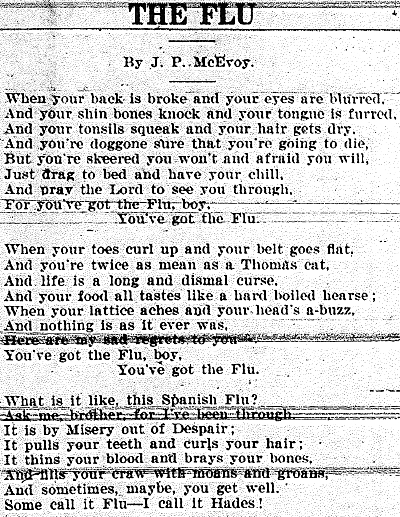
On the same page as Dr. Faulkner's statement, the News reprinted a poem by Joseph Patrick McEvoy, which tried to find some wry humor in the misery:

"The Flu"


Sources:
♦ "Influenza Still Rages." Hobart Gazette 13 Dec. 1918.
♦ "Local Drifts." Hobart Gazette 6 Dec. 1918; 13 Dec. 1918.
♦ McEvoy, J.P. "The Flu." Poem reprinted in Hobart News 12 Dec. 1918.
♦ "Notice to the Public." Hobart Gazette 13 Dec. 1918.
♦ "Notice to the Public." Hobart News 12 Dec. 1918.
♦ "Quarantine on Tight." Hobart Gazette 6 Dec. 1918.
♦ "Schools Closed Until Jan. 1 on Account Influenza Epidemic." Hobart News 5 Dec. 1918.
♦ "South of Deepriver." Hobart News 12 Dec. 1918.

Tuesday, November 29, 2011

A Second Wave

Patent medicine for flu 1918
(Click on image to enlarge)
A patent-medicine manufacturer tries to capitalize on the influenza epidemic, in this advertisement from the Hobart Gazette of Nov. 22, 1918.


George Sauter had the good fortune to be among the first 3,000 of Camp Custer's men, and the first of Hobart's soldiers, to be formally (and honorably) discharged from the service after the war's end. He came home on November 17. His army buddy, Fred Rose, Jr., remained at camp, hoping that he too would soon be a free man.

The town itself would soon be less free. The Spanish influenza had briefly receded, but now a second wave was bearing down. Over 30 new cases were reported on November 20 alone. Cautiously, Hobart's health officer, Dr. Clara Faulkner, re-imposed a partial quarantine, banning only "special meetings and dances." Schools, churches and "regular meetings" could operate as usual for the moment, but Dr. Faulkner pleaded with the townspeople to avoid crowds and to keep homes well ventilated and all public places clean. (Conditions were worse in Gary. There, schools and theaters had been closed again, the quarantine "tighter than ever.")

The Hobart town board had to postpone its regular semi-monthly meeting again — this time for lack of a quorum; too many members out with the flu. The newspapers' social columns became a litany of illness. Children, adults, whole families were laid low. Most recovered; some did not. Little Joseph Smelter died of influenza on his eighth birthday. Blanche Mellon died at 32 years of age, leaving a "truly heart broken" husband and six children — four of them sick with influenza. A 62-year-old woman, who some 20 year earlier had lived in Hobart, died of influenza at her home in Chicago, and was brought back to her former home for burial in the Hobart Cemetery.

As November drew to a close, the Gazette gave voice to a sense of helplessness: "Influenza has invaded dozens and dozens of homes in this vicinity during the past two weeks, and in instances every member of the family have been afflicted. It seems that few homes escape the disease this year, quarantine or no quarantine. No one seems to be immune. Whether one is careful or not careful, apparently makes no difference."

Thanksgiving was celebrated quietly.


Sources:
♦ 1910 Census.
♦ "Clamp Again Placed on All Special Meetings and Dances." Hobart News 21 Nov. 1918.
♦ "Death of Mrs. J.E. Mellon." Hobart Gazette 29 Nov. 1918.
♦ "Deaths." Hobart Gazette 29 Nov. 1918.
♦ "Local and Personal." Hobart News 21 Nov. 1918.
♦ "Local Drifts." Hobart Gazette 22 Nov. 1918.
♦ "People Must Be Careful." Hobart Gazette 22 Nov. 1918.
♦ "The Conditions Bad." Hobart Gazette 29 Nov. 1918.

Saturday, November 19, 2011

Unquarantined

At the end of October 1918 word came from Indianapolis that the capital was back to business as usual, having lifted its flu quarantine, and state authorities expected the quarantine could be lifted by the next weekend wherever local conditions allowed. Only 48 of Indiana's 92 counties had reported new influenza cases in the past week. Lake County had "been hit very hard with the epidemic," according to the Hobart News, "particularly Hammond, East Chicago and Indiana Harbor," but now even East Chicago planned to keep its schools, churches and places of amusement closed only through midnight on November 2. In Hobart, Dr. Clara Faulkner predicted that Hobart could do the same, as she had seen a fall-off in reports of new flu cases, though the Gazette commented that there was "still considerable sickness." Valparaiso was dealing with an outbreak of smallpox as well, but it had not spread to the Hobart area.

Dr. Faulkner's prediction was correct. On the morning of Sunday, November 3, churches were once again free to hold public services. Businesses were free to open again, and presumably the drugstores and ice-cream parlors could bring back their chairs and turn on their "electric pianos" again. On Monday morning, the schools re-opened, and those students and teachers well enough to attend had to start trying to catch up on four weeks' lost work.

If the epidemic seemed to be over, at least locally, the war effort was going full steam ahead. Dr. Dwight Mackey was well on his way to France; Edward Abel was to follow him. Stateside, George Wood left the village of Deep River, and George Smith (Sela Smith's son) left Hobart, both bound for southern aviation camps. Another four Hobart men were ordered to entrain for Camp Wadsworth at Spartansburg, South Carolina. George Sauter and Fred Rose, Jr. finally got to come home on leave from Camp Custer — but only 24 hours' leave.* It remained to be seen whether Herbert Hoover's prediction of another year of war would prove correct.

__________________________
*Perhaps that leave was the occasion of those three photos I posted earlier, since I now think the previously unidentified man with Fred Rose, Jr. was George Sauter.

Sources:
♦ "Boys Called to Service." Hobart Gazette 25 Oct. 1918.
♦ "Health Conditions Better." Hobart Gazette 1 Nov. 1918.
♦ "Influenza Epidemic Reported on Decrease Over the State." Hobart News 31 Oct. 1918.
♦ "Local and Personal." Hobart News 24 Oct. 1918.
♦ "Local Drifts." Hobart Gazette 25 Oct. 1918; 1 Nov. 1918; 8 Nov. 1918.

Thursday, November 17, 2011

Persistence

The Fourth Liberty Loan drive, drawing to its close in late October 1918, was a success. Lake County exceeded its quota by over $2 million; Hobart's quota had been $139,760, and its subscriptions amounted to $154,150 — this, in spite of the ravages that three previous Liberty Loan drives had wrought on local pocketbooks, and in spite of the influenza epidemic that had shut down public meetings throughout the state.

The flu was still spreading. Word came up from Indianapolis that health officials planned to extend the state quarantine until November 2. Hobart's health commissioner, Dr. Clara Faulkner, stated that while the disease had treated Hobart with unusual mildness, some 150 cases had been reported to her in less than a month. Dr. C.C. Brink said that he had treated 100 cases in the last two weeks, adding that he expected shortly to receive an order of anti-flu vaccine — useless, of course, but neither he nor his patients could know that.

Among the flu victims were six of Ross Graham's horses. Two died; the other four were expected to recover.

Human patients included Myrtle Guernsey, who lay ill at the Walter Blachly farm west of Ainsworth — she had returned from several months' stay in Montana just in time for the epidemic. West of Hobart, a delirious flu patient rose from his bed and wandered half-dressed around the neighborhood, brandishing a shotgun, until frightened neighbors sent for Marshal Fred Rose, Sr., who apparently got the man back to bed without violence. A 23-year-old employee in Charles Gruel's butcher shop fell ill with flu and was put to bed in the Gruel home where, in spite of the family's nursing, he died of pneumonia.

At Camp Custer in Michigan, the quarantine that had cancelled George Sauter's leave of absence did him no good: he caught the flu in camp. "For a few hours he was not expected to recover," said the Gazette, "but he did." Carl Halfman was not so fortunate — he died in camp of pneumonia on October 19, 23 years old, and not even two months a soldier; his remains were sent home for burial in the Turkey Creek cemetery. (The News soon reported that nearly 70 officers at Camp Custer were facing disciplinary action for carelessness or willful disregard of orders relating to the army's anti-epidemic measures.)

On October 25, Hobart lost a prominent and beloved figure: Jane Spray, who in her younger days had served as the town's postmistress for 17 years. While the News attributed her loss to the "heart trouble" from which she had suffered for several years, the Gazette (co-owned and edited by her brother-in-law) suggested that pneumonia developing from influenza had precipitated her death.

The following day, Dr. Faulkner — apparently troubled by the carelessness with which townspeople congregated in public places of refreshment — ordered local drugstores, soft-drink and ice-cream parlors to remove their chairs and shut off their "electric pianos." Furthermore, she warned, if in spite of such discomforts crowds persisted in gathering, she would close down those businesses altogether.

The October 24 issue of the News that carried the good news about the Liberty Loan drive and the bad news about the influenza epidemic also printed a statement attributed to Herbert Hoover, head of the U.S. Food Administration, who said, "There is no prospect of a proper ending of the war before the campaign of the summer of 1919."


Sources:
♦ "Closing Order May Hold For Another Week Is Report." Hobart News 24 Oct. 1918.
♦ "Dies of Pneumonia." Hobart Gazette 1 Nov. 1918.
♦ "Health Commissioner Issues Strict Closing Orders Last Saturday." Hobart News 31 Oct. 1918.
♦ "Hobart Goes Nicely Over Top in Fourth Liberty Loan Drive." Hobart News 24 Oct. 1918.
♦ "Hobart 'Over the Top.'" Hobart Gazette 25 Oct. 1918.
♦ Indiana Historical Commission. Indiana World War Records. Gold Star Honor Roll. A Record of Indiana Men and Women who died in the service of the United States and the Allied Nations in the World War. 1914 – 1918. Indianapolis: Indiana Historical Commission, 1921. http://books.google.com/books?id=OeMyAQAAIAAJ&l
♦ "Jane Eleanor Spray Passes Away Friday from Heart Trouble." Hobart News 31 Oct. 1918.
♦ "Jane Spray Passes Away." Hobart Gazette 1 Nov. 1918.
♦ "Kurt Seifert Passes Away at Midnight of Pneumonia." Hobart News 31 Oct. 1918.
♦ "Local and Personal." Hobart News 24 Oct. 1918; 31 Oct. 1918.
♦ "Local Drifts." Hobart Gazette 25 Oct. 1918.
♦ "Of General Interest." Hobart News 31 Oct. 1918.
♦ "The End of the War." Hobart News 24 Oct. 1918.

Sunday, October 23, 2011

Epidemic versus Patriotism

"The people of the United States were stark raving patriotic in summer 1918," says historian Alfred Crosby. "The interweaving of the war and the [Spanish influenza] pandemic make what from a distance of a half-century seems to be a pattern of complete insanity." Just as it became apparent that a highly contagious and uncommonly deadly disease was on the loose, massive crowds gathered in cities and towns across the country for Liberty Loan parades and other patriotic rallies and meetings.

Public health officials were caught between the needs of patriotism and the dangers of contagion, and patriotism generally won out. Chicago's Health Department allowed that city's Liberty Loan parade to take place, knowing full well that influenza would be among the crowds participating; to minimize the spread of disease, officials suggested that marchers "go home right afterwards, remove all clothing, rub the body dry, [and] take a laxative." Philadelphia's Bureau of Health knew by the third week of September that the epidemic was coming, and yet allowed a massive parade on September 28 that probably sparked the subsequent deadly explosion of influenza.

As for the ordinary citizens who marched, rallied, and canvassed door-to-door to sell Liberty Bonds, they seemed either oblivious to the danger or fearless of it — or perhaps the fear of appearing unpatriotic swept aside all other considerations.

Around Hobart a similar pattern played out on a much smaller scale, and with less deadly consequences. Though Hobart apparently did not host a Liberty Bond parade, we have already seen the Gazette, in the face of evidence that the influenza epidemic had reached town early in October, urging local patriots to go out in public for the sake of the Liberty Bond drive. Its attitude soon became even more reckless.

Just after midnight on Sunday, October 6, a report came over the wires that Germany, Austria and Turkey had signaled a willingness to enter peace negotiations based on President Wilson's "Fourteen Points." The news spread around town in the pre-dawn darkness, arousing a joyous, if slightly premature, belief that the war was at an end. By 4 a.m. the whole town was awakening to the blowing of factory whistles, the ringing of church bells and the random firing of handguns. People poured out of their houses and gathered downtown in the dawning light.

Someone thought to telephone over to Gary to confirm the news, and learned that that town was already "wild in celebration."

Around 8 a.m. an impromptu parade started up in Hobart, composed of "about 50 citizens, with drums, horns and various implements for noise-making," followed by perhaps a couple hundred marchers of all ages; they marched all around town during the morning. In the afternoon, Hobart's Company K organized a more formal parade, with its own band, some 500 other participants and countless spectators, that carried on for hours and did not disband until night had fallen, and "America" and "The Star-Spangled Banner" had been duly sung. Sometime during the afternoon, a dozen autos laden with merry-makers left Hobart for Crown Point to help the county seat celebrate.

From the point of view of public health, it was foolhardy behavior in the face of an epidemic. But one could hardly blame these war-weary people for being caught up in their enthusiasm in the hours just after the news broke.

On the other hand, the Gazette, a weekly paper, probably went to press on Thursday evening, so its editor had several days to weigh his words. And yet, in commenting on Sunday's celebrations, he came out with this: "Those who were not in sympathy with the peace offer either stood by or remained indoors, as did those who may have pro-German proclivities. It was not any time for a Kaiser sympathizer."

That opinion ran on the very same page with the Gazette's reprint of the standard advice for avoiding influenza, which included: "Avoid feeding or spreading of the disease. … Avoid crowds."

The schools and churches, the theaters and pool halls were closed; even the ladies of St. Bridget's Church had cancelled their little fund-raising bake sale out of health considerations; but here in black and white was an implication that anyone who had not willingly thrown himself into Sunday's crowds "may have pro-German proclivities." Apparently the Gazette was among those who had gone stark raving patriotic.


Sources:
♦ "Avoid Taking Influenza." Hobart Gazette 11 Oct. 1918.
♦ Crosby, Alfred W. America's Forgotten Epidemic: The Influenza of 1918. Cambridge: Cambridge University Press, 2003.
♦ "Hobart Celebrates Peace Offer." Hobart Gazette 11 Oct. 1918.
♦ "Hobart, Like Gary, Fell for the Peace Noise from Germany." Hobart News 10 Oct. 1918.
♦ "Local Drifts." Hobart Gazette 11 Oct. 1918.

Wednesday, October 19, 2011

"If Pneumonia Set In …"

A week after the first reports of Spanish influenza in and around Hobart, some 50 people had fallen ill with it. A week later, there were about 100 cases. (Among them was W.B. Owen, of brickyard fame; after several days of serious illness, he began to recover.) The whole force of the post office was out sick, except for Postmaster Kostbade himself. At the Pennsy depot, Agent Sayger struggled along with a depleted crew.

The Red Cross appealed to all nurses with any degree of training to help with nursing the sick.

By October 10 Indiana's Health Commissioner, Dr. J.E. Hurty — acting on a request by the federal government — ordered the closing of all places where people congregate, including schools and churches, theaters and pool halls. Worship services and public funerals were forbidden, along with all other public meetings. These measures, Dr. Hurty, insisted, were "wholly as a preventative against an epidemic."

The local newspapers ran advice for avoiding the contagion. Some of it was both sensible and effective (avoid crowds; stay at home if you feel sick), but some was useless (regulate your bodily functions, gargle with salt water, wear a mask). Dr. Hurty offered his own advice on how not to catch Spanish influenza: seek out fresh air, sunlight, exercise, clean surroundings, and avoid "the use of brushes and dusting"! That such an eminent doctor could offer such quaint advice is a reminder of the state of medicine in 1918.

Influenza was then widely and mistakenly thought to be caused by a bacillus. (While that was true of pneumonia, a common and sometimes deadly complication of Spanish influenza, the discovery of penicillin was a decade away, and the age of antibiotics would not come until the next world war.) A few late-19th-century experiments had demonstrated the existence of an infectious agent smaller than bacteria, but no one knew what that agent was or how it operated. No one had ever yet seen a virus: microscopes of that era were not powerful enough to capture those tiny, mysterious things. In the words of historian Alfred Crosby, researchers trying to find the cause of Spanish influenza "were in the position of looking for an invisible needle in a haystack crowded with visible needles and of not knowing that the visible needles were not what they were seeking."

And he is speaking of research conducted in the wake of the epidemic. At its height, overburdened doctors could do no more than hurry from one sickbed to the next, giving out words of reassurance and useless medicine. Those nurses called for by the Red Cross were the best remedy; again quoting Alfred Crosby: "Warm food, warm blankets, fresh air, and what nurses ironically called TLC — Tender Loving Care — to keep the patient alive until the disease passed away: that was the miracle drug of 1918."

♦    ♦    ♦

Ulric Blickensderfer left the little Ainsworth home where he had lived since 1903 for a visit to Chicago. There he caught influenza and died of pneumonia on October 5. His body was brought back to Hobart and buried in Crown Hill Cemetery beside his wife, Susan, who had died in 1911.*

From Chicago also came the sad news of the death of Florence "Flossie" Carey. Her family had spent several years farming southwest of Ainsworth before relocating near Wheeler, so she had grown up in the area. As a young woman she moved to Chicago and trained as a nurse, hiring herself out to work cases in private homes and, according to reports, becoming highly in demand among wealthy and prominent Chicagoans for her skill. Most recently, she had nursed a Catholic priest stricken with Spanish influenza. Just as he recovered, she fell ill. Her knowledge of the disease and its methods led her to remark that "if pneumonia set in she would never recover." She judged her last case correctly. Her parents brought her body home for burial in the McCool Cemetery.

Back in Ainsworth, August and Dora Maybaum heard from their son, Harold, late in September: he was now stationed at a training camp near London, England. The next news they had was of his death from pneumonia. That the newspapers could not agree on the date of his death may have been bad reporting, or may have reflected the disruption of the army's organization as the epidemic swept through its camps.

A couple days later, Bertha Bodamer left for Wheatfield, Indiana to attend the funeral of a nephew who had died of influenza at Camp Sherman in Ohio. Another nephew lay ill in a camp in Alabama.

___________________________
*The Blickensderfers can no longer be found there; either their remains were later moved, or their grave markers lost.


Sources:
♦ "Additional Local News." Hobart Gazette 27 Sept. 1918.
♦ Crosby, Alfred W. America's Forgotten Epidemic: The Influenza of 1918. Cambridge: Cambridge University Press, 2003.
♦ Davies, Pete. The Devil's Flu: The World's Deadliest Influenza Epidemic and the Scientific Hunt for the Virus That Caused It. New York: Henry Holt and Company, LLC, 2000.
♦ "Death of Florence M. Carey." Hobart Gazette 11 Oct. 1918.
♦ "Death of Harold Maybaum." Hobart Gazette 11 Oct. 1918.
♦ "Local and Personal." Hobart News 10 Oct. 1918; 17 Oct. 1918.
♦ "Local Drifts." Hobart Gazette 11 Oct. 1918; 18 Oct. 1918.
♦ "Mrs. Blickensderfer Dead." Hobart News 11 Nov. 1911.
♦ "Nurses Are Wanted For Red Cross Work." Hobart News 10 Oct. 1918.
♦ "Quarantine May Be Lifted Sunday." Hobart Gazette 18 Oct. 1918.
♦ "Schools and Public Places Closed." Hobart Gazette 11 Oct. 1918.
♦ "Schools to Be Closed Until Oct. 20 Is the Order Received Today." Hobart News 10 Oct. 1918.
♦ "Spanish Influenza Claims Miss Flossie Carey as a Victim." Hobart News 10 Oct. 1918.
♦ "Suggestions Regarding Influenza Epidemic." Hobart News 10 Oct. 1918.
♦ "Ulrick Blickensderfer Buried at Crown Hill Tuesday." Hobart News 10 Oct. 1918.
♦ Untitled obituary. Hobart Gazette 11 Oct. 1918.

Monday, October 17, 2011

Spanish Influenza

Local people who bought Chicago newspapers may have seen some mention of Spanish influenza in September 1918, but its first appearance in the Hobart papers came in early October with reports of the funeral of Arthur Wischmann. That young man had entered the military about four months earlier and was stationed at Fort Sheridan, north of Chicago, when he fell ill with influenza; pneumonia followed, and he died on September 27. His body was brought back to Hobart for a funeral with military honors, attended by some 30 members of Company K. At the request of his mother, who did not understand English, the Rev. E.R. Schuelke conducted the service in German.

The issues of the News and Gazette that reported on the funeral were strewn with evidence that Spanish influenza had become "almost epidemic" locally. Among the Hobart citizens stricken with it were Arthur Melin, William Halstead, William Wischman, Danny Shearer, Mrs. Henry Holler, Wilson and Walter Tolle, and Willard O. Halsted, who had been "quite sick" but now seemed to be mending. And those were just the ones who got into the social columns.

Dr. Clara Faulkner, as health commissioner, issued a plea to parents to keep influenza-stricken children out of school to avoid spreading the disease.

George Sauter and Fred Rose, Jr., tentmates at Camp Custer in Michigan, suffered indirectly from epidemic, as an army quarantine cancelled their leave and their planned visit home to Hobart.

The timing of the disease was most inconvenient: the fourth Liberty Loan drive had opened on September 28, and as we've seen, such drives involved door-to-door canvassing and massive public rallies. The News seemed to be trying to allay fear when it commented that the Spanish influenza was "the same old disease" that had sprung up every winter at various places around the nation for the past 30 years — only conceding that this time it took a "severe form." Meanwhile the Gazette positively urged its readers to go out: "Would you, Hobart citizen, like to have the 175 Hobart boys now in the service hear from home that they are not supported? … Go at once to the banks and do your full duty." Those who failed to subscribe for Liberty Bonds, it suggested, would be summoned to Crown Point to explain themselves to the Lake County Council of Defense.


Sources:
♦ "Bond Drive Still On." Hobart Gazette 4 Oct. 1918.
♦ "First Funeral of a Hobart Boy in Service Held Here Monday." Hobart Gazette 3 Oct. 1918.
♦ "Fourth Liberty Loan Drive." Hobart Gazette 23 Aug. 1918.
♦ "Hobart Soldier Boy Dies of Pneumonia." Hobart Gazette 4 Oct. 1918.
♦ "Local and Personal." Hobart News 3 Oct. 1918.
♦ "Local Drifts." Hobart Gazette 4 Oct. 1918.
♦ "School Children With Spanish Influenza Should Remain at Home." Hobart News 3 Oct. 1918.