Showing posts with label Hobart Cemetery. Show all posts

Friday, July 24, 2026

Dogs in Cemeteries

Today we have two tales of dogs in cemeteries.

The first comes from the "Local Drifts" column of the Hobart Gazette of February 22, 1924:
An incident of "dog faithfulness" is told of the pet dog of the late Wm. Kruse, who was buried Feb. 3 in the Hobart cemetery. The dog remains almost constantly upon the grave, departing only when forced to go to his master's late home for something to eat.
I previously wrote about William Kruse's death. I suppose it was the kind housekeeper, Emma Dunn, who was feeding the dog.

♦    ♦    ♦

The second dog in a cemetery came to my attention through a Facebook post by Michael White about one of his recent visits to some historical places in northwest Indiana. The post included some photos taken in Adams Cemetery, in Morgan Township, Porter County.

2026-07-24. Dog statuette in Adams Cemetery 01
(Click on images to enlarge)
Images courtesy of Michael White.


As a dog person, I was charmed by this little cast-stone canine, but also mystified: surely there could not be a dog buried in a human cemetery?

The dog statuette is near the grave of John B. Covert.

2026-07-24. Dog statuette in Adams Cemetery 02

That does not necessarily mean it has anything to do with Mr. Covert, or even that the statuette is now in the spot where it was originally placed.[1]

I went looking online for anything that could explain the presence of the dog. The only thing I could find involving both the Covert name and a dog is this story from the Valparaiso Vidette-Messenger of September 6, 1949:

2026-07-24. Valparaiso-Vidette-Messenger-September,6-1949-p-3
(Click on image to enlarge)

But, again, this canine WWII veteran could not be buried in the Adams Cemetery. Wilford Covert is not buried there, either; his grave is in Portland, Oregon.

Wilford and John Covert were cousins of some degree — Jeremiah Covert (1829-1906) was John's grandfather and Wilford's great-grandfather, if I'm reading the family trees on Ancestry.com correctly.

Maybe the Coverts in general were dog lovers. Maybe the statuette was indeed intended for John, to honor a beloved dog he had lost or left behind. Or maybe the statuette has wandered from its original placement and has nothing to do with the Coverts.

"Maybe" all kinds of things, right? I could sit here all day and think of possible explanations, and still not be close to the truth. I hope it has not been lost to time. I hope someone out there knows the story of this little sleeping dog.

_______________
[1] Recall my then-and-now post of the Chester Cemetery where in one case I could not produce a definite "now" because the arrangement of the old stones had seemingly changed so much since 1963.

Thursday, March 26, 2026

William Kruse, and Elusive Farms

On January 29, 1924, William Kruse died. His obituary tells us how the Kruse schoolhouse got its name.

2026-03-26. 1924-01-31 News, william kruse obit
(Click on image to enlarge)
Hobart News, 31 Jan. 1924. See also "Wm. Kruse Passes Away," Hobart Gazette, 1 Feb. 1924; "Hobart," Lake County Times (Hammond, Ind.), 2 Feb. 1924.


The only record we have of William owning a farm across from the Crown Hill Cemetery shows up in the 1891 Plat Book — his crossed-out name suggesting that he used to own 39.5 acres in Section 20, Twp. 36 N., Range 7 E. (a half-acre having gone to the school) …

2026-03-26. 1891 Sec. 20, Twp. 36 N, Range 7 E.
(Click on image to enlarge)

… but had sold it to Wm. H. Rifenburg.

Another connection between William Kruse and the schoolhouse turns up in a Hobart Township Trustee's account book entry dated July 23, 1890:

2026-03-26. HTTA1888-059 1890-07-23 Wm. Kruse - Hobart Twp. Trustee account ledger
(Click on image to enlarge)
Image courtesy of the Hobart Historical Society, Hobart, Indiana.


William received $75.50 for a "school house lot" and 8.5 days' labor. Probably $20-$30 of that was labor (if we can judge by the entry below him, where John North got $27.75 for 8 days' labor plus supplying his own team of horses). Since we know this school was in District #5, we can identify a few more entries relating to it: on August 2, P. (Philip?) Roper was paid $27 for 9 days' work by his team of horses (maybe himself as well); and the same day, William Rifenburg received over $400 for supplying lumber for the Districts 5 and 8 schoolhouses. All of this suggests to me that the Kruse schoolhouse was built in the summer of 1890. The Lake County records say it was built in 1925, but I believe that is an error.

♦    ♦    ♦

And now, let us speak of farms "near Ainsworth."

I was aware of a large farm southeast of Ainsworth that William Kruse bought sometime after 1891 and sold in 1913 to William and Vena Shults. But that is not the farm mentioned in the obituary.

Here is the 1870 Census showing the 13-year-old William Kruse and his siblings with their parents, Frederick and Johanna, in Ross Township:

2026-03-26. 1870 Census Kruse
(Click on image to enlarge)
Image from Ancestry.com.


Looking at the 1874 Plat Map, we don't find a farm owned by F. Kruse, but we do find one marked "F. Kruser":

2026-03-26. Kruser, Ross Twp. 1874
(Click on image to enlarge)

And we need only compare F. Kruser's neighbors on the map to Frederick Kruse's neighbors on the 1870 census to see that the map-maker just added an extra r to confuse future generations.

It's hard for me to imagine exactly where the Kruse house stood, as shown on the 1874 map — I have to imagine Hickory Top with no railroad, and to me the railroad seems as much a part of the landscape as the Deep River. And in 1874 Ainsworth Road still followed its original path. I don't suppose the 1874 map-maker was excruciatingly precise about the placement of the house, as he or she seems to place it in the part of the (present-day) horse pasture north of Ainsworth Road that is low and inclined to flood, and probably was the same way back then.

Here is the Kruse farm marked on the 1939 aerial photo (I'm not entirely sure I've got the boundaries right!):

2026-03-26. Kruse farm, 1939 aerial
(Click on image to enlarge)
Image from https://igws.iu.edu/ihapi/map/


The only structure on the property is the station built when the railroad came through in 1880. No trace remains of the old farmhouse, or cabin, or whatever it was. I do wonder if it might have been picked up and moved across the street, and is now hiding as one of the houses on the west side of S.R. 51 described by the county records as having been built in the 1890s. But there is no way of knowing that.

In 1917 when some of the Chester property was involved in an action to quiet title, one of the names involved was Frederick Kreuser. Which makes me ask myself if perhaps that was the original German spelling of their surname, and they decided that Kruse (which is a perfectly good German surname) seem more American? If so, they were remarkably committed to that one Americanization, since Frederick's grave marker, which is otherwise in German ("hier ruhet in Gott…") and gives his first name as Friedrich, sticks with the Kruse surname; so does Mrs. Kruse's. The other possibility is that — especially if the Kruses were not literate — someone else was writing down their name as they spoke it and imagined some extra letters in the German pronunciation of Kruse.

William shares a grave marker with his wife, Minnie, who died in 1897.

♦    ♦    ♦

Emma Dunn, who had looked after William and his family from shortly after Minnie Kruse's death, was also a German immigrant, born circa 1860. I can't trace her before the 1900 census, when she first appears in the Kruse household, widowed, as housekeeper. If I've found the right death certificate, she died in the "Lake County Poor Asylum" on February 1, 1936, and is buried — God knows where.

Wednesday, February 18, 2026

Love and Death at the Ainsworth Crossing

For Fred Ahrens, the 1920s started out with grief upon grief. In February 1920, he lost his mother to complications of influenza. In February 1921, his 38-year-old wife, Mollie, died of tuberculosis. Fred was left with a young daughter and son to raise. He moved into his widowed father's house, where his sister, Mary, could help with the children. His former home became a rental property.

In May of 1923, the house got a new tenant, a former Chicago resident named Catherine McManus. She had something in common with Fred: she too had lost a spouse and was raising a daughter and son on her own. Her husband, Matthew, had died in 1918. For a few years after her loss, Catherine had remained in Chicago, working as a waitress and taking in boarders to make ends meet.

Catherine probably was familiar with Hobart long before she moved there. Her married sister was a Hobart resident for some ten years before moving to Gary. Their mother, Carolina (Lena), had been one of the local Springmans by birth. Lena's first husband (Catherine's father) was Nicholas Semmer, whose parents had farmed in Ross Township in the mid-19th century before relocating to Chicago. Her second husband was Fred Maybaum. So Catherine had many local relations, and surely friends and acquaintances too. Fred Ahrens may have been among the latter.

He soon became something more. These two bereaved hearts found solace in each other. Catherine and Fred fell in love, decided to marry, and quietly told their family and friends of their decision.

Since the two of them were an item, it was natural for them to travel together to the surprise birthday party planned for Rollie Sizelove, an Ainsworth-area farmer, on the evening of January 9, 1924. They would drive south from Hobart on present-day State Road 51, cross the Grand Trunk tracks at Ainsworth, turn right onto Ainsworth Road to reach the Lincoln Highway, then west to Colorado and north to the Sizelove farm.

But their journey ended at the Ainsworth crossing.

2026-02-18. 1924-01-10 News, Fred Ahrens and Mrs. Catherine McManus Killed at Ainsworth
(Click on image to enlarge)
Hobart News, 10 Jan. 1924.


2026-02-18. 1924-01-11 Gazette, Two Hobart Citizens Killed
(Click on image to enlarge)
Hobart Gazette, 11 Jan. 1924.


There was no indication that Fred might have been trying to beat the train, as in the case of an earlier accident at this railroad crossing. It seems that he simply didn't notice it in time to react.

2026-02-18. 1924-01-17 News, Accidental Death Coroner's Verdict Ainsworth Tragedy
(Click on image to enlarge)
Hobart News, 17 Jan. 1924.


2026-02-18. 1924-01-18 Gazette, General News, inquest testimony about Ainsworth accident
(Click on image to enlarge)
"General News," Hobart Gazette, 18 Jan. 1924.


A double funeral for Fred and Catherine, held at the Evangelical Lutheran Church, was widely attended.[1] They were laid to rest in the Hobart Cemetery.[2]

The surviving family members thanked their friends and neighbors as one:

2026-02-18. 1924-01-17 News, Card of Thanks
(Click on image to enlarge)
Hobart News, 17 Jan. 1924.


The orphaned children all had relatives willing to give them a home:

2026-02-18. 1924-01-17 News, Local and Personal
(Click on image to enlarge)
"Local and Personal," Hobart News, 17 Jan. 1924.


_______________
[1] "Local Drifts," Hobart Gazette, 18 Jan. 1924.
[2] Catherine's grave is listed on findagrave.com and in the NWIGS's Hobart Township Cemeteries. Fred's grave does not appear in either source; nor does his wife's (Mollie).

Sunday, November 9, 2025

Maria Amanda Harvey Castle Lathrop

This obituary appeared in the Hobart Gazette of December 18, 1896:
Maria Amanda, wife of Samuel Lathrop, one of Ross township's oldest and well-known citizens, died at her home[1] about 2½ miles south of Hobart at 4 o'clock Wednesday afternoon, Dec. 16th, aged nearly 80 years. While Mrs. Lathrop had suffered more or less for the past ten years from heart difficulties her general health of late had been reasonably good for a person of her age and on the day of her death she had been about her home as usual.

The deceased was born in Vermont in February, 1817. By a former husband she was the mother of four children, sons, Lucius, Harrison A., Jackson and A[dmiral] R[odney] Castle, and by her marriage with Mr. Lathrop she was the mother of two sons, Charley and George, all of whom survive her.

The funeral services will be conducted at her late home this afternoon (Friday) at one o'clock and the interment will occur at the Hobart cemetery.
Poor Lysander Castle: he never got his own obituary, and here he's not even named — just "a former husband."

Maria probably placed the monument on his grave. I believe it was placed there before 1895, when the partners making up Kelly and Son both died, as we learn from helpful information posted to findagrave.com. I do not know when the firm started its business. The 1880 Census shows George Kelly as a farmer, and David as a farm laborer. The earliest reference to the firm I can find in the on-line newspapers comes from the Hobart Gazette of August 7, 1890:

2025-11-09. Hobart Gazette, August 7, 1890, p. 5
(Click on image to enlarge)

_______________
[1] The home where she died is still standing, though severely neglected, on the south bank of the Deep River, overlooking S.R. 51.

Friday, November 29, 2024

Bruce Mitchell Times Two

This postcard is postmarked 1955:

2024-11-29. Mitchell's sporting goods 01
(Click on images to enlarge)

2024-11-29. Mitchell's sporting goods 02

It introduces us to a father-and-son team of entrepreneurs who operated businesses in Hobart for some three decades. They sold a whole lot more than sporting goods, as we are told by this advertising flyer bound into the Classifieds section of the 1952-53 Hobart directory:[1]

2024-11-29. Mitchell's advertising insert in 1952-53 Hobart directory
(Click on image to enlarge)
Image courtesy of the Hobart Historical Society, Hobart, Indiana.


Wellington Bruce Mitchell was the father, and Thomas Bruce Mitchell the son. The father usually went by "W.B."; the son almost always went by his middle name.

According to W.B.'s obituary, their business connection to Hobart started in 1932.

2024-11-29. 1964-12-22, Deaths, Mitchell Rites (Wellington Bruce), Vidette-Messenger (Valparaiso, Ind.), p. 6
(Click on image to enlarge)
"Deaths," Vidette-Messenger (Valparaiso, Ind.), 22 Dec. 1964.


But their emotional connection to Hobart started even earlier. In April 1910 W.B. married Mary Blaemire (Cook County, Illinois, Marriages Index), a daughter of William and Isabell Blaemire,[2] who were Hobart residents as early as the 1880 Census, and who are now buried in Hobart Cemetery.

The 1910 Census, taken a couple of weeks before his wedding, recorded W.B. living with his parents in Chicago's Ward 8 — the furthest southeastern part of Chicago, bordering on Indiana. W.B. and his father both worked in steel mills.

W.B.'s draft card, filled out June 1917, stated that he and Mary, with their two children (the youngest being Thomas Bruce), lived in southeast Chicago while he commuted to a job in Gary, Indiana. Three years later, per the 1920 Census, they still lived in the same area, W.B. working as a millwright at an unnamed construction company.

In July 1929 we find this little personal item about the family in a south Chicago newspaper's social column: "Mr. and Mrs. Wellington Bruce Mitchell and their children, 7842 Paxton ave., left last week for a visit to their summer home at Hobart, Ind."[3] Their owning a summer home implies a fairly comfortable financial situation. In the 1930 Census, W.B. described himself as a self-employed real estate broker who owned his residence in south Chicago.

Two years after that, as we know, the family moved to Hobart. We start to find directory listings for them in the 1936-37 directory,[4] which shows them renting the house at 769 E. Third Street. We are told that W.B. is a merchant with a business called Hobart Paint & Glass, but there is no separate listing for that business. It was probably operating out of the Guyer Building, where the old-timers in 1979 remembered it, and where it was listed in the October 1940 directory.[5] A slightly later directory, for 1940-41,[6] showed Mitchell's Hobart Service Supply Co. (listed under "Paint Dealers") at 151 Illinois Street.[7]

In 1938 Thomas Bruce Mitchell got married.

2024-11-29. 1938-09-26, Hobart, The Hammond Times, p. 12
(Click on image to enlarge)
"Hobart," Hammond Times, 26 Sept. 1938.


The two Mitchell families set up separate households near each other on Kelly Street. Bruce (Jr.) worked in his father's stored; W.B. described himself as the owner of a lumber company (1940 Census) and a building contractor (1940-41 directory).

The sporting goods business makes its first appearance in Hobart's January 1946 directory,[8] with "Mitchell's" at 151 Illinois Street being listed in the Classified section under "Sporting Goods — Retail." The same business at the same address is also listed under "Hardware Stores" and "Paint — Retail." Under the latter heading we also find Hobart Paint & Glass at the same address. All these businesses shared one phone number: Hobart-75. In 1949, according to a photocopied newspaper article in the Hobart Historical Society museum files, a Mitchell appliance store was opened[9] (possibly at 225 Center Street, as listed in the 1952-53 directory insert posted above).

In the 1950 Census, W.B. is described as a "proprietor" in the "retail lumber & coal" industry, while Bruce is likewise a "proprietor," in the "retail sporting goods" industry.

As we already learned from his obituary, W.B. retired from business in 1952.

The 1956 directory[10] has a listing only for "Mitchell Bruce Sports" [sic] — no indication that any of the lumber, paint, or hardware business continued. But the Hobart Historical Society's file contains a photocopied newspaper article from 1957 about the "grand opening of Mitchell's Hardware store in its new location at 225 Center St."[11]

In 1962[12] Mitchell's of Hobart was operating at 151 Illinois. By 1968[13] it had moved across the street to 154 Illinois. That was the year of Thomas Bruce Mitchell's death, and, so far as I can tell, the end of the Mitchell business empire in Hobart. The 1970 directory has no business listings for any Mitchell business, and Bruce's widow, Loretta, is listed in Ogden Dunes.[14]

Bruce and Loretta (who died in 2005) are buried in Mosier Cemetery.

♦    ♦    ♦

As for the recipient of our postcard, Lloyd Schroeder — he lived a long, eventful life and now rests in Valparaiso.

_______________
[1] 1952 — Directory — 1953 (Hobart – Wheeler – New Chicago – Ainsworth – Green Acres – Deep River – South Hobart Twp. – South Portage Twp.), published by Advance-News, Nappanee, Indiana (copy at the Hobart Historical Society museum).
[2] Indiana Death Certificates.
[3] "Personals," Southtown Economist (Chicago, Ill.), 19 July 1929.
[4] City Directory/Hobart, Ind./1936-37 ["Compiled by House-to-House Canvas"]. 1936: Mrs. Sherlock Hope (copy at the Hobart Historical Society museum).
[5] Hobart/Chesterton/East Gary/Kouts/Ogden Dunes/Valparaiso/Wheeler. Indiana Associated Telephone Corporation, October 1940 (copy at the Hobart Historical Society museum).
[6] City Directory/Hobart, Indiana/1940 – 1941 (copy at the Hobart Historical Society museum).
[7] Per the county records, the gas station now on that site was built in 1979. I have not been able to find any bird's-eye or aerial views showing whatever buildings may have been there before 1979.
[8] Valparaiso/Chesterton/East Gary/Hobart/Kouts/Ogden Dunes/Wheeler. Indiana Associated Telephone Corporation, January 1946 (copy at the Hobart Historical Society museum).
[9] "Mitchell's To Hold Grand Opening Of New Appliance Center On Saturday, Oct. 1," Hobart Gazette, 15 Sept. 1949.
[10] Robinson's Hobart, Indiana City Directory. George C. Robinson Directory Service (Hillsdale, Mich.), 1956 (copy at the Hobart Historical Society museum).
[11] "Many Prizes Awarded at Grand Opening of Mitchell's Hardware," Hobart Gazette, 28 Mar. 1957.
[12] Polk's Hobart (Lake County, Ind.) City Directory 1962. R.L. Polk & Co. (Detroit, Mich.).
[13] Polk's Hobart (Lake County, Ind.) City Directory 1968. R.L. Polk & Co. (Detroit, Mich.) (copy at the Hobart Historical Society museum).
[14] Polk's Hobart (Lake County, Ind.) City Directory 1970. R.L. Polk & Co. (Detroit, Mich.) (copy at the Hobart Historical Society museum).

Wednesday, October 25, 2023

Good Old Reliable LaVerne

Since he was mentioned in the brick house article, I just wanted to take a look at LaVerne Manteuffel and the long-time Hobart business he was associated with.

2023-10-25. 1922 Aurora
(Click on image to enlarge)
From Hobart High School's annual, the Aurora, 1922.


LaVerne Paul Manteuffel was born in 1905 in Hobart, to William Paul and Emilie Manteuffel. Emilie was a widow and a business owner when she married Paul (he often went by his middle name) in 1898.

Her first husband, Herman Carl Piske, had been born in Prussia around 1858, and came to the U.S. with his family around 1868. The Piske family shows up in North Township, Lake County, Indiana (probably Tolleston, as we shall see from a later source) in the 1870 Census. By 1880, Herman was on his own, living in a Chicago boarding house and working as a shoemaker (1880 Census).

In September 1880 Herman married Bertha Boldt in Lake County, Indiana. Her family had also immigrated from Prussia and settled in North Township (1870 Census),[1] so perhaps the young people had met each other there.

Around the time of his marriage, Herman opened a shoe store in Hobart, called the "Reliable Boot & Shoe Store." I do not know how much time passed before the word "Old" started appearing before "Reliable."

In 1885 Bertha gave birth to a daughter, Clara. Not long afterward Bertha died. I suppose Herman's relatives stepped up to help him with the baby.

In May 1886, Herman married Emilie Voigt. She, like Herman and his first wife, came from a German immigrant family, possibly also Tolleston residents.[2] Her 1956 obituary (see below) says that she became a Hobart resident in 1884.

Herman and Emilie had two children: Elsa (b. 1888) and Walter (b. 1890). Herman continued operating the boot and shoe store, probably with considerable help from Emilie.

Here is an undated photo of the Piske store.

2023-10-25. Piske shoe store (undated)
(Click on image to enlarge)
Image courtesy of the Hobart Historical Society, Hobart, Indiana.


Although no one in the photo is identified, I suppose that's Herman and Emilie standing in the doorway.[3] The children may be Clara, Elsa, and Walter. Judging by the cut of Emilie's dress (and, if the little boy is Walter, his apparent age), I would guess the photo was taken around 1893-4.

At that time, I believe the store stood at 313 Main Street, a building known as the Stocker Block.[4]

In 1895, Herman died.

2023-10-25. Piske, H.C. obit, Hobart Gazette, 1895-10-18
(Click on image to enlarge)
Hobart Gazette, 18 Oct. 1895.


Emilie took over operating the Old Reliable herself.

In the spring of 1896 came the death of her only son, Walter, as described in this story from the Hobart Gazette of May 22, 1896, titled, "Scarlet Fever."
One day last week Mrs. H.C. Piske's little girls were taken sick and in time it was discovered that they had a light type of scarlet fever. On Friday her little boy about 7 years old was taken with it and became much worse than his sisters. On Monday evening about 8 o'clock the little fellow breathed his last.

Owing to the nature of the disease his body was buried on Tuesday and no funeral services were held except at the house where Rev. Schuelke spoke words of good cheer to the family and friends. His death is extremely sad and our citizens sympathize with the mother in the hours of her bereavement.
On April 1, 1898, as I've mentioned, Emilie married Paul Manteuffel, another German immigrant.[5]

Any attempt to sketch out Paul Manteuffel's history is complicated by the fact that there were two local Paul Manteuffels. They were cousins. Their fathers were brothers, Julius and Louis Manteuffel, who married two sisters, Auguste and Hermine Poppe.[6] Louis and Hermine Manteuffel lived in East Gary (Lake Station), and their Paul — sometimes called "Paul C." or "P.C." — eventually moved to Chicago. In cases where those details are included in a newspaper report about a Paul Manteuffel, I'm able to tell the East Gary/Chicago one from the Hobart one, but they are not always included, so I'm not always sure I'm talking about the right Paul.

As for Hobart's Paul Manteuffel — it appears that he did not join with Emilie in operating the Old Reliable: he had other occupations. In 1897 he had begun operating a saloon in the basement of the Hobart House, and continued in that business for several years.[7] In 1903, we find him filling in for the town's ailing night watchman.[8] Around 1904 he started working at Aetna, possibly at the munitions factory.[9] When the 1910 census was taken in April, Paul was working at a brickyard, but in May he took a position as "night foreman at the [Hobart] water and light plant."[10] By 1920 he was again working at the brickyard, and that is the last information I have about his occupations.

In May 1899, Emilie gave birth to a daughter, Evelyn.

Sometime after the 1900 census, Clara Piske left her stepmother's home. By 1904 she was described as "Miss Clara Piske of Chicago" when she came back to Hobart for a visit.[11] Beyond that, I have not been able to find any information about her.

Late in March 1905, the Manteuffels rented the "Gordon brick": 332-334 Main Street, known to us today as the former location of the Bright Spot restaurant. They moved the Old Reliable into the first floor, while the family occupied living quarters behind the store, and/or upstairs.[12]

In May of that year, Emilie gave birth to a son, LaVerne Paul — her last child.

The 1910 Census shows Emilie operating the shoe store while Paul worked in the brickyard. Elsa Piske, 22 years old, worked as a post-office clerk. In January 1918, Elsa married Allen Mummery (Indiana Marriage Collection). The two of them would be lifelong Hobart residents.

By the 1920 Census, Evelyn Manteuffel, at 20 years of age, was working as a "saleslady" in a "store": I suspect it was her mother's shoe store, as the early 1920s newspapers report several instances of her attending National Shoe Retailers' association conventions in Chicago with her mother.[13] Her brother, LaVerne, upon receiving his high-school diploma in 1922, also made the Old Reliable his full-time job.

Evelyn married Walter Boal in 1926[14] and became a stay-at-home wife.

In 1929, William Paul Manteuffel died — that is to say, there is a stone in Hobart Cemetery with his name and "1929" carved on it. But I have not been able to find a word about his death in the Hobart Gazette, nor can I find his death certificate on Ancestry.com. (I have found a record of a Paul Manteuffel dying in Cook County, Illinois, in April 1929, but the record doesn't include enough information to determine whether it was this Paul.) In the 1930 Census, the enumerator describes Emilie as married, which could simply be an error. The 1940 Census describes her as widowed. A search of Indiana and Illinois newspapers available online doesn't turn up any relevant Manteuffel death notices. I am going to have to do some more reading of microfilm.

Emilie carried on with the Old Reliable business. It earned enough money that in 1936 she was able to buy the building it occupied.[15]

The family suffered a tragedy in 1937, when Evelyn Manteuffel Boal died of cancer just short of her 38th birthday. She had no children.

In July 1939, Emilie sold the Old Reliable business to LaVerne and announced her retirement. The following November, LaVerne married Leotta Flick.

2023-10-25. 1939-11-27, The Hammond Times, Hobart -- Flick-Manteuffel
(Click on image to enlarge)
Hammond Times, 27 Nov. 1939.


Leotta had a lovely singing voice, it seems: she was a church soloist and often sang at weddings, funerals, and other social occasions. In the 1940s she was repeatedly elected director of a local choral club.[16] She and LaVerne had two children: Marvin (b. 1941) and Dorothy (b. 1947).

1956 was the year everything changed. On May 14 Emilie died.

2023-10-25. 1956-05-17 Gazette, Manteuffel Rites To Be Held This Friday
(Click on image to enlarge)
Hobart Gazette, 17 May 1956.


And in August, LaVerne closed the doors of the Old Reliable Boot & Shoe Store forever.

2023-10-25. 1956-08-09 Gazette, Manteuffel Store To Close Doors  This Week
(Click on image to enlarge)
Hobart Gazette, 9 Aug. 1956.


I think we can attribute the "81 years" and the "1875" in this article to the mutability of memory and oral history. The writer didn't have the 1880 Chicago census at hand.


LaVerne died in 1983.

2023-10-25. 1983-01-19 Gazette, LaVerne P. Manteuffel
(Click on image to enlarge)
Hobart Gazette, 19 Jan. 1983.


His daughter wrote this touching tribute to him:

2023-10-25. 1983-02-09 Gazette, In Memoriam (Paul Manteuffe)
(Click on image to enlarge)
Hobart Gazette, 9 Feb. 1983.


A garden still grows around his former home, 465 East 8th Street, but I don't know if any of it is LaVerne's work.

And if you'd like to learn how to play "the bones," there's a cute tutorial here.

♦    ♦    ♦

In conclusion, I would like to post two ads I found interesting.

The first is from the Hobart Gazette of October 31, 1889:

2023-10-25. Hobart-Gazette-October,31-1889-p-4
(Click on image to enlarge)

Per the old-timers' memories collected in 1979, B.W. Strattan did once operate a "general merchandise store" in the Strattan building. The second door south of that would be on the west side of Main Street. Thus perhaps the Gazette was correct in 1905 when it said that the store had been located on the east side of the street only from around 1894 (see footnote 12). (Also, Herman's initials in this ad are "C.H." instead of "H.C." as in the photograph of the store posted above.)

This ad, from the Gazette of April 7, 1910, is mystifying.

2023-10-25. Hobart-News-April,7-1910-p-5
(Click on image to enlarge)

218 Main is now the Ben Ack Building, but in 1910 only a frame house stood there.

_______________
[1] Her brother, William, married Mary Sullivan.
[2] Both of her parents were born in Germany: John/Johann (b. 1829) and Ernestine/Ernstena (b. 1827). The family came to the U.S. in 1874 or 1875 (as reported by Emilie in the 1910 and 1920 censuses). As of 1896, her parents lived in Tolleston ("Local Drifts," Hobart Gazette, 8 May 1896), and they died there within a decade — Ernestine in 1903 and John in 1905). But I have not been able to find them in any census.
[3] I have no idea who the guy lounging under the awning at left is. Note his sleeve protectors, which were often worn by storekeepers, bank tellers, bookkeepers, and even bartenders.
[4] The history of the store's location is a bit confused and has to be inferred from newspaper articles that don't mention addresses, oral histories that don't mention dates, and anonymous handwritten notes on the back of photographs in the Hobart Historical Society files.
[5] He was a son of Julius Manteuffel.
[6] "Local Drifts," Hobart Gazette, 2 Feb. 1917.
[7] "Application for License," Hobart Gazette, 5 Feb. 1897; "Local Drifts," Hobart Gazette, 5 Mar. 1897; 1900 Census.
[8] "Local Drifts, Hobart Gazette, 1 May 1903.
[9] "Local Drifts," Hobart Gazette, 18 Nov. 1904.
[10] "Local Drifts," Hobart Gazette, 6 May 1910.
[11] "Local Drifts," Hobart Gazette, 27 May 1904.
[12] "Local Drifts," Hobart Gazette, 17 Mar. 1905 and 31 Mar. 1905. The March 17 item mentioned that the shoe store had been in the Stocker Block location (313 Main) for the past eleven years, which would take us back to 1894. If this is not an error, it suggests that the original ca.-1880 store was in yet a different location.
[13] See, e.g., "Local and Personal," Hobart News, 21 Feb. 1921; "Local Drifts," Hobart Gazette, 22 Feb. 1922.
[14] He was a carpenter and helped to build the house at 5501 S. Liverpool Road.
[15] "Hobart," The Hammond Times, 5 Feb. 1936.
[16] "Leota Manteuffel to Direct Choral Club," Hobart Gazette, 27 Sept. 1945.

Tuesday, June 20, 2023

Fannie Wheeler Smith

I have been meaning to post this ever since I wrote about Frank and B.E. Smith.

This is the obituary of their mother, Fannie Wheeler Smith.

2023-06-20. Fannie Wheeler Smith obit, Hobart Gazette, 9-22-1899
(Click on image to enlarge)
Hobart Gazette, 22 Sept. 1899.


I never cease to marvel at how much people traveled in the days when traveling was hard, slow, and miserable.

Fannie's husband, Henry, may have been fairly comfortable financially, if he handled his mill earnings and his Gold Rush money wisely, so perhaps when he died in 1856, he did not leave her in dire financial straits with four young children (or three children and a pregnancy). Nonetheless, the 1860 Census shows her working as a seamstress. By the summer of 1866, as we learn from B.B. Bale's obituary, she and her eldest surviving son, Frank, were operating a hotel together (although the article about the Bales' 60th wedding anniversary describes it as a "small boarding house").

The 1870 Census lists Fannie's occupation as "keeping house." She had only one minor child still at home, but also her 23-year-old daughter, Mariam Brock — who may have been widowed by then — and a little granddaughter. Still, it seems she no longer felt the need to earn money.

As I've mentioned before, I can't find her in the 1880 Census.

I do not know Fannie's middle name. If it began with E., her grave in Hobart Cemetery is marked. If not, then, apparently, it isn't.

Incidentally, Fannie's surviving sister, Mrs. M.H. Earle of Pasadena, was the divorced first wife of John Earle (George's son). They had been married in Lake County on April 12, 1854. I do not know when they were divorced.

♦    ♦    ♦

While I'm at it, here is the obituary of Mariam Smith Brock from the Hobart Gazette of November 6, 1909.

2023-06-20. Mariam Smith Brock obituary, Hobart Gazette, 6 Nov. 1909
(Click on image to enlarge)

Subtract 37 from 1909 and you get 1872 as the year her husband died; however, the writer did say "about thirty-seven years," so it's possible she was widowed when the 1870 Census recorded her living with her mother. I haven't been able to locate any record of John Brock's death.

Mariam was laid to rest beside her mother, says the article, and the NWIGS' book of Hobart Township cemetery listings records M.N. Brock next to F.E. Smith in row W4 of Hobart Cemetery. Neither stone has any information about birth or death or anything else.

♦    ♦    ♦

7/5/2023 update — Thanks to Suzi at the Hobart Historical Society for finding Fannie and Mariam in the 1880 census:

2023-06-20. 1880 Census - Fannie Smith, Mariam Brock
(Click on image to enlarge)
Image from Ancestry.com.


Fannie kept house, while Mariam worked as a dressmaker. Mariam now has a seven-year-old son as well as a daughter, so perhaps I was wrong in guessing that she had been widowed by 1870.

Thursday, January 5, 2023

Letters to Fonso

It's 1897, and B.E. Smith has left Hobart to work as a teamster in Chicago. His older brother, Frank, remains in Hobart, dealing in groceries and writing business-like letters to B.E.

2023-01-05. Smith, Frank J. to B.E. Smith 1897 1
(Click on images to enlarge)

2023-01-05. Smith, Frank J. to B.E. Smith 1897 2

The first is dated January 2th, 1897.

Fonso I shiped you 27 bush & 30 lbs at 22 per bush. You can get it Thursday & be shure & send the bags rite back & you speak a bout sum Potatoes if they are good you can send a Baral & I would like a barel of good onions & a baral box of good celery if good & cheap but don't want no frosen stock but if you can't send them as well as not let them go but if you can send them send them rite a way & if you want more corn send sacks & I will try & get sum more
Yours Resp[ectfully] F. Smith
If you could send Bbl of parsnips
The second is undated, but seems to involve the same 27 bushels, along with some advice about how B.E. should feed his horses:
Fonso I Paid the freight 144 [illegible scrawl]
If you ar feading oates be carfal in changing fead a little corn with the oate & salt well un till they get youst to the corn
Now if you can get me sum Potatos & sum good onions & sum good celer[y] jest as well as not & [illegible] or Rhodab Rhudabages they are jest the same to me
27 B 30# at 22 X  604
freight                    144
                                 748

That make the corn stand you a bout 27 per Bushul then let me no what it is worth then [or "there"?] is there ena [any?] saven [or "sance"?] in it
Cr BE S. 3.50
I will try to interpret these: Frank has sent Fonso 27 bushels plus 30 pounds of corn at 22 cents per bushel. He has shipped the corn in sacks and wants his sacks back right away. At least some of the corn is for Fonso's horses (he's a teamster, remember?); Frank is concerned that if Fonso has been feeding his horses oats, the sudden switch to corn will upset their stomachs, so he advises mixing the corn gradually into the oats.

Apparently Fonso, up in Chicago, is able to scout out good produce in the various wholesale markets, so Frank wants him to send a barrel of potatoes, a barrel of onions, and a box of celery, so long as it's not frozen (which was a possibility in January[1]). Oh, and a barrel of parsnips. Also, some [illegible] or some rutabagas; Frank doesn't care, [illegible] and rutabagas are just the same as far as he's concerned. (Part of the [illegible] looks like "bananas" to me, but in what universe are rutabagas and bananas just the same to anyone?)

All these barrels of potatoes, etc., would be resold in Hobart, I'm guessing.

The "and Son" part of this business was probably Frank's son, Henry Sylvester (born ca. 1879 and named for his grandfather).

♦    ♦    ♦

Frank's obituary, printed in the Hobart Gazette of January 21, 1927, gives some of the family history going back to Hobart's earliest days.

2023-01-05. Death of Hobart's Oldest Pioneer, Gazette, 01-21-1927
(Click on image to enlarge)

This part about Frank's father is interesting:
Henry S. and Fannie (Wheeler) Smith, natives of Pennsylvania, … emigrated to Ohio and later to Michigan in pioneer days. Mr. Smith visited City West as early as 1838, where he became a great friend of the Indians and learned their language, ways, customs and desires. The Smiths and the Wheelers came to Hobart together and were active in its early growth. This pioneer Smith built the first sawmill for the late George Earle and also the first gristmill which gave service to the community in those early days. When the Mexican War broke out, Mr. Smith became an Indian interpreter for the government and was with Gen. Freemont [sic] in the west. He later entered the gold rush to California but soon returned to Hobart where he died Aug. 5, 1856.
Henry Sylvester Smith is buried in the Old Settlers Cemetery.

It's also interesting that Frank's older brother, Charlie, was probably the first fatality of the Hobart sawmill. That accident would have occurred in 1846 if Frank was then two years old. I do not know where young Charlie is buried.

Nor do I know where Frank's three wives are buried. We know from the obituary that Clara Loague Smith died in 1913 and her death certificate states that she was buried in Hobart, but I can't find a record of her grave. Harriet Ferrin Smith died of tuberculosis on February 6, 1887, [2] but again I can't find a grave. In the case of the first wife, Rosana Eastwood Smith, I don't even know when she died.

As a Civil War veteran, Frank lies beneath a military marker that has nothing to say about his birth or death, only his service.

I've identified only five of the seven children that the obituary attributes to Frank. One was Almantha Smith Bullock, born ca. 1882. The others are Henry Sylvester (b. ca. 1879, as mentioned above), Eugene (ca. 1884), Charles (ca. 1897), and Loleta Smith Havrilla (ca. 1901).

_______________
[1] To be perfectly honest, I don't know how they would prevent freezing during winter shipping in 1897. I'm profoundly ignorant of how wholesale produce was handled in Chicago in 1897.
[2] "Hobart Items," Crown Point Register, 10 Feb. 1887.


Tuesday, November 29, 2022

Alphonso Smith by Any Other Name

Let's take another look at those statements of account from my last post.

2022-11-04 Bale coal merchant papers 3a

(Reverse of the above:)

2022-11-04 Bale coal merchant papers 3b (verso)

2022-11-04 Bale coal merchant papers 4

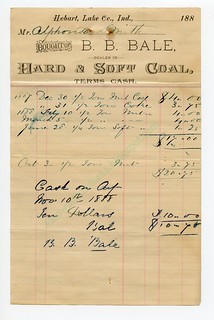
Who (you might ask) was that Alphonso Smith guy who bought all that coal from B.B. Bale?

Searching on that name in that place on Ancestry.com brings up only one record: the 1870 Census, where he's a boy of 14 living in the household of Fanny Smith, in Hobart.

2022-11-29. 1870 census - Alphonso Smith
(Click on image to enlarge)
Image from Ancestry.com.


This census did not record how household members were related to each other. It didn't take me long to find out that Mariam Brock was Fannie's daughter, and Carrie Brock her granddaughter. But no other records places Alphonso and Fannie together in one household.

However, in the 1860 Census, Fannie's household includes a boy named Bernett who was then four years old — born the same year as the 1870 Alphonso. Once we assume they are the one and the same, it becomes easier to find this coal-purchasing guy. He was Bernett Elfonso Smith — and yes, it seems he spelled his middle name with an E; only when other people are writing it does the A appear.[1]

I think it was he who signed that promissory note to B.B. Bale:

2022-11-04 Bale coal merchant papers 2

Part of the signature was lost, but you can see the E plainly enough.

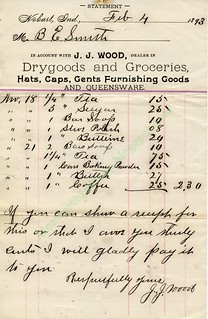
Bernett Elfonso was born to Henry and Fanny (Wheeler) Smith circa 1856. That was probably the same year his father died. His parents were in Porter County for the 1850 Census, but by 1860, as we've seen, the family moved to Hobart. There the widowed Fanny raised her children and spent the rest of her life. Although I can't find the family in the 1880 Census,[2] the Bale coal accounts place him there in the late 1880s, and the promissory note in 1892. And here we have another receipt placing him in Hobart in 1893 — buying some groceries and household goods from John Wood.

2022-11-29. J.J. Wood receipt to B.E. Smith 1893
(Click on image to enlarge)

Notwithstanding these appearances in Hobart, it seems that Bernett Elfonso also spent time in Illinois, probably Chicago: in 1888 he married Helen Brown in Cook County, and by 1900 they were living in Chicago with their young daughter, Sarah. At that time B.E. worked as a teamster.

But sometime after 1900 the family moved to California. The 1910 Census shows them in Pasadena (B.E. working as an "investigator" for a gas and electric company), and the 1920 Census shows B.E. and his wife farming in Fresno County (their daughter having moved out of the house and married). On May 30, 1929, B.E. Smith died in Fresno.[3]

2022-11-29. Smith, B.E. - death notice - The_Fresno_Morning_Republican_1929_06_03_page_3
(Click on image to enlarge)
Fresno Morning Republican, 3 June 1929.


♦    ♦    ♦

Having found that last death notice, I thought I had settled the whole life of Bernett Elfonso Smith, so you can imagine my confusion when I came across this obituary in the Hobart Gazette of October 29, 1942:

2022-11-29. Rites for B.E. Smith Held Tuesday, Hobart Gazette, 10-29-1942
(Click on image to enlarge)

Could there possibly be two Bernett Elfonso Smiths in Hobart's history? Unlikely as it seems, the answer is yes. The one who died in 1942 was the nephew of the one who died in 1929: the son of his elder brother, George.


_______________
[1] In the Union Sunday School record book that begins in 1868, a scholar named "Burnett" and one named "Alphonso" are (or is) recorded, although the actual dates of attendance are unclear.
[2] The 1880 census of Hobart is very hard to read, so the name could easily be mistranscribed; but I have looked through all 30 pages of it on Ancestry.com without being able to find Fannie or Bernett Elfonso — only her son/his brother, Frank Smith.
[3] The commercial papers in this post and my previous post about B.B. Bale (as well as another post to come) all came from a seller in Fresno.

Friday, November 4, 2022

Hobart's First Coal Merchant, and the Last of His Name

I recently bought a little packet of commercial papers, held together with a straight pin (because what else do you use when paper clips and staplers haven't been invented yet?).

2022-11-04 Bale coal merchant papers 1 in situ
(Click on images to enlarge)

Upon taking out the rusty straight pin and getting a good look at the individual papers, we find that they concern sales of coal in 1887 and 1888 by Hobart's own Bell Benjamin Bale.

2022-11-04 Bale coal merchant papers 3a

This is on the reverse of the above:

2022-11-04 Bale coal merchant papers 3b (verso)

2022-11-04 Bale coal merchant papers 4

2022-11-04 Bale coal merchant papers 2

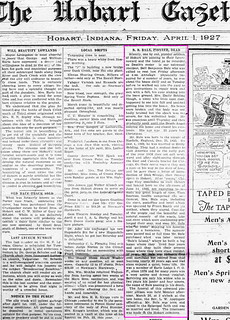
From the obituaries written up in the local papers following his death on March 25, 1927, we learn that he was Hobart's first coal merchant and established the first coal yard in town. We learn a good deal more, too, for B.B. Bale had been a Hobart resident for some 60 years, known to all, and so his death, and his life, received much attention.

2022-11-04 1927-04-01 Gazette, B.B. Bale, Pioneer, Dead
(Click on image to enlarge)
Hobart Gazette, 1 Apr. 1927.


2022-11-04 1927-03-31 News, B.B. Bale obit
(Click on image to enlarge)
Hobart News, 31 Mar. 1927


More details come from this write-up of his sixtieth wedding anniversary, which fell on December 1, 1922. (The text of the article comes from a photocopy of a typewritten manuscript in the Bale file at the Hobart Historical Society Museum, which has no date or source; while it reads like a newspaper article, it's not from the Gazette, and the issues of the News where it might have appeared are missing from the microfilm.)
Mr. and Mrs. Bale Observe 60th Wedding Anniversary

Mr. and Mrs. B.B. Bale, among Hobart's oldest and highly esteemed citizens, on Friday last passed the sixtieth anniversary of their wedded lives, the day being observed by no outward celebration but rather remembered quietly in their home together in keeping with their unostentatious lives.

Mrs. Bale, whose maiden name was Emily Turner Belding, was the daughter of George and Emily Belding and was born December 8, 1837, in the County of Norfolk, England, where her parents owned a large estate.

Mr. Bale, son of John and Mary Bale, also residents of Norfolk County, was born December 25, 1835. At the time of his marriage, December 1, 1862, which was celebrated in the Episcopal church of which both Mr. and Mrs. Bale have been life-long members, he operated one of the large farms of Mr. Belding's estate. Four years after their marriage Mr. and Mrs. Bale decided they would come to America, arriving in this country June 14, 1866. They came through to New York and soon thereafter to Hobart, then scarcely more than a wilderness with perhaps about a dozen and a half scattered homes.

They stayed at a little boarding house, located where the Kramer block now stands, for a few weeks after their arrival, while their own log cabin was being constructed on the beautiful little isle long since known as "Bale's Island." Traces yet remain there of what was once their home and its pleasant surroundings.

During the first year or two of their residence on the island they had no near neighbors, but later the Parks family located on the farm across the creek, [1] then quite a stream, and still later the Daniel Lightner family moved near on the place now owned by his grandson, Dick Johnston, and family. Four years, Mr. and Mrs. Bale lived on the island, then built their present home where they have resided for the past 52 years. At the time of their moving there, their own home and that of the Wettengel family and a little house occupied by the Decourcy family, located near where the Swedish Lutheran church now stands, were all the houses then built on the east side of the bridge over Duck creek.

"In town," Black's store was the center of business and the post-office. Andrew Wall, Sr., and family lived in a little house near Black's. Ernest Passow, a brother of the late Christian Passow, Sr., conducted a grocery and shoe shop in a little building located on the corner of Third and Main streets in the space now occupied by the Central Drug Store. Mr. and Mrs. John Mathews, both now passed away, had a home near what is now the Community building. The brick building on School Street at the rear of the M.E. Church, now remodeled and occupied as a dwelling by Mrs. Margaret Rohwedder, was once the public school building where also were conducted Sunday School and church services, a traveling preacher occasionally coming to officiate. Here Mrs. Bale, assisted by Mrs. Wedge, Mrs. DeCourcy, Mrs. Nixon and Alfred French as its superintendent, established the first Sunday school in Hobart, known as the "Union Sunday School." Their music was assisted by a little melodion which Mr. French carried to and from the building each Sunday.

Mr. Bale operated the first coal yard in Hobart. Some thirty years ago he was attacked with grip which settled in his hips leaving him a sufferer and partial invalid for life which caused him to retire from active business.

Mr. and Mrs. Bale have known Hobart through all its years of changes and development and, through their association with its interests, have contributed much to the upbuilding of the town.

May coming years be measured full of life's choice blessings is the wish prompted by the steadfast friendships they have won.
Emily Bale was interviewed in 1937 on the occasion of her 100th birthday.

2022-11-04 1937-12-12, Chicago Tribune, 100 Years Rest Gently on Lady of Old Norfolk

While the handwritten notes on this photocopy give the source as the Chicago Tribune of December 12, 1937, I have not been able to find this article in that issue online, or any other online paper.


I haven't finished with the Bales, or with this little collection of papers regarding coal sales, either, but this is all I have time for today.

_______________
[1] I believe the reference is to Duck Creek.