Showing posts with label Burge. Show all posts

Sunday, July 31, 2022

Finally Getting Back to the Harms 73rd Ave. Farm

Back in 2021 I started exploring the history of the Harms 73rd Avenue farm. I was making good progress when some shiny object passed before my eyes and I got totally distracted and lost my momentum. I have to go back and try to figure out how to pick up where I left off. This happens to me all the time.

Anyway …

Regarding the northern 40 acres, we left off with the elusive Ehrfurths buying the parcel in 1875.

Over the next few years, other elusive people bought and sold the land.

Even before the Ehrfurths' mortgage was released in February 1878, they turned around the sold their farm to one Henrich Kenneke.

2022-07-31. 1877-09-05 Ehrfurth to Kenneke - Harms 73rd Ave. farm abstract
(Click on images to enlarge)
Images courtesy of the Eldon Harms family.


I can't positively identify Henrich (whom one might also expect to encounter as Heinrich or even Henry). Tax assessment records from the 1860s show Henry Kenneke operating a hotel, selling liquor, and giving public exhibitions in Terre Haute.[1] In 1875, Heinrich Kenneke married a Johanne Bethke in Cook County, Illinois;[2] I think that may be our guy, although I would expect the 1877 sale record above to mention the wife. A wife by that name does get mentioned a year later, when she and Henrich sell the land.

2022-07-31. 1878-04-16 Kenneke to Wegner - Harms 73rd Ave. farm abstract

And that is all I've been able to find out about either of the Kennekes.

The buyers in that sale were Gustave and Wilhelmine Wegner. I may have found them in the 1880 Census, living in Chicago with their two small children. By then they themselves had sold the farm as well. About six months' ownership of 40 acres is all the contact I can find between them and Ross Township.

♦    ♦    ♦

Looking at the southern 40 acres, we pick up in 1882, when Frederick Suhr, a widower of just a few months, sold his farm to Christian Beilfuss.

2022-07-31. 1882-09-14 Suhr to Beilfuss - Harms 73rd Ave. farm history

2022-07-31. Beilfuss - abstract of title for Harms 73rd Ave. farm

Christian was a German immigrant, about 55 years old at the time. He and his wife, Johanna,[3] had both arrived in this country in 1872, the same year they married in Cook County, Illinois.[4] I can't actually place their family in Ross Township, but then I can't find them at all in the 1880 Census. The only other record I can find of them is the 1900 Census, where they are living in Chicago with their son, 19-year-old Louis. The record of their children is a bit mysterious. Per the 1900 census, Johanna had only one child, ever. And yet I've found a death certificate for a Martha Burge, born in 1879, who died in 1963 in Crown Point, and whose parents' names are recorded as Christian Beilfuss and Johanna Orgel. She had married Orrin Burge in Cook County in 1896, and subsequent censuses record them and their growing family in Lake County — farming in Winfield Township through 1930, then moving to Crown Point by 1940. Orrin was the son of Milo Burge and Lucy Sturtevant; thus the Beilfusses would have had a connection to two old local families.

Perhaps the 1900 enumerator made a mistake in noting that Johanna was the mother of only one child. Perhaps Johanna misunderstood the question.

Christian and Johanna Beilfuss sold their Ross Township farm four years after they bought it. As I said, I can't establish that they ever lived on that farm, or anywhere in Lake County, Indiana.

Christian died in Chicago in 1905, Johanna in 1925.[5]

_______________
[1] Ancestry.com, U.S., IRS Tax Assessment Lists, 1862-1918. This hotelkeeper might never have left Terre Haute, where he is buried.
[2] Cook County, Illinois, Marriages Index.
[3] Her maiden name is transcribed various ways, but most commonly "Oergel" or "Orgel."
[4] Cook County, Illinois, Marriages Index.
[5] Someone on findagrave.com has credited them with yet two more children, one of whom (William) might be Christian's son from a previous marriage, and the other of whom (Johanna) I cannot account for.

Thursday, January 13, 2022

The Burge-Underwood House

The Merrillville/Ross Township Historical Society museum has a three-ring binder labeled "Places" that includes numerous photos of local homes, farm buildings, and businesses, some of them identified more or less clearly, some not at all. One of the projects on my "when I have some time" list is to research the locations of the originals.

Among them was this photo, which looks as if it had been taken in the late 20th century (as opposed to early 20th/late 19th).

2022-01-13. Burge-Underwood
(Click on image to enlarge)
Image courtesy of the Merrillville/Ross Township Historical Society.


I had this filed as "Burge-Underwood house," so of course when I started researching the history of the Willy family farm and came across both of those names, I started wondering what the connection was. And when I received a photo of the Willy house, which looks similar (with differences that could be explained by half-a-century's remodeling), I jumped to the conclusion that they were the same house.

I was wrong about that. Looking more closely at the notes on the back of the museum photo, I find a different location specified: "Burge-Underwood House / 73rd Ave — next to town hall / 1976 / the right view."[1] What was the town hall in 1976 is now the historical society museum.

However, the house is still connected to the farm on Colorado because both were occupied by the same family for a time. According to A Pictorial History of Merrillville, the 73rd-Avenue house was built in 1880 by Winfield Scott and Mary Jane (Demmon) Burge. They lived there until, according to the book, Mary inherited a farm from her father, Julius Demmon, who died in 1898.[2] That was probably the Colorado-Street farm; so when when the 1900 Census recorded them there, they hadn't been occupying it for long.

After the Burges left the house in this photo shortly before 1900, A Pictorial History skips over the next 20-some years, and then tells us that in the 1920s it was bought by Frank Underwood — hence the "Burge-Underwood" appellation. Frank lived there for some time with two of his sisters, Clara Underwood and the long-widowed Mary Castle. "Frank, a confirmed bachelor for many years, startled the community when, at the age of 60, he took Mrs. Nettie Macy as his bride." (Nettie, a widow, married Frank in 1933, in Kankakee County, Illinois.)

I came across this item about the house in a 1937 newspaper:

2022-01-13. Hammond Times, 25 Aug. 1937
(Click on image to enlarge)
Hammond Times, Hammond (Ind.), 25 Aug. 1937.


The 1940 Census records them still in the 73rd Avenue house, apparently. Frank died in 1956. My 1958 Merrillville directory shows Nettie still at 15 W. 73rd Avenue. She died in 1965.

That is all the specifics we can find in A Pictorial History: after the Underwoods, "[o]ver the years, the house was rented or owned by several families." When Jan Clemens was writing up the first edition of the book, which came out in 1976, the Burge-Underwood house was still standing. She mentions that it was then owned by the Town of Merrillville and its fate was uncertain. But its fate was decided soon, I imagine — perhaps before the book was actually printed, since the Merrillville Public Works Department building, which now stands on the site, was built in 1975 per the county records. The house probably had to be demolished to make way for it.

Here's the site as it looks now, from Google street view (2019):

2022-01-13. Former site of Burge-Underwood house - Google street view
(Click on image to enlarge)
Image from Google.com.


The first photo I posted above was taken from the west side of the house. The Historical Society has another taken from the east — a negative, but with photo editing software, easily enough turned positive:

2022-01-13. Underwood - positive
(Click on image to enlarge)
Image courtesy of the Merrillville/Ross Township Historical Society.


In the foreground you can see the sign pointing to the town hall parking lot and entrance. The house stood very close to the driveway of the town hall (now the museum).

I wonder if those are the same asbestos shingles from 1937?

_______________
[1] The "right view" in contrast to the wrong view, which we also have: I think it's the same photo but printed backwards.
[2] Julius Demmon does not appear as owner of the farm on any of the plat maps I have, but he have might been if only the farm had been included in the 1891 Plat book.

Friday, November 19, 2021

The Farm Under the Big Boxes

Standing at the intersection of U.S. 30 and Colorado street today and looking west, you see a vast expanse of asphalt surrounding big-box stores such as Sam's Club, Wal-Mart, and Home Depot, as well as restaurants and gas stations. Thousands of vehicles pass through the intersection, day and night. The parking lots are never empty. The lights never go out.

You can hardly imagine those hundred-plus acres as quiet farmland. You can hardly imagine U.S. 30 ending there, either; and yet all the maps we have show the road that is now U.S. 30 going no further east than Colorado, until the new Lincoln Highway came through in the mid-1930s.

I have been researching that area because the Merrillville-Ross Township Historical Society received an inquiry about the farm that once lay there — specifically, the farm of Frank and Catherine Willy, which comprised approximately 115 acres on the west side of Colorado Street, cut in half by the road that is now U.S. 30.

Here is my attempt to outline the Willy farm on the modern-day Google satellite view:

2021-11-19. Willy farm outlines, 2021 satellite view
(Click on image to enlarge)
Image from Google.com.


This farm, under various owners, had retained nearly the same dimensions for over a century. The earliest record I can find of it comes from the NWIGS' Early Land Sales, Lake County: on October 18, 1852, Harmon Underwood bought a total of 160 acres.[1] On January 11, 1854, those 160 acres became the property of John Underwood, who I believe was Harmon's son.[2]

Sometime between 1854 and circa 1874, the farm lost 40 acres on the west, as we can see on the 1874 Plat Map:

2021-11-19. 1874 Ross Twp. - future Willy farm
(Click on image to enlarge)

The new owner of those 40 acres, P.A. Banks, was probably Parley A. Banks. You can also see that H[armon?] Underwood owned another 200 acres east of the original farm.

And lastly, you can see that the mapmaker has clearly drawn a road from the west up to what is now Colorado Street, but eastward of that point, there is no trace of a road.

The 1891 Plat book does not include Section 23, so next we have to jump forward to 1908. Now we find the farm owned by Mary Burge.

2021-11-19. 1908 Ross Twp. - future Willy farm
(Click on image to enlarge)

We also find the parcel reduced in size by almost five acres, taken, I believe, by the Chicago, Cincinnati & Louisville (later Chesapeake & Ohio) Railroad, which began buying up right-of-way through Ross Township circa 1903.

My best guess as to the identity of Mary Burge is that she was a daughter of Julius and Nancy Demmon and married Winfield Scott Burge in 1878. The 1900 Census shows Winfield and Mary, with numerous children, living on their own farm in Ross Township in the general area of Colorado and U.S. 30 (to judge by their neighbors). Mary died in 1922. By the mid-1920s the farm had been sold: we find a new owner in the 1926 Plat Book.

2021-11-19. 1926 Ross Twp - future Willy farm
(Click on image to enlarge)

I cannot identify Caroline Schwer.

In 1932 the farm changed hands again. I will let the new owner tell the story of how that came about, as he told it to his descendants:
Three Ears of Corn

by Frank Anthony Willy

After Frank and Catherine were married, they moved onto a farm in Dyer, Indiana, which Frank rented from his father August. Besides charging rent, August required his son to hire his brothers to work the farm. This was a difficult situation at best for Frank and Catherine. During the Depression they had little money to spend and Frank's brothers were teenagers, with poor work ethics. Eventually Frank and Catherine realized that they could no longer afford to rent the farm in Dyer. They knew they would have to go out on their own and start a new life away from Frank's family.

Frank set out to visit three farms that were for sale nearby. The first was in Wisconsin. The ears of corn in the fields were large and well-formed and the house was well built with a natural spring underneath that could be used to keep food cold. This farm, he thought, would be an excellent choice.

The second farm he visited was in Illinois. Once again, the corn in the field was large, showing that the soil had been well taken care of. The outbuildings and home were also in excellent shape. He believed this would be a good farm to own.

Lastly, Frank visited a farm for sale in Indiana. This corn was just "nubbin."[3] The soil seemed to be spent, with most of the nutrients used long ago. The farm and its buildings were neglected and in very poor shape. As he took pictures of this farm he thought, "This is a very poor farm. It would be difficult to make a go of it here." As Frank returned to Catherine to tell her of his trip, his heart was heavy. He laid an ear of corn from each farm in front of her and then began to cry, for he knew the only farm they could afford was the neglected one in Indiana. And so it came to pass, that in 1932, Frank and Catherine Willy moved their family of eight and all they owned to the neglected Indiana farm with "nubbin" corn. Little did either of them realize what an excellent choice it would turn out to be.
(Story courtesy of Nick Hopman.)

Frank was then about 35 years old, Catherine (née Alber) about 32. They had been married in 1920.

Frank mentions taking photos of the farm when he first visited it. That may be the source of these two photos of the farmhouse and barn.

2021-11-19. 1932 Farmhouse in country
(Click on images to enlarge)
This and the following image courtesy of Nick Hopman.
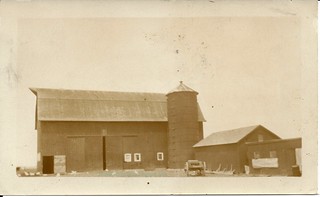

2021-11-19. 1932 Farm in Crown Point 1932

Again, thanks to Nick Hopman, we have Frank Willy's own story about the early days on the farm, and what the construction of the new Lincoln Highway did for the family:
You kids first went to St. Peter and Paul's School. I had to drive you. But when I had no money to buy gas, I sent you to the Ainsworth school as the bus passed our house. The first day you came home you said you needed about $14.60 for books. Had to sell corn for $.12 a bushel. Had about $.60 over on that truckload. That shows you what the Great Depression was like. I did not sell any more, as Henry Bloom[4] said, "Don’t sell. I will go along with you if it takes ten years. I won't foreclose on the mortgage!" The mortgage was for $7,000. The next year we had the cinch bugs. Twenty acres of corn barely filled my little silo. The next year we had the great dust storm. Steady wind from the southwest. In Kansas the dust covered fences and buildings. People left their farms. We bit our lips and held on.

Had 12 acres of fine wheat. Wanted to cut it on Monday. Henry Bloom was out on Saturday. "You ought to cut it. Sometimes it don't pay to wait 'til it has fully ripe." Sunday night it hailed. Shocked everything flat. Holes in the tarpaper roofs. Cut off branches of trees. It was a quarter-inch thick on the ground. I raked the wheat field and got Hank Homeier[5] to come and thrash it. Blew the straw into the barn and got 60 bushels of wheat. I needed that straw. Also paid Koehler[6] $10 so I could cut some slough grass, and Old Nick (our hired hand) herded the cattle there. In 1934 the new highway (US 30-the Lincoln Highway) came through. Then I had it made. When US 30 road work was being done I rented a small area to the state for material storage. When the work was done, instead of having the state clean up the storage area by removing the remaining sand, gravel, and steel, I negotiated to do it myself, for a price of course. But instead of cleaning up the mess, I just sold the materials until they were gone.
For some reason, the 1939 Plat Book fails to show the new highway east of Colorado:

2021-11-19. 1939 Ross Twp - Willy farm
(Click on image to enlarge)

But the 1939 aerial view shows it clearly:

2021-11-19. Aerial photo 1939 Willy Farm (LakeBFJ-04-043)
(Click on image to enlarge)
Image from https://igws.indiana.edu/IHAPI/Map/.


This raises the question whether the 1874 cartographer just made a mistake about the road extending east of Colorado, and that mistake was perpetuated by subsequent map-makers who didn't bother to investigate for themselves. But I am going to ignore that possibility because it's just no fun at all.

Anyway, the 1950 Plat Book shows the new U.S. 30:

2021-11-19. 1950 Ross Twp. - Willy farm
(Click on image to enlarge)


As you can see from the 1939 aerial view above, the Willys' house and farm buildings stood on the west side of Colorado Street, north of U.S. 30. This photograph shows more clearly how the buildings were arranged in relation to Colorado Street, which runs diagonally across the bottom of the photo:

2021-11-19. Willy farm, Crown Point mail address
Image courtesy of Nick Hopman.


Frank and Catherine Willy farmed that land for 30 years, through the Great Depression, through World War II, and beyond. Their children grew up, moved out, started families of their own. Frank and Catherine bought a modern ranch house in the Green Acres neighborhood. In 1962, they sold their farm.

Here is the former Willy farm as it appears in the 1972 Plat Book:
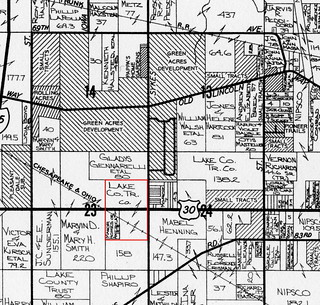
2021-11-19. 1972 Ross Twp. - former Willy farm
(Click on image to enlarge)

The new owner probably rented most of the land to locals who were still in the farming business.

This 1978 aerial view from the Lake County GIS website shows that the farmhouse and outbuildings have been removed, and some kind of business is operating in the northwest corner of the U.S. 30/Colorado intersection:

2021-11-19. 1978 aerial view (Lake County IN GIS)
(Click on image to enlarge)

The 1990s brought the era of the big-box store, and the landscape of the old farm was utterly transformed.


_______________
[1] He bought the south half of the northeast quarter, and the north half of the southeast quarter.
[2] Cf. Lake County Encyclopedia, p. 80. I'm a bit confused.
[3] "Nubbin" — a small or imperfect ear of corn [per the author].
[4] We don't know for certain who Henry Bloom was. My best guess is Henry Blume (1867-1958), who shows up in the 1910 Census farming his own land in Center Township, but in all subsequent censuses he gives no occupation. He and his wife, Mary, had only one child, who died in 1920.
[5] I think this was Henry Homeier, who farmed northeast of Merrillville.
[6] I give up.


Sunday, June 12, 2016

Mahala Burge Frame

Since this blog is full of Burges and Frames, I thought I should go back to 1912 and post this obituary, skipped over the first time …

2016-6-12. Mahala Burge Frame et al.
(Click on image to enlarge)
Hobart Gazette 1 Mar. 1912.


… not that it's particularly helpful, since it fails to name her parents or her children. But with a little research, we can try to remedy that.

Looking at the 1850 Census, we find J. and Julia Burge farming in Chautauqua County, New York. While the census does not include what relationship each member of the household has to its head, this household includes a 17-year-old Mahala Weaver, a 13-year-old Byron, and a nine-year-old Henry. This suggests that the obituary gave the date of Mahala's first marriage incorrectly. In the 1860 Census, still in Chautauqua County, we find a 27-year-old Mahala Weaver living with a 31-year-old carpenter, Oren Weaver, and a three-year-old Ida.

Sometime after 1860, the family came west. Orrin died in Porter County on June 9, 1866.** In 1867 Mahala married Levi Frame in Porter County (Indiana Marriage Collection). While I can't find them in the 1870 Census, another source* seems to place Levi Frame in Christian County, Illinois, by 1870; and that is where we find Mahala in the 1880 Census, by which time she was widowed. A child of her first marriage, the 17-year-old Arthur Weaver, was living with her, as well as a 10-year-old girl named Effie Brown, who was described as an adopted daughter. The children of the second marriage were: John (11 years old), Burton (10), Frank*** (6), and Jesse (4).

So that gives us the five sons mentioned in the obituary. I suppose the one surviving daughter was from the first marriage.****

Sometime during the next 20 years, Mahala left Illinois for Indiana. In the 1900 Census, she was living in Hobart with her youngest son, Jesse.

Well. That was a lot of research for a little bit of information.

♦    ♦    ♦

Elsewhere on that page from the Gazette, we find obituaries of people we've mentioned before — Patrick Sullivan and Ericka Pearson.

Marion Wilson was a member of the Wilson family of Union Township, which I've only recently noticed. The obituary says he was buried in the Boiling Springs cemetery, which may be the Leonard Family cemetery on Boiling Springs Road listed on the NWIGS site. If the obituary is correct, it seems he was later moved, as today he rests in Blachly Cemetery. His wife was a daughter of Harriet Towl Ragen.


________________________
*Ancestry.com. Selected U.S. Federal Census Non-Population Schedules, 1850-1880 [database on-line]. Provo, UT, USA: Ancestry.com Operations, Inc., 2010.
**According to his grave marker in Mosier Cemetery; the obituary states 1865.
***I swear the enumerator wrote "Freak," but that can't be right.
****Based on information at findagrave.com, I believe her name was Blanch.

Sunday, January 17, 2016

Harriet Towl Ragen

An early resident of Ross Township, Harriet Ragen died in June 1922, just short of her 79th birthday.

2016-1-17. Harriet Towl Ragen obit
(Click on images to enlarge)
Hobart Gazette 30 June 1922.


Here is the Ragen farm as it appeared on the 1874 Plat Map.

2016-1-17. Ragen 1874

This map suggests a house in the approximate location of 4012 E. 73rd Ave., where there now stands a house and large barn along with other outbuildings, most of which date to 1921 if the county property records are correct.

After moving to Hobart in 1896, the Ragens rented out their farm. Charles and Lovisa (Chester) Nelson rented it in the spring of 1903; by August of that year, the Ragens had rented it to a Wilhelm Neuman (or Newman), reportedly for a five-year term. By December 1908 George Ragen was advertising for a new tenant. In September 1914, the widowed Harriet, now living in Gary, offered it for sale or rent. She sold it in January 1915 to May Blachly (who sold it to S.J. Craig, who sold it to Emil Wojahn … who probably built that house and barn, etc.).

I believe "Mrs. Cora Maybaum of Gary" was married to Louis Maybaum, the streetcar motorman whose photo we've seen.

Harriet Ragen's husband, George, was not only a veteran of the Civil War but also a brother of Amanda Ragen Bullock, as we learn from his obituary:

2016-1-17. George Ragen obit
(Click on image to enlarge)
Hobart Gazette 1 Mar. 1912.


That would explain why Joseph (aka Josiah) Halladay came down from Chicago in June 1922 to attend Harriet Ragen's funeral — he was the husband of Amanda Ragen Bullock's daughter, Ruth. (I don't know why Ruth did not accompany him.)

From George's obituary, also, we also learn that the "Mrs. Mary Stevens of Gary" who survived Harriet was the wife of Hobart's one-time baker and restaurateur, Willard Stevens (so I suppose she is the Mate Stevens identified in one of the photos in that first link).

In closing, I will add this random item I came across in the 1901 microfilm: "A carload of laborers, men and women of the African type, have pitched camp upon George Ragon's farm near the Grand Trunk railroad and will be engaged in work on the double track grading. They are said to be a jolly crowd."

♦    ♦    ♦

The second story marked on the 1922 image above tells us that the elder Severances, George and Anna, had celebrated their 30th wedding anniversary. I believe Bunge is a misprint for Burge — the married name of their daughter, Mary.


Additional Sources:
♦ 1920 Census.
♦ "For Sale or Rent." Hobart Gazette 25 Sept. 1914.
♦ "General News Items." Hobart Gazette 19 Apr. 1901; 24 Apr. 1903; 28 Aug. 1903; 11 Mar. 1904; 11 Dec. 1908.
♦ "Local and Personal." Hobart News 6 July 1922.

Friday, December 11, 2015

Back in '02, When the Vincent School Burned

Here's an interesting little event that I didn't know enough to pay attention to the first time I was reading through the 1902 microfilm.

2015-12-11. Vincent schoolhouse fire
(Click on image to enlarge)
Hobart Gazette 28 Feb. 1902.


So when Gust Lindborg "bought the old Sullivan schoolhouse" in 1912 — assuming "Sullivan" and "Vincent" are two names for the same school — it wasn't really all that old, was it? — nine or ten years.

The property records for the former Vincent schoolhouse still standing at Clay St. and Harms Rd. give a construction date of 1925. If that's correct (and assuming Sullivan = Vincent), why was the Vincent school building available for purchase in 1912? Were they building a new wooden one then? This is getting complicated.

I wish the story had identified "Miss Burge" better. In the 1900 Census, (Winfield) Scott and Mary Burge had six daughters and two sons living at home. I suppose either of the two eldest daughters, May (born circa 1881) and Bertha (born circa 1882), could have become a teacher by 1902, and maybe even the next eldest, Libbie (born ca. 1885). The census shows the Burges owning their own farm; my guess at its location is marked on this image from the 1908 Plat Map, which also shows how conveniently close for the burned-out students the Goodrich house was.

2015-12-11. Goodrich 1908
(Click on image to enlarge)

The yellow X marks the present location of the brick house that used to be the Vincent schoolhouse. This map places the 1908 schoolhouse* on the north side of present-day E. 83rd Ave.

The Goodriches were Charles and Caroline. They had five children of their own who likely attended the Vincent school: Cora, Ida, Arthur, Clarence, and Harold. (The two youngest would later go to war, and Harold would not come home.)

___________________
*Which would be the one that ended up as the Lindborg home on Ainsworth Road, as I currently understand it all.

Monday, August 17, 2015

South of Deep River

First of all, I think that the reference to "Mrs. Carl Harper" as the secretary of the League of Women Voters' Ainsworth chapter was the newspaper's mistake for Pearl Harper, aka Mrs. Robert Harper. In the April 6, 1922 issue of the Hobart News, we find her placing a "Notice to Women Voters of Ainsworth" to announce a meeting at Lena Hunter's house, and signing herself as Secretary. Mystery solved.

Now, on to the social news from the countryside south of Deep River:

2015-8-17. South of Deepriver
(Click on image to enlarge)
Hobart News 6 Apr. 1922.


I suppose M.J. Guernsey was Melvin Guernsey, son of D.L. (David) and Stella Guernsey.

I'm having a little trouble identifying this newcomer, John Arnson. I suspect that the un-Americanized version of his name was Anders Johan Aronson, and the land he bought was in Union Township, Porter County, near Huffman's mill.

2015-8-17. Aronson 1928
(Click on image to enlarge)
Union Township plat map, 1928, from http://www.inportercounty.org/Data/Maps/1928Plats/Union-1928.jpg, courtesy of Steven R. Shook.


If I've identified him correctly, he was born in Sweden circa 1868, came to the U.S. circa 1886, and married Cora Burge on August 17, 1910. I suppose she was related to the Burges, a large family that went back to the 1830s locally, but I can't identify her precisely. As far as I can tell, John and Cora had no children. She died in 1939, he in 1944.


Additional Sources:
♦ 1920 Census.
♦ "Hold Rites for Mrs. Aronson." Vidette-Messenger (Valparaiso), 26 May 1939.
♦ Indiana Marriage Collection.
♦ "Johan Aronson, Age 74, Dies Sunday Night." Vidette-Messenger (Valparaiso), 21 Aug. 1944.

Thursday, June 26, 2014

Bad Times

From the heart-rending down to the merely annoying, bad news packed the front page of the Hobart Gazette of May 20, 1921.

2014-6-26. Shooting, thefts
(Click on images to enlarge)


The Gazette overestimated George Neimeyer's age. The 1920 Census information and the dates on his grave marker indicate that he would have been 13 years old at the time of his death.

I think the "old Scot Burge farm" straddled present-day U.S. 30 on the west side of Colorado Street, as seen on the 1908 Plat Map (Mary Burge being Winfield Scott Burge's wife):

2014-6-26. Burge 1908

George Niemeyer's parents, Fred and Eda, also had three teen-aged daughters, and a five-year-old son.


The Ridge Road Gardens was a restaurant, and I have the impression that it was near the site of the Black Cat — i.e., on Ridge Road where I-65 now passes over it. "Proprietor" Oleska's first name was Mike, and his wife was Anna.

H.W. Paxton was, I believe, Harry Windle Paxton of Hobart, who worked as a coal and lumber salesman (WWI Draft Cards, 1930 Census).

Monday, June 16, 2014

The Cheerful Liar and the Hot-Headed Shooter

Here's what was going on in the new Ainsworth school in May of 1921.

2014-6-16. Cheerful Liar
(Click on image to enlarge)
From the Hobart News, 12 May 1921.


I gather that the Palmer Stock Company got its name from the village of Palmer, in Winfield Township (where Randolph Street crossed the CC&L/C&O railroad). While I haven't identified C.H. and Mrs. C.H. Burge, the other cast members appear locally in the 1920 census.

In searching (unsuccessfully) for the text of the play, I came across a story of some Minnesota high school students who decided against performing it, I gather, because of its potential to corrupt young people.

Above the Cheerful Liar ad is another for a baseball game to be played at the Hobart Speedway … a novel way to use a motorcycle racetrack.


Meanwhile, at the old Ainsworth school …

2014-6-16. Shooting
(Click on image to enlarge)
From the Hobart Gazette, 13 May 1921.


The Gazette speaks of "Mike Murphy" as if local readers would know him, but he's a mystery to me. As is Dan Maybaum, still.

Tuesday, July 23, 2013

Yager and Severance News

The two families were linked by friendship even before George Yager, Jr. married Pearl Severance in 1915. Now it's October 1920, and George and Alberta Severance have moved from Rockford, Illinois, to Gary to help his two married sisters (Mrs. Ray Burge had been Mary M. Severance) make it a Severance kind of town.

Meanwhile, Jake Yager makes a trip over from Porter County with strawberries. I don't know whether the 64-year-old was bragging or complaining about having picked 1,500 boxes of berries. Perhaps he didn't do all the picking himself.

Yager, Severance and Guernsey news
(Click on image to enlarge)
From the Hobart Gazette of Oct. 1, 1920.


(Also, an update on the Melvin Guernsey family as they flee from farming.)

Sunday, April 15, 2012

Stay for Supper

"Stay for supper, won't you?" Minnie Osborne urged her sister, Ethel Meyers. The little Meyers family — Ethel, Warren and their nine-year-old daughter, Marie — had come out from their Porter County farm to spend Saturday, March 29, in Hobart with the Osbornes.

It was a tempting offer. Ethel and Warren wavered, but finally duty won out: there were chores that needed to be done before dark, and a drive of nearly 20 country miles lay between Hobart and their farm northeast of Hebron. So around 5 o'clock the Meyers climbed into their Ford and set out, heading southeast. Their route was through Wheeler.

At Wheeler, William Raschka sat in his car near the railroad depot, looking toward the west crossing. Two sets of railroad tracks, the Pennsy and the Nickel Plate, ran side-by-side through the town. William could probably already hear the rumble of the Nickel Plate mail train, approaching from the east. It was running late, and with no need to stop in Wheeler, the engineer could throw open the throttle to make up for lost time.

As William watched, two autos approached the crossing: from the north, the Meyers' Ford, and from the south, a car driven by Clarence Burge of Wheeler. There were, of course, no lights or gates at the crossing. Clarence cleared the Nickel Plate tracks, but he had noticed the train flying toward the crossing, so he called out a warning to Warren, who was just then crossing the Pennsy tracks.

What happened next mystified Clarence. Later he theorized that his shouting may have confused Warren. For whatever reason, the Meyers' Ford slowed down, and then, as it rolled onto the Nickel Plate tracks, it stopped.

The speeding train caught the Ford square in the middle. Pieces of the car were flung toward the south, scattered for a hundred feet along the tracks, but the top of the car and the three occupants it sheltered were caught by the engine's pilot and carried for the half-mile it took the train to stop.

Clarence and William left their cars and ran to catch up with the engine.

William knew the Meyers family, so it must have been a shock when the men pulled aside the wrecked car top and found Warren and Marie dead, killed instantly. Ethel, remarkably, was alive and conscious, though badly injured. She recognized William. He asked her if he could do anything to help, if he could notify anyone. She told him no, and added that she would be all right as soon as the pain stopped.

She and the bodies of her husband and child were loaded onto the train that had hit them, bound for Hobart. Someone probably called ahead to alert doctor and undertaker; when the train stopped at Hobart, the bodies were removed, to be taken to Alwin Wild's undertaking parlor, while Dr. C.C. Brink boarded the train to accompany Ethel to Mercy Hospital in Gary.

She died on the ambulance on the way to the hospital.

Warren was survived by his father, Henry Meyers of Crown Point, and one brother. Ethel was survived by her parents, Wallace and Mary Thompson of Hebron, two twin brothers, and — besides her sister, Minnie Osborne — another sister, Olive, now married to Arthur Weiler of Deep River.

The little family's funeral took place that Wednesday in Hebron, and they were laid to rest in the Salem Cemetery.

I expect that Minnie Osborne suffered a little from the kind of guilty hindsight that tends to afflict survivors in such cases — that she spent some time wishing she had been more forceful in urging her sister and brother-in-law to stop worrying about the chores so much, just this once, and stay for supper.


Sources:
♦ 1900 Census.
♦ 1910 Census.
♦ 1920 Census.
♦ 1930 Census.
♦ "Family of Three Killed at Wheeler." Hobart Gazette 4 Apr. 1919.
♦ "Myers Family Killed in R.R. Accident at Wheeler." Hobart News 3 Apr. 1919.

Tuesday, February 15, 2011

Small-Town Gossip, 1917

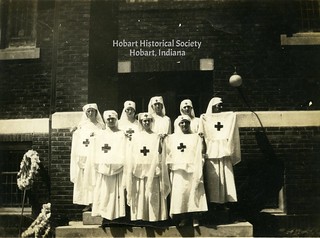
WWI Red Cross Hobart
(Click on image to enlarge)
These were some of Hobart's Red Cross volunteers during World War I. Handwritten notes on the back of the original identify only four of them: in the first row, from the left: Blanche Roper and Lillian Burge. In the second row, at center, Mrs. Lacey; at the right end, Mrs. Messick. They are in front of the M.E. Church on Fourth Street. Image courtesy of the Hobart Historical Society.


As summer faded into autumn, a story was making the rounds in Hobart about Mary Bruce (the plumber's wife). Eventually it reached Mary's own ears, and she was astonished to learn what she'd been up to lately.

According to the story, in an act of patriotic voluntarism, Mary had knitted a sweater as something the Red Cross could give to some soldier headed overseas to fight for his country. She had slipped a note inside it, with her name and address, asking the recipient to write to her. After some time she received a letter from the soldier now wearing her sweater — but he told her he'd bought it at Marshall Field's department store in Chicago. The story's implication was that the Red Cross was taking donated goods and selling them.

Mary was so annoyed that she wrote in to the Gazette to denounce this ridiculous concoction, and the Gazette printed her letter. In the first place, Mary said, she did not knit a sweater; she did not even give a purchased sweater to the Red Cross; so of course all the rest of the story was utter nonsense.

As a piece of gossip, however, it's both inventive and efficient: it packs the maximum slander into the minimum narrative. In just a few sentences, it insults Mary (for being so forward as to ask a strange man to write to her), the Red Cross (for selling donated goods) and Marshall Field's (for buying what it should have known were donated goods). The only one who comes out unscathed is the (nonexistent) soldier — I suppose even gossips wouldn't cross that line.


Source: "Just a Canard." Hobart Gazette 28 Sept. 1917.