Showing posts with label Old Settlers Cemetery. Show all posts

Thursday, January 5, 2023

Letters to Fonso

It's 1897, and B.E. Smith has left Hobart to work as a teamster in Chicago. His older brother, Frank, remains in Hobart, dealing in groceries and writing business-like letters to B.E.

2023-01-05. Smith, Frank J. to B.E. Smith 1897 1
(Click on images to enlarge)

2023-01-05. Smith, Frank J. to B.E. Smith 1897 2

The first is dated January 2th, 1897.

Fonso I shiped you 27 bush & 30 lbs at 22 per bush. You can get it Thursday & be shure & send the bags rite back & you speak a bout sum Potatoes if they are good you can send a Baral & I would like a barel of good onions & a baral box of good celery if good & cheap but don't want no frosen stock but if you can't send them as well as not let them go but if you can send them send them rite a way & if you want more corn send sacks & I will try & get sum more
Yours Resp[ectfully] F. Smith
If you could send Bbl of parsnips
The second is undated, but seems to involve the same 27 bushels, along with some advice about how B.E. should feed his horses:
Fonso I Paid the freight 144 [illegible scrawl]
If you ar feading oates be carfal in changing fead a little corn with the oate & salt well un till they get youst to the corn
Now if you can get me sum Potatos & sum good onions & sum good celer[y] jest as well as not & [illegible] or Rhodab Rhudabages they are jest the same to me
27 B 30# at 22 X  604
freight                    144
                                 748

That make the corn stand you a bout 27 per Bushul then let me no what it is worth then [or "there"?] is there ena [any?] saven [or "sance"?] in it
Cr BE S. 3.50
I will try to interpret these: Frank has sent Fonso 27 bushels plus 30 pounds of corn at 22 cents per bushel. He has shipped the corn in sacks and wants his sacks back right away. At least some of the corn is for Fonso's horses (he's a teamster, remember?); Frank is concerned that if Fonso has been feeding his horses oats, the sudden switch to corn will upset their stomachs, so he advises mixing the corn gradually into the oats.

Apparently Fonso, up in Chicago, is able to scout out good produce in the various wholesale markets, so Frank wants him to send a barrel of potatoes, a barrel of onions, and a box of celery, so long as it's not frozen (which was a possibility in January[1]). Oh, and a barrel of parsnips. Also, some [illegible] or some rutabagas; Frank doesn't care, [illegible] and rutabagas are just the same as far as he's concerned. (Part of the [illegible] looks like "bananas" to me, but in what universe are rutabagas and bananas just the same to anyone?)

All these barrels of potatoes, etc., would be resold in Hobart, I'm guessing.

The "and Son" part of this business was probably Frank's son, Henry Sylvester (born ca. 1879 and named for his grandfather).

♦    ♦    ♦

Frank's obituary, printed in the Hobart Gazette of January 21, 1927, gives some of the family history going back to Hobart's earliest days.

2023-01-05. Death of Hobart's Oldest Pioneer, Gazette, 01-21-1927
(Click on image to enlarge)

This part about Frank's father is interesting:
Henry S. and Fannie (Wheeler) Smith, natives of Pennsylvania, … emigrated to Ohio and later to Michigan in pioneer days. Mr. Smith visited City West as early as 1838, where he became a great friend of the Indians and learned their language, ways, customs and desires. The Smiths and the Wheelers came to Hobart together and were active in its early growth. This pioneer Smith built the first sawmill for the late George Earle and also the first gristmill which gave service to the community in those early days. When the Mexican War broke out, Mr. Smith became an Indian interpreter for the government and was with Gen. Freemont [sic] in the west. He later entered the gold rush to California but soon returned to Hobart where he died Aug. 5, 1856.
Henry Sylvester Smith is buried in the Old Settlers Cemetery.

It's also interesting that Frank's older brother, Charlie, was probably the first fatality of the Hobart sawmill. That accident would have occurred in 1846 if Frank was then two years old. I do not know where young Charlie is buried.

Nor do I know where Frank's three wives are buried. We know from the obituary that Clara Loague Smith died in 1913 and her death certificate states that she was buried in Hobart, but I can't find a record of her grave. Harriet Ferrin Smith died of tuberculosis on February 6, 1887, [2] but again I can't find a grave. In the case of the first wife, Rosana Eastwood Smith, I don't even know when she died.

As a Civil War veteran, Frank lies beneath a military marker that has nothing to say about his birth or death, only his service.

I've identified only five of the seven children that the obituary attributes to Frank. One was Almantha Smith Bullock, born ca. 1882. The others are Henry Sylvester (b. ca. 1879, as mentioned above), Eugene (ca. 1884), Charles (ca. 1897), and Loleta Smith Havrilla (ca. 1901).

_______________
[1] To be perfectly honest, I don't know how they would prevent freezing during winter shipping in 1897. I'm profoundly ignorant of how wholesale produce was handled in Chicago in 1897.
[2] "Hobart Items," Crown Point Register, 10 Feb. 1887.

Wednesday, September 12, 2018

The Skeleton in the Yard

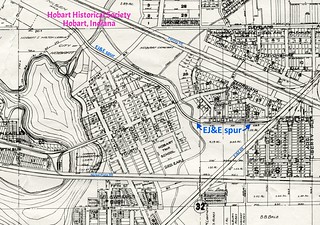
Let's step back to May 1902, when the J spur was being laid from the main EJ&E line through Hobart to the brickyards. That construction work led to an interesting discovery:

2018-9-12. Bones, Gazette, 5-9-1902
(Click on image to enlarge)

"Mr. Colburn" was, I believe, the 64-year-old Zerah Colburn, who had come to the Hobart area circa 1843 with his parents (Early Land Sales, Lake County) and lived out the rest of his life here. For Cruther I think we should read Carothers — and we have already mentioned that family in connection with the bridge on the tumbling dam. The young man who died in 1854 must have been John Carothers, Jr.; at that time he would have been about 17 years old.

I have found no follow-up story in later issues of the newspaper, so it is possible that young John's bones still lie in that box along the route of the vanished J spur.

We know the route:

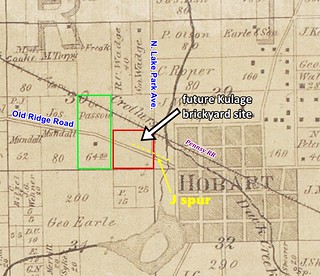
J Spur on map with labels
(Click on image to enlarge)
Image courtesy of the Hobart Historical Society.


The spur actually extended as far as the western Kulage brickyard (see 1902 Sanborn map), which I find interesting because that part of the brickyards was on land once owned by the Carothers family. The image below shows that area as it appears on the 1874 Plat Map, with the east half of the southeast quarter of Section 30 owned by "Crothers." In 1846 John Carothers, Sr. had bought the parcel outlined in green, and in 1851 the parcel outlined in red (Early Land Sales, Lake County). He must have sold the green parcel before 1874.

2018-9-12. Carothers 1874
(Click on image to enlarge)

However, I doubt that young John's bones lie in that land. Zerah Colburn said John was "buried upon his … father's lot" — which sounds like a (relatively) small lot in town. In further support of this theory, the "Heitmann place" was likely in town, if we assume it was one of the two Heidtmann households shown in the 1900 Census. That census records one household composed of Fred and Liddie Heidtmann and their children, and a separate household where Fred's mother, Sophia, lived with her own elderly mother and an unmarried son. Both homes were within "Hobart Town," but I don't know the exact location of either. The one that included Sophia was probably on Michigan Avenue: it was described that way when Sophia died in 1909[1], and its being recorded in the 1900 Census next to the Melin home (northeast corner of Michigan and Cleveland) suggests they were neighbors. However, even if that Heidtmann place was on the west side of Michigan Avenue — with a railroad track and a creek between it and the J spur's route, to call the excavation "below the Heitmann place" seems a bit of a stretch.

♦    ♦    ♦

It's odd that Zerah Colburn would say that in 1854 Hobart had no cemetery. I suppose he meant no cemetery within the village. Zerah's own parents are buried in the Old Settlers Cemetery, and both died before John Carothers, Jr.: his father, Allen, in 1843, and his mother, Maria, in 1851. Still, in 1854, small family burial grounds on private property were not so very unusual, although I would expect such grounds to be more rural — a burial in a town lot would be out of the ordinary.

_______________
[1] "Old Citizen Dies," Hobart Gazette, May 14, 1909.

Monday, July 30, 2018

Who Built the Bridge on the Tumbling Dam?

These guys did.

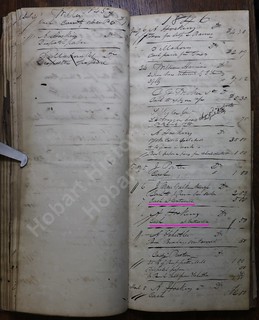
2018-7-30. DayB1840 220, 221
(Click on image to enlarge)
Image courtesy of the Hobart Historical Society.


Construction was going on, apparently, in January 1849 — cold working conditions! I assume this is the tumbling dam at George Earle's grist mill in Hobart.

"Cady" might be Cady Preston, a 33-year-old Hobart resident who came from New York via Michigan, per the 1850 Census. He must have been good friends with the ledger-keeper to be on a first-name basis. (Another possibility is Samuel Cady, but thus far I've found him in the ledgers only up to 1840, and only in the 1840 Census.)

George Cregg (or Craig) has been showing up in the ledgers but I can't identify him in a census.

Mr. Bush's initials may have been O.E., per another entry in the ledger, but otherwise he is a mystery to me.

We've already met Jesse Albee.

"F. Eastling" was probably Ferdinand Eastling, one of five children in the family headed by Luther and Maria Eastling. (Judging by the ages of the older children, I'd say Maria was Luther's second wife.) They farmed the southeast quarter of Section 33, on the west side of County Line Road where it meets State Road 130 (Early Land Sales, Lake County), so when the Pittsburgh, Ft. Wayne & Chicago Railroad came through circa 1858, it cut through their land.

"S. Sigler" may have been either Samuel Sr. or Samuel Jr.

Per the 1850 Census, the Carothers family had a John Sr. and a John Jr. In January 1849, John Jr. was only 12 years old, so I'm inclined to think this entry is for John Sr. He was born in New York circa 1805, died in Hobart in 1864, and is buried in the Old Settlers Cemetery. (Also listed there are a George Carothers — probably John's son — and a Charles, whom I can't identify; they were both Civil War veterans.) John Carothers owned much of the southwest quarter of Section 30, so Old Ridge Road, as it moves from N. Lake Park Avenue to Wisconsin Street, crossed his land (Early Land Sales, Lake County).

Tuesday, March 27, 2018

"Cash at Centreville"

This ledger page recording transactions during the winter of 1846 reminds us that Merrillville was once Centreville.

2018-3-27. DayB1836 058, 059
(Click on image to enlarge)
Image courtesy of the Hobart Historical Society.


The first marked transaction involves, I believe, Jacob Vanvolkenburg.[1] According to Early Land Sales, Lake County, in 1839 he bought 40 acres in St. John Township, right on its border with Ross Township. He shows up in Lake County in the 1840 Census, and while that census does not specify townships, I see among his neighbors other names that appear in our ledgers. By the 1850 Census he was living in Ross Township, describing himself as a millwright. The 1860 Census shows him still in Ross Township, now farming. His land lay in Section 19, according to the 1874 Plat Map,[2] — but by 1874 poor Jacob himself lay in Merrillville Cemetery, having died (according to the coroner's inquest) a cold and lonely death in October 1862.

2018-3-27. CP Register 1862-10-30
(Click on image to enlarge)
Crown Point Register, Oct. 30, 1862.


As for the second marked transaction, I am not entirely sure who A. Hoskins was: the Hobart area contained both an Alexander and an Ariel old enough to transact business in 1846.

Alexander bought land in Section 5, south of the town of Hobart, as early as 1843 (Early Land Sales, Lake County). He thus lived near Old Settlers Cemetery; and since his wife had been Emma L. Colburn (Indiana Marriage Collection), it would appear that the infant Allen Hoskins whom NWIGS recorded in that cemetery was theirs — "son of A. & E.L."

Ariel, on the other hand, lived slightly northeast of Hobart. Early Land Sales, Lake County records him buying land in Section 28 in 1848. I believe he shows up in my index once as "Rial Hoskins," so perhaps we're better off betting on Alexander as the "A. Hoskins" of the ledger.

Beyond that I know very little about either of them.

_______________

[1] The name shows up in various spellings. I am using the spelling that appears in NWIGS' Ross Township Cemeteries listing.
[2] If I'm reading the plat map correctly, Jacob's land was on the northeast corner of the intersection of U.S. 30 and Whitcomb Street … but I'm not sure I'm reading it correctly.

Tuesday, March 13, 2018

Not Guilty

The big Prohibition trial in Indianapolis in the spring of 1923 ended well for the locals — mostly. Mike Drakulich had pled guilty to one charge and was found guilty on another, but all the other Hobart defendants were acquitted: Fred Rose (marshal), Laurence Traeger (night marshal), George Fleck and William Busse (soft drink proprietors). ("Jury Renders Verdict of Guilty for 55 Conspirators," Hobart News, April 5, 1923.)

♦    ♦    ♦

On a totally unrelated note, Charles Sapper appeared at a meeting of the Hobart City Council and "notified the city that the fence around the abandoned cemetery near his place was in bad condition. St[reet] Com[missioner] Tyler was instructed to repair same." ("City Council Proceedings," Hobart News, April 5, 1923.) The cemetery in question was Old Settlers Cemetery. So Charles is telling us that by 1923 it was "abandoned" and neglected. Scanning over the NWIGS listing from its book of Hobart Township cemeteries, I find the most recent date of death for someone in that cemetery to be 1933, but he's an outlier. All the other death dates are before 1871.

Monday, February 8, 2016

A Dance and a Daughter

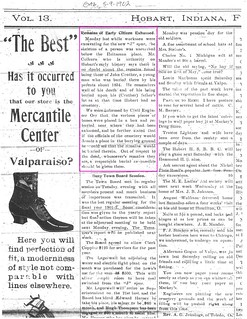
The Niksches were planning yet another dance for July 12, 1922, in the old Deep River schoolhouse; and the day after Independence Day, Mayme Harney gave birth to a baby daughter … unnamed at the time, apparently, but she would soon be Gladys.

2016-2-8. Dance and daughter
(Click on image to enlarge)
Hobart Gazette 7 July 1922.


♦    ♦    ♦

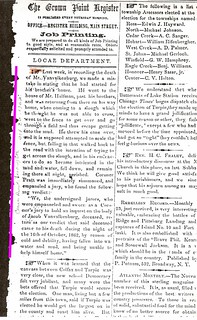
From the same issue of the Gazette, some random news — Calvin and Howard Shearer had a contract for sewer work; Old Settlers Cemetery on S.R. 51 was in sorry shape; someone had run a car down the "steep embankment" near the George Lutz farm (which steep embankment you can still run a car down, if you are so inclined); and on the Peterson farm, a big family reunion … but no list of surnames that might help a genealogist.

2016-2-8. Sewer, etc.
(Click on image to enlarge)