Showing posts with label domestic dispute. Show all posts

Thursday, November 5, 2026

A Grain of Truth in a Pearl of Gossip

Oral history usually starts with something that actually happened, and from there the human memory might create an amalgam of various real events, or the human imagination build up something more exciting than the bare facts. An interesting aspect of working with oral history is finding that grain of truth under the pearly layers of imagination or creative memory[1] — which is not to say I don't appreciate the pearly layers: they are art; they are a uniquely human activity.

What also fascinates me is that people who tell embroidered or confused history are not conscious of embroidery or confusion. For example, in my post about the Stoltz tragedies, the person who reported Mary Stoltz's thoughts in the minutes before her death — something impossible to know — believed what he or she was saying.

It is time now to return to the juicy story related by Minnie Rossow Harms that I discussed some 13 years ago. If you don't want to click on that link to read the original post, I will boil it down: the story told in the Ainsworth neighborhood (and written down years later by Minnie) was that Charles Chester's first marriage was to Ida Harms and went very badly; Ida developed a "weakened mind"; Charles brought another woman into the home; and finally Ida disappeared and locals suspected that Charles had murdered her and buried her body in the woods.

As I noted then, it's a great story that I could not find a shred of evidence to support.

Thanks in part to some amazing history-detective work by Emily Iland, we now know more of the truth about Charles' two marriages, and the surprising reason why the Harms name ever came up.

♦    ♦    ♦

On August 15, 1893, Charles Chester, 23 years old, married Dora Foreman,[2] a 20-year-old Illinois native. In May 1894, they had a son, Arthur, followed by a daughter, Theresa, in July 1895.

According to Charles' later testimony, the marriage went bad around that time. Dora was unfaithful to him (again, Charles' testimony) and by early 1896 had left their home in Ross Township[3] and gone to live on her own. In November 1898, Charles filed for divorce, saying that he had been completely abandoned by his wife for some two years.

There is one fact that is inconvenient for Charles' version of the story: that same month, Dora gave birth to another son, Willie,[4] who had been fathered by Charles, as established by modern DNA technology. Dora could thus not have completely abandoned Charles after 1896. However, the child was born in Iowa, so they were living apart at the time.

Charles was up to his own activities in the months before Willie was born. This item is from the Hobart News of October 14, 1898:
In speaking of the work of the recent grand jury the correspondent from Crown Point to the Hammond News uses the following: "One of the most surprising of the charges was that brought against Chas. Chester of Ross Township. … He is now charged with adultery and fornication and was arrested and stalled in the county jail last Friday on that indictment. According to reports Chester has a wife living in Iowa by whom he has had children, and one in Ross Township. If these reports are true Chester will find it hard work to clear his skirts."
The "wife" in Ross Township was Constance McClain Booty. She lived in his home, but she and Charles were not married.

Charles started the divorce action on November 12, 1898. Oddly enough for one whom the local papers viewed as a Ross Township resident, he filed in Cook County, Illinois, telling the court that he had been living in Chicago for the past three years. He said initially that Dora's last known address was in Hobart, Indiana, and that is where the court clerk mailed to her a copy of the notice of the pending divorce suit. The notice was also published in the National Corporation Reporter, a Chicago newspaper. At the divorce trial in December, Charles said Dora was living in Chicago. It is likely that Dora, the whole time, had been in Iowa, where she gave birth to Willie on November 14.

On November 25, in Lake County, Charles was cleared of the adultery charge.
The adultery case against Chas. Chester tried in the Lake circuit court the 25th of last month resulted in a vindication of the defendant. The report that the woman who is keeping house for him is his wife could not be proven and Mr. Chester and the woman swore they are not married, she being only his housekeeper working for weekly wages. Mr. Chester does not deny that he has a wife living in Chicago. We understand the defendant has begun a $10,000 damage suit against a number of Ainsworth farmers who were instrumental in his prosecution, for defamation of character.[5]
I never heard any more about that defamation suit, and I expect Charles quietly let it drop. While it's true he was not a bigamist, lawsuit proceedings might have elicited testimony making it difficult for him and Constance to maintain that there was absolutely nothing personal going on between them.

Charles' suit for divorce was heard in the Cook County court on December 21, 1898. Dora may not have attended the hearing — there is no record of testimony from her, although Charles and Constance testified. Charles was awarded his divorce and custody of the two children, Arthur and Theresa. There was a third child, as we know, but the court did not address that child. Charles may not have known about him.

Once a free man, Charles hastened to bind himself again.
On Tuesday of this week, Dec. 27th, 'Squire Mathews at his home spoke the words that united Chas. E. Chester and Constance Booty, of Ainsworth, as man and wife. Miss Booty for some time has been keeping house for Mr. Chester. We presume Mr. Chester has been successful in securing a divorce from his former wife, action for which was begun in Chicago some little time ago.
Thus began a long and apparently happy marriage between Charles and Constance.

♦    ♦    ♦

And now we get to the reason why the Harms name worked its way into the story when Minnie Rossow Harms wrote it down, over half a century after it happened: one of Dora Foreman Chester's alleged adulterous lovers was (according to Charles) none other than John Harms.

2026-11-05. John Harms accusation - Cook Co Court records Chester vs Chester divorce Nov-Dec 1898-1
(Click on image to enlarge)
I have not identified Edward Naughton.


How does "John Harms was Dora's lover" translate to "Ida Harms was Charles' wife"? That would be one of the creative miracles of human memory!

Although the divorce suit was tried in Cook County, I think it very likely that some knowledge of Charles' accusation reached John Harms' relatives in Ainsworth. (Whether there was any truth to the accusation, we'll never know. There was never a hint of any such goings-on in the local newspapers, which could sometimes be surprisingly frank about naming adulterers.) That knowledge injected the Harms name into the scandal. By the time Minnie Rossow Harms, born in 1897, was old enough to be told of such things (probably by her mother-in-law) memory may have already worked its magic; or maybe the magic happened between Minnie's hearing of the scandal and her writing it down — which I think was about 1952, and maybe later.

So in a sense, Minnie did not make up Ida Harms out of whole cloth. There really was some involvement of a Harms figure in Charles Chester's first marriage.

But what of the more serious allegation in the gossip: namely, that Ida-Dora disappeared and Charles was suspected of murdering her?

It may be that as far as Ainsworth people were concerned, Dora did disappear. She left her husband's Ross Township home. People probably heard she might be in various places — Chicago, Iowa, Hobart — but likely no one in the neighborhood ever saw her again. As for Charles' murdering her — if that can be explained by anything other than a wild flight of fancy, it might have arisen from the general feeling that Dora Foreman had been treated badly by Charles. He did have another woman living with him while he was still married to Dora. We see him emerging from the divorce proceedings with everything he wanted: his freedom, sole custody of his and Dora's two oldest children, and the love of a woman who would be his partner until her death. Meanwhile, Dora and Willie, her youngest child, had difficult and short lives.

Dora left Willie to be raised by her father and stepmother, while she went to work. The 1900 Census shows her boarding in a home in Lyons Township southwest of Chicago, giving her occupation as "servant," while her little boy lived in the city with Christ and Susan Foreman. Christ, at 57 years of age, worked as a day laborer, so likely the family was not well off.

A 1905 directory for East St. Louis, Illinois, apparently shows Dora and her father living there; but Dora may have already been an inmate of the St. Clair County Farm.

On January 4, 1908, the Belleville News-Democrat published her death notice:

2026-11-05. 1908-01-04 Dora Chester, The Belleville News Democrat, p. 8
(Click on image to enlarge)

The St. Clair County Farm housed indigent people. But I ask myself if perhaps, when this news trickled back to Ainsworth, the poorhouse became an institution … an asylum … an insane asylum — hence the "weakened mind" of "Ida Harms" in the original story. However, there were other possible origins of the "weakened mind," as we shall see.

Willie was not yet ten years old when his mother died. He went on living with his grandparents in East St. Louis (1910 Census).

We have to piece together some of Willie's subsequent history from family stories (as confirmed by DNA): later in that decade, he got a young woman pregnant. He did not marry her, it seems. She gave birth to a baby boy who was adopted by Willie's married cousin, Frances Bonanno, and her husband. Willie's draft card from 1918 shows him apparently living with the Bonannos, working as a coal miner. (Since he listed Frances as his nearest relative, his grandfather may have died sometime after 1910.) The 1920 Census likewise shows Willie with the Bonannos and their "adopted son" in Collinsville, Illinois. Willie worked in a brickyard.

In 1926 Willie became an inmate of the Peoria State Hospital — an insane asylum. This information, if it reached Ainsworth, might be another inspiration for the "weakened mind" of "Ida Harms." But there was one more possible source: when Arthur Chester (son of Dora Foreman and Charles Chester) died in 1930 at the Logansport State Hospital, the death certificate listed his cause of death as epilepsy, with a contributory cause of epileptic psychosis. This news most likely did reach Ainsworth, since Arthur had been a local most of his life, and he was brought back to Hobart for burial. A little confusion in human minds, after a decade or two, could transform Arthur's psychosis into his mother's "weakened mind."

Willie was still an inmate of the Peoria State Hospital when the 1930 Census came around. On August 29, 1931, he died there.

Considering the fate of her two sons, and her own untimely death, there is a sense of tragedy about Dora and her family. That tragic atmosphere might have eventually fermented into the story of Charles' murdering her. Yes, it would be an amazing transformation. This piece of neighborhood gossip, as reported by Minnie, is a tribute to the creativity of human memory.

♦    ♦    ♦

We know Charles was innocent of the worst allegation in the scandal. Yet he does not come out of this story looking very good. He lived under the same roof with Constance while still married to Dora (and we have to wonder — did he hire a housekeeper because Dora had left him, or did Dora leave him because he "hired" a "housekeeper"?). He filed for divorce in Cook County, not Lake County where he lived; and Charles and Constance both seem to have lied to the court about being residents of Chicago. I suspect they also lied, to both the Cook County and the Lake County courts, about being no more to each other than employer and employee. We know from the DNA results that Charles lied about being completely abandoned by Dora. And if he did not have more evidence than we know of for his accusations of adultery against Dora, he blackened her name unjustly.

But isn't there something in this that rises above the sordid? Perhaps my mind is shaded because just lately I've been re-reading the Kristin Lavransdatter trilogy and watching a similar story play out in great literature: two people in the throes of love abandoning all principles to be united, for better or for worse, until death. Charles and Constance became each other's lifelong companions, apparently happy together. If we believe that suffering can compensate for sin, we might look at what Charles and Constance went through in their marriage: the heartbreak of losing a son and a daughter, as well as dealing with a life-altering injury to one child (whom they both ultimately outlived) and the illegitimate pregnancy of another.

Those two latter, of course, were Dora Foreman Chester's children. I would have liked to see at least one of her children go through life without suffering a major misfortune.


It is a sad story all around. I almost feel guilty for having enjoyed finding out the truth behind what seemed to be a wildly fanciful piece of gossip; or at least, getting some insight into the possible route human brains might have travelled from Dora Foreman and a divorce, to Ida Harms and a murder.

I would never have found out the real story if Emily Iland had not tracked down the records from the divorce proceedings and shared them with me. To view those records, you may click here.


_______________
[1] I know it's a myth that pearls form around grains of sand. They form around pieces of the oyster's own mantle tissue, or in the case of cultured pearls an introduced bead, or even a parasite that drills through the oyster's shell. But was I supposed to title this post "The Piece of Mantle Tissue of Truth…"?
[2] Indiana Marriage Collection; "Chester-Foreman Nuptual," Hobart Gazette, 18 Aug. 1893. If Dora had any relation to the Ainsworth or Hobart Foremans, we have not uncovered it.
[3] I am not sure where Charles and Dora lived locally during their marriage. My guess is that they rented a farm somewhere in Ross Township.
[4] Ancestry.com. Iowa, U.S., Births and Christenings Index, 1800-1999 [database on-line]. Provo, UT, USA: Ancestry.com Operations, Inc., 2011. Original data: "Iowa Births and Christenings, 1830–1950." Index. FamilySearch, Salt Lake City, Utah, 2009, 2010. Index entries derived from digital copies of original and compiled records.

The 1900 Census seems to agree with the 1898 birth year for Willie, although in later records he himself gave 1897 as his year of birth.
[5] "Additional Locals," Hobart Gazette, 2 Dec. 1898.

Sunday, May 3, 2026

Merrillville Then and Now: 73rd Avenue West of Broadway

Circa 1909, and 2024:
2026-05-03. 1909-07-17 73rd Ave Walter to Casbon a
2026-05-03. 73rd looking west - 2024 - Google street view
(Click on images to enlarge)
Second image from Google street view.


"Main Street," also known as the Joliet road, had not yet become the Lincoln Highway when this photo was taken sometime before July 17, 1909. The road is dirt, but electrical wires (or are they telephone?) run along it.

We are standing more or less abreast of the Merrillville school building (now the Merrillville History Museum).

The Burge-Underwood house would be to the left, but just out of range of the camera. The first house visible on the left is the Floyd Pierce home, according to A Pictorial History of Merrillville. The next house is the Coffey (or Coffee) house. I do not know what families occupied any of the other houses.

On the right, of course, we can see the steeple of the Methodist Church.

In the distance on the right, I believe you can see a couple of businesses: the Stoltz general store, and next to it the Old California Exchange Hotel:

2026-05-03. 1909 California Exchange hotel, Stoltz
(Click on image to enlarge)

♦    ♦    ♦

The verso includes a postmark, thank goodness, and a friendly message from Howard Walter of Merrillville to Ruth Casbon of Valparaiso:

2026-05-03. 1909-07-17 73rd Ave Walter to Casbon b
(Click on image to enlarge)

It's interesting how he spells the town's name; is that evidence that he pronounced it "Valpo-RISE-o" rather than "Valpo-RAYS-o"?

Howard and Ruth were both about 16 in 1909. Howard was one of the Walter brothers of Merrillville.

Ruth was the daughter of Thomas and Ella (Downs) Casbon. She had been named Mable Ruth but preferred her middle name. She spent her early childhood on a farm in the vicinity of Deep River. Sometime after the 1900 census the family relocated to a Porter County farm, where the 1910 Census, and by 1920 they lived in the city of Valparaiso.

In January 1924, Thomas and Ella held a party to celebrate Ruth's engagement to a man named Joseph Albert Bancroft,[1] a native of Chesterton about 4 years older than Ruth. He had previously been married, in 1914, to Fay Smith (Indiana Marriage Collection); that marriage lasted at least through June 1917 (WWI Draft Cards), but must have ended in divorce at some point, since Fay lived to marry again.[2]

Ruth Casbon and Joseph Bancroft were married in April 1924:

2026-05-03. 1924-05-02 Gazette, Bancroft-Casbon nuptial
(Click on image to enlarge)
Hobart Gazette, 2 May 1924.


The marriage was not happy, apparently, as the couple were divorced within two years, according to a Chesterton newspaper item posted to Joseph's Findagrave.com entry.

Joseph moved to Michigan and married again. Ruth resumed her maiden name and lived out the rest of her life as a single woman in Valparaiso. She died in 1989.

For some surprising background information about Ruth, I refer you to the Casbon expert.


_______________
[1] "Local and Personal," Hobart News, 31 Jan. 1924.
[2] I have come across a record of a 1907 marriage in Lake County between a Joseph N. Bancroft and a Lillian Miller, but the record does not include enough information for me to say that this was or wasn't our Joseph.

Friday, January 23, 2026

Losing Lucy

I missed the good part, back when I wrote up a short bio of Levi D. Jones. The good part is how he lost his third(?) wife in August 1857, half a year after marrying her:[1]

2026-01-23. Warning (Jones), Crown Point Register, 4 Aug. 1857, p. 4
(Click on image to enlarge)
Crown Point Register, 4 Aug. 1857.


It gets even better: apparently, he got her back for a while, and then lost her again in February 1858.

2026-01-23. Warning 2 (Jones) Crown-Point-Register-February,16-1858-p-3
(Click on image to enlarge)
Crown Point Register, 16 Feb. 1858.


In case you can't read it:
WARNING

This is to forbid all persons harboring or trusting my wife Lucy Jones, after this date, as she has left my bed and board, without just cause or provocation.

Levi. D. Jones
Ross February 11th, 1858.
I don't think he found her again after that. In the 1860 Census, Levi is living with (I believe) his daughter from the previous marriage, and no one else. Lucy is back home with her parents:[2]

2026-01-23. 1860 census -- Jones, Lucy (Sly)
(Click on image to enlarge)
Image from Ancestry.com.


Notice the three "Jones" children and their ages in the census — George (9), Sydney (4), and Mary (2) — and remember that Lucy married Levi Jones in December 1856. So George can't be the product of that marriage, and Sydney also is questionable.

Let's take a little detour, and speed over to George's death in 1924. According to his death certificate, his parents were Lucy Sly …

2026-01-23. Bigelow, George -- death certificate 1924
(Click on image to enlarge)
Image from Ancestry.com.


… and Jacob Bigelow. I have not been able to find any record of marriage between those two. Nor can I positively identify Jacob Bigelow.[3]

As for Sydney, people on Ancestry.com and Findagrave.com believe he was actually Seneca Bigelow, born to Jacob and Lucy (Sly) Bigelow in November 1853.

But getting back to Lucy — we next catch up with her in July 1864, when she married William Brown in Berrien County, Michigan.[4] That was just an elopement, I believe; their permanent home was Porter County, where we find them in the 1880 Census:[5]

2026-01-23. 1880 census -- Brown, Lucy (Sly Jones, maybe Bigelow)
(Click on image to enlarge)

The interesting thing we learn here (aside from the fact that Lucy is completely illiterate) is that William has a 25-year-old stepson named Simon Bigelow. Maybe the enumerator got Seneca/Sydney's name wrong, or maybe that's his middle name.

William Brown died in 1897. In August 1902, Lucy married Samuel Scott, who was some 35 years her junior. The marriage did not work out:

2026-01-23. Deserts Bride After Few Months, La Porte County News (Union Mills, Ind.), 12 Feb. 1903
(Click on image to enlarge)
La Porte County News (Union Mills, Ind.), 12 Feb. 1903.


Somewhere, perhaps in the next world, Levi D. Jones was laughing.

Lucy died in Michigan City in 1912. Here is her death certificate:

2026-01-23. Death certificate - Brown, Lucy Sly
(Click on image to enlarge)
Image from Ancestry.com.


Martha Eckert, the informant, was Lucy's daughter. I find it interesting that Martha didn't know her maternal grandmother's name. Also, Lucy is described as widowed, but Samuel Scott outlived her by 30-plus years.

If you have the urge to stand at Lucy's grave and pay your respects, you'll need to go to Michigan City.

Seneca/Sydney/Simon Bigelow died, alas, in Chicago in 1941, meaning that his death certificate is not readily available and his obituary does not give his family background.

_______________
[1] Per the Indiana Marriage Collection, they took out a marriage license in July 1857, and married in December 1857.
[2] Their farm was probably in west-southwestern Ross Township, based on the few of their neighbors I've been able to find on the 1874 Plat Map. (By 1874, Lucy's parents and married brother Russell had relocated to Michigan, and both parents had died.)
[3] Someone by that name was buying land in Porter County in 1837, but I can't find him in any census in this area. There was also a Jacob Bigelow involved in the planning City West (see Lake County 1929 at 183). I just don't know if that was the man who married Lucy Sly.
[4] Ancestry.com. Michigan, U.S., County Marriage Records, 1822-1940 [database on-line]. Lehi, UT, USA: Ancestry.com Operations, Inc., 2016.
[5] Neither I nor anyone else, apparently, can find them in the 1870 census.

Tuesday, July 9, 2024

Bertha's Second Marriage: It Was Bad

Even today I still think, sometimes, of that strange and touching poem written (I'm guessing) by Bertha Mueller Bodamer in memory of her husband, Benjamin, who died in 1917. To judge by the emotions that poem conveys, one would think their marriage was very happy.

After Ben's death, Bertha and her sons, Harry, Ralph, and Carlton, continued farming their 35 acres (more or less[1]) on S. Hobart Rd., marked with "BB" on the plat map from the 1926 Plat Book:

2024-02-26. Bodamer 1926
(Click on image to enlarge)
As I mentioned in an earlier post, this map fails to show the 34-acre farm of Bertha's brother-in-law, John, bordering on the south side of her land.


In 1928, Ralph married Florence Wyant and set up a separate household close to his mother's; the following year Carlton married Helen Hardesty and moved to Hobart. The 1930 Census records only Bertha's unmarried eldest son, Harry, still under her roof.

By then, Bertha had been widowed over a decade. With her nest emptying, I suppose she was feeling lonely, and perhaps wishing for a pleasant and helpful companion, such as Ben had been. Anyway, somewhere she saw an advertisement by a man seeking a wife, and she answered it. The man was Fred Reuter, a widower living in West Virginia, about whom I know almost nothing. Fred came to Indiana, where he met Bertha. Evidently they liked each other.

Bertha's sons were not happy about this development. I wish I knew why! — did they object to a stranger moving in on what they viewed as their inheritance, or was there something about Fred in particular that they didn't like?

Around this time, possibly in February 1931,[2] Bertha's eldest son, Harry, married Ida Hollett[3] of Valparaiso.

Bertha soon went ahead with her own marriage. In April of 1931, she became Mrs. Fred Reuter (Indiana Marriage Collection). Shortly before the marriage, Fred lent her $2,000 to make improvements on her farm, with Bertha giving him a mortgage on property she owned in Porter County known as the "old Bodamer homestead," shown here on a 1938 plat map:

2024-07-09. Bodamer -- Union-1938
(Click on image to enlarge)
Image from https://www.inportercounty.org/Data/Maps/1938Plats/Union-1938.gif.


If there was a honeymoon period, it was short. Everything soon started to fall apart. In December 1932, Bertha suffered a personal loss when her son, Harry, died at only 32 years of age, leaving a widow and no children. Fred Reuter failed to provide the companionship and help Bertha wanted; in fact, he left the home (or was thrown out by Bertha's sons) and went to Idaho. Bertha filed for divorce. Fred came back and began proceedings to foreclose on the mortgage he held. The unpleasant details started appearing in local papers in the autumn of 1934.

2024-07-09. Valparaiso-Vidette-Messenger-October,19-1934-p-1
(Click on image to enlarge)
Vidette-Messenger (Valparaiso, Ind.), 19 Oct. 1934.


2024-07-09. Valparaiso-Vidette-Messenger-April,26-1935-p-2
(Click on image to enlarge)
Vidette-Messenger (Valparaiso, Ind.), 26 Apr. 1935.


2024-07-09. Valparaiso-Vidette-Messenger-May,28-1935-p-2
(Click on image to enlarge)
Vidette-Messenger (Valparaiso, Ind.), 28 May 1935.


I can't find any follow-up articles beyond this. But it appears that Fred lost his mortgage case, if the 1938 plat map, above, can be relied on. The local papers soon went back to calling Bertha "Mrs. Ben Bodamer"[4] (notwithstanding the 1938 plat map).

The 1940 Census records a widow, Bertha Bodamer, living with her widowed daughter-in-law, Ida, on the farm. Her son, Carlton, had moved back to her neighborhood with his wife and three daughters, not farming but employed as a truck driver with the WPA. Her other son, Ralph, lived with his family and several relatives in Hobart Township and worked in a steel mill.

Both sons were back in the farm neighborhood for the 1950 Census, both working in steel mills. Bertha, 81 years of age, lived in Ralph's household. Ida was nowhere to be found.

Bertha died the following year — August 16, 1951 (Indiana Death Certificates). She was buried beside her pleasant and helpful companion, Ben, in the Woodvale Cemetery.

I still don't know what became of Ida, whose name is next to her husband's on the family grave marker without a death date.


_______________
[1] The size varies slightly from one plat map to another.
[2] I'm getting the date from a family tree on Ancestry.com that does not cite a source. I cannot find a record of the marriage, nor any mention of it in on-line local papers.
[3] The surname comes from family trees on Ancestry.com, none of which cite a source. Occasionally it turns up spelled Hallett. Her middle name is given as Eve. (Just to make things more confusing, there was a longtime Valpo resident named Ida Mae Hollett, who was considerably older than our Ida.)
[4] E.g., "Hobart," Hammond Times, 13 May 1938.

Friday, May 19, 2023

She Was Wrong, But She Was Right

2023-05-19. 1952-08-014 Gazette, Hobart Woman Sets Home Afire
(Click on image to enlarge)
Hobart Gazette, 14 Aug. 1952.


Obviously, burning down your house is not a productive way to address any marital problems you might be having. But it does appear that Alice was right about Rex's feelings toward her.

Alice, born in 1914, was the daughter of our favorite plumber, Charles Lee, and his wife Anna. She married Rex Albany Roll (b. 1908) in 1942. The Hobart telephone directory for 1952-1953 lists the Rolls at 1219 Jackson Street, so they had probably just moved to their "West Third street" house when this event occurred.[1]

The children Alice took to Lakeview Park were Grace, Eileen, and Shirley.

Alice and Rex apparently tried to continue with their marriage for a few more years: they had another child, Rex Jr., around 1953 or 1954. But in the 1956 Hobart directory Rex (Sr.) is absent from the Roll family listing. I can't find any information about him until January 1969, when his death certificate describes him as a Hobart resident, divorced.

Sometime after 1958, Alice remarried, to a widower named Herman Alpert. They moved to Sheperdsville, Kentucky, where Herman died in 1989. Alice returned to this area and was living with her married daughter, Shirley, when she died in 1992.

I hope the second marriage was happier than the first.


I spent a little time looking in my 1947 and 1962 Hobart directories for any listing involving counseling, therapy, or psychiatry. There were none. I couldn't find any in 1952 Gary directories, either. Some quick internet research tells me that marriage counseling developed in the 1920s from the eugenics movement. "While in 1932 there were only three marriage counseling centers in the entire U.S., by 1968 there were 1,800 licensed marriage counselors in California alone."[2] The Ladies' Home Journal column called, "Can This Marriage Be Saved?," started in 1953.[3]

_______________
[1] The Hobart phone directory for 1956 lists the Roll family at 1364 W. Third Street. I can't find any such address now.
[2] Wendy Kline, "The Surprising History of Marriage Counseling," American Experience, 19 Oct. 2018, https://www.pbs.org/wgbh/americanexperience/features/eugenics-surprising-history-of-marriage-counseling/.
[3] "America's Longest-Running Magazine Column - Ladies' Home Journal's Can This Marriage Be Saved? - Launches as Webisode Series," Cision PR Newswire, 26 Mar. 2010, https://www.prnewswire.com/news-releases/americas-longest-running-magazine-column---ladies-home-journals-can-this-marriage-be-saved---launches-as-webisode-series-89015517.html.

Sunday, February 20, 2022

"Too Disgusting to Put in Print"

I promised you a story about Nehemiah Huntley, Jr., so here it is.

2022-02-20. Nehemiah Huntley, divorce, Crown-Point-Register-February,23-1882-p-2
(Click on image to enlarge)
Crown Point Register, 23 Feb. 1882.


Don't you wish they'd put those "disgusting" details in print?

Nehemiah had married Mary Palmer in 1868 (Indiana Marriage Collection). They lived on his farm, which, per the 1874 Plat Map, consisted of 40 acres. I believe it covered the land now occupied by Lowe's, Bob's Discount Furniture, and IHOP.

It's a little confusing when we find their household in the 1870 Census including three Huntley children who were all born before the year of their marriage …

2022-02-20. 1870 Census - Nehemiah and Mary Huntley
(Click on image to enlarge)
Image from Ancestry.com.


… but the 1880 Census makes clear that the three boys were from Mary's previous marriage (and went by their stepfather's surname, as young stepchildren sometimes did). This marriage produced the two daughters, Florence and Helen.

2022-02-20. 1880 Census - Nehemiah and Mary Huntley
(Click on image to enlarge)
Image from Ancestry.com.


By 1880 Mary's sons had reverted to their father's surname — was that just a matter of young men asserting their own identities, I wonder, or a reflection of strained family relations?

♦    ♦    ♦

Mary, born in 1842, was one of the many children of Jonas and Susan Rhodes, early residents of Hobart Township. We find her in that household in the 1850 Census. From her death certificate and her obituary, we learn that her first husband's name was George Palmer.

2022-02-20. Palmer, Mary -- obit, The_Times_Thu__Jan_2__1913_
(Click on image to enlarge)
The Times (Hammond, Ind.), 2 Jan. 1913.


Helen Huntley had married William F. Rockwell in 1901 in Cook County, Illinois; also in Cook County, Clarence Palmer married Rose Beynon in 1889.[1] Florence Huntley married Robert Steger in Milwaukee in 1891.[2] (If I've found the right person, Elmer Palmer died in 1899.[3] I can't identify a death record for Clarence.)

The only record I can find that might be of the first marriage shows Mary E. Rhodes marrying George A.W. Palmer in 1857 in Cass County, Michigan (just over the Indiana border). According to the transcription on Ancestry.com, Mary gave her age as 18 — if this is our Mary, either someone made a mistake or someone told a fib; our Mary was really 15. As for George Palmer, his background is a mystery to me.

It appears that Mary and George moved around the country, since their three sons were born in Kansas, Illinois, and California, respectively. I can't find the Palmers in the 1860 census.

George died, presumably, between about 1866 and 1868, but I don't know when or where.

I suppose Mary and her children came to live with her parents. Then she caught the eye of Nehemiah Huntley, Jr., and then came their marriage, and their two daughters, before finally their messy divorce.

♦    ♦    ♦

Nehemiah, after winning his divorce in February 1882, seems to have moved to South Chicago within a couple of months.[4] Six years later, he somehow turns up in Kendallville, Indiana, marrying Mary E. Newlin.

That marriage, too, ended in divorce. (I'm beginning to sense a pattern here.)

The next news we have of him is his last disaster, recounted in the Hobart Gazette of October 16, 1896.

Death From Fire
Mr. N.J. Huntley who was suffocated last Sunday night during a fire in his own house in South Chicago, is well remembered by our older inhabitants. The deceased was a brother-in-law of Dan Underwood and at one time was married to a sister of Mrs. Maggie Roper, of Louis Rhodes and also Mrs. Geo. Roper. He went to his room Sunday evening quite late and shortly after the building was discovered on fire in his room.

Mr. Huntley was a G.A.R.[5] and his remains were brought here on Tuesday for burial by that society. The funeral services were held at the Congregational church. He was married twice but was divorced from both wives who still survive him. He also had two children with his first wife.

We understand he lived a secluded life of late years and had accumulated considerable money.
His first wife and one of his daughters administered his estate:

2022-02-20. Huntley, Nehemiah - estate administration, 1896
(Click on image to enlarge)
Illinois, U.S., Wills and Probate Records, 1772-1999 [database on-line]. Lehi, UT, USA: Ancestry.com Operations, Inc., 2015.


(Incidentally, the third person involved in the estate was probably Edgar Lee Masters, who was then building up a law practice in Chicago and had not yet achieved renown as a poet.)

The 1900 Census shows Mary Palmer living in Chicago with Florence, who described herself as married (but Robert Steger was not recorded in the same household), and the as-yet-unmarried Helen.

The 1910 Census finds Mary and Florence in El Paso, Texas. Both described themselves as widowed.

Mary evidently returned to Indiana after 1910, to visit or to live permanently with Helen and William Rockwell in Gary. And so it was there in 1913 that Mary Rhodes Palmer Huntley died, and all knowledge of what really happened in her marriage with Nehemiah died with her.


_______________
[1] Cook County, Illinois, Marriages Index.
[2] Ancestry.com. Milwaukee, Wisconsin, U.S., Marriages, 1838-1911 [database on-line]. Lehi, UT, USA: Ancestry.com Operations, Inc., 2018.
[3] Cook County, Illinois, Deaths Index.
[4] "Mr. N.J. Huntley, of South Chicago, was in town on Tuesday." The Crown Point Register, 20 Apr. 1882.
[5] As a Civil War veteran of the Union side, he was eligible to join the Grand Army of the Republic.

Wednesday, February 27, 2019

In-Law Troubles: Extreme Edition

Accusing one's in-laws of meddling in one's marriage is not all that rare. But on July 6, 1923, in-law troubles reached an unusual level, involving attempted murder.

2019-02-27. Mize, Gazette, 7-13-1923
(Click on image to enlarge)
Hobart Gazette, July 13, 1923


The last time we met Clifford O. Mize, he was brawling on Main Street. Evidently that was not out of character for him.

The 1920 Census places the Schreffler household on Indiana Street, and that seems to go along with the references in the article to the Bruhn factory and the Nickel Plate and "J" tracks. So these events probably happened in the general area of 400 South Indiana.

♦    ♦    ♦

I had noticed Harriet "Hattie" Schreffler in February of 1919, when she opened a millinery shop on Main Street.

2019-02-27. Schreffler, Gazette, 2-7-1919
(Click on image to enlarge)
Hobart Gazette, February 7, 1919


In June of that year, she married Clifford Mize. It was his second marriage, and a child of the first was reported living with them in the 1920 Census. Harriet and Clifford had two sons together.

Saturday, December 22, 2018

In-Law Troubles

Here's some juicy gossip reprinted from the Valparaiso Vidette about people with Deep River ties.

2018-12-22. Hill, News, 6-28-1923
(Click on image to enlarge)
Hobart News, June 28, 1923.


Douglas Maxwell was one of the children of William and Roxanna Maxwell and thus, I believe, was "Uncle Douglas" to Gladys Maxwell Rose. He grew up in Ross Township (1870 Census, 1880 Census). His wife, Florence (aka Flora), was born a Sturtevant. They married in 1904, but it was his second marriage (Indiana Marriage Collection), and Olive was a child of his first. It doesn't appear that Douglas and Florence had any children together.

Olive Maxwell had married Charles R. Hill in 1921. (His parents, William and Lillian, were farming in Winfield Township in the 1920 Census.) They had only the one child, Violet. In the 1930 Census, Olive described herself as divorced; she and Violet were living with Douglas and Florence in Valparaiso.

I don't know how Charles spent the rest of his life, but (if I've found the right death certificate) he died in the Veterans' Home in West Lafayette, Indiana.

Saturday, November 27, 2010

It Had Its Ups and Downs

Back in March, I concluded that Otis Guernsey's hastily contracted fourth marriage to Minnie Jones was happy, based on pretty slender evidence: they were still married when he died, and his will was generous to her.

Now I have to amend that conclusion. The marriage may have been happy for much of the time, but there was a time in October 1916 when it teetered on the brink of dissolution:

11-27-2010 Guernsey 1916
From the Hobart Gazette of Oct. 27, 1916.

Sunday, May 30, 2010

Her Price Is Far Above Rubies

(Continued from part 3)

Actually, Fred had a plan for coming up with much more than $2,000, and I suspect that's why he apparently contested the divorce: he wanted to paint himself as an injured but still-loving husband because he had filed an alienation-of-affection lawsuit against Jerome Chester, seeking $10,000 in damages.

Now, $10,000 seems a high price to put on the affection of a woman who bestowed it so freely, but Fred probably figured Jerome could afford it, and when would another such money-making opportunity present itself?

The complaint Fred filed with the court stated that the affair between Jerome and Anna had begun as early as 1909. If Fred was informed at that time about Anna's behavior, it's astonishing he did nothing for so long. More likely, I think, is that investigation by law enforcement and his attorney brought out more details than Fred had previously known.

It was through this complaint that we learn of Jerome's courtship of his neighbor's wife — about the visits to the Yager house when Fred was away, about the walks in the woods, the buggy rides, the dances and shows. But the complaint got even more explicit, stating that "on or about the 1st of May, 1909, and on divers other times at the house of the plaintiff and on the 20th of May, 1911, at the Franklin Hotel, Valparaiso, and elsewhere, [Jerome Chester] wrongfully and carnally knew the said Anna Yager."

Fred's suit against Jerome and Anna's suit against Fred were both scheduled for hearing during the autumn term of court at Crown Point.

The first to come up was Anna's divorce case, in December 1911. The court devoted two days to hearing arguments and evidence, but — alas for the gossip-loving blogger! — the Gazette reported only the final decision: Anna's petition was denied. She left the courtroom as she had entered it, the legal wife of Fred Yager. Whether he still wanted her, I don't know, but at least he was off the hook for the $2,000 alimony she'd requested.

And even more sadly for the gossip-loving blogger, Fred's suit against Jerome never came up for hearing. The two men settled out of court, with Jerome reportedly paying Fred $2,000 — a nice sum for a working man, about $44,000 in today's dollars. So Fred definitely came out the winner in the whole mess, ending up with the furniture, the paycheck, the $2,000 … and the wife.

That seems to be the end of the reports, so far, but it's not the end of the story. The 1920 census shows Fred divorced and living alone on his little farm, and Jerome living in Chicago, married to a woman not named Anna. I hope the newspapers will tell me how they reached their respective conditions — and perhaps even what became of Anna, although I have little hope of that.


Sources:
♦ 1920 Census.
♦ CPI Inflation Calculator.
♦ "Divorce Is Refused." Hobart Gazette 1 Dec. 1911.
♦ "Get Big Damages." Hobart Gazette 16 Feb. 1912.

Saturday, May 29, 2010

He Told Me He Had a Nice Big One … Farm, That Is

(Continued from part 2.)

Anna Yager was not the type to slink off and hide herself in shame. She came back fighting. Soon after her arrest she filed a petition for divorce from Fred, blaming her behavior on her husband's bad character.

From the start, she claimed, she had been the innocent victim of Fred's lies. Throughout their courtship, she had remained in Illinois, artlessly accepting his claims about the big farm he owned in Indiana and the very comfortable income it earned him, never thinking to investigate for herself. She married him, arrived at Ainsworth, and was shocked to discover that Fred's holdings amounted to no more than 15 acres, that his house was a one-room log cabin, and that he lived by hiring himself out as a day laborer, earning less than the equivalent of today's minimum wage. Even when he landed the job at the Hobart power plant, he was making less than he had promised her.

(It's possible that Fred had exaggerated his situation; it's possible that he'd outright lied; but it's also possible that he'd simply told Anna about the various farms in his family — for example, his older brother George, who lived within walking distance of Fred's place, owned a nice spread that grew from 40 acres in 1891 to 120 acres by the 1920s — and Anna got confused about who owned what.)

Anna said that in spite of having been deceived and disappointed, she "tried to make the best of it," but Fred himself was impossible: "he was so quarrelsome that she was finally compelled to leave him."

There's no word in the newspaper report of what, if anything, her divorce petition said about her relations with Jerome Chester.

Anyway, she wanted a divorce and $2,000 in alimony. How she expected a man living on the edge of poverty to come up with $2,000, she did not explain.

[To be continued]

Sources:
♦ "$2,000 Asked for Alimony." Hobart News 15 June 1911.
♦ 1891 Plat Book.
♦ 1926 Plat Book.

Friday, May 28, 2010

"Arrested For Adultery"

(Continued from part 1)

For several weeks the Gazette and the News maintained a prudent silence regarding the identity of the man who'd stolen Fred Yager's wife. Meanwhile, Hobart's Marshal Fred Rose was working on the case. Near the end of May, he cracked it, and at last the newspapers felt free to trumpet the wife-stealer's name on their front pages. That name was — did you guess it? I did! — Jerome Chester.

Apparently Jerome had decided to delay his Wild West adventure for some horseplay closer to home. Now his poor old mother, as well as his more respectable siblings, had yet another scandal to live down. (In reporting this story, the News saw fit to dredge up Jerome's bastardy case from 1908.)

Back in March, a few days after Anna Yager disappeared on a westbound passenger train, Jerome went missing too. Fred told Marshal Rose he believed they were together in Chicago.

If so, they were well hidden in that teeming city. After some fruitless attempts to trace them, the Marshal decided the best way to catch them was to be patient. Sooner or later, he figured, Jerome would show up in Hobart — I suppose because all his worldly goods were here, and the money he'd need to fund his Chicago love shack was in a Hobart bank.

The Marshal proved correct.

On May 20, 1911, Jerome showed up in Hobart, alone. Rose discreetly kept an eye on him. When Jerome finished his business transactions, he boarded a Chicago-bound Penna train, and so did Rose.

On arrival in Chicago, the Marshal trailed Jerome through the streets, on foot and on streetcar, until his quarry disappeared into a rooming house at 532 LaSalle Street.

After ascertaining that several rooms there were rented by Anna Yager and her father, and enlisting the help of two Chicago police detectives and the owner of the building, Marshal Rose made entry to those rooms. At first he saw no one, but one of the rooms was closed off by a curtain, and the Marshal yanked it aside to reveal a bedroom and the two astonished lovers. Jerome was sitting on the bed, taking off his shoes; Anna was standing nearby.

Arrested, and informed that they could either return to Hobart to face prosecution or go directly to (Chicago) jail, they chose Hobart. They all returned by train that night, and before Justice of the Peace John Mathews, Jerome and Anna were booked for trial the following Friday. Jerome posted bond for the both of them, totaling $2,000.

The two lovers then hopped the late train for Valparaiso, and signed themselves into a Valpo hotel as "J.N. White and wife." Hobart authorities expected them to return eventually to Chicago.

[To be continued]

Sources:
♦ "Arrested For Adultery." Hobart Gazette 26 May 1911.
♦ "Jerome Chester in Trouble." Hobart News 25 May 1911.

Thursday, May 27, 2010

My Wife Ran Off With My Furniture, and I Sure Do Miss It

Yagerland
(Click on image to enlarge)
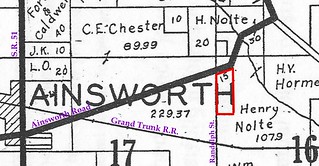
Fred Yager's farm is outlined in red on this map from the 1926 Plat Book.


Fred Yager lived on a little parcel of land on the southeast corner of the T-intersection of (present-day) Ainsworth Road and Randolph Street. That land had been in the Yager family as early as 1891, either coming down from his father, who died in 1887, or initially bought by his older brother (both were named Jacob).

It wasn't much — just 15 acres tucked in between the more impressive spreads of Henry Chester and Henry Nolte. You weren't likely to get rich on 15 acres, and even as a landowner Fred apparently hired himself out for day labor.

Around 1907 he landed a steady job as an engineer at the Hobart light and water plant. Every two weeks he took home $35, and by his own account handed every last cent of it over to his wife, Anna.

They had been married in 1905. Somehow their courtship had first begun by correspondence; eventually he traveled to her home in Aurora, Illinois, where they became engaged. It was her third marriage: of the two before, one ended in divorce, the other in death. But Fred didn't care about any of that. He seemed determined to make the third time the charm for Anna. He handed his paycheck over to her; he took her widowed father into his home; he indulged her mania for collecting (she had over 4,000 postcards from around the world). In the summer of 1910 he took her on a pleasure trip through northwest Indiana, into Chicago, and on a cruise across Lake Michigan.

He would soon prove to be a more indulgent husband than anyone could reasonably expect.

Somehow it came to Fred's attention that Anna had developed a habit of entertaining a visitor while he was at work. A certain bachelor in the neighborhood was coming to their house, sometimes taking Anna out driving in a buggy or walking in the woods, or even to dances and shows.

I don't know how all this came to Fred's attention. I expect he was clued in by observant neighbors. His closest neighbors, the Noltes, were a quiet, respectable family, and with an unmarried daughter in the household, Henry Nolte père would not have been indifferent to flagrant impropriety going on next door.

Whatever the source of his information, by the early spring of 1911, Fred could no longer doubt that his wife had a lover — and yet he went to work every day, knowing what Anna would get up to in his absence; and yet he came home and dutifully handed her his paycheck every two weeks.

On Thursday, March 30, 1911, Fred went to work as usual. Late in the afternoon he got a phone call advising him that strange things were going on in Ainsworth. Anna had spent the day packing up the Yager household, and then hired someone to haul it all to the Grand Trunk depot, leaving everything there under her father's name with instructions to ship it to Aurora, Illinois. As for Anna herself, she and her father had already left on a westbound passenger train. Fred hurried home to see for himself. He found the house bare except for a stove, bed and table, and a few dishes.

Now this was beyond endurance!

He returned to Hobart and hired attorney Roscoe R. Peddicord to start proceedings to recover his furniture. The next morning, a deputy sheriff seized the household goods (which were still at the Ainsworth depot awaiting shipment) and hauled them back to the Yager house. At a hearing the following Monday, Fred won possession by default judgment, since Anna did not show up.

Fred seemed less heartbroken than relieved to be through with indulging her. If only she'd waited two more days to leave him, he said, she would have had another $35 to travel on; but now his paycheck was his own, and in his opinion he had "much to gain and little to lose through the affair."

But his subsequent behavior showed that he did not accept the loss of his wife as calmly as his philosophical remarks would suggest. Adultery was then a crime, and Fred wanted his wife and her lover hunted down and brought to justice. He and his attorney asked Marshal Fred Rose of Hobart to get on the case.

In reporting this story, the Gazette noted that Fred "hesitate[d] not in naming" his wife's lover, but the newspaper wisely withheld the man's name. There was no proof — yet.

[To be continued]

Sources:
♦ "$2,000 Asked For Alimony." Hobart News 15 June 1911.
♦ 1891 Plat Map.
♦ 1900 Census.
♦ 1910 Census.
♦ "Ainsworth Pick-Ups." Hobart Gazette 7 Oct. 1910.
♦ "Local Drifts." Hobart Gazette 22 July 1910.
♦ "Loses His Wife." Hobart Gazette 7 Apr. 1911.

Wednesday, March 17, 2010

"They Died in Their Sin"

The Hobart Gazette described Ainsworth resident William Potter as a "well-known character." What exactly earned him that description, I do not know, but since his family had been farming in Ross Township at least since 1870, there are a good ten years of newspapers I haven't read yet that may enlighten me. So far I've come across a couple random facts about him: in 1899 he went to Iowa to work; by 1901 he was back in Ainsworth, appearing in court because of a tangle with a railroad worker (but that report doesn't say who allegedly did what).

In 1903 he was about 45 years old, unmarried and living with his widowed mother in Ainsworth, when he became involved with Amanda Guernsey, ex-wife of Otis.

Otis was just one of many Guernseys farming in southeastern Ross Township. He had been born around 1865 to Chester and Elizabeth Guernsey. In August 1894 he married Amanda Rex. She was his third wife. (What had happened to the first two, I wish someone could tell me.) Together they had five children.

At some point things went sour between Otis and Amanda. In March of 1903 she obtained a divorce. According to one report, she had charged him with cruelty — and yet, having secured her divorce, she returned to his house, employed by him as a live-in domestic servant. That sounds like an awkward situation, but I suppose it worked for them.

While still living with her ex-husband, Amanda found new love with William Potter.

On Friday, October 9, William and Amanda took Otis' horse and buggy and disappeared. They did not resurface until the evening of Monday, October 12, when they arrived at Adam Hetzler's saloon, at the north end of Cedar Lake. They took a room on the second story of the saloon and retired for the night.

About 4 a.m., Mr. Hetzler awoke to find his room filled with smoke. His shouts of "Fire!" were loud enough to wake another tenant of the saloon, who helped him get Mrs. Hetzler and their two little daughters out of the burning building. By the time the Hetzlers realized their two new guests had not gotten out, the wooden structure was engulfed in flames. It would have been suicidal to go back in to search for anyone.

William and Amanda died together in the fire. It isn't clear why they couldn't get out. One report speculated that "[t]he heavy smoke must have stupefied them."

"They Died in Their Sin," fulminated a Logansport newspaper, adding: "The woman, it is said, had deserted her husband and five children." The Hobart Gazette treated the couple more gently, calling their death "tragic," and as to the question of sin, said only, "Whether Mr. Potter and Mrs. Guernsey had recently been married, reports differ, and is doubted by many."

In short order Otis, too, found new love. He took Mrs. Minnie Jones as his fourth wife on October 15, three days after Amanda's death — or, as a Fort Wayne newspaper put it, "[b]efore the charred remains of the mother of his five children were interred." The Hobart Gazette, again, was kinder, although unable to resist a little indiscretion:
Their courtship was very short, in fact it was a case of love at first sight as only two days before Mrs. Jones had gone to the Guernsey residence to care for his household as his former domestic had recently before met with a fatal accident in the burning of the Cedar Lake hotel. The groom is 41 years old and has taken to himself the fourth wife while the bride is 39 years old and had been married once previously.
Together they raised his five children. Their marriage was apparently happy; they were still married when Otis died in 1927. His will provided that Minnie would receive the interests and proceeds of his estate until her death or remarriage. Upon either of those events, the estate would be divided among the children of Otis and Amanda.

Sources:
♦ 1870 Census.
♦ 1880 Census.
♦ 1900 Census.
♦ 1910 Census.
♦ "Additional Locals." Hobart Gazette 12 May 1899.
♦ "General News Items." Hobart Gazette 21 June 1901; 6 March 1903.
♦ "Hobart." Times (Hammond, Ind.) 12 March 1927.
♦ Indiana Marriage Collection.
♦ "Meet Tragic Death In Burning Hotel." Hobart Gazette 16 Oct. 1903.
♦ "Otis Guernsey Leaves a Will at His Death." Hobart News 7 April 1927.
♦ "They Died in Their Sin." Logansport Pharos 15 Oct. 1903 (Newspaper Archive).
♦ "Two Hearts Made Happy." Hobart Gazette 23 Oct. 1903.
♦ "Was in Haste to Wed." Fort Wayne Weekly Sentinel 21 Oct. 1903 (Newspaper Archive).

Sunday, February 21, 2010

I'd Like to Hear HER Side of the Story

Gernenznotice

"Without just cause or provocation" — that, of course, was the legal formula, not necessarily the truth. Perhaps Charles knew in his heart she had cause. Perhaps he was the oblivious type who never thinks anything is his fault. Or perhaps his young wife had truly wronged him.

Amelia had come to the U.S. from Germany around 1893, at 15 years of age. By 17 she had married Charles Gernenz, 11 years her senior. Before she was 18 she would be a mother.

By June of 1900 she had borne two children, and was pregnant again. The house where she lived held — in addition to her four-member family — Charles' parents, Amelia's mother, and a boarder.

Gernenzland
(Click on image to enlarge)
The Gernenz family land (outlined in red) in 1926. The parcels outlined in green had been held by Charles Gernenz' father at least since 1891.


Sometime between mid-June and early October, Amelia gave birth to a baby boy. They named him Ernest. In October, Ernest died.

Another seven months, and we have Charles' "Notice to the Public." How long, I wonder, did he wait for Amelia to come back before he published that embarrassing admission of his marital troubles?

He might have waited a little longer. She came back pretty quickly, it would seem: the 1910 census records her at home again, with three more children added to her brood — one of them, apparently, born in 1902. (For the sake of family harmony, let us hope Charles was the father.)

And she stayed. She was still with him in 1920, and the 1930 census finds them entering middle age together, with Charles, of course, well in the lead.


Sources