
It's odd that I was shocked to find that story. I must have seen it before: it was reported on by both of the Hobart newspapers, which I had read on microfilm long ago. Not only did I neglect the story the first time, I forgot I that my eyes had ever swept over it. The fallibility of human memory is a topic that comes up sometimes in this blog, and I have to say that my own memory heads the list of the fallible.
But let us proceed.
Among John Stoltz's many siblings was an older brother, Joseph, born in Illinois (like John) in 1868. By the time we catch up with Joseph in the 1880 Census, with the family living in Hammond, he was 12 years old and already gainfully employed. In what capacity, the census doesn't say; I hope he wasn't working in the slaughterhouse with his father.
In February 1891, Joseph married Mary Diedrich, and the young couple quickly started a family. In the 1900 Census, they were the parents of five children, four of whom were still living. Joseph described himself as an "express man." Trying to find out exactly what that meant took me on a side trek and I'm still not sure exactly what his job entailed. But evidently it didn't pay a great deal, as the household included two boarders.
Joseph and Mary lived more quietly than his brother John, so I'm not sure when they moved their family from Hammond to rural Ross Township. But that is where we find them in the 1910 Census. They were farmers, not storekeepers. Their rented farm appears to have been south of Merrillville (to judge by those of their neighbors who were not also renting). The household included seven children: Daniel (15), Cora (13), Margaret (9), Philomena (6), Fredrick (4), and Theresa (1); their oldest daughter, 17-year-old Katherine, is not listed with them (which may be a mistake by the enumerator).
A couple years after the census, Joseph's mother, Elizabeth — widowed in 1899 — came to live with them.
On October 2, 1914, tragedy struck the family.
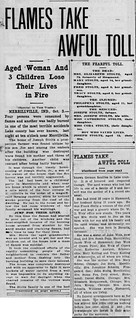
(Click on image to enlarge)
Lake County Times (Hammond, Ind.), 3 Oct. 1914.
The reference to "Tracy Stoltz, aged 6," is to little Theresa, who was one year old in the 1910 census.
Two days later, the Times reported on the funerals and burials of the victims.

(Click on image to enlarge)
Lake County Times (Hammond, Ind.), 5 Oct. 1914.
Besides adding some heart-rending details, the article mentions a "passing Chicago autoist." Some days later, he and his wife, who also helped, were identified:

(Click on image to enlarge)
North Judson News, 15 Oct. 1914.
As mentioned in the October 5 article, all the children were buried in SS. Peter and Paul Cemetery. Their entry on FindAGrave does not include a photo of a grave marker; nor does NWIGS' Ross Township Cemeteries note their grave in its listing, so it may be unmarked.
The grandmother, Elizabeth Weis Stoltz, is buried in Hammond.
The exact location of the Stoltz farmhouse is unclear. The family was probably still on rented land. One of the newspaper articles describes the house as "about a quarter of a mile south of the four corners in Merrillville" — the "four corners" being the intersection of 73rd and Madison. That would translate to a bit south of the intersection of 75th and Madison, which means Section 16, or Section 21 if the article's writer underestimated the distance south from the "four corners."
If we look at the 1908 Plat Map, we find some interesting names on the east side of Madison in Section 16, and just below its southern boundary:

(Click on image to enlarge)
Andrew Popp was Elizabeth Weis Stoltz's brother-in-law. And her own brother, John Weis, was among the "et al." in the "Elizabeth Weis et al." who owned 120 acres south of the Popp land. (John and Elizabeth Weis were the parents of Michael, whom we met in my previous post as the manager of the Marion Pierce store that preceded the Stoltz store.) It seems likely to me that the Stoltz family would rent land from relatives. However, according to A Pictorial History of Merrillville, both the Popp home and the Weis home were (and still are) the original structures — there is no mention of either burning in 1914.[1] There may have been another house on the land, or the Stoltzes may have rented on the west side of Madison. In short, I don't know the location of the farmhouse that burned.
Nor do I know where the surviving family lived after the loss of their rented home. The 1920 Census shows them living in their own home in Merrillville. It was probably a home in town, or close to town with a much smaller lot, as the 1926 Plat Book doesn't show any parcel belonging to them. Joseph was no longer farming; he had gotten work in the steel mills. The family was again taking in boarders.
At the Merrillville History Museum is a three-ring binder full of notes that we believe were gathered through interviews conducted by Jan Clemens (and any helpers she may have had) in the mid-1970s in preparation for writing A Pictorial History of Merrillville. The 1914 Stoltz tragedy is not mentioned in A Pictorial History, but it is mentioned in the notes in the three-ring binder, along with another tragedy in the family.

(Click on images to enlarge)
Images courtesy of the Merrillville-Ross Township Historical Society.


I think there were two interviewees, one of whom comes in on the third page with only a few lines. The first interviewee, covering the first two pages plus the top of the third, is surprisingly familiar with the tragedy some 60 years after it happened, naming all the young victims of the fire.
There is one odd detail in the story — the house that burned is described as "the old cheese factory." Now, among the people who run the Merrillville-Ross Township Historical Society, the old cheese factory in Merrillville is thought to be still standing at 7200 Madison Street. According to A Pictorial History, that house/cheese factory was built in 1880 to replace an earlier cheese factory on Walter Avenue. (The county records give it a build date of 1900, which is often a way of saying, "We don't know the exact year, but it was a long time ago.") The only other cheese factory mentioned in A Pictorial History was one built in 1855 by Dudley Merrill along 73rd Avenue — that one was donated to the Methodist Church's Ladies Aid Society by Charles Merrill (1850-1913).
So, was the interviewee confused, or was there yet another cheese factory south of Merrillville that has been lost to memory?
The second interviewee has only a few remarks on the tragedy: "Grandmother [Mary Diedrich Stoltz?] had to jump out the window; broke both ear drums — stone deaf. Spark from train set house on fire." Although the Times article of October 5, 1914, describes the house as one story high, I suppose a fall from a first-story window could rupture eardrums. The detail about the fire's originating with a spark from a train is more confusing — there were no train tracks between 73rd and (present-day) U.S. 30, so if the newspapers were correct about the Stoltz house being south of Merrillville, this detail could not be true. The "old cheese factory" house was close to train tracks, but it (so far as we know) never burned.
Could the second interviewee's memory have been shaded somehow by that other family tragedy mentioned on the first page of notes — Mary Stoltz's death on the C&O train tracks?

(Click on image to enlarge)
Hammond Times, 24 Sept. 1943.
It's interesting how this event is retold by the first interviewee in the 1970s notes:
Mary … was killed by a train while walking from Walter Demmon's grocery store. She used to walk on the railroad track to the store…..they had a path worn from their house to the store…..she had thought about stopping to visit next to the store but changed her mind and decided to take the short-cut home.How on earth could anyone have known what she was thinking in those last minutes before she was killed?
It is just possible, of course, that the odd details in these retellings resulted from confusion on the part of the note-taker!
_______________
[1] Per the county assessor's records, both the Popp home (7489 Madison), and what I believe to be the Weis home (7883 Madison) were built in 1870. Build dates in the 19th century are often approximations. Incidentally, A Pictorial History does not give an address for the Weis home, but says that it is south of U.S. 30; I believe this to be an error. No plat map shows John and Elizabeth Weis owning any land south of what is now U.S. 30.


No comments:
Post a Comment