(Click on image to enlarge)
The Ainsworth blacksmith shop and dance hall built by Edward Sauter. Date of photo unknown, but probably between 1904 and 1910. (Image courtesy of the Hobart Historical Society.)
Before Ed Sauter built his
saloon and blacksmith shop in Ainsworth in 1899, he had run a saloon in Hobart "in the O'Boyle building on Third Street," wherever that might be. In October 1899, closing his Hobart saloon, the 38-year-old Ed moved his whole family — his wife, Augusta; their teenage daughters, Clara and Lizzie; and their young sons, George and Edward — to Ainsworth.
While Frank Miller of Deep River ran the Ainsworth saloon for him, Ed set up as a blacksmith here. He'd done blacksmithing before, and perhaps a little during, his Hobart days, but he'd been keeping a saloon for so long that he seemed to think people would be skeptical of this change of occupation, as he ran this announcement in the November 10, 1899
Hobart Gazette:
Yes, I'm a blacksmith and horseshoer. I did blacksmithing before some people were born. I understand shoeing horses right and I can prove it. You bet I don't take a back seat for any one when it comes to horseshoeing. I can prove what I say in my shop at Ainsworth. Ed. Sauter.
Two years later, his business was coming along well enough that he felt able to expand. He added a frame addition to the west side of the blacksmith shop, with storage space on the ground floor, and on the upper floor a dance hall.
The May 10, 1901
Hobart Gazette carried this announcement:
Ed. Sauter will initiate his hall at Ainsworth next week Thursday evening, May 16th, by having a grand ball. He will employ good music and will insure all his friends who attend of having a good time. The dancing hall is 24 by 50 feet and the room contains a fine hardwood floor, the pride of any dancer. He invites all his old Hobart friends to attend and join in the festivities at the grand opening.
The Hobart Cornet Band provided the music.
By November Ed had gotten the hall plastered and was painting it to be ready for the New Year's dance. Other dances followed, only some of which were announced: a mask ball in February 1902, an April dance, a September dance with music by the Balatka orchestra of Chicago, a "Married Peoples'" dance in December 1902, a "sheet and pillow case masquerade ball" in March 1903, followed the next month by an Easter dance, and so on.
Some of the Ainsworth news items in the
Gazette were, I suspect, reported and shaded by their subjects, such as this March 1902 item: "Ed. Sauter has recently purchased a lot adjoining his property from John Miller. Ed. is a hustler and is branching out in his various industries in that burg. He has also put down a town pump, for public use." Or this, from August 1903:
One has only to go to Ainsworth to realize what a busy little burg the place is. Two stores, postoffice and Ed. Sauter's various industries constitute the business features there but one will be surprised if they visit the place to see what a lively business center it is. Mr. Sauter besides satisfying the wants of the inner man supplies him with all kinds of farm implements and vehicles, shoes his horses and attends to all manner of general blacksmithing and recently has employed Paul Schillo of this place to attend to the woodwork department. His is a busy place and Ed. with his three helpers is kept at work early and late.
The "wants of the inner man," of course, were satisfied in the saloon. The saloon building was a two-story terra cotta structure, 20 feet wide and 34 feet deep. The upper floor and the back part of the lower floor were taken up with living quarters. The saloon itself occupied only the front room of the first floor, 20' x 15', with a nine-foot bar and (in 1905, at least, when this description was written) two tables and six chairs for customers' use.
As we know, early in 1904 Ed sold his saloon to
Claus Ziegler, building, business and all, for $2,100.
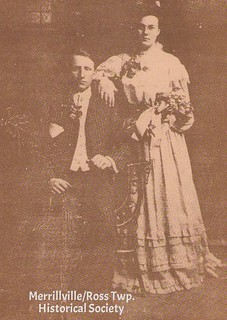
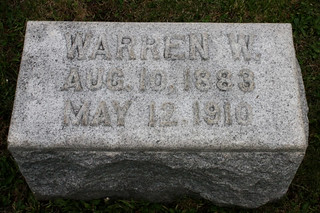
In April 1904, Lizzie Sauter married Warren Boyd and the young couple moved to his farm in Merrillville. Later that year Clara Sauter took a job clerking at the Spot Cash Store in Hobart.
Ed continued operating the blacksmith shop and dance hall. If we can believe the newspaper reports, business was good; in May of 1904 he had "installed a new gasoline engine" in his shop and was "doing a rushing business"; in the last week of December he shod eight teams. January 1905 was a busy month in his dance hall: one Saturday evening 119 ducks and 27 geese were raffled off to the music of a Chicago orchestra, and a couple weeks later came a big entertainment and social event with "real calcium and Bengal lights." April brought an announcement of a series of dancing parties organized by two local residents.
And that's why it came as a shock when I read a one-line announcement in the
Gazette's "General News Items" of November 24, 1905: "Wm. Raschka the Ainsworth merchant has been appointed receiver for the Ed Sauter estate at Ainsworth."
Was Ed bankrupt? Dead? What on earth happened?
As it turned out, he wasn't dead. Apparently some disaster befell his "rushing business." Perhaps it wasn't so rushing after all, or he mishandled his money, or perhaps the young men who
fell from his staircase in May 1904 sued him into oblivion — but no such suits were ever mentioned by the
Gazette, nor any other explanation ever given. All I know is that Ed somehow got over his head in debt to the First State Bank, and the bank foreclosed on his property.
On February 17, 1906, a sheriff's sale was held at the east door of the Court House in Crown Point, offering seven years' "rents and profits" from Ed's property — or, if that would not bring a sufficient price to pay Ed's debts, then the property itself. The
Gazette noted that some time earlier Ed had refused an offer of $2,800 for his property, and "[t]he bank's claim and costs in the foreclosure proceedings amount to about half of that price."
At that sale, the First State Bank itself bought the property, and then turned around and advertised to sell it. When they couldn't sell it, they rented it — to Claus Ziegler, who now intended to live in Ainsworth.
In April 1906, the
Gazette reported, "Mrs. Ed Sauter has moved upstairs in the Rohwedder house on our Main street," which sounds as if husband and wife were now living apart. (No word of where the children were staying.) In June came the announcement, "Edward Sauter . . . is working now in South Chicago and is looking fine." The irrepressible Ed was apparently back on his feet, or wanted to give that impression.
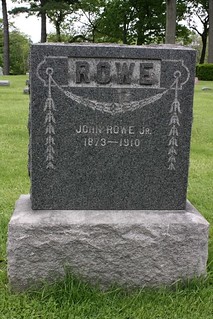
When Clara Sauter married John Rowe, Jr., in February 1907, her parents were described as "Mr. and Mrs. Edward Sauter," without further comment. (The announcement added that the young newlyweds "have the best wishes of a large circle of friends, in which the Gazette heartily joins.")
The 1910 Census shows an Edward Sauter living in Chicago, married but apparently living apart from his wife in a boardinghouse, and working as a blacksmith in a factory. In the 1920 Census, he is listed as single. I don't know what ultimately became of Ed and Augusta.
Well, that's rather depressing, isn't it? I may find out more as I go along with reading. I don't know if I ought to write open-ended stories like this, but if I waited until I read enough microfilm to get the full story, it would be a long time between blog entries.
Sources:
♦ 1900 Census.
♦ 1910 Census.
♦ 1920 Census.
♦ "Additional Locals." Hobart Gazette 10 Nov. 1899.
♦ "Ainsworth Pick-Ups." Hobart Gazette 30 Dec. 1904; 6 Jan. 1905; 13 Jan. 1905.
♦ "Application for License." Hobart Gazette 22 Sept. 1905.
♦ "Buy Sauter Property." Hobart Gazette 23 Feb. 1906.
♦ "General News Items." Hobart Gazette 29 Mar. 1901; 21 Mar. 1902; 5 Sept. 1902; 3 Oct. 1902; 19 Dec. 1902; 6 Mar. 1903; 10 Apr. 1903; 15 May 1903; 14 Aug. 1903; 6 Nov. 1903; 4 Dec. 1903; 29 Jan. 1904; 6 May 1904; 28 Oct. 1904; 25 Nov. 1904; 7 Apr. 1905; 24 Nov. 1905; 22 June 1906; 1 Mar. 1907.
♦ Indiana Marriage Collection.
♦ "Local Drifts." Hobart Gazette 14 July 1899; 18 Aug. 1899; 13 Oct. 1899; 27 Oct. 1899; 29 March 1901; 10 May 1901; 29 Nov. 1901; 7 Feb. 1902; 5 Feb. 1904; 26 Feb. 1904; 11 Mar. 1904; 16 Mar. 1906; 20 Apr. 1906.
♦ "Married in Hobart." Hobart Gazette 22 Apr. 1904.
♦ "Sheriff's Sale." Hobart Gazette 2 Feb. 1906.