Showing posts with label Witt. Show all posts

Friday, August 14, 2020

Ainsworth School-Year Souvenir, 1897-98 (Part 2)

(continued from Part 1)

As we now turn our attention to the pupils listed on the souvenir, I find there are more names here than I can index, so I'm going to have to split this up still further.

2020-08-14. Ainsworth school souvenir 1897-98 b
(Click on image to enlarge)

I'll deal first with the names I've encountered before.

Blachly — Earl and May were siblings, the children of Morgan and Amelia. Earl had been born in 1882, May in 1884. By the way, I think the house at 4301 E. 73rd Ave. was the Blachly house, built in 1905[1] to replace whatever the family had been living in until then.

Bullock — Hubert probably met up with the Blachly kids as he walked down from the Bullock home, unless he walked along the Grand Trunk Railroad tracks or cut across the fields … but the latter would be some rough walking.

Chase — I thought this would be easy, since I know of a Chase (aka Chace) family recorded in Ross Township in the 1870 Census and 1880 Census, members of whom were residing in Hobart into the 1920s (Minnie Chase Smith and Gust Chase). But I can't place Gracie in any census. She might not have belonged to the local Chases, but to some Chase family just passing through.

Coyle — Nina, Stella, and Arlie were the daughters of Ainsworth's postmaster, Frank Coyle. Nina, the youngest, was the only one born in Indiana (1892). Her older sisters had been born in Kansas. Why the family moved from Kansas to Ainsworth, Indiana, is a mystery, but I suspect it might have something to do with Frank's wife, Susanne, having been born a Chase — possibly she had some relation to the local Chases. The Coyle family left this area probably around 1904 (when Frank resigned as postmaster) and moved permanently to Kansas City, Missouri.

Halsted — Howard lived above the Ainsworth general store with his parents, Willard O. and Barbara (Fiester) Halsted. He probably was a promising student, since he went on to law school. As we know, he died before his time.

Kagabein aka Kegebein — Frieda lived on a farm north of Ainsworth. Her parents were John and Carolina "Lena" (Eick) Kegebein. Frieda was born in 1891. In 1911, she became Mrs. Albert Witt.

Maybaum — There were so many Maybaums around here that I can't keep them straight. These two, Louis and Hattie, were cousins, I believe. Hattie was the youngest child of Charles and Caroline, born in 1886. In 1907 she became Mrs. R.D. Sizelove. Charles and Caroline's (I believe) eldest child, August, begat Louis in 1891. The 1900 Census shows the family — August and Dora, with Louis and his two younger brothers, Harold and Clarence — farming rented land among southeast Ross Township neighbors such as Bragington, Campbell, and Doepping.[2] In 1916 Louis married Ruby Man in Porter County. By 1917 they had moved to Battle Creek, Michigan,[3] and by the 1930 Census they were running an "oil station" in San Antonio, California.

Ols — Edward was the grandson of John and Charlotte Ols, born in 1890 to their son, John Jr., and Alta (Whittemore/Whitmer). Based on the 1900 Census, I believe they owned the 80-acre parcel in the southeast corner of Section 7 that later passed to Henry Chester, then Charles Chester, then John Berndt. The census records after 1900 show Edward in various places like Starke County and Gary, Indiana; as far as I know he never lived in Ainsworth after the family sold their 80 acres.

Pierce — Ruth (b. 1882) and Jennie (b. 1884) lived with their father, Reuben, and stepmother, Catherine. Their mother, Caroline (née Kegebein), had died in June 1895, not quite a week after their grandfather, Orrin Pierce, who had owned the farm where they lived as far back as 1874:

2020-08-14. Pierce, Orrin - 1874
(Click on image to enlarge)
From the 1874 Plat Map.


I don't know what, if any, relation they had to their Pierce neighbors.

Ruth Pierce married William Kelleher in Chicago in 1908; they lived and raised their family in Chicago. All I know about Jennie is that she is buried in the Hobart Cemetery under her maiden name.

Smith — Pearl Smith was the adopted daughter of Cyrus and Ellen Smith. So she was also the adopted cousin of the teacher, Mabel Smith Peterson.

Wojohn aka Wojahn — Frieda, Emil, Gust and Paul were some of the children of Julius and Alvina Wojahn. These four were born between 1884 and 1889. We've already met another of their children — Elsie, who married Howard Shearer. The Wojahn family lived on Ainsworth Road just west of the Lindborgs.[4] The schoolhouse was an easy walk west.

[to be continued]

_______________
[1] Per the county records; also in my notes I find a reference in 1907 to Morgan Blachly's "new" house being blown off its foundation during a storm ("General News Items," Hobart Gazette, Mar. 29, 1907).
[2] From that location, they may have been attending a different school, such as the Deep River school, or the Hurlburt school if it was still operating.
[3] "General News," Hobart Gazette, Dec. 21, 1917.
[4] I believe the house at 6222 Ainsworth was built for the Wojahn family, in 1930 according to the county records, so it would have replaced an earlier house.

Saturday, April 7, 2018

Chicken Thieves Again

As long as there are chickens, there will be chicken thieves. And there were plenty of chickens around Ainsworth in 1923.

2018-4-7. Thieves
(Click on image to enlarge)
Hobart News, April 5, 1923.


Albert Witt lived just north of Ainsworth.

John Wojahn, a former Ainsworth-area farmer, was probably living in the village of Ainsworth, to judge by his neighbors in the 1920 Census and 1930 Census. He was retired — or so I thought, but that was quite a "hennery" for a village backyard.


Over in the next column, Ruby Fisher has been exhibiting her musicianship.

Friday, September 26, 2014

Baby, Burn

Monday, July 11, 1921, was a day of joy the Kegebein farm, as Albert and Frieda Witt welcomed a baby boy into the world — their fifth child.

Tuesday was a day of disaster.

2014-9-26. Barn fires
(Click on image to enlarge)
From the Hobart Gazette 15 July 1921.


Going into Hobart, Albert had actually seen the town's fire engine rush by him, never suspecting it was headed towards his own place. Perhaps someone telephoned Jim Chester, who lived on Water Street, and told him go find Albert; the Herman Neef residence, where Jim caught up with Albert, was on Lake Street.

It must have been a shock to the unnamed sister (in-law) staying with Frieda when she looked outside and saw the roof of the 36' x 66' barn all on fire, and she in charge of a sick woman and five children. The Bullock home to which Frieda was carried was probably the Claude and Mary Bullock farm on the bank of the Deep River.

With no fire hydrants in the area, the Hobart fire department had to rely on its "chemical engine." When its chemicals were exhausted, the house and new granary had been saved, but the wreckage of the barn and other buildings was still smoldering. The last of the fire was put out with a hose "attached to the feed pipe running from the creek [Deep River] to Ainsworth used in mixing concrete."

Frieda recovered, and so did the baby, whom they named — not Blaise, Incendio, or even Phoenix, but — Clyde.

(You will notice just above the newspaper report of the Kegebein fire, another barn fire in Hobart.)

♦    ♦    ♦

In local sporting events we have Hobart's Everett Newman triumphing at the Roby speedway, and a mercenary baseball team from Valpo.

2014-9-26. Everett Newman racing
(Click on image to enlarge)
From the Hobart News 14 July 1921.


Additional Sources:
♦ "$5,000 Fire at the Kegebein Farm, Tuesday Afternoon." Hobart News 14 July 1921.
♦ 1920 Census.
♦ 1930 Census.
♦ "Births." Hobart Gazette 15 July 1921.

Friday, June 20, 2014

The Camp Ground in McAfee's Woods

Since January 1921 the Hobart Commercial Club had been working with Paul Newman, trailsman, to develop a camping ground near Hobart for tourists on the Yellowstone Trail. At a Commercial Club meeting in March, the camping-ground committee reported on its progress: it had entered negotiations with William McAfee to rent four acres of his "7-acre wood lot east of town"; it had planned what improvements would be built and roughly how much those improvements would cost (about $250, to be raised by subscription); it had already received donations of over $100.

I do not know exactly where these four acres were. William McAfee had owned land along the south side of Cleveland Avenue, east of town, for many years (indeed, his parents had owned land there at least since the 1870s), but it's in different places per the 1908 Plat Map …

2014-6-20. W. McAfee 1908
(Click on images to enlarge)

…and the 1926 Plat Book.

2014-6-20. W. McAfee 1926

Nor can I see anything recognizable as a camping ground in the 1939 aerial photos, though we do see what looks like a wooded tract on the southeast corner of Cleveland and S.R. 51. But it's a long time between 1921 and 1939, and the camping ground may not have been in existence by then, even if it could be identified from the air.


Anyway, work went forward during the spring of 1921, and by the end of April, the camping ground was nearly completed.

2014-6-20. Camping ground

The Commercial Club had exceeded its own goal in raising money. So many local individuals and businesses had contributed that I can't index them all. The Kulage Brick Works even donated bricks.

2014-6-20. Report


Sources:
♦ "Commercial Club Holds Good Meeting." Hobart Gazette 11 Mar. 1921.
♦ "Report on Tourists' Camp Ground." Hobart News 19 May 1921.
♦ "Tourists' Camp Ground About Ready." Hobart Gazette 29 Apr. 1921.

Sunday, June 8, 2014

A Double Sapper Wedding

The last of April 1921 was a joyous day in the home of Charles and Minnie Sapper, as two of their daughters, Matilda and Rosella, became wives.

6-8-2014 Sapper wedding
(Click on image to enlarge)

I don't know what Caroline (Sapper) Nelson did about her nine-day-old infant — perhaps she wasn't able to attend her sisters' wedding. On the other hand, I'd be surprised if Albert and Frieda Witt didn't drive up from the Kegebein farm to see his brother married.


6-8-2014 Sapper-Witt-Henschel wedding
(Click on images to enlarge)
Photos courtesy of the Ewen family.
Back row: Wilbert Wagener, Lillian Fasel, unidentified, Annabel Sapper, Albert Kraft, unidentified. Front Row: Emil Henschel, Rose Sapper, Matilda Sapper, Paul Witt.


6-8-2014 Emil and Rosella Sapper Henschel
Emil and Rosella (Sapper) Henschel.

I don't know much about Emil Henschel. He was born in Germany in 1890 and came to this country in 1905. I can't find him in the 1920 census.


Sources:
♦ 1920 Census.
♦ 1930 Census.
♦ "Double Wedding." Hobart Gazette 6 May 1921.
♦ WWII Army Enlistment Records.

Wednesday, April 2, 2014

"A Small Ugly Looking Still"

The last I heard, Albert and Frieda Witt had come back to farm the Kegebein land north of Ainsworth. Now it's the spring of 1921 and the outbreak of pertussis at the Ainsworth school has infected all of their children — a little girl of eight and three boys ranging from six to three years old.

Happier news out of Crown Point, where 18-year-old Elmer Bullock has been demonstrating his musical abilities.

Beyond that, the news was disorderly drunks and a raid on a still.

4-2-14 Witt-Bullock, News, 4-14-1921
(Click on images to enlarge)
From the Hobart News 14 Apr. 1921.


(I believe Floyd Bayor was a Ross Township native, son of Frank and Flora Bayor. In 1920, he was a 41-year-old bachelor living in Hobart with his parents, plastering houses for a living. As for Walter Hensel, he is a mystery to me.)

The Gazette's description of the seized still was a little more informative.

4-2-14 Still, Gaz, 4-15-1921
From the Hobart Gazette 15 Apr. 1921.

I believe that the previous still raid mentioned was in 1919.

Neither paper ever gives "Mr. Osborn" a first name, so I'm not going to try, either.

… And in other places, other Prohibition-flouters.

4-2-14 Liquor, Gaz, 4-22-1921
From the Hobart Gazette 22 Apr. 1921.

If "sand-hills" = "sand dunes," that seemed to be a popular location for illicit stills.

4-2-14 Liquor, Gaz, 5-27-1921
From the Hobart Gazette 27 May 1921.

I like the way they reassembled the still and put it on display so the public could come and get still-making tips.


Sources:
♦ 1920 Census.
♦ "Capture Another Still in Hobart." Hobart Gazette 15 Apr. 1921.
♦ "Local and Personal." Hobart News 14 Apr. 1921.
♦ "Local Drifts." Hobart Gazette 15 Apr. 1921; 22 Apr. 1921.
♦ "Was Making Good Whisky." Hobart Gazette 27 May 1921.

Thursday, November 21, 2013

Third Time's the Charm?

Albert Witt started farming again late in December 1920 — the third start, by my count. (Also, a few random happy reports about people whose names we know.)

Albert Witt starts farming again
(Click on images to enlarge)

Albert's first start was barely perceptible. Born into a farming family, he grew up with the line of work, and in 1910, at the age of 25, he still lived on the family farm, giving his occupation as farmhand. On March 1, 1911, he "quietly married" Frieda Kegebein, the only surviving child of John and Lena Kegebein — likewise a farming family — and came to live with his wife and in-laws, to farm the land the Kegebeins had bought sometime between 1874 and 1891.

Kegebein land 1908

In November 1915, Albert placed this notice in the Gazette:
Having decided to quit farming, I will offer for public sale at the John Kegebein farm, located 2½ miles south of Hobart, and ½ mile north of Ainsworth, beginning at 10 a.m., Monday, Nov. 15, three horses, 12 milch cows, 14 heifers, 15 head of hogs, chickens, farming implements, household furniture, and many articles not mentioned.
I don't know what Albert did instead of farming, but he was still on the Kegebein land in 1916 when he traded farms with his neighbor, Glen Nelson.

Albert remained on the Charles Chester farm until he quit farming the second time, and this time he really meant it — temporarily, at least. The January 1920 census records him working in the steel mills; he and Frieda and their four children lived on the "Chicago road," which I believe is Old Ridge Road.

(I don't know where John and Lena Kegebein had been living while their farm was rented by Glen and Elsie Nelson. The 1920 census shows the Kegebeins on their own property somewhere in the vicinity of Ainsworth, but John's occupation is given as "retired farmer." Perhaps they had a little house in the village, or even on their own land.)

But now, as we see, Albert and Frieda Witt have come back to the Kegebein farm, and we shall see how long the farming lasts this time.


Sources:
♦ 1874 Plat Map.
♦ 1891 Plat Book.
♦ 1908 Plat Map.
♦ 1920 Census.
♦ "Local and Personal." Hobart News 30 Dec. 1920.
♦ "Public Sale." Hobart Gazette 12 Nov. 1915.
♦ "Quietly Married." Hobart Gazette 3 Mar. 1911.

Sunday, December 23, 2012

Scarlet Fever

Adding to the miseries of the winter of 1919-20 — on top of influenza and smallpox — we now find scarlet fever. By early March, it had caused the quarantine of three homes in Hobart: those of Albert Witt, Henry Ittel and Alvin Shafer.

The miseries of the approaching spring threatened to include Albert Halsted, a Ross Township farmer, running for Lake County sheriff.

♦    ♦    ♦

This little item caught my eye, as it concerns two of our acquaintances — William Schavey (Hattie's husband and Mable's uncle) and John Harms.

Harms-Schavey sale
(Click on image to enlarge)

According to the 1930 census, the address where William and Hattie Schavey were living was 750 Lincoln Street. (I can't find them in the 1920 census.)


Sources:
♦ 1920 Census.
♦ 1930 Census.
♦ "Local and Personal." Hobart News 11 Mar. 1920.
♦ "Local Drifts." Hobart Gazette 12 Mar. 1920.

Thursday, January 5, 2012

Brave New Year

Flu epidemic or no flu epidemic, young Harry Coons was going to have his usual birthday bash on New Year's Day — so said Harry Sr. and his wife, Mary, in late December as they issued invitations to many of their son's friends.

Others in Hobart sounded equally determined that the new year would be a new start. The Gazette's last issue of 1918 predicted that Dr. Clara Faulkner would allow the general quarantine to be lifted on January 1. Dr. Richard Mackey, Hobart's school board president, and George A. Fowble, school superintendent, announced that local schools would open on Monday, January 6.

This was in spite of the flu's being still "strong in evidence" in and around Hobart. The Gazette seemed to be wavering between optimism and accuracy as it reported that "generally speaking there is a lessening [of the flu] although there are several severe cases. There are now very few cases right in town but in some rural neighborhoods nearly every family is afflicted."

Nor had the flu stopped killing: it, or its complications, took Martha Wischmann Dewell, a 33-year-old wife and mother, the day after Christmas; on December 27th, Lillie Ruth Witt, just 14 days old; the next day, Cornelius Goodenow, a Civil War veteran one day short of his 81st birthday; and on New Year's Eve, 11-year-old Cornelius Carstensen.

Nonetheless, the brave plans went forward. Dr. Faulkner did indeed lift the general quarantine on New Year's Day — the same day that Harry Coons, Jr. celebrated his 10th birthday with 28 young friends in attendance. On the morning of January 6, Hobart's children went to school for the first time in over a month.

Two days later, near Ainsworth, Albert Hagerty lost his 25-year-old wife, Cora, to influenza.


Sources:
♦ "Ban Is Lifted." Hobart Gazette 3 Jan. 1919.
♦ "Ban May Be Lifted." Hobart Gazette 27 Dec. 1918.
♦ "Cornelius Carstensen." Hobart News 2 Jan. 1919.
♦ "Cornelius Goodenow, Veteran of the Civil War, Passes Away." Hobart News 26 Dec. 1918.
♦ "Deaths for the Week." Hobart Gazette 3 Jan. 1919; 10 Jan. 1919.
♦ "Harry Coons Jr. Celebrates His Tenth Birthday Anniversary." Hobart News 2 Jan. 1919.
♦ "Hobart Schools to Start Again January Sixth." Hobart News 26 Dec. 1918.
♦ "Influenza Ban Raised in Hobart Jan. 1, by Health Commissioner." Hobart News 2 Jan. 1919.
♦ "Local Drifts." Hobart Gazette 27 Dec. 1918.
♦ "Mrs. Albert Hagerty Dies of Influenza Near Ainsworth." Hobart News 9 Jan. 1919
♦ "Mrs. Wm. Dewell." Hobart News 2 Jan. 1919.
♦ "Schools to Open." Hobart Gazette 27 Dec. 1918.

Saturday, February 26, 2011

Albert Witt Quits Farming

2-26-2011 Albert Witt sale HN 10-11-1917
(Click on image to enlarge)

Albert Witt placed the above notice of public sale in the News early in October 1917. The social column on the same page sums up the situation: Albert had been renting and farming Charles Chester's 80 acres of land just north of Ainsworth; Charles sold the parcel to John Berndt; perhaps Albert was required to vacate to make way for the new owner, but it was no skin off his nose because he'd had enough of farming anyway.

The 80 acres we're talking about were probably the same as John Berndt owned in 1926:

Berndt80
(Click on image to enlarge)

That parcel belonged to John Ols in 1891, but there was time enough between then and 1910 for either Henry or Charles Chester to buy it.

♦    ♦    ♦

I have to revise my earlier guess at which parcel Lovisa Chester Nelson had rented from Charles Chester in 1911. Now I think it was the Berndt 80 plus an additional 30 acres somewhere adjacent (which Charles sold to Charles Ols at the same time as the Berndt sale).


Sources:
♦ 1891 Plat Book.
♦ 1926 Plat Book.
♦ "Personal and Local Mention." Hobart News 12 Oct. 1916.
♦ "Public Sale." Hobart News 11 Oct. 1917.
♦ Untitled social column. Hobart News 11 Oct. 1917.

Friday, February 18, 2011

A Man of Mystery

After Morgan Blachly's death in 1910, his widow, Amelia, retained ownership of at least part of the 180-acre homestead, although she and their only daughter, May, went to live in Hobart. In 1912 Amelia sold the southeast 40 acres to Christian Weiler. As for the rest, she may have rented or sold parts of it to the three Blachly sons, Walter, J.B. and Earl, as all of them were farmers.

In 1913 Earl got tired of farming, bought a partnership in B.C. Wells' Hobart garage and sold all his livestock and farming equipment — but he didn't sell his land, just rented it to someone else. After about a year in the garage business, Earl had enough of that and returned to the farming life. His wife of 12 years, Elizabeth (née Bodamer), divorced him in 1916 and was awarded custody of their daughter. Earl consoled himself in 1917 by marrying Annie Witt — yes, of that same Witt family whose members have been all over the Ainsworth area. (Elizabeth married Walter J. Tutwiler of Hobart in December 1917.)

By contrast, J.B. and Walter Blachly had more stable lives. Their farming and their marriages went on without interruption.

In 1915 May Blachly traded three lots she owned in Hobart for 75 acres of farmland, known as the old Ragen farm and lying across the Joliet road (73rd Ave.) from the Blachly homestead. A couple years later, she and her mother left their Hobart home and moved to May's farm. After living there about four months, May began advertising her farm for sale.

MayBlachly75
(Click on image to enlarge)
Outlined in green is the 75-acre parcel May Blachly bought in 1915 — just north of the old Blachly homestead, outlined in red.


She found a buyer in S.J. Craig, Lake County's agricultural agent and the author of this immortal tome:

AgriAdvisor
(Click on image to enlarge)

I wonder if there was any awkwardness about his coming into the neighborhood, considering the unpleasantness of 1914 — following the outbreak hoof-and-mouth disease that year, local farmers John Gruel and William Shults (along with Fred Bowman of Lowell) led an effort to remove S.J. from office, and the petitions they circulated eventually garnered 200 signatures. But perhaps by 1917 that was all bygones.

As for S.J. himself, he's a man of mystery. I don't even know his given name, since he never used it, even, it seems, hiding out from census enumerators so he wouldn't have to give it — which also means I know nothing about his family, if he had one. I've seen him now and then in the news, but only in his official capacity, e.g., haranguing people to produce food for the war effort.

Perhaps if he comes to live on this farm, we'll find out more about him.

CraigontheJob
County Agent S.J. Craig (right) on the job, from The Lake County Agricultural Advisor. Note how he carefully hides his face from the camera.


Sources:
♦ 1891 Plat Book.
♦ 1926 Plat Book.
♦ "Additional Local News." Hobart Gazette 21 Sept. 1917.
♦ "Blachly-Witt." Hobart News 19 Apr. 1917.
♦ Craig, S.J. The Lake County Agricultural Advisor. Crown Point: Lake County Star, 1916.
♦ Indiana Marriage Collection.
♦ "Local Drifts." Hobart Gazette 30 Jan. 1914; 1 May 1914; 3 Aug. 1917.
♦ "Personal and Local Mention." Hobart News 31 July 1913; 10 Dec. 1914; 28 Jan. 1915; 4 Feb. 1915; 9 Mar. 1916.
♦ "Personal Mention." Hobart News 8 Aug. 1912.
♦ "Public Sale." Hobart News 20 Feb. 1913.
♦ "Tutwiler-Blachly Nuptial." Hobart Gazette 7 Dec. 1917.
♦ Untitled social column. Hobart News 19 Apr. 1917; 2 Aug. 1917; 11 Oct. 1917.
♦ "Wells & Blachly Is Name of New Garage Firm." Hobart News 3 Apr. 1913.

Monday, January 3, 2011

How Ainsworth Welcomed Its Returning Exiles

Julius Triebess lived in Chicago, but his heart was in Ainsworth. Sometime after 1891 he'd bought a farm of 100 acres south of the village. I don't know whether, or for how long, he farmed it himself; but in 1900 he joined the Chicago Fire Department, and the demands of that job required Julius and his family to live in the city. At that point, probably, he began renting the farm out. In August 1908 we find him advertising for a tenant, and by September he'd rented the land to John Witt, Jr.

Julius came out from the city now and then to visit his farm, staying in the farmhouse with John's family. After John's failing health forced him to give up farming, Julius next rented the place to John W. Harms. He still came out from the city now and then to visit his land.

And then, providentially, on April 1, 1917, the Chicago Fire Department changed its rules of operation: firemen were now on duty for 24 hours, then off a for full 24 hours. At last it became practical for Julius to commute between his job in Chicago and his farm in Ainsworth. He jumped at the chance. He hired a man to take care of the farm work during his 24-hour shifts; he packed up all the contents of his Chicago dwelling; and by mid-April, he and his family had come home to the farm.

On the evening of April 29, the Triebesses drove up to Hobart and caught the train to Chicago for a short visit. Around 9 p.m. they returned to their peaceful country home to find it "ransacked from cellar to garret." Missing were some household implements, such as buckets and tubs, and all of the food they'd brought out from Chicago — about 3 dozen cans of fruit and a couple of hams — and several loaves of bread that Mrs. Triebess had lovingly baked the previous day. Half of one loaf lay discarded in the yard.

Investigation turned up some eyewitness accounts. Neighbors had seen a Ford drive up to the house around dusk, and two men and a woman got out and went into the house. Another passerby noticed a light in the house around 8 o'clock. All the witnesses, unaware that the Triebesses were away, simply assumed the trio were visitors. Oddly enough, there was no sign of forced entry; evidently the robbers let themselves in with a key, and calmly went about clearing the place out. The Ford was traced as far as Merrillville, and then the trail vanished.


Sources:
♦ 1891 Plat Book.
♦ "Additional Local News." Hobart Gazette 19 Sept. 1913; 20 Apr. 1917
♦ "General News Items." Hobart Gazette 14 Aug. 1908.
♦ "Local Drifts." Hobart Gazette 18 Sept. 1908; 2 July 1909; 27 July 1916; 30 Mar. 1917.
♦ "Personal and Local Mention." Hobart News 12 Feb. 1914.
♦ "Rob Farm House." Hobart Gazette 4 May 1917.
♦ "Ross Township Notes." Hobart Gazette 1 Sept. 1911.
♦ "Thieves Continue Their Depredations in This Vicinity." Hobart News 3 May 1917.

Thursday, December 16, 2010

Pay Up, You Deadbeats!

Yes, I'm following William Witt's life story. Some of these Ainsworth connections are ridiculously remote, and then sometimes I drop all pretense that a topic has anything to do with Ainsworth and just write about it because, well, this is my blog and I can write about whatever I want.

William apparently wanted to raise money in the autumn of 1916. We've already seen him sell his team and equipment. And as winter came on he started pressuring his debtors to pay up. A late December issue of the Gazette carried his polite but firm request: "Those who have borrowed money in various amounts from [me] are requested to pay same within 30 days or action will be started to collect same."

When we hear from him next, in early January, he sounds as if he's losing patience with the deadbeats: "Unless those having borrowed money from me settle very promptly, I will be compelled to take legal action to collect the same. Nothing but a settlement will suffice."

Around the end of the year he and his father had paid a brief visit to some Chicago relatives. William had earlier gone to Chicago for treatment of pain in his amputated arm. I wonder if the treatment was continuing, and that's what he needed money for.


Sources:
♦ "Local Drifts." Hobart Gazette 5 Jan. 1916.
♦ "Notice to Those Concerned." Hobart Gazette 22 Dec. 1916; 5 Jan. 1916.

Thursday, November 18, 2010

More Trouble for a Corn-Husker Victim

A month after he lost his older brother John to tuberculosis, William Witt found himself with a medical problem of his own.

We first met William when he lost an arm to a corn husker in November 1901. Fifteen years later, we find him, in spite of his loss, able to earn a living as a teamster, managing a team of horses and a wagon. But in August 1916, he began suffering such severe pain in the amputated arm that Dr. L.M. Friedrich of Hobart decided to take him to Chicago to be seen by a specialist.

LMFriedrich1955
(Click on image to enlarge)
Dr. L.M. Friedrich circa 1955. He is standing on Main Street opposite the office of the Hobart Gazette. Image courtesy of the Hobart Historical Society.


The Gazette did not report the results of that visit. But it may be significant that a month later William began placing ads to sell his team and wagon "Team of bays," one of his ads said; "weight about 2,800, good pullers, good wind, gentle, drive single or double, also harness in good condition, and Birdsell wagon and 2-yard Studebaker dump box. Price right."

Early in November he sold the whole outfit to William Raschka.

♦    ♦    ♦

Meanwhile, farm machines continued their bloody harvest. For example, on September 30, 18-year-old Kenneth Humes was working a corn shredder on the Walter Blachly farm west of Ainsworth when he got his fingers too near the machine's blades. That mistake that cost him part of his right index finger and all of his left middle finger. His left index finger was severely cut up, but his doctor hoped it could be saved.


Sources:
♦ "Gets Fingers in Shredder." Hobart Gazette 6 Oct. 1916.
♦ "Local Drifts." Hobart Gazette 29 Sept. 1916; 20 Oct. 1916; 10 Nov. 1916.
♦ "Personal and Local Mention." Hobart News 26 Oct. 1916.
♦ "To Consult Specialist." Hobart Gazette 18 Aug. 1916.

Monday, November 15, 2010

Another Case of Tuberculosis

I mentioned John Witt, Jr. earlier, when his sister, Bertha, married Daisy Chester's widower, E.D. Scroggins. Bertha and E.D. might have met while Bertha was living in her brother's household, as he rented a farm just south of Ainsworth along present-day 73rd Avenue.

John had grown up on a farm, and had farmed on his own since he left his parents' home to marry Louise Sievert in 1903. But in late 1912 he began having serious health problems, and after nearly a year of poor health (ranging from "congestion of the kidneys" to "a stroke of paralysis") he decided in September 1913 to give up farming. He held a public auction and sold off all his livestock, his farming implements, and 25 acres of corn in the shock. Then he moved his family to Hobart, to the Melin subdivision where he'd bought the house his brother August had built the previous year.

His health rallied briefly, then deteriorated again, and this time it was tuberculosis. By 1915 he was in Longcliff Hospital in Logansport, Indiana, which, though it primarily served the mentally ill, seems to have had a tuberculosis ward as well. There John probably received the standard treatment for tuberculosis — rest, fresh air and good nutrition. In December 1915 his father and brother Albert visited him and returned to Hobart with optimistic reports of his progress.

That progress proved illusory, and only temporary. By late spring 1916 John had come home — evidently Longcliff could do no more for him. His family could only provide comfort and hope against hope as over several weeks his condition worsened. He died July 2, at the age of 34, leaving his wife and three little children, aged 7, 5 and 3.

According to both Hobart newspapers, he was buried in Crown Hill Cemetery, but I have not been able to find his grave marker, nor could the people who read the markers there in 1988 and 1993. So that's another mystery of Crown Hill.


Sources:
♦ 1926 Plat Book.
♦ "Additional Local News." Hobart Gazette 25 Apr. 1913; 19 Sept. 1913; 14 Nov. 1913.
♦ "Death of John Witt, Jr." Hobart Gazette 7 July 1916.
♦ "Funeral of John Witt Jr. Held Wednesday Afternoon." Hobart News 6 July 1916.
♦ "General News Items." Hobart Gazette 14 Aug. 1908.
♦ "Local Drifts." Hobart Gazette 6 Dec. 1912.
♦ Northwest Indiana Genealogical Society. Hobart Township Cemeteries. Valparaiso: Northwest Indiana Genealogical Society, 1994.
♦ "Personal and Local Mention." Hobart News 23 Jan. 1913; 24 Apr. 1913; 23 Dec. 1915.
♦ "Public Sale." Hobart Gazette 26 Sept. 1913.

Saturday, October 16, 2010

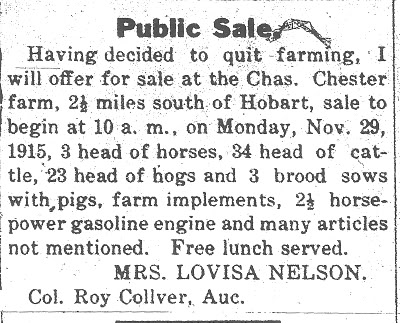
Lovisa Quits Farming

In the Hobart News of November 25, 1915, Lovisa Chester Nelson announced that she was retiring from farming.

10-16-2010 Lovisa Nelson Public Sale

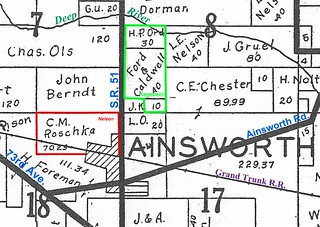
I think the land that Lovisa farmed is the parcel shown as belonging to her sister, Carrie Raschka, in the 1926 Plat Book:

LovisaNelsonfarm
(Click on image to enlarge)

The 1891 Plat Book shows that same parcel as the property of "H. Chester," and who could that be but their father, Henry? So its being in 1915 in the hands of his son Charles makes sense.

You're probably wondering why I outlined that other parcel, marked "Kegebein," on that map. (That's rhetoric. I know you don't care, but I'm going to tell you anyway.) I did that because early in 1916, we come upon this little news item: "Albert Witt moved [on January 26] to the Chas. Chester farm, and Glen Nelson moved to the Kegebein farm, both exchanging farms."

Oh, you crazy guys! The grass is always greener on the other side of State Road 51, isn't it?

Perhaps I was wrong about where Glen and Elsie were running a dairy in 1920; perhaps it was the Kegebein farm; but there are four more years until the 1920 census, plenty of time for more farm-switching.

In February, Glen and Elsie had a little boy — Lovisa's first grandson. Evidently something went wrong: although the baby was delivered at home, the following day Elsie had to be taken to Gary General Hospital.


Sources:
♦ 1891 Plat Book.
♦ 1926 Plat Book.
♦ "Additional Local." Hobart News 10 Feb. 1916.
♦ "Personal and Local Mention." Hobart News 27 Jan. 1916.
♦ "Public Sale." Hobart News 25 Nov. 1915.

Sunday, June 27, 2010

The Second Mrs. Scroggins

Edward D. Scroggins had married Daisy Chester sometime between 1900 and 1907 (probably closer to the latter), and throughout their short marriage, they wandered. They lived in Minnesota for nearly a year, and then — interspersed with visits to her sister Carrie Raschka in Ainsworth — briefly in La Moille and then Steward, Illinois (where their first daughter was born); and when Daisy returned to say farewell to her dying father, she came from Flint, Michigan.

But after Daisy's untimely death in 1910, E.D. (as he preferred to be called) ceased his wandering. He and his two little daughters moved in with his mother-in-law, the newly widowed Mary Chester, and there they stayed. No doubt the extended Chester family gave E.D. much-needed help in caring for his little girls, the younger being only a few months old.

I don't know what E.D.'s usual line of work was. While at Steward, Illinois, he had worked as an operator with the Chicago, Burlington and Quincy line, and he may have continued railroad work in Flint, Michigan, possibly even with the Grand Trunk Railroad. By 1920, he would be an electrician at a steel mill. When he first came to live in Ainsworth, I expect he worked on the Chester farm. But within a year of his coming here, he had found a novel way to earn money — as an auto liveryman.

In March of 1911, he purchased a Badger touring car through the Dorman Brothers agency. He and Carlisle Dorman traveled to the Badger factory at Columbus, Wisconsin, to fetch the car, and drove it back.

In May, E.D. placed an ad in the Hobart Gazette:

Car For Hire

I am prepared to accommodate those wishing to hire automobile livery service. Car carries five. Terms reasonable. E.D. Scroggins. Phone 371.
That ad would continue running weekly.

His brothers-in-law must have been impressed with E.D.'s Badger: in June 1911 John bought one for himself; the following month Charles bought one too, and E.D. helped him drive it home. E.D. maintained friendly relations with all of his in-laws. The Ainsworth news columns often reported his outings with one Chester or another — a trip to Chicago with Mary; a drive with John to Elgin, Illinois, to watch the auto races; a visit to Knox, Indiana, for the wedding of Carrie and William Raschka's daughter, Minnie.

In August 1911, he rented his 80 acres of the Henry Chester farmland (which may have come to him through Daisy) to another Ainsworth farmer, thus gaining a second source of income.

At some point amid all these activities, he met Bertha Witt. She was a daughter of the John Witt whose cow had needed avenging in one of the shotgun stories. A few years earlier, her older brother, John Jr., married Louise Sievert, who had lived along the county line mid-way between Hobart and Ainsworth, and in 1908, the young couple moved onto a rented farm south of Ainsworth. By 1910, Bertha was living there in her brother's household, describing herself to the census enumerator as a servant.

Not a word ever made it into the social columns of Bertha and E.D. even being in each other's company. In fact, they were well apart during January 1912, as E.D. went on a long trip to Kansas to visit his brother there, and Bertha moved back in with her parents to recuperate from a bad burn she had suffered while working in the kitchen in her brother's house.

But she did recover; E.D. did come back; and at the end of May 1912 came the sudden announcement that the two of them had married. The wedding took place in her parents' home west of Hobart.

And that's all I know thus far. The 1920 census finds E.D. and Bertha living in Hobart, with their six-year-old son, Edward, and four-month-old daughter, Mabel. And E.D.'s daughters by Daisy were living in a Chicago rooming-house with their grandmother, Mary Chester McDaniel, and their step-grandfather John. But that's seven years' worth of microfilm away.


Sources:
♦ 1910 Census.
♦ 1920 Census.
♦ "Ainsworth." Hobart News 24 Aug. 1911; 31 Aug. 1911; 14 Dec. 1911; 4 Jan. 1912.
♦ "Car For Hire." Hobart Gazette 19 May 1911 and passim.
♦ "General News Items." Hobart Gazette 3 Jan. 1908; 7 Feb. 1908; 6 Mar. 1908; 10 Apr. 1908.
♦ "Local Drifts." Hobart Gazette 18 Sept. 1908; 2 July 1908; 31 Mar. 1911; 23 June 1911; 28 July 1911; 26 Jan. 1912.
♦ "Personal Mention." Hobart News 30 May 1912.
♦ "Ross Township Notes." Hobart Gazette 25 Aug. 1911.

Saturday, May 22, 2010

A Corn-Husker Victim in Later Life

Lately at the Hobart Historical Museum I've been paging through a large collection of arrest reports from the Hobart police department that begin in 1938 and run through the mid-1940s. Thus far it's mostly been petty crime — trespassing on railroad property, speeding, double-parking, U-turns on Main Street, petty larceny, runaway boys. Now and then an assault and battery. A couple suspicion-of-involuntary-manslaughters in the wake of a fatal car accident, but so far those cases were cleared by the coroner. The most common crime seems to be public intoxication, and that's also where we see the most repeat offenders. One name that keep coming up is William Witt. He's in his fifties, gives his occupation as laborer, sometimes teamster, and his most distinguishing characteristic is that his right arm has been amputated.

He sounds to me like the same William Witt who lost his arm to a corn husker in 1901, at the age of nineteen.

That's sad. Not to say that alcoholics always have a reason for being alcoholics, but if I'd had my right arm violently injured and cut off, I might take to drink too. Especially considering the degree to which a person who suffered such an injury, in those days, was simply left to deal with it on his own. Prosthetics, particularly for arms and hands, were crude. Physical therapy, psychological counseling — did they even exist?

Thursday, March 25, 2010

Shotgun Stories

Another thing that surprises me about these old newspapers is how readily people used their shotguns and with what impunity, as in these 1907 incidents.

1. Glad to Be a Bad Shot

Thomas and Ella Casbon and their children lived on a farm just west of the village of Deep River. During the day on Friday, June 14, they noticed a stranger loitering around their place. They thought he looked like a tramp, or worse, and they told him to get on about his business elsewhere. They had to tell him several times because he kept coming back.

When night fell, Thomas and Ella grew worried that the stranger had been scoping out their place and intended to return under cover of darkness to do goodness knows what — steal something, at the very least. So they decided to sit up and keep watch.

Hours went by and nothing happened. Friday night passed into the early hours of Saturday. Thomas and Ella grew sleepy. Finally they dozed off.
♦    ♦    ♦
On Friday evening, nineteen-year-old Floyd Guernsey left his home — a farm just east of Merrillville where he lived with his mother Cora and stepfather Bruno Kleine — and went to a dance, possibly at Deep River, where Dietz hall was a popular venue for dancers.

The dancing went on for hours. It was well past midnight when the merrymakers broke up. Floyd, who had gone stag, climbed into his buggy and set out along present-day 73rd Avenue, heading west.

Tired out from the night's fun, and perhaps with a few drinks in him, Floyd soon fell asleep at the reins, but his trusty horse knew the road and ambled along toward home.
♦    ♦    ♦
At the Casbon farm, sometime in the wee hours of Saturday morning, Thomas was wrenched awake by a screech that sounded to his sleep-fogged ears like the barn door hinges. He leapt up, grabbed his shotgun and ran outside. Through the darkness he could just make out the shape of a horse and buggy heading down the road away from his place.

"Stop!" he yelled. But his shout in the calm night startled the horse, who plunged forward.

Thomas raised his shotgun and blazed away.

Inside the buggy, Floyd Guernsey was roused from his little nap by shouts, gunfire and the frightened plunge of his horse. Thinking robbers were attacking him, he whipped up the horse to its fastest gallop and fled down the road.

The buggy quickly outdistanced Thomas. He was disappointed that the thief had gotten away, but at least his family was no longer in danger.

The next day Thomas told the story of his dangerous encounter to some people in Deep River. They, being better informed, told him that he had been firing away at the harmless young Floyd.

Thomas was reportedly "very thankful that his aim was not more true."

2. The Cow's Avenger

On Sunday, May 12, a couple of Chicago automobile parties went out for a spin in the Indiana countryside. When they decided to head home, they got onto a road through Hobart and traveled west. On the western outskirts of town, they passed by the farms of John Witt and Jacob Kramer.

Jacob and his family were out on the porch of his house, talking to a couple of the Witt boys. They all watched, shaking their heads in disapproval, as the Chicago cars sped by.

John Witt's daughters were just then driving a herd of cows home along that same road. The cars zipped through the herd without even slowing down. It was sheer luck that they didn't hit the girls or their cows.

When the cars came to a bend in the road further west, their drivers must have figured out that they were on the wrong road. They pulled a U-turn and headed back the way they had come — and just as fast.

This time luck was not with them. The first car passed through the herd of cows safely, but the second struck a cow so hard it knocked her into a ditch.

The car didn't stop. As it passed Jacob's house, he heard the driver make "a slight remark about the accident." Jacob's sense of justice was roused.

He ran into the house, grabbed his shotgun and quickly loaded two cartridges. Then he and one of the Witt boys set out running. By cutting north across the fields, they figured they could intercept the car, which had to follow the curve of the road. It had been a long time since Jacob had run so far and so fast, and the first auto passed before he reached the road, but he was just in time to intercept the second — the guilty party.

Standing in the middle of the road, waving his hat in one hand and his shotgun in the other, Jacob gasped out: "Stop or I'll shoot!" The car raced toward him. He again called out the order to stop, and leveled his shotgun straight at the car.

The car came to a screeching stop.

John Witt, who'd been told about his cow being struck, had set out after Jacob, along with one of his sons. They now came running up on the stopped car. The driver was in no position to claim innocence. Not only were there witnesses, but his own car testified against him, bearing some of the cow's hair and skin on its side.

John marched the driver back to the scene of the accident. They examined the poor cow, who was beyond saving. Under threat of arrest, the driver finally agreed to pay John $30 in damages.

The Hobart Gazette approved:
The actions of Mr. Kramer in stopping the machine and of Mr. Witt in compelling the owner of the machine to settle for the damage done are commendable and may serve as a warning to other reckless city auto drivers.


Sources:
♦ "Auto Held Up." Hobart Gazette 17 May 1907.
♦ "Thought He Shot at Thief." Hobart Gazette 21 June 1907.

Wednesday, March 3, 2010

. . . And the Corn Husker Taketh Away

A few things jar my modern sensibilities as I read these early-20th-century newspapers — the casual, blatant racism; the number of people killed by railroad trains; and the frequency with which people lost body parts, especially fingers, hands and arms. That last one is today's topic.

Many of those body parts were lost on farms to a machine called a corn husker, also called a husker-shredder, which I believe looked like this.

Just a sampling of injuries from the Ainsworth-Deep River-Hobart area:
  • In November of 1900, Jude Blachly got the index finger of his left hand caught in a corn husker. A prominent Hobart physician, Dr. Mackey, treated the wound but ended up having to amputate the finger at the first joint.
  • In April of 1901, Edward Maybaum lost a thumb to a corn husker.
  • In November of 1901, 19-year-old William Witt's arm was so badly crushed in a corn husker that it had to be amputated.
  • In November of 1903, Schuyler Hardesty's hand was mangled in a corn husker; the thumb and first two fingers had to be amputated at the hand.
  • Also in November 1903, John Witt lost the ends of two fingers.
Those last two incidents appeared in an article entitled, "Corn Husker Did It." People were well aware of the dangers of that machine. In November 1901 — in the wake of President McKinley's assassination by a self-proclaimed anarchist — the Gazette said, "An Indiana paper suggests a worthy position for anarchists by giving them a job feeding a corn husker."

The corn husker was not the only culprit. For example, in June 1902, Frank Maybaum lost a finger to a machine in the East Tolleston furniture factory where he worked; three months later a young man pressing grapes had three fingers on his right hand mangled, and they had to be amputated.


Sources:
♦ "Corn Husker Did It." Hobart Gazette 6 Nov. 1903.
♦ "General News Items." Hobart Gazette 5 Apr. 1901.
♦ "General News Items." Hobart Gazette 15 Nov. 1901.
♦ "General News Items." Hobart Gazette 19 Sept. 1902.
♦ "Local Drifts." Hobart Gazette 9 Nov. 1900.
♦ "Local Drifts." Hobart Gazette 27 June 1902.