Showing posts with label Guernsey. Show all posts

Monday, June 1, 2026

Sale on the Howard Smith Farm

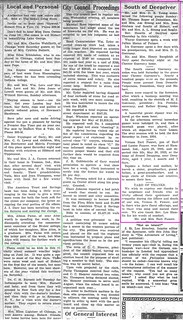
For some reason I thought this notice about a sale on Howard Smith's farm in February 1924 was interesting enough to retrieve from the microfilm. Maybe because Howard Smith was dead, and dead people are my favorite people. Anyway, I'm going to slap this up here, because I'm still too busy to do any kind of post that requires research.

2026-06-01. 1924-01-31 News, Administrator's Sale - Howard Smith
(Click on image to enlarge)
Hobart News, 31 Jan. 1924.


The last time we saw Melvin Guernsey, it was 1920 and he was planning to leave for Florida. If he did go, he was obviously back, and farming again. Melvin was not planning on quitting farming (unlike Barney Rhoda in the notice below his): he was just moving to the "Wm. Bixenman farm three miles east of Crown Point."[1]

The notice names "M. Hurlburt" as the administrator of Howard Smith's estate. That would be Milan Hurlburt, who was Howard's uncle.

♦    ♦    ♦

I did not realize when I was getting this page from the microfilm that the story in the left-hand column quotes Charles Chester of Ainsworth. If only I had! — I would have gotten the whole story, so we could have found out what Charles Chester of Ainsworth said about Calumet Electric company's proposal. Now we'll never know. But at least we now know that in 1924, the Chester farm was getting electricity from its own generating system.

_______________
[1] "Local and Personal," Hobart News, 31 Jan. 1924.

Saturday, August 24, 2019

Warning Signs at the Death Crossing

After the recent fatal accident at the Lincoln Highway intersection south of Ainsworth, a private organization put up warning signs, and other steps were taken to improve visibility.

2019-08-24. Warning Signs, Gazette, 8-31-1923
(Click on image to enlarge)
Hobart Gazette, Aug. 31, 1923.


Two columns over, a couple other stories caught my eye.

I've mentioned Charles Boyd before but never took the time to figure out exactly where his farm was. Here is his land as it appeared in the 1926 Plat Book:

2019-08-24. Boyd, C.E. 1926
(Click on image to enlarge)

I don't know exactly where the house and burning barn were.

Below that, we find H.W. Traeger — probably the same man who gave that awful Traeger crossing its name — warning people to stay off not only his land, but "the land known as the Garden City, controlled by" him. Does that mean the former site of the Garden City brickyard, on the east side of the intersection of County Line Road and S.R. 130? It seems likely, with that land being so close to H.W. Traeger's own land. I find it interesting that the Garden City name stuck, although the brickyard had stopped operating long ago.

♦    ♦    ♦

Here's the social news from south of Deep River for the last week of August 1923:

2019-08-24. SoDR, News, 8-30-1923
(Click on image to enlarge)
Hobart News, Aug. 30, 1923.

Friday, July 5, 2019

There's Only One Merrillville?

I'm sure everyone who's done online research knows the pain of chasing down wild geese that happen to have the same name as your own goose. There are towns in Iowa and Nebraska called Ainsworth, and both of them still exist, unlike this little Ainsworth of mine, and they clog up my search results. And in looking for Hobart, Indiana, I keep turning up things about towns in Tasmania, New York, Oklahoma, and Washington. The good thing about Merrillville is that there's only one … or so I thought, until I saw the first item in this "South of Deepriver" column:

2019-07-05. SoDR, News, 8-9-1923
(Click on image to enlarge)
Hobart News, Aug. 9, 1923.


Internet research fails to turn up the location of this town in Missouri. It does turn up references from the 19th century to a town called Merrellsville, but no one seems to know exactly where that town was. Google Maps, which identify such obscure places as my Ainsworth, don't acknowledge the existence of any Merrillville or Merrellsville in Missouri.

So if there is a Merrillville in Missouri, it keeps quiet. Very quiet.

Beyond that, the news south of Deepriver is not very thrilling.

Wednesday, January 30, 2019

Who's Teaching and Who's Being Taught

Here are updates on two young south-of-Deepriver women who embarked on teaching careers.

2019-01-30. Teachers, News, 7-5-1923
(Click on image to enlarge)
Hobart News, July 5, 1923.


Esther Strong had earned her high-school diploma in 1922; the position at the Vincent school was her first.

The last we heard of Esther Guernsey, she was heading off to South Dakota in August 1920. I am a little confused about her parents — it appears she was born to Randolph and Nancy (Hardesty) Guernsey, but after her father's death in 1902 (when Esther was only about two years old[1]), her mother married Randolph's elder brother (by about 13 years), Chester. Nancy went on to have more children with Chester, so there were a lot of step-siblings in the family, but all had the Guernsey name from birth.

Esther Guernsey continued teaching school, I believe, until her marriage in 1933 (in Iowa) to Leslie J. Moreland, after which they located on a farm in Ross Township and she stayed home to care for their two adopted daughters (1940 Census). She is buried in Valparaiso.

♦    ♦    ♦

Hobart's budding artist, Dalia Messick, began an eight-week course at the Art Institute of Chicago, according to an item in the "Local Drifts" of the Hobart Gazette of July 6, 1923. She had just completed her freshman year at Hobart High School and had illustrated the 1923 Aurora yearbook.

_______________
[1] Esther and her younger sister were mistakenly omitted from the list of survivors in the Gazette's account of Randolph's death.

Saturday, November 3, 2018

Conflict of Interest

I just can't get over the fact that ambulance service used to be provided by funeral homes rather than fire departments or other dedicated emergency responders.

2018-11-3. South of Deepriver, News, 6-21-1923
(Click on image to enlarge)
Hobart News, June 21, 1923


Also, the rural social news from south of Deep River. Ellen Smith, whom Emily Strong helped with housecleaning, was the widow of Cyrus and by now nearly 80 years old. Per the 1920 Census, she lived alone; if she still lived in that big farmhouse, I expect she could use help in cleaning it.

Tuesday, September 18, 2018

South of Deepriver, June 7, 1923

Social news from the countryside.

2018-9-18. SoDR, News, 6-7-1923
(Click on image to enlarge)
Hobart News, June 7, 1923


We previously encountered the story about little Vernon Fauser.

Over in the "Local and Personal" column, we find Ethel Paine traveling Indianapolis for the graduation of her daughter, Alice … who remained there to get even more educated.

Thursday, September 6, 2018

Fanny's Finery

In my post about the Lake County courthouse, I said I was going to talk about John Premer. But first I want to talk about Fanny Premer.

She makes her first appearance on the first page of the Liverpool merchant's daybook: on May 15, 1840, she came to the store and bought nothing but finery, including a Dunstable bonnet (that would be imported from England, I believe).

2018-9-6. DayB1840 001
(Click on images to enlarge)
This image and the following image courtesy of the Hobart Historical Society.


She comes back over the next couple of weeks and buys gloves, stay laces (for lacing up her corset), and muslin.

2018-9-6. DayB1840 002, 003

And so it goes, throughout the summer and into the autumn of 1840. She buys more dress fabric, and ribbon; several pairs of stockings; an artificial flower and a cape; a child's bonnet; ornamental combs; a pair of shoes. She buys one book (title unknown), and one pocket-knife. In September, along with a comb and thread, she buys ten cents' worth of raisins. But never does she buy mundane items like molasses, coffee, sugar, tobacco, whiskey — those purchases are made by John Premer. In December, Fanny buys another pair of shoes. Her last appearance is in January 1841, when she buys eight yards of calico.

Apparently Fanny was well dressed; that's one of the two things I know about her. The other thing is: on January 13, 1842, she married a man named Abraham Balts (Indiana Marriage Collection). I can't find her (or him, for that matter) in any other record, anywhere. Was she related to John Premer? — seems likely, but I can't prove it. I can't put them in the same household in any census. Sometimes they came to the Liverpool store on the same day; sometimes not.

Now, as for John Premer, he is all over the ledgers (so far, I've indexed him 66 times as "John Premer," more than a dozen times, probably, as "J. Premer," and once as "Mr. Premer"), and he is only a little less elusive than Fanny in the official records.

John was born circa 1794 in Virginia. The earliest I can find him in Lake County is in the 1840 census:

2018-9-6 1840 Premer, John
(Click on image to enlarge)
Image from Ancestry.com.


… At least, I think that's our John; with so little information given about him, it's hard to be sure. But we know from the ledgers he was in this area by 1840, and among his neighbors on the census page are the names of early local settlers, including Sigler, Zuvers, Hayward, and Merrill.

The 1850 Census is a little more informative.

2018-9-6. 1850 Premer, John
(Click on image to enlarge)
Image from Ancestry.com.


John gives his occupation as "miller" so perhaps he worked in one of George Earle's mills. One assumes that Olive is his wife and the younger folks are all his children … but there are two boys named John, with different middle initials. That's odd.

Per the Indiana Marriage Collection, John married Olive Sperling in 1847. The children in the 1850 census can't be children of that marriage; they must be from previous marriages. Perhaps that can explain the two young Johns — one of them is Olive's, and he was young enough when his mother remarried to take his new stepfather's surname.

From the same source we find another marriage involving a John Premer, in Lawrence County, Indiana in 1820, to Susan Burns (but per the 1850 census, they would have had to move to Ohio for the birth of Valentine and the next two children). The Ohio marriage records[1] show John Premer marrying Mary Ann Vandermark in 1817 in Wayne County, which sounds more likely: it would account for the birthplace of the first three children, as well as the first daughter's being named for her mother. At the same place in 1836, John Premer married Elizabeth Caston. If the family then moved to Indiana, Elizabeth could be the mother of some of the children in the 1850 census.

I can't find any land belonging to John Premer (the eldest) in Early Land Sales, Lake County, or on any plat map I have. His son(?), Valentine, did buy a few parcels: in 1850, he bought 80 acres northwest of Hobart from Jesse Albee (and later sold them to George Earle); in 1854, 80 acres just northwest of Hobart (also sold to George Earle the next year); and in 1854, 40 acres on the west side of S.R. 51 where it meets 61st Avenue. By the time of the 1874 Plat Map, there is no land under the Premer name.

In the 1860 Census, I can find only two Premers still in this area. The John born circa 1833 is a "farm laborer" on the farm of George and Margaret Guernsey in Ross Township; the younger John (born ca. 1841) is likewise employed by Jerry and Susan Vanness in Hobart Township.[2] I cannot locate any other members of this family locally — or anywhere else, for that matter.

Two Premer boys, Jacob and one of the Johns, joined the military during the Civil War and lost their lives before it ended. The veterans' headstones to mark their graves (or at least memorialize them, if they were buried in some distant place where they died) were intended, as of 1888, to be located in Hobart …

2018-9-6. Premer Civil War veterans
(Click on image to enlarge)
Ancestry.com. Headstones Provided for Deceased Union Civil War Veterans, 1861-1904 [database on-line]. Lehi, UT, USA: Ancestry.com Operations Inc, 2007. Original data: Card Records of Headstones Provided for Deceased Union Civil War Veterans, ca. 1879-ca. 1903; (National Archives Microfilm Publication M1845, 22 rolls); Records of the Office of the Quartermaster General, Record Group 92; National Archives, Washington, D.C.


… but both of them ended up in the Blake Cemetery in Porter County — Jacob and John.


_______________
[1] Ancestry.com. Ohio, County Marriage Records, 1774-1993 [database on-line]. Lehi, UT, USA: Ancestry.com Operations, Inc., 2016. Original data: Marriage Records. Ohio Marriages. Various Ohio County Courthouses.
[2] There is a John Premer born in Ohio circa 1838 working for a "hotel proprietor" named David Young (this would be the father of George Young) in Hobart Township. If he wasn't a relative who'd come out here from Ohio, he might have been the youngest John, accidentally counted twice in the census and understandably assigned an age a few years off from the correct one by whoever was talking to the enumerator.

Monday, May 14, 2018

Howard H. Smith and the Union Center Cemetery

The "South of Deepriver" community was shocked when the news began to spread on the morning of April 20, 1923, that Howard H. Smith had died in his sleep.

2018-5-14. Howard H. Smith
(Click on image to enlarge)
Hobart News, April 26, 1923.


"A large procession followed the remains to their last resting place in the Union Center cemetery" — where??? I asked myself, never having heard of such a place. But then I remembered that little cemetery marked on plat maps near the location of the Walnut Gardens. So I consulted the Northwest Indiana Genealogical Society's listing of Union Township cemeteries, and found it there among the "Small Cemeteries" with this information: "The [Union Center] cemetery could not be found in 1994. It was located on the northeast corner of Route 30 and 600 W. '… When Hiway 30 was built any stones left there were buried or were moved.'"[1]

Naturally my mind formed a picture of Howard H. Smith lying there at the corner of Route 30 and 600 W, trying to get some eternal sleep beneath the rumbling traffic of Route 30.

However, a little more investigation convinced me that the News simply got their information wrong, and that Howard has been resting peacefully in Mosier Cemetery all these years, where his death certificate and the April 27 Gazette placed him …

2018-5-14. Howard H. Smith
(Click on image to enlarge)
Hobart Gazette, April 27, 1923.


… and where today you can find his grave marker.

If I live long enough to read the microfilm from when Route 30 came through, I hope to learn more details about what happened to the Union Center Cemetery.

♦    ♦    ♦

Howard's death notice partially answers the question of what happened to his siblings. Mildred Smith had married John Dick in 1898 (Indiana Marriage Collection); the 1920 Census shows them farming in Porter Township, with a son (Sherman) and a daughter (Margaret). Abbie and Rudie apparently died before Howard — but when, and where they are buried, I do not know.


_______________
[1] NWIGS does not identify the source of that last sentence.

Friday, April 27, 2018

Dance on the Dan Kraft Farm

Here's a good-times post. Let's start off with an ad for a dance to be held on the Dan Kraft farm …

2018-4-27. Kraft
(Click on image to enlarge)
Hobart News, April 29, 1923.


… which naturally leads me to wonder where the Dan Kraft farm was. Of course I thought of that wonderful brick house on the northeast corner of County Line Road and Cleveland/700 N; that's a Kraft house. But looking over the Porter County plat maps, I find that's not the right Kraft house — it belonged to Dan's brother, Fred. Dan's farm was a bit further northeast:

2018-4-27. Dan Kraft Portage-1921
(Click on image to enlarge)
Image from http://www.inportercounty.org/Data/Maps/1921Plats/Portage-1921.jpg.


I am not sure that Dan Kraft actually resided on his farm in 1923. He was about 75 by then, retirement age even in that hard-working era. The 1920 Census seems to have counted him twice: once as a dairy farmer on his farm in Portage Township; and again as a retired resident of Hobart.


Below the Kraft ad in the same column, we learn of a very large party for a 14-year-old. Apparently Louis and Lena Wojahn had moved back to Ainsworth from Hobart since 1917.

I believe this Wojahn house is still standing, but it sits so far from the road that you can't really see it as you drive by.

♦    ♦    ♦

Elsewhere in the same issue, a "South of Deepriver" column …

2018-4-27. SoDR
(Click on image to enlarge)
Hobart News, April 19, 1923.


… with a couple of unfamiliar names — King and Lakotski. I can't identify any of them for certain.

Sunday, February 4, 2018

South of Deepriver, March 29, 1923

My part-time job has been trying to be full-time lately. So here's a "South of Deepriver" column to save me the trouble of writing a real post.

2018-2-4. South of Deepriver 3-29-1923
(Click on image to enlarge)
Hobart News, Mar. 29, 1923.


One thing these columns are good for is to remind me who's living in the area.

Friday, December 22, 2017

South of Deepriver, March 22, 1923

2017-12-22. South of Deepriver 3-22-1923
(Click on image to enlarge)
Hobart News 23 March 1923.


Among all the other social news, we find Maybelle Guernsey marrying Lloyd Moreland of Sedley, who thus far has figured in this blog only as a visitor in other "South of Deepriver" columns. But looking into his background a little, I find that his family goes back to the 1870s in Union Township, Porter County. His grandparents were Joshua and Margaret Anna. I believe that Joshua, born in Ohio in 1834 (Indiana Death Certificates), shows up in Union Township in the 1870 Census with his name spelled Moorland. The following year he went back to Ohio to marry his sweetheart, Margaret Anna McConkey.[1]

The young couple probably returned to Indiana soon after their marriage. The 1876 plat map for Union Township shows a J. Moreland owning a nice big parcel of land not far southeast of where Sedley would be after the Grand Trunk Railroad came through.

Around 1874, Joshua and Margaret had a son named Harrison (1880 Census). In 1896, Harrison married Jessie Wilson (Indiana Marriage Collection). Their son Lloyd was born in 1898 (Indiana Death Certificates).

Per the Union Township plat map of 1921, Harrison Moreland owned nearly 200 acres around Sedley.

2017-12-22. Moreland 1921
(Click on image to enlarge)
Image from http://www.inportercounty.org/Data/Maps/1921Plats/Union-1921.jpg.


The 1930 Census shows Lloyd and Maybelle farming rented land in roughly the same vicinity (to judge by their neighbors); it may have been his father's land. By then they had three children.


To the left of the "South of Deepriver" column is an open letter from William O. Sievert. He may or may not be somehow related to the Ainsworth-area Sieverts — I don't know. I believe he was a Hobart resident; the 1920 Census shows a 25-year-old steel-mill employee by that name in Hobart with his widowed mother, Anna. The Charles Carlson (who was allegedly to blame for the accident) was a son of Swan Peter and Hedwig Carlson, and per the 1920 Census lived in Ross Township, farming on part of the old Carlson place on S.R. 51, roughly across S.R. 51 from the present-day Indian Ridge Golf Course.

____________________

[1] Ancestry.com. Ohio, County Marriages, 1774-1993 [database on-line]. Lehi, UT, USA: Ancestry.com Operations, Inc., 2016. Original data: Marriage Records. Ohio Marriages. FamilySearch, Salt Lake City, UT.

Sunday, November 26, 2017

Here Comes the Triebess Family … Again

Julius Triebess had moved his family from Chicago to Ainsworth in 1917 — and I'm still not sure if that was a return for them, or their first attempt to live on the farm Julius owned.

Whatever it was, that experience ended when they moved back to Chicago in 1919.

Now it's 1923, and the family (what's left of it) is returning to Ainsworth …

2017-11-26. Triebess family returns to Ainsworth
(Click on images to enlarge)
Hobart Gazette 16 March 1923.


… not to farm, apparently, since they have rented the land to Sophie Triebess's brother, but only to live.

Down in the right-hand column, we learn that the Triebess farm had previously been rented to John H. Meyer … which might explain why there was an Andy Meyer graduating from (I believe) the Ainsworth school in 1922.

And below that item comes a little news about the Ainsworth Department Store under its new proprietor, Henry Paulus. Verna Guernsey, the lucky winner of a bag of flour, may still be occupying the Howard H. Smith farm.

By the way, I'm guessing that the "Raschke" in the article in the left-hand column entitled "Ready to Bore for Oil" is our own William Raschka, formerly of Ainsworth.


Elsewhere in the same issue of the Gazette, an ad for the Ainsworth Department Store.

2017-11-26. Ad for Ainsworth Dept.Store

Wednesday, November 22, 2017

South of Deepriver, March 15, 1923

Among all the usual visiting going on in southern Ross Township, I am introduced to a connection between the Hurlburt-Smith family and the Ripley family that I didn’t know about.

2017-11-22. South of Deepriver
(Click on image to enlarge)
Hobart News 15 Mar. 1923.


Aside from a couple of passing mentions of the surname Ripley — back when I was figuring out who those south-of-Deepriver Smiths were, and in a 1920 "South of Deepriver" column — I have thoroughly ignored the Ripleys. That name shows up a couple more times in my notes, but never to tell of the Ripleys doing anything more interesting than being related to Milan Hurlburt and Rachel (Hurlburt) Smith. I am inclined to continue ignoring them.

However, I should do my duty as an amateur historian and at least get some of the basics. Per the Indiana Marriage Collection, Horace Ripley married Frances Hurlburt in Lake County, Indiana, on June 24, 1873. They were married by Horace Marble, J.P.

How on earth they ever met, I do not know, since Horace Ripley, aka "Hod," was born in Canada, raised in Wisconsin, and then moved to Missouri, according to his obituary on findagrave.com.

Frances Hurlburt Ripley was born March 25, 1852, according to her death certificate. Her parents were Jacob and Susan* (Perry Sheffield) Hurlburt.

What little information I have suggests that the Ripley presence in this area was never long-term, consisting only in visits to the Hurlburts and Smiths.

Now I've done my duty and can go back to ignoring the Ripleys.

♦    ♦    ♦

The shower for Bertha Fisher, also mentioned in the next column to the right, reminds us of the existence of Hubert Hahn.

______________
*Frances' death certificate gives her mother's name as "Jane," but I believe that is a mistake.

Monday, October 23, 2017

South of Deepriver, March 1923

Much innocent sociability in the countryside.

2017-10-23. South of Deepriver
(Click on image to enlarge)
Hobart News 8 Mar. 1923.


"The Raschka barn near Leroy" might have belonged to Frank and George, William's brothers.

Arthur Bowman's radio sounds more like a ham set than something to receive commercial broadcasts — but then again, for all I know about radios, it might have done both.

Sunday, February 12, 2017

A Chopping Bee

In December 1922, the men of the South of Deepriver neighborhood got together and held a "chopping bee" to supply Jim Jeffrey with stove wood for the winter — as Jim was in no condition to chop wood for himself, with a twice-broken leg.

2017-2-12. South of Deepriver
(Click on image to enlarge)
Hobart News 21 Dec. 1922.


I've paid so little attention to the Prescott family that I had to go look them up to remind myself that Mrs. John Prescott was born Carrie Sturtevant.


Over in the left-hand column, the Central Drug Store in downtown Hobart was selling popular recordings. I've never heard of either "Indiana Lullaby" or "Three O'Clock in the Morning" before. I guess I need to get out more.

Tuesday, October 4, 2016

Cursing, and Other Unpleasantness

Some nice local news … a new silo on the Gruel farm, innocent social activities South of Deepriver, blah, blah, blah …

2016-10-4. Gruel et al.
(Click on image to enlarge)
Hobart News 5 Oct. 1922.


… but also some juicy stuff, like "Mr. Traeger" cussing out Dr. Friedrich, a city health officer.

I do not want to guess at the identity of Mr. Traeger, whose first name is not given; but the location, I suppose, was the building at 235 Main Street. In 1922 it was only a former "saloon," as we use the word, since liquor could not legally be sold there.

And in the next column, we have a report of a big Ku Klux Klan recruitment rally in Hammond which gives us a look at how the Klan presented itself at that time and place. The open avowal of white supremacism is jarring, but otherwise the speaker was saying things that you can still commonly hear in both public and private discussions, and his concern that "a foreigner can come in here with a bomb in his hand" could have been voiced five minutes ago.

Wednesday, July 27, 2016

For Sale or Rent: Mysterious Places

Two items from the "All kinds of Wants" column in the Hobart Gazette of Sept. 8, 1922:
FOR RENT — My farm of 100 acres, on Lincoln Highway, south of Ainsworth. Julius Triebess, 6936 Michigan avenue, Chicago.
FOR SALE — My house, barn and acre tract at Fatout, south of old Deepriver schoolhouse, on C.&I. railroad. Otis Guernsey, Route 2, Crown Point.
I've been unsure about who, if anyone, has been renting the Triebess farm; I hope one of the papers will report on its new tenant.

That second item has taken up 'way more of my time than it should have. We know that Otis Guernsey's farm lay northeast of where Randolph Street crosses the C&O Railroad. When Harold Guernsey died in 1921, his obituary used the name "Putout" — which I believe to be a simple typographical error, since my notes from 1916 carry the first mention of "Fatout":
Delbert Young has moved into the new house which he has built on the road leading south of the Deepriver schoolhouse past "Fatout," the new railroad station. His new house and barn look fine.*
And now in 1922 we see it spelled "Fatout" again. Majority wins. But Google, which knows about everything, doesn't know about the village or railroad station called Fatout.**

And what about the railroad where Otis' property lay? Is "C.&I." a typo for "C.&O."? The C&O railroad has had several names, but I can't confirm that "C.&I." was among them. There was a railroad in Pennsylvania with those initials, which I didn't want to know but had to spend the time finding out because of this stupid little want ad. Is it any wonder I can't get anything done?

Well, if you want my theory on all this, here it is: the C&O Railroad built a new station circa 1916, probably about where Randolph crosses the tracks, called it Fatout after one of its bigwigs, but — in contrast to how thoroughly the station name "Ainsworth" was adopted — the name never really took hold among the locals and was forgotten until I came along nosing around in the old microfilm.

♦    ♦    ♦

Another mystifying item from the "Local Drifts" of the Hobart Gazette of Sept. 1, 1922:
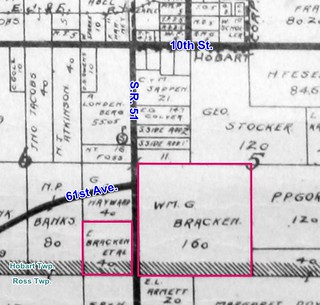
H.F. Carey, who recently moved upon his farm, has rented his house and five acres south of 10th street to Mr. and Mrs. Wm. Bracken, who have leased the place for 14 months, and moved yesterday.
I don't know where the Carey house was. I used to think it was one of the older ones on the north side of 10th but according to this news item it was the south side. Or was just the five acres on the south side?

The item goes on to say that Mr. and Mrs. Howard Bracken would continue to occupy the Bracken place, moving into the big house from the small house. I gather that Mr. and Mrs. William Bracken are the parents of Howard. William was born on that farm and when he married, he and his wife took up housekeeping there, so this was the first time he'd ever lived off the old Bracken place. But the Bracken milk route — William's, I'm assuming, though it's not clear — would continue without interruption.

2016-7-27. Bracken 1908
(Click on image to enlarge)
Bracken land as shown on the 1908 Plat Map. The 1926 Plat Book shows the parcel on the west side of S.R. 51 belonging to someone else.


_______________
*"Additional Local News," Hobart Gazette 30 June 1916.
**It doesn't help that there was a Purdue U. professor named Paul Fatout who wrote about historical topics and whose name clogs up the Google searches.

Tuesday, May 31, 2016

South of Deepriver

Thank goodness for these South of Deepriver columns, they save me from having to write a real post.

2016-5-31. South of Deepriver 8-10-1922
(Click on image to enlarge)
Hobart News 10 Aug. 1922.

Wednesday, April 20, 2016

South of Deepriver

Random bits from the countryside south of Deepriver, late July-early August 1922.

2016-4-20. South of Deep River
(Click on images to enlarge)
Hobart News 3 Aug. 1922


I don't know exactly what a separator canvas is, but the wording of that item suggests that the farmers of southeastern Ross Township had chipped in to buy themselves a communal farm machine — a sensible thing to do — and it was getting a workout in that summer's wheat threshing.

… Here's a little article about a threshing machine that has a separator and a canvas, somehow or another.

2016-4-20. Separator
(Click on image to enlarge)
From the Chilton Tractor Journal, Vol VIII, No. 4 (April 1, 1922). Retrieved from https://books.google.com/books?id=xsZMAQAAMAAJ&lpg=RA3-PA14&ots=pSADxxAJwL&pg=RA3-PA14&ci=80%2C816%2C899%2C500&source=bookclip#v=onepage&q&f=false.


♦    ♦    ♦

Elsewhere in the August 3, 1922 issue of the News, we find out that the strikebreaker has still not recovered …

2016-4-20. Ida Heck Carlson et al.

… and among the familiar names in the second column, we also find Miss Jeanette Peterson, daughter of Lena and George. The Hugo Zobjeck at Camp Knox in Kentucky was Hugo Jr., now about 17 years old.

In the third column are a couple of obituaries. The first concerns the untimely death of Ida (Heck) Carlson, who probably grew up on the old Heck place. The second brings me to consider the Wilson family of Union Township, Porter County, whom I have considered very little up to now. Mrs. Jane Harwood would have been Aunt Jane to "Miss Leola Wilson of Blachly's corners," and also, I believe, to Ralph Wilson, who in his youth took music lessons from Ainsworth's own Hugh Dotzer ("Ainsworth Pick-Ups," Hobart Gazette 6 Jan. 1905). In my notes and in the blog, I find several references to Wilsons, and some day when I retire and have time on my hands, perhaps I shall investigate which of them belonged to the Wilson family of Union Township.

Here is the farm of Jane's parents, Amos and Hannah Wilson, as it appeared on the 1876 plat map:

2016-4-20. Wilson 1876
From http://www.inportercounty.org/Data/Maps/1876Plats/Union-1876.jpg, courtesy of Steven R. Shook.

Monday, March 7, 2016

This Is Why He Couldn't Have a Gas Station

While the human race exists, there will be jerks. At the time we are concerned with — 1922 — jerks had found a relatively new way to be jerks, involving that relatively recent invention, the gas station. But already this avatar of jerkitude was so well known that the neighbors of John Kibler's triangle rose up to prevent his building a gas station where jerks could be jerks.

2016-3-7. No gas station in my neighborhood!
(Click on image to enlarge)
Hobart News 13 July 1922.


Also, news from the countryside south of Deepriver, some of it involving huckleberries in a way that I interpret to mean they grew wild around here. News to me!