Showing posts with label Sykes. Show all posts

Friday, March 30, 2018

A Heavenly Exclamation Point

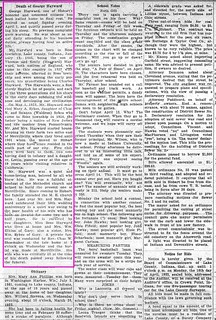
It is simply the natural course of events when an aged man, after a life of useful work, passes quietly to his rest; and so George Hayward's death on April 1, 1923, no doubt saddened but did not greatly surprise those he left behind.

2018-3-30. George Hayward obit
(Click on image to enlarge)
Hobart Gazette, April 6, 1923.


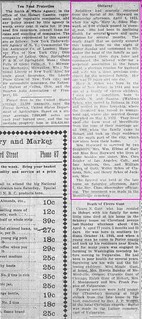
Yes, that last sentence is a little surprising — it is not the usual course of events that the aged man's wife, who (according to another account) was too ill to know that he had died, should follow him out of this world just after his funeral; but thus it was with Mary Sykes Hayward.

2018-3-30. Mary Sykes Hayward obit
(Click on image to enlarge)
Hobart Gazette, April 13, 1923.


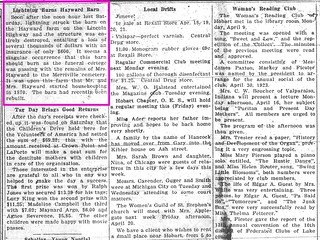
The really astonishing event happened as Mary's funeral cortege left Hobart, heading southeast toward the Merrillville Cemetery.

2018-3-30. Fire
(Click on image to enlarge)
Hobart Gazette, April 13, 1923.


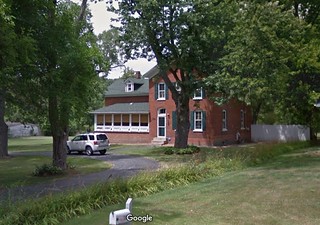
The barn may have been rebuilt again after the fire, but these days there is no barn on the old Hayward place. Still, if you've traveled along the Old Lincoln Highway east of Mississippi Street, you've probably noticed, on the north side of the road, the sturdy brick farmhouse where the Haywards lived and worked and raised their children for three decades.

2018-3-30. Hayward house Google street view
(Click on image to enlarge)
Image from Google street view.


Additional Sources:
♦ "Mr. and Mrs. George Hayward Pass Away," Hobart News, April 5, 1923.
♦ "Mrs. Hayward Passes on," Hobart Gazette, April 6, 1923.

Thursday, October 8, 2015

Married 50 Years

Since we've been talking about the Sykes farm, this article about George and Mary (Sykes) Hayward caught my eye.

2015-10-8. Hayward 50th anniversary
(Click on image to enlarge)
Hobart Gazette 5 May 1922.


They were married May 1, 1872 (Indiana Marriage Collection). I'm guessing it was on the Colorado Street Sykes farm, but they probably weren't married in the big brick house, since it wasn't built until 1898 (per the county property records, which don't always tell the story in the way you'd expect). As for their home "south of town," having looked at the 1920 Census and the plat maps, I think they lived on this farm at S.R. 51 and 61st Ave.:

2015-10-8. Hayward 1926
(Click on image to enlarge)
Image from the 1926 Plat Book.


In other words, all traces of their farm are now buried under hospitals.

♦    ♦    ♦

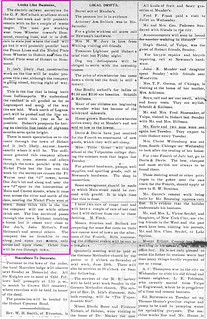
That page of the Hobart Gazette includes a number of small items that also caught my eye.

Well, I'm not particularly interested in Homer Gradle except in that he was the brother-in-law of Eathel Westbay Gradle.

"Casborro" is a misprint for Casbon.

I wonder whether Henry and Anna Harms took a train, or drove a car, up to Chicago to visit Henry Jr.?

Mary Foreman left Ainsworth for Mercy Hospital in Gary. I'm afraid I've already looked in the back of the book and can tell you that this story will not have a happy ending.

Road improvements were planned on the Lincoln Highway through part of Porter County.

And yet another dance at the former Deepriver schoolhouse.

Thursday, September 3, 2015

On Sykes Farm

Two copies of the same photo have come down to us via Ida Rossow Hendrix. Handwritten notes on one of them identify the scene as "on Sykes Farm."

img014
(Click on images to enlarge)
Images courtesy of the Hobart Historical Society and Tom Rainford.


img039

We have no date for this photo, nor can I judge by anything in the photo, since I can't really see any fashions, and people around here continued to use horses for transportation into the 1930s and even later.

We know who Herman Rossow was, but Betty Koepke is a mystery to me.

From what we can see of the house in the background, it does look like the house on the Sykes farm we've identified, but as I've mentioned, there were several Sykes farms. However, the Rossows had a connection with the Wm. Sykes farm southwest of Hobart (which sounds like the one we've identified) through Harve F. Carey, who rented and occupied it for several years until the late winter of 1906.* Harve was the son of William H. Carey, the second husband of Augusta Stolp Rossow Carey, mother of Herman Rossow, and Ida Rossow Hendrix.

If the Rossows or the Koepkes (whoever they were) ever had a more direct connection with the Sykes farm, I haven't found out about it yet.

♦    ♦    ♦

[9/30/2015 update] Betty Koepke has become just slightly less mysterious since I found this item in the "Local Drifts" of the Hobart Gazette of Jan. 23, 1903: "Miss Bettie Koepke, of Chicago, was a guest last week at the home of Mrs. H. Rossow." I'm guessing that "Mrs. H. Rossow" was Augusta Stolp Rossow, widow of Henry Rossow and soon-to-be second wife of William H. Carey. (In January 1903 Mr. Carey was not yet a widower.) So whoever Betty was, she lived in Chicago and was a friend of the Rossows. She may have been the Bettie Kopke who was recorded in the 1900 Census as a 14-year-old schoolgirl, a daughter of a widowed German immigrant, living on Milwaukee Avenue in Chicago.

From the "Local Drifts" of the January 9 Gazette:
Wm. Sykes will have his public sale on Thursday of next week Jan. 15th, at his farm about three and a half miles southwest of Hobart, which is now under the management of his brother Henry. It will be one of the largest sales ever conducted in these parts. Besides farming implements, grain, some household furniture and several head of horses he will offer for sale some high grade Polled Durham cattle and many head of swine of the Victoria breed. He will give a credit of one year on all sums over $5.00. L.E. Fehlman will cry the sale.
It appears that Betty Koepke's visit coincided with the public sale on the Sykes farm, which, by the way, "was attended by over 500 people …. The weather was very pleasant and many stock buyers from distant points were present" ("Local Drifts," Hobart Gazette 23 Jan. 1903).

If Herman drove his mother and her friend Betty over to that public sale, and someone happened to take a photo of the two young people with their team and wagon, the only thing I would find surprising is that none of the other 497 people who attended were visible in the background.

Toward the end of January 1903, Harve Carey moved onto the Sykes farm, having leased it for several years ("Local Drifts," Hobart Gazette 30 Jan. 1903).

♦    ♦    ♦

[10/23/2015 update] Betty Koepke paid another visit to her friend the following autumn, as reported in the "General News Items" in the Hobart Gazette of Nov. 13, 1903:
Miss Helen and Betty Koepke and Messrs. Lou and Herman Rossow and Wm. Scholtz, of Chicago, visited over Sunday [Nov. 8] at the home of W.H. Carey, near Wheeler.
This provides an even more likely occasion for the photo above to have been taken: it would explain why no one else was visible in the background, and why Betty might be visiting a farm rented by Harve Carey — by then her friend Augusta was Mrs. Wm. Carey, Harve's stepmother. And this time, we know for sure that Herman Rossow was visiting as well.

Along with Betty (the newspaper tells us) came Helen Koepke, which supports the theory that the Bettie Kopke mentioned in my previous update is our girl, since the 1900 Census records that Bettie had a 16-year-old sister named Helene.


_____________________
*A son was born to Harve and Kate Carey on that farm in 1903 ("Local Drifts," Hobart Gazette 6 Nov. 1903). An untitled social column in the Hobart Gazette of January 5, 1906, included an item advertising a public sale by H.F. Carey "on the Wm. Sykes farm southwest of Hobart." Late in February, Harve moved to the "Elmer Wolf homestead," which he had purchased, and the Charles Chester family moved to the Sykes farm ("General News Items," Hobart Gazette 2 March 1906).

Wednesday, August 5, 2015

The Sykes House

This is the house on the Sykes farm, where the Charles Chester family (among others) once lived.

2015-8-5. Sykes house
(Click on image to enlarge)
Image courtesy of the Merrillville/Ross Township Historical Society.


The house is still standing today, but this picture was taken sometime in the 1970s or early 1980s, I think. It's one of a number of photos, now at the Merrillville museum, that someone took of local old houses, and I just have the loosey-goosey impression that they date to the 1970s/early 1980s. Whoever took the photos made only very rough notes on the back, sometimes only a name, and if any reference was made to location, it was vague. Whenever I look at those photos, I feel grateful that someone took the trouble to take them, and frustrated that the notes on the back aren't more informative.

On the back of this photo, someone wrote: "Sykes house — also where Shult lived." I did not understand who "Shult" was until Suzi Emig clued me in, telling me that in the late 1960s or early 1970s a family named Schultz had lived and farmed there, and Mr. Schultz had been murdered there, apparently by robbers. I have not been able to find any newspaper articles about the incident.

According to A Pictorial History of Merrillville, the house was built circa 1875 by Charles Sykes. That book, written in 1976, described the Sykes house as nearly hidden by surrounding trees, which is certainly isn't now, and apparently wasn't in the above photo … although the trees were leafless when the photo was taken.

Saturday, August 1, 2015

From Logansport to Nowhere, via Hobart

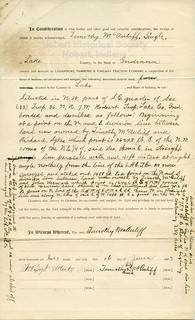
Among the interesting documents in the McAuliffe-Hahn collection are a couple relating to Timothy McAuliffe's selling of a right-of-way to the Logansport, Hammond & Chicago Traction Company, an interurban railway company so obscure that today it doesn't even have a Wikpedia page.


'Twas the 16th of June, 1903 …

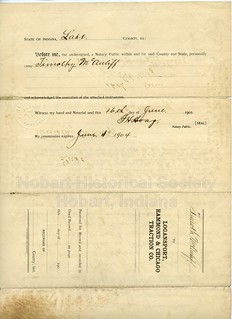
2015-8-1. Conveyance, side 2
(Click on images to enlarge)
Images courtesy of the Hobart Historical Society and Jocelyn Hahn Johnson.


2015-8-1. Conveyance, side 1

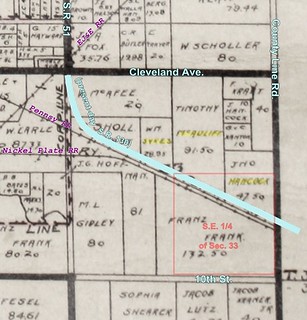
The description refers to the "line of the L.H.C.T.Co. as now surveyed and staked out," which may have been apparent enough in 1903, but certainly isn't now. However, from looking at the McAuliffe land on the 1908 Plat Map, with the Sykes* land on the west and the Hancock land on the east as mentioned in the description, I suppose it was just a strip of land running across the southern part of the McAuliffe farm (possibly alongside the Pennsy and Nickel Plate tracks):

2015-8-1. Sec 33 1908
(Click on image to enlarge)

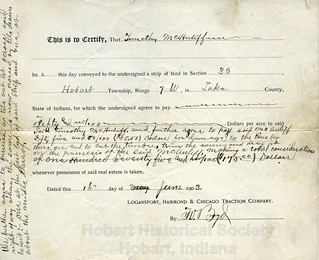
Another document pertaining to this agreement between the parties deals with drainage and the removal of timber from the land.

2015-8-1. Conveyance No. 1 001

♦    ♦    ♦

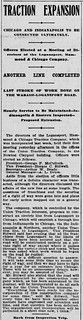
The Logansport, Hammond & Chicago Traction Co. was just over a month old when these documents were signed, having filed its articles of association with the Indiana Secretary of State on May 4, 1903 (Annual Report of the Officers of State of the State of Indiana … for the Fiscal Year Ending October 31, 1904).

The Indianapolis Journal of May 7, 1903 reported on the first meeting of the L.H.&C.T.Co.:

2015-8-1. Traction report
(Click on image to enlarge)

In 1909, a historian of Indiana's interurban railways classified the Logansport-to-Hammond line among some 16 lines "projected, but not as yet built. … Work has been done on some of these lines, and it is probable that some of them will be completed in the near future, but most of them have been totally abandoned." (Fred B. Hiatt, "Development of Interurbans in Indiana," Indiana Magazine of History, Vol. 5, Issue 3 (1909)).

And here we too shall abandon the Logansport, Hammond & Chicago interurban, leaving it to genuine railroad enthusiasts to tell the whole story, if possible.

♦    ♦    ♦

[12/4/2015 update] OK, just a little more of the story — this article from the Hobart Gazette of June 12, 1903, describes the planned route of the L.H.&C. line as it was understood by "some" in Hobart:

2015-12-4. LH&C RR plans
(Click on image to enlarge)

The next week's "Local Drifts" column included this item: "It is said the right-of-way man for the electric road has been buying right of way east of town, paying about $50 an acre and securing a 100-foot right of way. The surveyors for the road have run a line west of town to the Calumet marsh and for the past few days have been running a number of lines through town." The McAuliffe land was east of town.

__________________
*Another Sykes farm!

Monday, July 13, 2015

The Lye Accident, and an Update

I was nosing around in old issues of the Hobart Gazette, looking for any mention of Daisy Chester's marriage to E.D. Scroggins that I might have missed the first time around, when I came across this item in the January 4, 1907 issue that I definitely missed the first time around:
A week ago last Sunday the 2-year-old son of Mr. and Mrs. Chas. Chester who live on the Dick Sykes farm pulled from a table a can of concentrated lye which flew upon the little fellow's face and severely burnt him. The right eye seemed to be the worst for the accident and for several days it was feared he would lose its sight but it is now thought the eye will be all right in time.
Based on the 1910 Census, I conclude that the unnamed two-year-old was Robert Chester.

I do not know where the Dick Sykes farm was. Per the 1891 Plat Book, there had been farms belonging to Sykeses in Ross, Hobart and Winfield Townships — not to mention any that may have been in Porter County — but which was known as the "Dick Sykes farm," I do not know.

[7/20/2015 update] Suzi Emig has solved the mystery of the Dick Sykes farm! She writes:
Climb into the time machine ... we are going back to April of 1912. I have attached the newspaper account of my dad's parent's wedding. It was extremely yellowed and fragile when I got it years ago from my aunt. Fortunately she laminated it, so it survives. You will see many familiar names in the list of wedding guests. There is one error. The bride's mother, Mrs. Susan Casey, was a sister to Constance Chester, not to Mr. as stated. If you refer to the 1908 plat map (which you so conveniently provide!) the SE corner of 61st and Colorado is owned by a William Sykes ... maybe Dick was a nickname or he was incorrectly named in the lye incident article. William is shown in the 1880 census to be living on this property as a 21 year old with his mother and siblings, 3 brothers and a sister. Their neighbors are the John Schnabels. Their main house was on the SW corner of the intersection. It appears that William and his family were living here per the 1900 census, as the Fred Schnabels are listed as neighbors. Evidently William decided to give up farming and leased his home and land ... he is in Mississippi, working as a public road contractor in 1910, then in 1920 is back up north residing in Gary as a city clerk, and a garage owner there in 1930. He died in 1940 in CA. My dad always referred to that SE property as "the old Sykes farm", so I guess to the old timers that name stuck. The Charles Chesters were living in Stark Co., IN per the 1900 census. In 1910 they were somewhere in Ross Twp., and evidently relocated by 1912 to the Sykes property. By 1920 they were in the old house that Henry built.
2015-7-20. Schnabel Casey
(Click on image to enlarge)
I believe this clipping is from the Hobart Gazette of April 19, 1912.


Here is the William "Dick" Sykes farm on the 1908 Plat Map:

2015-7-20. Sykes 1908
(Click on image to enlarge)

Here's a clipping from the "General News Items" of the Hobart Gazette of July 5, 1907 (I didn't miss it the first time around; I just didn't post it) in which "Dick" is enclosed in quotes, as if to mark that it is a nickname.

2015-7-20. Chester-Sykes, Gaz, 7-5-1907

Here ends this update. If I find out how William got his nickname, I will update again.

♦    ♦    ♦

Thanks to our identifying-est commenter ever, we now have IDs on the people in the Chester-house-then-and-now pictures. (I have also added Chuck's IDs to each picture's description on Flickr, for ease of reference.)

Thursday, May 28, 2015

Ainsworth Then and Now: Summit Lawn/Indian Ridge

Circa 1898, and 2015.

2015-5-28. Dorman house circa 1898
2015-5-28. Indian Ridge 2015
(Click on images to enlarge)
First image courtesy of the Hobart Historical Society.


I had intended to take the "now" photo in the winter, when the view wasn't blocked by all those leaves, but you know how it goes. The circa-1898 photo is not very clear, being a reprint from the Gazette souvenir edition of 1898 — how I wish we had the original. When I moved out here in 1990, there was still a house standing among those trees. I'm not sure whether it was the same house as in the 1898 photo; it was knocked down so long ago that I scarcely remember how it looked.

The stone pillars and walls remaining on the grounds may date to 1911, when "John R. Dorman … greatly ornamented his home place by erecting some tall stone posts" ("Ross Township Notes," Hobart Gazette 1 Sep. 1911).

2015-5-28. Pillars

2015-5-28. Summit Lawn pillar

2015-5-28. JFDorman pillar

The newspapers rarely referred to the Dorman place as "Summit Lawn," but I do find this in my notes from the Hobart Gazette of Sept. 13, 1907:
Dorman's Summit Lawn Stock Farm of Duroc Jersey swine captured nine firsts and two seconds, also sweepstakes making this the second year the same herd has done this. He showed against 5 different herds and breeds this year at Porter County Fair.
When I go back and read the 1890s newspapers, I hope to get a better idea of when John Dorman bought this parcel. The 1891 Plat Book shows it belonging to George Sykes, but John Dorman owned it by 1899 per the notes I have on hand, and perhaps earlier.


Another pillar, north of those shown above, has halfway collapsed. I have no idea when or why it got a horseshoe embedded in the cement:

2015-5-28. Horseshoe


Here is a picture of John Dorman in his later years, from an unidentified 1944 newspaper (clipped and pasted into a scrapbook by Minnie Harms).

John Dorman circa 1944.
(Click on image to enlarge)
Image courtesy of Eldon Harms.


♦    ♦    ♦

[7/18/2015 update] From the Hobart Gazette of June 15, 1928, here is an article describing the types and sources of the rocks composing these pillars:

Stone pillars on Dorman (Indian Ridge) property
(Click on image to enlarge)

The description of pillars — their height and the four-sided pyramid topping them — matches the existing pillars, but I'm wondering why the article was not written until 1928 if the pillars were indeed erected in 1911. On the other hand, the article does not say they were recently built.

Wednesday, October 22, 2014

The Noted Chicken Farm and the Disgusting Hog Farm

I don't know anything about the "Chicken Farm," but apparently the Gazette's readers were expected to know all about it, as the paper reported in August 1921: "The noted 'Chicken Farm' gambling house may be transferred into a school house, as East Gary is said to be considering its purchase. A school house is needed in that part of town." So it was somewhere in or near present-day Lake Station.

Elsewhere, the paper noted that "[t]he Berghoff Road House had its grand opening last Saturday evening. This is Hobart's new place south of the Chicken Farm." The two establishments being mentioned in the same paragraph suggests to me that they were of similar character.

♦    ♦    ♦

West of Hobart, a hog farm was stinking up the place. At a special session of the town board on Tuesday evening, August 9, the "secretary of the local board of health was directed, through a notice from the Clerk, to notify the owners of the hog farm, situated in the west part of town, to place their farm of 40 acres in a sanitary condition. This place is known as the Sykes hog farm, the hogs being fed on garbage from Gary." (I have not been able to identify those 40 acres or their owner.)

At the same meeting, Sherman Henderson was appointed to the town board to fill the vacancy left by Hugo Zobjeck's departure the previous spring.


Sources:
♦ "Local Drifts." Hobart Gazette 5 Aug. 1921.
♦ "Town Board Meeting." Hobart Gazette 12 Aug. 1921.

Sunday, December 8, 2013

Los Angeles Honeymoon

Carlisle Dorman was sufficiently recovered from his nervous breakdown to be married in January 1921. (Who knows? — maybe he suffered the breakdown waiting for her to say yes.)

Dorman-Sykes marriage

It sounds as if Carlisle is marrying his business partner's daughter, which would be convenient as long as both relationships go smoothly; otherwise, things could get awkward. Dorman & Sykes owned the Fifth Avenue Garage in Gary. The 1920 census lists Edith Sykes, 28, as a stenographer in a garage — I have an idea which garage. The News mentioned that she had once taught in the Hobart public schools.

The young couple were shipping their car to Los Angeles for the honeymoon, they (and the car) traveling there by rail, I suppose.

Edith Dorman
(Click on image to enlarge)
Image courtesy of the Hobart Historical Society.
Handwritten notes on the back of this photo identify it as Edith Dorman. Since John and Ella Dorman did not have a daughter by that name, I'm guessing it's Carlisle's wife.


Sources:
♦ 1920 Census.
♦ "Dorman-Sykes." Hobart News 13 Jan. 1921.
♦ "Local Drifts." Hobart Gazette 21 Jan. 1921.

Saturday, February 12, 2011

Two Long-Timers Leave (Part 1)

WojahnMaybaum1917
(Click on image to enlarge)
Outlined in red is the John Wojahn farm, where his son Louis farmed; outlined in orange is the extensive Bragington farm, part or all of which was rented and farmed by Ed Maybaum.


Late in the summer of 1917, two long-time Ainsworth farmers separately announced their intention to get out of farming and Ainsworth.

If we can believe the News, the Wojahn family bought their 92 acres on the south side of the Lincoln Highway around 1882, when Louis was born.

Louis' parents, John and Minnie Wojahn, had both immigrated from Germany (1871 for John, unknown date for Minnie). Ross Township was crawling with Wojahns, but since I haven't figured out their family relationships yet — I suppose I have to wait for the right obituary — I won't go into that now.

At the age of 20, Louis went to work on the William Sykes farm in northern Ross Township. After about a year of that, he came back home to rent the old place from his parents and farm it for himself.

On May 10, 1903, Louis married Lena (Carolina) Fasel, eldest daughter of Henry and Mary Fasel, who farmed south of Hobart. The young couple lived and worked on the Wojahn farm. (About a year later his parents moved to Chicago to stay with another son, but they eventually came back to Ainsworth.) In 1905 Louis expanded his operations by renting additional farm land near Wheeler. The little household had increased by one: in 1904 the Wojahns took in an 11-year-old orphan boy named Charlie Wishon. He stayed with them for six years, then abruptly ran away.

Louis and Lena had three children — Irwin (born 1908), Emily (1910) and Lucile (1914). In 1910 the Wojahns bought Dr. L.M. Friedrich's brick house in Hobart and moved it onto a lot on Lake Street south of the "J" tracks, to rent out for additional income. By 1911 they had a telephone and an automobile. Life seems to have gone along peacefully for them, aside from the occasional tree thief and uninvited visitor.

Then in July 1917, Louis placed an ad in the News: "For Rent — 92-acre farm, one mile southeast of Ainsworth on Lincoln highway. Louis Wojahn, Phone 1626-J-2." From the description, it could only be the old homestead. A week later the Gazette explained that the Wojahns were planning to retire from their farm. Lena's parents had given them a 15-acre parcel southeast of Hobart (I believe it was on the south side of 10th Street, east of Hobart Road) where they were now building a six-room bungalow, their new home.

By mid-September, the Wojahns had found for the old farm a new tenant, who was to take possession on November 1. All that remained to do was to sell off the livestock and farming equipment they would not need on their new 15 acres. They hired an auctioneer and ran this advertisement for the October 2 auction:

Hobart News 9-27-1917
(Click on image to enlarge)

I find ads like this interesting for the information they give about what livestock and equipment made up a farm in that era. (For those who may be wondering — as I was until I looked it up — a cow is said to be "fresh" when she has newly come into milking condition, e.g., after having delivered a calf).

Just below this ad in the News of September 17, a similar ad appeared for the other long-time Ainsworth-area farming who was about to cut and run — Ed Maybaum.

(To be continued)


Sources:
♦ 1874 Plat Book.
♦ 1891 Plat Book.
♦ 1900 Census.
♦ 1910 Census.
♦ 1920 Census.
♦ 1926 Plat Book.
♦ 1930 Census.
♦ 1939 Plat Book.
♦ "Ainsworth Pick-Ups." Hobart Gazette 30 Sept. 1904; 5 Aug. 1910; 2 Sept. 1910.
♦ "General News Items." Hobart Gazette 28 Mar. 1902; 29 Sept. 1905.
♦ "General News." Hobart Gazette 20 July 1917.
♦ "Local and Personal." Hobart News 23 Aug. 1917.
♦ "Local Drifts." Hobart Gazette 9 Jan. 1903; 29 July 1910; 5 May 1911; 24 Nov. 1911.
♦ "Personal and Local Mention." Hobart News 29 Oct. 1914.
♦ "Personal Mention." Hobart News 11 May 1911.
♦ "Public Sale." Hobart News 27 Sept. 1917.
♦ Untitled social column. Hobart News 12 July 1917; 20 Sept. 1917.
♦ "Wojahn-Fasal Nuptial." Hobart Gazette 15 May 1903.