Showing posts with label Miller. Show all posts

Wednesday, January 28, 2026

"Killed By a Fall from a Wagon"

Another entry from the Jeremiah Wiggins estate papers. (We are close to the finish line.)

2026-01-28. Wiggins estate 05a
(Click on image to enlarge)
Images courtesy of Alice Flora Smedstad.


My transcription:
State of Indiana    Lake County
Received of Henry Miller a Noat of two Dollars and fifty Cts payable to mr. Sherman

May the 28 — 1838
        Jere'h Wiggins

The notes on the back establish that Mr. Sherman's first name was William:

2026-01-28. Wiggins estate 05b

I'm not sure I understand how this transaction came about — maybe something like this: Jeremiah owed Henry Miller money but didn't have cash on hand, so he undertook Henry's obligation to pay off a note to William Sherman when it came due. Two and a half months later, Jeremiah was dead and the note hadn't been paid off. Of course, William wanted his money.


William Sherman settled in Lake County in 1837.[1] Various family trees on Ancestry.com say he was born in New Hampshire in 1784 (although I haven't yet found one that cites a source for that). According to T.H. Ball, William married Calista (more usually spelled Celista) Smith in 1807 in New York.[2]

The 1840 Census records William and (probably) Celista, with six other people in the household — their children, I would guess. T.H. Ball said that William was the father of 13 children in total,[3] but some may have been out of the house already, and some yet to enter it.

Tragedy struck in 1843. T.H. Ball quotes, from an unnamed diary, an entry for September 16, 1843: "This morning Mr. Sherman was found dead, killed by a fall from a wagon."[4] He was presumed to have died the previous day, according to his grave marker.

Celista never remarried. She died October 1, 1884 at nearly 96 years of age.

2026-01-28. Celista Sherman - death notice - untitled social column, Crown Point Register, 2 Oct. 1884, p. 3
(Click on image to enlarge)
Untitled social column, Crown Point Register, 2 Oct. 1884, p. 3


James Luther was her son-in-law, the widower of her daughter, also named Celista, who had died in 1881:

2026-01-28. Obituary (Celista Sherman Luther), Crown Point Register, 8 Dec. 1881, p. 3
(Click on image to enlarge)
Crown Point Register, 8 Dec. 1881.


I believe the "old Sherman farm" may have been the southwest quarter of Section 21 (east of Grant Street, south of 129th), which William Sherman bought (160 acres) per Early Land Sales, Lake County (although the sale was dated December 1843, and there was a William Sherman, Jr.).

The younger Celista's obituary gives the impression (doesn't it?) that her parents, native New Englanders, made a detour through Canada before coming to Lake County.

Writing in 1904, T.H. Ball noted that "the living descendants of these Lake county Shermans numbered, a few years ago, fifty-two."[5] I shall not try to account for that many people.

♦    ♦    ♦

The other party to this transaction, Henry Miller, is just a brief blip on the radar. He gets this one mention in T.H. Ball's discussion of the Squatters' Union (quoting I think, from the Union's records):
"1837, March 16. This day an arbitration was held between Denton and Henry Miller and John Reed, who had gone on to Millers' claim and built a cabin, and the Arbitrators decide that Reed shall give up the cabin to Millers, and pay the costs of this arbitration, but that Millers shall pay Reed seventeen dollars for the cabin which he has built."[6]
Then he disappears.

_______________
[1] Lake County 1834-1872 at 56.
[2] Lake County Encyclopedia at 97.
[3] Lake County Encyclopedia at 97).
[4] Lake County 1834-1872 at 89.
[5] Lake County Encyclopedia at 97.
[6] Lake County 1834-1872 at 49.

Tuesday, April 8, 2025

"Send to Ainsworth on the Grand Trunk Road"

In April of 1886, J. Miller of Deep River asked F. Madlener of Chicago to send him numerous bottles of … something.

2025-04-08 1886-04-13 Miller, Deep River order to Madlener 01
(Click on image to enlarge)

2025-04-08 1886-04-13 Miller, Deep River order to Madlener 02

This was a government-issued postal card of the kind that had been authorized by 1872 legislation. Apparently, the F. Madlener firm of Chicago bought a lot of these, stamped its own address on them, and handed them out to people to use for ordering its products.

The Madlener firm manufactured alcoholic beverages. Its most famous and profitable product was Fig Rye, a concoction of figs and rye whiskey touted as a health supplement. Fig Rye was first marketed sometime in the 1880s.[1]

J. Miller didn't bother to specify what was supposed to be in those pint and half-pint bottles, but it had to be some kind of alcohol. The fact that he ordered numerous small bottles, rather than one big one, suggests that his intent was sales, not his own personal use.

Now I'm wondering if he was selling, or trying to sell, alcohol in the village of Deep River. Its founder, John Wood, had been a temperance advocate, and had taken steps to keep saloons out of his village during his lifetime. Now in 1886, just three years after Wood's death, had his anti-saloon policy been abandoned already? Or was J. Miller a grocer, perhaps, who intended to sell Fig Rye as a health aid? … which, incidentally, just happened to produce drunkenness if you drank enough of it.

♦    ♦    ♦

I would like to find out who J. Miller was, but with such a common surname and only an initial for his first name, the task seems hopeless.

Of course, I immediately thought of Ainsworth's John Miller. Born in Germany in 1865, he came to the U.S. in 1880 (1900 Census). It was in Chicago in 1896 that he married Martha Maybaum (Cook County, Illinois, Marriages Index). I do not know where he spent the years between 1880 and 1896, but his meeting and courting Martha, who lived in our area, probably took a little time. However, there is a problem with my hypothesis that the "J. Miller" of the postcard was this John Miller (besides the fact that I have no records to show him here in 1886): the handwriting and wording of the postcard don't suggest, to me, someone whose language until he was at least 15 years of age was German, and who was, in April 1886, just short of 21 years old and six years in this country. The postcard sounds as if it had been written by someone born in the U.S.

I turned to the on-line newspapers to try to find any mention of someone named Miller doing alcoholic business around Deep River circa 1886, and did not find it.

A saloon-keeping John Miller, born in Indiana in 1863, turns up in Griffith, St. John Township, in the 1900 Census. But I have absolutely no evidence that he ever tried doing business in Deep River!

I think our postcard-writer is going to be a mystery forever.

_______________
[1] Source. Unfortunately, that source doesn't cite its own sources, and I could not find any other source giving even a general date for Fig Rye's introduction, nor any newspaper ads for it prior to the late 1890s.

Friday, January 24, 2025

Mills of Mystery

Here are some random excerpts from Solon Robinson's "Lake County, 1833 – 1847"[1] that amused me:
In the summer of 1834, most of the land in the county was surveyed by the United States Surveyors, and settlers began to "make claims," and four or five families settled that fall.

One of these I found in October, 1834, in a little shed roof cabin on Sec. 6, T. 35, R. 7, at a place afterward known as "Miller's Mill." His name is already among those that once were, but now are forgotten.

I am inclined to think that an old man by the name of Ross, also settled on the same section that fall. This man was killed by the falling of a tree near Deep river in 1836. (I believe King Alcohol was there to see, and it happened on a Sunday.)[2]

.    .    .

The next family [after Robert Wilkinson's] was that of Lyman Wells; (afterwards well known as "Lying Wells.") With him came "Irish Johnny", now known as John Driscoll.

They came in January, 1835, and settled on Sec. 25, T. 33, R. 9, near where Driscoll now lives. Driscoll was then single, but has since obeyed the scriptural command to multiply and replenish the earth.

Wells had a wife and 4 or 5 children. He lived a few years here and moved further west, and his wife died, and some say the world would not have suffered much loss if he had died too.[3]

.    .    .

Walton's saw mill on Turkey Creek, Wood's and also Dustin's on Deep River and Taylor's on Cedar Creek, were all building during this year [1837]. But with the exception of Wood's they might as well never have been built for the good they have done. The same may be said of the one called "Miller's Saw Mill" on Deep river. Dustin's, Miller's and Walton's have been in utter ruins for years, on account of the difficulty of making a dam of dirt stand, and Taylor's is about half the time without water, and the other half without a dam.[4]

.    .    .

The accommodation of the people of the county was greatly increased this year [1847], in getting grain made into bread stuff, by the mill of Wilson & Saunders on Deep River below Wood's (and as he thinks not quite far enough below).[5]
A little snark livens up history, doesn't it? But I was also intrigued by the references to several local mills I had never heard of before. I wanted to see what information I could find about them (excepting "Taylor's on Cedar Creek," which is outside my bailiwick).

First, let's deal with "Miller's Mill."

Upon learning that this mill was built in Section 6, Township 35 N., Range 7 W., I consulted the 1874 Plat Map and was puzzled because it does not show the Deep River crossing that section:

2025-01-24. Section 6, T. 35 N, R. 7 W -- 1874 plat map
(Click on image to enlarge)

But here is that section as it appears on the Lake County GIS parcel viewer:

2025-01-24. screen shot of Section 6
(Click on image to enlarge)
Screenshot from the Lake County Indiana GIS Hub Parcel Viewer Page.


You can see that 61st Avenue, a/k/a Bracken Road, crosses the river in the southwest part of the section. Also, Solon's Robinson's 1838 map shows the river crossing Section 6. I think we can conclude that the mapmaker of 1874 made a mistake.

The Lake County Encyclopedia, in a chapter containing "Memorial Sketches of Early Settlers," includes this information:
Miller. — There was beyond any room for doubt an early mill seat found and a mill built on Deep River. The Claim Register, which is authority, says: "William Crooks and Samuel Miller in Co. Timber and Mill Seat." Claim made in June, 1835, but settled in November, 1834. Locality, Section 6, Township 35, Range 7. W. Crooks from Montgomery county. This William B. Crooks was elected, in 1837, Associate Judge, and a "Permit" was granted, July 31, "to Samuel Miller to retail foreign merchandise at his store on Deep River." That he had a mill and a store is certain; but of himself very little is known. It is said, and this is tradition and not history, and for its accuracy no good authority can be named, that his wife was part Indian, that he had sold property at Michigan City for eighty thousand dollars in gold and silver, and that much whiskey, as well as other articles of "foreign merchandise," was sold at his store. This last particular is no doubt true. If the gold and silver tradition is true, he must have been the most wealthy adventurer who came into the county in those early years. He made no long stay at that store but sold it to A. Hopkins, who soon sold it to H. Young, and he sold the mill irons to a mill builder, and for himself opened a gun shop which he kept for several years.

A gravel road crosses Deep River now at this locality and a few years ago some of the old timbers of Miller's mill could still be seen in the waters. Somewhere there may be descendants of this Samuel Miller.

Note. — Since the above was written there has come into my hands a little book of autobiography by Dr. James Crooks, a son of Judge William B. Crooks, who it seems was also a physician, and Dr. James Crooks says that his father settled at Michigan City in the spring of 1834. This James Crooks was then eight years of age. He says that Samuel Miller was then the principal business man of that place, that he "owned considerable real estate, houses, a store, warehouse, and a schooner." He also says that his father, Dr. W. B. Crooks, removed into what became Lake county in November, 1834; and that in the spring of 1835 his father and Samuel Miller commenced building a mill on Deep river. After narrating many interesting recollections of his childhood in Lake county he at length says that his father sold out, in the spring of 1838, "his possessions in Lake county to Samuel Miller of Michigan City," for one thousand dollars, and that five hundred dollars was paid "in gold." So Miller must have had some gold. He further adds that "Miller failed a short time afterwards." In June of 1838 the Crooks family left Lake county.[6]
The "gravel road" crossing the Deep River where the mill had been would be 61st Avenue — that is, by 1904, when these "sketches" were published, it was a gravel road; but when the mill was built, it was likely no more than wagon tracks in the dirt.

In a speech delivered in 1884 to the Old Settlers Association, the Rev. T.H. Ball said:
We date our beginning of actual settlement in 1834; yet there is now evidence, which has lately come to light, that at least one family, the first to open a farmer's home in what is now Lake county, spent the winter of 1833 and 1834 on section six, in township thirty-five, range seven west, now in the township of Hobart, formerly in that of Ross. The name of this pioneer was William Ross.[7] … Next came those whom we have learned to call "claim seekers," men seeking locations on the newly surveyed Government lands. Among these we have the now historic names of William B. Crooks, making his claim, near the home of William Ross, in June of 1834, and in company with him Samuel Miller, these selecting "Timber and Mill Seat," and some of the foundation timber of "Miller's Mill" can be seen on this fiftieth year down in the clear water of Deep River.[8]
At the same Old Settlers Association meeting in 1884, Bartlett Woods commented:
William Crooks settled on Deep River near the bridge across that stream on the present road from Merrillville to Hobart. Samuel Miller, of Michigan City, in company with Crooks built a mill there. I knew Miller but do not remember Crooks; the same Crooks was afterwards an associate Judge. There was a store there in an early day, selling a little of everything. Whiskey was part of the stock in trade. Whiskey was cheap then, and was retailed at a shilling a quart. The mill and store were finally abandoned, but the place always was known as Miller's Mill.[9]
I have not found Samuel Miller in the 1840 census of Lake County; in fact, Ancestry.com's search function doesn't return a single Miller in the 1840 census, which is surprising for such a common surname. Early Land Sales, Lake County doesn't list Samuel, either. Among the names I have indexed thus far from the early ledgers at the Hobart Historical Society museum, I find a few references in the 1840s to a "Miller, S.," but there is no way for me to determine what the "S." stands for.[10] It's possible that Samuel Miller came to Ross Township, built his mill, found it didn't pay, and got out of Lake County, all before the 1840 census.

I suppose it's no use walking along the bridge on 61st Avenue and looking down into the river around there. The old pilings that used to be visible have probably long since worn, or been swept, away.

This post has already gotten too long, with too many footnotes, so I am going to have to postpone talking about the other mystery mills for now.


_______________
[1] Printed in Lake County Historical Association (John O. Bowers, Arthur G. Taylor, and Sam B. Woods, eds.), History of Lake County, Vol. 10 (Gary, Ind.: Calumet Press, 1929), p. 35 et seq.
[2] Ibid., p. 37. This is probably the Ross for whom Ross Township was named. See Howat's discussion, which does not mention King Alcohol.
[3] Ibid., pp. 38-39.
[4] Ibid., p. 48.
[5] Ibid., p. 57.
[6] Ibid., pp. 119-120.
[7] Lake County 1884, p. 18.
[8] Ibid., p. 20.
[9] Ibid., p. 80.
[10] I have also failed to turn up any record of William Crooks, or the purchasers of the mill, A. Hopkins and H. Young.

Monday, February 6, 2023

Photographers Who Fell Into My Lap

While looking for something else in the Gazette microfilm, I came across some information about a few photographers operating in Hobart in the 1940s.

2023-02-06. 1948-02-05 Gazette, Ehlen Closes Photo Shop
(Click on images to enlarge)
Hobart Gazette, 5 Feb. 1948.


It was nice of the writer to package up Fred Ehlen's beginning and ending so neatly for me — if the opening of his studio circa 1942 was announced in the Gazette, I wasn't paying attention.


Next comes Herbert Hagenwald, Jr., who doesn't stay very long.

2023-02-06. 1948-04-15 Gazette, New Photo Studio To Open Here
Hobart Gazette, 15 Apr. 1948.


And then Arthur Miller of East Gary (Lake Station), whose duration has yet to be determined.

2023-02-06. 1948-07-08 Gazette, East Gary Man Buys Hobart Studio
Hobart Gazette, 8 July 1948.

I myself don't recall ever seeing any photos with the Hobart Studio or Loray Studio name. They may be out there somewhere.


I have also updated the entry for Roland Grabill to reflect that, according to his 1943 obituary, he closed his studio in 1938.

The updated photographer list is available here.

Monday, December 12, 2022

A Stealth Dentist

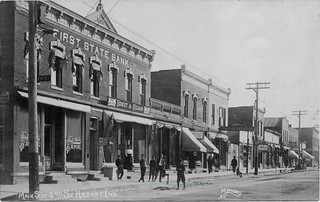
I bought this postcard because I didn't have this exact view of the 300 block of Main Street.

2022-12-12. Main Street 1911-02-01 a
(Click on image to enlarge)

It is the east side of Main Street, looking south from Third Street. The postcard is postmarked February 1, 1911.

We've seen all of these things before. What interests me in particular is the second story of 301-305 Main, where we see several awnings and a sign jutting out, all with the word "Dentist." At street level, under the big sign for the law partnership of Bozarth & Bozarth,[1] there is a small plaque with the nearly illegible name of a dentist.

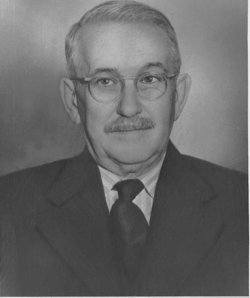
The 1910 Census shows two dentists in town — Fred Werner and Charles Kenward — and of those two names, I think Kenward looks more likely.

But I never heard of Charles Kenward before. How is it possible that I've read so many issues of Hobart newspapers from this era and never heard of one of the two town dentists?

His obituary, from the Hobart Gazette of June 10, 1943, says that he moved to Hobart in 1905 and practiced his profession here until 1918.

2022-12-12. 1943-06-10 Gazette, Dr. Kenward, Former Hobart Dentist, Dies Thursday
(Click on image to enlarge)

2022-12-12. Dr. Charles Franklin Kenward
Image from findagrave.com

♦    ♦    ♦

I already covered most of the other businesses in this photo in another post about a similar postcard, dated the same year, but looking at this side of the 300 block from the other direction.

Notice that the awning of Scheddell's Drug Store reads "The Mackey Drug Store."

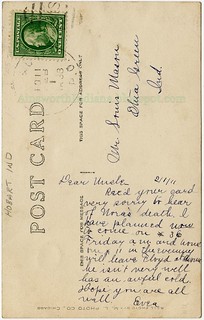
Turning the postcard over, we find it signed "Evea" — I think that's Evea Miller, whom we've met before.

2022-12-12. Main Street 1911-02-01 b

The Floyd with a cold was her toddler-age son. I wonder whom she was planning on leaving him at home with? As for poor Nora, she is a mystery to me.

_______________
[1] I'm not sure who the lawyers were; possibly Nelson and William Bozarth, father and son, who were Valparaiso residents in 1910 but might have had an office in Hobart.

Friday, December 31, 2021

New Year's Greetings for 1910

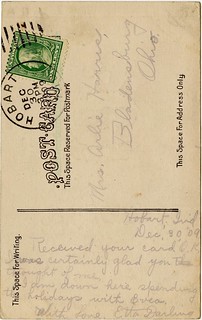
On December 30, 1909, two sisters sent out New Year's greetings from Hobart.

2021-12-31. Miller, Evea 1909-12-30 a-1
(Click on images to enlarge)

2021-12-31. Miller, Evea 1909-12-30 a-2

2021-12-31. Miller, Evea 1909-12-30 b-1

2021-12-31. Miller, Evea 1909-12-30 b-2

The senders were Mrs. Evea Miller and her younger sister, Miss Etta Darling.

Evea had married Jesse Miller in 1905, in Kosciusko County, Indiana, where the Darling family lived at the time. Shortly after that, the remaining Darlings moved permanently to South Bend, whence they traveled to Hobart in 1909 for this holiday visit with Evea and Jesse, as both postcards mention.

The 1910 Census shows Jesse (27) and Evea (22) living on Lillian Street with their first child, a two-year-old named Floyd. Jesse is described as an "operator" for an unnamed railroad — probably the Pennsy, if he had to hike to Liverpool every day (as Evea says in her postcard message). Their Lillian-Street neighbors apparently included Lewis Barnes and Rose Hendrix Gilpin.

It was probably Jesse's railroad job that brought them to Hobart. Neither had any previous local connection that I can find, or any subsequent either. By 1920 they had relocated to Warsaw, Kosciusko County, Indiana, which became their permanent home. Both Jesse and Evea are buried there.

Bladensburg, Ohio (where Etta was sending her postcard), was where her and Evea's father, Otto Darling, had been born in 1863 and where he married Stella Mason in 1885. The family moved to Indiana by 1900.

In 1911 Etta married a man named Clyde Carr in South Bend. There they lived out their lives and raised their three daughters, and both are now buried in South Bend's Highland Cemetery.

Sunday, November 17, 2019

And They Lived Happily Ever After

On September 23, 1923, Miss Leona Raschka became Mrs. Fred Ewigleben, Jr.

2019-11-17. Raschka, News, 9-27-1923
(Click on image to enlarge)
Hobart News, Sept. 27, 1923.


We just recently met Leona's bridesmaid, Florence Ewigleben. We've also met the best man, Walter Miller.

In all these years that I've been hearing that wonderful name, Ewigleben — it means "live forever" in German — I've never looked into the family much; I was content to know that they were a farming family from somewhere west of Hobart. Now I'd like to find out exactly where that farm was. Let's look at the 1908 Plat Map:

2019-11-17. Ewigleben 1908
(Click on image to enlarge)

Why, you may ask, should I be interested in the land owned by "C. Erigleton"? — because that land coincides with the land owned by Christ Ewigleben as shown in the 1891 Plat Book. My theory is that Erigleton is a butchered spelling of Ewigleben.

I've often wondered about that big parcel on the northwest corner of Liverpool and 49th, which seems like a throwback to the old rural days of this area, almost untouched by the development that has transformed the old Hayward farm on the east side of Liverpool Road. The farmhouse that sits on that land was built in 1890 according to the county records, so perhaps it is the old Ewigleben home.

Christ Ewigleben, the patriarch of this family, was a German immigrant. It appears that he married and had some children in the old country; I do not know what happened to his first wife. In 1865 Christ came to the U.S. (1900 Census). In Cook County, Illinois, in 1873, he married a woman named Johanna, whose surname is listed as Hillmann or Maas.[1]

The earliest I can find the Ewigleben family in Hobart Township is in the 1880 Census, on the same page with (among others) Berndts, Boldts and Mummerys, which suggests that they were in the area west of Hobart where the 1891 Plat Book places them. Christ's wife is listed as "Teressa" or some such thing, not Johanna; it's a mystery.

Their son, Frederick — the father of the groom in our 1923 story above — was born in Hobart in 1878 (Indiana Death Certificates). He married Tillie Blanchard in 1898 (Indiana Marriage Collection); and their son, Frederick, was born in 1902 (Indiana Death Certificates).

Frederick Jr. and Leona's home at 520 E. Fourth Street seems to be a bank parking lot now.

♦    ♦    ♦

Elsewhere on the same page of the News, above, we find Clifford O. Mize going to prison for the attempted murder of his mother-in-law back in July 1923.

We also find the Gem Theater receiving a letter demanding that it stop showing movies on Sunday evenings. Just remember how recently we Hoosiers could not buy alcohol on Sunday.

_______________
[1] "Hillmann" per Ancestry.com, Cook County, Illinois, Marriages Index, 1871-1920 [database on-line], Provo, UT, USA: Ancestry.com Operations, Inc., 2011. "Maas" per Ancestry.com, Illinois, Marriage Index, 1860-1920 [database on-line], Provo, UT, USA: Ancestry.com Operations, Inc., 2015.

Friday, November 23, 2018

Hobart Then and Now: Lillian Street from Ohio

Circa 1910, and 2018

2018-11-23. Lillian St. ca 1910
(Click on images to enlarge)
2018-11-23. Lillian St 2018

We are standing at the intersection of Lillian and Ohio Streets, looking northwest toward S.R. 51.

The photo is by August Haase, so we know it was taken between 1902 and 1913. Accord to the county records, the house now standing at the corner in the foreground was built in 1909 (all the structures beyond it in that block were built in the late 19th century). Is the 2018 house the 1909 house after a century of remodeling? It looks possible.

Here's the verso of the postcard:

2018-11-23. Lillian Street 002

The stamp box style, according to playle.com, dates between 1908 and 1924.

All things considered, I'm going to estimate this photo at circa 1910, give or take a couple of years.

The writer tells us that the dot over the second house from the corner shows us where "Eva" lived. But who was Eva? The 1910 Census shows two Evas on Lillian Street.

One was Eva (Kitchen) Bowen, wife of William Boyd Owen, Jr., brickyard superintendent. I have been told that the "Owen house" is on Lillian north of S.R. 51 … but were all the Owens confined to that area?

The other was Eva (Darling) Miller, who was born circa 1887 in Ohio (hence, maybe, the Ohio connection with the postcard's addressee?). By the 1900 Census her family had moved to Kosciusko County, Indiana, where in 1906 she married Jesse Miller. By 1910 the young couple were living in Hobart, but the 1920 Census records them back in Kosciusko County.

It could be either, as far as I know, but I have a feeling it was Eva Miller.

Thursday, June 29, 2017

Mary McAuliffe and Dr. A.G. Miller

Or: When Posts Collide.

I was trying to think of what to write about, when I remembered that I had just posted about Mary McAuliffe … and not so very long ago, about Dr. A.G. Miller … and I have them both together in a few documents from the early 1940s.

Dr. Miller sent this bill to Mary at the old McAuliffe farm on Cleveland Avenue.

2017-6-29. img851
(Click on images to enlarge)
Images courtesy of the Hobart Historical Society and Jocelyn Hahn Johnson.


She (or perhaps her adopted son, Edward Hahn) paid it in full.

2017-6-29. img852

A couple months later, Dr. Miller sent a bill to Mary at 1123 Devonshire.

2017-6-29. img853

My 1947 directory lists Edward Hahn at that address.

Wednesday, May 24, 2017

Hobart Then and Now: The Miller Corner

1970s, and 2017.

2017-5-24. img887-d
(Click on images to enlarge)
Image above courtesy of the Hobart Historical Society.

2017-5-24. Miller corner 2017

I call this house the Miller house, because Eldon Harms told me that the Miller family lived there. But since I don't know when the house was built, I don't know who among the previous owners of that land might have lived there; nor do I know who might have lived there after the Millers ceased to own it. By 1950 it was part of Chester Wasy's extensive property, but surely he did not live there when he might choose the spacious Chester house or the riverside Nolte house.

If the house dated back to the early 1890s, it once housed Peter and Caroline Stolp, the maternal grandparents of Minnie (Rossow) Harms. They rented that farm for a short time. Peter may have died there (1892).

However, after that mystifying news item about John Miller moving his house, I don't know what to think.

The house was still standing when I moved here in 1990. By then it was painted green. There was a dog house behind it, and beyond the back yard a fenced-in area where a horse was kept, with a shed for its shelter. At the edge of the field to the south was a rusty farm machine — a tractor or some such thing. I liked that house. It was demolished before I began my historical research.

But getting back to the photo above — I'm dating it to the 1970s simply because of the style of photo. We have a similar photo, likewise undated, but taking in a car that looks like the sort of car you might see in the mid-1970s.

2017-5-24. img886-a
(Click on image to enlarge)
Image courtesy of the Hobart Historical Society.


These two photos were taken at least a few months apart, since here the trees are in full leaf, while in the first one the leaves are changing color and falling. I think this photo was taken when the Tonagels had their store up for sale. We have some others taken apparently at the same time with a better view of the automobiles that are helping me date these photos to the 1970s.

Thursday, May 18, 2017

Dr. A.G. Miller

This photo of Dr. Miller is from 1934, about eleven years after he began his practice in Hobart.

2017-5-18. Dr. A.G. Miller 1934
(Click on images to enlarge)

This was a press photo, and from the copy on the back we learn that … he had rhythm.

2017-5-18. Dr. A.G. Miller 1934 verso


His name is at the top of the building at 225 Center Street.

Monday, May 15, 2017

In Miller News

In January 1923, the Gazette announced that Dr. Arthur G. Miller was planning to set up business in Hobart.

2017-5-15. Miller news - Dr. A.G. Miller, John Miller
(Click on image to enlarge)
Hobart Gazette 19 Jan. 1923.


More germane to this blog, however, is that mystifying move by John Miller. Can that be right? The southeast corner of the Miller land would be out in the fields. Possibly what was meant was the southeast corner of the intersection where the Lincoln Highway and present-day Grand Boulevard meet. That's where the Miller house stood until it was demolished some years ago.

I'm still wondering where the house was in the first place.


2017-5-15. Dr. A.G. Miller ad
(Click on image to enlarge)
Hobart Gazette 2 Feb. 1923.

Sunday, January 29, 2017

Trench Mouth and a Twice-Broken Leg

In early December 1922 we find disease and an accident in the Ainsworth area. Alice Paine had to suspend her schooling while she battled a case of trench mouth, which sounds rather unpleasant. In the Goldman household, little Reva, only a few months after coming to America, was hospitalized. (And in the left-hand column we see that the Goldmans' store was going to be open every evening until Christmas!) On the former Otis Guernsey farm, James Jeffrey had broken the same leg twice.

2017-1-29. Wesley etc. news
(Click on image to enlarge)
Hobart Gazette 8 Dec. 1922.


Happier news comes in the "Births" column — a new Wesley baby. I haven't completely ignored the Wesley family, but I have pretty well ignored this particular member of it. I had to go checking on Ancestry.com to get some basic information about William Wesley. Thanks to William's death certificate, I now know that his mother (his father's first wife) was Augusta Miller.

William was born in 1890 and named, apparently, for his grandfather (1900 Census). In 1917 he married the 18-year-old Pearl Auton (Indiana Marriage Collection), daughter of Harvey and Elma (Smith) Auton (1900 Census).

Per the 1920 Census, William and Pearl owned their own farm, somewhere in southeastern Ross Township. It may have been this small parcel shown in the 1939 Plat Book.

2017-1-29. Wesley 1939
(Click on image to enlarge)

(The 1926 Plat Book shows that land owned by "J.W." — probably John Wesley, William's father.)

By 1920 they had one little boy, Howard. The daughter born in 1922 was named Helen. They would have another three daughters (Thelma, Betty, and Elsie Mae) by the time of the 1940 Census.

Monday, October 19, 2015

Hobart Class of 1922: Walter Miller

Among the seniors at Hobart High School in the spring of 1922 was Ainsworth's own Walter Miller.

2015-10-19. Miller, Walter 1922
(Click on images to enlarge)
Images courtesy of the Hobart Historical Society.


Seeing that title — "Duke of Ainsworth" — made me wonder if we had misidentified this photo … but no, that Duke of Ainsworth is not Walter Miller. Ainsworth had more than one Duke, it seems.

Walter's sister, Ruth, had graduated from Hobart High in 1917. With Ruth now married and living in Michigan, Walter was the only child left at home.

♦    ♦    ♦

Among the random photos printed in the 1922 Aurora yearbook is a pair of shots from the upper floor of the old high school on Fourth Street:

2015-10-19. img937

In the photo on the left, the camera is pointed toward New Street; the library building (now the Hobart Historical Society museum) is in the upper left-hand corner. In the photo on the right, the camera points northwesterly; in the upper right we see just a corner of the second M.E. Church, with the old parsonage next door.

Saturday, March 7, 2015

Ross Township Trustee's Report, 1921

2015-3-7. Ross Twp. Trustee's Report for 1921
(Click on image to enlarge)
Hobart Gazette 13 Jan. 1922.


So many of our acquaintances here, I can't index them all. Gus Lindborg was still the go-to man for bus repairs, among other things. Bus drivers included C.S. Guernsey, Paul Fredrick, William Springman, John Miller, and Thomas Sullivan. Schoolteachers included Elsie Gruel, Olive Wood, and Evelyn Fredrick (Paul's daughter). Charles Goldman sold unspecified merchandise to the township. Robert Harper provided "advisory service." And under "Road Fund Disbursements," many familiar names.

Thursday, February 26, 2015

Fox News

Throughout December 1921, henhouses in southeastern Ross Township were suffering greatly from foxes, and James Frame intended to do something about it.

2015-2-26. Fox news
(Click on image to enlarge)
Hobart News 29 Dec. 1921.


On January 2, 1922, some 40 to 50 men showed up to wander about the countryside with their guns and their dogs.

2015-2-26. Fox hunt report
(Click on image to enlarge)
Hobart Gazette 6 Jan. 1922.


A separate hunt took place in Porter County the same day, with the same result — only one fox killed.

I believe that the "Dick Hoffman of Deepriver" who shot the fox was 14-year-old Richard Huffman. His parents, Randall and Nellie, owned a 40-acre farm on the east side of County Line Road just south of the Grand Trunk Railroad, in Union Township.

As for Charley Pierson, I leave it to anyone who cares to figure out who he was.


(Walter Miller, who wrote the "School Notes" in the Jan. 6 Gazette, was Ruth Miller Powell's brother.)


Additional Source: "Local and Personal." Hobart News 5 Jan. 1922.

Tuesday, February 24, 2015

Ruth Miller's Wedding

On December 24, 1921 Ruth Miller of Ainsworth became Mrs. Powell of Battle Creek.

2015-2-24. Miller-Powell wedding
(Click on images to enlarge)
Hobart Gazette 30 Dec. 1921.


As we know, Ruth had been working as a sanitarium nurse. Her new husband (as best I can determine) was Gleason A. Powell, a 21-year-old railroad fireman.

Following the couple through the 1930 Census and 1940 Census, they remained in Battle Creek. Ruth left her nursing work to become a gas-company bookkeeper. Gleason remained a railroader. It appears they had no children.

♦    ♦    ♦

The same issue of the Gazette, in an article titled, "Hobart Builds 32 Dwellings," gave a summary of 1921's new construction, as well as repairs and remodeling of existing construction. While in general "rural improvements" were "not enumerated," the article mentions the new barn on the Gruel farm.

2015-2-24. Building in Hobart in 1921


Cut off from the above print-out was an interesting little item in the "Local Drifts" column:

2015-2-24. Divorce over some guy in Hobart

Friday, October 10, 2014

Orphans

In the wee hours of the morning on Thursday, July 21, 1921, a car carrying two men and two women was speeding north on Broadway in Gary when it slammed into a parked car. The impact sent the woman in the front seat flying through the windshield. Unconscious and critically injured, she was rushed to a hospital. Oddly, no one seemed know her name, only that she lived somewhere "between Hobart and Ainsworth" — or, at any rate, that was the sketchy report that reached the offices of the Hobart News around noon that day. With the paper about to go to press, the staff scrambled to confirm the report and get more information. They failed. The paper came out with no mention of the accident.

The woman died soon after reaching the hospital, without ever regaining consciousness. Her body was taken to the Gary morgue. Gary authorities, having somehow reached a tentative identification, got in touch with a Hobart resident, Jesse Peas, who had just finished a day's work with the EJ&E railroad, and asked him to come to the Gary morgue. He did. There he identified the dead woman as his 31-year-old wife, Carrie.

The next week's Hobart papers printed Carrie's obituary. Hers was a touching story.

2014-10-10. Carrie Peas
(Click on image to enlarge)

As a child, Carrie had been placed in the Julia E. Work Training School in Marshall County, Indiana; and Jesse* in the Rush County Poor Asylum & Orphans Home. Sometime after 1900, Adolph and Augusta Mueller took these two children into their home. The Muellers' only natural child, Bertha, had married Ben Bodamer in 1898, so perhaps they were feeling lonely, and they probably needed help around the farm.

The only census showing the Muellers and Peases together (1910) describes Jesse as a "handman" and Carrie as a "servant." By then Jesse and Carrie had a three-year-old boy, Albert, and had lost one child. This joint household farmed rented land in Winfield Township. Apparently these folks moved around a bit. In 1907 the Adolph Muellers lived on "the Ainsworth-Deepriver road" (probably E. 73rd Ave.). In October 1908 the Gazette reported that "Mr. and Mrs. Jesse Peas who formerly lived west of Deepriver have moved upon a farm near Hebron" — suggesting that the two little families separated for a time.

Adolph Mueller died in May 1914; Augusta in December of that year, at which time her home had been with Jesse and Carrie somewhere south of Ainsworth, "near Deer Creek." In February 1915, Jesse and Carrie moved to Hobart, to "the Dr. Friedrich house on Lillian street." A year and a half later, they had moved to Ainsworth, where Jesse was "working on the railroad" — the Grand Trunk, presumably. The following spring they moved back to Hobart, to "the Gordon house on Lake street." They remained in Hobart, as far as I can tell. Jesse got work in a Gary steel mill for several years before joining the EJ&E railroad.

I'd like to think that this was a story of two orphans, adopted by kindly old folks, finding true love and happiness together for a few precious years. The only thing that puzzles me — and no newspaper had a word of explanation — was why Carrie was running around in Gary at 1:30 a.m. with some man who was not her husband. The driver of the car was George Akers of Gary. Their other companions were Rush Harmon of Gary and Mrs. Myrtle Seeps of Indiana Harbor. Who were these people?

Well, all I can say is that if Carrie had not been behaving exactly as she ought to, I can see plenty in her background that might push a person toward instability: her being orphaned by the age of 9, and becoming a wife and mother by the age of 16; the frequent moves of her household and Jesse's job changes; the loss of a child early on in the marriage, and then the death of her three-year-old daughter from diphtheria in November 1920.

Within a week of the accident, Jesse filed an affidavit against this mysterious George Akers, charging him with manslaughter, alleging that he "did drive a car at a high and unlawful rate of speed and thereby [cause] the death of Mrs. Carrie Pease."

We may learn more from this case.

For now, I'm not sure what Jesse's future holds. I can't find him in the 1930 census. By 1940, he may have remarried and moved back to Rushville.

If Carrie's final resting place remains Crown Hill Cemetery, her grave is unmarked.

______________________________________
*Jesse's surname turns up spelled various ways over the years, including "Pea," "Peas" and "Pease."


Sources:
♦ 1900 Census.
♦ 1910 Census.
♦ 1920 Census.
♦ 1930 Census.
♦ 1940 Census.
♦ "Additional Local News." Hobart Gazette 16 June 1916.
♦ Ancestry.com. Lake County, Indiana Index to Birth Records, 1882-1920 [database on-line]. Provo, UT, USA: Ancestry.com Operations Inc, 2002. Original data: Indiana Works Progress Administration, comp. Index to birth records, Lake County, Indiana, 1882-1920. Crown Point, IN, USA: The Administration, 1938.
♦ "Death of Mrs. Mueller." Hobart Gazette 18 Dec. 1914.
♦ "Funeral of Mrs. Jesse Pease Held at Christian Church Sunday P.M." Hobart News 28 July 1921.
♦ "General News Items." Hobart Gazette 31 May 1907.
♦ "Identity of Mrs. Pease Not Known Until Thursday Afternoon." Hobart News 28 July 1921.
♦ Indiana WPA Death Records Index.
♦ "Local Drifts." Hobart Gazette 16 Oct. 1908; 19 Feb. 1915; 16 Mar. 1917.
♦ "Mrs. Peas Meets Death by Accident." Hobart Gazette 29 July 1921.

Friday, October 3, 2014

From God's House to Men's Houses

2014-10-3. Frame church for sale
(Click on images to enlarge)
Hobart Gazette 24 June 1921.


This is what Joe E. Mellon was offering for sale:

First St. Bridget Church

By 1921 this frame building had been moved from Main Street onto the parsonage lawn along Front Street.

Mr. Mellon found a buyer whose name we don't know — just an ordinary man who contributed as best he could to Hobart's long tradition of demolishing its historical buildings.

2014-10-3. Landmark lost
Hobart Gazette 22 July 1921.


(Happier news of some other acquaintances: John Kegebein already planning to rebuild his burned barn, and Ruth Miller visiting her family on their farm south of Ainsworth.)

Wednesday, June 18, 2014

Lincoln Highway Update, and a Party at the Lutes'

Aside from road workers nearly killing each other, work on the Lincoln Highway was "progressing very nicely" in the late spring of 1921.

2014-6-18. Lincoln Hwy progress, etc.
(Click on image to enlarge)
From the Hobart News 12 May 1921.


The right-hand column includes a few items about acquaintances of ours. Dr. Mary Faulkner and Mary Kipp had arrived at Millertown, Pennsylvania (where they had also stopped on their previous year's road trip), and William Jahnke demonstrates how much it cost him to serve on a jury in Crown Point.

We haven't talked too much about the Lutes yet, but "Will Lute and family" probably included the 12-year-old Clarence Lute, Mildred Lindborg's future husband. William Lute, Sr. had come over from Germany in 1868, at about 14 years of age. His wife, Louise, was a native Hoosier with German-immigrant parents. They lived in LaPorte County, Indiana, when the 1880 Census came around, and in Porter County (Portage Township) for the 1900 Census. The 1908 Plat Map shows them in Hobart Township, on the farm at 61st Avenue and Arizona Street, where they would remain.

2014-6-18. Lute land 1908
(Click on image to enlarge)

I'm guessing the Shults, Schnabel and Berndt connections came about through marriages of the Lute daughters. I know nothing about Fritz Miller of LaPorte.