Showing posts with label Kegebein. Show all posts

Friday, August 14, 2020

Ainsworth School-Year Souvenir, 1897-98 (Part 2)

(continued from Part 1)

As we now turn our attention to the pupils listed on the souvenir, I find there are more names here than I can index, so I'm going to have to split this up still further.

2020-08-14. Ainsworth school souvenir 1897-98 b
(Click on image to enlarge)

I'll deal first with the names I've encountered before.

Blachly — Earl and May were siblings, the children of Morgan and Amelia. Earl had been born in 1882, May in 1884. By the way, I think the house at 4301 E. 73rd Ave. was the Blachly house, built in 1905[1] to replace whatever the family had been living in until then.

Bullock — Hubert probably met up with the Blachly kids as he walked down from the Bullock home, unless he walked along the Grand Trunk Railroad tracks or cut across the fields … but the latter would be some rough walking.

Chase — I thought this would be easy, since I know of a Chase (aka Chace) family recorded in Ross Township in the 1870 Census and 1880 Census, members of whom were residing in Hobart into the 1920s (Minnie Chase Smith and Gust Chase). But I can't place Gracie in any census. She might not have belonged to the local Chases, but to some Chase family just passing through.

Coyle — Nina, Stella, and Arlie were the daughters of Ainsworth's postmaster, Frank Coyle. Nina, the youngest, was the only one born in Indiana (1892). Her older sisters had been born in Kansas. Why the family moved from Kansas to Ainsworth, Indiana, is a mystery, but I suspect it might have something to do with Frank's wife, Susanne, having been born a Chase — possibly she had some relation to the local Chases. The Coyle family left this area probably around 1904 (when Frank resigned as postmaster) and moved permanently to Kansas City, Missouri.

Halsted — Howard lived above the Ainsworth general store with his parents, Willard O. and Barbara (Fiester) Halsted. He probably was a promising student, since he went on to law school. As we know, he died before his time.

Kagabein aka Kegebein — Frieda lived on a farm north of Ainsworth. Her parents were John and Carolina "Lena" (Eick) Kegebein. Frieda was born in 1891. In 1911, she became Mrs. Albert Witt.

Maybaum — There were so many Maybaums around here that I can't keep them straight. These two, Louis and Hattie, were cousins, I believe. Hattie was the youngest child of Charles and Caroline, born in 1886. In 1907 she became Mrs. R.D. Sizelove. Charles and Caroline's (I believe) eldest child, August, begat Louis in 1891. The 1900 Census shows the family — August and Dora, with Louis and his two younger brothers, Harold and Clarence — farming rented land among southeast Ross Township neighbors such as Bragington, Campbell, and Doepping.[2] In 1916 Louis married Ruby Man in Porter County. By 1917 they had moved to Battle Creek, Michigan,[3] and by the 1930 Census they were running an "oil station" in San Antonio, California.

Ols — Edward was the grandson of John and Charlotte Ols, born in 1890 to their son, John Jr., and Alta (Whittemore/Whitmer). Based on the 1900 Census, I believe they owned the 80-acre parcel in the southeast corner of Section 7 that later passed to Henry Chester, then Charles Chester, then John Berndt. The census records after 1900 show Edward in various places like Starke County and Gary, Indiana; as far as I know he never lived in Ainsworth after the family sold their 80 acres.

Pierce — Ruth (b. 1882) and Jennie (b. 1884) lived with their father, Reuben, and stepmother, Catherine. Their mother, Caroline (née Kegebein), had died in June 1895, not quite a week after their grandfather, Orrin Pierce, who had owned the farm where they lived as far back as 1874:

2020-08-14. Pierce, Orrin - 1874
(Click on image to enlarge)
From the 1874 Plat Map.


I don't know what, if any, relation they had to their Pierce neighbors.

Ruth Pierce married William Kelleher in Chicago in 1908; they lived and raised their family in Chicago. All I know about Jennie is that she is buried in the Hobart Cemetery under her maiden name.

Smith — Pearl Smith was the adopted daughter of Cyrus and Ellen Smith. So she was also the adopted cousin of the teacher, Mabel Smith Peterson.

Wojohn aka Wojahn — Frieda, Emil, Gust and Paul were some of the children of Julius and Alvina Wojahn. These four were born between 1884 and 1889. We've already met another of their children — Elsie, who married Howard Shearer. The Wojahn family lived on Ainsworth Road just west of the Lindborgs.[4] The schoolhouse was an easy walk west.

[to be continued]

_______________
[1] Per the county records; also in my notes I find a reference in 1907 to Morgan Blachly's "new" house being blown off its foundation during a storm ("General News Items," Hobart Gazette, Mar. 29, 1907).
[2] From that location, they may have been attending a different school, such as the Deep River school, or the Hurlburt school if it was still operating.
[3] "General News," Hobart Gazette, Dec. 21, 1917.
[4] I believe the house at 6222 Ainsworth was built for the Wojahn family, in 1930 according to the county records, so it would have replaced an earlier house.

Wednesday, June 3, 2020

A Case for 23andMe

I haven't done much looking into the extended Ols family mainly because they have their own local historian/genealogist, but to get it all straight in my own mind I'm going to write a little summary.

We've already met (briefly) the families of four Ols siblings: Christ(ian), Charles, Henry, and Sophia. These, and a few additional siblings, were the children of John and Charlotte (née Kegebein), who were born and married, and had their first five children, in Germany (Prussia). They came to the U.S. circa 1871. The 1880 Census shows them farming in Hobart Township. I can't find them owning land on the 1874 Plat Map, but the 1891 Plat Book shows a John Ols (who may have been either father or son) owning an 80-acre parcel just north of Ainsworth. (By 1905 that parcel belonged by Henry Chester.[1])

Charlotte Ols died in 1885, per the local Ols expert. I can't find John in any census after 1880. They are both buried in Hobart Cemetery.


The event that prompted all this attention happened in November 1923 and concerns John and Charlotte's grandson, Herman (son of Henry and Bertha Ols). Herman was born circa 1894. In 1916 he married Katherine Yandow (Indiana Marriage Collection), about whom I know nothing. Gary city directories from 1918 and 1920 show the young couple living at 2136 Adams Street. But in 1923 they were living in Hobart, according to this news item:

2020-06-03. Ols, Gazette, 11-23-1923
(Click on image to enlarge)
Hobart Gazette, Nov. 23, 1923.


The News gave a few more details:

2020-06-03. Ols, News, 11-23-1923
(Click on image to enlarge)
Hobart News, Nov. 22, 1923.


Yes, they got Herman's name wrong.

No clue as to the baby's biological parents has come down through the family. Her birth was local enough, it seems, to have involved Dr. Friedrich — which could mean Hobart, of course, but also Gary and other places.

The little girl would be named Mary Geraldine (or vice versa; I'm not sure), and commonly went by Geraldine. The 1930 Census records her with her parents on East Third Street, living next door to Grandma and Grandpa:

2020-06-03. Ols, Geraldine, 1930
(Click on image to enlarge)
Image from Ancestry.com.


For the birthplaces of her mother and father, the enumerator used Katherine's and Herman's.

Geraldine graduated from Hobart High School in 1942. Here is her senior portrait:

2020-06-03. Ols, Geraldine 1942 senior
(Click on image to enlarge)

The caption reads: "Gerry had an urge for drama and took the lead in many of the Dramatic Club's productions. She belonged to the band for two and a half years."

In 1944, Geraldine married a young Hobart widower named Robin Cliff.[2] Here is his senior photo:

2020-06-03. Cliff, Robin, 1931
(Click on image to enlarge)

Geraldine and Robin still have living descendants — so I am told by the local Ols genealogist. This makes me wonder what biological relatives a genetic test might turn up for them.

♦    ♦    ♦

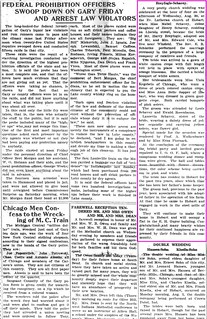
The page from the News, above, includes an item about the "road leading from the Lincoln highway at Ainsworth to the Dunes highway at Miller" possibly being taken over by the State Highway Commission. That stretch of road corresponds to present-day State Road 51. We shall see.

_______________
[1] "Barns and Contents Destroyed," Hobart Gazette, Jan. 6, 1905.
[2] He had married Eunice Edith Peterson in 1938 (Indiana Marriage Collection); she died in 1943 (Indiana Death Certificates).

Saturday, April 7, 2018

Chicken Thieves Again

As long as there are chickens, there will be chicken thieves. And there were plenty of chickens around Ainsworth in 1923.

2018-4-7. Thieves
(Click on image to enlarge)
Hobart News, April 5, 1923.


Albert Witt lived just north of Ainsworth.

John Wojahn, a former Ainsworth-area farmer, was probably living in the village of Ainsworth, to judge by his neighbors in the 1920 Census and 1930 Census. He was retired — or so I thought, but that was quite a "hennery" for a village backyard.


Over in the next column, Ruby Fisher has been exhibiting her musicianship.

Thursday, July 7, 2016

Wedding Bells for Mabel and Harry

Isn't it lovely? — our friends have gotten married.

2016-7-7. Breyfogle/Schavey wedding
(Click on image to enlarge)
Hobart News 31 Aug. 1922.


(Below that, a wedding involving Charles Kisela, which may or may not interest the Kisela-related person who contacted me a few years ago. Also, I did not know that Terre Haute was the standard by which Indiana bootlegging was judged in 1922.)

Tuesday, January 19, 2016

Giertz, Gertz, Gerts, Whatever

What shall I say of the Giertz — Gertz — Gerts — however you spell it — family?

I haven't said much about them so far. When I found out that Mrs. Charles Ols had been born Louise Giertz, I didn't go trumpeting it about; I just quietly cited her father's obituary as one source of my knowledge of that branch of the Ols family.

I haven't said much because I didn't know much, because I wasn't paying much attention, because I wasn't really interested.

Then last summer I was going through the "Lake County Record of Recognizance Bonds" at the Merrillville/Ross Township Historical Society museum, and found this:

2016-1-19. Giertz Recognizance Bond
(Click on image to enlarge)
Image courtesy of the Merrillville/Ross Township Historical Society.


At first I was more intrigued by Christian Kegebein. Was he related to the north-of-Ainsworth Kegebeins? I haven't been able to figure that out yet. I think I've found Christian Kegebein in the 1870 Census: a 60-year-old German immigrant farming in Ross Township with his wife, Mary (also 60), and Caroline, their 13-year-old daughter (or some kind of relative; she has the same surname). After that he vanishes.

But when I came across this little tidbit in the "General News Items" of the Hobart Gazette of Oct. 24, 1902: "It is reported that Frank Gertz quietly left Ainsworth early last week and that many creditors are wondering where he is" — that's when I started getting interested in the Giertzes. A guy slipping out of town to avoid creditors … his mother once accused of assault and battery … they sound like fun.

I'd paid enough attention to preserve the obituaries of the elder Giertzes. So I know that the Giertz family consisted of John, Hannah, and an uncertain number of children, including Louise and Frank.

Hannah died first, in December 1901:

2016-1-19. Hannah Giertz obituary
(Click on image to enlarge)
"Mortuary Record," Hobart Gazette 13 Dec. 1901.


No doubt her survivors found comfort in seeing all these nice things printed about Hannah, but this obituary doesn't help us as much as a prosaic listing of the children's names would.

John's obituary, from March 1910, only deepens the mystery.

2016-1-19. John Giertz obituary
(Click on image to enlarge)
Hobart Gazette 11 March 1910.


If we're to believe this, John had two more children in total than he had with Hannah. Where did they come from — his first marriage?

Turning to the census records, I think I've found John and Hannah in 1870, farming in Mason County, Illinois. They have five children: Mary (born ca. 1856), Fred (ca. 1858), Albert (ca. 1865), Americus (ca. 1868), and baby Joseph (1870). If the marriage date given in Hannah's obituary (1855) is correct, these children are all by Hannah.

Sometime after August 1870, they move into Indiana and resume farming in Ross Township. I can't find them in any plat map; I can only judge by their apparent neighbors in the 1880 census in placing them in the eastern part of the township. At that time, John and Hannah had five children: Albert (born ca. 1866), Lucinda (ca. 1869), John Jr. (ca. 1871), Minnie (ca. 1878), and Frank (1880). Also in the household is John's 76-year-old father-in-law, Christopher Carbiene.

Now I'm wondering whether the Christian Kegebein of the recognizance bond and the 1870 census could be the same person as the Christopher Carbiene of the 1880 census. Who better to post bond for Hannah than her own father? — But could enumerator confusion account for the difference in names and ages?

In 1900 John and Hannah are living in their own little household, next door to their son, Frank (who had married Minnie Miller* in December 1898 and now had a baby daughter). Again judging by their neighbors, I think they were living more or less in the village of Ainsworth. (I wonder if they were living in those two little houses just north of the tracks on the west side of S.R. 51 — both had been built by then, if the county property records are correct. And in January 1902 we find "Agent Griffith," presumably Elmer Griffith, the Grand Trunk station telegraph operator, moving "into Mr. Giertz's house," so it likely was convenient to the depot.)

John Giertz died two months before the 1910 census, so we don't find him in the household of Charles and Louisa Ols. Louisa's ages in the various censuses place her birthdate around 1878, so perhaps she was the Minnie of the 1880 census.

I'm still confused.

____________________
*I have no idea whether she was related to Ainsworth's John Miller.


Sources:
♦ 1870 Census.
♦ 1880 Census.
♦ 1900 Census.
♦ 1910 Census.
♦ 1920 Census.
♦ "Ainsworth News." Hobart Gazette 24 Jan. 1902.
♦ Indiana Marriage Collection.

Friday, October 17, 2014

Return-to-Hobart Report

Paul and Bliss Emery are back in Hobart, living with her parents, Calvin and Huldah Shearer. John and Mary McDaniel have left her stepson's house and are living with her son, John Chester, while they think about moving back to Hobart.

2014-10-17. Emery et al.
(Click on image to enlarge)
Hobart Gazette 5 Aug. 1921.


I found that story about the Kulage brickyard interesting not only because it had shut down for a while, perhaps due to the general hard times the nation was going through, but also because of the "subway" under "Chicago street," by which I suppose they mean the Chicago road, now known as Old Ridge Road.

And, speaking of the Chicago road, it's about to get improved, "from the brick yards west to Gary city limits," according to the article at the top of the right-hand column.

Friday, October 3, 2014

From God's House to Men's Houses

2014-10-3. Frame church for sale
(Click on images to enlarge)
Hobart Gazette 24 June 1921.


This is what Joe E. Mellon was offering for sale:

First St. Bridget Church

By 1921 this frame building had been moved from Main Street onto the parsonage lawn along Front Street.

Mr. Mellon found a buyer whose name we don't know — just an ordinary man who contributed as best he could to Hobart's long tradition of demolishing its historical buildings.

2014-10-3. Landmark lost
Hobart Gazette 22 July 1921.


(Happier news of some other acquaintances: John Kegebein already planning to rebuild his burned barn, and Ruth Miller visiting her family on their farm south of Ainsworth.)

Friday, September 26, 2014

Baby, Burn

Monday, July 11, 1921, was a day of joy the Kegebein farm, as Albert and Frieda Witt welcomed a baby boy into the world — their fifth child.

Tuesday was a day of disaster.

2014-9-26. Barn fires
(Click on image to enlarge)
From the Hobart Gazette 15 July 1921.


Going into Hobart, Albert had actually seen the town's fire engine rush by him, never suspecting it was headed towards his own place. Perhaps someone telephoned Jim Chester, who lived on Water Street, and told him go find Albert; the Herman Neef residence, where Jim caught up with Albert, was on Lake Street.

It must have been a shock to the unnamed sister (in-law) staying with Frieda when she looked outside and saw the roof of the 36' x 66' barn all on fire, and she in charge of a sick woman and five children. The Bullock home to which Frieda was carried was probably the Claude and Mary Bullock farm on the bank of the Deep River.

With no fire hydrants in the area, the Hobart fire department had to rely on its "chemical engine." When its chemicals were exhausted, the house and new granary had been saved, but the wreckage of the barn and other buildings was still smoldering. The last of the fire was put out with a hose "attached to the feed pipe running from the creek [Deep River] to Ainsworth used in mixing concrete."

Frieda recovered, and so did the baby, whom they named — not Blaise, Incendio, or even Phoenix, but — Clyde.

(You will notice just above the newspaper report of the Kegebein fire, another barn fire in Hobart.)

♦    ♦    ♦

In local sporting events we have Hobart's Everett Newman triumphing at the Roby speedway, and a mercenary baseball team from Valpo.

2014-9-26. Everett Newman racing
(Click on image to enlarge)
From the Hobart News 14 July 1921.


Additional Sources:
♦ "$5,000 Fire at the Kegebein Farm, Tuesday Afternoon." Hobart News 14 July 1921.
♦ 1920 Census.
♦ 1930 Census.
♦ "Births." Hobart Gazette 15 July 1921.

Tuesday, December 3, 2013

Mable (Fasel) Dewell

From the steamer trunk.

15a
(Click on images to enlarge)
Images courtesy of E.H.

16a

This cute little kid is identified by handwritten notes on the back of each photo as Mable (Fasel) Dewell.

The DeWell family archivist was able to save me a lot of work by explaining where this little creature came from and where she went: "Mable's parents were John J. Fasel and Anna Foreman (sister of Otto). Her grandparents were Henry J. Fasel and Mary Ann Springman. Mary Ann was another daughter of Charles Springman and Caroline Kegebein." We have already seen Mable's younger sister, Marie, among the early-1930s students at W.G. Haan School.

Mable Fasel grew up to become Mrs. Conrad DeWell. (Conrad was the son of William F. DeWell and his first wife, Martha Wischman, who died in the flu epidemic.) Mable and Conrad were married May 11, 1937.

Conrad DeWell and Mable Fasel
(Click on image to enlarge)
Image courtesy of the DeWell Family Archives.

Thursday, November 21, 2013

Third Time's the Charm?

Albert Witt started farming again late in December 1920 — the third start, by my count. (Also, a few random happy reports about people whose names we know.)

Albert Witt starts farming again
(Click on images to enlarge)

Albert's first start was barely perceptible. Born into a farming family, he grew up with the line of work, and in 1910, at the age of 25, he still lived on the family farm, giving his occupation as farmhand. On March 1, 1911, he "quietly married" Frieda Kegebein, the only surviving child of John and Lena Kegebein — likewise a farming family — and came to live with his wife and in-laws, to farm the land the Kegebeins had bought sometime between 1874 and 1891.

Kegebein land 1908

In November 1915, Albert placed this notice in the Gazette:
Having decided to quit farming, I will offer for public sale at the John Kegebein farm, located 2½ miles south of Hobart, and ½ mile north of Ainsworth, beginning at 10 a.m., Monday, Nov. 15, three horses, 12 milch cows, 14 heifers, 15 head of hogs, chickens, farming implements, household furniture, and many articles not mentioned.
I don't know what Albert did instead of farming, but he was still on the Kegebein land in 1916 when he traded farms with his neighbor, Glen Nelson.

Albert remained on the Charles Chester farm until he quit farming the second time, and this time he really meant it — temporarily, at least. The January 1920 census records him working in the steel mills; he and Frieda and their four children lived on the "Chicago road," which I believe is Old Ridge Road.

(I don't know where John and Lena Kegebein had been living while their farm was rented by Glen and Elsie Nelson. The 1920 census shows the Kegebeins on their own property somewhere in the vicinity of Ainsworth, but John's occupation is given as "retired farmer." Perhaps they had a little house in the village, or even on their own land.)

But now, as we see, Albert and Frieda Witt have come back to the Kegebein farm, and we shall see how long the farming lasts this time.


Sources:
♦ 1874 Plat Map.
♦ 1891 Plat Book.
♦ 1908 Plat Map.
♦ 1920 Census.
♦ "Local and Personal." Hobart News 30 Dec. 1920.
♦ "Public Sale." Hobart Gazette 12 Nov. 1915.
♦ "Quietly Married." Hobart Gazette 3 Mar. 1911.

Friday, July 26, 2013

Charles and Carlina (Kegebein) Springman

Frances Schavey's obituary from the Gazette, which I recently posted, was even more confused than I thought, as it listed her parents as "Mr. and Mrs. Henry Springman." The DeWell family archivist has written in to correct that:
Her parents were in fact Johann Carl 'Charles' Springman and Carlina (Caroline) Kegebein. Charles was a brother to William Springman Sr., whom you have mentioned before in the blog.

Charles and Carlina were also the parents of Christ Springman who got shot in the rabbit hunting mishap you featured some time ago. The parent's tombstone in Hobart Cemetery spells the name 'Springmann', and their family accounts for quite a few of the residents of Lake and Porter Counties, as they had 16 children.
And so, here are Frances Schavey's real parents:

Springman, Charles & Carolina Kegebein
(Click on image to enlarge)
Image courtesy of the DeWell Family Archives.


I don't have a date for the picture, but judging by the style of Caroline's bodice, I'd guess 1880s. Her dress looks simple enough to be homemade, and I count 14 buttons, with more, I'm sure, hidden by the bow at her neck. Buttonholes are hard to make. Whoever made those was using a treadle machine or sewing by hand.

Wednesday, January 16, 2013

Mary Kegebein

From the Busse autograph collection.

Mary Kegebein
(Click on image to enlarge)
Image courtesy of the Hobart Historical Society.


Mary was about 13 years old when she wrote this. The 1910 Census shows her living on Lake Street in Hobart, with her parents, Charles and Anna Kegebein — the third of their nine children. At that time both her father and older brother were employed in a brickyard. Her 17-year-old sister was a telephone operator. Her father was a brother of the John Kegebein, Jr. who owned a farm north of Ainsworth (see also the 1891 Plat Book).

I believe Mary became Mrs. Homer R. White in July 1917 (Indiana Marriage Collection) and in the 1920 Census can be found in South Bend, Indiana, with her husband and a little daughter, Gertrude.

As for the "angles," this is one of those traditional children's prayers with a morbid twist (like "if I should die before I wake…"). A little research suggests that the more common form is:
Four corners to my bed
Four angels round my head
One to watch and one to pray
And two to bear my soul away.
These days you can buy a sanitized version to hang on your wall.

Saturday, July 21, 2012

Farm Buildings and Buyings

The Price family set about improving the farm they had recently bought. By early August 1919, they had hired numerous local contractors to do work for them:
F.B. Price of Ross township has given the contract to Wall & Fleming for the building of a new house and barn, including half a dozen outbuildings on his farm which he recently purchased from W.O. Halsted. The cement contract goes to Vincent Boyd and the electrical wiring to Henry Kegebein. He will install a private electric generating outfit, making his farm one of the most up-to-date in the vicinity.
I'm not sure if any of that glorious work has survived. I've gone out there and tried to spot anything that suggested 1919, but then I have trouble applying those boundaries, so clear in the plat maps, to the real land outside the window of my car.

♦    ♦    ♦

A little distance northeast of the Price farm lay some 200 acres that had been known as the Clinton farm for decades — as early as 1874 we find most of that land under Eli Clinton's name, and by 1919 it all belonged to Steve Clinton. Now it passed into the hands of David and Agnes Frank. Those 200 acres touched on the 167 acres that the Franks had farmed since at least 1908 (I can't find any earlier records of them).

Clinton-Frank farm
(Click on image to enlarge)
From the 1908 Plat Map: outlined in red, the Frank farm in Hobart Township; outlined in green, the Clinton 200 acres in Ross Township.


David Frank intended to continue farming all his land, with the help of his 20-year-old son, John. His other son, Robert, was 17 years old and probably still in school.

♦    ♦    ♦

If we look again at that 1908 map, we will notice the Bullock land due north of Ainsworth, 160 acres bordering State Road 51 and divided by the Deep River.

Claude Bullock farm

In 1919 this land changed ownership on paper only. Since 1912, Claude and Mary Ann (Chandler) Bullock had lived and farmed there. Now they bought out the shares in that land belonging to Claude's brother, Hubert, and sister, Ruth Mackey.

Claude was then about 39 years old, Mary Ann 34. They had two sons: three-year-old Kenneth, and little Gilbert, just past his first birthday.


Sources:
♦ 1908 Plat Map.
♦ "Local and Personal." Hobart News 7 Aug. 1919; 14 Aug. 1919.
♦ "Local Drifts." Hobart Gazette 8 Aug. 1919.

Tuesday, January 17, 2012

The Little Engine That Couldn't

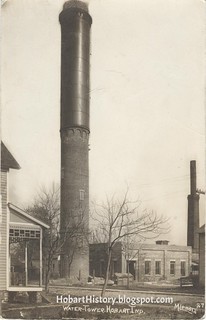
Water tower undated
(Click on image to enlarge)
Hobart's electrical power and water plant circa 1912. (Image courtesy of Bonnie.)


Hobart had been producing its own electricity for at least two decades, and its citizens had grown used to its convenience in their homes and businesses, and in their illuminated streets. Newspaper reports suggest that by 1918 the municipal plant on New Street had two engines producing electricity, but during that hard winter one of them "fell to pieces" and was not replaced. Thus for many months Hobart's power depended on a single ten-year-old engine running 24 hours a day. Around midnight on January 6, 1919, that little engine just couldn't take anymore — something wrong with its piston rings, apparently, as they disintegrated during a hasty attempt at repair. No replacement rings were on hand, nor were they easy to get. Plant superintendent Robert Wheaton set about tracking down a source. By early morning he had learned that in Milwaukee were two of the rings his engine needed, the only two rings available in the whole city. He jumped on the first train out of Hobart for a mad dash to Milwaukee.

Fortunately, the town's water supply was provided by a separate steam pump that continued to operate. But there would be no electricity until Superintendent Wheaton got back with those rings and fitted them to the engine.

Hobart awoke that Tuesday morning to a taste of the inconvenience of the good old days. The greatest problem was not in heating homes and businesses (coal stoves and furnaces were abundant) nor even in lighting them (there were probably numerous kerosene lamps still on hand), but in the sudden absence of the machines that people had come to rely on, in homes, stores, factories, lumberyards — everywhere. "Those who use motors for power in various ways were strictly up against it for the time being," the Gazette said. "All machinery was at a standstill. People can get along for a day or so without lights much better than without power. Electricity to operate motors is needed every hour of the day."

An evening train brought Superintendent Wheaton back from Milwaukee, bearing the precious rings. He hurried to the power plant, and there he labored through the night. About 2:00 a.m. Wednesday morning, the old engine fired up again, and brought back the 20th century.

It had been only 24 hours, a minor inconvenience, but it showed a serious problem in relying on a single, aging engine to power the town. Possibly spurred by this episode, before the end of the week Hobart had settled with the town of West Branch, Iowa, for the purchase of that town's power plant engine — no longer needed, now that West Branch was buying electricity rather than manufacturing its own. While August Kegebein* went to West Branch to get the new engine, the newspapers settled down to fighting over the lesson to be drawn from those powerless 24 hours.

In the opinion of the Gazette, Hobart ought to quit trying to manufacture its own power and instead buy it from a large supplier. The large manufacturers were better equipped to supply power reliably. As to the question of cost, the town could buy electricity wholesale to get a good price, then resell it to local homes and businesses (and streetcar lines) at a price that would more than recoup the wholesale cost, while still being cheaper than home-manufactured power. The scheme was quite feasible, the editor pointed out, as there were "two large power lines at our very door."

The next week's News implied that behind such talk were large electricity manufacturers who were just itching to "break into our midst and take over" Hobart's power-plant business. After running at a loss for much of its early history, the town's plant had begun to break even and even turn a profit in recent years, and now that it was recovering from the "lightless nights" and other difficulties of 1918, it naturally became a target for the greed of private power companies.

Were the large suppliers more reliable? Not a bit of it! — to back up this point, the News now had August Kegebein's report from West Branch, Iowa. During the week he had spent there making arrangements to bring back the new engine, he said, the purchased power supply had failed twice — on two separate occasions the town had spent a whole night in darkness. Hobart could probably expect the same thing if it was foolish enough to follow West Branch's example. Moreover, the Calumet Region often had electrical storms, and they were known to cause trouble for long transmission lines.

And Hobart was not the only town in the area to have trouble lately; Valparaiso had gone half a day without power, and Waukegan, Illinois, more than two days. After all those years of largely uninterrupted service in Hobart, a 24-hour power failure no reason to get hysterical.

I believe the viewpoint put forth by the News held sway for many years to come, but we will see.

___________________________
*His first name is not given in any of the newspaper reports. I am guessing at it based on the 1920 census, which shows August Kegebein as an "operator" employed in a "Light & W. Plant."


Sources:
♦ 1920 Census.
♦ "Hobart in Darkness." Hobart Gazette 10 Jan. 1919.
♦ "Hobart's Municipal Light and Water Plant." Hobart News 16 Jan. 1919.

Saturday, October 16, 2010

Lovisa Quits Farming

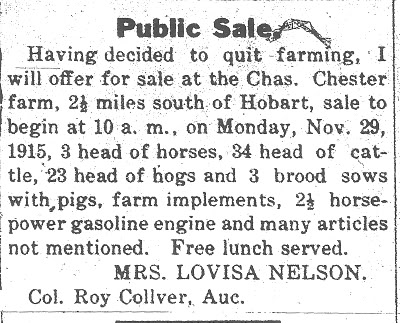
In the Hobart News of November 25, 1915, Lovisa Chester Nelson announced that she was retiring from farming.

10-16-2010 Lovisa Nelson Public Sale

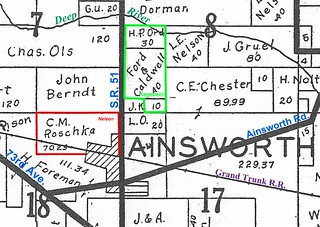
I think the land that Lovisa farmed is the parcel shown as belonging to her sister, Carrie Raschka, in the 1926 Plat Book:

LovisaNelsonfarm
(Click on image to enlarge)

The 1891 Plat Book shows that same parcel as the property of "H. Chester," and who could that be but their father, Henry? So its being in 1915 in the hands of his son Charles makes sense.

You're probably wondering why I outlined that other parcel, marked "Kegebein," on that map. (That's rhetoric. I know you don't care, but I'm going to tell you anyway.) I did that because early in 1916, we come upon this little news item: "Albert Witt moved [on January 26] to the Chas. Chester farm, and Glen Nelson moved to the Kegebein farm, both exchanging farms."

Oh, you crazy guys! The grass is always greener on the other side of State Road 51, isn't it?

Perhaps I was wrong about where Glen and Elsie were running a dairy in 1920; perhaps it was the Kegebein farm; but there are four more years until the 1920 census, plenty of time for more farm-switching.

In February, Glen and Elsie had a little boy — Lovisa's first grandson. Evidently something went wrong: although the baby was delivered at home, the following day Elsie had to be taken to Gary General Hospital.


Sources:
♦ 1891 Plat Book.
♦ 1926 Plat Book.
♦ "Additional Local." Hobart News 10 Feb. 1916.
♦ "Personal and Local Mention." Hobart News 27 Jan. 1916.
♦ "Public Sale." Hobart News 25 Nov. 1915.